BS-PSYCHOLOGY (1)
ADVERBS
DATE:
PRESENTED BY:
◦ AYESHA SHAREEF
◦ HUDA TABASSUM
◦ ALEENA AKHTAR
◦ MAIMONA KHALID
◦ AFRAH SAEED
◦ ALIA BIBI
◦ BAHISHT
◦ AISHA SIDDIQUA
◦ AYESHA NASIR
◦ RABIA SAQIB
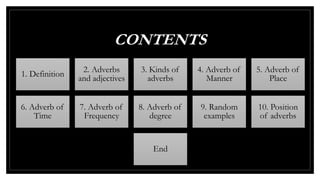
CONTENTS
1. Definition
2. Adverbs
and adjectives
3. Kinds of
adverbs
4. Adverb of
Manner
5. Adverb of
Place
6. Adverb of
Time
7. Adverb of
Frequency
8. Adverb of
degree
9. Random
examples
10. Position
of adverbs
End
What is an adverb?
◦ An adverb is a word/a set of words that modifies verbs, adjectives, and other
adverbs. It tells when, where, and how an action is performed or indicates the
quality or degree of the action.
◦ In other words, they describe the manner, place or time of an action.
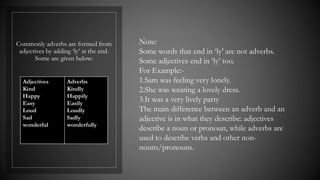
Commonly adverbs are formed from
adjectives by adding ‘ly’ at the end.
Some are given below:
Adjectives
Kind
Happy
Easy
Loud
Sad
wonderful
Adverbs
Kindly
Happily
Easily
Loudly
Sadly
wonderfully
Note:
Some words that end in ‘ly’ are not adverbs.
Some adjectives end in ‘ly’ too.
For Example:-
1.Sam was feeling very lonely.
2.She was wearing a lovely dress.
3.It was a very lively party
The main difference between an adverb and an
adjective is in what they describe: adjectives
describe a noun or pronoun, while adverbs are
used to describe verbs and other non-
nouns/pronouns.
KINDS OF
ADVERBS
◦ There are 5 kinds of adverbs:
1. Adverb of Manner
2. Adverb of Time
3. Adverb of Place
4. Adverb of Frequency
5. Adverb of Degree
ADVERB OF
MANNER
◦ It describes in which manner an action is done.
◦ They mostly modify verbs and can often be found at
the end of a clause.
◦ This category comprises the most common adverbs —
the ones that end in -ly.
◦ Some adverbs of manner are:
1. beautifully
2. generously
3. happily
4. neatly
5. Patiently
◦ Examples:
1. He trimmed the white roses neatly.
2. I combed my dog’s fur carefully because it had lots
of tangles.
3. There’s no reason why you can’t discuss the topic
with me calmly.
ADVERB OF
PLACE
◦ It describes where an action is done/ where the verb took
place.
◦ These tend to pop up after the main verb or direct object of
the sentence.
◦ Here are some common adverbs of place:
1. above
2. below
3. everywhere
4. here
5. in
◦ Examples:
1. In Ireland, there are thatched-roof cottages everywhere.
2. Clearly, there aren’t any leprechauns here.
3. I was so beguiled, I drove into a ditch.
ADVERB OF
TIME
◦ It describes when an action is done/ when the verb took
place.
◦ These adverbs placed at the beginning or end of a sentence.
◦ Adverbs of time include:
1. annually
2. daily
3. monthly
4. recently
5. Tomorrow
◦ Examples:
1. Lately, you’ve been rude to everyone around.
2. They recently relocated to Santa Fe.
3. The morning newspaper arrives daily.
ADVERB OF
FREQUENCY
◦ It shows how many times/ how often an action is done or the verb
occurs.
◦ Therefore, they mostly modify verbs./ These adverbs tend to
appear right before the main verb in the sentence.
◦ Popular adverbs in this category include:
1. again
2. always
3. never
4. normally
5. Rarely
◦ Examples:
1. I always read a book before bed.
2. Does he normally walk his dog at this time?
3. She usually shops at the Korean market in town.
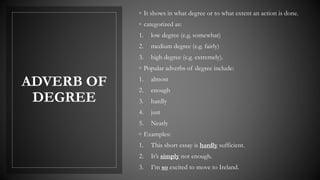
ADVERB OF
DEGREE
◦ It shows in what degree or to what extent an action is done.
◦ categorized as:
1. low degree (e.g. somewhat)
2. medium degree (e.g. fairly)
3. high degree (e.g. extremely).
◦ Popular adverbs of degree include:
1. almost
2. enough
3. hardly
4. just
5. Nearly
◦ Examples:
1. This short essay is hardly sufficient.
2. It’s simply not enough.
3. I’m so excited to move to Ireland.
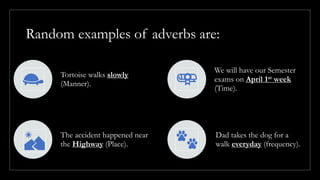
Random examples of adverbs are:
Tortoise walks slowly
(Manner).
We will have our Semester
exams on April 1st week
(Time).
The accident happened near
the Highway (Place).
Dad takes the dog for a
walk everyday (frequency).
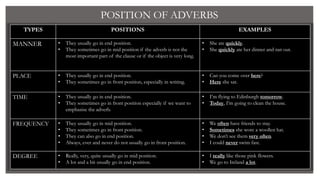
POSITION OF ADVERBS
TYPES POSITIONS EXAMPLES
MANNER • They usually go in end position.
• They sometimes go in mid position if the adverb is not the
most important part of the clause or if the object is very long.
• She ate quickly.
• She quickly ate her dinner and ran out.
PLACE • They usually go in end position.
• They sometimes go in front position, especially in writing.
• Can you come over here?
• Here she sat.
TIME • They usually go in end position.
• They sometimes go in front position especially if we want to
emphasise the adverb.
• I’m flying to Edinburgh tomorrow.
• Today, I’m going to clean the house.
FREQUENCY • They usually go in mid position.
• They sometimes go in front position.
• They can also go in end position.
• Always, ever and never do not usually go in front position.
• We often have friends to stay.
• Sometimes she wore a woollen hat.
• We don’t see them very often.
• I could never swim fast.
DEGREE • Really, very, quite usually go in mid position.
• A lot and a bit usually go in end position.
• I really like those pink flowers.
• We go to Ireland a lot.
ADJECTIVES ARE THE SUGAR OF
LITERATURE AND ADVERBS
THE SALT.
- HENRY JAMES -
THANK YOU

Adverbs

  • 1.
    BS-PSYCHOLOGY (1) ADVERBS DATE: PRESENTED BY: ◦AYESHA SHAREEF ◦ HUDA TABASSUM ◦ ALEENA AKHTAR ◦ MAIMONA KHALID ◦ AFRAH SAEED ◦ ALIA BIBI ◦ BAHISHT ◦ AISHA SIDDIQUA ◦ AYESHA NASIR ◦ RABIA SAQIB
  • 2.
    CONTENTS 1. Definition 2. Adverbs andadjectives 3. Kinds of adverbs 4. Adverb of Manner 5. Adverb of Place 6. Adverb of Time 7. Adverb of Frequency 8. Adverb of degree 9. Random examples 10. Position of adverbs End
  • 3.
    What is anadverb? ◦ An adverb is a word/a set of words that modifies verbs, adjectives, and other adverbs. It tells when, where, and how an action is performed or indicates the quality or degree of the action. ◦ In other words, they describe the manner, place or time of an action.
  • 4.
    Commonly adverbs areformed from adjectives by adding ‘ly’ at the end. Some are given below: Adjectives Kind Happy Easy Loud Sad wonderful Adverbs Kindly Happily Easily Loudly Sadly wonderfully Note: Some words that end in ‘ly’ are not adverbs. Some adjectives end in ‘ly’ too. For Example:- 1.Sam was feeling very lonely. 2.She was wearing a lovely dress. 3.It was a very lively party The main difference between an adverb and an adjective is in what they describe: adjectives describe a noun or pronoun, while adverbs are used to describe verbs and other non- nouns/pronouns.
  • 5.
    KINDS OF ADVERBS ◦ Thereare 5 kinds of adverbs: 1. Adverb of Manner 2. Adverb of Time 3. Adverb of Place 4. Adverb of Frequency 5. Adverb of Degree
  • 6.
    ADVERB OF MANNER ◦ Itdescribes in which manner an action is done. ◦ They mostly modify verbs and can often be found at the end of a clause. ◦ This category comprises the most common adverbs — the ones that end in -ly. ◦ Some adverbs of manner are: 1. beautifully 2. generously 3. happily 4. neatly 5. Patiently ◦ Examples: 1. He trimmed the white roses neatly. 2. I combed my dog’s fur carefully because it had lots of tangles. 3. There’s no reason why you can’t discuss the topic with me calmly.
  • 7.
    ADVERB OF PLACE ◦ Itdescribes where an action is done/ where the verb took place. ◦ These tend to pop up after the main verb or direct object of the sentence. ◦ Here are some common adverbs of place: 1. above 2. below 3. everywhere 4. here 5. in ◦ Examples: 1. In Ireland, there are thatched-roof cottages everywhere. 2. Clearly, there aren’t any leprechauns here. 3. I was so beguiled, I drove into a ditch.
  • 8.
    ADVERB OF TIME ◦ Itdescribes when an action is done/ when the verb took place. ◦ These adverbs placed at the beginning or end of a sentence. ◦ Adverbs of time include: 1. annually 2. daily 3. monthly 4. recently 5. Tomorrow ◦ Examples: 1. Lately, you’ve been rude to everyone around. 2. They recently relocated to Santa Fe. 3. The morning newspaper arrives daily.
  • 9.
    ADVERB OF FREQUENCY ◦ Itshows how many times/ how often an action is done or the verb occurs. ◦ Therefore, they mostly modify verbs./ These adverbs tend to appear right before the main verb in the sentence. ◦ Popular adverbs in this category include: 1. again 2. always 3. never 4. normally 5. Rarely ◦ Examples: 1. I always read a book before bed. 2. Does he normally walk his dog at this time? 3. She usually shops at the Korean market in town.
  • 10.
    ADVERB OF DEGREE ◦ Itshows in what degree or to what extent an action is done. ◦ categorized as: 1. low degree (e.g. somewhat) 2. medium degree (e.g. fairly) 3. high degree (e.g. extremely). ◦ Popular adverbs of degree include: 1. almost 2. enough 3. hardly 4. just 5. Nearly ◦ Examples: 1. This short essay is hardly sufficient. 2. It’s simply not enough. 3. I’m so excited to move to Ireland.
  • 11.
    Random examples ofadverbs are: Tortoise walks slowly (Manner). We will have our Semester exams on April 1st week (Time). The accident happened near the Highway (Place). Dad takes the dog for a walk everyday (frequency).
  • 12.
    POSITION OF ADVERBS TYPESPOSITIONS EXAMPLES MANNER • They usually go in end position. • They sometimes go in mid position if the adverb is not the most important part of the clause or if the object is very long. • She ate quickly. • She quickly ate her dinner and ran out. PLACE • They usually go in end position. • They sometimes go in front position, especially in writing. • Can you come over here? • Here she sat. TIME • They usually go in end position. • They sometimes go in front position especially if we want to emphasise the adverb. • I’m flying to Edinburgh tomorrow. • Today, I’m going to clean the house. FREQUENCY • They usually go in mid position. • They sometimes go in front position. • They can also go in end position. • Always, ever and never do not usually go in front position. • We often have friends to stay. • Sometimes she wore a woollen hat. • We don’t see them very often. • I could never swim fast. DEGREE • Really, very, quite usually go in mid position. • A lot and a bit usually go in end position. • I really like those pink flowers. • We go to Ireland a lot.
  • 13.
    ADJECTIVES ARE THESUGAR OF LITERATURE AND ADVERBS THE SALT. - HENRY JAMES - THANK YOU