1


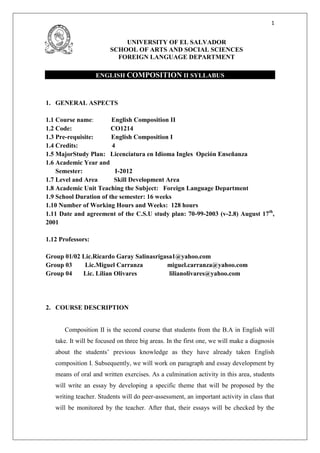
                            UNIVERSITY OF EL SALVADOR
                        SCHOOL OF ARTS AND SOCIAL SCIENCES
                          FOREIGN LANGUAGE DEPARTMENT

                   ENGLISH COMPOSITION II SYLLABUS


1. GENERAL ASPECTS

1.1 Course name:        English Composition II
1.2 Code:               CO1214
1.3 Pre-requisite:      English Composition I
1.4 Credits:            4
1.5 MajorStudy Plan: Licenciatura en Idioma Ingles Opción Enseñanza
1.6 Academic Year and
    Semester:            I-2012
1.7 Level and Area       Skill Development Area
1.8 Academic Unit Teaching the Subject: Foreign Language Department
1.9 School Duration of the semester: 16 weeks
1.10 Number of Working Hours and Weeks: 128 hours
1.11 Date and agreement of the C.S.U study plan: 70-99-2003 (v-2.8) August 17th,
2001

1.12 Professors:

Group 01/02 Lic.Ricardo Garay Salinasrigasa1@yahoo.com
Group 03     Lic.Miguel Carranza         miguel.carranza@yahoo.com
Group 04    Lic. Lilian Olivares          lilianolivares@yahoo.com


2. COURSE DESCRIPTION


      Composition II is the second course that students from the B.A in English will
   take. It will be focused on three big areas. In the first one, we will make a diagnosis
   about the students’ previous knowledge as they have already taken English
   composition I. Subsequently, we will work on paragraph and essay development by
   means of oral and written exercises. As a culmination activity in this area, students
   will write an essay by developing a specific theme that will be proposed by the
   writing teacher. Students will do peer-assessment, an important activity in class that
   will be monitored by the teacher. After that, their essays will be checked by the
2


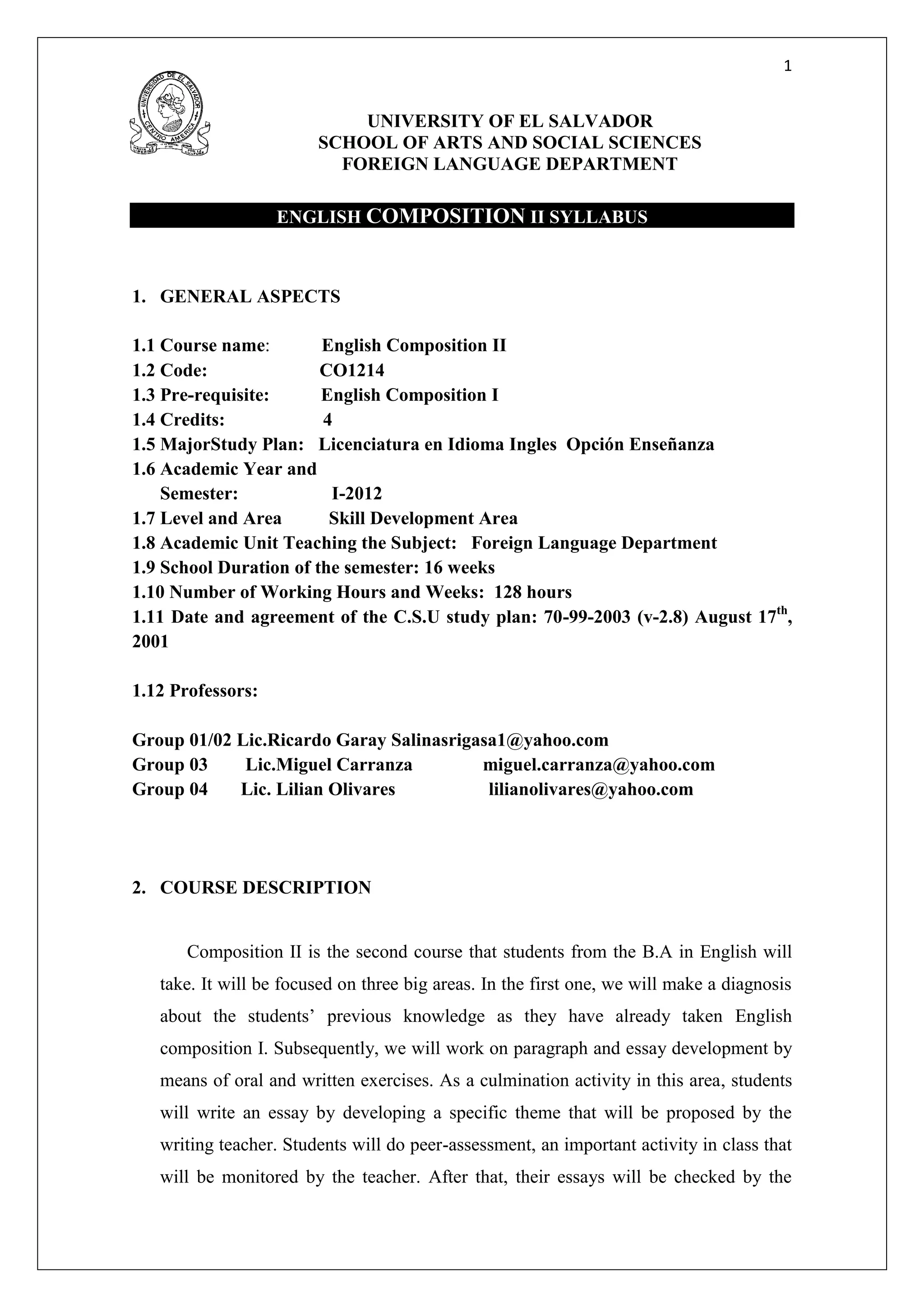
   teacher and he/she will provide some feedback by giving some time to do revision
   and later, to submit it. The teacher will use a rubric or checklist to grade the
   students´essays.
      In the second area, we will instruct students about how to write summaries,
   paraphrases and quotations. Learners will be guided to make summaries as a way to
   show their understanding of a text or article. Subsequently, they will be taught how
   to paraphrase and include quotations as a way to support what they want to convey.
   They will continue doing peer-assessment through the use of a checklist. In this
   area, they will be instructed to write their essays by providing them a general theme
   and some specific topics. They will have the opportunity to choose the specific topic
   and make the connection with the general one to create their essays. Their pieces of
   writing have to be supported by using different sources and this way, they have to
   make summaries, paraphrase and make quotations. The whole activity will be
   monitored by the writing teacher, by students doing peer-assessment, attending
   conferences and receiving oral and written feedback. The best developed essays will
   be published in a magazine called “TheAcademic Composition Magazine” which
   will be sponsored by the writing teachers from the Composition II class.
      In the third area, students should have their essays ready. If time permits, there
   will be a period of time in class in which the best essays will be chosen by students
   as taking into account some characteristics or a guideline provided by the writing
   teacher. After that, these will be edited by the Composition II teachers. All the
   students will be encouraged to write their essays and apply what they have learned
   along the semester.


3. GENERAL OBJECTIVES
   3.1.Continue developing the writing process.
   3.2. Teach learners how to make summaries as well as supporting their pieces of
   writing with paraphrases and quotations.
   3.3. Have students publish their essays in the “Academic Composition Magazine.”
   3.4 Assess students´ essays by using peer-assessment and conferences.
3


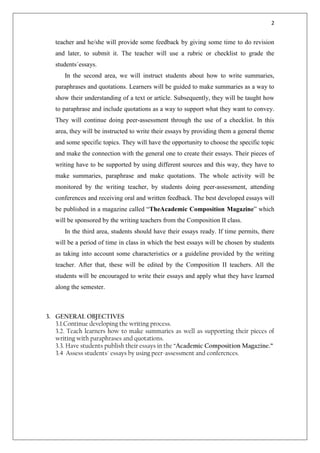
4. CONTENT
   4.1 UNIT 1 OR MODULE NAME: Paragraph and Essay Development
       SPECIFIC OBJECTIVE

      4.1.1Write well-developed paragraphs and essays by including all its elements
   such as introduction, thesis statement, topic sentences, supporting sentences, and
   conclusion.
      4.1.2 Write a well-developed essay based on a specific topic that will be
   proposed by the teacher.


   4.2 UNIT 2 OR MODULE NAME: Writing Summaries, Paraphrases and
   Quotations
       SPECIFIC OBJECTIVE
       4.2.1 Write summaries.
       4.2.2 Write paraphrases.
       4.2.3 Include paraphrases and quotations in essays.
   4.2.4 Write essays to be published in the “Academic Composition Magazine”


   4.3 UNIT 3 OR MODULE NAME: Essays Development
       SPECIFIC OBJECTIVE
       4.3.1Write essays, edit them and publish them in the ¨Academic Composition
   Magazine.¨


5. METHODOLOGY

             In this course, students will be encouraged to write essays, make
      summaries and support what they want to convey by means of supporting their
      essays with paraphrases and quotations. Also, they will do peer-assessment in
      which they will provide constructive feedback to their own classmates. Learners
      will have some time to make their draft revision and subsequently the writing
      teacher will provide some direct or indirect feedback or will schedule the learner
      to attend a conference and talk about their essays. Students will count on
      sufficient time to do the revision and submit the last version of their essays. The
      teacher will use a checklist, or a rubric to revise the final version of the essays
      and a checklist when students are scheduled to attend conferences.
             In addition, students will be encouraged and monitored by their writing
      teacher to write essays based on a general and some specific topics assigned
      previously by the teacher. Learners will have the opportunity to publish their
4


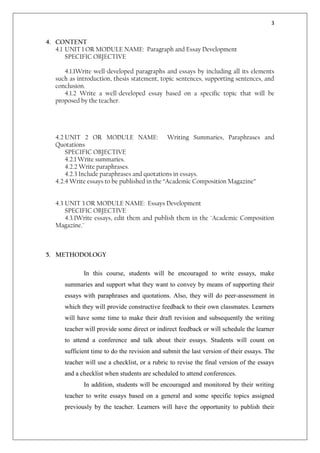
     essays in “The Academic Composition Magazine”sponsored by the writing
     teachers from the English Composition II class.
             The system of evaluation of this class is formative so students will be
     graded based on their work as they will be monitored by the teacher along the
     semester. Writing teachers will give emphasis and importance to the process
     students follow to develop their tasks as well as the product that will be
     obtained.


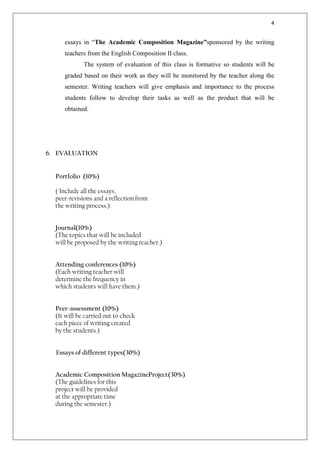
6. EVALUATION


  Portfolio (10%)

  ( Include all the essays,
  peer-revisions and a reflection from
  the writing process.)


  Journal(10%)
  (The topics that will be included
  will be proposed by the writing teacher.)


  Attending conferences (10%)
  (Each writing teacher will
  determine the frequency in
  which students will have them.)


  Peer-assessment (10%)
  (It will be carried out to check
  each piece of writing created
  by the students.)


  Essays of different types(30%)


  Academic Composition MagazineProject(30%)
  (The guidelines for this
  project will be provided
  at the appropriate time
  during the semester.)
5


7. REFERENCES


     Folse S. et al. (2010). From Great Paragraphs to Great Essays.The United
  States.Heinle, Cengage Learning.

     Hughey, J et al. (1983).Teaching ESL Composition: Principles and Techniques.
  The United States. Newbury House Publishers, Inc.

     Smalley, R. et al.( 2001).Refining        Composition    Skills.The   United
  States.Heinle&Heinle Thomson learning.

     Center for English as a Second language.EAP 2 Writer´s Workshop. Spring
  2009 Southern Illinois University Carbondale.
6


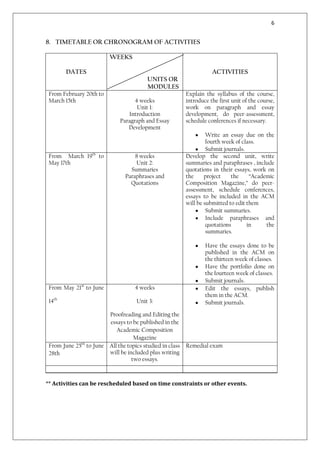
8. TIMETABLE OR CHRONOGRAM OF ACTIVITIES

                         WEEKS

        DATES                                                   ACTIVITIES
                                      UNITS OR
                                      MODULES
 From February 20th to                               Explain the syllabus of the course,
 March 15th                       4 weeks            introduce the first unit of the course,
                                   Unit 1:           work on paragraph and essay
                               Introduction          development, do peer-assessment,
                            Paragraph and Essay      schedule conferences if necessary.
                               Development
                                                              Write an essay due on the
                                                              fourth week of class.
                                                              Submit journals.
 From March 19th to               8 weeks            Develop the second unit, write
 May 17th                         Unit 2:            summaries and paraphrases , include
                                Summaries            quotations in their essays, work on
                              Paraphrases and        the     project    the     “Academic
                                Quotations           Composition Magazine,” do peer-
                                                     assessment, schedule conferences,
                                                     essays to be included in the ACM
                                                     will be submitted to edit them
                                                              Submit summaries.
                                                              Include paraphrases and
                                                              quotations       in     the
                                                              summaries.

                                                             Have the essays done to be
                                                             published in the ACM on
                                                             the thirteen week of classes.
                                                             Have the portfolio done on
                                                             the fourteen week of classes.
                                                             Submit journals.
 From May 21st to June           4 weeks                     Edit the essays, publish
                                                             them in the ACM.
 14th                             Unit 3:                    Submit journals.

                      Proofreading and Editing the
                      essays to be published in the
                         Academic Composition
                                 Magazine
             th
 From June 25 to June All the topics studied in class Remedial exam
 28th                 will be included plus writing
                                two essays.


** Activities can be rescheduled based on time constraints or other events.

Compo syllabus

  • 1.
    1 UNIVERSITY OF EL SALVADOR SCHOOL OF ARTS AND SOCIAL SCIENCES FOREIGN LANGUAGE DEPARTMENT ENGLISH COMPOSITION II SYLLABUS 1. GENERAL ASPECTS 1.1 Course name: English Composition II 1.2 Code: CO1214 1.3 Pre-requisite: English Composition I 1.4 Credits: 4 1.5 MajorStudy Plan: Licenciatura en Idioma Ingles Opción Enseñanza 1.6 Academic Year and Semester: I-2012 1.7 Level and Area Skill Development Area 1.8 Academic Unit Teaching the Subject: Foreign Language Department 1.9 School Duration of the semester: 16 weeks 1.10 Number of Working Hours and Weeks: 128 hours 1.11 Date and agreement of the C.S.U study plan: 70-99-2003 (v-2.8) August 17th, 2001 1.12 Professors: Group 01/02 Lic.Ricardo Garay Salinasrigasa1@yahoo.com Group 03 Lic.Miguel Carranza miguel.carranza@yahoo.com Group 04 Lic. Lilian Olivares lilianolivares@yahoo.com 2. COURSE DESCRIPTION Composition II is the second course that students from the B.A in English will take. It will be focused on three big areas. In the first one, we will make a diagnosis about the students’ previous knowledge as they have already taken English composition I. Subsequently, we will work on paragraph and essay development by means of oral and written exercises. As a culmination activity in this area, students will write an essay by developing a specific theme that will be proposed by the writing teacher. Students will do peer-assessment, an important activity in class that will be monitored by the teacher. After that, their essays will be checked by the
  • 2.
    2 teacher and he/she will provide some feedback by giving some time to do revision and later, to submit it. The teacher will use a rubric or checklist to grade the students´essays. In the second area, we will instruct students about how to write summaries, paraphrases and quotations. Learners will be guided to make summaries as a way to show their understanding of a text or article. Subsequently, they will be taught how to paraphrase and include quotations as a way to support what they want to convey. They will continue doing peer-assessment through the use of a checklist. In this area, they will be instructed to write their essays by providing them a general theme and some specific topics. They will have the opportunity to choose the specific topic and make the connection with the general one to create their essays. Their pieces of writing have to be supported by using different sources and this way, they have to make summaries, paraphrase and make quotations. The whole activity will be monitored by the writing teacher, by students doing peer-assessment, attending conferences and receiving oral and written feedback. The best developed essays will be published in a magazine called “TheAcademic Composition Magazine” which will be sponsored by the writing teachers from the Composition II class. In the third area, students should have their essays ready. If time permits, there will be a period of time in class in which the best essays will be chosen by students as taking into account some characteristics or a guideline provided by the writing teacher. After that, these will be edited by the Composition II teachers. All the students will be encouraged to write their essays and apply what they have learned along the semester. 3. GENERAL OBJECTIVES 3.1.Continue developing the writing process. 3.2. Teach learners how to make summaries as well as supporting their pieces of writing with paraphrases and quotations. 3.3. Have students publish their essays in the “Academic Composition Magazine.” 3.4 Assess students´ essays by using peer-assessment and conferences.
  • 3.
    3 4. CONTENT 4.1 UNIT 1 OR MODULE NAME: Paragraph and Essay Development SPECIFIC OBJECTIVE 4.1.1Write well-developed paragraphs and essays by including all its elements such as introduction, thesis statement, topic sentences, supporting sentences, and conclusion. 4.1.2 Write a well-developed essay based on a specific topic that will be proposed by the teacher. 4.2 UNIT 2 OR MODULE NAME: Writing Summaries, Paraphrases and Quotations SPECIFIC OBJECTIVE 4.2.1 Write summaries. 4.2.2 Write paraphrases. 4.2.3 Include paraphrases and quotations in essays. 4.2.4 Write essays to be published in the “Academic Composition Magazine” 4.3 UNIT 3 OR MODULE NAME: Essays Development SPECIFIC OBJECTIVE 4.3.1Write essays, edit them and publish them in the ¨Academic Composition Magazine.¨ 5. METHODOLOGY In this course, students will be encouraged to write essays, make summaries and support what they want to convey by means of supporting their essays with paraphrases and quotations. Also, they will do peer-assessment in which they will provide constructive feedback to their own classmates. Learners will have some time to make their draft revision and subsequently the writing teacher will provide some direct or indirect feedback or will schedule the learner to attend a conference and talk about their essays. Students will count on sufficient time to do the revision and submit the last version of their essays. The teacher will use a checklist, or a rubric to revise the final version of the essays and a checklist when students are scheduled to attend conferences. In addition, students will be encouraged and monitored by their writing teacher to write essays based on a general and some specific topics assigned previously by the teacher. Learners will have the opportunity to publish their
  • 4.
    4 essays in “The Academic Composition Magazine”sponsored by the writing teachers from the English Composition II class. The system of evaluation of this class is formative so students will be graded based on their work as they will be monitored by the teacher along the semester. Writing teachers will give emphasis and importance to the process students follow to develop their tasks as well as the product that will be obtained. 6. EVALUATION Portfolio (10%) ( Include all the essays, peer-revisions and a reflection from the writing process.) Journal(10%) (The topics that will be included will be proposed by the writing teacher.) Attending conferences (10%) (Each writing teacher will determine the frequency in which students will have them.) Peer-assessment (10%) (It will be carried out to check each piece of writing created by the students.) Essays of different types(30%) Academic Composition MagazineProject(30%) (The guidelines for this project will be provided at the appropriate time during the semester.)
  • 5.
    5 7. REFERENCES Folse S. et al. (2010). From Great Paragraphs to Great Essays.The United States.Heinle, Cengage Learning. Hughey, J et al. (1983).Teaching ESL Composition: Principles and Techniques. The United States. Newbury House Publishers, Inc. Smalley, R. et al.( 2001).Refining Composition Skills.The United States.Heinle&Heinle Thomson learning. Center for English as a Second language.EAP 2 Writer´s Workshop. Spring 2009 Southern Illinois University Carbondale.
  • 6.
    6 8. TIMETABLE ORCHRONOGRAM OF ACTIVITIES WEEKS DATES ACTIVITIES UNITS OR MODULES From February 20th to Explain the syllabus of the course, March 15th 4 weeks introduce the first unit of the course, Unit 1: work on paragraph and essay Introduction development, do peer-assessment, Paragraph and Essay schedule conferences if necessary. Development Write an essay due on the fourth week of class. Submit journals. From March 19th to 8 weeks Develop the second unit, write May 17th Unit 2: summaries and paraphrases , include Summaries quotations in their essays, work on Paraphrases and the project the “Academic Quotations Composition Magazine,” do peer- assessment, schedule conferences, essays to be included in the ACM will be submitted to edit them Submit summaries. Include paraphrases and quotations in the summaries. Have the essays done to be published in the ACM on the thirteen week of classes. Have the portfolio done on the fourteen week of classes. Submit journals. From May 21st to June 4 weeks Edit the essays, publish them in the ACM. 14th Unit 3: Submit journals. Proofreading and Editing the essays to be published in the Academic Composition Magazine th From June 25 to June All the topics studied in class Remedial exam 28th will be included plus writing two essays. ** Activities can be rescheduled based on time constraints or other events.