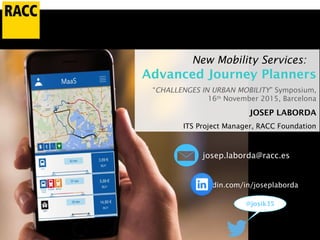
New Mobility Services:
Advanced Journey Planners
“CHALLENGES IN URBAN MOBILITY” Symposium,
16th
November 2015, Barcelona
JOSEP LABORDA
ITS Project Manager, RACC Foundation
@josik35
linkedin.com/in/joseplaborda
josep.laborda@racc.es
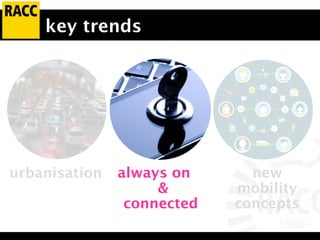
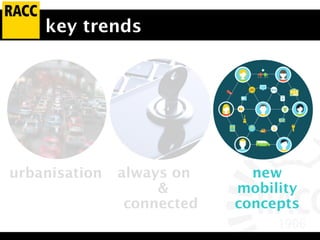
key trends
urbanisation always on
&
connected
new
mobility
concepts
key trends
always on
&
connected
new
mobility
concepts
urbanisation
urbanisation
MIT Technology Review January / February 2015 Business Report (Transportation) “Cities get
smarter”
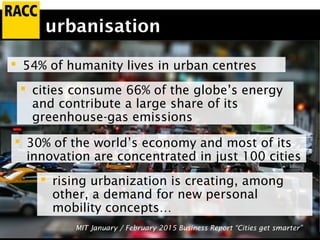
 54% of humanity lives in urban centres
 cities consume 66% of the globe’s energy
and contribute a large share of its
greenhouse-gas emissions
 30% of the world’s economy and most of its
innovation are concentrated in just 100 cities
 rising urbanization is creating, among
other, a demand for new personal
mobility concepts…
MIT January / February 2015 Business Report “Cities get smarter”
5
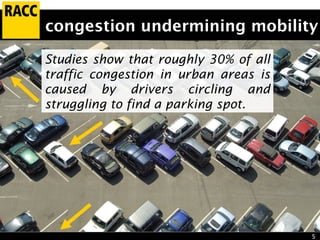
congestion undermining mobility
Studies show that roughly 30% of all
traffic congestion in urban areas is
caused by drivers circling and
struggling to find a parking spot.
6
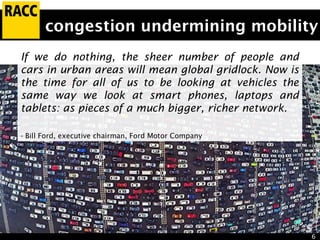
If we do nothing, the sheer number of people and
cars in urban areas will mean global gridlock. Now is
the time for all of us to be looking at vehicles the
same way we look at smart phones, laptops and
tablets: as pieces of a much bigger, richer network.
- Bill Ford, executive chairman, Ford Motor Company
congestion undermining mobility
key trends
always on
&
connected
new
mobility
concepts
urbanisation
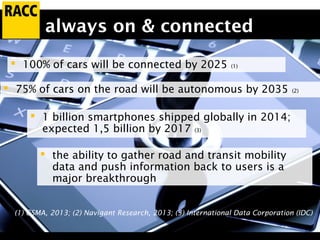
always on & connected
 100% of cars will be connected by 2025 (1)
 75% of cars on the road will be autonomous by 2035 (2)
(1) GSMA, 2013; (2) Navigant Research, 2013; (3) International Data Corporation (IDC)
 1 billion smartphones shipped globally in 2014;
expected 1,5 billion by 2017 (3)
 the ability to gather road and transit mobility
data and push information back to users is a
major breakthrough
always on & connected
 smartphones as the key to advanced mobility
 “Internet of Cars”  integration with
smartphones and embedded connectivity
 mobility-related connected services most
wanted by drivers after safety-related
 increasing connectivity as key enabler for
automation and C-ITS
 user as a sensor (passive / proactive)
 (efficient, intelligent, ethic, secure)
management of (big) data
key trends
always on
&
connected
new
mobility
concepts
urbanisation
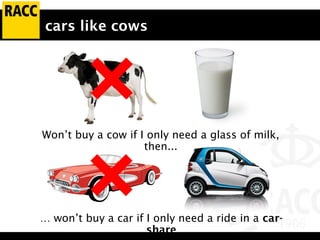
cars like cows
Won’t buy a cow if I only need a glass of milk,
then...
… won’t buy a car if I only need a ride in a car-
share
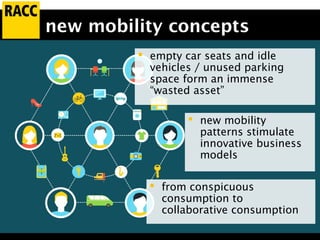
new mobility concepts
 empty car seats and idle
vehicles / unused parking
space form an immense
“wasted asset”
 new mobility
patterns stimulate
innovative business
models
 from conspicuous
consumption to
collaborative consumption
14
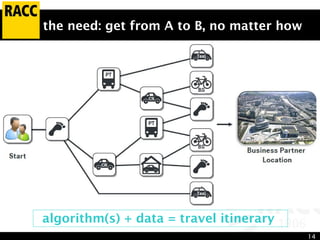
the need: get from A to B, no matter how
algorithm(s) + data = travel itinerary
15
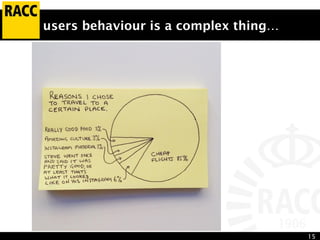
users behaviour is a complex thing…
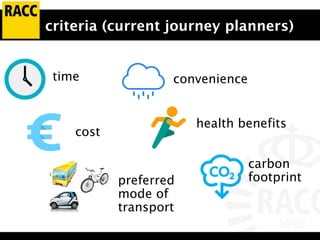
criteria (current journey planners)
time
cost
carbon
footprint
health benefits
convenience
preferred
mode of
transport
advanced criteria and advanced features
• ETA (Estimated Time of Arrival) vs BTTL (Best
Time To Leave)  Predictive features
(including scheduled events, historical data,
etc.)
• Transit schedules (static) vs Real-Time (for
Public Transport)  Incident management
• Free flow vs Real-Time Traffic status (for Road
Transport)  Congestion estimation
time
cost
• “cheapest” route (e.g. avoid toll roads) or
“estimated cost” (e.g. PT cheaper than car) vs
Accurate cost calculation (e.g. customized to
my car characteristics, own or not a PT travel
card, age, …)
• Payment feature  smartphone as the key to
mobility
advanced criteria and advanced features
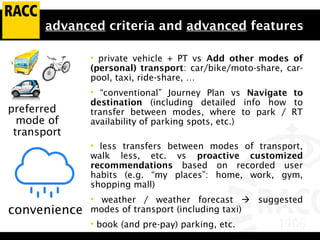
• private vehicle + PT vs Add other modes of
(personal) transport: car/bike/moto-share, car-
pool, taxi, ride-share, …
• “conventional” Journey Plan vs Navigate to
destination (including detailed info how to
transfer between modes, where to park / RT
availability of parking spots, etc.)
• less transfers between modes of transport,
walk less, etc. vs proactive customized
recommendations based on recorded user
habits (e.g. “my places”: home, work, gym,
shopping mall)
• weather / weather forecast  suggested
modes of transport (including taxi)
• book (and pre-pay) parking, etc.
convenience
preferred
mode of
transport
advanced criteria and advanced features
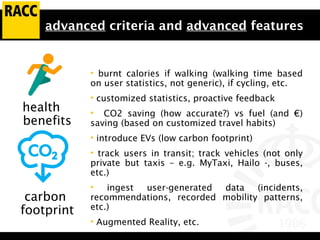
• burnt calories if walking (walking time based
on user statistics, not generic), if cycling, etc.
• customized statistics, proactive feedback
• CO2 saving (how accurate?) vs fuel (and €)
saving (based on customized travel habits)
• introduce EVs (low carbon footprint)
• track users in transit; track vehicles (not only
private but taxis – e.g. MyTaxi, Hailo -, buses,
etc.)
• ingest user-generated data (incidents,
recommendations, recorded mobility patterns,
etc.)
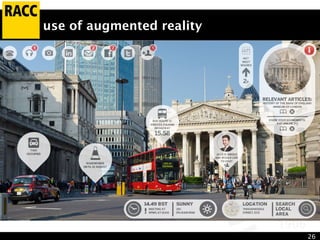
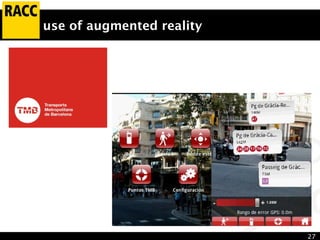
• Augmented Reality, etc.
health
benefits
carbon
footprint
20
the right mode of transport for each
situation
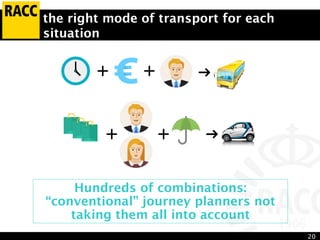
Hundreds of combinations:
“conventional” journey planners not
taking them all into account
remarkable examples of (A)JP
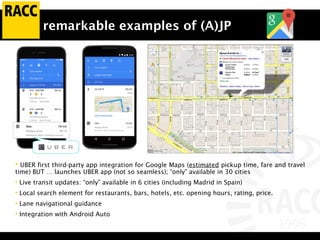
• UBER first third-party app integration for Google Maps (estimated pickup time, fare and travel
time) BUT … launches UBER app (not so seamless); “only” available in 30 cities
• Live transit updates: “only” available in 6 cities (including Madrid in Spain)
• Local search element for restaurants, bars, hotels, etc. opening hours, rating, price.
• Lane navigational guidance
• Integration with Android Auto
remarkable examples of (A)JP
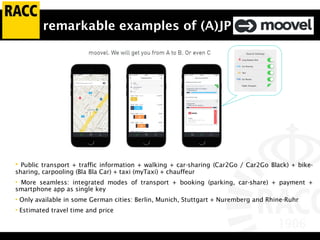
• Public transport + traffic information + walking + car-sharing (Car2Go / Car2Go Black) + bike-
sharing, carpooling (Bla Bla Car) + taxi (myTaxi) + chauffeur
• More seamless: integrated modes of transport + booking (parking, car-share) + payment +
smartphone app as single key
• Only available in some German cities: Berlin, Munich, Stuttgart + Nuremberg and Rhine-Ruhr
• Estimated travel time and price
remarkable examples of (A)JP
25
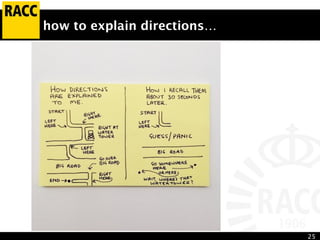
how to explain directions…
26
use of augmented reality
27
use of augmented reality
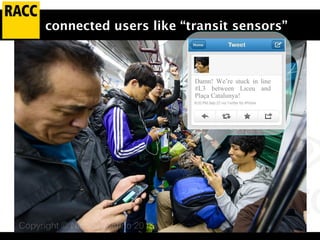
connected users like “transit sensors”
Damn! We’re stuck in line
#L3 between Liceu and
Plaça Catalunya!
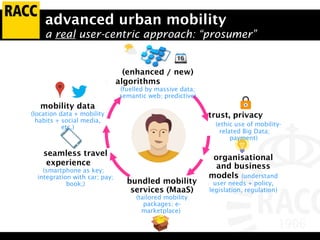
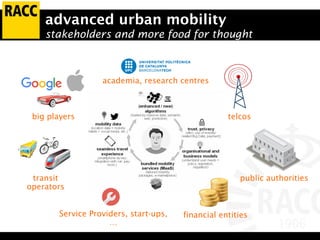
advanced urban mobility
a real user-centric approach: “prosumer”
organisational
and business
models (understand
user needs + policy,
legislation, regulation)
seamless travel
experience
(smartphone as key;
integration with car; pay;
book;) bundled mobility
services (MaaS)
(tailored mobility
packages; e-
marketplace)
mobility data
(location data + mobility
habits + social media,
etc.)
(enhanced / new)
algorithms
(fuelled by massive data;
semantic web; predictive)
trust, privacy
(ethic use of mobility-
related Big Data;
payment)
advanced urban mobility
stakeholders and more food for thought
big players
transit
operators
public authorities
telcos
financial entitiesService Providers, start-ups,
…
academia, research centres
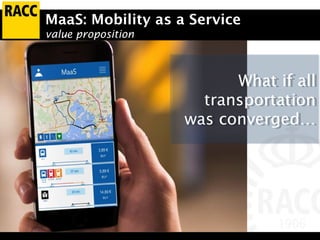
MaaS: Mobility as a Service
value proposition
What if all
transportation
was converged…
What if all
transportation
was converged…
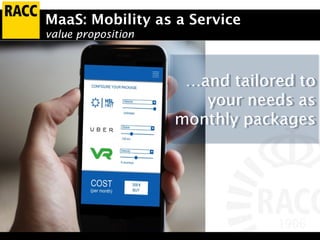
MaaS: Mobility as a Service
value proposition
…and tailored to
your needs as
monthly packages
…and tailored to
your needs as
monthly packages
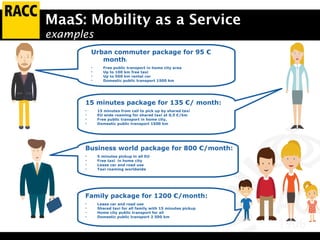
MaaS: Mobility as a Service
examples
Urban commuter package for 95 €
month:
• Free public transport in home city area
• Up to 100 km free taxi
• Up to 500 km rental car
• Domestic public transport 1500 km
15 minutes package for 135 €/ month:
• 15 minutes from call to pick up by shared taxi
• EU wide roaming for shared taxi at 0,5 €/km
• Free public transport in home city,
• Domestic public transport 1500 km
Business world package for 800 €/month:
• 5 minutes pickup in all EU
• Free taxi in home city
• Lease car and road use
• Taxi roaming worldwide
Family package for 1200 €/month:
• Lease car and road use
• Shared taxi for all family with 15 minutes pickup
• Home city public transport for all
• Domestic public transport 2 500 km
36
recap: main ideas
 cell phones turning into personal travel assistants
 connectivity, Big Data
 trends
– vehicle ownership, especially in urban areas, will
decline
– automation
– bundled mobility services (MaaS)
 game changers, disruptive technologies / business
models: on-demand transport, sharing economy
 “prosumer”, empowering the users
Gràcies!
Thank you!
@josik35
linkedin.com/in/joseplaborda
josep.laborda@racc.es

Advanced Journey Planners

  • 1.
    New Mobility Services: AdvancedJourney Planners “CHALLENGES IN URBAN MOBILITY” Symposium, 16th November 2015, Barcelona JOSEP LABORDA ITS Project Manager, RACC Foundation @josik35 linkedin.com/in/joseplaborda josep.laborda@racc.es
  • 2.
    key trends urbanisation alwayson & connected new mobility concepts
  • 3.
  • 4.
    urbanisation MIT Technology ReviewJanuary / February 2015 Business Report (Transportation) “Cities get smarter”  54% of humanity lives in urban centres  cities consume 66% of the globe’s energy and contribute a large share of its greenhouse-gas emissions  30% of the world’s economy and most of its innovation are concentrated in just 100 cities  rising urbanization is creating, among other, a demand for new personal mobility concepts… MIT January / February 2015 Business Report “Cities get smarter”
  • 5.
    5 congestion undermining mobility Studiesshow that roughly 30% of all traffic congestion in urban areas is caused by drivers circling and struggling to find a parking spot.
  • 6.
    6 If we donothing, the sheer number of people and cars in urban areas will mean global gridlock. Now is the time for all of us to be looking at vehicles the same way we look at smart phones, laptops and tablets: as pieces of a much bigger, richer network. - Bill Ford, executive chairman, Ford Motor Company congestion undermining mobility
  • 7.
  • 8.
    always on &connected  100% of cars will be connected by 2025 (1)  75% of cars on the road will be autonomous by 2035 (2) (1) GSMA, 2013; (2) Navigant Research, 2013; (3) International Data Corporation (IDC)  1 billion smartphones shipped globally in 2014; expected 1,5 billion by 2017 (3)  the ability to gather road and transit mobility data and push information back to users is a major breakthrough
  • 9.
    always on &connected
  • 10.
    always on &connected  smartphones as the key to advanced mobility  “Internet of Cars”  integration with smartphones and embedded connectivity  mobility-related connected services most wanted by drivers after safety-related  increasing connectivity as key enabler for automation and C-ITS  user as a sensor (passive / proactive)  (efficient, intelligent, ethic, secure) management of (big) data
  • 11.
  • 12.
    cars like cows Won’tbuy a cow if I only need a glass of milk, then... … won’t buy a car if I only need a ride in a car- share
  • 13.
    new mobility concepts empty car seats and idle vehicles / unused parking space form an immense “wasted asset”  new mobility patterns stimulate innovative business models  from conspicuous consumption to collaborative consumption
  • 14.
    14 the need: getfrom A to B, no matter how algorithm(s) + data = travel itinerary
  • 15.
    15 users behaviour isa complex thing…
  • 16.
    criteria (current journeyplanners) time cost carbon footprint health benefits convenience preferred mode of transport
  • 17.
    advanced criteria andadvanced features • ETA (Estimated Time of Arrival) vs BTTL (Best Time To Leave)  Predictive features (including scheduled events, historical data, etc.) • Transit schedules (static) vs Real-Time (for Public Transport)  Incident management • Free flow vs Real-Time Traffic status (for Road Transport)  Congestion estimation time cost • “cheapest” route (e.g. avoid toll roads) or “estimated cost” (e.g. PT cheaper than car) vs Accurate cost calculation (e.g. customized to my car characteristics, own or not a PT travel card, age, …) • Payment feature  smartphone as the key to mobility
  • 18.
    advanced criteria andadvanced features • private vehicle + PT vs Add other modes of (personal) transport: car/bike/moto-share, car- pool, taxi, ride-share, … • “conventional” Journey Plan vs Navigate to destination (including detailed info how to transfer between modes, where to park / RT availability of parking spots, etc.) • less transfers between modes of transport, walk less, etc. vs proactive customized recommendations based on recorded user habits (e.g. “my places”: home, work, gym, shopping mall) • weather / weather forecast  suggested modes of transport (including taxi) • book (and pre-pay) parking, etc. convenience preferred mode of transport
  • 19.
    advanced criteria andadvanced features • burnt calories if walking (walking time based on user statistics, not generic), if cycling, etc. • customized statistics, proactive feedback • CO2 saving (how accurate?) vs fuel (and €) saving (based on customized travel habits) • introduce EVs (low carbon footprint) • track users in transit; track vehicles (not only private but taxis – e.g. MyTaxi, Hailo -, buses, etc.) • ingest user-generated data (incidents, recommendations, recorded mobility patterns, etc.) • Augmented Reality, etc. health benefits carbon footprint
  • 20.
    20 the right modeof transport for each situation Hundreds of combinations: “conventional” journey planners not taking them all into account
  • 21.
    remarkable examples of(A)JP • UBER first third-party app integration for Google Maps (estimated pickup time, fare and travel time) BUT … launches UBER app (not so seamless); “only” available in 30 cities • Live transit updates: “only” available in 6 cities (including Madrid in Spain) • Local search element for restaurants, bars, hotels, etc. opening hours, rating, price. • Lane navigational guidance • Integration with Android Auto
  • 22.
    remarkable examples of(A)JP • Public transport + traffic information + walking + car-sharing (Car2Go / Car2Go Black) + bike- sharing, carpooling (Bla Bla Car) + taxi (myTaxi) + chauffeur • More seamless: integrated modes of transport + booking (parking, car-share) + payment + smartphone app as single key • Only available in some German cities: Berlin, Munich, Stuttgart + Nuremberg and Rhine-Ruhr • Estimated travel time and price
  • 23.
  • 24.
  • 25.
    25 how to explaindirections…
  • 26.
  • 27.
  • 28.
    connected users like“transit sensors” Damn! We’re stuck in line #L3 between Liceu and Plaça Catalunya!
  • 29.
    advanced urban mobility areal user-centric approach: “prosumer” organisational and business models (understand user needs + policy, legislation, regulation) seamless travel experience (smartphone as key; integration with car; pay; book;) bundled mobility services (MaaS) (tailored mobility packages; e- marketplace) mobility data (location data + mobility habits + social media, etc.) (enhanced / new) algorithms (fuelled by massive data; semantic web; predictive) trust, privacy (ethic use of mobility- related Big Data; payment)
  • 30.
    advanced urban mobility stakeholdersand more food for thought big players transit operators public authorities telcos financial entitiesService Providers, start-ups, … academia, research centres
  • 31.
    MaaS: Mobility asa Service value proposition What if all transportation was converged… What if all transportation was converged…
  • 32.
    MaaS: Mobility asa Service value proposition …and tailored to your needs as monthly packages …and tailored to your needs as monthly packages
  • 33.
    MaaS: Mobility asa Service examples Urban commuter package for 95 € month: • Free public transport in home city area • Up to 100 km free taxi • Up to 500 km rental car • Domestic public transport 1500 km 15 minutes package for 135 €/ month: • 15 minutes from call to pick up by shared taxi • EU wide roaming for shared taxi at 0,5 €/km • Free public transport in home city, • Domestic public transport 1500 km Business world package for 800 €/month: • 5 minutes pickup in all EU • Free taxi in home city • Lease car and road use • Taxi roaming worldwide Family package for 1200 €/month: • Lease car and road use • Shared taxi for all family with 15 minutes pickup • Home city public transport for all • Domestic public transport 2 500 km
  • 34.
    36 recap: main ideas cell phones turning into personal travel assistants  connectivity, Big Data  trends – vehicle ownership, especially in urban areas, will decline – automation – bundled mobility services (MaaS)  game changers, disruptive technologies / business models: on-demand transport, sharing economy  “prosumer”, empowering the users
  • 35.

Editor's Notes

  • #5 https://www.technologyreview.com/purchase/businessreport/cities-get-smarter/ http://www.technologyreview.com/news/532466/cities-find-rewards-in-cheap-technologies/
  • #6 Un estudio realizado por B:SM (2012) sobre la congestión en la ciudad de Barcelona demuestra que un 17,8% de los vehículos que circulan por la ciudad necesitan un lugar para aparcar.
  • #7 “CHANGE THE METRICS: from vehicle throughput to people throughput to reinforce a broader view of mobility” You think your measly four-lane rush hour commute is bad? How about trying to navigate a bottleneck that spans 50 lanes and several miles. This week, seemingly every person in China – in reality, nearly 750 million people – were on the move for the week-long Chinese Golden Week celebration, resulting in a gridlocked highway-to-hell that extended for miles. 8/9/2015, The People’s Daily reported that cars in Beijing were stranded for hours in a traffic jam that can only be described as our idea of a living hell. And the cause for the nightmare commute? An ill-conceived checkpoint on the Beijing-Hong Kong-Macau Expressway.
  • #18 I might be using my own motorcycle instead of car! Then, TCO vs car/moto-share, …
  • #22 http://techcrunch.com/2014/05/06/google-maps-on-mobile-gets-uber-integration-and-more/ For users with Uber installed on their Android or iPhone, Google Maps now shows the estimated pickup time, fare, and travel time to the destination in an Uber. A single tap on the Uber card seamlessly jumps you into the Uber app and sets the destination address, which is then passed on to your driver upon pickup. The feature is now live for users in over 30 cities around the world, with more cities to come in the future. Live transit data in four U.S. cities and two European cities: Boston, Portland, Ore., San Diego, San Francisco, Madrid and Turin.
  • #30 Integration with Siri / Google Now (whatever this is) + autonomous vehicles (personal, PT, taxi)
  • #35 The transport sector would develop into a co-operative, interconnected ecosystem, providing services reflecting the needs of the customers. The boundaries between different transport modes are blurred or disappear completely. The ecosystem consists of transport infrastructure, information and services. The infrastructure and information will act as a platform for mobility services We need to feel secure that all our mobility needs are covered, simply and hassle free. Every day of the week and also on those special occasions. We need a systematic change in our transportation. We need Mobility as a Service. Mobility as a Service is fundamental change on how we think of our mobility. MaaS builds upon on what already exists but takes it to the next level. The current infrastructure, transportation, fleets and data create the service platform. Aim is to fill in those caps in door to door mobility which lead us to choose our cars. When your foundations or building blocks are in order can we have networked, interoperable mobility services for every day of the week. The true revolution will be us the users. Transport in the future will be consumer business with personalized mobility choises. From the user perspective MaaS offers door-to-door services that are easy to use; information, payment and bookings via mobile application(s). There already are several apps for certain modes of transport, like Uber and Blablacar, but the novelty is, that all the transport modes / services would be combined in all-inclusice apps.
  • #37 request a bus ride when you want it and where you want it – you may pay more than you would on a traditional bus, but less than in a taxi; The use of data analytics to efficiently service real-time demand is crucial to offering passengers a competitive tariff whilst also providing as close to a “door to door” service as possible. The potential market for Pop-up transit is significant given the key reasons travellers use the car are flexibility and convenience, and it is against these features that Pop-up transit is positioned.