1
ADVANCE MANUFACTURINGTECHNIQUE
METALLURGY AND MATERIALS
ENGINEERING
MNIT,JAIPUR
PREPAREDBY:
NIKUNJ PATEL
2
INDEX TABLE
1.ADVANCE MANUFACTURING TECHNIQUE.................................................................4
1.1.Classifications...................................................................................................................4
1.1.1. Product Technology................................................................................................4
1.1.2.Process Technology..................................................................................................5
2.RAPID PROTOTYPE.............................................................................................................9
2.1.Introduction.......................................................................................................................9
2.2.Why rapid prototype..........................................................................................................9
2.3.Methodology of Rapid prototype process.......................................................................10
2.4.History.............................................................................................................................10
2.5.Various technique used in Rapid prototypes are given below........................................11
2.6.The reasons of Rapid Prototyping are.............................................................................12
2.7.The trends in manufacturing industries continue to emphasize the following................12
2.8.Medical Applications of Rapid Prototyping....................................................................13
2.8.1.INTRODUCTION.....................................................................................................13
2.8.2. Steps in production of rapid prototyping models.....................................................13
2.8.3.PROTOTECH ASIA Company.................................................................................14
2.9.RAPID PROTOTYPE MACHINE.................................................................................16
3.LASER ENGINEERED NET SHAPING.............................................................................18
3.1.Method of LENS.............................................................................................................18
3.2.LENS and other techniques.............................................................................................18
3.2.1.Capabilities................................................................................................................19
3.2.2. Accomplishments.....................................................................................................20
4. 3-D PRINTING....................................................................................................................21
4.1.TERMINOLOGY............................................................................................................22
4.2.HISTORY........................................................................................................................23
3
4.3.GENERAL PRINCIPLES...............................................................................................24
4.3.1.Modeling...................................................................................................................24
4.3.2.Printing......................................................................................................................25
4.3.3.Finishing....................................................................................................................26
4.4.PROCESS AND PRINTERS..........................................................................................26
4.5.HEALTH AND SAFETY.......................................................................................................32
4.6.Health regulation.............................................................................................................33
4.7.BIO PRINTING..............................................................................................................33
4.8.1.PROCESS IN BIOPRINTING..................................................................................33
4.8.List of common 3D test models......................................................................................35
4.9.List of 3D printer manufacturers.....................................................................................40
4.10.WORLD BEST 3D PRINTER......................................................................................42
4.11.1.MakerBot Replicator...............................................................................................42
4.11.2.XYZ PRINTING.....................................................................................................44
4.11.ROLE OF CAD CAM...................................................................................................47
5.SCAFOLDING......................................................................................................................52
5.1.INTRODUCTION...........................................................................................................52
5.2.Basic scaffolding.............................................................................................................54
5.3.Foundations.....................................................................................................................56
5.4.Fabrication of Tissue Engineering Scaffolds using Rapid Prototyping Techniques.......57
6.Reference...............................................................................................................................58
4
1.ADVANCE MANUFACTURING
TECHNIQUE
It is the use of innovative technology to improve product or process. It is different from
conventional manufacturing process in terms of number of uses, accuracy, quality and also in
terms of quantity.
The rate of technology adoption and ability to use that technology to remain competitive and
add quality value to product defines company's level in manufacturing sector.
Advance manufacturing is defined as:
Advanced manufacturing centers upon improving the performance of US industry through
the innovative application of technologies, processes and methods to product design and
production.
Finally, several sources pointed out that any definition of advanced manufacturing will need
to change with the changing times, and that the definition will vary for different companies
and for different industries due to different mentality.
The term "advanced manufacturing" encompasses many of the developments in the
manufacturing field during the late 20th and early 21st centuries, including high
technological products and processes and clean, green, and flexible manufacturing, among
others. No one definition captures everything said about advanced manufacturing, although
the majority of definitions found on the web include the use of innovative technology to
improve products and/or processes, and many also include the use of new
business/management methodologies.
Accordingly, the definition that probably comes closest to being comprehensive is that given
by Paul Fowler of the National Association of Advanced Manufacturing (NACFAM),
celebrating its 20th anniversary this year:
"The Advanced Manufacturing entity makes extensive use of computer, high precision, and
information technologies integrated with a high performance workforce in a production
system capable of furnishing a heterogeneous mix of products in small or large volumes with
both the efficiency of mass production and the flexibility of custom manufacturing in order to
respond quickly to customer demands."
1.1.Classifications:
Addvance manufacturing technique can be classified as two types:
First one is Product Technology and Process Technology:
1.1.1. Product Technology:
1.1 Products with high levels of design
5
1.2 Technologically complex products
1.3 Innovative products
1.4 Reliable, affordable, and available products
1.5 Newer, better, more exciting products
1.6 Products that solve a variety of society's problems
1.1.2.Process Technology:
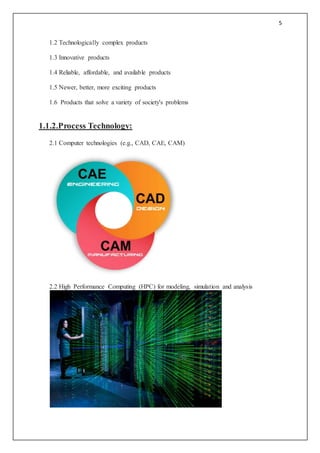
2.1 Computer technologies (e.g., CAD, CAE, CAM)
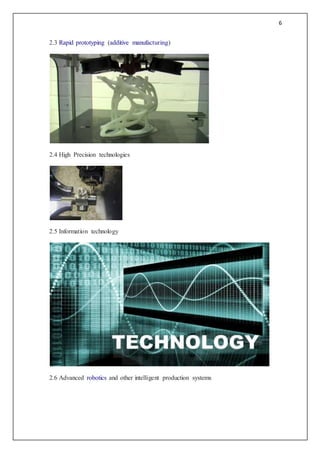
2.2 High Performance Computing (HPC) for modeling, simulation and analysis
6
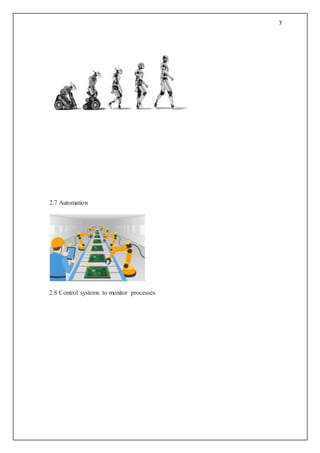
2.3 Rapid prototyping (additive manufacturing)
2.4 High Precision technologies
2.5 Information technology
2.6 Advanced robotics and other intelligent production systems
7
2.7 Automation
2.8 Control systems to monitor processes
8
2.9 Sustainable and green processes and technologies
2.10 New industrial platform technologies
2.11 Ability to custom manufacture
2.12 Ability to manufacture high or low volume
2.13 High rate of manufacturing
9
2.RAPID PROTOTYPE:
2.1.Introduction:
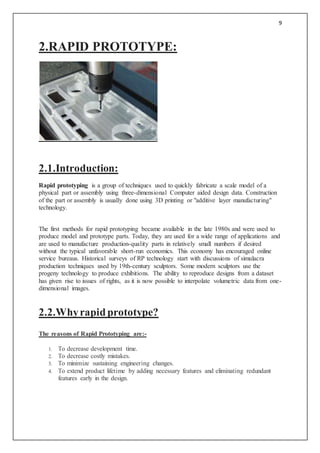
Rapid prototyping is a group of techniques used to quickly fabricate a scale model of a
physical part or assembly using three-dimensional Computer aided design data. Construction
of the part or assembly is usually done using 3D printing or "additive layer manufacturing"
technology.
The first methods for rapid prototyping became available in the late 1980s and were used to
produce model and prototype parts. Today, they are used for a wide range of applications and
are used to manufacture production-quality parts in relatively small numbers if desired
without the typical unfavorable short-run economics. This economy has encouraged online
service bureaus. Historical surveys of RP technology start with discussions of simulacra
production techniques used by 19th-century sculptors. Some modern sculptors use the
progeny technology to produce exhibitions. The ability to reproduce designs from a dataset
has given rise to issues of rights, as it is now possible to interpolate volumetric data from one-
dimensional images.
2.2.Whyrapidprototype?
The reasons of Rapid Prototyping are:-
1. To decrease development time.
2. To decrease costly mistakes.
3. To minimize sustaining engineering changes.
4. To extend product lifetime by adding necessary features and eliminating redundant
features early in the design.
10
Rapid Prototyping decreases development time by allowing corrections to a product to be
made early in the process. By giving engineering, manufacturing, marketing, and purchasing
a look at the product early in the design process, mistakes can be corrected and changes can
be made while they are still inexpensive.
The trends in manufacturing industries continue to emphasize the following:
1. Increasing number of variants of products.
2. Increasing product complexity.
3. Decreasing product lifetime before obsolescence.
4. Decreasing delivery time.
Rapid Prototyping improves product development by enabling better communication in a
concurrent engineering environment.
2.3.Methodologyof Rapid prototypeprocess:-
The basic methodology for all current rapid prototyping techniques can be summarized
as follows:
1. A CAD model is constructed, then converted to STL format. The resolution can be set
to minimize stair stepping.
2. The RP machine processes the STL file by creating sliced layers of the model.
3. The first layer of the physical model is created. The model is then lowered by the
thickness of the next layer, and the process is repeated until completion of the model.
4. The model and any supports are removed. The surface of the model is then finished and
cleaned.
2.4.History:-
In the 1970s, Joseph Henry Condon and others at Bell labs developed the Unix Circuit
Design System(UCDS), automating the laborious and error-prone task of manually
converting drawings to fabricate circuit boards for the purposes of research and development.
In the 1980s U.S. policy makers and industrial managers were forced to take note that
America's dominance in the field of machine tool manufacturing evaporated, in what was
named the machine tool crisis. Numerous projects sought to counter these trends in the
traditional CNC CAM area, which had begun in the US. Later when Rapid Prototyping
Systems moved out of labs to be commercialized it was recognized that developments were
already international and U.S. rapid prototyping companies would not have the luxury of
letting a lead slip away. The National science foundation was an umbrella for the National
11
Aeronoutics and space Administrations (NASA), the US Department of Energy, the US
Department of Commerce NIST, the US Department of Defense, Defense Advanced
Research Projects Agency(DARPA), and the Office of Naval Research coordinated studies to
inform strategic planners in their deliberations. One such report was the 1997 Rapid
Prototyping in Europe and Japan Panel Report[2] in which Joseph J. Beaman[8] founder of
DTM Corporation [DTM RapidTool pictured] provides a historical perspective:
“ The roots of rapid prototyping technology can be traced to practices in topography and
photosculpture. Within TOPOGRAPHY Blanther (1892) suggested a layered method
for making a mold for raised relief paper topographical maps .The process involved
cutting the contour lines on a series of plates which were then stacked. Matsubara
(1974) of Mitsubishi proposed a topographical process with a photo-
hardening photopolymer resin to form thin layers stacked to make a casting mold.
PHOTOSCULPTURE was a 19th-century technique to create exact three-dimensional
replicas of objects. Most famously Francois Willeme (1860) placed 24 cameras in a
circular array and simultaneously photographed an object. The silhouette of each
photograph was then used to carve a replica. Morioka (1935, 1944) developed a
hybrid photo sculpture and topographic process using structured light to
photographically create contour lines of an object.The lines could then be developed
into sheets and cut and stacked, or projected onto stock material for carving. The
Munz(1956) Process reproduced a three-dimensional image of an object by selectively
exposing, layer by layer, a photo emulsion on a lowering piston. After fixing, a solid
transparent cylinder contains an image of the object. ”
— Joseph J. Beaman[9]
The technologies referred to as Solid Freeform Fabrication are what we recognize today as
rapid prototyping, 3D printing or additive manufacturing: Swainson (1977), Schwerzel
(1984) worked on polymerization of a photosensitive polymer at the intersection of two
computer controlled laser beams. Ciraud (1972)
considered magnetostatic or electrostatic deposition with electron beam, laser or plasma for
sintered surface cladding. These were all proposed but it is unknown if working machines
were built. Hideo Kodama of Nagoya Municipal Industrial Research Institute was the first to
publish an account of a solid model fabricated using a photopolymer rapid prototyping
system (1981).[2] Even at that early date the technology was seen as having a place in
manufacturing practice. A low resolution, low strength output had value in design
verification, mould making, production jigs and other areas. Outputs have steadily advanced
toward higher specification uses.[10]
Innovations are constantly being sought,to improve speed and the ability to cope with mass
production applications.[11] A dramatic development which RP shares with related CNC areas
is the freeware open-sourcing of high level applications which constitute an entire CAD-
CAM toolchain. This has created a community of low res device manufacturers. Hobbyists
have even made forays into more demanding laser-effected device designs.[12]
12
2.5.Varioustechnique used in Rapid prototypes are
given below:
1. 3D printing (3DP)
2. Ballistic particle manufacturing (BPM)
3. Directed light fabrication (DLF)
4. Direct-shell production casting (DSPC)
5. Fused deposition modeling (FDM)
6. Laminated object manufacturing (LOM)
7. Shape deposition manufacturing (SDM) (and Mold SDM)
8. Solid ground curing (SGC)
9. Stereolithography (SL)
10. Selective laser sintering (SLS)
2.6.Thereasons of RapidPrototypingare:
1. To increase effective communication.
2. To decrease development time.
3. To decrease costly mistakes.
4. To minimize sustaining engineering changes.
5. To extend product lifetime by adding necessary features and eliminating redundant
features early in the design.
Rapid Prototyping decreases development time by allowing corrections to a product to be
made early in the process. By giving engineering, manufacturing, marketing, and purchasing
a look at the product early in the design process, mistakes can be corrected and changes can
be made while they are still inexpensive.
2.7.Thetrends in manufacturing industriescontinue
to emphasize the following:
1. Increasing number of variants of products.
2. Increasing product complexity.
3. Decreasing product lifetime before obsolescence.
4. Decreasing delivery time.
Rapid Prototyping improves product development by enabling better communication in a
concurrent engineering environment.
13
2.8.Medical Applicationsof RapidPrototyping
2.8.1.INTRODUCTION
Rapid Prototyping is a promising powerful technology that has the potential to revolutionize
certain spheres in the ever changing and challenging field of medical science. The process
involves building of prototypes or working models in relatively less time to help create and
test various ideas, concepts, design features, functionality and in certain instances outcome
and performance.
The technology is also known by several other names like digital fabrication, 3D printing,
solid imaging, solid free form fabrication, layer based manufacturing, laser prototyping, free
form fabrication, and additive manufacturing.
The history of use of this technique can be traced back to sixties and its foundation credited
to engineering Prof Herbert Voelcker who devised basic tools of mathematics that described
the three dimensional aspects of the objects and resulted in the mathematical and algorithmic
theories for solid modeling and fabrication.
However the true impetus came in 1987 through the work of Carl Deckard, a university of
Texas researcher who developed layered manufacturing and printed 3 D model by utilizing
laser light for fusing the metal powder in solid prototypes, single layer at a time.
The first patent of an apparatus for production of 3D objects by stereo lithography was
awarded to Charles Hull whom many believe to be father of Rapid prototyping industry.
Since its first use in industrial design process, Rapid prototyping has covered vast territories
right form aviation sector to the more artful sculpture designing.
The use of Rapid prototyping for medical applications although still in early days has made
impressive strides. Its use in orthopedic surgery, maxillo-facial and dental reconstruction,
preparation of scaffold for tissue engineering and as educational tool in fields as diverse as
obstetrics and gynecology and forensic medicine to plastic surgery has now gained wide
acceptance and is likely to have far reaching impact on how complicated cases are treated and
various conditions taught in medical schools.
2.8.2. Steps in production of rapid prototyping models The
various steps in production of an RP model include-
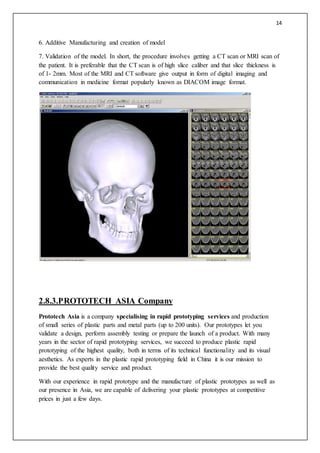
1. Imaging using CT scan or MRI scan
2. Acquisition of DIACOM files.
3. Conversion of DIACOM into. STL files.
4. Evaluation of the design
5. Surgical planning and superimposition if desired
14
6. Additive Manufacturing and creation of model
7. Validation of the model. In short, the procedure involves getting a CT scan or MRI scan of
the patient. It is preferable that the CT scan is of high slice caliber and that slice thickness is
of 1- 2mm. Most of the MRI and CT software give output in form of digital imaging and
communication in medicine format popularly known as DIACOM image format.
2.8.3.PROTOTECH ASIA Company
Prototech Asia is a company specialising in rapid prototyping services and production
of small series of plastic parts and metal parts (up to 200 units). Our prototypes let you
validate a design, perform assembly testing or prepare the launch of a product. With many
years in the sector of rapid prototyping services, we succeed to produce plastic rapid
prototyping of the highest quality, both in terms of its technical functionality and its visual
aesthetics. As experts in the plastic rapid prototyping field in China it is our mission to
provide the best quality service and product.
With our experience in rapid prototype and the manufacture of plastic prototypes as well as
our presence in Asia, we are capable of delivering your plastic prototypes at competitive
prices in just a few days.
15
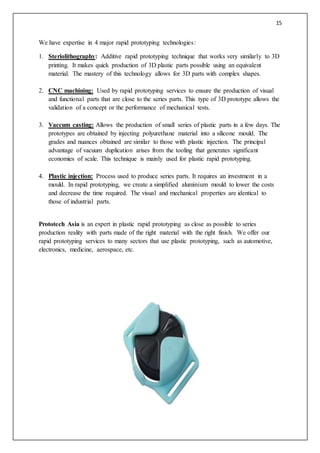
We have expertise in 4 major rapid prototyping technologies:
1. Steriolithography: Additive rapid prototyping technique that works very similarly to 3D
printing. It makes quick production of 3D plastic parts possible using an equivalent
material. The mastery of this technology allows for 3D parts with complex shapes.
2. CNC machining: Used by rapid prototyping services to ensure the production of visual
and functional parts that are close to the series parts. This type of 3D prototype allows the
validation of a concept or the performance of mechanical tests.
3. Vaccum casting: Allows the production of small series of plastic parts in a few days. The
prototypes are obtained by injecting polyurethane material into a silicone mould. The
grades and nuances obtained are similar to those with plastic injection. The principal
advantage of vacuum duplication arises from the tooling that generates significant
economies of scale. This technique is mainly used for plastic rapid prototyping.
4. Plastic injection: Process used to produce series parts. It requires an investment in a
mould. In rapid prototyping, we create a simplified aluminium mould to lower the costs
and decrease the time required. The visual and mechanical properties are identical to
those of industrial parts.
Prototech Asia is an expert in plastic rapid prototyping as close as possible to series
production reality with parts made of the right material with the right finish. We offer our
rapid prototyping services to many sectors that use plastic prototyping, such as automotive,
electronics, medicine, aerospace, etc.
16
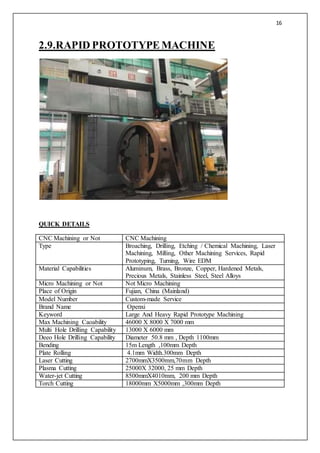
2.9.RAPID PROTOTYPEMACHINE
QUICK DETAILS
CNC Machining or Not CNC Machining
Type Broaching, Drilling, Etching / Chemical Machining, Laser
Machining, Milling, Other Machining Services, Rapid
Prototyping, Turning, Wire EDM
Material Capabilities Aluminum, Brass, Bronze, Copper, Hardened Metals,
Precious Metals, Stainless Steel, Steel Alloys
Micro Machining or Not Not Micro Machining
Place of Origin Fujian, China (Mainland)
Model Number Custom-made Service
Brand Name Openxi
Keyword Large And Heavy Rapid Prototype Machining
Max Machining Caoability 46000 X 8000 X 7000 mm
Multi Hole Drilling Capability 13000 X 6000 mm
Deeo Hole Drilling Capability Diameter 50.8 mm , Depth 1100mm
Bending 15m Length ,100mm Depth
Plate Rolling 4.1mm Width.300mm Depth
Laser Cutting 2700mmX3500mm,70mm Depth
Plasma Cutting 25000X 32000, 25 mm Depth
Water-jet Cutting 8500mmX4010mm, 200 mm Depth
Torch Cutting 18000mm X5000mm ,300mm Depth
17
COMPANY PROFILE
Business Type Manufacturer
Main Products Meatal machining,Metal fabrication,Ferrous
and non-ferrous alloy.
Total Annual Revenue US$50 Million - US$100 Million
Top 3 Markets Ocenia 50% North America 20% Eastern
Europe 10%
Location Fujian, China (Mainland)
Total employees 501 - 1000 People
Year established 2009
18
3.LASER ENGINEERED NET SHAPING
Laser Powder Forming, also known by the proprietary name Laser Engineered Net
Shaping is an additive manufacturing technology developed for fabricating metal parts
directly from a computer aided design(CAD) solid model by using a metal powder injected
into a molten pool created by a focused, high-powered laser beam. This technique is also
equivalent to several trademarked techniques that have the monikers Direct metal deposition
(DMD), and Laser Consolidation (LC). Compared to processes that use powder beds, such
as Selective Laser Melting (SLM) objects created with this technology can be substantially
larger, even up to several feet long.
3.1.Methodof LENS
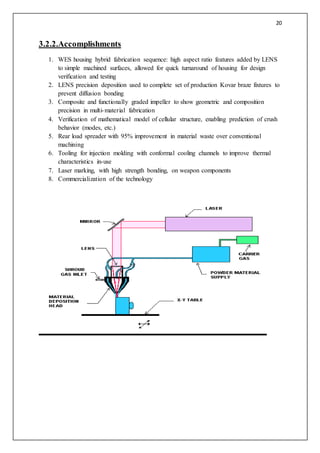
A high power laser is used to melt metal powder supplied coaxially to the focus of the laser
beam through a deposition head. The laser beam typically travels through the center of the
head and is focused to a small spot by one or more lenses. The X-Y table is moved
in raster fashion to fabricate each layer of the object. The head is moved up vertically after
each layer is completed.
Metal powders are delivered and distributed around the circumference of the head either by
gravity, or by using a pressurized carrier gas. An inert shroud gas is often used to shield the
melt pool from atmospheric oxygen for better control of properties, and to promote layer to
layer adhesion by providing better surface wetting.
3.2.LENSand other techniques
This process is similar to other 3D fabrication technologies in its approach in that it forms a
solid component by the layer additive method. The LENS process can go from metal and
metal oxide powder to metal parts, in many cases without any secondary operations. LENS
is similar to selective laser sintering, but the metal powder is applied only where material is
being added to the part at that moment. It can produce parts in a wide range of alloys,
including titanium, stainless steel, aluminium, and other specialty materials; as well as
composite and functionally graded materials. Primary applications for LENS technology
include repair & overhaul, rapid prototyping, rapid manufacturing, and limited-run-
manufacturing for aerospace, defense, and medical markets. Microscopy studies show the
LENS parts to be fully dense with no compositional degradation. Mechanical testing reveals
outstanding as-fabricated mechanical properties.
The process can also make "near" net shape parts when it is not possible to make an item to
exact specifications. In these cases post production process like light machining, surface
finishing, or heat treatment may be applied to achieve end compliance. It is used as finishing
operations.
Sandia National Laboratories has developed a new technology to fabricate three-dimensional
metallic components directly from CAD solid models. This process, called Laser Engineered
Net Shaping (LENS), exhibits enormous potential to revolutionize the way in which metal
parts, such as complex prototypes, tooling, and small-lot production items, are produced. The
process fabricates metal parts directly from the Computer Aided Design (CAD) solid models
using a metal powder injected into a molten pool created by a focused, high-powered laser
19
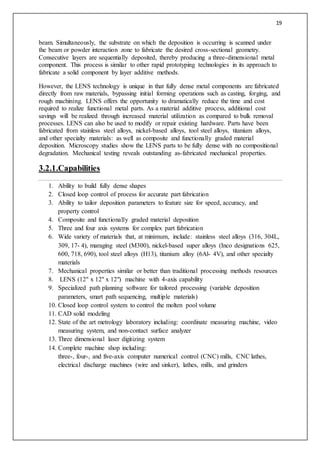
beam. Simultaneously, the substrate on which the deposition is occurring is scanned under
the beam or powder interaction zone to fabricate the desired cross-sectional geometry.
Consecutive layers are sequentially deposited, thereby producing a three-dimensional metal
component. This process is similar to other rapid prototyping technologies in its approach to
fabricate a solid component by layer additive methods.
However, the LENS technology is unique in that fully dense metal components are fabricated
directly from raw materials, bypassing initial forming operations such as casting, forging, and
rough machining. LENS offers the opportunity to dramatically reduce the time and cost
required to realize functional metal parts. As a material additive process, additional cost
savings will be realized through increased material utilization as compared to bulk removal
processes. LENS can also be used to modify or repair existing hardware. Parts have been
fabricated from stainless steel alloys, nickel-based alloys, tool steel alloys, titanium alloys,
and other specialty materials: as well as composite and functionally graded material
deposition. Microscopy studies show the LENS parts to be fully dense with no compositional
degradation. Mechanical testing reveals outstanding as-fabricated mechanical properties.
3.2.1.Capabilities
1. Ability to build fully dense shapes
2. Closed loop control of process for accurate part fabrication
3. Ability to tailor deposition parameters to feature size for speed, accuracy, and
property control
4. Composite and functionally graded material deposition
5. Three and four axis systems for complex part fabrication
6. Wide variety of materials that, at minimum, include: stainless steel alloys (316, 304L,
309, 17- 4), maraging steel (M300), nickel-based super alloys (Inco designations 625,
600, 718, 690), tool steel alloys (H13), titanium alloy (6Al- 4V), and other specialty
materials
7. Mechanical properties similar or better than traditional processing methods resources
8. LENS (12" x 12" x 12") machine with 4-axis capability
9. Specialized path planning software for tailored processing (variable deposition
parameters, smart path sequencing, multiple materials)
10. Closed loop control system to control the molten pool volume
11. CAD solid modeling
12. State of the art metrology laboratory including: coordinate measuring machine, video
measuring system, and non-contact surface analyzer
13. Three dimensional laser digitizing system
14. Complete machine shop including:
three-, four-, and five-axis computer numerical control (CNC) mills, CNC lathes,
electrical discharge machines (wire and sinker), lathes, mills, and grinders
20
3.2.2.Accomplishments
1. WES housing hybrid fabrication sequence: high aspect ratio features added by LENS
to simple machined surfaces, allowed for quick turnaround of housing for design
verification and testing
2. LENS precision deposition used to complete set of production Kovar braze fixtures to
prevent diffusion bonding
3. Composite and functionally graded impeller to show geometric and composition
precision in multi-material fabrication
4. Verification of mathematical model of cellular structure, enabling prediction of crush
behavior (modes, etc.)
5. Rear load spreader with 95% improvement in material waste over conventional
machining
6. Tooling for injection molding with conformal cooling channels to improve thermal
characteristics in-use
7. Laser marking, with high strength bonding, on weapon components
8. Commercialization of the technology
21
4. 3-D PRINTING
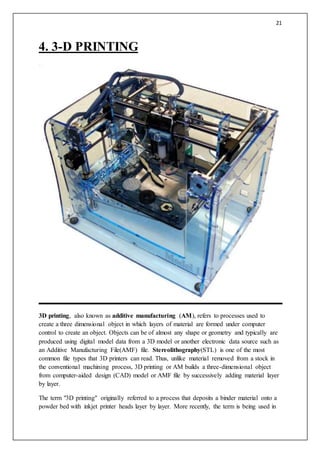
3D printing, also known as additive manufacturing (AM), refers to processes used to
create a three dimensional object in which layers of material are formed under computer
control to create an object. Objects can be of almost any shape or geometry and typically are
produced using digital model data from a 3D model or another electronic data source such as
an Additive Manufacturing File(AMF) file. Stereolithography(STL) is one of the most
common file types that 3D printers can read. Thus, unlike material removed from a stock in
the conventional machining process, 3D printing or AM builds a three-dimensional object
from computer-aided design (CAD) model or AMF file by successively adding material layer
by layer.
The term "3D printing" originally referred to a process that deposits a binder material onto a
powder bed with inkjet printer heads layer by layer. More recently, the term is being used in
22
popular vernacular to encompass a wider variety of additive manufacturing techniques.
United States and global technical standards use the official term additive manufacturing for
this broader sense.
4.1.TERMINOLOGY
The umbrella term additive manufacturing (AM) gained wide currency in the 2000s.The
term subtractive manufacturing appeared as a retronym for the large family
of machining processes with metal removal as their common theme. The term 3D printingstill
referred only to the polymer technologies in most minds, and the term AM was likelier to be
used in metalworking and end use part production contexts than among polymer, inkjet, or
stereo lithography enthusiasts.
By the early 2010s, the terms 3D printing and additive manufacturing evolved senses in
which they were alternate umbrella terms for AM technologies, one being used in popular
vernacular by consumer-maker communities and the media, and the other used more formally
by industrial AM end-use part producers, AM machine manufacturers, and global technical
standards organizations. Until recently, the term 3D printing has been associated with
machines low-end in price or in capability. Both terms reflect that the technologies share the
theme of sequential-layer material addition or joining throughout a 3D work envelope under
automated control. Peter Zelinski, the editor-in-chief of Additive Manufacturing magazine,
pointed out in 2017 that the terms are still often synonoums in casual usage but that some
manufacturing industry experts are increasingly making a sense distinction whereby
AM comprises 3D printing plus other technologies or other aspects of a manufacturing
process.
Other terms that have been used as AM synonyms or hypernyms have included desktop
manufacturing, rapid manufacturing (as the logical production-level successor to rapid
prototype), and on-demand manufacturing(which echoes on demand printing in the 2D sense
of printing). That such application of the adjectives rapid and on-demand to the
noun manufacturing was novel in the 2000s reveals the prevailing mental model of the long
industrial era in which almost all production manufacturing involved long lead times for
laborious tooling development. Today, the term subtractive has not replaced the
term machining, instead complementing it when a term that covers any removal method is
needed. Agile tooling is the use of modular means to design tooling that is produced by
additive manufacturing or 3D printing methods, to enable quick prototyping and responses to
tooling and fixture needs. Agile tooling uses a cost effective and high quality method to
quickly respond to customer and market needs, and it can be used in hydro
forming, stamping, injection moulding and other manufacturing processes.
23
4.2.HISTORY
Early additive manufacturing equipment and materials were developed in the 1980s.In
1981, Hideo kodama of Nagoya Municipal Industrial Research Institute invented two additive
methods for fabricating three-dimensional plastic models with photo-hardening thermo set
polymer, where the UV exposure area is controlled by a mask pattern or a scanning fiber
transmitter.
On July 16, 1984 Alain Le Méhauté, Olivier de Witte, and Jean Claude André filed their
patent for the stereolithography process.The application of the French inventors was
abandoned by the French General Electric Company (now Alcatel-Alsthom) and CILAS(The
Laser Consortium).The claimed reason was "for lack of business perspective".
Three weeks later in 1984, Chuck Hull of 3D system Corporation filed his own patent for
a steriolithography fabrication system, in which layers are added by
curing photopolymers with ultra-violet light laser. Hull defined the process as a "system for
generating three-dimensional objects by creating a cross-sectional pattern of the object to be
formed". Hull's contribution was the STL file format and the digital slicing and infill
strategies common to many processes today.
The technology used by most 3D printers to date—especially hobbyist and consumer-
oriented models—is fused deposition moulding, a special application of plastic extrusion,
developed in 1988 by S. Scott Crump and commercialized by his company Stratasys, which
marketed its first FDM machine in 1992.
The term 3D printing originally referred to a powder bed process employing standard and
custom inkjet print heads, developed at MIT in 1993 and commercialized by Soligen
Technologies, Extrude Hone Corporation, and Z Corporation.
The year 1993 also saw the start of a company called Solidscap, introducing a high-precision
polymer jet fabrication system with soluble support structures, (categorized as a "dot-on-dot"
technique).
AM processes for metal sintering or melting (such as selective laser sintering, direct metal
laser sintering, and selective laser melting) usually went by their own individual names in the
1980s and 1990s. At the time, all metalworking was done by processes that we now call non-
additive (casting, fabrication, stamping, and machining); although plenty of automation was
applied to those technologies (such as by robot welding and CNC), the idea of a tool or head
moving through a 3D work envelope transforming a mass of raw material into a desired
shape layer by layer was associated in metalworking only with processes that removed metal
(rather than adding it), such as CNC milling, CNC EDM, and many others. But the automated
techniques that added metal, which would later be called additive manufacturing, were
beginning to challenge that assumption. By the mid-1990s, new techniques for material
deposition were developed at Stanford and Carnegie Mellon University, including
microcasting and sprayed materials. Sacrificial and support materials had also become more
common, enabling new object geometries.
24
As the various additive processes matured, it became clear that soon metal removal would no
longer be the only metal working process done through a tool or head moving through a 3D
work envelope transforming a mass of raw material into a desired shape layer by layer. The
2010s were the first decade in which metal end use parts such as engine bracketsand large
nutswould be grown (either before or instead of machining) in job production rather
than obligately being machined from bar stock or plate. It is still the case that casting,
fabrication, stamping, and machining are more prevalent than AM in metalworking, but AM
is now beginning to make significant inroads, and with the advantages of desined for additive
manufacturing, it is clear to engineers that much more is to come.As technology matured,
several authors had begun to speculate that 3D printing could aid in sustainable
development in the developing world.
4.3.GENERALPRINCIPLES
4.3.1.Modeling
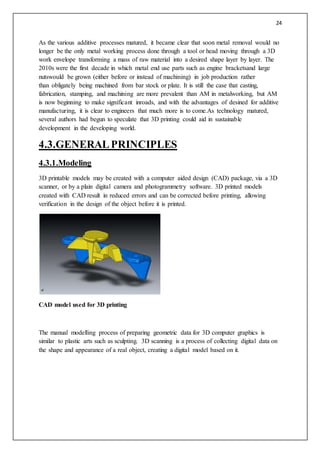
3D printable models may be created with a computer aided design (CAD) package, via a 3D
scanner, or by a plain digital camera and photogrammetry software. 3D printed models
created with CAD result in reduced errors and can be corrected before printing, allowing
verification in the design of the object before it is printed.
CAD model used for 3D printing
The manual modelling process of preparing geometric data for 3D computer graphics is
similar to plastic arts such as sculpting. 3D scanning is a process of collecting digital data on
the shape and appearance of a real object, creating a digital model based on it.
25
4.3.2.Printing
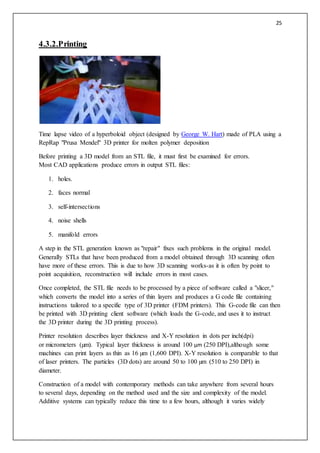
Time lapse video of a hyperboloid object (designed by George W. Hart) made of PLA using a
RepRap "Prusa Mendel" 3D printer for molten polymer deposition
Before printing a 3D model from an STL file, it must first be examined for errors.
Most CAD applications produce errors in output STL files:
1. holes.
2. faces normal
3. self-intersections
4. noise shells
5. manifold errors
A step in the STL generation known as "repair" fixes such problems in the original model.
Generally STLs that have been produced from a model obtained through 3D scanning often
have more of these errors. This is due to how 3D scanning works-as it is often by point to
point acquisition, reconstruction will include errors in most cases.
Once completed, the STL file needs to be processed by a piece of software called a "slicer,"
which converts the model into a series of thin layers and produces a G code file containing
instructions tailored to a specific type of 3D printer (FDM printers). This G-code file can then
be printed with 3D printing client software (which loads the G-code, and uses it to instruct
the 3D printer during the 3D printing process).
Printer resolution describes layer thickness and X-Y resolution in dots per inch(dpi)
or micrometers (µm). Typical layer thickness is around 100 µm (250 DPI),although some
machines can print layers as thin as 16 µm (1,600 DPI). X-Y resolution is comparable to that
of laser printers. The particles (3D dots) are around 50 to 100 µm (510 to 250 DPI) in
diameter.
Construction of a model with contemporary methods can take anywhere from several hours
to several days, depending on the method used and the size and complexity of the model.
Additive systems can typically reduce this time to a few hours, although it varies widely
26
depending on the type of machine used and the size and number of models being produced
simultaneously.
Traditional techniques like injection moulding can be less expensive for
manufacturing polymer products in high quantities, but additive manufacturing can be faster,
more flexible and less expensive when producing relatively small quantities of parts. 3D
printers give designers and concept development teams the ability to produce parts and
concept models using a desktop size printer.
Seemingly paradoxic more complex objects can be cheaper for 3D printing production than
less complex objects.
4.3.3.Finishing
Though the printer-produced resolution is sufficient for many applications, printing a slightly
oversized version of the desired object in standard resolution and then removing
material with a higher-resolution subtractive process can achieve greater precision.
Some printable polymers such as ABS, allow the surface finish to be smoothed and improved
using chemical vapor processes based on acetone or similar solvents.
Some additive manufacturing techniques are capable of using multiple materials in the course
of constructing parts. These techniques are able to print in multiple colors and color
combinations simultaneously, and would not necessarily require painting.
Some printing techniques require internal supports to be built for overhanging features during
construction. These supports must be mechanically removed or dissolved upon completion of
the print.
All of the commercialized metal 3D printers involve cutting the metal component off the
metal substrate after deposition. A new process for the GMAW 3D printing allows for
substrate surface modifications to remove aluminium and steel.
4.4.PROCESSAND PRINTERS
A large number of additive processes are available. The main differences between processes
are in the way layers are deposited to create parts and in the materials that are used. Each
method has its own advantages and drawbacks, which is why some companies offer a choice
of powder and polymer for the material used to build the object.Others sometimes use
standard, off-the-shelf business paper as the build material to produce a durable prototype.
The main considerations in choosing a machine are generally speed, costs of the 3D printer,
of the printed prototype, choice and cost of the materials, and color capabilities.Printers that
work directly with metals are generally expensive. However less expensive printers can be
used to make a mold, which is then used to make metal parts.
27
ISO/ASTM52900-15 defines seven categories of Additive Manufacturing (AM) processes
within its meaning: binder jetting, directed energy deposition, material extrusion, material
jetting, powder bed fusion, sheet lamination, and vat photopolymerization.
Some methods melt or soften the material to produce the layers. In Fused filament
fabrications, also known as Fused deposition moulding(FDM), the model or part is produced
by extruding small beads or streams of material which harden immediately to form layers. A
filament of thermoplastic, metal wire, or other material is fed into an extrusion nozzle head
(3D printer extruder), which heats the material and turns the flow on and off. FDM is
somewhat restricted in the variation of shapes that may be fabricated. Another technique
fuses parts of the layer and then moves upward in the working area, adding another layer of
granules and repeating the process until the piece has built up. This process uses the unfused
media to support overhangs and thin walls in the part being produced, which reduces the need
for temporary auxiliary supports for the piece.Laser sintering techniques include selective
laser sintering, with both metals and polymers, and direct metal laser sintering. Selective laser
melting does not use sintering for the fusion of powder granules but will completely melt the
powder using a high-energy laser to create fully dense materials in a layer-wise method that
has mechanical properties similar to those of conventional manufactured metals. Electron
beam melting is a similar type of additive manufacturing technology for metal parts
(e.g. titanium alloys). EBM manufactures parts by melting metal powder layer by layer with
an electron beam in a high vacuum.Another method consists of an inkjet 3D printing system,
which creates the model one layer at a time by spreading a layer of powder (plaster, or resins)
and printing a binder in the cross-section of the part using an inkjet-like process.
With laminated object manufavturing, thin layers are cut to shape and joined together.
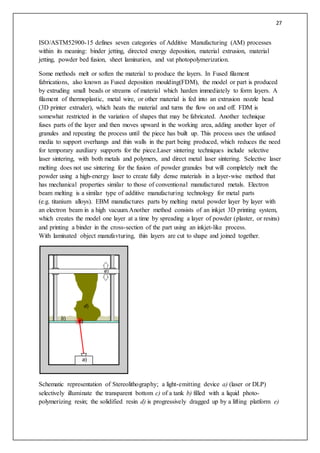
Schematic representation of Stereolithography; a light-emitting device a) (laser or DLP)
selectively illuminate the transparent bottom c) of a tank b) filled with a liquid photo-
polymerizing resin; the solidified resin d) is progressively dragged up by a lifting platform e)
28
Other methods cure liquid materials using different sophisticated technologies, such as sterio
lithography. Photo polymerisation is primarily used in stereo lithography to produce a solid
part from a liquid. Inkjet printer systems like the Objet Poly Jet system spray photopolymer
materials onto a build tray in ultra-thin layers (between 16 and 30 µm) until the part is
completed. Each photopolymer layer is cured with UV light after it is jetted, producing fully
cured models that can be handled and used immediately, without post-curing. Ultra-small
features can be made with the 3D micro-fabrication technique used in multi photon photo
polymerisation. Due to the nonlinear nature of photo excitation, the gel is cured to a solid
only in the places where the laser was focused while the remaining gel is then washed away.
Feature sizes of under 100 nm are easily produced, as well as complex structures with
moving and interlocked parts. Yet another approach uses a synthetic resin that is solidified
using LEDs. In Mask-image-projection-based stereo lithography, a 3D digital model is sliced
by a set of horizontal planes. Each slice is converted into a two-dimensional mask image. The
mask image is then projected onto a photo curable liquid resin surface and light is projected
onto the resin to cure it in the shape of the layer.
Continuous liquid interface production begins with a pool of liquid photopymer resin. Part of
the pool bottom is transparent to ultraviolet light (the "window"), which causes the resin to
solidify. The object rises slowly enough to allow resin to flow under and maintain contact
with the bottom of the object. In powder-fed directed-energy deposition, a high-power laser is
used to melt metal powder supplied to the focus of the laser beam. The powder fed directed
energy process is similar to Selective Laser Sintering, but the metal powder is applied only
where material is being added to the part at that moment.
As of October 2012, additive manufacturing systems were on the market that ranged from
$2,000 to $500,000 in price and were employed in industries including aerospace,
architecture, automotive, defence, and medical replacements, among many others. For
example, General electric uses the high-end model to build parts for turbines. Many of these
systems are used for rapid prototyping, before mass production methods are employed.
Higher education has proven to be a major buyer of desktop and professional 3D printers
which industry experts generally view as a positive indicator. Libraries around the world have
also become locations to house smaller 3D printers for educational and community access.
Several projects and companies are making efforts to develop affordable 3D printers for
home desktop use. Much of this work has been driven by and targeted
at DIY/Maker/enthusiast/early adopter communities, with additional ties to the academic
and hacker communities.
29
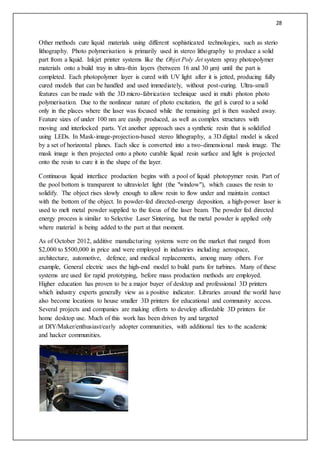
The Audi RSQ was made with rapid prototyping industrial KUKA robots.
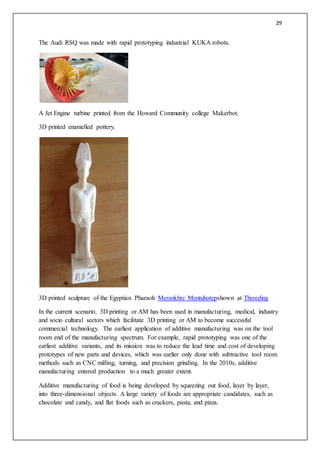
A Jet Engine turbine printed from the Howard Community college Makerbot.
3D printed enamelled pottery.
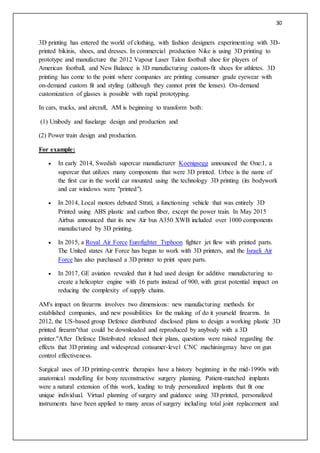
3D printed sculpture of the Egyptian Pharaoh Merankhre Mentuhotepshown at Threeding
In the current scenario, 3D printing or AM has been used in manufacturing, medical, industry
and socio cultural sectors which facilitate 3D printing or AM to become successful
commercial technology. The earliest application of additive manufacturing was on the tool
room end of the manufacturing spectrum. For example, rapid prototyping was one of the
earliest additive variants, and its mission was to reduce the lead time and cost of developing
prototypes of new parts and devices, which was earlier only done with subtractive tool room
methods such as CNC milling, turning, and precision grinding. In the 2010s, additive
manufacturing entered production to a much greater extent.
Additive manufacturing of food is being developed by squeezing out food, layer by layer,
into three-dimensional objects. A large variety of foods are appropriate candidates, such as
chocolate and candy, and flat foods such as crackers, pasta, and pizza.
30
3D printing has entered the world of clothing, with fashion designers experimenting with 3D-
printed bikinis, shoes, and dresses. In commercial production Nike is using 3D printing to
prototype and manufacture the 2012 Vapour Laser Talon football shoe for players of
American football, and New Balance is 3D manufacturing custom-fit shoes for athletes. 3D
printing has come to the point where companies are printing consumer grade eyewear with
on-demand custom fit and styling (although they cannot print the lenses). On-demand
customization of glasses is possible with rapid prototyping.
In cars, trucks, and aircraft, AM is beginning to transform both:
(1) Unibody and fuselarge design and production and
(2) Power train design and production.
For example:
 In early 2014, Swedish supercar manufacturer Koenigsegg announced the One:1, a
supercar that utilizes many components that were 3D printed. Urbee is the name of
the first car in the world car mounted using the technology 3D printing (its bodywork
and car windows were "printed").
 In 2014, Local motors debuted Strati, a functioning vehicle that was entirely 3D
Printed using ABS plastic and carbon fiber, except the power train. In May 2015
Airbus announced that its new Air bus A350 XWB included over 1000 components
manufactured by 3D printing.
 In 2015, a Royal Air Force Eurofighter Typhoon fighter jet flew with printed parts.
The United states Air Force has begun to work with 3D printers, and the Israeli Air
Force has also purchased a 3D printer to print spare parts.
 In 2017, GE aviation revealed that it had used design for additive manufacturing to
create a helicopter engine with 16 parts instead of 900, with great potential impact on
reducing the complexity of supply chains.
AM's impact on firearms involves two dimensions: new manufacturing methods for
established companies, and new possibilities for the making of do it yourseld firearms. In
2012, the US-based group Defence distributed disclosed plans to design a working plastic 3D
printed firearm"that could be downloaded and reproduced by anybody with a 3D
printer."After Defence Distributed released their plans, questions were raised regarding the
effects that 3D printing and widespread consumer-level CNC machiningmay have on gun
control effectiveness.
Surgical uses of 3D printing-centric therapies have a history beginning in the mid-1990s with
anatomical modelling for bony reconstructive surgery planning. Patient-matched implants
were a natural extension of this work, leading to truly personalized implants that fit one
unique individual. Virtual planning of surgery and guidance using 3D printed, personalized
instruments have been applied to many areas of surgery including total joint replacement and
31
craniomaxillofacial reconstruction with great success. One example of this is the
bioresorbable trachial splint to treat newborns with tracheobronchomalacia developed at the
University of Michigan. The use of additive manufacturing for serialized production of
orthopedic implants (metals) is also increasing due to the ability to efficiently create porous
surface structures that facilitate osseointegration. The hearing aid and dental industries are
expected to be the biggest area of future development using the custom 3D printing
technology. In March 2014, surgeons in Swansea used 3D printed parts to rebuild the face of
a motorcyclist who had been seriously injured in a road accident. As of 2012, 3D bio printing
technology has been studied by biotechnology firms and academia for possible use in tissue
engineering applications in which organs and body parts are built using inkjet techniques. In
this process, layers of living cells are deposited onto a gel medium or sugar matrix and slowly
built up to form three-dimensional structures including vascular systems. Recently, a heart-
on-chip has been created which matches properties of cells.
In 2005, academic journals had begun to report on the possible artistic applications of 3D
printing technology. As of 2012, domestic 3D printing was mainly practiced by hobbyists and
enthusiasts. However, little was used for practical household applications, for example,
ornamental objects. Some practical examples include a working clock and gears printed for
home woodworking machines among other purposes. Web sites associated with home 3D
printing tended to include backscratchers, coat hooks, door knobs, etc.
3D printing, and open source 3D printers in particular, are the latest technology making
inroads into the classroom. Some authors have claimed that 3D printers offer an
unprecedented "revolution" in STEM education. The evidence for such claims comes from
both the low cost ability for rapid prototype in the classroom by students, but also the
fabrication of low-cost high-quality scientific equipment from open hardware designs
forming open-source labs.Future applications for 3D printing might include creating open-
source scientific equipment.
In the last several years 3D printing has been intensively used by in the cultural heritage field
for preservation, restoration and dissemination purposes. Many Europeans and North
American Museums have purchased 3D printers and actively recreate missing pieces of their
relics. The Metropolitan Museum of Art and the British Museum have started using their 3D
printers to create museum souvenirs that are available in the museum shops. Other museums,
like the National Museum of Military History and Varna Historical Museum, have gone
further and sell through the online platform threeding digital models of their artifacts, created
using Artec 3D scanners, in 3D printing friendly file format, which everyone can 3D print at
home.
3D printed soft actuators is a growing application of 3D printing technology which has found
its place in the 3D printing applications. These soft actuators are being developed to deal with
soft structures and organs especially in biomedical sectors and where the interaction between
human and robot is inevitable. The majority of the existing soft actuators are fabricated by
conventional methods that require manual fabrication of devices, post processing/assembly,
and lengthy iterations until maturity in the fabrication is achieved. To avoid the tedious and
32
time-consuming aspects of the current fabrication processes, researchers are exploring an
appropriate manufacturing approach for effective fabrication of soft actuators. Thus, 3D
printed soft actuators are introduced to revolutionise the design and fabrication of soft
actuators with custom geometrical, functional, and control properties in a faster and
inexpensive approach. They also enable incorporation of all actuator components into a
single structure eliminating the need to use external joints, adhesives, and fasteners.
4.5.HEALTH AND SAFETY
Research on the health and safety concerns of 3D printing is new and in development due to
the recent proliferation of 3D printing devices. In 2017 the European Agency for Safety and
Health at Work has published a discussion paper on the processes and materials involved in
3D printing, potential implications of this technology for occupational safety and health and
avenues for controlling potential hazards. Most concerns involve gas and material exposures,
in particular nano-materials, material handling, static electricity, moving parts and pressures.
A National Institute for Occupational Safety and Health (NIOSH) study noted particle
emissions from a fused filament peaked a few minutes after printing started and returned to
baseline levels 100 minutes after printing ended. Emissions from fused filament printers can
include a large number of ultrafine particles and volatile organic compound(VOCs).
The toxicity from emissions varies by source material due to differences in size, chemical
properties, and quantity of emitted particles. Excessive exposure to VOCs can lead to
irritation of the eyes, nose, and throat, headache, loss of coordination, and nausea and some
of the chemical emissions of fused filament printers have also been linked to asthma.Based
on animal studies, carbon nanotubes and carbon nanofibres sometimes used in fused filament
printing can cause pulmonary effects including inflamation, granulomas, and pulmonary
fibrosis when at the nanoparticle size.
Carbon nanoparticle emissions and processes using powder metals are highly combustible
and raise the risk of dust explosions.At least one case of severe injury was noted from an
explosion involved in metal powders used for fused filament printing.Other general health
and safety concerns include the hot surface of UV lamps and print head blocks, high
voltage, ultraviolet radiation from UV lamps, and potential for mechanical injury from
moving parts.
The problems noted in the NIOSH report were reduced by using manufacturer-supplied
covers and full enclosures, using proper ventilation, keeping workers away from the printer,
using respirators, turning off the printer if it jammed, and using lower emission printers and
filaments. At least one case of severe injury was noted from an explosion involved in metal
powders used for fused filament. Personal protective equipment has been found to be the
least desirable control method with a recommendation that it only be used to add further
protection in combination with approved emissions protection.
Hazards to health and safety also exist from post-processing activities done to finish parts
after they have been printed. These post-processing activities can include chemical baths,
33
sanding, polishing, or vapor exposure to refine surface finish, as well as general suhstrative
manufacturing techniques such as drilling, milling, or turning to modify the printed geometry.
Any technique that removes material from the printed part has the potential to generate
particles that can be inhaled or cause eye injury if proper personal protective equipment is not
used, such as respirators or safety glasses. Caustic baths are often used to dissolve support
material used by some 3D printers that allows them to print more complex shapes. These
baths require personal protective equipment to prevent injury to exposed skin.
4.6.Healthregulation
Although no occupational exposure limits specific to 3D printer emissions exist, certain
source materials used in 3D printing, such as carbon nanofibres and carbon nanotubes, have
established occupational exposure limits at the nanoparticle size.
4.7.BIO PRINTING
3D bioprinting is the process of creating cell patterns in a confined space using 3D
printing technologies, where cell function and viability are preserved within the printed
construct. Generally, 3D bioprinting utilizes the layer-by-layer method to deposit materials
known as Bio-inks to create tissue-like structures that are later used in medical and tissue
engineering fields. Bio-printing covers a broad range of materials. Currently, bioprinting can
be used to print tissues and organs to help research drugs and pills. In addition, 3D
bioprinting has begun to incorporate the printing of scaffolds. These scaffolds can be used to
regenerate joints and ligaments. The first patent related to this technology was filed in the
United States in 2003 and granted in 2006.
4.7.1.PROCESS IN BIOPRINTING
3D bioprinting generally follows three steps, pre-bioprinting, bioprinting, and post-
bioprinting.
4.7.1.1.Pre-bioprinting
Pre-bioprinting is the process of creating a model that the printer will later create and
choosing the materials that will be used. One of the first steps is to obtain a biopsy of the
organ. The common technologies used for bioprinting are computed tomography (CT) and
magnetic resonance imaging (MRI). To print with a layer-by-layer approach, tomographic
reconstruction is done on the images. The now-2D images are then sent to the printer to be
made. Once the image is created, certain cells are isolated and multiplied. These cells are then
mixed with a special liquefied material that provides oxygen and other nutrients to keep them
alive. In some processes, the cells are encapsulated in cellular spheroids 500μm in diameter.
This aggregation of cells does not require a scaffold, and are required for placing in the
tubular-like tissue fusion for processes such as extrusion.
34
4.7.1.2.Bioprinting
In the second step, the liquid mixture of cells, matrix, and nutrients known as Bioinks are
placed in a printer cartridge and deposited using the patients' medical scans.When a
bioprinted pre-tissue is transferred to an incubator, this cell-based pre-tissue matures into a
tissue
3D bioprinting for fabricating biological constructs typically involves dispensing cells onto a
biocompatible scaffold using a successive layer-by-layer approach to generate tissue-like
three-dimensional structures. Artificial organs such as livers and kidneys made by 3D
bioprinting have been shown to lack crucial elements that affect the body such as working
blood vessels, tubules for collecting urine, and the growth of billions of cells required for
these organs. Without these components the body has no way to get the essential nutrients
and oxygen deep within their interiors. Given that every tissue in the body is naturally
compartmentalized of different cell types, many technologies for printing these cells vary in
their ability to ensure stability and viability of the cells during the manufacturing process.
Some of the methods that are used for 3D bioprinting of cells are photolithography, magnetic
bioprinting, stereolithography, and direct cell extrusion.
4.7.1.3.Post-bioprinting
The post-bioprinting process is necessary to create a stable structure from the biological
material. If this process is not well-maintained, the mechanical integrity and function of the
3D printed object is at risk. To maintain the object, both mechanical and chemical
stimulations are needed. These stimulations send signals to the cells to control the remodeling
and growth of tissues. In addition, in recent development, bioreactor technologies have
allowed the rapid maturation of tissues, vascularization of tissues and the ability to survive
transplants.
Bioreactors work in either providing convective nutrient transport, creating microgravity
environments, changing the pressure causing solution to flow through the cells, or add
compression for dynamic or static loading. Each type of bioreactor is ideal for different types
of tissue, for example compression bioreactors are ideal for cartilage tissue.
35
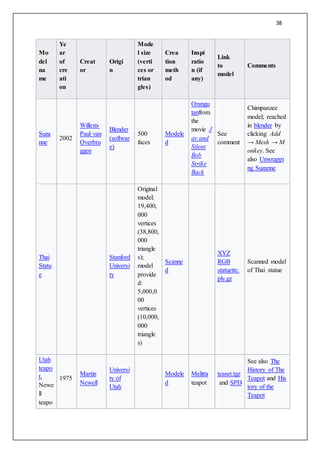
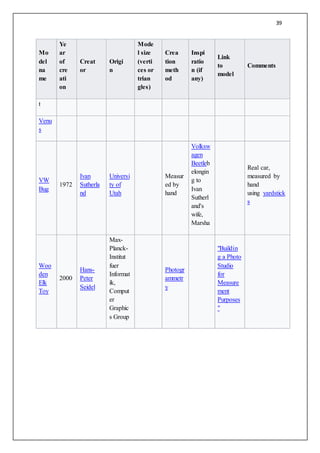
4.8.Listof common 3D test models
Mo
del
na
me
Ye
ar
of
cre
ati
on
Creat
or
Origi
n
Mode
l size
(verti
ces or
trian
gles)
Crea
tion
meth
od
Inspi
ratio
n (if
any)
Link
to
model
Comments
3DBe
nchy
2015
Creative
Tools
Specifically
designed for
testing the
accuracy and
capabilities of
3D printers
Arma
dillo
1996
Stanford
Universi
ty
345,944
triangle
s
Scanne
d
Armadill
o.ply.gz
Armadillo toy.
Asian
Drag
on
Stanford
Universi
ty
3,609,4
55
vertices,
7,218,9
06
triangle
s
Scanne
d
XYZ
RGB
dragon.pl
y.gz
A
different Chine
se dragon.
Bust
of M
ax
Planc
k
2001
Hans-
Peter
Seidel
Max-
Planck-
Institut
fuer
Informat
ik,
Comput
er
Graphic
s Group
Scanne
d
Corn
ell
box
1984
Cindy
M.
Goral, K
enneth
Cornell
Universi
ty
Modele
d
See Corn
ell Box
Data
Many different
versions of the
Cornell Box
exist, although
36
Mo
del
na
me
Ye
ar
of
cre
ati
on
Creat
or
Origi
n
Mode
l size
(verti
ces or
trian
gles)
Crea
tion
meth
od
Inspi
ratio
n (if
any)
Link
to
model
Comments
E.
Torrance
, Donald
P.
Greenber
g, Benne
tt
Battaile
one of them is
considered the
standard
Cornell Box.
See
also History of
the Cornell
Box
Davi
d[8][9]
Stanford
Universi
ty
About
1 billion
polygon
s
Scanne
d[7]
Michel
angelo's
5-meter
statue
of Davi
d
See
comment
Only available
to established
scholars and
for non-
commercial
use only.
Fertil
ity
AIM@S
HAPE
Reposito
ry
241,607
vertices,
483,226
triangle
s
Scanne
d
From the
AIM@S
HAPE
Reposito
ry
Small statue
with two
joined figures.
Laser scanned
from a stone
sculpture.
Happ
y
Budd
ha
1996[
4]
Brian
Curless,
Marc
Levoy[4]
Stanford
Universi
ty
1,087,4
74
triangle
s and
543,524
vertices
Scanne
d
Budaist
atuette[5
]
happy_re
con.tar.g
z
Phleg
matic
Drag
on[6]
2007
See
comment
Eurogra
phics20
07
conferen
ce
original:
667,214
faces;
smoothe
d:
480,076
Scanne
d
See
comment
See also EG
2007
Phlegmatic
Dragon
37
Mo
del
na
me
Ye
ar
of
cre
ati
on
Creat
or
Origi
n
Mode
l size
(verti
ces or
trian
gles)
Crea
tion
meth
od
Inspi
ratio
n (if
any)
Link
to
model
Comments
faces
Spot 2012
Keenan
Crane
The
Californ
ia
Institute
of
Technol
ogy
2,930
vertices,
5,856
triangle
s
Modele
d
From
Keenan's
3D
Model
Reposito
ry
A spotted cow
homeomorphic
to a sphere.
Comes with
Catmull-Clark
control mesh,
quadrangulatio
n,
triangulation,
vector texture,
and bitmap
texture. All
meshes are
manifold,
genus-0
embeddings.
Stanf
ord
Bunn
y
1993-
94
Greg
Turk, M
arc
Levoy
Stanford
Universi
ty
69,451
triangle
s[2]
Scanne
d
Clay bu
nny[3]
bunny.tar
.gz
Stanf
ord
Drag
on
1996
Stanford
Universi
ty
1,132,8
30
triangle
s
Scanne
d
dragon_r
econ.tar.
gz
Chinese
dragon.
Stanf
ord
Lucy
Stanford
Universi
ty
14,027,
872
vertices,
28,055,
742
triangle
s
Scanne
d
lucy.tar.g
z
Scanned model
of Christian
angel.
38
Mo
del
na
me
Ye
ar
of
cre
ati
on
Creat
or
Origi
n
Mode
l size
(verti
ces or
trian
gles)
Crea
tion
meth
od
Inspi
ratio
n (if
any)
Link
to
model
Comments
Suza
nne
2002
Willem-
Paul van
Overbru
ggen
Blender
(softwar
e)
500
faces
Modele
d
Orangu
tanfrom
the
movie J
ay and
Silent
Bob
Strike
Back
See
comment
Chimpanzee
model; reached
in blender by
clicking Add
→ Mesh → M
onkey. See
also Unwrappi
ng Suzanne
Thai
Statu
e
Stanford
Universi
ty
Original
model:
19,400,
000
vertices
(38,800,
000
triangle
s);
model
provide
d:
5,000,0
00
vertices
(10,000,
000
triangle
s)
Scanne
d
XYZ
RGB
statuette.
ply.gz
Scanned model
of Thai statue
Utah
teapo
t,
Newe
ll
teapo
1975
Martin
Newell
Universi
ty of
Utah
Modele
d
Melitta
teapot
teaset.tgz
and SPD
See also The
History of The
Teapot and His
tory of the
Teapot
39
Mo
del
na
me
Ye
ar
of
cre
ati
on
Creat
or
Origi
n
Mode
l size
(verti
ces or
trian
gles)
Crea
tion
meth
od
Inspi
ratio
n (if
any)
Link
to
model
Comments
t
Venu
s
VW
Bug
1972
Ivan
Sutherla
nd
Universi
ty of
Utah
Measur
ed by
hand
Volksw
agen
Beetleb
elongin
g to
Ivan
Sutherl
and's
wife,
Marsha
Real car,
measured by
hand
using yardstick
s
Woo
den
Elk
Toy
2000
Hans-
Peter
Seidel
Max-
Planck-
Institut
fuer
Informat
ik,
Comput
er
Graphic
s Group
Photogr
ammetr
y
"Buildin
g a Photo
Studio
for
Measure
ment
Purposes
"
40
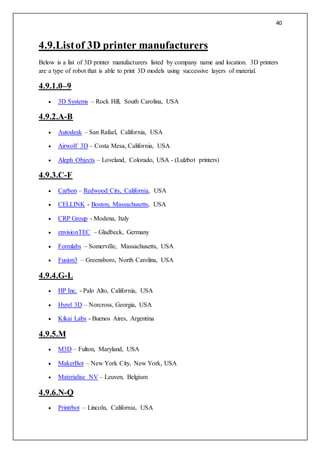
4.9.Listof 3D printer manufacturers
Below is a list of 3D printer manufacturers listed by company name and location. 3D printers
are a type of robot that is able to print 3D models using successive layers of material.
4.9.1.0–9
 3D Systems – Rock Hill, South Carolina, USA
4.9.2.A-B
 Autodesk – San Rafael, California, USA
 Airwolf 3D – Costa Mesa, California, USA
 Aleph Objects – Loveland, Colorado, USA - (Lulzbot printers)
4.9.3.C-F
 Carbon – Redwood City, California, USA
 CELLINK - Boston, Massachusetts, USA
 CRP Group - Modena, Italy
 envisionTEC – Gladbeck, Germany
 Formlabs – Somerville, Massachusetts, USA
 Fusion3 – Greensboro, North Carolina, USA
4.9.4.G-L
 HP Inc. - Palo Alto, California, USA
 Hyrel 3D – Norcross, Georgia, USA
 Kikai Labs - Buenos Aires, Argentina
4.9.5.M
 M3D – Fulton, Maryland, USA
 MakerBot – New York City, New York, USA
 Materialise NV – Leuven, Belgium
4.9.6.N-Q
 Printrbot – Lincoln, California, USA
41
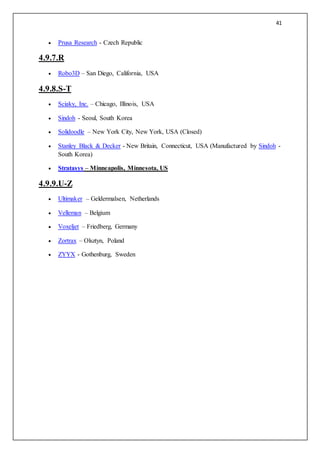
 Prusa Research - Czech Republic
4.9.7.R
 Robo3D – San Diego, California, USA
4.9.8.S-T
 Sciaky, Inc. – Chicago, Illinois, USA
 Sindoh - Seoul, South Korea
 Solidoodle – New York City, New York, USA (Closed)
 Stanley Black & Decker - New Britain, Connecticut, USA (Manufactured by Sindoh -
South Korea)
 Stratasys – Minneapolis, Minnesota, US
4.9.9.U-Z
 Ultimaker – Geldermalsen, Netherlands
 Velleman – Belgium
 Voxeljet – Friedberg, Germany
 Zortrax – Olsztyn, Poland
 ZYYX - Gothenburg, Sweden
42
4.10.WORLDBEST 3D PRINTER
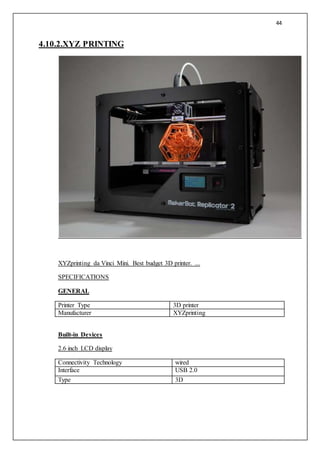
4.10.1.MakerBot Replicator
PrintTechnology FusedDepositionModeling
BuildVolume 28.5L X15.3 W X 15.5 H CM
[11.2 X 6.0 X 6.1 IN]
Layer Resolution 100 Microns[0.0039 IN]
PositioningPrecision XY: 11 Microns [0.0004 IN]
Z: 2.5 Microns [0.001 IN]
FilamentDiameter 1.75MM [0.069 IN]
Nozzle Diameter 0.4MM [0.015 IN]
MECHANICAL SPECIFICATIONS
Chassis PowderCoatedSteel
Body PVCPanels
[9.8 X 6.3 X 5.9 IN]
BuildPlatform Acrylic
XYZ Bearings Wear-resistant,oil-infusedbronze
StepperMotors 1.8o
Stepangle with1/16 micro-
stepping
DIMENSIONS
Productwithoutspool 49 (L) X 32 (W) X 38 (H) CM
[19.1 X 12.8 X 14.7 IN]
Productwithspool 49 (L) X (42 (W) X 38 (H) CM
[19.1 X 16.5 X 14.7 IN]
ShippingDimensions 59 (L) X 55 (W) X 43 (H) CM
[23 X 21.5 X 17 IN]
43
ProductWeight 11.5 KG [25.4 LBS]
ShippingWeight 16.8 KG [37.0 LBS]
SOFTWARE
YOUTUBE VIDEO
https://youtu.be/EomLOykZhms
Software Bundle MakerBot MakerWare
File Types STL, OBJ,THING
OperatingSystems Windows(XP32-bit/7+)
MAC OS X (10.6+)
Linux (Ubuntu12.04+)
Connectivity USB, SD Card (Bothincluded)
44
4.10.2.XYZ PRINTING
XYZprinting da Vinci Mini. Best budget 3D printer. ...
SPECIFICATIONS
GENERAL
Printer Type 3D printer
Manufacturer XYZprinting
Built-in Devices
2.6 inch LCD display
Connectivity Technology wired
Interface USB 2.0
Type 3D
45
MISCELLANEOUS
Color Category orange, white
CARD READER
Type card reader
Supported Flash Memory Cards SD Memory Card
SYSTEM REQUIREMENTS
OS Required Apple MacOS X 10.8 or later, Microsoft
Windows 7 or later
DOCUMENT & MEDIA HANDLING
Media Type Class other
Media Size Class Other
HEADER
Brand XYZprinting
Product Line XYZprinting da Vinci
Model Jr. 1.0
Packaged Quantity 1
Compatibility Mac, PC
OFFICE MACHINE
Type 3D printer
Functions 3D printer
INTERFACE REQUIRED
Connector Type 4 pin USB Type B
Type USB 2.0
Total Qty 1
DIMENSIONS & WEIGHT (SHIPPING)
Width (Shipping) 21.5 in
Depth (Shipping) 22.9 in
Height (Shipping) 18.7 in
Weight (Shipping) 33.1 lbs
46
3D PRINTER
Technology Fused Filament Fabrication (FFF)
Build Materials Supported polylactide (PLA)
Resolution 0.004 in - 0.02 in
Max Build Size 5.91 in x 5.91 in x 5.91 in
Input File Formats Supported 3w, STL
Filament Diameter 0.1 in
DIMENSIONS & WEIGHT
Width 16.5 in
Depth 16.9 in
Height 15 in
PC CONNECTIVITY
PC Connection USB 2.0
SYSTEM REQUIREMENTS DETAILS
Min RAM Size 4 GB
GENERAL
Manufacturer XYZprinting
YOUTUBE VIDEO
https://www.youtube.com/watch?v=s9XaPPD0qUA
47
4.11.ROLEOF CAD CAM
4.11.1.ROLE OF CAD/CAM IN DESIGNING, DEVELOPING
AND MANUFACTURING OF NEW PRODUCTS
Smart CAD/CAM technologies for superior product modeling in the intelligence of designing
complete product variants become more and more pertinent in future. Many design
techniques to help interdisciplinary design actions in different engineering domains in
addition to consequent processes have to be developed. A necessary job to achieve this aim is
to permanently investigate the present state of the art, emerging trends, new approaches, in
addition to industrial problems and requirements about the entire CAD/CAM area. With the
aim of direct future research and development activities as close as possible to the
continuously rising requirements of a worldwide market we carried out a wide-ranging
national study in cooperation with one of the Germans leading CAD/CAM magazines. In this
way, it became possible to reach a representative amount of users, to obtain their experience
based assessments on today’s most important aspects of CAD/CAM technology. The results
of this examination are summarized in this paper to give system developers, engineers, and
researchers an overview of the present condition as well as to serve as a direction for decision
makers in the Design and Development areas. Keywords: CAD/CAM; CIM; CAPP; Product
development; Design and Manufacture.
4.11.1.1. INTRODUCTION
In a globally competitive environment, time compression strategies in product development
are of critically importance. Certain products have long development cycle times. Examples
are aircraft and automobiles. In some of the products like computers, technological
obsolescence puts a constraint on the product development time. As soon as a new
microprocessor is released in the market, the manufacturers of the computers via with each
other to market computers based on the new processor. Frequent releases of newer and newer
microprocessors have consistently narrowed down the product life cycle of computers. The
pursuit of excellence in performance has resulted in new technologies being developed in
entertainment electronics. The life cycle of entertainment electronic products is thus reduced,
thereby necessitating new products being delivered to the market at reduced intervals.
The time compression in product development has also necessitated:
Avoidance of design errors, rework of componentsand tooling,
Better data management,
 Improved supply chain management,
 Attaining higher and higher levels of performance,
48
 Providing quality levels superior to what is offered
 by competitors, Above all supplying the product at the lowest
 possible cost.
4.11.1.2. STAGES IN PRODUCT DEVELOPMENT
The need to be right first time every time has changed the approach to design. The initial
phase of design consists of conceptual design, design analysis and performance simulation.
The phase is highly iterative as shown in fig. 1. The techniques like concurrent engineering,
failure mode and effect analysis etc., are used to ensure a reliable and quality design at this
stage. This is followed by detailed design, tool design, prototype manufacture and evaluation
and documentation. (Fig. 2) The next phase of product development involved second phase
of engineering where the design may be further refined. Here focus is on manufacturing
planning, data management, supply chain management and manufacture.
3.3 Rapid Prototyping Rapid Prototyping technology is being more widely employed to
verify and improve designs, rapid tooling as well as initial prototypes.
4.11.1.3. PRODUCT DEVELOPMENT AND MANUFACTURE
CAD/CAM as an enabling technology for product development and manufacture
Developments in computers and software relating to CAD/CAM have made CAD/CAM an
indispensable enabling technology for time compression in product development. This is
made possible by an integrated approach to carry out different activities in product
development through seamless data transfer. (Fig. 3) CAD/CAM technologies help to
simulate and the manufacturing methodologies in the following ways: 3.1 Assemble Analysis
With the help of today’s CAD/CAM technology, design team can work in a top down and
bottom up manner to create a complete electronic product mock up. Once an assembly is
completed, solids based kinematic analysis can be used to simulate complex motions of
mechanisms as well to carry out tolerance analysis. 3.2 CAD/CAM in Aid to Manufacture
through Better Tool Design and Optimize Manufacturing Processes Manufacturing
simulation uses a set of powerful CAD/Cam tools which seek to create virtual manufacturing
environment. Many uncertainties which may result in time delay, rework or production of
defective parts can be eliminated through simulation or manufacturing, whether it is CNC
machining, plastic injection moulding, casting, forging or welding. 3.3 Rapid Prototyping
Rapid Prototyping technology is being more widely employed to verify and improve designs,
rapid tooling as well as initial prototypes. Fig. 3: CAD/CAM Database 3.4 Agile
Manufacturing Agile Manufacturing is oriented in the direction of high mix/ low volume,
flexibility and adding velocity in the production process. It applies to
environmentssomewhere configurable, customized, or dedicated orders, suggest a
competitive improvement. Consequently, that manufacturing has been one of most important
49
strategies of new enterprises. In the atmosphere of the market ongoing to vary the quality,
speed, quick responds, at very low cost by improving its agility of the manufacturing firm. A
task of several highly developed technologies in Agile Manufacturing atmosphere has been
examined through a few researchers. A number of them comprise computeraided design,
CIM, computer-aided manufacturing, IT, computer-aided process planning (CAPP). A small
number of papers coverage the researchers investigative the integration of such highly
developed technologies in Agile Manufacturing environment. 3.5 Agile Manufacturing
Conception and Enabling Technologies Even though there are many definitions of Agile
Manufacturing brought out as a result of the researchers, the most familiar definition is, Agile
Manufacturing is the ability of a manufacturing association to manufacture a range of
products contained by a short period of time also in a cost effectiveness approach. Agile
Manufacturing is an idea to standardize general manufacturing data, CAD/ CAM structure,
research data, and join together them into a network. a standardized research data base and a
general manufacturing data base are very critical for agility and can considerably decrease
planning period and the product design period.
Characteristics of Agile Manufacturing
There are many characteristics of agile manufacturing such as show in following: Rapid new
product development,
 Short lead times, cycle times,
 Use of superior CAD/CAM,
 Modular design and technology,
 highly flexible machines and equipment,
 Short and fast order processing,
 Fast supplier deliveries,
 Very Short time to market,
 Short guide times and short cycle times,
 Highly flexible and responsive processes,
 Modular assembly,
 Use of Solids model.
50
Mold Industry
In recent machinery manufacturing industry, mold industry has developed into the beginning
industry for national financial system. Several innovative product development and
production relies deeply on mold manufacturing expertise, especially in the light industry,
automotive industry, and aerospace and electronics industries. The capability of mold
manufacturing and stage of consequent technique has turn out to be a significant pointer of a
nation’s level of mechanical manufacturing technique. It straight affects several sectors of the
nation’s economy. Mold CAM/ CAD is developed from the origin brought concerning by the
self-governing development of mold CAM and mold CAD. It is a novel jump in the wide-
ranging application of mold manufacturing and computer technology. The fast development
of CAD/CAM technology and the further development of software and hardware level
provided well-built technical support for mold industry and brought a jump on the quality of
production level, endeavor product design and manufacturing. It has become the best option
for a modern enterprise networking, integration and information. 3.8 Mold CAD/CAM
Design Flow By means of the rapid development of manufacturing technology and computer
technology there are growing concerns on how to shorten machining production period and
mold design time and to enhance manufacturing quality. Mold technology is also migrating
regularly from manual design, relying on manual knowledge and ordinary machine
processing skill to mold computer-aided design, aided engineering and aided manufacturing
technology. The US has pioneered implementing computer technology on mold
industry,realizing mold CAD/CAE/CAM incorporated system and achieving purposes of
enhancing mold manufacture quality, boosting production period and design effectiveness.
4.11.1.4. CONCLUSIONS
This paper concluded the results of a study relating to advanced CAD/CAM technologies in
respect to product development and manufacture. This paper presented the present
methodologies are being used and the future oriented methodologies will be preferred.
CAD/CAM users as well as designers have been asked to rate several smart CAD/CAM
technologies in respect to product development and manufacture. Furthermore, problems in
reverence to the consciousness of product variant design have been discussed. The Constant
development of product design and manufacturing increasingly inflict impacts upon smart
CAD/CAM technologies, proposing greater requirements for the research on and growth of
CAD/CAM.
51
52
5.SCAFOLDING
Scaffolding, also called scaffoldor staging, is astructure made for temporary use,used to
support a work crew and materials to aid in the construction, maintenance and repair of
buildings, bridges and all other man made structures. Scaffolds are mostly used on site to get
access to heights and areas that would be otherwise hard to get to. Unsafe scaffolding and
lack of strength has the potential to result in death or serious injury. Scaffolding is also used
in adapted forms for formwork and shoring, grandstand seating, concert stages,
access/viewing towers, exhibition stands, ski ramps, half pipes and art projects.
There are five main types of scaffolding used worldwide today. These are tubes and
coupler (fitting) components, prefabricated modular system scaffold components, H-frame /
facade modular system scaffolds, timber scaffolds and bamboo scaffolds (particularly in
China).
Each type is made from various components which includes:
 A base jack or plate which is a load-bearing base for the scaffold.
 The standard, the upright component with connector joins.
 The ledger, a horizontal brace.
 The transom, a horizontal cross-section load-bearing component which holds the batten,
board, or decking unit.
 Brace diagonal and/or cross section bracing component.
 Batten or board decking component used to make the working platform.
 Coupler, a fitting used to join components together.
 Scaffold tie, used to tie in the scaffold to structures.
 Brackets, used to extend the width of working platforms.
Specialized components used to aid in their use as a temporary structureinclude heavy duty
load bearing transoms, ladders or stairway units for the ingress and egress of the scaffold,
beams ladder/unit types used to span obstacles and rubbish chutes used to remove unwanted
materials from the scaffold or construction project.
5.1.INTRODUCTION
The European Standard, BS EN 12811-1, specifies performance requirements and methods of
structural and general design for access and working scaffolds. Requirements given are for
scaffold structures that rely on the adjacent structures for stability. In general these
requirements also apply to other types of working scaffolds.
The purpose of a working scaffold is to provide a safe working platform and access suitable
for work crews to carry out their work. The European Standard sets out performance
requirements for working scaffolds. These are substantially independent of the materials of
which the scaffold is made. The standard is intended to be used as the basis for enquiry and
design.
5.1.1.Materials
The basic components of scaffolding are tubes, couplers and boards.
53
Extensive scaffolding on a building in downtown Cincinatti,Ohio. This type of scaffolding is
called pipe staging.
Assembly of bamboo scaffolding cantilevered over a Hong Kong street.
The basic lightweight tube scaffolding that became the standard and revolutionised
scaffolding, becoming the baseline for decades, was invented and marketed in year of mid-
1950s. With one basic 24 pound unit a scaffold of various sizes and heights could be
assembled easily by a couple of labourers without the nuts or bolts previously needed.
Tubes are usually made either of steel or aluminium, although there is composite scaffolding,
which uses filament-wound tubes of glass fiber in a nylon or polyster matrix, because of the
high cost of composite tube, it is usually only used when there is a risk from overhead electric
cables that cannot be isolated. If steel, they are either 'black' or galvanised. The tubes come in
a variety of lengths and a standard diameter of 48.3 mm. (1.5 NPS pipe). The chief difference
between the two types of metal tubes is the lower weight of aluminium tubes (1.7 kg/m as
opposed to 4.4 kg/m). However they are more flexible and havelow resistance to stress.
Tubes are generally bought in 6.3 m lengths and can then be cut down to certain typical sizes.
Most large companies will brand their tubes with their name and address in order to deter
theft.
Boards provide a working surface for scaffold users. They are seasoned wood and come in
three thicknesses (38 mm, 50 mm and 63 mm) are a standard width (225 mm) and are a
maximum of 3.9 m long. The board ends are protected either by metal plates called hoop
irons or sometimes nail plates, which often have the company name stamped into them.
Timber scaffold boards in the UK should comply with the requirements of BS 2482. As well
as timber, steel or aluminium decking is used, as well as laminate boards. In addition to the
boards for the working platform, there are sole boards which are placed beneath the
scaffolding if the surface is soft or otherwise suspect, although ordinary boards can also be
used. Another solution, called a scaffpad, is made from a rubber base with a base plate
54
moulded inside; these are desirable for use on uneven ground since they adapt, whereas sole
boards may split and have to be replaced.
A short section of steel scaffold tube.
Couplers are the fittings which hold the tubes together. The most common are called scaffold
couplers, and there are three basic types: right-angle couplers, putlog couplers and swivel
couplers. To join tubes end-to-end joint pins (also called spigots) or sleeve couplers are used.
Only right angle couplers and swivel couplers can be used to fix tube in a 'load-bearing
connection'. Single couplers are not load-bearing couplers and have no design capacity.
Other common scaffolding components include base plates, ladders, ropes, anchor ties, reveal
ties, gin wheels, sheeting, etc. Most companies will adopt a specific colour to paint the
scaffolding with, in order that quick visual identification can be made in case of theft. All
components that are made from metal can be painted but items that are wooden should never
be painted as this could hide defects. Despite the metric measurements given, many
scaffolders measure tubes and boards in imperial units, with tubes from 21 feet down and
boards from 13 ft down.
Bamboo scaffolding is widely used in Hong Kong and Macau with nylon straps tied into
knots as couplers. In India, bamboo or other wooden scaffolding is also mostly used, with
poles being lashed together using ropes made from coconut hair.
5.2.Basicscaffolding
The key elements of the scaffolding are the standard, ledger and transoms. The standards,
also called uprights, are the vertical tubes that transfer the entire mass of the structure to the
ground where they rest on a square base plate to spread the load. The base plate has a shank
in its centre to hold the tube and is sometimes pinned to a sole board.Ledgers are horizontal
tubes which connect between the standards. Transoms rest upon the ledgers at right
angles. Main transoms are placed next to the standards, they hold the standards in place and
provide support for boards; intermediate transoms are those placed between the main
transoms to provide extra support for boards. In Canada this style is referred to as "English".
"American" has the transoms attached to the standards and is used less but has certain
advantages in some situations. Since scaffolding is a physical structure, it is possible to go in
and come out of scaffolding.
55
Scaffolding in Moscow.
As well as the tubes at right angles there are cross braces to increase rigidity, these are placed
diagonally from ledger to ledger, next to the standards to which they are fitted. If the braces
are fitted to the ledgers they are called ledger braces. To limit sway a facade brace is fitted to
the face of the scaffold every 30 metres or so at an angle of 35°-55° running right from the
base to the top of the scaffold and fixed at every level.
Of the couplers previously mentioned, right-angle couplers join ledgers or transoms to
standards, putlog or single couplers join board bearing transoms to ledgers. Non-board
bearing transoms should be fixed using a right-angle coupler. Swivel couplers are to connect
tubes at any other angle. The actual joints are staggered to avoid occurring at the same level
in neighbouring standards.
Basic scaffold dimensioning terms. No boards, bracing or couplers shown
The spacings of the basic elements in the scaffold are fairly standard. For a general purpose
scaffold the maximum bay length is 2.1 m, for heavier work the bay size is reduced to 2 or
even 1.8 m while for inspection a bay width of up to 2.7 m is allowed.
The scaffolding width is determined by the width of the boards, the minimum width
allowed is 600 mm but a more typical four-board scaffold would be 870 mm wide from
standard to standard. More heavy-duty scaffolding can require 5, 6 or even up to 8 boards
width. Often an inside board is added to reduce the gap between the inner standard and the
structure.
The lift height, the spacing between ledgers, is 2 m, although the base lift can be up to 2.7 m.
The diagram above also shows a kicker lift, which is just 150 mm or so above the ground.
56
Transom spacing is determined by the thickness of the boards supported, 38 mm boards
require a transom spacing of no more than 1.2 m while a 50 mm board can stand a transom
spacing of 2.6 m and 63 mm boards can have a maximum span of 3.25 m. The minimum
overhang for all boards is 50 mm and the maximum overhang is no more than 4x the
thickness of the board.
5.3.Foundations
Good foundations are essential. Often scaffold frameworks will require more than simple
base plates to safely carry and spread the load. Scaffolding can be used without base plates on
concrete or similar hard surfaces, although base plates are always recommended. For surfaces
like pavements or tarmac base plates are necessary. For softer or more doubtful surfaces sole
boards must be used, beneath a single standard a sole board should be at least 1,000 square
centimetres (160 in2) with no dimension less than 220 millimetres (8.7 in), the thickness must
be at least 35 millimetres (1.4 in). For heavier duty scaffold much more substantial baulks set
in concrete can be required. On uneven ground steps must be cut for the base plates, a
minimum step size of around 450 millimetres (18 in) is recommended. A working platform
requires certain other elements to be safe. They must be close-boarded, have double guard
rails and toe and stop boards. Safe and secure access must also be provided.
57
5.4.Fabricationof TissueEngineering Scaffolds
using Rapid PrototypingTechniques
Rapid prototyping (RP) techniques are a group of advanced manufacturing processes that can
produce custom made objects directly from computer data such as Computer Aided Design
(CAD), Computed Tomography (CT) and Magnetic Resonance Imaging (MRI) data. Using
RP fabrication techniques, constructs with controllable and complex internal architecture
with appropriate mechanical properties can be achieved. One of the attractive and promising
utilization of RP techniques is related to tissue engineering (TE) scaffold fabrication. Tissue
engineering scaffold is a 3D construction that acts as a template for tissue regeneration.
Although several conventional techniques such as solvent casting and gas forming are
utilized in scaffold fabrication; these processes show poor interconnectivity and
uncontrollable porosity of the produced scaffolds. So, RP techniques become the best
alternative fabrication methods of TE scaffolds. This paper reviews the current state of the art
in the area of tissue engineering scaffolds fabrication using advanced RP processes, as well as
the current limitations and future trends in scaffold fabrication RP techniques.
58
6.Reference
1. https://prototechasia.com/en/?gclid=Cj0KCQiA84rQBRDCARIsAPO8RFyw7Pltp65j
2q2OxV1hKwP9hxDLv9MGUwykw0kFy_f5eejiZBh_HfUaAo5jEALw_wcB
2. https://en.wikipedia.org/wiki/Advanced_manufacturing
3. https://en.wikipedia.org/wiki/Rapid_prototyping
4. http://www.efunda.com/processes/rapid_prototyping/intro.cfm
5. http://www.alibaba.com/product-detail/Large-And-Heavy-Rapid-Prototype-
Machining_60626636144.html?spm=a2700.7735674.35.8.673efb1bI2r7f7&s=p
6. https://en.wikipedia.org/wiki/3D_printing
7. https://en.wikipedia.org/wiki/List_of_3D_printed_weapons_and_parts
8. https://en.wikipedia.org/wiki/List_of_3D_printer_manufacturers
9. http://www.alibaba.com/premium/ultimaker_2.html?src=sem_ggl&cmpgn=89671769
5&adgrp=44699156557&fditm=&tgt=aud-362622410597:kwd-
493094105232&locintrst=&locphyscl=9061783&mtchtyp=p&ntwrk=g&device=c&d
vcmdl=&creative=210998561663&plcmnt=&plcmntcat=&p1=&p2=&aceid=&positio
n=1t1&gclid=Cj0KCQiA84rQBRDCARIsAPO8RFzvYBmToFkxHZU_TWVLNj_V
d_v1JkKn0DgqfvQWuc39UpjpNTC7TSYaAg73EALw_wcB
10. https://www.google.co.in/url?sa=t&rct=j&q=&esrc=s&source=web&cd=4&cad=rja&
uact=8&ved=0ahUKEwjehp6hyK7XAhWLK48KHYbGB50QFgg5MAM&url=https
%3A%2F%2Fwww.cnet.com%2Fproducts%2Fxyzprinting-da-vinci-jr-3d-
printer%2Fspecs%2F&usg=AOvVaw0KBWlrBX_wFmzFvq7Kvprm
11. http://esatjournals.net/ijret/2014v03/i06/IJRET20140306026.pdf
12. https://en.wikipedia.org/wiki/Scaffolding
13. http://waset.org/publications/2856/fabrication-of-tissue-engineering-scaffolds-using-
rapid-prototyping-techniques
14. http://www.sandia.gov/mst/pdf/LENS.pdf

Advance manufacturig technique1 copy

  • 1.
    1 ADVANCE MANUFACTURINGTECHNIQUE METALLURGY ANDMATERIALS ENGINEERING MNIT,JAIPUR PREPAREDBY: NIKUNJ PATEL
  • 2.
    2 INDEX TABLE 1.ADVANCE MANUFACTURINGTECHNIQUE.................................................................4 1.1.Classifications...................................................................................................................4 1.1.1. Product Technology................................................................................................4 1.1.2.Process Technology..................................................................................................5 2.RAPID PROTOTYPE.............................................................................................................9 2.1.Introduction.......................................................................................................................9 2.2.Why rapid prototype..........................................................................................................9 2.3.Methodology of Rapid prototype process.......................................................................10 2.4.History.............................................................................................................................10 2.5.Various technique used in Rapid prototypes are given below........................................11 2.6.The reasons of Rapid Prototyping are.............................................................................12 2.7.The trends in manufacturing industries continue to emphasize the following................12 2.8.Medical Applications of Rapid Prototyping....................................................................13 2.8.1.INTRODUCTION.....................................................................................................13 2.8.2. Steps in production of rapid prototyping models.....................................................13 2.8.3.PROTOTECH ASIA Company.................................................................................14 2.9.RAPID PROTOTYPE MACHINE.................................................................................16 3.LASER ENGINEERED NET SHAPING.............................................................................18 3.1.Method of LENS.............................................................................................................18 3.2.LENS and other techniques.............................................................................................18 3.2.1.Capabilities................................................................................................................19 3.2.2. Accomplishments.....................................................................................................20 4. 3-D PRINTING....................................................................................................................21 4.1.TERMINOLOGY............................................................................................................22 4.2.HISTORY........................................................................................................................23
  • 3.
    3 4.3.GENERAL PRINCIPLES...............................................................................................24 4.3.1.Modeling...................................................................................................................24 4.3.2.Printing......................................................................................................................25 4.3.3.Finishing....................................................................................................................26 4.4.PROCESS ANDPRINTERS..........................................................................................26 4.5.HEALTH AND SAFETY.......................................................................................................32 4.6.Health regulation.............................................................................................................33 4.7.BIO PRINTING..............................................................................................................33 4.8.1.PROCESS IN BIOPRINTING..................................................................................33 4.8.List of common 3D test models......................................................................................35 4.9.List of 3D printer manufacturers.....................................................................................40 4.10.WORLD BEST 3D PRINTER......................................................................................42 4.11.1.MakerBot Replicator...............................................................................................42 4.11.2.XYZ PRINTING.....................................................................................................44 4.11.ROLE OF CAD CAM...................................................................................................47 5.SCAFOLDING......................................................................................................................52 5.1.INTRODUCTION...........................................................................................................52 5.2.Basic scaffolding.............................................................................................................54 5.3.Foundations.....................................................................................................................56 5.4.Fabrication of Tissue Engineering Scaffolds using Rapid Prototyping Techniques.......57 6.Reference...............................................................................................................................58
  • 4.
    4 1.ADVANCE MANUFACTURING TECHNIQUE It isthe use of innovative technology to improve product or process. It is different from conventional manufacturing process in terms of number of uses, accuracy, quality and also in terms of quantity. The rate of technology adoption and ability to use that technology to remain competitive and add quality value to product defines company's level in manufacturing sector. Advance manufacturing is defined as: Advanced manufacturing centers upon improving the performance of US industry through the innovative application of technologies, processes and methods to product design and production. Finally, several sources pointed out that any definition of advanced manufacturing will need to change with the changing times, and that the definition will vary for different companies and for different industries due to different mentality. The term "advanced manufacturing" encompasses many of the developments in the manufacturing field during the late 20th and early 21st centuries, including high technological products and processes and clean, green, and flexible manufacturing, among others. No one definition captures everything said about advanced manufacturing, although the majority of definitions found on the web include the use of innovative technology to improve products and/or processes, and many also include the use of new business/management methodologies. Accordingly, the definition that probably comes closest to being comprehensive is that given by Paul Fowler of the National Association of Advanced Manufacturing (NACFAM), celebrating its 20th anniversary this year: "The Advanced Manufacturing entity makes extensive use of computer, high precision, and information technologies integrated with a high performance workforce in a production system capable of furnishing a heterogeneous mix of products in small or large volumes with both the efficiency of mass production and the flexibility of custom manufacturing in order to respond quickly to customer demands." 1.1.Classifications: Addvance manufacturing technique can be classified as two types: First one is Product Technology and Process Technology: 1.1.1. Product Technology: 1.1 Products with high levels of design
  • 5.
    5 1.2 Technologically complexproducts 1.3 Innovative products 1.4 Reliable, affordable, and available products 1.5 Newer, better, more exciting products 1.6 Products that solve a variety of society's problems 1.1.2.Process Technology: 2.1 Computer technologies (e.g., CAD, CAE, CAM) 2.2 High Performance Computing (HPC) for modeling, simulation and analysis
  • 6.
    6 2.3 Rapid prototyping(additive manufacturing) 2.4 High Precision technologies 2.5 Information technology 2.6 Advanced robotics and other intelligent production systems
  • 7.
    7 2.7 Automation 2.8 Controlsystems to monitor processes
  • 8.
    8 2.9 Sustainable andgreen processes and technologies 2.10 New industrial platform technologies 2.11 Ability to custom manufacture 2.12 Ability to manufacture high or low volume 2.13 High rate of manufacturing
  • 9.
    9 2.RAPID PROTOTYPE: 2.1.Introduction: Rapid prototypingis a group of techniques used to quickly fabricate a scale model of a physical part or assembly using three-dimensional Computer aided design data. Construction of the part or assembly is usually done using 3D printing or "additive layer manufacturing" technology. The first methods for rapid prototyping became available in the late 1980s and were used to produce model and prototype parts. Today, they are used for a wide range of applications and are used to manufacture production-quality parts in relatively small numbers if desired without the typical unfavorable short-run economics. This economy has encouraged online service bureaus. Historical surveys of RP technology start with discussions of simulacra production techniques used by 19th-century sculptors. Some modern sculptors use the progeny technology to produce exhibitions. The ability to reproduce designs from a dataset has given rise to issues of rights, as it is now possible to interpolate volumetric data from one- dimensional images. 2.2.Whyrapidprototype? The reasons of Rapid Prototyping are:- 1. To decrease development time. 2. To decrease costly mistakes. 3. To minimize sustaining engineering changes. 4. To extend product lifetime by adding necessary features and eliminating redundant features early in the design.
  • 10.
    10 Rapid Prototyping decreasesdevelopment time by allowing corrections to a product to be made early in the process. By giving engineering, manufacturing, marketing, and purchasing a look at the product early in the design process, mistakes can be corrected and changes can be made while they are still inexpensive. The trends in manufacturing industries continue to emphasize the following: 1. Increasing number of variants of products. 2. Increasing product complexity. 3. Decreasing product lifetime before obsolescence. 4. Decreasing delivery time. Rapid Prototyping improves product development by enabling better communication in a concurrent engineering environment. 2.3.Methodologyof Rapid prototypeprocess:- The basic methodology for all current rapid prototyping techniques can be summarized as follows: 1. A CAD model is constructed, then converted to STL format. The resolution can be set to minimize stair stepping. 2. The RP machine processes the STL file by creating sliced layers of the model. 3. The first layer of the physical model is created. The model is then lowered by the thickness of the next layer, and the process is repeated until completion of the model. 4. The model and any supports are removed. The surface of the model is then finished and cleaned. 2.4.History:- In the 1970s, Joseph Henry Condon and others at Bell labs developed the Unix Circuit Design System(UCDS), automating the laborious and error-prone task of manually converting drawings to fabricate circuit boards for the purposes of research and development. In the 1980s U.S. policy makers and industrial managers were forced to take note that America's dominance in the field of machine tool manufacturing evaporated, in what was named the machine tool crisis. Numerous projects sought to counter these trends in the traditional CNC CAM area, which had begun in the US. Later when Rapid Prototyping Systems moved out of labs to be commercialized it was recognized that developments were already international and U.S. rapid prototyping companies would not have the luxury of letting a lead slip away. The National science foundation was an umbrella for the National
  • 11.
    11 Aeronoutics and spaceAdministrations (NASA), the US Department of Energy, the US Department of Commerce NIST, the US Department of Defense, Defense Advanced Research Projects Agency(DARPA), and the Office of Naval Research coordinated studies to inform strategic planners in their deliberations. One such report was the 1997 Rapid Prototyping in Europe and Japan Panel Report[2] in which Joseph J. Beaman[8] founder of DTM Corporation [DTM RapidTool pictured] provides a historical perspective: “ The roots of rapid prototyping technology can be traced to practices in topography and photosculpture. Within TOPOGRAPHY Blanther (1892) suggested a layered method for making a mold for raised relief paper topographical maps .The process involved cutting the contour lines on a series of plates which were then stacked. Matsubara (1974) of Mitsubishi proposed a topographical process with a photo- hardening photopolymer resin to form thin layers stacked to make a casting mold. PHOTOSCULPTURE was a 19th-century technique to create exact three-dimensional replicas of objects. Most famously Francois Willeme (1860) placed 24 cameras in a circular array and simultaneously photographed an object. The silhouette of each photograph was then used to carve a replica. Morioka (1935, 1944) developed a hybrid photo sculpture and topographic process using structured light to photographically create contour lines of an object.The lines could then be developed into sheets and cut and stacked, or projected onto stock material for carving. The Munz(1956) Process reproduced a three-dimensional image of an object by selectively exposing, layer by layer, a photo emulsion on a lowering piston. After fixing, a solid transparent cylinder contains an image of the object. ” — Joseph J. Beaman[9] The technologies referred to as Solid Freeform Fabrication are what we recognize today as rapid prototyping, 3D printing or additive manufacturing: Swainson (1977), Schwerzel (1984) worked on polymerization of a photosensitive polymer at the intersection of two computer controlled laser beams. Ciraud (1972) considered magnetostatic or electrostatic deposition with electron beam, laser or plasma for sintered surface cladding. These were all proposed but it is unknown if working machines were built. Hideo Kodama of Nagoya Municipal Industrial Research Institute was the first to publish an account of a solid model fabricated using a photopolymer rapid prototyping system (1981).[2] Even at that early date the technology was seen as having a place in manufacturing practice. A low resolution, low strength output had value in design verification, mould making, production jigs and other areas. Outputs have steadily advanced toward higher specification uses.[10] Innovations are constantly being sought,to improve speed and the ability to cope with mass production applications.[11] A dramatic development which RP shares with related CNC areas is the freeware open-sourcing of high level applications which constitute an entire CAD- CAM toolchain. This has created a community of low res device manufacturers. Hobbyists have even made forays into more demanding laser-effected device designs.[12]
  • 12.
    12 2.5.Varioustechnique used inRapid prototypes are given below: 1. 3D printing (3DP) 2. Ballistic particle manufacturing (BPM) 3. Directed light fabrication (DLF) 4. Direct-shell production casting (DSPC) 5. Fused deposition modeling (FDM) 6. Laminated object manufacturing (LOM) 7. Shape deposition manufacturing (SDM) (and Mold SDM) 8. Solid ground curing (SGC) 9. Stereolithography (SL) 10. Selective laser sintering (SLS) 2.6.Thereasons of RapidPrototypingare: 1. To increase effective communication. 2. To decrease development time. 3. To decrease costly mistakes. 4. To minimize sustaining engineering changes. 5. To extend product lifetime by adding necessary features and eliminating redundant features early in the design. Rapid Prototyping decreases development time by allowing corrections to a product to be made early in the process. By giving engineering, manufacturing, marketing, and purchasing a look at the product early in the design process, mistakes can be corrected and changes can be made while they are still inexpensive. 2.7.Thetrends in manufacturing industriescontinue to emphasize the following: 1. Increasing number of variants of products. 2. Increasing product complexity. 3. Decreasing product lifetime before obsolescence. 4. Decreasing delivery time. Rapid Prototyping improves product development by enabling better communication in a concurrent engineering environment.
  • 13.
    13 2.8.Medical Applicationsof RapidPrototyping 2.8.1.INTRODUCTION RapidPrototyping is a promising powerful technology that has the potential to revolutionize certain spheres in the ever changing and challenging field of medical science. The process involves building of prototypes or working models in relatively less time to help create and test various ideas, concepts, design features, functionality and in certain instances outcome and performance. The technology is also known by several other names like digital fabrication, 3D printing, solid imaging, solid free form fabrication, layer based manufacturing, laser prototyping, free form fabrication, and additive manufacturing. The history of use of this technique can be traced back to sixties and its foundation credited to engineering Prof Herbert Voelcker who devised basic tools of mathematics that described the three dimensional aspects of the objects and resulted in the mathematical and algorithmic theories for solid modeling and fabrication. However the true impetus came in 1987 through the work of Carl Deckard, a university of Texas researcher who developed layered manufacturing and printed 3 D model by utilizing laser light for fusing the metal powder in solid prototypes, single layer at a time. The first patent of an apparatus for production of 3D objects by stereo lithography was awarded to Charles Hull whom many believe to be father of Rapid prototyping industry. Since its first use in industrial design process, Rapid prototyping has covered vast territories right form aviation sector to the more artful sculpture designing. The use of Rapid prototyping for medical applications although still in early days has made impressive strides. Its use in orthopedic surgery, maxillo-facial and dental reconstruction, preparation of scaffold for tissue engineering and as educational tool in fields as diverse as obstetrics and gynecology and forensic medicine to plastic surgery has now gained wide acceptance and is likely to have far reaching impact on how complicated cases are treated and various conditions taught in medical schools. 2.8.2. Steps in production of rapid prototyping models The various steps in production of an RP model include- 1. Imaging using CT scan or MRI scan 2. Acquisition of DIACOM files. 3. Conversion of DIACOM into. STL files. 4. Evaluation of the design 5. Surgical planning and superimposition if desired
  • 14.
    14 6. Additive Manufacturingand creation of model 7. Validation of the model. In short, the procedure involves getting a CT scan or MRI scan of the patient. It is preferable that the CT scan is of high slice caliber and that slice thickness is of 1- 2mm. Most of the MRI and CT software give output in form of digital imaging and communication in medicine format popularly known as DIACOM image format. 2.8.3.PROTOTECH ASIA Company Prototech Asia is a company specialising in rapid prototyping services and production of small series of plastic parts and metal parts (up to 200 units). Our prototypes let you validate a design, perform assembly testing or prepare the launch of a product. With many years in the sector of rapid prototyping services, we succeed to produce plastic rapid prototyping of the highest quality, both in terms of its technical functionality and its visual aesthetics. As experts in the plastic rapid prototyping field in China it is our mission to provide the best quality service and product. With our experience in rapid prototype and the manufacture of plastic prototypes as well as our presence in Asia, we are capable of delivering your plastic prototypes at competitive prices in just a few days.
  • 15.
    15 We have expertisein 4 major rapid prototyping technologies: 1. Steriolithography: Additive rapid prototyping technique that works very similarly to 3D printing. It makes quick production of 3D plastic parts possible using an equivalent material. The mastery of this technology allows for 3D parts with complex shapes. 2. CNC machining: Used by rapid prototyping services to ensure the production of visual and functional parts that are close to the series parts. This type of 3D prototype allows the validation of a concept or the performance of mechanical tests. 3. Vaccum casting: Allows the production of small series of plastic parts in a few days. The prototypes are obtained by injecting polyurethane material into a silicone mould. The grades and nuances obtained are similar to those with plastic injection. The principal advantage of vacuum duplication arises from the tooling that generates significant economies of scale. This technique is mainly used for plastic rapid prototyping. 4. Plastic injection: Process used to produce series parts. It requires an investment in a mould. In rapid prototyping, we create a simplified aluminium mould to lower the costs and decrease the time required. The visual and mechanical properties are identical to those of industrial parts. Prototech Asia is an expert in plastic rapid prototyping as close as possible to series production reality with parts made of the right material with the right finish. We offer our rapid prototyping services to many sectors that use plastic prototyping, such as automotive, electronics, medicine, aerospace, etc.
  • 16.
    16 2.9.RAPID PROTOTYPEMACHINE QUICK DETAILS CNCMachining or Not CNC Machining Type Broaching, Drilling, Etching / Chemical Machining, Laser Machining, Milling, Other Machining Services, Rapid Prototyping, Turning, Wire EDM Material Capabilities Aluminum, Brass, Bronze, Copper, Hardened Metals, Precious Metals, Stainless Steel, Steel Alloys Micro Machining or Not Not Micro Machining Place of Origin Fujian, China (Mainland) Model Number Custom-made Service Brand Name Openxi Keyword Large And Heavy Rapid Prototype Machining Max Machining Caoability 46000 X 8000 X 7000 mm Multi Hole Drilling Capability 13000 X 6000 mm Deeo Hole Drilling Capability Diameter 50.8 mm , Depth 1100mm Bending 15m Length ,100mm Depth Plate Rolling 4.1mm Width.300mm Depth Laser Cutting 2700mmX3500mm,70mm Depth Plasma Cutting 25000X 32000, 25 mm Depth Water-jet Cutting 8500mmX4010mm, 200 mm Depth Torch Cutting 18000mm X5000mm ,300mm Depth
  • 17.
    17 COMPANY PROFILE Business TypeManufacturer Main Products Meatal machining,Metal fabrication,Ferrous and non-ferrous alloy. Total Annual Revenue US$50 Million - US$100 Million Top 3 Markets Ocenia 50% North America 20% Eastern Europe 10% Location Fujian, China (Mainland) Total employees 501 - 1000 People Year established 2009
  • 18.
    18 3.LASER ENGINEERED NETSHAPING Laser Powder Forming, also known by the proprietary name Laser Engineered Net Shaping is an additive manufacturing technology developed for fabricating metal parts directly from a computer aided design(CAD) solid model by using a metal powder injected into a molten pool created by a focused, high-powered laser beam. This technique is also equivalent to several trademarked techniques that have the monikers Direct metal deposition (DMD), and Laser Consolidation (LC). Compared to processes that use powder beds, such as Selective Laser Melting (SLM) objects created with this technology can be substantially larger, even up to several feet long. 3.1.Methodof LENS A high power laser is used to melt metal powder supplied coaxially to the focus of the laser beam through a deposition head. The laser beam typically travels through the center of the head and is focused to a small spot by one or more lenses. The X-Y table is moved in raster fashion to fabricate each layer of the object. The head is moved up vertically after each layer is completed. Metal powders are delivered and distributed around the circumference of the head either by gravity, or by using a pressurized carrier gas. An inert shroud gas is often used to shield the melt pool from atmospheric oxygen for better control of properties, and to promote layer to layer adhesion by providing better surface wetting. 3.2.LENSand other techniques This process is similar to other 3D fabrication technologies in its approach in that it forms a solid component by the layer additive method. The LENS process can go from metal and metal oxide powder to metal parts, in many cases without any secondary operations. LENS is similar to selective laser sintering, but the metal powder is applied only where material is being added to the part at that moment. It can produce parts in a wide range of alloys, including titanium, stainless steel, aluminium, and other specialty materials; as well as composite and functionally graded materials. Primary applications for LENS technology include repair & overhaul, rapid prototyping, rapid manufacturing, and limited-run- manufacturing for aerospace, defense, and medical markets. Microscopy studies show the LENS parts to be fully dense with no compositional degradation. Mechanical testing reveals outstanding as-fabricated mechanical properties. The process can also make "near" net shape parts when it is not possible to make an item to exact specifications. In these cases post production process like light machining, surface finishing, or heat treatment may be applied to achieve end compliance. It is used as finishing operations. Sandia National Laboratories has developed a new technology to fabricate three-dimensional metallic components directly from CAD solid models. This process, called Laser Engineered Net Shaping (LENS), exhibits enormous potential to revolutionize the way in which metal parts, such as complex prototypes, tooling, and small-lot production items, are produced. The process fabricates metal parts directly from the Computer Aided Design (CAD) solid models using a metal powder injected into a molten pool created by a focused, high-powered laser
  • 19.
    19 beam. Simultaneously, thesubstrate on which the deposition is occurring is scanned under the beam or powder interaction zone to fabricate the desired cross-sectional geometry. Consecutive layers are sequentially deposited, thereby producing a three-dimensional metal component. This process is similar to other rapid prototyping technologies in its approach to fabricate a solid component by layer additive methods. However, the LENS technology is unique in that fully dense metal components are fabricated directly from raw materials, bypassing initial forming operations such as casting, forging, and rough machining. LENS offers the opportunity to dramatically reduce the time and cost required to realize functional metal parts. As a material additive process, additional cost savings will be realized through increased material utilization as compared to bulk removal processes. LENS can also be used to modify or repair existing hardware. Parts have been fabricated from stainless steel alloys, nickel-based alloys, tool steel alloys, titanium alloys, and other specialty materials: as well as composite and functionally graded material deposition. Microscopy studies show the LENS parts to be fully dense with no compositional degradation. Mechanical testing reveals outstanding as-fabricated mechanical properties. 3.2.1.Capabilities 1. Ability to build fully dense shapes 2. Closed loop control of process for accurate part fabrication 3. Ability to tailor deposition parameters to feature size for speed, accuracy, and property control 4. Composite and functionally graded material deposition 5. Three and four axis systems for complex part fabrication 6. Wide variety of materials that, at minimum, include: stainless steel alloys (316, 304L, 309, 17- 4), maraging steel (M300), nickel-based super alloys (Inco designations 625, 600, 718, 690), tool steel alloys (H13), titanium alloy (6Al- 4V), and other specialty materials 7. Mechanical properties similar or better than traditional processing methods resources 8. LENS (12" x 12" x 12") machine with 4-axis capability 9. Specialized path planning software for tailored processing (variable deposition parameters, smart path sequencing, multiple materials) 10. Closed loop control system to control the molten pool volume 11. CAD solid modeling 12. State of the art metrology laboratory including: coordinate measuring machine, video measuring system, and non-contact surface analyzer 13. Three dimensional laser digitizing system 14. Complete machine shop including: three-, four-, and five-axis computer numerical control (CNC) mills, CNC lathes, electrical discharge machines (wire and sinker), lathes, mills, and grinders
  • 20.
    20 3.2.2.Accomplishments 1. WES housinghybrid fabrication sequence: high aspect ratio features added by LENS to simple machined surfaces, allowed for quick turnaround of housing for design verification and testing 2. LENS precision deposition used to complete set of production Kovar braze fixtures to prevent diffusion bonding 3. Composite and functionally graded impeller to show geometric and composition precision in multi-material fabrication 4. Verification of mathematical model of cellular structure, enabling prediction of crush behavior (modes, etc.) 5. Rear load spreader with 95% improvement in material waste over conventional machining 6. Tooling for injection molding with conformal cooling channels to improve thermal characteristics in-use 7. Laser marking, with high strength bonding, on weapon components 8. Commercialization of the technology
  • 21.
    21 4. 3-D PRINTING 3Dprinting, also known as additive manufacturing (AM), refers to processes used to create a three dimensional object in which layers of material are formed under computer control to create an object. Objects can be of almost any shape or geometry and typically are produced using digital model data from a 3D model or another electronic data source such as an Additive Manufacturing File(AMF) file. Stereolithography(STL) is one of the most common file types that 3D printers can read. Thus, unlike material removed from a stock in the conventional machining process, 3D printing or AM builds a three-dimensional object from computer-aided design (CAD) model or AMF file by successively adding material layer by layer. The term "3D printing" originally referred to a process that deposits a binder material onto a powder bed with inkjet printer heads layer by layer. More recently, the term is being used in
  • 22.
    22 popular vernacular toencompass a wider variety of additive manufacturing techniques. United States and global technical standards use the official term additive manufacturing for this broader sense. 4.1.TERMINOLOGY The umbrella term additive manufacturing (AM) gained wide currency in the 2000s.The term subtractive manufacturing appeared as a retronym for the large family of machining processes with metal removal as their common theme. The term 3D printingstill referred only to the polymer technologies in most minds, and the term AM was likelier to be used in metalworking and end use part production contexts than among polymer, inkjet, or stereo lithography enthusiasts. By the early 2010s, the terms 3D printing and additive manufacturing evolved senses in which they were alternate umbrella terms for AM technologies, one being used in popular vernacular by consumer-maker communities and the media, and the other used more formally by industrial AM end-use part producers, AM machine manufacturers, and global technical standards organizations. Until recently, the term 3D printing has been associated with machines low-end in price or in capability. Both terms reflect that the technologies share the theme of sequential-layer material addition or joining throughout a 3D work envelope under automated control. Peter Zelinski, the editor-in-chief of Additive Manufacturing magazine, pointed out in 2017 that the terms are still often synonoums in casual usage but that some manufacturing industry experts are increasingly making a sense distinction whereby AM comprises 3D printing plus other technologies or other aspects of a manufacturing process. Other terms that have been used as AM synonyms or hypernyms have included desktop manufacturing, rapid manufacturing (as the logical production-level successor to rapid prototype), and on-demand manufacturing(which echoes on demand printing in the 2D sense of printing). That such application of the adjectives rapid and on-demand to the noun manufacturing was novel in the 2000s reveals the prevailing mental model of the long industrial era in which almost all production manufacturing involved long lead times for laborious tooling development. Today, the term subtractive has not replaced the term machining, instead complementing it when a term that covers any removal method is needed. Agile tooling is the use of modular means to design tooling that is produced by additive manufacturing or 3D printing methods, to enable quick prototyping and responses to tooling and fixture needs. Agile tooling uses a cost effective and high quality method to quickly respond to customer and market needs, and it can be used in hydro forming, stamping, injection moulding and other manufacturing processes.
  • 23.
    23 4.2.HISTORY Early additive manufacturingequipment and materials were developed in the 1980s.In 1981, Hideo kodama of Nagoya Municipal Industrial Research Institute invented two additive methods for fabricating three-dimensional plastic models with photo-hardening thermo set polymer, where the UV exposure area is controlled by a mask pattern or a scanning fiber transmitter. On July 16, 1984 Alain Le Méhauté, Olivier de Witte, and Jean Claude André filed their patent for the stereolithography process.The application of the French inventors was abandoned by the French General Electric Company (now Alcatel-Alsthom) and CILAS(The Laser Consortium).The claimed reason was "for lack of business perspective". Three weeks later in 1984, Chuck Hull of 3D system Corporation filed his own patent for a steriolithography fabrication system, in which layers are added by curing photopolymers with ultra-violet light laser. Hull defined the process as a "system for generating three-dimensional objects by creating a cross-sectional pattern of the object to be formed". Hull's contribution was the STL file format and the digital slicing and infill strategies common to many processes today. The technology used by most 3D printers to date—especially hobbyist and consumer- oriented models—is fused deposition moulding, a special application of plastic extrusion, developed in 1988 by S. Scott Crump and commercialized by his company Stratasys, which marketed its first FDM machine in 1992. The term 3D printing originally referred to a powder bed process employing standard and custom inkjet print heads, developed at MIT in 1993 and commercialized by Soligen Technologies, Extrude Hone Corporation, and Z Corporation. The year 1993 also saw the start of a company called Solidscap, introducing a high-precision polymer jet fabrication system with soluble support structures, (categorized as a "dot-on-dot" technique). AM processes for metal sintering or melting (such as selective laser sintering, direct metal laser sintering, and selective laser melting) usually went by their own individual names in the 1980s and 1990s. At the time, all metalworking was done by processes that we now call non- additive (casting, fabrication, stamping, and machining); although plenty of automation was applied to those technologies (such as by robot welding and CNC), the idea of a tool or head moving through a 3D work envelope transforming a mass of raw material into a desired shape layer by layer was associated in metalworking only with processes that removed metal (rather than adding it), such as CNC milling, CNC EDM, and many others. But the automated techniques that added metal, which would later be called additive manufacturing, were beginning to challenge that assumption. By the mid-1990s, new techniques for material deposition were developed at Stanford and Carnegie Mellon University, including microcasting and sprayed materials. Sacrificial and support materials had also become more common, enabling new object geometries.
  • 24.
    24 As the variousadditive processes matured, it became clear that soon metal removal would no longer be the only metal working process done through a tool or head moving through a 3D work envelope transforming a mass of raw material into a desired shape layer by layer. The 2010s were the first decade in which metal end use parts such as engine bracketsand large nutswould be grown (either before or instead of machining) in job production rather than obligately being machined from bar stock or plate. It is still the case that casting, fabrication, stamping, and machining are more prevalent than AM in metalworking, but AM is now beginning to make significant inroads, and with the advantages of desined for additive manufacturing, it is clear to engineers that much more is to come.As technology matured, several authors had begun to speculate that 3D printing could aid in sustainable development in the developing world. 4.3.GENERALPRINCIPLES 4.3.1.Modeling 3D printable models may be created with a computer aided design (CAD) package, via a 3D scanner, or by a plain digital camera and photogrammetry software. 3D printed models created with CAD result in reduced errors and can be corrected before printing, allowing verification in the design of the object before it is printed. CAD model used for 3D printing The manual modelling process of preparing geometric data for 3D computer graphics is similar to plastic arts such as sculpting. 3D scanning is a process of collecting digital data on the shape and appearance of a real object, creating a digital model based on it.
  • 25.
    25 4.3.2.Printing Time lapse videoof a hyperboloid object (designed by George W. Hart) made of PLA using a RepRap "Prusa Mendel" 3D printer for molten polymer deposition Before printing a 3D model from an STL file, it must first be examined for errors. Most CAD applications produce errors in output STL files: 1. holes. 2. faces normal 3. self-intersections 4. noise shells 5. manifold errors A step in the STL generation known as "repair" fixes such problems in the original model. Generally STLs that have been produced from a model obtained through 3D scanning often have more of these errors. This is due to how 3D scanning works-as it is often by point to point acquisition, reconstruction will include errors in most cases. Once completed, the STL file needs to be processed by a piece of software called a "slicer," which converts the model into a series of thin layers and produces a G code file containing instructions tailored to a specific type of 3D printer (FDM printers). This G-code file can then be printed with 3D printing client software (which loads the G-code, and uses it to instruct the 3D printer during the 3D printing process). Printer resolution describes layer thickness and X-Y resolution in dots per inch(dpi) or micrometers (µm). Typical layer thickness is around 100 µm (250 DPI),although some machines can print layers as thin as 16 µm (1,600 DPI). X-Y resolution is comparable to that of laser printers. The particles (3D dots) are around 50 to 100 µm (510 to 250 DPI) in diameter. Construction of a model with contemporary methods can take anywhere from several hours to several days, depending on the method used and the size and complexity of the model. Additive systems can typically reduce this time to a few hours, although it varies widely
  • 26.
    26 depending on thetype of machine used and the size and number of models being produced simultaneously. Traditional techniques like injection moulding can be less expensive for manufacturing polymer products in high quantities, but additive manufacturing can be faster, more flexible and less expensive when producing relatively small quantities of parts. 3D printers give designers and concept development teams the ability to produce parts and concept models using a desktop size printer. Seemingly paradoxic more complex objects can be cheaper for 3D printing production than less complex objects. 4.3.3.Finishing Though the printer-produced resolution is sufficient for many applications, printing a slightly oversized version of the desired object in standard resolution and then removing material with a higher-resolution subtractive process can achieve greater precision. Some printable polymers such as ABS, allow the surface finish to be smoothed and improved using chemical vapor processes based on acetone or similar solvents. Some additive manufacturing techniques are capable of using multiple materials in the course of constructing parts. These techniques are able to print in multiple colors and color combinations simultaneously, and would not necessarily require painting. Some printing techniques require internal supports to be built for overhanging features during construction. These supports must be mechanically removed or dissolved upon completion of the print. All of the commercialized metal 3D printers involve cutting the metal component off the metal substrate after deposition. A new process for the GMAW 3D printing allows for substrate surface modifications to remove aluminium and steel. 4.4.PROCESSAND PRINTERS A large number of additive processes are available. The main differences between processes are in the way layers are deposited to create parts and in the materials that are used. Each method has its own advantages and drawbacks, which is why some companies offer a choice of powder and polymer for the material used to build the object.Others sometimes use standard, off-the-shelf business paper as the build material to produce a durable prototype. The main considerations in choosing a machine are generally speed, costs of the 3D printer, of the printed prototype, choice and cost of the materials, and color capabilities.Printers that work directly with metals are generally expensive. However less expensive printers can be used to make a mold, which is then used to make metal parts.
  • 27.
    27 ISO/ASTM52900-15 defines sevencategories of Additive Manufacturing (AM) processes within its meaning: binder jetting, directed energy deposition, material extrusion, material jetting, powder bed fusion, sheet lamination, and vat photopolymerization. Some methods melt or soften the material to produce the layers. In Fused filament fabrications, also known as Fused deposition moulding(FDM), the model or part is produced by extruding small beads or streams of material which harden immediately to form layers. A filament of thermoplastic, metal wire, or other material is fed into an extrusion nozzle head (3D printer extruder), which heats the material and turns the flow on and off. FDM is somewhat restricted in the variation of shapes that may be fabricated. Another technique fuses parts of the layer and then moves upward in the working area, adding another layer of granules and repeating the process until the piece has built up. This process uses the unfused media to support overhangs and thin walls in the part being produced, which reduces the need for temporary auxiliary supports for the piece.Laser sintering techniques include selective laser sintering, with both metals and polymers, and direct metal laser sintering. Selective laser melting does not use sintering for the fusion of powder granules but will completely melt the powder using a high-energy laser to create fully dense materials in a layer-wise method that has mechanical properties similar to those of conventional manufactured metals. Electron beam melting is a similar type of additive manufacturing technology for metal parts (e.g. titanium alloys). EBM manufactures parts by melting metal powder layer by layer with an electron beam in a high vacuum.Another method consists of an inkjet 3D printing system, which creates the model one layer at a time by spreading a layer of powder (plaster, or resins) and printing a binder in the cross-section of the part using an inkjet-like process. With laminated object manufavturing, thin layers are cut to shape and joined together. Schematic representation of Stereolithography; a light-emitting device a) (laser or DLP) selectively illuminate the transparent bottom c) of a tank b) filled with a liquid photo- polymerizing resin; the solidified resin d) is progressively dragged up by a lifting platform e)
  • 28.
    28 Other methods cureliquid materials using different sophisticated technologies, such as sterio lithography. Photo polymerisation is primarily used in stereo lithography to produce a solid part from a liquid. Inkjet printer systems like the Objet Poly Jet system spray photopolymer materials onto a build tray in ultra-thin layers (between 16 and 30 µm) until the part is completed. Each photopolymer layer is cured with UV light after it is jetted, producing fully cured models that can be handled and used immediately, without post-curing. Ultra-small features can be made with the 3D micro-fabrication technique used in multi photon photo polymerisation. Due to the nonlinear nature of photo excitation, the gel is cured to a solid only in the places where the laser was focused while the remaining gel is then washed away. Feature sizes of under 100 nm are easily produced, as well as complex structures with moving and interlocked parts. Yet another approach uses a synthetic resin that is solidified using LEDs. In Mask-image-projection-based stereo lithography, a 3D digital model is sliced by a set of horizontal planes. Each slice is converted into a two-dimensional mask image. The mask image is then projected onto a photo curable liquid resin surface and light is projected onto the resin to cure it in the shape of the layer. Continuous liquid interface production begins with a pool of liquid photopymer resin. Part of the pool bottom is transparent to ultraviolet light (the "window"), which causes the resin to solidify. The object rises slowly enough to allow resin to flow under and maintain contact with the bottom of the object. In powder-fed directed-energy deposition, a high-power laser is used to melt metal powder supplied to the focus of the laser beam. The powder fed directed energy process is similar to Selective Laser Sintering, but the metal powder is applied only where material is being added to the part at that moment. As of October 2012, additive manufacturing systems were on the market that ranged from $2,000 to $500,000 in price and were employed in industries including aerospace, architecture, automotive, defence, and medical replacements, among many others. For example, General electric uses the high-end model to build parts for turbines. Many of these systems are used for rapid prototyping, before mass production methods are employed. Higher education has proven to be a major buyer of desktop and professional 3D printers which industry experts generally view as a positive indicator. Libraries around the world have also become locations to house smaller 3D printers for educational and community access. Several projects and companies are making efforts to develop affordable 3D printers for home desktop use. Much of this work has been driven by and targeted at DIY/Maker/enthusiast/early adopter communities, with additional ties to the academic and hacker communities.
  • 29.
    29 The Audi RSQwas made with rapid prototyping industrial KUKA robots. A Jet Engine turbine printed from the Howard Community college Makerbot. 3D printed enamelled pottery. 3D printed sculpture of the Egyptian Pharaoh Merankhre Mentuhotepshown at Threeding In the current scenario, 3D printing or AM has been used in manufacturing, medical, industry and socio cultural sectors which facilitate 3D printing or AM to become successful commercial technology. The earliest application of additive manufacturing was on the tool room end of the manufacturing spectrum. For example, rapid prototyping was one of the earliest additive variants, and its mission was to reduce the lead time and cost of developing prototypes of new parts and devices, which was earlier only done with subtractive tool room methods such as CNC milling, turning, and precision grinding. In the 2010s, additive manufacturing entered production to a much greater extent. Additive manufacturing of food is being developed by squeezing out food, layer by layer, into three-dimensional objects. A large variety of foods are appropriate candidates, such as chocolate and candy, and flat foods such as crackers, pasta, and pizza.
  • 30.
    30 3D printing hasentered the world of clothing, with fashion designers experimenting with 3D- printed bikinis, shoes, and dresses. In commercial production Nike is using 3D printing to prototype and manufacture the 2012 Vapour Laser Talon football shoe for players of American football, and New Balance is 3D manufacturing custom-fit shoes for athletes. 3D printing has come to the point where companies are printing consumer grade eyewear with on-demand custom fit and styling (although they cannot print the lenses). On-demand customization of glasses is possible with rapid prototyping. In cars, trucks, and aircraft, AM is beginning to transform both: (1) Unibody and fuselarge design and production and (2) Power train design and production. For example:  In early 2014, Swedish supercar manufacturer Koenigsegg announced the One:1, a supercar that utilizes many components that were 3D printed. Urbee is the name of the first car in the world car mounted using the technology 3D printing (its bodywork and car windows were "printed").  In 2014, Local motors debuted Strati, a functioning vehicle that was entirely 3D Printed using ABS plastic and carbon fiber, except the power train. In May 2015 Airbus announced that its new Air bus A350 XWB included over 1000 components manufactured by 3D printing.  In 2015, a Royal Air Force Eurofighter Typhoon fighter jet flew with printed parts. The United states Air Force has begun to work with 3D printers, and the Israeli Air Force has also purchased a 3D printer to print spare parts.  In 2017, GE aviation revealed that it had used design for additive manufacturing to create a helicopter engine with 16 parts instead of 900, with great potential impact on reducing the complexity of supply chains. AM's impact on firearms involves two dimensions: new manufacturing methods for established companies, and new possibilities for the making of do it yourseld firearms. In 2012, the US-based group Defence distributed disclosed plans to design a working plastic 3D printed firearm"that could be downloaded and reproduced by anybody with a 3D printer."After Defence Distributed released their plans, questions were raised regarding the effects that 3D printing and widespread consumer-level CNC machiningmay have on gun control effectiveness. Surgical uses of 3D printing-centric therapies have a history beginning in the mid-1990s with anatomical modelling for bony reconstructive surgery planning. Patient-matched implants were a natural extension of this work, leading to truly personalized implants that fit one unique individual. Virtual planning of surgery and guidance using 3D printed, personalized instruments have been applied to many areas of surgery including total joint replacement and
  • 31.
    31 craniomaxillofacial reconstruction withgreat success. One example of this is the bioresorbable trachial splint to treat newborns with tracheobronchomalacia developed at the University of Michigan. The use of additive manufacturing for serialized production of orthopedic implants (metals) is also increasing due to the ability to efficiently create porous surface structures that facilitate osseointegration. The hearing aid and dental industries are expected to be the biggest area of future development using the custom 3D printing technology. In March 2014, surgeons in Swansea used 3D printed parts to rebuild the face of a motorcyclist who had been seriously injured in a road accident. As of 2012, 3D bio printing technology has been studied by biotechnology firms and academia for possible use in tissue engineering applications in which organs and body parts are built using inkjet techniques. In this process, layers of living cells are deposited onto a gel medium or sugar matrix and slowly built up to form three-dimensional structures including vascular systems. Recently, a heart- on-chip has been created which matches properties of cells. In 2005, academic journals had begun to report on the possible artistic applications of 3D printing technology. As of 2012, domestic 3D printing was mainly practiced by hobbyists and enthusiasts. However, little was used for practical household applications, for example, ornamental objects. Some practical examples include a working clock and gears printed for home woodworking machines among other purposes. Web sites associated with home 3D printing tended to include backscratchers, coat hooks, door knobs, etc. 3D printing, and open source 3D printers in particular, are the latest technology making inroads into the classroom. Some authors have claimed that 3D printers offer an unprecedented "revolution" in STEM education. The evidence for such claims comes from both the low cost ability for rapid prototype in the classroom by students, but also the fabrication of low-cost high-quality scientific equipment from open hardware designs forming open-source labs.Future applications for 3D printing might include creating open- source scientific equipment. In the last several years 3D printing has been intensively used by in the cultural heritage field for preservation, restoration and dissemination purposes. Many Europeans and North American Museums have purchased 3D printers and actively recreate missing pieces of their relics. The Metropolitan Museum of Art and the British Museum have started using their 3D printers to create museum souvenirs that are available in the museum shops. Other museums, like the National Museum of Military History and Varna Historical Museum, have gone further and sell through the online platform threeding digital models of their artifacts, created using Artec 3D scanners, in 3D printing friendly file format, which everyone can 3D print at home. 3D printed soft actuators is a growing application of 3D printing technology which has found its place in the 3D printing applications. These soft actuators are being developed to deal with soft structures and organs especially in biomedical sectors and where the interaction between human and robot is inevitable. The majority of the existing soft actuators are fabricated by conventional methods that require manual fabrication of devices, post processing/assembly, and lengthy iterations until maturity in the fabrication is achieved. To avoid the tedious and
  • 32.
    32 time-consuming aspects ofthe current fabrication processes, researchers are exploring an appropriate manufacturing approach for effective fabrication of soft actuators. Thus, 3D printed soft actuators are introduced to revolutionise the design and fabrication of soft actuators with custom geometrical, functional, and control properties in a faster and inexpensive approach. They also enable incorporation of all actuator components into a single structure eliminating the need to use external joints, adhesives, and fasteners. 4.5.HEALTH AND SAFETY Research on the health and safety concerns of 3D printing is new and in development due to the recent proliferation of 3D printing devices. In 2017 the European Agency for Safety and Health at Work has published a discussion paper on the processes and materials involved in 3D printing, potential implications of this technology for occupational safety and health and avenues for controlling potential hazards. Most concerns involve gas and material exposures, in particular nano-materials, material handling, static electricity, moving parts and pressures. A National Institute for Occupational Safety and Health (NIOSH) study noted particle emissions from a fused filament peaked a few minutes after printing started and returned to baseline levels 100 minutes after printing ended. Emissions from fused filament printers can include a large number of ultrafine particles and volatile organic compound(VOCs). The toxicity from emissions varies by source material due to differences in size, chemical properties, and quantity of emitted particles. Excessive exposure to VOCs can lead to irritation of the eyes, nose, and throat, headache, loss of coordination, and nausea and some of the chemical emissions of fused filament printers have also been linked to asthma.Based on animal studies, carbon nanotubes and carbon nanofibres sometimes used in fused filament printing can cause pulmonary effects including inflamation, granulomas, and pulmonary fibrosis when at the nanoparticle size. Carbon nanoparticle emissions and processes using powder metals are highly combustible and raise the risk of dust explosions.At least one case of severe injury was noted from an explosion involved in metal powders used for fused filament printing.Other general health and safety concerns include the hot surface of UV lamps and print head blocks, high voltage, ultraviolet radiation from UV lamps, and potential for mechanical injury from moving parts. The problems noted in the NIOSH report were reduced by using manufacturer-supplied covers and full enclosures, using proper ventilation, keeping workers away from the printer, using respirators, turning off the printer if it jammed, and using lower emission printers and filaments. At least one case of severe injury was noted from an explosion involved in metal powders used for fused filament. Personal protective equipment has been found to be the least desirable control method with a recommendation that it only be used to add further protection in combination with approved emissions protection. Hazards to health and safety also exist from post-processing activities done to finish parts after they have been printed. These post-processing activities can include chemical baths,
  • 33.
    33 sanding, polishing, orvapor exposure to refine surface finish, as well as general suhstrative manufacturing techniques such as drilling, milling, or turning to modify the printed geometry. Any technique that removes material from the printed part has the potential to generate particles that can be inhaled or cause eye injury if proper personal protective equipment is not used, such as respirators or safety glasses. Caustic baths are often used to dissolve support material used by some 3D printers that allows them to print more complex shapes. These baths require personal protective equipment to prevent injury to exposed skin. 4.6.Healthregulation Although no occupational exposure limits specific to 3D printer emissions exist, certain source materials used in 3D printing, such as carbon nanofibres and carbon nanotubes, have established occupational exposure limits at the nanoparticle size. 4.7.BIO PRINTING 3D bioprinting is the process of creating cell patterns in a confined space using 3D printing technologies, where cell function and viability are preserved within the printed construct. Generally, 3D bioprinting utilizes the layer-by-layer method to deposit materials known as Bio-inks to create tissue-like structures that are later used in medical and tissue engineering fields. Bio-printing covers a broad range of materials. Currently, bioprinting can be used to print tissues and organs to help research drugs and pills. In addition, 3D bioprinting has begun to incorporate the printing of scaffolds. These scaffolds can be used to regenerate joints and ligaments. The first patent related to this technology was filed in the United States in 2003 and granted in 2006. 4.7.1.PROCESS IN BIOPRINTING 3D bioprinting generally follows three steps, pre-bioprinting, bioprinting, and post- bioprinting. 4.7.1.1.Pre-bioprinting Pre-bioprinting is the process of creating a model that the printer will later create and choosing the materials that will be used. One of the first steps is to obtain a biopsy of the organ. The common technologies used for bioprinting are computed tomography (CT) and magnetic resonance imaging (MRI). To print with a layer-by-layer approach, tomographic reconstruction is done on the images. The now-2D images are then sent to the printer to be made. Once the image is created, certain cells are isolated and multiplied. These cells are then mixed with a special liquefied material that provides oxygen and other nutrients to keep them alive. In some processes, the cells are encapsulated in cellular spheroids 500μm in diameter. This aggregation of cells does not require a scaffold, and are required for placing in the tubular-like tissue fusion for processes such as extrusion.
  • 34.
    34 4.7.1.2.Bioprinting In the secondstep, the liquid mixture of cells, matrix, and nutrients known as Bioinks are placed in a printer cartridge and deposited using the patients' medical scans.When a bioprinted pre-tissue is transferred to an incubator, this cell-based pre-tissue matures into a tissue 3D bioprinting for fabricating biological constructs typically involves dispensing cells onto a biocompatible scaffold using a successive layer-by-layer approach to generate tissue-like three-dimensional structures. Artificial organs such as livers and kidneys made by 3D bioprinting have been shown to lack crucial elements that affect the body such as working blood vessels, tubules for collecting urine, and the growth of billions of cells required for these organs. Without these components the body has no way to get the essential nutrients and oxygen deep within their interiors. Given that every tissue in the body is naturally compartmentalized of different cell types, many technologies for printing these cells vary in their ability to ensure stability and viability of the cells during the manufacturing process. Some of the methods that are used for 3D bioprinting of cells are photolithography, magnetic bioprinting, stereolithography, and direct cell extrusion. 4.7.1.3.Post-bioprinting The post-bioprinting process is necessary to create a stable structure from the biological material. If this process is not well-maintained, the mechanical integrity and function of the 3D printed object is at risk. To maintain the object, both mechanical and chemical stimulations are needed. These stimulations send signals to the cells to control the remodeling and growth of tissues. In addition, in recent development, bioreactor technologies have allowed the rapid maturation of tissues, vascularization of tissues and the ability to survive transplants. Bioreactors work in either providing convective nutrient transport, creating microgravity environments, changing the pressure causing solution to flow through the cells, or add compression for dynamic or static loading. Each type of bioreactor is ideal for different types of tissue, for example compression bioreactors are ideal for cartilage tissue.
  • 35.
    35 4.8.Listof common 3Dtest models Mo del na me Ye ar of cre ati on Creat or Origi n Mode l size (verti ces or trian gles) Crea tion meth od Inspi ratio n (if any) Link to model Comments 3DBe nchy 2015 Creative Tools Specifically designed for testing the accuracy and capabilities of 3D printers Arma dillo 1996 Stanford Universi ty 345,944 triangle s Scanne d Armadill o.ply.gz Armadillo toy. Asian Drag on Stanford Universi ty 3,609,4 55 vertices, 7,218,9 06 triangle s Scanne d XYZ RGB dragon.pl y.gz A different Chine se dragon. Bust of M ax Planc k 2001 Hans- Peter Seidel Max- Planck- Institut fuer Informat ik, Comput er Graphic s Group Scanne d Corn ell box 1984 Cindy M. Goral, K enneth Cornell Universi ty Modele d See Corn ell Box Data Many different versions of the Cornell Box exist, although
  • 36.
    36 Mo del na me Ye ar of cre ati on Creat or Origi n Mode l size (verti ces or trian gles) Crea tion meth od Inspi ratio n(if any) Link to model Comments E. Torrance , Donald P. Greenber g, Benne tt Battaile one of them is considered the standard Cornell Box. See also History of the Cornell Box Davi d[8][9] Stanford Universi ty About 1 billion polygon s Scanne d[7] Michel angelo's 5-meter statue of Davi d See comment Only available to established scholars and for non- commercial use only. Fertil ity AIM@S HAPE Reposito ry 241,607 vertices, 483,226 triangle s Scanne d From the AIM@S HAPE Reposito ry Small statue with two joined figures. Laser scanned from a stone sculpture. Happ y Budd ha 1996[ 4] Brian Curless, Marc Levoy[4] Stanford Universi ty 1,087,4 74 triangle s and 543,524 vertices Scanne d Budaist atuette[5 ] happy_re con.tar.g z Phleg matic Drag on[6] 2007 See comment Eurogra phics20 07 conferen ce original: 667,214 faces; smoothe d: 480,076 Scanne d See comment See also EG 2007 Phlegmatic Dragon
  • 37.
    37 Mo del na me Ye ar of cre ati on Creat or Origi n Mode l size (verti ces or trian gles) Crea tion meth od Inspi ratio n(if any) Link to model Comments faces Spot 2012 Keenan Crane The Californ ia Institute of Technol ogy 2,930 vertices, 5,856 triangle s Modele d From Keenan's 3D Model Reposito ry A spotted cow homeomorphic to a sphere. Comes with Catmull-Clark control mesh, quadrangulatio n, triangulation, vector texture, and bitmap texture. All meshes are manifold, genus-0 embeddings. Stanf ord Bunn y 1993- 94 Greg Turk, M arc Levoy Stanford Universi ty 69,451 triangle s[2] Scanne d Clay bu nny[3] bunny.tar .gz Stanf ord Drag on 1996 Stanford Universi ty 1,132,8 30 triangle s Scanne d dragon_r econ.tar. gz Chinese dragon. Stanf ord Lucy Stanford Universi ty 14,027, 872 vertices, 28,055, 742 triangle s Scanne d lucy.tar.g z Scanned model of Christian angel.
  • 38.
    38 Mo del na me Ye ar of cre ati on Creat or Origi n Mode l size (verti ces or trian gles) Crea tion meth od Inspi ratio n(if any) Link to model Comments Suza nne 2002 Willem- Paul van Overbru ggen Blender (softwar e) 500 faces Modele d Orangu tanfrom the movie J ay and Silent Bob Strike Back See comment Chimpanzee model; reached in blender by clicking Add → Mesh → M onkey. See also Unwrappi ng Suzanne Thai Statu e Stanford Universi ty Original model: 19,400, 000 vertices (38,800, 000 triangle s); model provide d: 5,000,0 00 vertices (10,000, 000 triangle s) Scanne d XYZ RGB statuette. ply.gz Scanned model of Thai statue Utah teapo t, Newe ll teapo 1975 Martin Newell Universi ty of Utah Modele d Melitta teapot teaset.tgz and SPD See also The History of The Teapot and His tory of the Teapot
  • 39.
    39 Mo del na me Ye ar of cre ati on Creat or Origi n Mode l size (verti ces or trian gles) Crea tion meth od Inspi ratio n(if any) Link to model Comments t Venu s VW Bug 1972 Ivan Sutherla nd Universi ty of Utah Measur ed by hand Volksw agen Beetleb elongin g to Ivan Sutherl and's wife, Marsha Real car, measured by hand using yardstick s Woo den Elk Toy 2000 Hans- Peter Seidel Max- Planck- Institut fuer Informat ik, Comput er Graphic s Group Photogr ammetr y "Buildin g a Photo Studio for Measure ment Purposes "
  • 40.
    40 4.9.Listof 3D printermanufacturers Below is a list of 3D printer manufacturers listed by company name and location. 3D printers are a type of robot that is able to print 3D models using successive layers of material. 4.9.1.0–9  3D Systems – Rock Hill, South Carolina, USA 4.9.2.A-B  Autodesk – San Rafael, California, USA  Airwolf 3D – Costa Mesa, California, USA  Aleph Objects – Loveland, Colorado, USA - (Lulzbot printers) 4.9.3.C-F  Carbon – Redwood City, California, USA  CELLINK - Boston, Massachusetts, USA  CRP Group - Modena, Italy  envisionTEC – Gladbeck, Germany  Formlabs – Somerville, Massachusetts, USA  Fusion3 – Greensboro, North Carolina, USA 4.9.4.G-L  HP Inc. - Palo Alto, California, USA  Hyrel 3D – Norcross, Georgia, USA  Kikai Labs - Buenos Aires, Argentina 4.9.5.M  M3D – Fulton, Maryland, USA  MakerBot – New York City, New York, USA  Materialise NV – Leuven, Belgium 4.9.6.N-Q  Printrbot – Lincoln, California, USA
  • 41.
    41  Prusa Research- Czech Republic 4.9.7.R  Robo3D – San Diego, California, USA 4.9.8.S-T  Sciaky, Inc. – Chicago, Illinois, USA  Sindoh - Seoul, South Korea  Solidoodle – New York City, New York, USA (Closed)  Stanley Black & Decker - New Britain, Connecticut, USA (Manufactured by Sindoh - South Korea)  Stratasys – Minneapolis, Minnesota, US 4.9.9.U-Z  Ultimaker – Geldermalsen, Netherlands  Velleman – Belgium  Voxeljet – Friedberg, Germany  Zortrax – Olsztyn, Poland  ZYYX - Gothenburg, Sweden
  • 42.
    42 4.10.WORLDBEST 3D PRINTER 4.10.1.MakerBotReplicator PrintTechnology FusedDepositionModeling BuildVolume 28.5L X15.3 W X 15.5 H CM [11.2 X 6.0 X 6.1 IN] Layer Resolution 100 Microns[0.0039 IN] PositioningPrecision XY: 11 Microns [0.0004 IN] Z: 2.5 Microns [0.001 IN] FilamentDiameter 1.75MM [0.069 IN] Nozzle Diameter 0.4MM [0.015 IN] MECHANICAL SPECIFICATIONS Chassis PowderCoatedSteel Body PVCPanels [9.8 X 6.3 X 5.9 IN] BuildPlatform Acrylic XYZ Bearings Wear-resistant,oil-infusedbronze StepperMotors 1.8o Stepangle with1/16 micro- stepping DIMENSIONS Productwithoutspool 49 (L) X 32 (W) X 38 (H) CM [19.1 X 12.8 X 14.7 IN] Productwithspool 49 (L) X (42 (W) X 38 (H) CM [19.1 X 16.5 X 14.7 IN] ShippingDimensions 59 (L) X 55 (W) X 43 (H) CM [23 X 21.5 X 17 IN]
  • 43.
    43 ProductWeight 11.5 KG[25.4 LBS] ShippingWeight 16.8 KG [37.0 LBS] SOFTWARE YOUTUBE VIDEO https://youtu.be/EomLOykZhms Software Bundle MakerBot MakerWare File Types STL, OBJ,THING OperatingSystems Windows(XP32-bit/7+) MAC OS X (10.6+) Linux (Ubuntu12.04+) Connectivity USB, SD Card (Bothincluded)
  • 44.
    44 4.10.2.XYZ PRINTING XYZprinting daVinci Mini. Best budget 3D printer. ... SPECIFICATIONS GENERAL Printer Type 3D printer Manufacturer XYZprinting Built-in Devices 2.6 inch LCD display Connectivity Technology wired Interface USB 2.0 Type 3D
  • 45.
    45 MISCELLANEOUS Color Category orange,white CARD READER Type card reader Supported Flash Memory Cards SD Memory Card SYSTEM REQUIREMENTS OS Required Apple MacOS X 10.8 or later, Microsoft Windows 7 or later DOCUMENT & MEDIA HANDLING Media Type Class other Media Size Class Other HEADER Brand XYZprinting Product Line XYZprinting da Vinci Model Jr. 1.0 Packaged Quantity 1 Compatibility Mac, PC OFFICE MACHINE Type 3D printer Functions 3D printer INTERFACE REQUIRED Connector Type 4 pin USB Type B Type USB 2.0 Total Qty 1 DIMENSIONS & WEIGHT (SHIPPING) Width (Shipping) 21.5 in Depth (Shipping) 22.9 in Height (Shipping) 18.7 in Weight (Shipping) 33.1 lbs
  • 46.
    46 3D PRINTER Technology FusedFilament Fabrication (FFF) Build Materials Supported polylactide (PLA) Resolution 0.004 in - 0.02 in Max Build Size 5.91 in x 5.91 in x 5.91 in Input File Formats Supported 3w, STL Filament Diameter 0.1 in DIMENSIONS & WEIGHT Width 16.5 in Depth 16.9 in Height 15 in PC CONNECTIVITY PC Connection USB 2.0 SYSTEM REQUIREMENTS DETAILS Min RAM Size 4 GB GENERAL Manufacturer XYZprinting YOUTUBE VIDEO https://www.youtube.com/watch?v=s9XaPPD0qUA
  • 47.
    47 4.11.ROLEOF CAD CAM 4.11.1.ROLEOF CAD/CAM IN DESIGNING, DEVELOPING AND MANUFACTURING OF NEW PRODUCTS Smart CAD/CAM technologies for superior product modeling in the intelligence of designing complete product variants become more and more pertinent in future. Many design techniques to help interdisciplinary design actions in different engineering domains in addition to consequent processes have to be developed. A necessary job to achieve this aim is to permanently investigate the present state of the art, emerging trends, new approaches, in addition to industrial problems and requirements about the entire CAD/CAM area. With the aim of direct future research and development activities as close as possible to the continuously rising requirements of a worldwide market we carried out a wide-ranging national study in cooperation with one of the Germans leading CAD/CAM magazines. In this way, it became possible to reach a representative amount of users, to obtain their experience based assessments on today’s most important aspects of CAD/CAM technology. The results of this examination are summarized in this paper to give system developers, engineers, and researchers an overview of the present condition as well as to serve as a direction for decision makers in the Design and Development areas. Keywords: CAD/CAM; CIM; CAPP; Product development; Design and Manufacture. 4.11.1.1. INTRODUCTION In a globally competitive environment, time compression strategies in product development are of critically importance. Certain products have long development cycle times. Examples are aircraft and automobiles. In some of the products like computers, technological obsolescence puts a constraint on the product development time. As soon as a new microprocessor is released in the market, the manufacturers of the computers via with each other to market computers based on the new processor. Frequent releases of newer and newer microprocessors have consistently narrowed down the product life cycle of computers. The pursuit of excellence in performance has resulted in new technologies being developed in entertainment electronics. The life cycle of entertainment electronic products is thus reduced, thereby necessitating new products being delivered to the market at reduced intervals. The time compression in product development has also necessitated: Avoidance of design errors, rework of componentsand tooling, Better data management,  Improved supply chain management,  Attaining higher and higher levels of performance,
  • 48.
    48  Providing qualitylevels superior to what is offered  by competitors, Above all supplying the product at the lowest  possible cost. 4.11.1.2. STAGES IN PRODUCT DEVELOPMENT The need to be right first time every time has changed the approach to design. The initial phase of design consists of conceptual design, design analysis and performance simulation. The phase is highly iterative as shown in fig. 1. The techniques like concurrent engineering, failure mode and effect analysis etc., are used to ensure a reliable and quality design at this stage. This is followed by detailed design, tool design, prototype manufacture and evaluation and documentation. (Fig. 2) The next phase of product development involved second phase of engineering where the design may be further refined. Here focus is on manufacturing planning, data management, supply chain management and manufacture. 3.3 Rapid Prototyping Rapid Prototyping technology is being more widely employed to verify and improve designs, rapid tooling as well as initial prototypes. 4.11.1.3. PRODUCT DEVELOPMENT AND MANUFACTURE CAD/CAM as an enabling technology for product development and manufacture Developments in computers and software relating to CAD/CAM have made CAD/CAM an indispensable enabling technology for time compression in product development. This is made possible by an integrated approach to carry out different activities in product development through seamless data transfer. (Fig. 3) CAD/CAM technologies help to simulate and the manufacturing methodologies in the following ways: 3.1 Assemble Analysis With the help of today’s CAD/CAM technology, design team can work in a top down and bottom up manner to create a complete electronic product mock up. Once an assembly is completed, solids based kinematic analysis can be used to simulate complex motions of mechanisms as well to carry out tolerance analysis. 3.2 CAD/CAM in Aid to Manufacture through Better Tool Design and Optimize Manufacturing Processes Manufacturing simulation uses a set of powerful CAD/Cam tools which seek to create virtual manufacturing environment. Many uncertainties which may result in time delay, rework or production of defective parts can be eliminated through simulation or manufacturing, whether it is CNC machining, plastic injection moulding, casting, forging or welding. 3.3 Rapid Prototyping Rapid Prototyping technology is being more widely employed to verify and improve designs, rapid tooling as well as initial prototypes. Fig. 3: CAD/CAM Database 3.4 Agile Manufacturing Agile Manufacturing is oriented in the direction of high mix/ low volume, flexibility and adding velocity in the production process. It applies to environmentssomewhere configurable, customized, or dedicated orders, suggest a competitive improvement. Consequently, that manufacturing has been one of most important
  • 49.
    49 strategies of newenterprises. In the atmosphere of the market ongoing to vary the quality, speed, quick responds, at very low cost by improving its agility of the manufacturing firm. A task of several highly developed technologies in Agile Manufacturing atmosphere has been examined through a few researchers. A number of them comprise computeraided design, CIM, computer-aided manufacturing, IT, computer-aided process planning (CAPP). A small number of papers coverage the researchers investigative the integration of such highly developed technologies in Agile Manufacturing environment. 3.5 Agile Manufacturing Conception and Enabling Technologies Even though there are many definitions of Agile Manufacturing brought out as a result of the researchers, the most familiar definition is, Agile Manufacturing is the ability of a manufacturing association to manufacture a range of products contained by a short period of time also in a cost effectiveness approach. Agile Manufacturing is an idea to standardize general manufacturing data, CAD/ CAM structure, research data, and join together them into a network. a standardized research data base and a general manufacturing data base are very critical for agility and can considerably decrease planning period and the product design period. Characteristics of Agile Manufacturing There are many characteristics of agile manufacturing such as show in following: Rapid new product development,  Short lead times, cycle times,  Use of superior CAD/CAM,  Modular design and technology,  highly flexible machines and equipment,  Short and fast order processing,  Fast supplier deliveries,  Very Short time to market,  Short guide times and short cycle times,  Highly flexible and responsive processes,  Modular assembly,  Use of Solids model.
  • 50.
    50 Mold Industry In recentmachinery manufacturing industry, mold industry has developed into the beginning industry for national financial system. Several innovative product development and production relies deeply on mold manufacturing expertise, especially in the light industry, automotive industry, and aerospace and electronics industries. The capability of mold manufacturing and stage of consequent technique has turn out to be a significant pointer of a nation’s level of mechanical manufacturing technique. It straight affects several sectors of the nation’s economy. Mold CAM/ CAD is developed from the origin brought concerning by the self-governing development of mold CAM and mold CAD. It is a novel jump in the wide- ranging application of mold manufacturing and computer technology. The fast development of CAD/CAM technology and the further development of software and hardware level provided well-built technical support for mold industry and brought a jump on the quality of production level, endeavor product design and manufacturing. It has become the best option for a modern enterprise networking, integration and information. 3.8 Mold CAD/CAM Design Flow By means of the rapid development of manufacturing technology and computer technology there are growing concerns on how to shorten machining production period and mold design time and to enhance manufacturing quality. Mold technology is also migrating regularly from manual design, relying on manual knowledge and ordinary machine processing skill to mold computer-aided design, aided engineering and aided manufacturing technology. The US has pioneered implementing computer technology on mold industry,realizing mold CAD/CAE/CAM incorporated system and achieving purposes of enhancing mold manufacture quality, boosting production period and design effectiveness. 4.11.1.4. CONCLUSIONS This paper concluded the results of a study relating to advanced CAD/CAM technologies in respect to product development and manufacture. This paper presented the present methodologies are being used and the future oriented methodologies will be preferred. CAD/CAM users as well as designers have been asked to rate several smart CAD/CAM technologies in respect to product development and manufacture. Furthermore, problems in reverence to the consciousness of product variant design have been discussed. The Constant development of product design and manufacturing increasingly inflict impacts upon smart CAD/CAM technologies, proposing greater requirements for the research on and growth of CAD/CAM.
  • 51.
  • 52.
    52 5.SCAFOLDING Scaffolding, also calledscaffoldor staging, is astructure made for temporary use,used to support a work crew and materials to aid in the construction, maintenance and repair of buildings, bridges and all other man made structures. Scaffolds are mostly used on site to get access to heights and areas that would be otherwise hard to get to. Unsafe scaffolding and lack of strength has the potential to result in death or serious injury. Scaffolding is also used in adapted forms for formwork and shoring, grandstand seating, concert stages, access/viewing towers, exhibition stands, ski ramps, half pipes and art projects. There are five main types of scaffolding used worldwide today. These are tubes and coupler (fitting) components, prefabricated modular system scaffold components, H-frame / facade modular system scaffolds, timber scaffolds and bamboo scaffolds (particularly in China). Each type is made from various components which includes:  A base jack or plate which is a load-bearing base for the scaffold.  The standard, the upright component with connector joins.  The ledger, a horizontal brace.  The transom, a horizontal cross-section load-bearing component which holds the batten, board, or decking unit.  Brace diagonal and/or cross section bracing component.  Batten or board decking component used to make the working platform.  Coupler, a fitting used to join components together.  Scaffold tie, used to tie in the scaffold to structures.  Brackets, used to extend the width of working platforms. Specialized components used to aid in their use as a temporary structureinclude heavy duty load bearing transoms, ladders or stairway units for the ingress and egress of the scaffold, beams ladder/unit types used to span obstacles and rubbish chutes used to remove unwanted materials from the scaffold or construction project. 5.1.INTRODUCTION The European Standard, BS EN 12811-1, specifies performance requirements and methods of structural and general design for access and working scaffolds. Requirements given are for scaffold structures that rely on the adjacent structures for stability. In general these requirements also apply to other types of working scaffolds. The purpose of a working scaffold is to provide a safe working platform and access suitable for work crews to carry out their work. The European Standard sets out performance requirements for working scaffolds. These are substantially independent of the materials of which the scaffold is made. The standard is intended to be used as the basis for enquiry and design. 5.1.1.Materials The basic components of scaffolding are tubes, couplers and boards.
  • 53.
    53 Extensive scaffolding ona building in downtown Cincinatti,Ohio. This type of scaffolding is called pipe staging. Assembly of bamboo scaffolding cantilevered over a Hong Kong street. The basic lightweight tube scaffolding that became the standard and revolutionised scaffolding, becoming the baseline for decades, was invented and marketed in year of mid- 1950s. With one basic 24 pound unit a scaffold of various sizes and heights could be assembled easily by a couple of labourers without the nuts or bolts previously needed. Tubes are usually made either of steel or aluminium, although there is composite scaffolding, which uses filament-wound tubes of glass fiber in a nylon or polyster matrix, because of the high cost of composite tube, it is usually only used when there is a risk from overhead electric cables that cannot be isolated. If steel, they are either 'black' or galvanised. The tubes come in a variety of lengths and a standard diameter of 48.3 mm. (1.5 NPS pipe). The chief difference between the two types of metal tubes is the lower weight of aluminium tubes (1.7 kg/m as opposed to 4.4 kg/m). However they are more flexible and havelow resistance to stress. Tubes are generally bought in 6.3 m lengths and can then be cut down to certain typical sizes. Most large companies will brand their tubes with their name and address in order to deter theft. Boards provide a working surface for scaffold users. They are seasoned wood and come in three thicknesses (38 mm, 50 mm and 63 mm) are a standard width (225 mm) and are a maximum of 3.9 m long. The board ends are protected either by metal plates called hoop irons or sometimes nail plates, which often have the company name stamped into them. Timber scaffold boards in the UK should comply with the requirements of BS 2482. As well as timber, steel or aluminium decking is used, as well as laminate boards. In addition to the boards for the working platform, there are sole boards which are placed beneath the scaffolding if the surface is soft or otherwise suspect, although ordinary boards can also be used. Another solution, called a scaffpad, is made from a rubber base with a base plate
  • 54.
    54 moulded inside; theseare desirable for use on uneven ground since they adapt, whereas sole boards may split and have to be replaced. A short section of steel scaffold tube. Couplers are the fittings which hold the tubes together. The most common are called scaffold couplers, and there are three basic types: right-angle couplers, putlog couplers and swivel couplers. To join tubes end-to-end joint pins (also called spigots) or sleeve couplers are used. Only right angle couplers and swivel couplers can be used to fix tube in a 'load-bearing connection'. Single couplers are not load-bearing couplers and have no design capacity. Other common scaffolding components include base plates, ladders, ropes, anchor ties, reveal ties, gin wheels, sheeting, etc. Most companies will adopt a specific colour to paint the scaffolding with, in order that quick visual identification can be made in case of theft. All components that are made from metal can be painted but items that are wooden should never be painted as this could hide defects. Despite the metric measurements given, many scaffolders measure tubes and boards in imperial units, with tubes from 21 feet down and boards from 13 ft down. Bamboo scaffolding is widely used in Hong Kong and Macau with nylon straps tied into knots as couplers. In India, bamboo or other wooden scaffolding is also mostly used, with poles being lashed together using ropes made from coconut hair. 5.2.Basicscaffolding The key elements of the scaffolding are the standard, ledger and transoms. The standards, also called uprights, are the vertical tubes that transfer the entire mass of the structure to the ground where they rest on a square base plate to spread the load. The base plate has a shank in its centre to hold the tube and is sometimes pinned to a sole board.Ledgers are horizontal tubes which connect between the standards. Transoms rest upon the ledgers at right angles. Main transoms are placed next to the standards, they hold the standards in place and provide support for boards; intermediate transoms are those placed between the main transoms to provide extra support for boards. In Canada this style is referred to as "English". "American" has the transoms attached to the standards and is used less but has certain advantages in some situations. Since scaffolding is a physical structure, it is possible to go in and come out of scaffolding.
  • 55.
    55 Scaffolding in Moscow. Aswell as the tubes at right angles there are cross braces to increase rigidity, these are placed diagonally from ledger to ledger, next to the standards to which they are fitted. If the braces are fitted to the ledgers they are called ledger braces. To limit sway a facade brace is fitted to the face of the scaffold every 30 metres or so at an angle of 35°-55° running right from the base to the top of the scaffold and fixed at every level. Of the couplers previously mentioned, right-angle couplers join ledgers or transoms to standards, putlog or single couplers join board bearing transoms to ledgers. Non-board bearing transoms should be fixed using a right-angle coupler. Swivel couplers are to connect tubes at any other angle. The actual joints are staggered to avoid occurring at the same level in neighbouring standards. Basic scaffold dimensioning terms. No boards, bracing or couplers shown The spacings of the basic elements in the scaffold are fairly standard. For a general purpose scaffold the maximum bay length is 2.1 m, for heavier work the bay size is reduced to 2 or even 1.8 m while for inspection a bay width of up to 2.7 m is allowed. The scaffolding width is determined by the width of the boards, the minimum width allowed is 600 mm but a more typical four-board scaffold would be 870 mm wide from standard to standard. More heavy-duty scaffolding can require 5, 6 or even up to 8 boards width. Often an inside board is added to reduce the gap between the inner standard and the structure. The lift height, the spacing between ledgers, is 2 m, although the base lift can be up to 2.7 m. The diagram above also shows a kicker lift, which is just 150 mm or so above the ground.
  • 56.
    56 Transom spacing isdetermined by the thickness of the boards supported, 38 mm boards require a transom spacing of no more than 1.2 m while a 50 mm board can stand a transom spacing of 2.6 m and 63 mm boards can have a maximum span of 3.25 m. The minimum overhang for all boards is 50 mm and the maximum overhang is no more than 4x the thickness of the board. 5.3.Foundations Good foundations are essential. Often scaffold frameworks will require more than simple base plates to safely carry and spread the load. Scaffolding can be used without base plates on concrete or similar hard surfaces, although base plates are always recommended. For surfaces like pavements or tarmac base plates are necessary. For softer or more doubtful surfaces sole boards must be used, beneath a single standard a sole board should be at least 1,000 square centimetres (160 in2) with no dimension less than 220 millimetres (8.7 in), the thickness must be at least 35 millimetres (1.4 in). For heavier duty scaffold much more substantial baulks set in concrete can be required. On uneven ground steps must be cut for the base plates, a minimum step size of around 450 millimetres (18 in) is recommended. A working platform requires certain other elements to be safe. They must be close-boarded, have double guard rails and toe and stop boards. Safe and secure access must also be provided.
  • 57.
    57 5.4.Fabricationof TissueEngineering Scaffolds usingRapid PrototypingTechniques Rapid prototyping (RP) techniques are a group of advanced manufacturing processes that can produce custom made objects directly from computer data such as Computer Aided Design (CAD), Computed Tomography (CT) and Magnetic Resonance Imaging (MRI) data. Using RP fabrication techniques, constructs with controllable and complex internal architecture with appropriate mechanical properties can be achieved. One of the attractive and promising utilization of RP techniques is related to tissue engineering (TE) scaffold fabrication. Tissue engineering scaffold is a 3D construction that acts as a template for tissue regeneration. Although several conventional techniques such as solvent casting and gas forming are utilized in scaffold fabrication; these processes show poor interconnectivity and uncontrollable porosity of the produced scaffolds. So, RP techniques become the best alternative fabrication methods of TE scaffolds. This paper reviews the current state of the art in the area of tissue engineering scaffolds fabrication using advanced RP processes, as well as the current limitations and future trends in scaffold fabrication RP techniques.
  • 58.
    58 6.Reference 1. https://prototechasia.com/en/?gclid=Cj0KCQiA84rQBRDCARIsAPO8RFyw7Pltp65j 2q2OxV1hKwP9hxDLv9MGUwykw0kFy_f5eejiZBh_HfUaAo5jEALw_wcB 2. https://en.wikipedia.org/wiki/Advanced_manufacturing 3.https://en.wikipedia.org/wiki/Rapid_prototyping 4. http://www.efunda.com/processes/rapid_prototyping/intro.cfm 5. http://www.alibaba.com/product-detail/Large-And-Heavy-Rapid-Prototype- Machining_60626636144.html?spm=a2700.7735674.35.8.673efb1bI2r7f7&s=p 6. https://en.wikipedia.org/wiki/3D_printing 7. https://en.wikipedia.org/wiki/List_of_3D_printed_weapons_and_parts 8. https://en.wikipedia.org/wiki/List_of_3D_printer_manufacturers 9. http://www.alibaba.com/premium/ultimaker_2.html?src=sem_ggl&cmpgn=89671769 5&adgrp=44699156557&fditm=&tgt=aud-362622410597:kwd- 493094105232&locintrst=&locphyscl=9061783&mtchtyp=p&ntwrk=g&device=c&d vcmdl=&creative=210998561663&plcmnt=&plcmntcat=&p1=&p2=&aceid=&positio n=1t1&gclid=Cj0KCQiA84rQBRDCARIsAPO8RFzvYBmToFkxHZU_TWVLNj_V d_v1JkKn0DgqfvQWuc39UpjpNTC7TSYaAg73EALw_wcB 10. https://www.google.co.in/url?sa=t&rct=j&q=&esrc=s&source=web&cd=4&cad=rja& uact=8&ved=0ahUKEwjehp6hyK7XAhWLK48KHYbGB50QFgg5MAM&url=https %3A%2F%2Fwww.cnet.com%2Fproducts%2Fxyzprinting-da-vinci-jr-3d- printer%2Fspecs%2F&usg=AOvVaw0KBWlrBX_wFmzFvq7Kvprm 11. http://esatjournals.net/ijret/2014v03/i06/IJRET20140306026.pdf 12. https://en.wikipedia.org/wiki/Scaffolding 13. http://waset.org/publications/2856/fabrication-of-tissue-engineering-scaffolds-using- rapid-prototyping-techniques 14. http://www.sandia.gov/mst/pdf/LENS.pdf