Government Polytechnic,
Himatnagar
Report on
Equipment’s Used in Construction
Name:- Sundaram C. Goand
En No:- 186240306515
Guide by :- M.M. Shah sir
Introduction
It is a common fact that we find a wide variety of construction machines on every
construction site, which make the construction jobs easy, safe and quicker.Good
projectmanagementin construction mustvigorously pursue the efficient
utilization of labour,material and equipment.
The use of newequipmentand innovative methods has made possible wholesale
changes in construction technologies in recentdecades.The selection of the
appropriate type and size of construction equipmentoften affects the required
amountof time and effort and thus the job- site productivity of a project.
These act as a backbonein the case of huge construction projects. Properuse of
the appropriate equipmentcontributes to economy,quality, safety, speed and
timely completion of a project. Equipment’s are used for highway projects,
irrigation, buildings.powerprojects etc. Almost 15-30%of total project costhas
been accounted towards equipmentand machinery.
It is therefore important for site managers and construction planners to be familiar
with the characteristics of the majortypes of equipmentmostcommonly used in
construction.
Advantages of utilizing the construction equipment’s:
 Increase the rate of output through work progress with the best and efficient
methods.
 Reduce the overall construction costs especiallyfor large contracts.
 Carry outactivities which cannotbe done manuallyor to do them more
economicallyand much faster.
 Eliminate the heavy manualwork by human thus reducing fatigue and various
other hazards and health issues.
 Maintain the planned rate of production where there is a shortage of skilled or
unskilled labour.
 Maintain the high-quality standards often required by present-daydesign and
specifications (technical standards).
CLASSIFICATIONOF CONSTRUCTIONEQUIPMENTS
 Depending on the application, construction machines are classified into various
categories which we are discussing here.
1. Earth-moving equipment
2. Earth-compacting equipment
3. Hauling equipment
4. Hoisting equipment
5. Conveying equipment
6. Aggregate production equipment
7. Equipment’s used in Concrete Construction.
8. Pile-driving equipment
EARTH-MOVING EQUIPMENTS
SELECTIONCRITERIA FOR EARTHWORK EQUIPMENTS
 The selection of earthmoving equipmentis mainly dependenton the following
factors:
 Quantities of material to be moved
 The available time to complete the work the job conditions
 The prevailing soil types, the swell and compaction factors, etc.
 The job conditions include factors such as availability of loading and dumping
area accessibility of site, traffic flows and weather conditions at site.
 In orderto plan the numberofEarthwork Equipmentneeded,the plannerfirst
determines the following:
 The suitable class of equipmentfor earthwork-for example,if the soil to be
excavated is loose and marshy, and bulk excavation is involved In the project,
one may opt for a dragline.
 The appropriate modelofequipmentbased on different characteristics such as
payload of bucketand speeds required.Forex ample,draglines come in different
capacities ranging from 0.38 cum to 3.06 cum;scrapers in capacities ranging
from 8 cum to 50 cum and so on.
 The numberofequipmentneeded forthe projectto carry out the given quantity.
 The numberofassociated equipmentrequired to supportthe main equipment
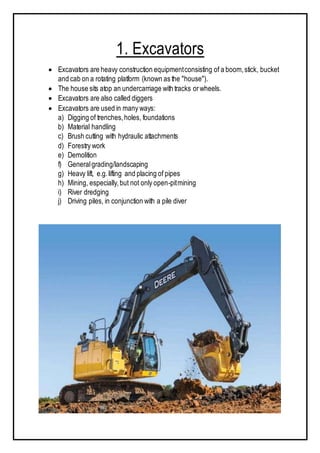
1. Excavators
 Excavators are heavy construction equipmentconsisting of a boom,stick, bucket
and cab on a rotating platform (known as the "house").
 The house sits atop an undercarriage with tracks orwheels.
 Excavators are also called diggers
 Excavators are used in many ways:
a) Digging of trenches,holes, foundations
b) Material handling
c) Brush cutting with hydraulic attachments
d) Forestry work
e) Demolition
f) Generalgrading/landscaping
g) Heavy lift, e.g.lifting and placing of pipes
h) Mining, especially,but not only open-pitmining
i) River dredging
j) Driving piles, in conjunction with a pile diver
2. Back hoe
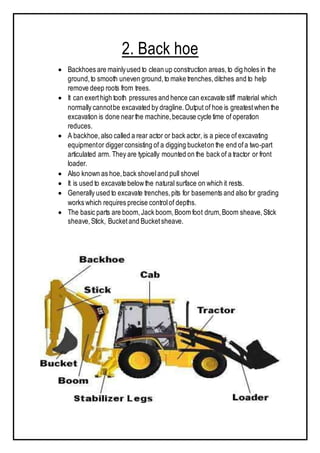
 Backhoes are mainlyused to clean up construction areas,to dig holes in the
ground,to smooth uneven ground,to make trenches,ditches and to help
remove deep roots from trees.
 It can exerthigh tooth pressures and hence can excavate stiff material which
normally cannotbe excavated by dragline.Output of hoe is greatestwhen the
excavation is done nearthe machine,because cycle time of operation
reduces.
 A backhoe, also called a rear actor or back actor, is a piece of excavating
equipmentor diggerconsisting of a digging bucketon the end ofa two-part
articulated arm. They are typically mounted on the back of a tractor or front
loader.
 Also known as hoe,back shoveland pull shovel
 It is used to excavate belowthe natural surface on which it rests.
 Generally used to excavate trenches,pits for basements and also for grading
works which requires precise controlof depths.
 The basic parts are boom,Jack boom,Boom foot drum,Boom sheave,Stick
sheave,Stick, Bucketand Bucketsheave.
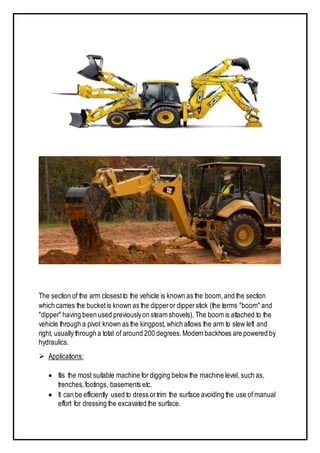
The section of the arm closestto the vehicle is known as the boom,and the section
which carries the bucketis known as the dipperor dipperstick (the terms "boom" and
"dipper" having been used previouslyon steam shovels). The boom is attached to the
vehicle through a pivot known as the kingpost, which allows the arm to slew left and
right, usually through a total of around 200 degrees.Modem backhoes are powered by
hydraulics.
 Applications:
 Itis the most suitable machine for digging belowthe machine level, such as,
trenches,footings, basements etc.
 It can be efficiently used to dress ortrim the surface avoiding the use of manual
effort for dressing the excavated the surface.
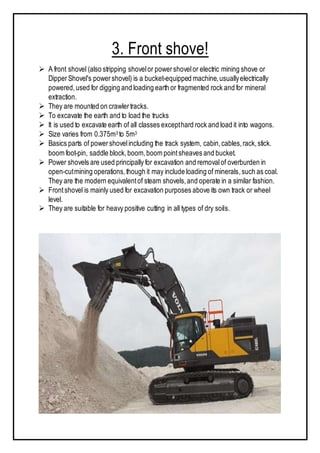
3. Front shove!
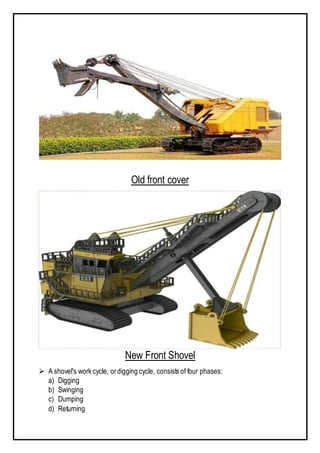
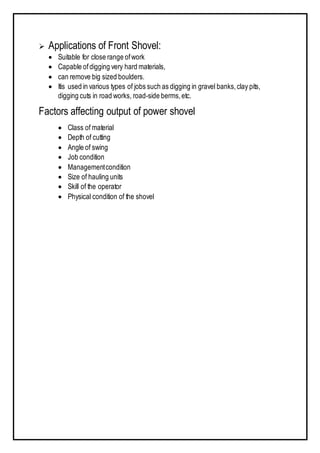
 A front shovel (also stripping shovelor powershovelor electric mining shove or
DipperShovel's powershovel) is a bucket-equipped machine,usuallyelectrically
powered,used for digging and loading earth or fragmented rock and for mineral
extraction.
 They are mounted on crawlertracks.
 To excavate the earth and to load the trucks
 It is used to excavate earth of all classes excepthard rock and load it into wagons.
 Size varies from 0.375m3 to 5m3
 Basics parts of powershovelincluding the track system, cabin,cables,rack,stick.
boom foot-pin, saddle block,boom,boom pointsheaves and bucket.
 Power shovels are used principally for excavation and removalof overburden in
open-cutmining operations,though it may include loading of minerals,such as coal.
They are the modern equivalentof steam shovels,and operate in a similar fashion.
 Frontshovel is mainly used for excavation purposes above its own track or wheel
level.
 They are suitable for heavy positive cutting in all types of dry soils.
Old front cover
New Front Shovel
 A shovel's work cycle, ordigging cycle, consists of four phases:
a) Digging
b) Swinging
c) Dumping
d) Returning
 Applications of Front Shovel:
 Suitable for close range ofwork
 Capable ofdigging very hard materials,
 can remove big sized boulders.
 Itis used in various types of jobs such as digging in gravel banks,clay pits,
digging cuts in road works, road-side berms,etc.
Factors affecting output of power shovel
 Class of material
 Depth of cutting
 Angle of swing
 Job condition
 Managementcondition
 Size of hauling units
 Skill of the operator
 Physical condition of the shovel
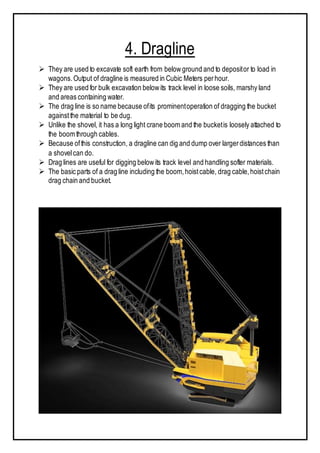
4. Dragline
 They are used to excavate soft earth from belowground and to depositor to load in
wagons.Output of dragline is measured in Cubic Meters perhour.
 They are used for bulk excavation belowits track level in loose soils, marshy land
and areas containing water.
 The drag line is so name because ofits prominentoperation of dragging the bucket
againstthe material to be dug.
 Unlike the shovel, it has a long light crane boom and the bucketis loosely attached to
the boom through cables.
 Because ofthis construction, a dragline can dig and dump over largerdistances than
a shovelcan do.
 Drag lines are useful for digging belowits track level and handling softer materials.
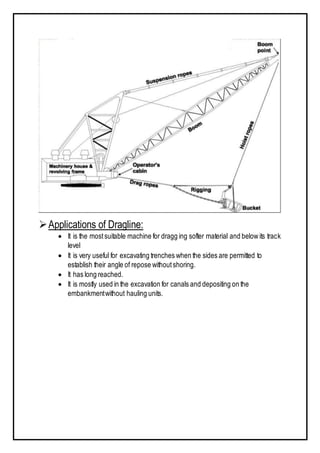
 The basic parts of a drag line including the boom,hoistcable, drag cable,hoistchain
drag chain and bucket.
Applications of Dragline:
 It is the mostsuitable machine for dragg ing softer material and belowits track
level
 It is very useful for excavating trenches when the sides are permitted to
establish their angle of repose withoutshoring.
 It has long reached.
 It is mostly used in the excavation for canals and depositing on the
embankmentwithout hauling units.
5. Clamshell
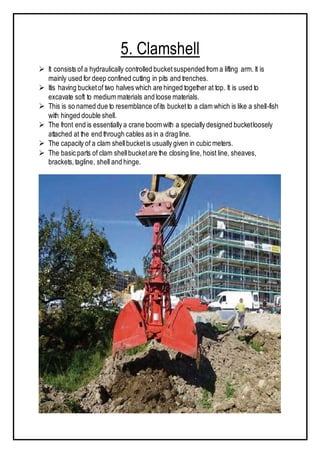
 It consists of a hydraulically controlled bucketsuspended from a lifting arm. It is
mainly used for deep confined cutting in pits and trenches.
 Itis having bucketof two halves which are hinged together at top. It is used to
excavate soft to medium materials and loose materials.
 This is so named due to resemblance ofits bucketto a clam which is like a shell-fish
with hinged double shell.
 The front end is essentially a crane boom with a specially designed bucketloosely
attached at the end through cables as in a drag line.
 The capacity of a clam shellbucketis usually given in cubic meters.
 The basic parts of clam shellbucketare the closing line, hoist line, sheaves,
brackets,tagline, shell and hinge.
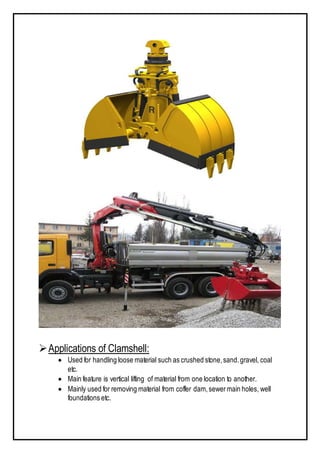
Applications of Clamshell:
 Used for handling loose material such as crushed stone,sand.gravel, coal
etc.
 Main feature is vertical lifting of material from one location to another.
 Mainly used for removing material from coffer dam,sewermain holes, well
foundations etc.
6. Bulldozers
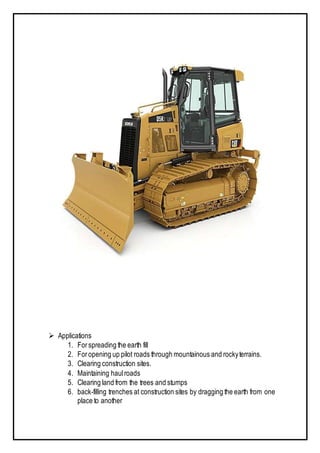
 A bulldozeris a crawler (continuous tracked tractor) equipped with a
substantial metal plate (known as a blade)used to push large quantities of
soil, sand,rubble,or other such material during construction or conversion
work and typically equipped atthe rearwith a claw-like device (known as a
ripper) to loosen densely-compacted materials.
 They are used for moving earth up to a distance of about100m and actas a
towing tractor and pusherto scrapermachines.Theycan be track-mounted or
wheel-mounted.
 The heavy blade attached to the tractor pushes the material from one place to
another.
 The tractor can be of the crawler or the wheeled type.
Classification of bull dozer
1) Position of blades
 Bull dozers in which the blade perpendicularto the direction of movement
 Angle dozers in which the blade is set at an angle with the direction of
movement.
2) Based on mountings
 Wheelmounted
 Crawler mounted
3) Based on the control
 Cable controlled
 Hydraulically controlled
 Applications
1. For spreading the earth fill
2. Foropening up pilot roads through mountainous and rockyterrains.
3. Clearing construction sites.
4. Maintaining haulroads
5. Clearing land from the trees and stumps
6. back-filling trenches at construction sites by dragging the earth from one
place to another
7. Scraper
 It is a device to scrap the ground &load it simultaneously, transport it over
required distance.It can dig. load,hauland discharge the material in uniformly
thick layers.
 In civil engineering,a wheeltractor-scraperis a piece of heavy equipmentused
for earthmoving.
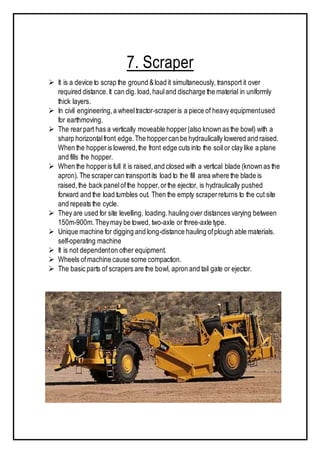
 The rearpart has a vertically moveable hopper(also known as the bowl) with a
sharp horizontalfront edge.The hoppercan be hydraulically lowered and raised.
When the hopperis lowered,the front edge cuts into the soil or clay like a plane
and fills the hopper.
 When the hopperis full it is raised,and closed with a vertical blade (known as the
apron).The scrapercan transportits load to the fill area where the blade is
raised,the back panelofthe hopper,orthe ejector, is hydraulically pushed
forward and the load tumbles out. Then the empty scraperreturns to the cut site
and repeats the cycle.
 They are used for site levelling, loading.hauling over distances varying between
150m-900m.Theymay be towed, two-axle or three-axle type.
 Unique machine for digging and long-distance hauling ofplough able materials.
self-operating machine
 It is not dependenton other equipment.
 Wheels ofmachine cause some compaction.
 The basic parts of scrapers are the bowl, apron and tail gate or ejector.
8. Grader
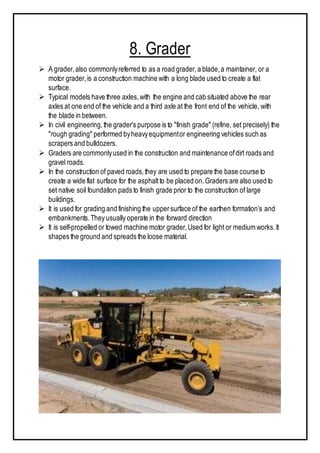
 A grader,also commonlyreferred to as a road grader,a blade,a maintainer, or a
motor grader,is a construction machine with a long blade used to create a flat
surface.
 Typical models have three axles,with the engine and cab situated above the rear
axles at one end of the vehicle and a third axle at the front end of the vehicle, with
the blade in between.
 In civil engineering,the grader's purpose is to "finish grade" (refine, set precisely) the
"rough grading" performed byheavyequipmentor engineering vehicles such as
scrapers and bulldozers.
 Graders are commonlyused in the construction and maintenance ofdirt roads and
gravel roads.
 In the construction of paved roads,they are used to prepare the base course to
create a wide flat surface for the asphaltto be placed on.Graders are also used to
set native soil foundation pads to finish grade prior to the construction of large
buildings.
 It is used for grading and finishing the uppersurface of the earthen formation’s and
embankments.They usually operate in the forward direction
 It is self-propelled or towed machine motor grader,Used for light or medium works.It
shapes the ground and spreads the loose material.
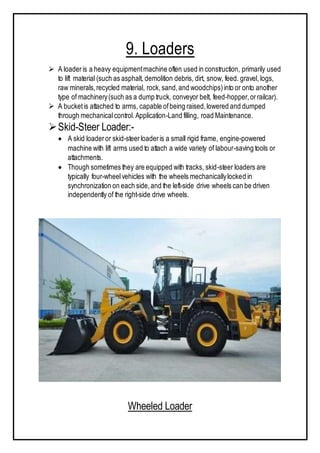
9. Loaders
 A loaderis a heavy equipmentmachine often used in construction, primarily used
to lift material (such as asphalt, demolition debris, dirt, snow, feed. gravel, logs,
raw minerals,recycled material, rock,sand,and woodchips)into or onto another
type of machinery(such as a dump truck, conveyor belt, feed-hopper,orrailcar).
 A bucketis attached to arms, capable ofbeing raised,lowered and dumped
through mechanicalcontrol.Application-Land filling, road Maintenance.
Skid-Steer Loader:-
 A skid loaderor skid-steerloaderis a small rigid frame, engine-powered
machine with lift arms used to attach a wide variety of labour-saving tools or
attachments.
 Though sometimes they are equipped with tracks, skid-steer loaders are
typically four-wheelvehicles with the wheels mechanicallylocked in
synchronization on each side,and the left-side drive wheels can be driven
independently of the right-side drive wheels.
Wheeled Loader
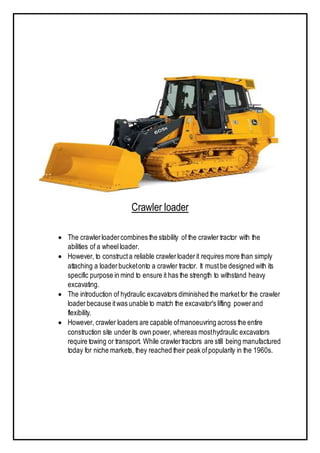
Crawler loader
 The crawlerloadercombines the stability of the crawler tractor with the
abilities of a wheelloader.
 However, to constructa reliable crawlerloaderit requires more than simply
attaching a loaderbucketonto a crawler tractor. It mustbe designed with its
specific purpose in mind to ensure it has the strength to withstand heavy
excavating.
 The introduction of hydraulic excavators diminished the marketfor the crawler
loaderbecause itwas unable to match the excavator's lifting powerand
flexibility.
 However, crawler loaders are capable ofmanoeuvring across the entire
construction site underits own power, whereas mosthydraulic excavators
require towing or transport. While crawlertractors are still being manufactured
today for niche markets, they reached their peak ofpopularity in the 1960s.
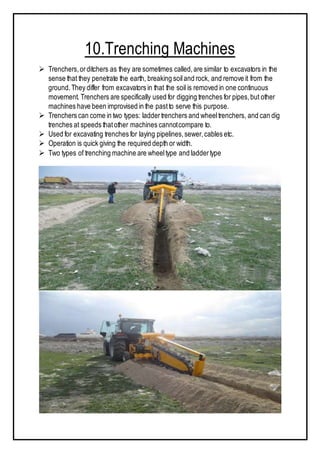
10.Trenching Machines
 Trenchers,orditchers as they are sometimes called,are similar to excavators in the
sense that they penetrate the earth, breaking soiland rock, and remove it from the
ground.They differ from excavators in that the soil is removed in one continuous
movement. Trenchers are specifically used for digging trenches for pipes,but other
machines have been improvised in the pastto serve this purpose.
 Trenchers can come in two types: laddertrenchers and wheeltrenchers, and can dig
trenches at speeds thatother machines cannotcompare to.
 Used for excavating trenches for laying pipelines,sewer,cables etc.
 Operation is quick giving the required depth or width.
 Two types of trenching machine are wheeltype and laddertype
11. Tractors
 Multi-purpose machines used mainlyfor pulling and pus hing the other equipment
 Important Equipmentfor earthmoving,worked by Diesel engines,having horse
powerranging from 20HP to 200HP.
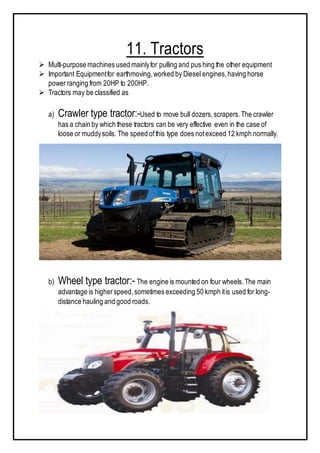
 Tractors may be classified as
a) Crawler type tractor:-Used to move bull dozers,scrapers.The crawler
has a chain by which these tractors can be very effective even in the case of
loose or muddysoils. The speed ofthis type does notexceed 12 kmph normally.
b) Wheel type tractor:- The engine is mounted on four wheels.The main
advantage is higherspeed,sometimes exceeding 50 kmph itis used for long-
distance hauling and good roads.
EARTH COMPACTION EQUIPMENTS
 Compactors are machines frequently used to compactmaterials such as soil in order
to increase its density for construction.
1. In addition, compactors are utilized in landfill tasks.
2. Common varieties are plate tampers (also known as rammers)
3. Vibratory plates, compactors (also known as tamping foot rollers) &
4. Vibratory pad foot compactors.
 These categories are further divided below...
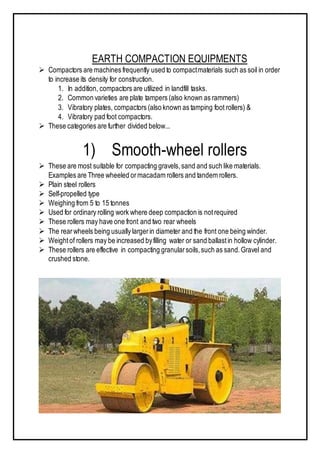
1) Smooth-wheel rollers
 These are most suitable for compacting gravels,sand and such like materials.
Examples are Three wheeled ormacadam rollers and tandem rollers.
 Plain steel rollers
 Self-propelled type
 Weighing from 5 to 15 tonnes
 Used for ordinary rolling work where deep compaction is notrequired
 These rollers may have one front and two rear wheels
 The rearwheels being usually largerin diameter and the front one being winder.
 Weightof rollers may be increased byfilling water or sand ballastin hollow cylinder.
 These rollers are effective in compacting granularsoils,such as sand.Gravel and
crushed stone.
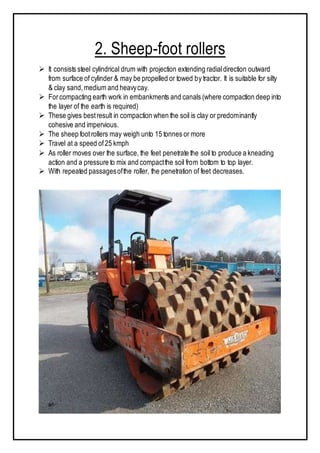
2. Sheep-foot rollers
 It consists steel cylindrical drum with projection extending radialdirection outward
from surface of cylinder & may be propelled or towed by tractor. It is suitable for silty
& clay sand,medium and heavycay.
 Forcompacting earth work in embankments and canals (where compaction deep into
the layer of the earth is required)
 These gives bestresult in compaction when the soil is clay or predominantly
cohesive and impervious.
 The sheep footrollers may weigh unto 15 tonnes or more
 Travel at a speed of25 kmph
 As roller moves over the surface, the feet penetrate the soil to produce a kneading
action and a pressure to mix and compactthe soil from bottom to top layer.
 With repeated passagesofthe roller, the penetration of feet decreases.
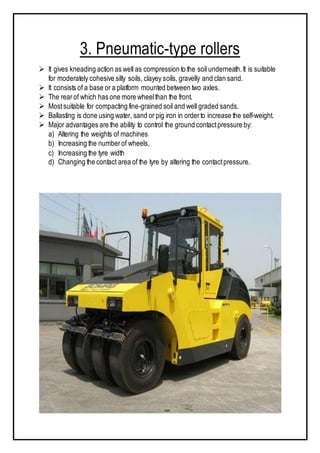
3. Pneumatic-type rollers
 It gives kneading action as well as compression to the soil underneath.It is suitable
for moderately cohesive silty soils, clayey soils, gravelly and clan sand.
 It consists of a base or a platform mounted between two axles.
 The rearof which has one more wheelthan the front.
 Mostsuitable for compacting fine-grained soil and well graded sands.
 Ballasting is done using water, sand or pig iron in orderto increase the self-weight.
 Major advantages are the ability to control the ground contactpressure by:
a) Altering the weights of machines
b) Increasing the numberof wheels,
c) Increasing the tyre width
d) Changing the contact area of the tyre by altering the contactpressure.
HAULING EQUIPMENTS
 The equipmentused for transportation of material are known as hauling equipment
or simply haulers.
 Haulers may operate on the roadways or railways
 It in valve
 transportation of building materials,
 carriage and disposalofexcavated earth
 Haulage ofheavy construction equipment.
 Haulage by road is carried out by trucks, rubber-tired tractor with wagons orcrawler
tractor with wagons.It transports the earth, aggregate,rock,ore,coal and other
materials. Road vehicles used for haulage on construction work are two types.
1. On Highway Vehicle-Design to be used on Public Highways
2. Off Highway Vehicle-Designed to be used construction sites & designed and
manufactured to preclude there use on their use on public roads and they may or
may not comply highwaylimitation.
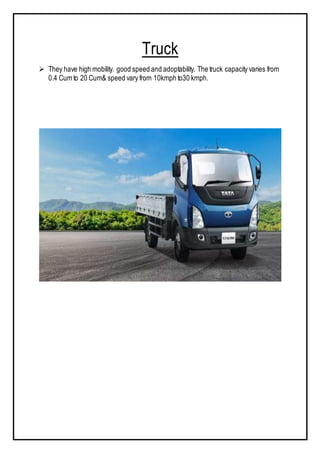
Truck
 They have high mobility. good speed and adoptability. The truck capacity varies from
0.4 Cum to 20 Cum& speed vary from 10kmph to30 kmph.
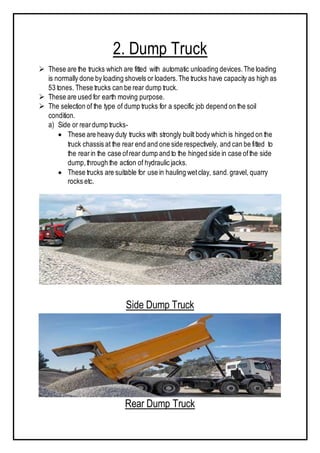
2. Dump Truck
 These are the trucks which are fitted with automatic unloading devices.The loading
is normally done by loading shovels or loaders.The trucks have capacity as high as
53 tones. These trucks can be rear dump truck.
 These are used for earth moving purpose.
 The selection of the type of dump trucks for a specific job depend on the soil
condition.
a) Side or reardump trucks-
 These are heavy duty trucks with strongly built body which is hinged on the
truck chassis at the rear end and one side respectively, and can be fitted to
the rearin the case ofrear dump and to the hinged side in case ofthe side
dump,through the action of hydraulic jacks.
 These trucks are suitable for use in hauling wetclay, sand.gravel, quarry
rocks etc.
Side Dump Truck
Rear Dump Truck
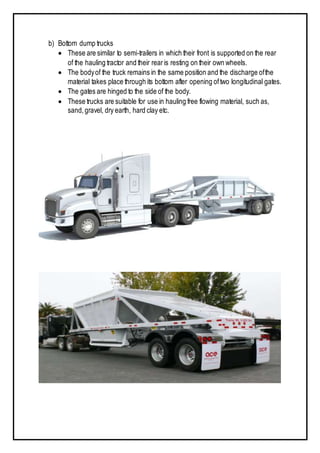
b) Bottom dump trucks
 These are similar to semi-trailers in which their front is supported on the rear
of the hauling tractor and their rearis resting on their own wheels.
 The bodyof the truck remains in the same position and the discharge ofthe
material takes place through its bottom after opening oftwo longitudinal gates.
 The gates are hinged to the side of the body.
 These trucks are suitable for use in hauling free flowing material, such as,
sand,gravel, dry earth, hard clay etc.
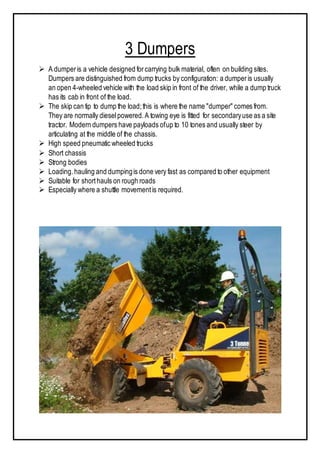
3 Dumpers
 A dumperis a vehicle designed forcarrying bulk material, often on building sites.
Dumpers are distinguished from dump trucks by configuration: a dumperis usually
an open 4-wheeled vehicle with the load skip in front of the driver, while a dump truck
has its cab in front of the load.
 The skip can tip to dump the load;this is where the name "dumper" comes from.
They are normally dieselpowered.A towing eye is fitted for secondaryuse as a site
tractor. Modern dumpers have payloads ofup to 10 tones and usually steer by
articulating at the middle of the chassis.
 High speed pneumatic wheeled trucks
 Short chassis
 Strong bodies
 Loading.hauling and dumpingis done very fast as compared to other equipment
 Suitable for shorthauls on rough roads
 Especially where a shuttle movementis required.
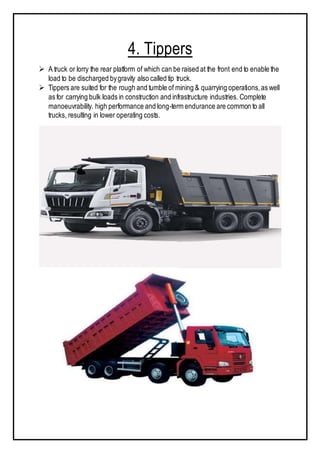
4. Tippers
 A truck or lorry the rear platform of which can be raised at the front end to enable the
load to be discharged bygravity also called tip truck.
 Tippers are suited for the rough and tumble of mining & quarrying operations,as well
as for carrying bulk loads in construction and infrastructure industries. Complete
manoeuvrability. high performance and long-term endurance are common to all
trucks, resulting in lower operating costs.
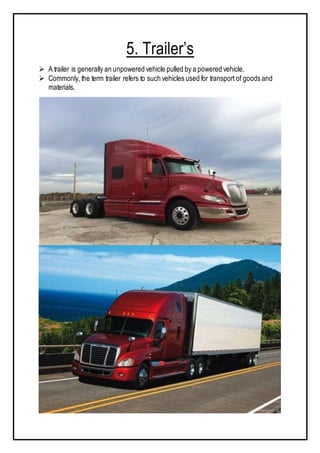
5. Trailer’s
 A trailer is generally an unpowered vehicle pulled by a powered vehicle.
 Commonly, the term trailer refers to such vehicles used for transport of goods and
materials.
HOISTING EQUIPMENTS
 Hoisting is the lifting a weight from one location and moving it to another
location which is at a reasonable distance.
 These equipment’s are used for lifting the loads,holding them in suspension
during transfer from one place to other and placing them at designated
location.
 Big projects such as, construction of dams,industrial buildings etc. require
hoisting equipment.
 Hoisting equipmentincludes jacks,winches,chain hoists and cranes.
 Crane is the only single machine which,as a single piece,is capable of
providing three-dimensionalmovementof a weight.
 It constitutes a group ofequipmentwhich are employed mainly for lifting or
lowering of unit load and other
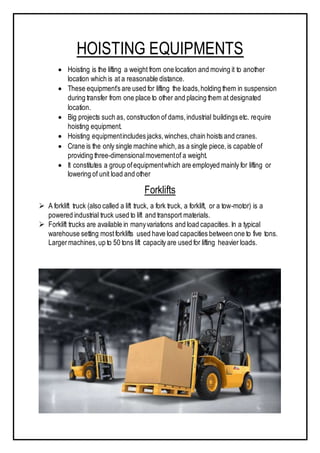
Forklifts
 A forklift truck (also called a lift truck, a fork truck, a forklift, or a tow-motor) is a
powered industrial truck used to lift and transport materials.
 Forklift trucks are available in manyvariations and load capacities. In a typical
warehouse setting mostforklifts used have load capacities between one to five tons.
Largermachines,up to 50 tons lift capacity are used for lifting heavier loads.
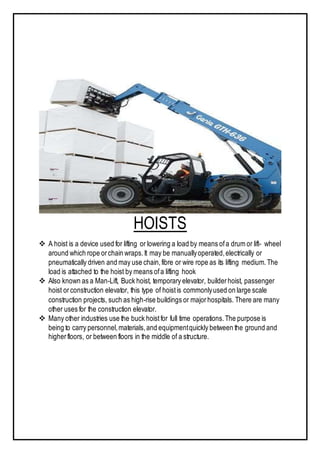
HOISTS
 A hoist is a device used for lifting or lowering a load by means ofa drum or lift- wheel
around which rope orchain wraps.It may be manuallyoperated,electrically or
pneumatically driven and may use chain,fibre or wire rope as its lifting medium.The
load is attached to the hoist by means ofa lifting hook
 Also known as a Man-Lift, Buck hoist, temporary elevator, builderhoist, passenger
hoist orconstruction elevator, this type of hoistis commonlyused on large scale
construction projects, such as high-rise buildings or majorhospitals. There are many
other uses for the construction elevator.
 Many other industries use the buck hoist for full time operations.The purpose is
being to carry personnel,materials,and equipmentquickly between the ground and
higherfloors, or between floors in the middle of a structure.
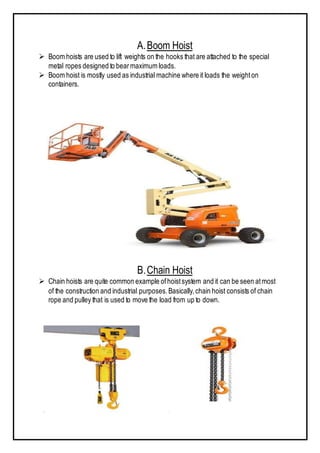
A.Boom Hoist
 Boom hoists are used to lift weights on the hooks that are attached to the special
metal ropes designed to bearmaximum loads.
 Boom hoist is mostly used as industrial machine where it loads the weighton
containers.
B.Chain Hoist
 Chain hoists are quite common example ofhoistsystem and it can be seen atmost
of the construction and industrial purposes.Basically,chain hoist consists of chain
rope and pulley that is used to move the load from up to down.
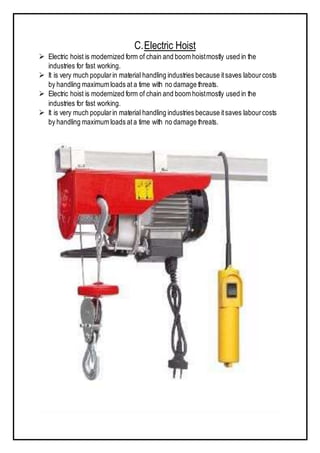
C.Electric Hoist
 Electric hoist is modernized form of chain and boom hoistmostly used in the
industries for fast working.
 It is very much popularin material handling industries because itsaves labourcosts
by handling maximum loads at a time with no damage threats.
 Electric hoist is modernized form of chain and boom hoistmostly used in the
industries for fast working.
 It is very much popularin material handling industries because itsaves labourcosts
by handling maximum loads ata time with no damage threats.
D.Tractor Hoist
 Tractor hoistconsistof a boom that is attached with base of tractor and a hook with
rope is installed on this boom that can operated through driver controls.
CRANES
 A crane is a type of machine,generallyequipped with a hoist, wire ropes orchains,
and sheaves,that can be used both to lift and lowermaterials and to move them
horizontally. It is mainly used for lifting heavy things and transporting them to other
places.
 It uses one ormore simple machines to create mechanicaladvantage and thus move
loads beyond the normalcapability of a man.Cranes are commonlyemployed in the
transport industry for the loading and unloading offreight, in the construction industry
for the movementof materials and in the manufacturing industry for the assembling
of heavy equipment.
 Cranes are considered to be one ofthe mostimportant equipmentused in
construction due to their key role in performing lifting tasks all over the construction
site.
 Plenty of crane models are available in different shapes and sizes.
SELECTION OF CRANES
 Factors affecting the selection of cranes are-
1. Building Design
 Building Height
 Project Duration
2. Capability
 Power Supply
 Load lifting frequency
 Operators Visibility
3. Safety
 Initial Planning and Engineering
1) Derrick cranes:-
 Derrick cranes consistof a mast, a boom and a bull wheel on which the boom
rotates abouta vertical axis and guys or supporting members.
 Preferable for high-rise and apartmentbuildings.
 Can be used for both long term and short-term projects.
 Cheaperthan mobile and tower cranes.Not considered to be safe.
 Used when clearance is inadequate for the other units and sufficient space is
unavailable for the erection of a tower foundation.
 Electrically operated,diesel operated ordiesel-electrically operated.
 The boom can revolve through 360°.This crane is used for heavy loads upto 200
tons.
2) Mobile cranes:-
 These cranes are mounted on mobile units which is either crawlertype or wheel
type
 Truck cranes have high mobility while the crawler mounted cranes move slowly.
 Crawler mounted cranes are capable ofmoving on rough terrain.
 Adequate for all types of structures (up to 107 m)
 Used for shorter projects duration (less than 4 months).
 Not considered to be very safe due to lack of safety devices or limited switches to
preventoverloading.
 Can operate in muddyterrain butrequires good ground conditions.
 Needs adequate operating clearance.
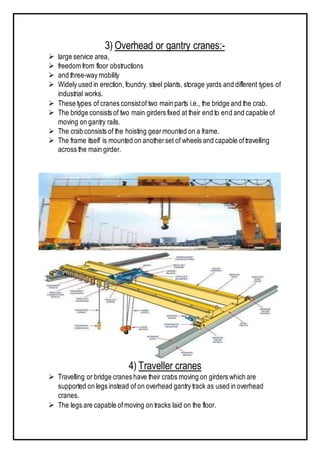
3) Overhead or gantry cranes:-
 large service area,
 freedom from floor obstructions
 and three-way mobility
 Widely used in erection, foundry. steel plants, storage yards and different types of
industrial works.
 These types of cranes consistof two main parts i.e., the bridge and the crab.
 The bridge consists of two main girders fixed at their end to end and capable of
moving on gantry rails.
 The crab consists of the hoisting gearmounted on a frame.
 The frame itself is mounted on anotherset of wheels and capable oftravelling
across the main girder.
4) Traveller cranes
 Travelling or bridge cranes have their crabs moving on girders which are
supported on legs instead of on overhead gantry track as used in overhead
cranes.
 The legs are capable ofmoving on tracks laid on the floor.
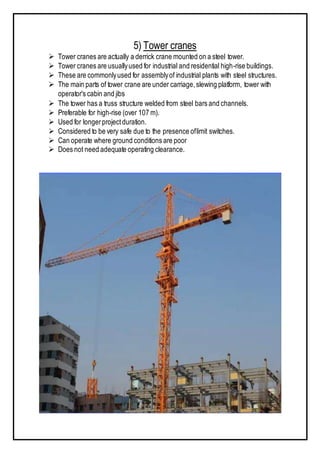
5) Tower cranes
 Tower cranes are actually a derrick crane mounted on a steel tower.
 Tower cranes are usuallyused for industrial and residential high-rise buildings.
 These are commonlyused for assemblyof industrial plants with steel structures.
 The main parts of tower crane are under carriage,slewing platform, tower with
operator's cabin and jibs
 The tower has a truss structure welded from steel bars and channels.
 Preferable for high-rise (over 107 m).
 Used for longerprojectduration.
 Considered to be very safe due to the presence oflimit switches.
 Can operate where ground conditions are poor
 Does not need adequate operating clearance.
CONVEYING EQUIPMENTS
 A conveyor system is a common piece ofmechanicalhandling equipmentthat
moves materials from one location to another.Conveyors are especiallyuseful in
applications involving the transportation of heavy orbulky materials. Conveyor
systems allow quick and efficient transportation for a wide variety of materials,
which make them very popularin the material handling and packagingindustries
 Transporting material from one place to anotherover a stationary structure.
 Caries material in continuous stream with its distinct feature such as endless
chain or belt.
 Can be done horizontally, vertically or inclined.
 When the equipmentdoes horizontalconveying,it is known as conveyor and
when it does vertical, it is known as elevator.
 Conveying are mainly used in mining. construction and in some ofthe industries.
 In construction industry, conveyors are mainly used for concreting purpose.
Utility
 The Advantage of using conveyors are as follows:
 It increases the output.
 It facilitates continuity in operation.
 It results in time saving.
 There are no waiting periods.
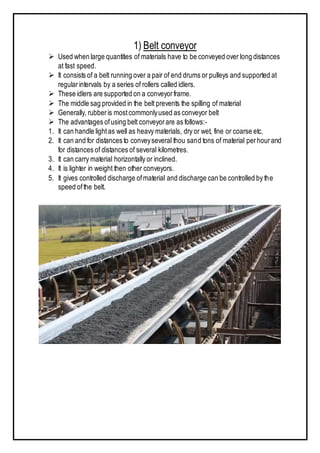
1) Belt conveyor
 Used when large quantities of materials have to be conveyed over long distances
at fast speed.
 It consists of a belt running over a pair of end drums or pulleys and supported at
regularintervals by a series of rollers called idlers.
 These idlers are supported on a conveyorframe.
 The middle sag provided in the belt prevents the spilling of material
 Generally, rubberis mostcommonlyused as conveyor belt
 The advantages ofusing belt conveyorare as follows:-
1. It can handle lightas well as heavy materials, dry or wet, fine or coarse etc.
2. It can and for distances to conveyseveral thou sand tons of material perhourand
for distances of distances of several kilometres.
3. It can carry material horizontally or inclined.
4. It is lighter in weight then other conveyors.
5. It gives controlled discharge ofmaterial and discharge can be controlled by the
speed ofthe belt.
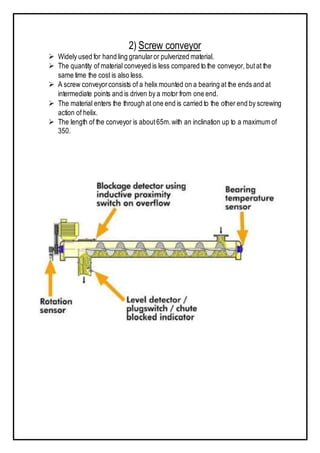
2) Screw conveyor
 Widely used for hand ling granularor pulverized material.
 The quantity of material conveyed is less compared to the conveyor, butat the
same time the cost is also less.
 A screw conveyorconsists of a helix mounted on a bearing at the ends and at
intermediate points and is driven by a motor from one end.
 The material enters the through at one end is carried to the other end by screwing
action of helix.
 The length of the conveyor is about65m.with an inclination up to a maximum of
350.
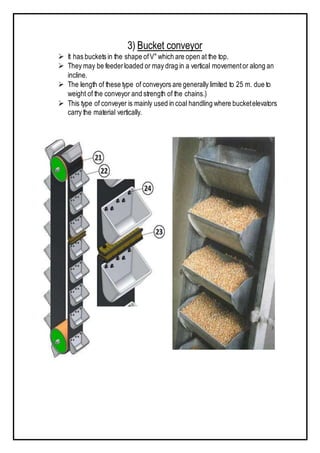
3) Bucket conveyor
 It has buckets in the shape ofV" which are open at the top.
 They may be feederloaded or may drag in a vertical movementor along an
incline.
 The length of these type of conveyors are generally limited to 25 m. due to
weight of the conveyor and strength of the chains.)
 This type of conveyer is mainly used in coal handling where bucketelevators
carry the material vertically.
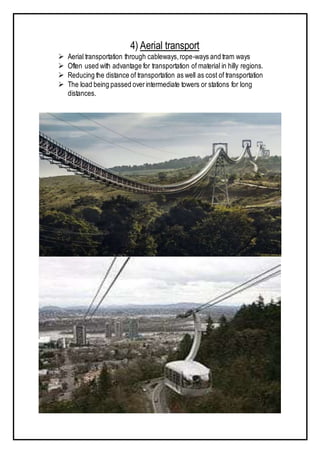
4) Aerial transport
 Aerial transportation through cableways,rope-ways and tram ways
 Often used with advantage for transportation of material in hilly regions.
 Reducing the distance of transportation as well as cost of transportation
 The load being passed overintermediate towers or stations for long
distances.
Aggregateproduction equipment
 Aggregate has to be produced atthe site, if the quantity needed is very large.
 Therefore, in any projectwhere concrete requirementis very high,an aggregate
preparation and processing plantare essentialto complete the concreting
operations.
 Aggregate production consists of two stages is recovery and processing.
 Basic material, such as stone, is recovered from a rock quarry or from the river bed
and processing is done which consists of crushing.grading,washing and stock piling
of aggregate.
 Crushers are used mainly to reduce the size of large stone or rock to smaller uniform
sized aggregates required forconcrete mix.
 Crushing consists of
 Pressure,
 Impact,
 Attrition
 A combination of these operations.
1) Jaw crushers
 Itis one of the primary crushers.
 It operates by allowing stone to flow into the space between two jaws, one of which is
stationary and other is movable,which together constitute the crushing surfaces.
 The distance between the two jaws decreases as the stone travels downward under
the effect of gravity and ultimately passes through the lower opening.
 The moveable jaw is capable ofexerting a pressure sufficiently high to crush the
hardestrock.
 The movable jaw is suspended from a shaft mounted on bearings on the crusher
frame.
 The jaw plates are made of manganesesteelwhich can be removed,replaced or
reversed.
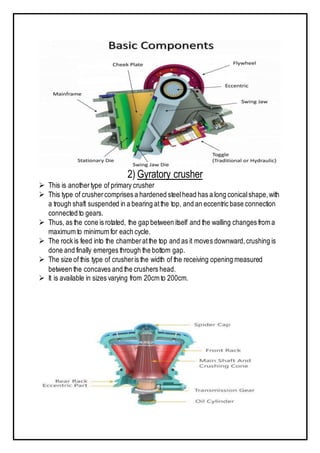
2) Gyratory crusher
 This is anothertype of primary crusher
 This type of crushercomprises a hardened steelhead has a long conicalshape,with
a trough shaft suspended in a bearing atthe top, and an eccentric base connection
connected to gears.
 Thus, as the cone is rotated, the gap between itself and the walling changes from a
maximum to minimum for each cycle.
 The rock is feed into the chamberatthe top and as it moves downward,crushing is
done and finally emerges through the bottom gap.
 The size of this type of crusheris the width of the receiving opening measured
between the concaves and the crushers head.
 It is available in sizes varying from 20cm to 200cm.
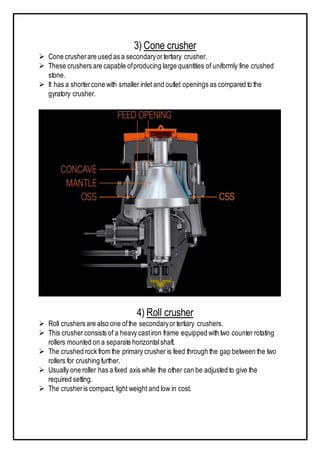
3) Cone crusher
 Cone crusherare used as a secondaryortertiary crusher.
 These crushers are capable ofproducing large quantities of uniformly fine crushed
stone.
 It has a shortercone with smaller inlet and outlet openings as compared to the
gyratory crusher.
4) Roll crusher
 Roll crushers are also one ofthe secondaryortertiary crushers.
 This crusherconsists of a heavy castiron frame equipped with two counter rotating
rollers mounted on a separate horizontalshaft.
 The crushed rock from the primary crusher is feed through the gap between the two
rollers for crushing further.
 Usually one roller has a fixed axis while the other can be adjusted to give the
required setting.
 The crusheris compact, light weight and low in cost.
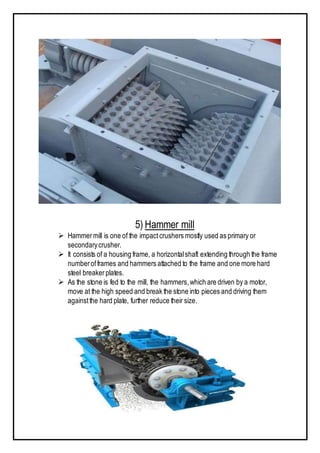
5) Hammer mill
 Hammermill is one of the impactcrushers mostly used as primary or
secondarycrusher.
 It consists of a housing frame, a horizontalshaft extending through the frame
numberofframes and hammers attached to the frame and one more hard
steel breakerplates.
 As the stone is fed to the mill, the hammers,which are driven by a motor,
move at the high speed and break the stone into pieces and driving them
againstthe hard plate, further reduce their size.
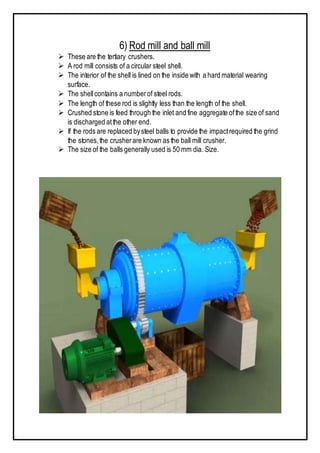
6) Rod mill and ball mill
 These are the tertiary crushers.
 A rod mill consists of a circular steel shell.
 The interior of the shell is lined on the inside with a hard material wearing
surface.
 The shellcontains a numberof steel rods.
 The length of these rod is slightly less than the length of the shell.
 Crushed stone is feed through the inlet and fine aggregate ofthe size of sand
is discharged atthe other end.
 If the rods are replaced bysteel balls to provide the impactrequired the grind
the stones,the crusherare known as the ball mill crusher.
 The size of the balls generally used is 50 mm dia. Size.
CONCRETING EQUIPMENTS
 They are mainly used for weighing and mixing large quantity of concrete
constituents. capacity:- 20cum/hr-250cum/hr
 Concrete is basically cement,aggregate & water mixed together and then deposited
and permitted to solidify.
 Operation involved in concrete production batching,mixing, handling and
transportation, placing.finishing curing.
 In huge concreting concrete and quality depends on time of mixing, so mixers are
used.

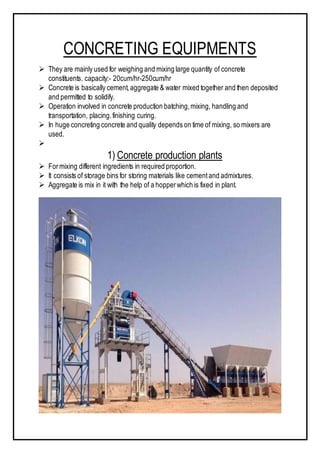
1) Concrete production plants
 Formixing different ingredients in required proportion.
 It consists of storage bins for storing materials like cementand admixtures.
 Aggregate is mix in it with the help of a hopperwhich is fixed in plant.
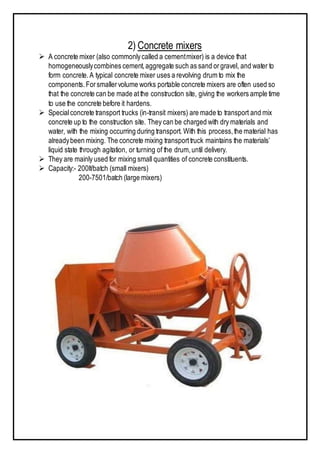
2) Concrete mixers
 A concrete mixer (also commonlycalled a cementmixer) is a device that
homogeneouslycombines cement,aggregate such as sand orgravel, and water to
form concrete.A typical concrete mixer uses a revolving drum to mix the
components.Forsmallervolume works portable concrete mixers are often used so
that the concrete can be made atthe construction site, giving the workers ample time
to use the concrete before it hardens.
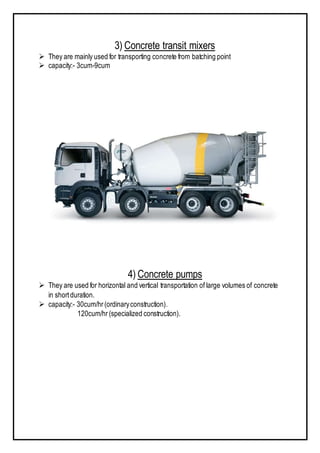
 Specialconcrete transport trucks (in-transit mixers) are made to transport and mix
concrete up to the construction site. They can be charged with dry materials and
water, with the mixing occurring during transport. With this process,the material has
alreadybeen mixing. The concrete mixing transporttruck maintains the materials’
liquid state through agitation, or turning of the drum,until delivery.
 They are mainly used for mixing small quantities of concrete constituents.
 Capacity:- 200lt/batch (small mixers)
200-7501/batch (large mixers)
3) Concrete transit mixers
 They are mainly used for transporting concrete from batching point
 capacity:- 3cum-9cum
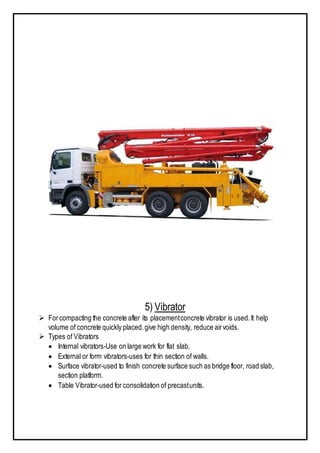
4) Concrete pumps
 They are used for horizontal and vertical transportation of large volumes of concrete
in shortduration.
 capacity:- 30cum/hr(ordinaryconstruction).
120cum/hr (specialized construction).
5) Vibrator
 Forcompacting the concrete after its placementconcrete vibrator is used.It help
volume of concrete quickly placed.give high density, reduce airvoids.
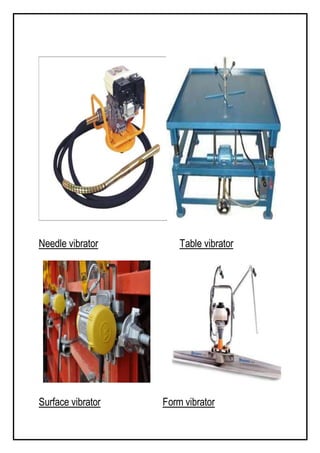
 Types of Vibrators
 Internal vibrators-Use on large work for flat slab.
 External or form vibrators-uses for thin section of walls.
 Surface vibrator-used to finish concrete surface such as bridge floor, road slab,
section platform.
 Table Vibrator-used for consolidation of precastunits.
Needle vibrator Table vibrator
Surface vibrator Form vibrator
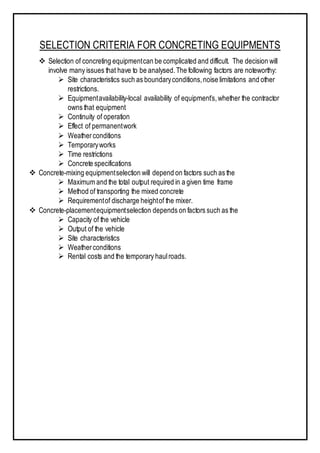
SELECTION CRITERIA FOR CONCRETING EQUIPMENTS
 Selection of concreting equipmentcan be complicated and difficult. The decision will
involve many issues that have to be analysed.The following factors are noteworthy:
 Site characteristics such as boundaryconditions,noise limitations and other
restrictions.
 Equipmentavailability-local availability of equipment’s,whether the contractor
owns that equipment
 Continuity of operation
 Effect of permanentwork
 Weatherconditions
 Temporaryworks
 Time restrictions
 Concrete specifications
 Concrete-mixing equipmentselection will depend on factors such as the
 Maximum and the total output required in a given time frame
 Method of transporting the mixed concrete
 Requirementof discharge heightof the mixer.
 Concrete-placementequipmentselection depends on factors such as the
 Capacity of the vehicle
 Output of the vehicle
 Site characteristics
 Weatherconditions
 Rental costs and the temporary haulroads.
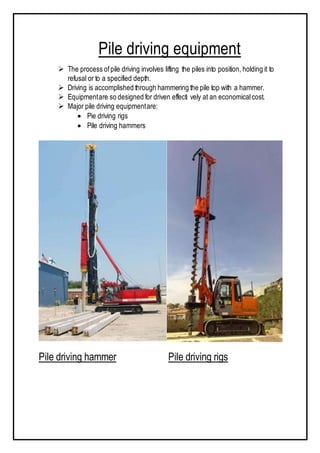
Pile driving equipment
 The process ofpile driving involves lifting the piles into position, holding it to
refusal or to a specified depth.
 Driving is accomplished through hammering the pile top with a hammer.
 Equipmentare so designed for driven effecti vely at an economicalcost.
 Major pile driving equipmentare:
 Pie driving rigs
 Pile driving hammers
Pile driving hammer Pile driving rigs

Advance Construction equipment's reports

  • 1.
    Government Polytechnic, Himatnagar Report on Equipment’sUsed in Construction Name:- Sundaram C. Goand En No:- 186240306515 Guide by :- M.M. Shah sir
  • 2.
    Introduction It is acommon fact that we find a wide variety of construction machines on every construction site, which make the construction jobs easy, safe and quicker.Good projectmanagementin construction mustvigorously pursue the efficient utilization of labour,material and equipment. The use of newequipmentand innovative methods has made possible wholesale changes in construction technologies in recentdecades.The selection of the appropriate type and size of construction equipmentoften affects the required amountof time and effort and thus the job- site productivity of a project. These act as a backbonein the case of huge construction projects. Properuse of the appropriate equipmentcontributes to economy,quality, safety, speed and timely completion of a project. Equipment’s are used for highway projects, irrigation, buildings.powerprojects etc. Almost 15-30%of total project costhas been accounted towards equipmentand machinery. It is therefore important for site managers and construction planners to be familiar with the characteristics of the majortypes of equipmentmostcommonly used in construction. Advantages of utilizing the construction equipment’s:  Increase the rate of output through work progress with the best and efficient methods.  Reduce the overall construction costs especiallyfor large contracts.  Carry outactivities which cannotbe done manuallyor to do them more economicallyand much faster.  Eliminate the heavy manualwork by human thus reducing fatigue and various other hazards and health issues.  Maintain the planned rate of production where there is a shortage of skilled or unskilled labour.  Maintain the high-quality standards often required by present-daydesign and specifications (technical standards).
  • 3.
    CLASSIFICATIONOF CONSTRUCTIONEQUIPMENTS  Dependingon the application, construction machines are classified into various categories which we are discussing here. 1. Earth-moving equipment 2. Earth-compacting equipment 3. Hauling equipment 4. Hoisting equipment 5. Conveying equipment 6. Aggregate production equipment 7. Equipment’s used in Concrete Construction. 8. Pile-driving equipment
  • 4.
    EARTH-MOVING EQUIPMENTS SELECTIONCRITERIA FOREARTHWORK EQUIPMENTS  The selection of earthmoving equipmentis mainly dependenton the following factors:  Quantities of material to be moved  The available time to complete the work the job conditions  The prevailing soil types, the swell and compaction factors, etc.  The job conditions include factors such as availability of loading and dumping area accessibility of site, traffic flows and weather conditions at site.  In orderto plan the numberofEarthwork Equipmentneeded,the plannerfirst determines the following:  The suitable class of equipmentfor earthwork-for example,if the soil to be excavated is loose and marshy, and bulk excavation is involved In the project, one may opt for a dragline.  The appropriate modelofequipmentbased on different characteristics such as payload of bucketand speeds required.Forex ample,draglines come in different capacities ranging from 0.38 cum to 3.06 cum;scrapers in capacities ranging from 8 cum to 50 cum and so on.  The numberofequipmentneeded forthe projectto carry out the given quantity.  The numberofassociated equipmentrequired to supportthe main equipment
  • 5.
    1. Excavators  Excavatorsare heavy construction equipmentconsisting of a boom,stick, bucket and cab on a rotating platform (known as the "house").  The house sits atop an undercarriage with tracks orwheels.  Excavators are also called diggers  Excavators are used in many ways: a) Digging of trenches,holes, foundations b) Material handling c) Brush cutting with hydraulic attachments d) Forestry work e) Demolition f) Generalgrading/landscaping g) Heavy lift, e.g.lifting and placing of pipes h) Mining, especially,but not only open-pitmining i) River dredging j) Driving piles, in conjunction with a pile diver
  • 6.
    2. Back hoe Backhoes are mainlyused to clean up construction areas,to dig holes in the ground,to smooth uneven ground,to make trenches,ditches and to help remove deep roots from trees.  It can exerthigh tooth pressures and hence can excavate stiff material which normally cannotbe excavated by dragline.Output of hoe is greatestwhen the excavation is done nearthe machine,because cycle time of operation reduces.  A backhoe, also called a rear actor or back actor, is a piece of excavating equipmentor diggerconsisting of a digging bucketon the end ofa two-part articulated arm. They are typically mounted on the back of a tractor or front loader.  Also known as hoe,back shoveland pull shovel  It is used to excavate belowthe natural surface on which it rests.  Generally used to excavate trenches,pits for basements and also for grading works which requires precise controlof depths.  The basic parts are boom,Jack boom,Boom foot drum,Boom sheave,Stick sheave,Stick, Bucketand Bucketsheave.
  • 7.
    The section ofthe arm closestto the vehicle is known as the boom,and the section which carries the bucketis known as the dipperor dipperstick (the terms "boom" and "dipper" having been used previouslyon steam shovels). The boom is attached to the vehicle through a pivot known as the kingpost, which allows the arm to slew left and right, usually through a total of around 200 degrees.Modem backhoes are powered by hydraulics.  Applications:  Itis the most suitable machine for digging belowthe machine level, such as, trenches,footings, basements etc.  It can be efficiently used to dress ortrim the surface avoiding the use of manual effort for dressing the excavated the surface.
  • 8.
    3. Front shove! A front shovel (also stripping shovelor powershovelor electric mining shove or DipperShovel's powershovel) is a bucket-equipped machine,usuallyelectrically powered,used for digging and loading earth or fragmented rock and for mineral extraction.  They are mounted on crawlertracks.  To excavate the earth and to load the trucks  It is used to excavate earth of all classes excepthard rock and load it into wagons.  Size varies from 0.375m3 to 5m3  Basics parts of powershovelincluding the track system, cabin,cables,rack,stick. boom foot-pin, saddle block,boom,boom pointsheaves and bucket.  Power shovels are used principally for excavation and removalof overburden in open-cutmining operations,though it may include loading of minerals,such as coal. They are the modern equivalentof steam shovels,and operate in a similar fashion.  Frontshovel is mainly used for excavation purposes above its own track or wheel level.  They are suitable for heavy positive cutting in all types of dry soils.
  • 9.
    Old front cover NewFront Shovel  A shovel's work cycle, ordigging cycle, consists of four phases: a) Digging b) Swinging c) Dumping d) Returning
  • 10.
     Applications ofFront Shovel:  Suitable for close range ofwork  Capable ofdigging very hard materials,  can remove big sized boulders.  Itis used in various types of jobs such as digging in gravel banks,clay pits, digging cuts in road works, road-side berms,etc. Factors affecting output of power shovel  Class of material  Depth of cutting  Angle of swing  Job condition  Managementcondition  Size of hauling units  Skill of the operator  Physical condition of the shovel
  • 11.
    4. Dragline  Theyare used to excavate soft earth from belowground and to depositor to load in wagons.Output of dragline is measured in Cubic Meters perhour.  They are used for bulk excavation belowits track level in loose soils, marshy land and areas containing water.  The drag line is so name because ofits prominentoperation of dragging the bucket againstthe material to be dug.  Unlike the shovel, it has a long light crane boom and the bucketis loosely attached to the boom through cables.  Because ofthis construction, a dragline can dig and dump over largerdistances than a shovelcan do.  Drag lines are useful for digging belowits track level and handling softer materials.  The basic parts of a drag line including the boom,hoistcable, drag cable,hoistchain drag chain and bucket.
  • 12.
    Applications of Dragline: It is the mostsuitable machine for dragg ing softer material and belowits track level  It is very useful for excavating trenches when the sides are permitted to establish their angle of repose withoutshoring.  It has long reached.  It is mostly used in the excavation for canals and depositing on the embankmentwithout hauling units.
  • 13.
    5. Clamshell  Itconsists of a hydraulically controlled bucketsuspended from a lifting arm. It is mainly used for deep confined cutting in pits and trenches.  Itis having bucketof two halves which are hinged together at top. It is used to excavate soft to medium materials and loose materials.  This is so named due to resemblance ofits bucketto a clam which is like a shell-fish with hinged double shell.  The front end is essentially a crane boom with a specially designed bucketloosely attached at the end through cables as in a drag line.  The capacity of a clam shellbucketis usually given in cubic meters.  The basic parts of clam shellbucketare the closing line, hoist line, sheaves, brackets,tagline, shell and hinge.
  • 14.
    Applications of Clamshell: Used for handling loose material such as crushed stone,sand.gravel, coal etc.  Main feature is vertical lifting of material from one location to another.  Mainly used for removing material from coffer dam,sewermain holes, well foundations etc.
  • 15.
    6. Bulldozers  Abulldozeris a crawler (continuous tracked tractor) equipped with a substantial metal plate (known as a blade)used to push large quantities of soil, sand,rubble,or other such material during construction or conversion work and typically equipped atthe rearwith a claw-like device (known as a ripper) to loosen densely-compacted materials.  They are used for moving earth up to a distance of about100m and actas a towing tractor and pusherto scrapermachines.Theycan be track-mounted or wheel-mounted.  The heavy blade attached to the tractor pushes the material from one place to another.  The tractor can be of the crawler or the wheeled type. Classification of bull dozer 1) Position of blades  Bull dozers in which the blade perpendicularto the direction of movement  Angle dozers in which the blade is set at an angle with the direction of movement. 2) Based on mountings  Wheelmounted  Crawler mounted 3) Based on the control  Cable controlled  Hydraulically controlled
  • 16.
     Applications 1. Forspreading the earth fill 2. Foropening up pilot roads through mountainous and rockyterrains. 3. Clearing construction sites. 4. Maintaining haulroads 5. Clearing land from the trees and stumps 6. back-filling trenches at construction sites by dragging the earth from one place to another
  • 17.
    7. Scraper  Itis a device to scrap the ground &load it simultaneously, transport it over required distance.It can dig. load,hauland discharge the material in uniformly thick layers.  In civil engineering,a wheeltractor-scraperis a piece of heavy equipmentused for earthmoving.  The rearpart has a vertically moveable hopper(also known as the bowl) with a sharp horizontalfront edge.The hoppercan be hydraulically lowered and raised. When the hopperis lowered,the front edge cuts into the soil or clay like a plane and fills the hopper.  When the hopperis full it is raised,and closed with a vertical blade (known as the apron).The scrapercan transportits load to the fill area where the blade is raised,the back panelofthe hopper,orthe ejector, is hydraulically pushed forward and the load tumbles out. Then the empty scraperreturns to the cut site and repeats the cycle.  They are used for site levelling, loading.hauling over distances varying between 150m-900m.Theymay be towed, two-axle or three-axle type.  Unique machine for digging and long-distance hauling ofplough able materials. self-operating machine  It is not dependenton other equipment.  Wheels ofmachine cause some compaction.  The basic parts of scrapers are the bowl, apron and tail gate or ejector.
  • 18.
    8. Grader  Agrader,also commonlyreferred to as a road grader,a blade,a maintainer, or a motor grader,is a construction machine with a long blade used to create a flat surface.  Typical models have three axles,with the engine and cab situated above the rear axles at one end of the vehicle and a third axle at the front end of the vehicle, with the blade in between.  In civil engineering,the grader's purpose is to "finish grade" (refine, set precisely) the "rough grading" performed byheavyequipmentor engineering vehicles such as scrapers and bulldozers.  Graders are commonlyused in the construction and maintenance ofdirt roads and gravel roads.  In the construction of paved roads,they are used to prepare the base course to create a wide flat surface for the asphaltto be placed on.Graders are also used to set native soil foundation pads to finish grade prior to the construction of large buildings.  It is used for grading and finishing the uppersurface of the earthen formation’s and embankments.They usually operate in the forward direction  It is self-propelled or towed machine motor grader,Used for light or medium works.It shapes the ground and spreads the loose material.
  • 19.
    9. Loaders  Aloaderis a heavy equipmentmachine often used in construction, primarily used to lift material (such as asphalt, demolition debris, dirt, snow, feed. gravel, logs, raw minerals,recycled material, rock,sand,and woodchips)into or onto another type of machinery(such as a dump truck, conveyor belt, feed-hopper,orrailcar).  A bucketis attached to arms, capable ofbeing raised,lowered and dumped through mechanicalcontrol.Application-Land filling, road Maintenance. Skid-Steer Loader:-  A skid loaderor skid-steerloaderis a small rigid frame, engine-powered machine with lift arms used to attach a wide variety of labour-saving tools or attachments.  Though sometimes they are equipped with tracks, skid-steer loaders are typically four-wheelvehicles with the wheels mechanicallylocked in synchronization on each side,and the left-side drive wheels can be driven independently of the right-side drive wheels. Wheeled Loader
  • 20.
    Crawler loader  Thecrawlerloadercombines the stability of the crawler tractor with the abilities of a wheelloader.  However, to constructa reliable crawlerloaderit requires more than simply attaching a loaderbucketonto a crawler tractor. It mustbe designed with its specific purpose in mind to ensure it has the strength to withstand heavy excavating.  The introduction of hydraulic excavators diminished the marketfor the crawler loaderbecause itwas unable to match the excavator's lifting powerand flexibility.  However, crawler loaders are capable ofmanoeuvring across the entire construction site underits own power, whereas mosthydraulic excavators require towing or transport. While crawlertractors are still being manufactured today for niche markets, they reached their peak ofpopularity in the 1960s.
  • 21.
    10.Trenching Machines  Trenchers,orditchersas they are sometimes called,are similar to excavators in the sense that they penetrate the earth, breaking soiland rock, and remove it from the ground.They differ from excavators in that the soil is removed in one continuous movement. Trenchers are specifically used for digging trenches for pipes,but other machines have been improvised in the pastto serve this purpose.  Trenchers can come in two types: laddertrenchers and wheeltrenchers, and can dig trenches at speeds thatother machines cannotcompare to.  Used for excavating trenches for laying pipelines,sewer,cables etc.  Operation is quick giving the required depth or width.  Two types of trenching machine are wheeltype and laddertype
  • 22.
    11. Tractors  Multi-purposemachines used mainlyfor pulling and pus hing the other equipment  Important Equipmentfor earthmoving,worked by Diesel engines,having horse powerranging from 20HP to 200HP.  Tractors may be classified as a) Crawler type tractor:-Used to move bull dozers,scrapers.The crawler has a chain by which these tractors can be very effective even in the case of loose or muddysoils. The speed ofthis type does notexceed 12 kmph normally. b) Wheel type tractor:- The engine is mounted on four wheels.The main advantage is higherspeed,sometimes exceeding 50 kmph itis used for long- distance hauling and good roads.
  • 23.
    EARTH COMPACTION EQUIPMENTS Compactors are machines frequently used to compactmaterials such as soil in order to increase its density for construction. 1. In addition, compactors are utilized in landfill tasks. 2. Common varieties are plate tampers (also known as rammers) 3. Vibratory plates, compactors (also known as tamping foot rollers) & 4. Vibratory pad foot compactors.  These categories are further divided below... 1) Smooth-wheel rollers  These are most suitable for compacting gravels,sand and such like materials. Examples are Three wheeled ormacadam rollers and tandem rollers.  Plain steel rollers  Self-propelled type  Weighing from 5 to 15 tonnes  Used for ordinary rolling work where deep compaction is notrequired  These rollers may have one front and two rear wheels  The rearwheels being usually largerin diameter and the front one being winder.  Weightof rollers may be increased byfilling water or sand ballastin hollow cylinder.  These rollers are effective in compacting granularsoils,such as sand.Gravel and crushed stone.
  • 24.
    2. Sheep-foot rollers It consists steel cylindrical drum with projection extending radialdirection outward from surface of cylinder & may be propelled or towed by tractor. It is suitable for silty & clay sand,medium and heavycay.  Forcompacting earth work in embankments and canals (where compaction deep into the layer of the earth is required)  These gives bestresult in compaction when the soil is clay or predominantly cohesive and impervious.  The sheep footrollers may weigh unto 15 tonnes or more  Travel at a speed of25 kmph  As roller moves over the surface, the feet penetrate the soil to produce a kneading action and a pressure to mix and compactthe soil from bottom to top layer.  With repeated passagesofthe roller, the penetration of feet decreases.
  • 25.
    3. Pneumatic-type rollers It gives kneading action as well as compression to the soil underneath.It is suitable for moderately cohesive silty soils, clayey soils, gravelly and clan sand.  It consists of a base or a platform mounted between two axles.  The rearof which has one more wheelthan the front.  Mostsuitable for compacting fine-grained soil and well graded sands.  Ballasting is done using water, sand or pig iron in orderto increase the self-weight.  Major advantages are the ability to control the ground contactpressure by: a) Altering the weights of machines b) Increasing the numberof wheels, c) Increasing the tyre width d) Changing the contact area of the tyre by altering the contactpressure.
  • 26.
    HAULING EQUIPMENTS  Theequipmentused for transportation of material are known as hauling equipment or simply haulers.  Haulers may operate on the roadways or railways  It in valve  transportation of building materials,  carriage and disposalofexcavated earth  Haulage ofheavy construction equipment.  Haulage by road is carried out by trucks, rubber-tired tractor with wagons orcrawler tractor with wagons.It transports the earth, aggregate,rock,ore,coal and other materials. Road vehicles used for haulage on construction work are two types. 1. On Highway Vehicle-Design to be used on Public Highways 2. Off Highway Vehicle-Designed to be used construction sites & designed and manufactured to preclude there use on their use on public roads and they may or may not comply highwaylimitation.
  • 27.
    Truck  They havehigh mobility. good speed and adoptability. The truck capacity varies from 0.4 Cum to 20 Cum& speed vary from 10kmph to30 kmph.
  • 28.
    2. Dump Truck These are the trucks which are fitted with automatic unloading devices.The loading is normally done by loading shovels or loaders.The trucks have capacity as high as 53 tones. These trucks can be rear dump truck.  These are used for earth moving purpose.  The selection of the type of dump trucks for a specific job depend on the soil condition. a) Side or reardump trucks-  These are heavy duty trucks with strongly built body which is hinged on the truck chassis at the rear end and one side respectively, and can be fitted to the rearin the case ofrear dump and to the hinged side in case ofthe side dump,through the action of hydraulic jacks.  These trucks are suitable for use in hauling wetclay, sand.gravel, quarry rocks etc. Side Dump Truck Rear Dump Truck
  • 29.
    b) Bottom dumptrucks  These are similar to semi-trailers in which their front is supported on the rear of the hauling tractor and their rearis resting on their own wheels.  The bodyof the truck remains in the same position and the discharge ofthe material takes place through its bottom after opening oftwo longitudinal gates.  The gates are hinged to the side of the body.  These trucks are suitable for use in hauling free flowing material, such as, sand,gravel, dry earth, hard clay etc.
  • 30.
    3 Dumpers  Adumperis a vehicle designed forcarrying bulk material, often on building sites. Dumpers are distinguished from dump trucks by configuration: a dumperis usually an open 4-wheeled vehicle with the load skip in front of the driver, while a dump truck has its cab in front of the load.  The skip can tip to dump the load;this is where the name "dumper" comes from. They are normally dieselpowered.A towing eye is fitted for secondaryuse as a site tractor. Modern dumpers have payloads ofup to 10 tones and usually steer by articulating at the middle of the chassis.  High speed pneumatic wheeled trucks  Short chassis  Strong bodies  Loading.hauling and dumpingis done very fast as compared to other equipment  Suitable for shorthauls on rough roads  Especially where a shuttle movementis required.
  • 31.
    4. Tippers  Atruck or lorry the rear platform of which can be raised at the front end to enable the load to be discharged bygravity also called tip truck.  Tippers are suited for the rough and tumble of mining & quarrying operations,as well as for carrying bulk loads in construction and infrastructure industries. Complete manoeuvrability. high performance and long-term endurance are common to all trucks, resulting in lower operating costs.
  • 32.
    5. Trailer’s  Atrailer is generally an unpowered vehicle pulled by a powered vehicle.  Commonly, the term trailer refers to such vehicles used for transport of goods and materials.
  • 33.
    HOISTING EQUIPMENTS  Hoistingis the lifting a weight from one location and moving it to another location which is at a reasonable distance.  These equipment’s are used for lifting the loads,holding them in suspension during transfer from one place to other and placing them at designated location.  Big projects such as, construction of dams,industrial buildings etc. require hoisting equipment.  Hoisting equipmentincludes jacks,winches,chain hoists and cranes.  Crane is the only single machine which,as a single piece,is capable of providing three-dimensionalmovementof a weight.  It constitutes a group ofequipmentwhich are employed mainly for lifting or lowering of unit load and other Forklifts  A forklift truck (also called a lift truck, a fork truck, a forklift, or a tow-motor) is a powered industrial truck used to lift and transport materials.  Forklift trucks are available in manyvariations and load capacities. In a typical warehouse setting mostforklifts used have load capacities between one to five tons. Largermachines,up to 50 tons lift capacity are used for lifting heavier loads.
  • 34.
    HOISTS  A hoistis a device used for lifting or lowering a load by means ofa drum or lift- wheel around which rope orchain wraps.It may be manuallyoperated,electrically or pneumatically driven and may use chain,fibre or wire rope as its lifting medium.The load is attached to the hoist by means ofa lifting hook  Also known as a Man-Lift, Buck hoist, temporary elevator, builderhoist, passenger hoist orconstruction elevator, this type of hoistis commonlyused on large scale construction projects, such as high-rise buildings or majorhospitals. There are many other uses for the construction elevator.  Many other industries use the buck hoist for full time operations.The purpose is being to carry personnel,materials,and equipmentquickly between the ground and higherfloors, or between floors in the middle of a structure.
  • 35.
    A.Boom Hoist  Boomhoists are used to lift weights on the hooks that are attached to the special metal ropes designed to bearmaximum loads.  Boom hoist is mostly used as industrial machine where it loads the weighton containers. B.Chain Hoist  Chain hoists are quite common example ofhoistsystem and it can be seen atmost of the construction and industrial purposes.Basically,chain hoist consists of chain rope and pulley that is used to move the load from up to down.
  • 36.
    C.Electric Hoist  Electrichoist is modernized form of chain and boom hoistmostly used in the industries for fast working.  It is very much popularin material handling industries because itsaves labourcosts by handling maximum loads at a time with no damage threats.  Electric hoist is modernized form of chain and boom hoistmostly used in the industries for fast working.  It is very much popularin material handling industries because itsaves labourcosts by handling maximum loads ata time with no damage threats.
  • 37.
    D.Tractor Hoist  Tractorhoistconsistof a boom that is attached with base of tractor and a hook with rope is installed on this boom that can operated through driver controls. CRANES  A crane is a type of machine,generallyequipped with a hoist, wire ropes orchains, and sheaves,that can be used both to lift and lowermaterials and to move them horizontally. It is mainly used for lifting heavy things and transporting them to other places.  It uses one ormore simple machines to create mechanicaladvantage and thus move loads beyond the normalcapability of a man.Cranes are commonlyemployed in the transport industry for the loading and unloading offreight, in the construction industry for the movementof materials and in the manufacturing industry for the assembling of heavy equipment.  Cranes are considered to be one ofthe mostimportant equipmentused in construction due to their key role in performing lifting tasks all over the construction site.  Plenty of crane models are available in different shapes and sizes.
  • 38.
    SELECTION OF CRANES Factors affecting the selection of cranes are- 1. Building Design  Building Height  Project Duration 2. Capability  Power Supply  Load lifting frequency  Operators Visibility 3. Safety  Initial Planning and Engineering 1) Derrick cranes:-  Derrick cranes consistof a mast, a boom and a bull wheel on which the boom rotates abouta vertical axis and guys or supporting members.  Preferable for high-rise and apartmentbuildings.  Can be used for both long term and short-term projects.  Cheaperthan mobile and tower cranes.Not considered to be safe.  Used when clearance is inadequate for the other units and sufficient space is unavailable for the erection of a tower foundation.  Electrically operated,diesel operated ordiesel-electrically operated.  The boom can revolve through 360°.This crane is used for heavy loads upto 200 tons.
  • 39.
    2) Mobile cranes:- These cranes are mounted on mobile units which is either crawlertype or wheel type  Truck cranes have high mobility while the crawler mounted cranes move slowly.  Crawler mounted cranes are capable ofmoving on rough terrain.  Adequate for all types of structures (up to 107 m)  Used for shorter projects duration (less than 4 months).  Not considered to be very safe due to lack of safety devices or limited switches to preventoverloading.  Can operate in muddyterrain butrequires good ground conditions.  Needs adequate operating clearance.
  • 40.
    3) Overhead organtry cranes:-  large service area,  freedom from floor obstructions  and three-way mobility  Widely used in erection, foundry. steel plants, storage yards and different types of industrial works.  These types of cranes consistof two main parts i.e., the bridge and the crab.  The bridge consists of two main girders fixed at their end to end and capable of moving on gantry rails.  The crab consists of the hoisting gearmounted on a frame.  The frame itself is mounted on anotherset of wheels and capable oftravelling across the main girder. 4) Traveller cranes  Travelling or bridge cranes have their crabs moving on girders which are supported on legs instead of on overhead gantry track as used in overhead cranes.  The legs are capable ofmoving on tracks laid on the floor.
  • 41.
    5) Tower cranes Tower cranes are actually a derrick crane mounted on a steel tower.  Tower cranes are usuallyused for industrial and residential high-rise buildings.  These are commonlyused for assemblyof industrial plants with steel structures.  The main parts of tower crane are under carriage,slewing platform, tower with operator's cabin and jibs  The tower has a truss structure welded from steel bars and channels.  Preferable for high-rise (over 107 m).  Used for longerprojectduration.  Considered to be very safe due to the presence oflimit switches.  Can operate where ground conditions are poor  Does not need adequate operating clearance.
  • 42.
    CONVEYING EQUIPMENTS  Aconveyor system is a common piece ofmechanicalhandling equipmentthat moves materials from one location to another.Conveyors are especiallyuseful in applications involving the transportation of heavy orbulky materials. Conveyor systems allow quick and efficient transportation for a wide variety of materials, which make them very popularin the material handling and packagingindustries  Transporting material from one place to anotherover a stationary structure.  Caries material in continuous stream with its distinct feature such as endless chain or belt.  Can be done horizontally, vertically or inclined.  When the equipmentdoes horizontalconveying,it is known as conveyor and when it does vertical, it is known as elevator.  Conveying are mainly used in mining. construction and in some ofthe industries.  In construction industry, conveyors are mainly used for concreting purpose. Utility  The Advantage of using conveyors are as follows:  It increases the output.  It facilitates continuity in operation.  It results in time saving.  There are no waiting periods.
  • 43.
    1) Belt conveyor Used when large quantities of materials have to be conveyed over long distances at fast speed.  It consists of a belt running over a pair of end drums or pulleys and supported at regularintervals by a series of rollers called idlers.  These idlers are supported on a conveyorframe.  The middle sag provided in the belt prevents the spilling of material  Generally, rubberis mostcommonlyused as conveyor belt  The advantages ofusing belt conveyorare as follows:- 1. It can handle lightas well as heavy materials, dry or wet, fine or coarse etc. 2. It can and for distances to conveyseveral thou sand tons of material perhourand for distances of distances of several kilometres. 3. It can carry material horizontally or inclined. 4. It is lighter in weight then other conveyors. 5. It gives controlled discharge ofmaterial and discharge can be controlled by the speed ofthe belt.
  • 44.
    2) Screw conveyor Widely used for hand ling granularor pulverized material.  The quantity of material conveyed is less compared to the conveyor, butat the same time the cost is also less.  A screw conveyorconsists of a helix mounted on a bearing at the ends and at intermediate points and is driven by a motor from one end.  The material enters the through at one end is carried to the other end by screwing action of helix.  The length of the conveyor is about65m.with an inclination up to a maximum of 350.
  • 45.
    3) Bucket conveyor It has buckets in the shape ofV" which are open at the top.  They may be feederloaded or may drag in a vertical movementor along an incline.  The length of these type of conveyors are generally limited to 25 m. due to weight of the conveyor and strength of the chains.)  This type of conveyer is mainly used in coal handling where bucketelevators carry the material vertically.
  • 46.
    4) Aerial transport Aerial transportation through cableways,rope-ways and tram ways  Often used with advantage for transportation of material in hilly regions.  Reducing the distance of transportation as well as cost of transportation  The load being passed overintermediate towers or stations for long distances.
  • 47.
    Aggregateproduction equipment  Aggregatehas to be produced atthe site, if the quantity needed is very large.  Therefore, in any projectwhere concrete requirementis very high,an aggregate preparation and processing plantare essentialto complete the concreting operations.  Aggregate production consists of two stages is recovery and processing.  Basic material, such as stone, is recovered from a rock quarry or from the river bed and processing is done which consists of crushing.grading,washing and stock piling of aggregate.  Crushers are used mainly to reduce the size of large stone or rock to smaller uniform sized aggregates required forconcrete mix.  Crushing consists of  Pressure,  Impact,  Attrition  A combination of these operations. 1) Jaw crushers  Itis one of the primary crushers.  It operates by allowing stone to flow into the space between two jaws, one of which is stationary and other is movable,which together constitute the crushing surfaces.  The distance between the two jaws decreases as the stone travels downward under the effect of gravity and ultimately passes through the lower opening.  The moveable jaw is capable ofexerting a pressure sufficiently high to crush the hardestrock.  The movable jaw is suspended from a shaft mounted on bearings on the crusher frame.  The jaw plates are made of manganesesteelwhich can be removed,replaced or reversed.
  • 48.
    2) Gyratory crusher This is anothertype of primary crusher  This type of crushercomprises a hardened steelhead has a long conicalshape,with a trough shaft suspended in a bearing atthe top, and an eccentric base connection connected to gears.  Thus, as the cone is rotated, the gap between itself and the walling changes from a maximum to minimum for each cycle.  The rock is feed into the chamberatthe top and as it moves downward,crushing is done and finally emerges through the bottom gap.  The size of this type of crusheris the width of the receiving opening measured between the concaves and the crushers head.  It is available in sizes varying from 20cm to 200cm.
  • 49.
    3) Cone crusher Cone crusherare used as a secondaryortertiary crusher.  These crushers are capable ofproducing large quantities of uniformly fine crushed stone.  It has a shortercone with smaller inlet and outlet openings as compared to the gyratory crusher. 4) Roll crusher  Roll crushers are also one ofthe secondaryortertiary crushers.  This crusherconsists of a heavy castiron frame equipped with two counter rotating rollers mounted on a separate horizontalshaft.  The crushed rock from the primary crusher is feed through the gap between the two rollers for crushing further.  Usually one roller has a fixed axis while the other can be adjusted to give the required setting.  The crusheris compact, light weight and low in cost.
  • 50.
    5) Hammer mill Hammermill is one of the impactcrushers mostly used as primary or secondarycrusher.  It consists of a housing frame, a horizontalshaft extending through the frame numberofframes and hammers attached to the frame and one more hard steel breakerplates.  As the stone is fed to the mill, the hammers,which are driven by a motor, move at the high speed and break the stone into pieces and driving them againstthe hard plate, further reduce their size.
  • 51.
    6) Rod milland ball mill  These are the tertiary crushers.  A rod mill consists of a circular steel shell.  The interior of the shell is lined on the inside with a hard material wearing surface.  The shellcontains a numberof steel rods.  The length of these rod is slightly less than the length of the shell.  Crushed stone is feed through the inlet and fine aggregate ofthe size of sand is discharged atthe other end.  If the rods are replaced bysteel balls to provide the impactrequired the grind the stones,the crusherare known as the ball mill crusher.  The size of the balls generally used is 50 mm dia. Size.
  • 52.
    CONCRETING EQUIPMENTS  Theyare mainly used for weighing and mixing large quantity of concrete constituents. capacity:- 20cum/hr-250cum/hr  Concrete is basically cement,aggregate & water mixed together and then deposited and permitted to solidify.  Operation involved in concrete production batching,mixing, handling and transportation, placing.finishing curing.  In huge concreting concrete and quality depends on time of mixing, so mixers are used.  1) Concrete production plants  Formixing different ingredients in required proportion.  It consists of storage bins for storing materials like cementand admixtures.  Aggregate is mix in it with the help of a hopperwhich is fixed in plant.
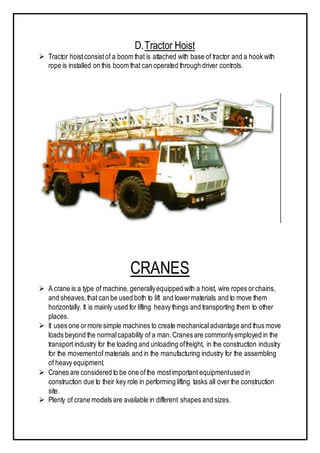
  • 53.
    2) Concrete mixers A concrete mixer (also commonlycalled a cementmixer) is a device that homogeneouslycombines cement,aggregate such as sand orgravel, and water to form concrete.A typical concrete mixer uses a revolving drum to mix the components.Forsmallervolume works portable concrete mixers are often used so that the concrete can be made atthe construction site, giving the workers ample time to use the concrete before it hardens.  Specialconcrete transport trucks (in-transit mixers) are made to transport and mix concrete up to the construction site. They can be charged with dry materials and water, with the mixing occurring during transport. With this process,the material has alreadybeen mixing. The concrete mixing transporttruck maintains the materials’ liquid state through agitation, or turning of the drum,until delivery.  They are mainly used for mixing small quantities of concrete constituents.  Capacity:- 200lt/batch (small mixers) 200-7501/batch (large mixers)
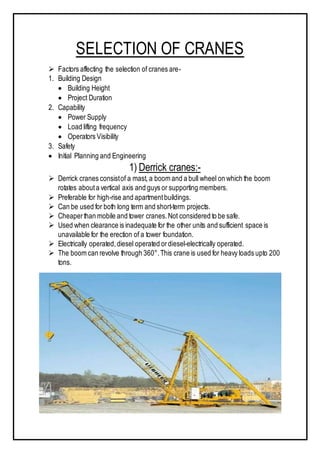
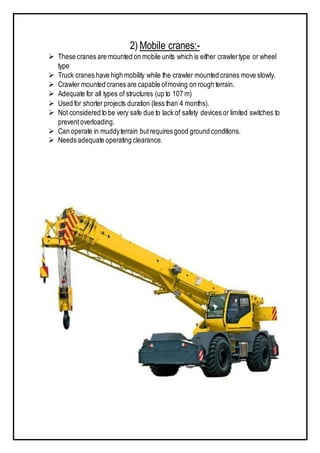
  • 54.
    3) Concrete transitmixers  They are mainly used for transporting concrete from batching point  capacity:- 3cum-9cum 4) Concrete pumps  They are used for horizontal and vertical transportation of large volumes of concrete in shortduration.  capacity:- 30cum/hr(ordinaryconstruction). 120cum/hr (specialized construction).
  • 55.
    5) Vibrator  Forcompactingthe concrete after its placementconcrete vibrator is used.It help volume of concrete quickly placed.give high density, reduce airvoids.  Types of Vibrators  Internal vibrators-Use on large work for flat slab.  External or form vibrators-uses for thin section of walls.  Surface vibrator-used to finish concrete surface such as bridge floor, road slab, section platform.  Table Vibrator-used for consolidation of precastunits.
  • 56.
    Needle vibrator Tablevibrator Surface vibrator Form vibrator
  • 57.
    SELECTION CRITERIA FORCONCRETING EQUIPMENTS  Selection of concreting equipmentcan be complicated and difficult. The decision will involve many issues that have to be analysed.The following factors are noteworthy:  Site characteristics such as boundaryconditions,noise limitations and other restrictions.  Equipmentavailability-local availability of equipment’s,whether the contractor owns that equipment  Continuity of operation  Effect of permanentwork  Weatherconditions  Temporaryworks  Time restrictions  Concrete specifications  Concrete-mixing equipmentselection will depend on factors such as the  Maximum and the total output required in a given time frame  Method of transporting the mixed concrete  Requirementof discharge heightof the mixer.  Concrete-placementequipmentselection depends on factors such as the  Capacity of the vehicle  Output of the vehicle  Site characteristics  Weatherconditions  Rental costs and the temporary haulroads.
  • 58.
    Pile driving equipment The process ofpile driving involves lifting the piles into position, holding it to refusal or to a specified depth.  Driving is accomplished through hammering the pile top with a hammer.  Equipmentare so designed for driven effecti vely at an economicalcost.  Major pile driving equipmentare:  Pie driving rigs  Pile driving hammers Pile driving hammer Pile driving rigs