construction equipment 1
Introduction
CONSTRUCTION EQUIPMENT 2
 In the case of huge construction projects;
 Proper use of the appropriate equipment contributes to
economy, quality, safety, speed and timely completion of a
project.
 Equipment are use for highway projects, irrigation,
buildings, power projects etc.
 15-30% of total project cost has been accounted towards
equipment and machinery.
Classification of Construction Equipment
CONSTRUCTION EQUIPMENT 3
1. Earth-moving equipment
2. Hauling equipment
3. Hoisting equipment
4. Conveying equipment
5. Aggregate and concrete production equipment
6. Pile-driving equipment
7. Tunneling and rock drilling equipment
8. Pumping and dewatering equipment
Operations involved in construction
of any project
CONSTRUCTION EQUIPMENT 4
 Excavation
 Digging of large quantities of earth
 Moving them to distances which are sometimes fairly long
 Placement
 Compacting
 Leveling
 Dozing
 Grading
 Hauling
EXCAVATINGANDEARTHMOVINGEQUIPMENT
CONSTRUCTION EQUIPMENT 5
 Power shovel
 Back hoe
 Drag line
 Clam shell
 Scrapers
 Bull dozer
POWERSHOVEL
CONSTRUCTION EQUIPMENT 6
 To excavate the earth and to load the trucks
 capable of excavating all types of earth except
hard rock
 size varies from 0.375m3 to 5m3 .
 Basics parts of power shovel including the track
system, cabin, cables, rack, stick, boom foot-pin,
saddle block, boom, boom point sheaves and
bucket.
APPLICATIONS
CONSTRUCTION EQUIPMENT 7
• Suitable for close range of work
• Capable of digging very hard materials,
• can remove big sized boulders.
• It is used in various types of jobs such as digging
in gravel banks, clay pits, digging cuts in road
works, road-side berms, etc.
Factors affecting output of power shovel
CONSTRUCTION EQUIPMENT 8
• Class of material
• Depth of cutting
• Angle of swing
• Job condition
• Management condition
• Size of hauling units
• Skill of the operator
• Physical condition of the shovel
OLD NEW
CONSTRUCTION EQUIPMENT 9
BACKHOE
CONSTRUCTION EQUIPMENT 10
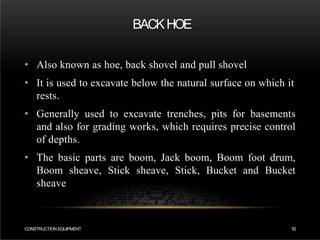
• Also known as hoe, back shovel and pull shovel
• It is used to excavate below the natural surface on which it
rests.
• Generally used to excavate trenches, pits for basements
and also for grading works, which requires precise control
of depths.
• The basic parts are boom, Jack boom, Boom foot drum,
Boom sheave, Stick sheave, Stick, Bucket and Bucket
sheave
Back hoe
CONSTRUCTION EQUIPMENT 11
Application
CONSTRUCTION EQUIPMENT 12
• It is the most suitable machine for digging below the
machine level, such as, trenches, footings, basements etc.
• It can be efficiently used to dress or trim the surface
avoiding the use of manual effort for dressing the
excavated the surface.
Drag line
CONSTRUCTION EQUIPMENT 13
• The drag line is so name because of its prominent operation of
dragging the bucket against the material to be dug.
• Unlike the shovel, it has a long light crane boom and the bucket is
loosely attached to the boom through cables.
• Because of this construction, a dragline can dig and dump over larger
distances than a shovel can do.
• Drag lines are useful for digging below its track level and handling
softer materials.
• The basic parts of a drag line including the boom, hoist cable, drag
cable, hoist chain, drag chain and bucket.
Application
CONSTRUCTION EQUIPMENT 14
• It is the most suitable machine for dragging softer material
and below its track level
• It is very useful for excavating trenches when the sides are
permitted to establish their angle of repose without
shoring.
• It has long reaches.
• It is mostly used in the excavation for canals and
depositing on the embankment without hauling units.
DRAGLINE
CONSTRUCTION EQUIPMENT 15
Clam shell
CONSTRUCTION EQUIPMENT 16
• This is so named due to resemblance of its bucket to a
clam which is like a shell-fish with hinged double shell.
• The front end is essentially a crane boom with a specially
designed bucket loosely attached at the end through cables
as in a drag line.
• The capacity of a clam shell bucket is usually given in
cubic meters.
• The basic parts of clam shell bucket are the closing line,
hoist line, sheaves, brackets, tagline, shell and hinge.
Application
CONSTRUCTION EQUIPMENT 17
• Used for handling loose material such as crushed stone,
sand, gravel, coal etc.
• Main feature is vertical lifting of material from one
location to another.
• Mainly used for removing material from coffer dam,
sewer main holes, well foundations etc.
CLAMSHELL
CONSTRUCTION EQUIPMENT 18
Comparisonbetween different types of equipment
CONSTRUCTION EQUIPMENT 19
s.no. Items of comparison Power
shovel
Back hoe Drag line Clam shell
1 Excavation in hard
soil or rock
Good Good Not good Poor
2 Excavation in wet
soil or mud
Poor Poor Moderately
good
Moderately
good
3 Distance between
footing and digging
Small Small Long Long
4 Loading efficiency Very good Good Moderately
good
Precise but
slow
5 Footing required Close to work Close to pit Fairly away
from pit
Fairly away
from pit
6 Digging level Digs at or
above
footing
level
Digs
below
footing
level
Digs
below
footing
level
Digs at or
below
footing level
7 Cycle time Short Shortly
more
than
power
More than
power shovel
More than
the other
equipment
Trenching machine
CONSTRUCTION EQUIPMENT 20
Used for excavating
trenches for laying
sewer,
pipelines,
cables etc.
Operation is quick
giving the required
depth or width.
Two types of
trenching machine
wheel type, ladder
type
Scrapers
CONSTRUCTION EQUIPMENT 21
• Unique machine for digging and long-distance hauling of
plough able materials.
• self-operating machine
• It is not dependent on other equipment.
• Wheels of machine cause some compaction.
• The basic parts of scrapers are the bowl, apron and tail
gate or ejector.
SCRAPER
CONSTRUCTION EQUIPMENT 22
Bull dozer
CONSTRUCTION EQUIPMENT 23
• The heavy blade attached to the tractor pushes the material
from one place to another.
• The tractor can be of the crawler or the wheeled type.
• Classification of bull dozer
1. Position of blades
a) Bull dozers in which the blade perpendicular to the
direction of movement
b) Angle dozers in which the blade is set at an angle with the
direction of movement.
2. Based on mountings
a) Wheel mounted
b)Crawler mounted
3. Based on the control
a) Cable controlled
b)Hydraulically controlled
CONSTRUCTION EQUIPMENT 24
Bull dozer
CONSTRUCTION EQUIPMENT 25
Applications
CONSTRUCTION EQUIPMENT 26
Bull dozers are mainly used for the following operations
1. For spreading the earth fill
2. For opening up pilot roads through mountainous and
rocky terrains.
3. Clearing construction sites.
4. Maintaining haul roads
5. Clearing land from the trees and stumps
6. back-filling trenches at construction sites by dragging the
earth from one place to another
Tractors
CONSTRUCTION EQUIPMENT 27
• Multi-purpose machines used mainly for pulling and pushing the
other equipment.
• Tractors may be classified as
a) Crawler type tractor- Used to move bull dozers, scrapers. The
crawler has a chain by which these tractors can be very effective even
in the case of loose or muddy soils. The speed of this type dose not
exceed 12 kmph normally.
b) Wheel type tractor- The engine is mounted on four wheels. The
main advantage is higher speed, sometimes exceeding 50 kmph it is
used for long-distance hauling and good roads.
TRACTOR
CONSTRUCTION EQUIPMENT 28
Comparison between crawler and
wheeled tractors
CONSTRUCTION EQUIPMENT 29
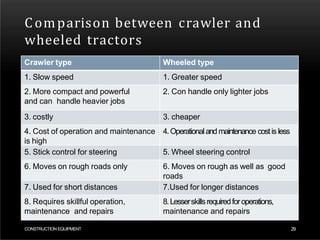
Crawler type Wheeled type
1. Slow speed 1. Greater speed
2. More compact and powerful
and can handle heavier jobs
2. Con handle only lighter jobs
3. costly 3. cheaper
4. Cost of operation and maintenance
is high
4.Operationaland maintenance costis less
5. Stick control for steering 5. Wheel steering control
6. Moves on rough roads only 6. Moves on rough as well as good
roads
7. Used for short distances 7.Used for longer distances
8. Requires skillful operation,
maintenance and repairs
8.Lesserskillsrequiredforoperations,
maintenance and repairs
Earth compaction equipment
CONSTRUCTION EQUIPMENT 30
• Smooth-wheel rollers.
• Sheep-foot rollers
a)Ordinary sheep-foot roller
b)Convertible roller
c)Turn foot roller
• Pneumatic-tyred rollers
Smooth-wheel rollers
CONSTRUCTION EQUIPMENT 31
• Plain steel rollers
• Self-propelled type
• Weighing from 5 to 15 tonnes
• Used for ordinary rolling work where deep compaction is
not required
• These rollers may have one front and two rear wheels
• The rear wheels being usually larger in diameter and the
front one being winder.
• Weight of rollers may be increased by filling water or sand
ballast in hollow cylinder.
• These rollers are effective in compacting granular soils,
such as sand, gravel and crushed stone.
CONSTRUCTION EQUIPMENT 32
SMOOTHWHEELROLLER
CONSTRUCTION EQUIPMENT 33
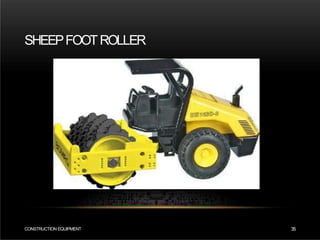
Sheep-foot rollers
CONSTRUCTION EQUIPMENT 34
• For compacting earth work in embankments and canals (where
compaction deep into the layer of the earth is required)
• These gives best result in compaction when the soil is clay or
predominantly cohesive and impervious.
• The sheep foot rollers may weigh upto 15 tonnes or more
• Travel at a speed of 25 kmph
• As roller moves over the surface, the feet penetrate the soil to produce
a kneading action and a pressure to mix and compact the soil from
bottom to top layer.
• With repeated passages of the roller, the penetration of feet decreases.
SHEEPFOOTROLLER
CONSTRUCTION EQUIPMENT 35
Pneumatic-tyred rollers
CONSTRUCTION EQUIPMENT 36
• It consists a base or a platform mounted between two
axles.
• The rear of which has one more wheel than the front.
• Most suitable for compacting fine-grained soil and well
graded sands.
• Ballasting is done using either water, sand or pig iron in
order to increase the self weight.
• Major advantages are the ability to control the ground
contact pressure by:
a) Altering the weights of machines,
b) Increasing the number of wheels,
c) Increasing the tyre width
d) Changing the contact area of the tyre by altering the
contact pressure.
CONSTRUCTION EQUIPMENT 37
PNEUMATICTYREDROLLER
CONSTRUCTION EQUIPMENT 38
Hauling equipment
CONSTRUCTION EQUIPMENT 39
• The equipment used for transportation of material are known as
hauling equipment or simply haulers.
• Haulers may operate on the roadways or railways
• It involve
 transportation of building materials,
 carriage and disposal of excavated earth
 haulage of heavy construction equipment.
• These are classified on the basis of method of dumping the
load
1. Dump trucks
a) Side or rear dump trucks
b) Bottom dump trucks
2. Dumpers
CONSTRUCTION EQUIPMENT 40
Dump trucks
CONSTRUCTION EQUIPMENT 41
• These are used for earth moving purpose.
• The selection of the type of dump trucks for a specific job depend on
the soil condition.
(a) Side or rear dump trucks-
 These are heavy duty trucks with strongly built body which is
hinged on the truck chassis at the rear end and one side
respectively, and can be fitted to the rear in the case of rear dump
and to the hinged side in case of the side dump, through the action
of hydraulic jacks.
 These trucks are suitable for use in hauling wet clay, sand, gravel,
quarry rocks etc.
Side dump truck
CONSTRUCTION EQUIPMENT 42
Rear dump truck
CONSTRUCTION EQUIPMENT 43
Bottom dump trucks
CONSTRUCTION EQUIPMENT 44
• These are similar to semi-trailers in which their front is supported on
the rear of the hauling tractor and their rear is resting on their own
wheels.
• The body of the truck remains in the same position and the discharge
of the material takes place through its bottom after opening of two
longitudinal gates.
• The gates are hinged to the side of the body.
• These trucks are suitable for use in hauling free flowing material,
such as, sand, gravel, dry earth, hard clay etc.
BOTTOMDUMPTRUCK
CONSTRUCTION EQUIPMENT 45
Dumpers
CONSTRUCTION EQUIPMENT 46
• High speed pneumatic wheeled trucks
• Short chasis
• Strong bodies
• Loading, hauling and dumping is done very fast as compared to other
equipment
• Suitable for short hauls on rough roads
• Specially where a shuttle movement is required.
Dumper
CONSTRUCTION EQUIPMENT 47
Hoisting equipment
CONSTRUCTION EQUIPMENT 48
• Hoisting is the lifting a weight from one location and moving it
to another location which is at a reasonable distance.
• Big projects such as, construction of dams, industrial buildings
etc. require hoisting equipment.
• Hoisting equipment includes jacks, winches, chain hoists and
cranes.
• Crane is the only single machine which, as a single piece, is
capable of providing three-dimensional movement of a weight.
• Cranes are broadly classified as :
i. Stationary or derrick cranes
ii. Mobile cranes
iii. Overhead or gantry cranes
iv. Traveller cranes
v. Tower cranes
CONSTRUCTION EQUIPMENT 49
Derrick cranes-
CONSTRUCTION EQUIPMENT 50
• Derrick cranes consist of a mast, a boom and a bull wheel on which
the boom rotates about a vertical axis and guys or supporting
members.
• Electrically operated, diesel operated or diesel-electrically operated.
• The boom can revolve through 360º.
• This crane is used for heavy loads upto 200 tons.
Mobile cranes-
• These cranes are mounted on mobile units which is either crawler
type or wheel type
• Truck cranes have high mobility while the crawler mounted cranes
move slowly.
• Crawler mounted cranes are capable of moving on rough terrain.
MOBILECRANES
CONSTRUCTION EQUIPMENT 51
Overhead or gantry cranes-
CONSTRUCTION EQUIPMENT 52
• large service area,
• freedom from floor obstructions
• and three-way mobility,
• Widely used in erection, foundry, steel plants, storage yards and
different types of industrial works.
• These type of cranes consist of two main parts i.e., the bridge and the
crab.
• The bridge consists of two main girders fixed at their end to end and
capable of moving on gantry rails.
• The crab consists of the hoisting gear mounted on a frame.
• The frame itself is mounted on another set of wheels and capable of
travelling across the main girder.
OVERHEADCRANE
CONSTRUCTION EQUIPMENT 53
TRAVELLERCRANES
CONSTRUCTION EQUIPMENT 54
• Travelling or bridge cranes have their crabs moving on girders
which are supported on legs instead of on overhead gantry track
as used in overhead cranes.
• The legs are capable of moving on tracks laid on the floor.
Tower cranes
CONSTRUCTION EQUIPMENT 55
• Tower cranes are actually a derrick crane mounted on a steel
tower.
• Tower cranes are usually used for industrial and residential
high-rise buildings.
• These are commonly used for assembly of industrial plants with
steel structures.
• The main parts of tower crane are under carriage, slewing
platform, tower with operator’s cabin and jibs.
• The tower has a truss structure welded from steel bars and
channels.
TOWERCRANE
CONSTRUCTION EQUIPMENT 56
Conveying equipment
CONSTRUCTION EQUIPMENT 57
• Transporting material from one place to another over a stationary
structure.
• Caries material in continuous stream with its distinct feature such as
endless chain or belt.
• Can be done horizontally, vertically or inclined.
• When the equipment does horizontal conveying, it is known as
conveyor and when it does vertical, it is known as elevator.
• Conveying are mainly used in mining, construction and in some of
the industries.
• In construction industry, conveyors are mainly used for concreting
purpose.
Utility
CONSTRUCTION EQUIPMENT 58
The Advantage of using conveyors are as follows:-
1. It increases the output.
2. It facilitates continuity in operation.
3. It results in time saving.
4. There are no waiting periods.
Some of the popular conveyors are as
follows:-
CONSTRUCTION EQUIPMENT 59
1. Belt conveyor
2. Screw conveyor
3. Bucket conveyor
4. Aerial transport
Belt conveyor
CONSTRUCTION EQUIPMENT 60
• Used when large quantities of materials have to be conveyed over
long distances at fast speed.
• It consists of a belt running over a pair of end drums or pulleys and
supported at regular intervals by a series of rollers called idlers.
• These idlers are supported on a conveyor frame.
• The middle sag provided in the belt prevent the spilling of material.
• Generally, rubber is most commonly used as conveyor belt.
BELTCONVEYOR
CONSTRUCTION EQUIPMENT 61
The advantages of using belt
conveyor are as follows:-
CONSTRUCTION EQUIPMENT 62
1. It can handle light as well as heavy materials, dry or wet, fine or
coarse etc.
2. It can and for distances to convey several thousand tons of material
per hour and for distances of distances of several kilometers.
3. It can carry material horizontally or inclined.
4. It is lighter in weight then other conveyors.
5. It gives controlled discharge of material and discharge can be
controlled by the speed of the belt.
SCREW CONVEYOR
CONSTRUCTION EQUIPMENT 63
• Widely used for handling granular or pulverized material.
• The quantity of material conveyed is less compared to the conveyor,
but at the same time the cost is also less.
• A screw conveyor consists of a helix mounted on a bearing at the
ends and at intermediate points and is driven by a motor from one
end.
• The material enters the through at one end is carried to the other end
by screwing action of helix.
• The length of the conveyor is about 65m. with an inclination up to a
maximum of 350.
SCREWCONVEYOR
CONSTRUCTION EQUIPMENT 64
Bucket conveyor
CONSTRUCTION EQUIPMENT 65
• It has buckets in the shape of ‘V’ which are open at the top.
• They may be feeder loaded or may drag in a vertical movement or
along an incline.
• The length of these type of conveyors are generally limited to 25 m.
(due to weight of the conveyor and strength of the chains.)
• This type of conveyer is mainly used in coal handling where bucket
elevators carry the material vertically.
BUCKETCONVEYOR
CONSTRUCTION EQUIPMENT 66
Aerial transport
CONSTRUCTION EQUIPMENT 67
• Aerial transportation through cableways, rope-ways and tram ways
• Often used with advantage for transportation of material in hilly
regions.
• Reducing the distance of transportation as well as cost of
transportation
• The load being passed over intermediate towers or stations for long
distances.
Aerial transport
CONSTRUCTION EQUIPMENT 68
construction equipment 88

construction equipment.pptx

  • 1.
  • 2.
    Introduction CONSTRUCTION EQUIPMENT 2 In the case of huge construction projects;  Proper use of the appropriate equipment contributes to economy, quality, safety, speed and timely completion of a project.  Equipment are use for highway projects, irrigation, buildings, power projects etc.  15-30% of total project cost has been accounted towards equipment and machinery.
  • 3.
    Classification of ConstructionEquipment CONSTRUCTION EQUIPMENT 3 1. Earth-moving equipment 2. Hauling equipment 3. Hoisting equipment 4. Conveying equipment 5. Aggregate and concrete production equipment 6. Pile-driving equipment 7. Tunneling and rock drilling equipment 8. Pumping and dewatering equipment
  • 4.
    Operations involved inconstruction of any project CONSTRUCTION EQUIPMENT 4  Excavation  Digging of large quantities of earth  Moving them to distances which are sometimes fairly long  Placement  Compacting  Leveling  Dozing  Grading  Hauling
  • 5.
    EXCAVATINGANDEARTHMOVINGEQUIPMENT CONSTRUCTION EQUIPMENT 5 Power shovel  Back hoe  Drag line  Clam shell  Scrapers  Bull dozer
  • 6.
    POWERSHOVEL CONSTRUCTION EQUIPMENT 6 To excavate the earth and to load the trucks  capable of excavating all types of earth except hard rock  size varies from 0.375m3 to 5m3 .  Basics parts of power shovel including the track system, cabin, cables, rack, stick, boom foot-pin, saddle block, boom, boom point sheaves and bucket.
  • 7.
    APPLICATIONS CONSTRUCTION EQUIPMENT 7 •Suitable for close range of work • Capable of digging very hard materials, • can remove big sized boulders. • It is used in various types of jobs such as digging in gravel banks, clay pits, digging cuts in road works, road-side berms, etc.
  • 8.
    Factors affecting outputof power shovel CONSTRUCTION EQUIPMENT 8 • Class of material • Depth of cutting • Angle of swing • Job condition • Management condition • Size of hauling units • Skill of the operator • Physical condition of the shovel
  • 9.
  • 10.
    BACKHOE CONSTRUCTION EQUIPMENT 10 •Also known as hoe, back shovel and pull shovel • It is used to excavate below the natural surface on which it rests. • Generally used to excavate trenches, pits for basements and also for grading works, which requires precise control of depths. • The basic parts are boom, Jack boom, Boom foot drum, Boom sheave, Stick sheave, Stick, Bucket and Bucket sheave
  • 11.
  • 12.
    Application CONSTRUCTION EQUIPMENT 12 •It is the most suitable machine for digging below the machine level, such as, trenches, footings, basements etc. • It can be efficiently used to dress or trim the surface avoiding the use of manual effort for dressing the excavated the surface.
  • 13.
    Drag line CONSTRUCTION EQUIPMENT13 • The drag line is so name because of its prominent operation of dragging the bucket against the material to be dug. • Unlike the shovel, it has a long light crane boom and the bucket is loosely attached to the boom through cables. • Because of this construction, a dragline can dig and dump over larger distances than a shovel can do. • Drag lines are useful for digging below its track level and handling softer materials. • The basic parts of a drag line including the boom, hoist cable, drag cable, hoist chain, drag chain and bucket.
  • 14.
    Application CONSTRUCTION EQUIPMENT 14 •It is the most suitable machine for dragging softer material and below its track level • It is very useful for excavating trenches when the sides are permitted to establish their angle of repose without shoring. • It has long reaches. • It is mostly used in the excavation for canals and depositing on the embankment without hauling units.
  • 15.
  • 16.
    Clam shell CONSTRUCTION EQUIPMENT16 • This is so named due to resemblance of its bucket to a clam which is like a shell-fish with hinged double shell. • The front end is essentially a crane boom with a specially designed bucket loosely attached at the end through cables as in a drag line. • The capacity of a clam shell bucket is usually given in cubic meters. • The basic parts of clam shell bucket are the closing line, hoist line, sheaves, brackets, tagline, shell and hinge.
  • 17.
    Application CONSTRUCTION EQUIPMENT 17 •Used for handling loose material such as crushed stone, sand, gravel, coal etc. • Main feature is vertical lifting of material from one location to another. • Mainly used for removing material from coffer dam, sewer main holes, well foundations etc.
  • 18.
  • 19.
    Comparisonbetween different typesof equipment CONSTRUCTION EQUIPMENT 19 s.no. Items of comparison Power shovel Back hoe Drag line Clam shell 1 Excavation in hard soil or rock Good Good Not good Poor 2 Excavation in wet soil or mud Poor Poor Moderately good Moderately good 3 Distance between footing and digging Small Small Long Long 4 Loading efficiency Very good Good Moderately good Precise but slow 5 Footing required Close to work Close to pit Fairly away from pit Fairly away from pit 6 Digging level Digs at or above footing level Digs below footing level Digs below footing level Digs at or below footing level 7 Cycle time Short Shortly more than power More than power shovel More than the other equipment
  • 20.
    Trenching machine CONSTRUCTION EQUIPMENT20 Used for excavating trenches for laying sewer, pipelines, cables etc. Operation is quick giving the required depth or width. Two types of trenching machine wheel type, ladder type
  • 21.
    Scrapers CONSTRUCTION EQUIPMENT 21 •Unique machine for digging and long-distance hauling of plough able materials. • self-operating machine • It is not dependent on other equipment. • Wheels of machine cause some compaction. • The basic parts of scrapers are the bowl, apron and tail gate or ejector.
  • 22.
  • 23.
    Bull dozer CONSTRUCTION EQUIPMENT23 • The heavy blade attached to the tractor pushes the material from one place to another. • The tractor can be of the crawler or the wheeled type. • Classification of bull dozer 1. Position of blades a) Bull dozers in which the blade perpendicular to the direction of movement b) Angle dozers in which the blade is set at an angle with the direction of movement.
  • 24.
    2. Based onmountings a) Wheel mounted b)Crawler mounted 3. Based on the control a) Cable controlled b)Hydraulically controlled CONSTRUCTION EQUIPMENT 24
  • 25.
  • 26.
    Applications CONSTRUCTION EQUIPMENT 26 Bulldozers are mainly used for the following operations 1. For spreading the earth fill 2. For opening up pilot roads through mountainous and rocky terrains. 3. Clearing construction sites. 4. Maintaining haul roads 5. Clearing land from the trees and stumps 6. back-filling trenches at construction sites by dragging the earth from one place to another
  • 27.
    Tractors CONSTRUCTION EQUIPMENT 27 •Multi-purpose machines used mainly for pulling and pushing the other equipment. • Tractors may be classified as a) Crawler type tractor- Used to move bull dozers, scrapers. The crawler has a chain by which these tractors can be very effective even in the case of loose or muddy soils. The speed of this type dose not exceed 12 kmph normally. b) Wheel type tractor- The engine is mounted on four wheels. The main advantage is higher speed, sometimes exceeding 50 kmph it is used for long-distance hauling and good roads.
  • 28.
  • 29.
    Comparison between crawlerand wheeled tractors CONSTRUCTION EQUIPMENT 29 Crawler type Wheeled type 1. Slow speed 1. Greater speed 2. More compact and powerful and can handle heavier jobs 2. Con handle only lighter jobs 3. costly 3. cheaper 4. Cost of operation and maintenance is high 4.Operationaland maintenance costis less 5. Stick control for steering 5. Wheel steering control 6. Moves on rough roads only 6. Moves on rough as well as good roads 7. Used for short distances 7.Used for longer distances 8. Requires skillful operation, maintenance and repairs 8.Lesserskillsrequiredforoperations, maintenance and repairs
  • 30.
    Earth compaction equipment CONSTRUCTIONEQUIPMENT 30 • Smooth-wheel rollers. • Sheep-foot rollers a)Ordinary sheep-foot roller b)Convertible roller c)Turn foot roller • Pneumatic-tyred rollers
  • 31.
    Smooth-wheel rollers CONSTRUCTION EQUIPMENT31 • Plain steel rollers • Self-propelled type • Weighing from 5 to 15 tonnes • Used for ordinary rolling work where deep compaction is not required • These rollers may have one front and two rear wheels • The rear wheels being usually larger in diameter and the front one being winder.
  • 32.
    • Weight ofrollers may be increased by filling water or sand ballast in hollow cylinder. • These rollers are effective in compacting granular soils, such as sand, gravel and crushed stone. CONSTRUCTION EQUIPMENT 32
  • 33.
  • 34.
    Sheep-foot rollers CONSTRUCTION EQUIPMENT34 • For compacting earth work in embankments and canals (where compaction deep into the layer of the earth is required) • These gives best result in compaction when the soil is clay or predominantly cohesive and impervious. • The sheep foot rollers may weigh upto 15 tonnes or more • Travel at a speed of 25 kmph • As roller moves over the surface, the feet penetrate the soil to produce a kneading action and a pressure to mix and compact the soil from bottom to top layer. • With repeated passages of the roller, the penetration of feet decreases.
  • 35.
  • 36.
    Pneumatic-tyred rollers CONSTRUCTION EQUIPMENT36 • It consists a base or a platform mounted between two axles. • The rear of which has one more wheel than the front. • Most suitable for compacting fine-grained soil and well graded sands. • Ballasting is done using either water, sand or pig iron in order to increase the self weight.
  • 37.
    • Major advantagesare the ability to control the ground contact pressure by: a) Altering the weights of machines, b) Increasing the number of wheels, c) Increasing the tyre width d) Changing the contact area of the tyre by altering the contact pressure. CONSTRUCTION EQUIPMENT 37
  • 38.
  • 39.
    Hauling equipment CONSTRUCTION EQUIPMENT39 • The equipment used for transportation of material are known as hauling equipment or simply haulers. • Haulers may operate on the roadways or railways • It involve  transportation of building materials,  carriage and disposal of excavated earth  haulage of heavy construction equipment.
  • 40.
    • These areclassified on the basis of method of dumping the load 1. Dump trucks a) Side or rear dump trucks b) Bottom dump trucks 2. Dumpers CONSTRUCTION EQUIPMENT 40
  • 41.
    Dump trucks CONSTRUCTION EQUIPMENT41 • These are used for earth moving purpose. • The selection of the type of dump trucks for a specific job depend on the soil condition. (a) Side or rear dump trucks-  These are heavy duty trucks with strongly built body which is hinged on the truck chassis at the rear end and one side respectively, and can be fitted to the rear in the case of rear dump and to the hinged side in case of the side dump, through the action of hydraulic jacks.  These trucks are suitable for use in hauling wet clay, sand, gravel, quarry rocks etc.
  • 42.
  • 43.
  • 44.
    Bottom dump trucks CONSTRUCTIONEQUIPMENT 44 • These are similar to semi-trailers in which their front is supported on the rear of the hauling tractor and their rear is resting on their own wheels. • The body of the truck remains in the same position and the discharge of the material takes place through its bottom after opening of two longitudinal gates. • The gates are hinged to the side of the body. • These trucks are suitable for use in hauling free flowing material, such as, sand, gravel, dry earth, hard clay etc.
  • 45.
  • 46.
    Dumpers CONSTRUCTION EQUIPMENT 46 •High speed pneumatic wheeled trucks • Short chasis • Strong bodies • Loading, hauling and dumping is done very fast as compared to other equipment • Suitable for short hauls on rough roads • Specially where a shuttle movement is required.
  • 47.
  • 48.
    Hoisting equipment CONSTRUCTION EQUIPMENT48 • Hoisting is the lifting a weight from one location and moving it to another location which is at a reasonable distance. • Big projects such as, construction of dams, industrial buildings etc. require hoisting equipment. • Hoisting equipment includes jacks, winches, chain hoists and cranes. • Crane is the only single machine which, as a single piece, is capable of providing three-dimensional movement of a weight.
  • 49.
    • Cranes arebroadly classified as : i. Stationary or derrick cranes ii. Mobile cranes iii. Overhead or gantry cranes iv. Traveller cranes v. Tower cranes CONSTRUCTION EQUIPMENT 49
  • 50.
    Derrick cranes- CONSTRUCTION EQUIPMENT50 • Derrick cranes consist of a mast, a boom and a bull wheel on which the boom rotates about a vertical axis and guys or supporting members. • Electrically operated, diesel operated or diesel-electrically operated. • The boom can revolve through 360º. • This crane is used for heavy loads upto 200 tons. Mobile cranes- • These cranes are mounted on mobile units which is either crawler type or wheel type • Truck cranes have high mobility while the crawler mounted cranes move slowly. • Crawler mounted cranes are capable of moving on rough terrain.
  • 51.
  • 52.
    Overhead or gantrycranes- CONSTRUCTION EQUIPMENT 52 • large service area, • freedom from floor obstructions • and three-way mobility, • Widely used in erection, foundry, steel plants, storage yards and different types of industrial works. • These type of cranes consist of two main parts i.e., the bridge and the crab. • The bridge consists of two main girders fixed at their end to end and capable of moving on gantry rails. • The crab consists of the hoisting gear mounted on a frame. • The frame itself is mounted on another set of wheels and capable of travelling across the main girder.
  • 53.
  • 54.
    TRAVELLERCRANES CONSTRUCTION EQUIPMENT 54 •Travelling or bridge cranes have their crabs moving on girders which are supported on legs instead of on overhead gantry track as used in overhead cranes. • The legs are capable of moving on tracks laid on the floor.
  • 55.
    Tower cranes CONSTRUCTION EQUIPMENT55 • Tower cranes are actually a derrick crane mounted on a steel tower. • Tower cranes are usually used for industrial and residential high-rise buildings. • These are commonly used for assembly of industrial plants with steel structures. • The main parts of tower crane are under carriage, slewing platform, tower with operator’s cabin and jibs. • The tower has a truss structure welded from steel bars and channels.
  • 56.
  • 57.
    Conveying equipment CONSTRUCTION EQUIPMENT57 • Transporting material from one place to another over a stationary structure. • Caries material in continuous stream with its distinct feature such as endless chain or belt. • Can be done horizontally, vertically or inclined. • When the equipment does horizontal conveying, it is known as conveyor and when it does vertical, it is known as elevator. • Conveying are mainly used in mining, construction and in some of the industries. • In construction industry, conveyors are mainly used for concreting purpose.
  • 58.
    Utility CONSTRUCTION EQUIPMENT 58 TheAdvantage of using conveyors are as follows:- 1. It increases the output. 2. It facilitates continuity in operation. 3. It results in time saving. 4. There are no waiting periods.
  • 59.
    Some of thepopular conveyors are as follows:- CONSTRUCTION EQUIPMENT 59 1. Belt conveyor 2. Screw conveyor 3. Bucket conveyor 4. Aerial transport
  • 60.
    Belt conveyor CONSTRUCTION EQUIPMENT60 • Used when large quantities of materials have to be conveyed over long distances at fast speed. • It consists of a belt running over a pair of end drums or pulleys and supported at regular intervals by a series of rollers called idlers. • These idlers are supported on a conveyor frame. • The middle sag provided in the belt prevent the spilling of material. • Generally, rubber is most commonly used as conveyor belt.
  • 61.
  • 62.
    The advantages ofusing belt conveyor are as follows:- CONSTRUCTION EQUIPMENT 62 1. It can handle light as well as heavy materials, dry or wet, fine or coarse etc. 2. It can and for distances to convey several thousand tons of material per hour and for distances of distances of several kilometers. 3. It can carry material horizontally or inclined. 4. It is lighter in weight then other conveyors. 5. It gives controlled discharge of material and discharge can be controlled by the speed of the belt.
  • 63.
    SCREW CONVEYOR CONSTRUCTION EQUIPMENT63 • Widely used for handling granular or pulverized material. • The quantity of material conveyed is less compared to the conveyor, but at the same time the cost is also less. • A screw conveyor consists of a helix mounted on a bearing at the ends and at intermediate points and is driven by a motor from one end. • The material enters the through at one end is carried to the other end by screwing action of helix. • The length of the conveyor is about 65m. with an inclination up to a maximum of 350.
  • 64.
  • 65.
    Bucket conveyor CONSTRUCTION EQUIPMENT65 • It has buckets in the shape of ‘V’ which are open at the top. • They may be feeder loaded or may drag in a vertical movement or along an incline. • The length of these type of conveyors are generally limited to 25 m. (due to weight of the conveyor and strength of the chains.) • This type of conveyer is mainly used in coal handling where bucket elevators carry the material vertically.
  • 66.
  • 67.
    Aerial transport CONSTRUCTION EQUIPMENT67 • Aerial transportation through cableways, rope-ways and tram ways • Often used with advantage for transportation of material in hilly regions. • Reducing the distance of transportation as well as cost of transportation • The load being passed over intermediate towers or stations for long distances.
  • 68.
  • 69.