AS SALAMO ALAIKOM
WELCOME TO THE PRESENTATION ON
AUTOMATION IN WEAVING
 This Term paper Presentation Is Presented By:
Shamsuzzaman sheikh
M.Sc 4th batch
Roll: 2015-2-2-002
 Submitted To:
Professor Masud Ahamed
VC, Bangladesh University Of Textiles
(BUTex)
TERM PAPER OUTLINE
 1.0 Introduction
 2.0 Automation
 3.0 Automation in Weaving process
 4.0 Machine requirements in Weaving Automation
 5.0 Demands on the automation
 6.0 Benefits of automation process
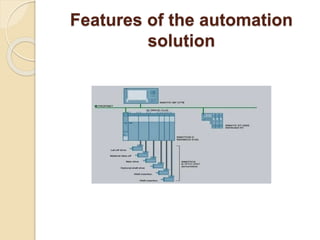
 7.0 Features of the automation solution:
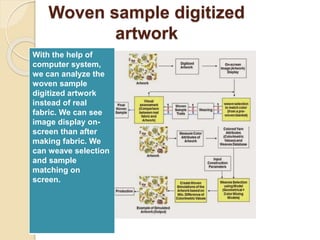
 7.1 Woven sample digitized artwork
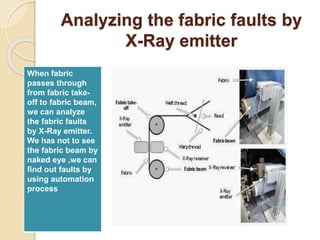
 7.2 Analyzing the fabric faults by X-Ray emitter
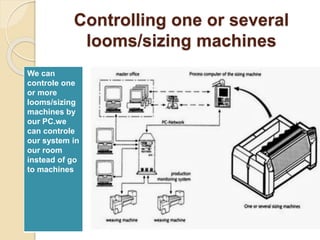
 7.3 Controlling one or several looms/sizing machines
 7.4 Sketch jacard design on image processor
 7.5 Comparison between manual designing and computer designing
 7.8 On-loom automation process
 8.0 Process automation system
 9.0 Important of Automation in the Weaving Sector
 10.0 Conclusion
 References
Introduction
 Weaving is best described by inter-
lacing, typically at right angles, two sets
of threads to shape cloth, a rug or else
other types of woven textiles. Today of
course this progression is for the most
part automated in addition to mass
produced, but the quality and the charm
of handmade, hand woven rugs and
clothing is immeasurable. Weaving is an
important process in textile
manufacturing, which manipulates
threads into a plumb interlocking outline,
which forms cloth.
Automation
 Automation or automatic control, is the use
of various control systems for operating
equipment such as machinery, processes in
factories, boilers and heat treating ovens,
switching in telephone networks, steering and
stabilization of ships, aircraft and other
applications with minimal or reduced human
intervention. Some processes have been
completely automated.
 The biggest benefit of automation is that it
saves labor, however, it is also used to save
energy and materials and to improve quality,
accuracy and precision.
Automation in Weaving
process
Automation in Weaving
process
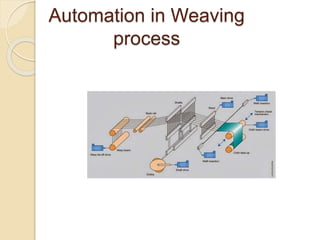
 The six production steps winding, warping, sizing,
weaving inspection and packing include 16 points of
automation. Of these, 12 deal with materials handling or
transport. Only four applications deal with automating
the machine operations themselves. This includes
automated process control on the slasher and the
weaving functions of
 Automatic Pick Repair
 Automated Warp breakage Locator
 Computerized Machine Control. Manual assistance is
still required for beam replacement and repair of warp
breaks.
 Implementation of electronic control such as computer
control in automatic looms has simplified operations as
only the conditions such as yarn type and weave, width
need to be input in order for the optimum operations to
Machine requirements in
Weaving Automation
 Weaving is the most widely used method of fabric
production for the decoration, clothing and home
furnishing textile sectors. However, technical textiles,
including wire cloth, are also produced on modern
weaving machines.
Irrespective of the weft insertion method used, very high
cycle and acceleration rates are essential for weaving
machines. Furthermore, weaving machines are
characterized by a large number of nonlinear motion
sequences and time-critical starting times. Mechatronic
solutions devised from a combination of mechanical
cams and servo drives for warp let-off and fabric take
up are the modern state of the art. More recently,
harness motion and weft insertion have also been
implemented with individual electric drives in some
instances.[3]
Demands on the automation
The demands on the automation are:
 Constant velocity relation between warp let-off and
fabric take-up as a function of the main drive
 Constant thread tension during the process (uniform
fabric quality)
 Weft insertion synchronized precisely with cycle times
 Fast position-oriented supply of weft threads
corresponding to the color selection
 Increase in machine cycle times
 Different weft insertion processes using a projectile, air
jet, or picker
 Short resetting times for lot changes
 Reproducibility of process data
 Pattern data management and preparation
Benefits of automation
process
 To attain even faster resetting times, the mechanical cam can
be replaced by a high resolution SIMOTION cam function for
harness motions.
 The technology functions integrated in SIMOTION,
particularly the electronic cam, make it easy to implement the
required motion control easily and safely for the process.
Furthermore, where necessary, they allow motion profiles to
be modified flexibly and with minimum effort.
 Variable user interfaces enable process parameters to be
quickly adapted to the execution system. These data can be
reproduced at any time and assigned according to process
technology. A lot change no longer requires you to make
manual adjustments.
 Tools for commissioning, configuration and diagnostics
integrated in the uniform, scalable SCOUT engineering
system reduce service and configuration times.
 Drive System : The integrated automation and drives
structure is rounded off by the bus-coupled dynamic
SINAMICS S120 drive system and SIMOTICS S-1FT7/1FK7
motors.
Features of the automation
solution
Woven sample digitized
artwork
With the help of
computer system,
we can analyze the
woven sample
digitized artwork
instead of real
fabric. We can see
image display on-
screen than after
making fabric. We
can weave selection
and sample
matching on
screen.
Analyzing the fabric faults by
X-Ray emitter
When fabric
passes through
from fabric take-
off to fabric beam,
we can analyze
the fabric faults
by X-Ray emitter.
We has not to see
the fabric beam by
naked eye ,we can
find out faults by
using automation
process
Controlling one or several
looms/sizing machines
We can
controle one
or more
looms/sizing
machines by
our PC.we
can controle
our system in
our room
instead of go
to machines
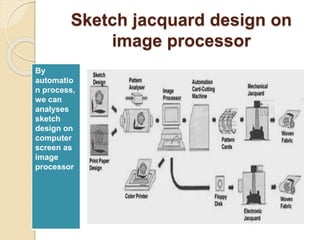
Sketch jacquard design on
image processor
By
automatio
n process,
we can
analyses
sketch
design on
computer
screen as
image
processor
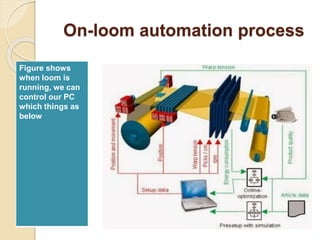
On-loom automation process
Figure shows
when loom is
running, we can
control our PC
which things as
below
Important of Automation in
the Weaving Sector
 Global competition ensures that only
the fittest survive. Today's weaver
needs to ensure that he/she is able to
manufacture and supply the finest
quality of fabric, at the lowest cost, in
the shortest possible time-frame.
Automation is the only option which
will allow the weaver to attain this
objective.
Conclusion
 Automation has resulted in control of
machines electronically from user
friendly interfaces, produce intricate
jacquard fabrics at the speed of
commodity fabrics, inspect fabrics on
loom, use optical and laser detection of
warp break, reduce downtime due to
higher levels of automation and quick
style and warp beam change. The
machine speed upto 1000 rpm is
possible, 5 to 10 times faster than 20
References
 The Automation of Weaving: an examination of the past and future
of loom design by Wendy C. Beatty Union College, 807 Union
Street, Schenectady NY,
 https://eb.automation.siemens.com/mall/en/WW/Catalog/Products/1
0087619;sited on :08/01/2014
 http://textilelearner.blogspot.com/2013/08/automation-in-weaving-
process-why-is.html
 Bennett, S. (1993). A History of Control Engineering 1930-1955.
London: Peter Peregrinus Ltd. On behalf of the Institution of
Electrical Engineers. ISBN 0-86341-280-7.
 The elevator example is commonly used in programming texts, such
as Unified modeling language http://www.exman.com/mshoass.ht. A
History of Control Engineering 1800-1930. London: Peter Peregrinus
Ltd. pp. 47, 266. ISBN 0-86341-047-2.
 Wiktionary on "[[wikt:automation|]]"
 Rifkin, Jeremy (1995). The End of Work: The Decline of the Global
Labor Force and the Dawn of the Post-Market Era. Putnam
Publishing Group. pp. 66, 75. ISBN 0-87477-779-8.
Jazak allah
and
Thanks to All

Advaced weaving

  • 1.
    AS SALAMO ALAIKOM WELCOMETO THE PRESENTATION ON AUTOMATION IN WEAVING  This Term paper Presentation Is Presented By: Shamsuzzaman sheikh M.Sc 4th batch Roll: 2015-2-2-002  Submitted To: Professor Masud Ahamed VC, Bangladesh University Of Textiles (BUTex)
  • 2.
    TERM PAPER OUTLINE 1.0 Introduction  2.0 Automation  3.0 Automation in Weaving process  4.0 Machine requirements in Weaving Automation  5.0 Demands on the automation  6.0 Benefits of automation process  7.0 Features of the automation solution:  7.1 Woven sample digitized artwork  7.2 Analyzing the fabric faults by X-Ray emitter  7.3 Controlling one or several looms/sizing machines  7.4 Sketch jacard design on image processor  7.5 Comparison between manual designing and computer designing  7.8 On-loom automation process  8.0 Process automation system  9.0 Important of Automation in the Weaving Sector  10.0 Conclusion  References
  • 3.
    Introduction  Weaving isbest described by inter- lacing, typically at right angles, two sets of threads to shape cloth, a rug or else other types of woven textiles. Today of course this progression is for the most part automated in addition to mass produced, but the quality and the charm of handmade, hand woven rugs and clothing is immeasurable. Weaving is an important process in textile manufacturing, which manipulates threads into a plumb interlocking outline, which forms cloth.
  • 4.
    Automation  Automation orautomatic control, is the use of various control systems for operating equipment such as machinery, processes in factories, boilers and heat treating ovens, switching in telephone networks, steering and stabilization of ships, aircraft and other applications with minimal or reduced human intervention. Some processes have been completely automated.  The biggest benefit of automation is that it saves labor, however, it is also used to save energy and materials and to improve quality, accuracy and precision.
  • 5.
  • 6.
    Automation in Weaving process The six production steps winding, warping, sizing, weaving inspection and packing include 16 points of automation. Of these, 12 deal with materials handling or transport. Only four applications deal with automating the machine operations themselves. This includes automated process control on the slasher and the weaving functions of  Automatic Pick Repair  Automated Warp breakage Locator  Computerized Machine Control. Manual assistance is still required for beam replacement and repair of warp breaks.  Implementation of electronic control such as computer control in automatic looms has simplified operations as only the conditions such as yarn type and weave, width need to be input in order for the optimum operations to
  • 7.
    Machine requirements in WeavingAutomation  Weaving is the most widely used method of fabric production for the decoration, clothing and home furnishing textile sectors. However, technical textiles, including wire cloth, are also produced on modern weaving machines. Irrespective of the weft insertion method used, very high cycle and acceleration rates are essential for weaving machines. Furthermore, weaving machines are characterized by a large number of nonlinear motion sequences and time-critical starting times. Mechatronic solutions devised from a combination of mechanical cams and servo drives for warp let-off and fabric take up are the modern state of the art. More recently, harness motion and weft insertion have also been implemented with individual electric drives in some instances.[3]
  • 8.
    Demands on theautomation The demands on the automation are:  Constant velocity relation between warp let-off and fabric take-up as a function of the main drive  Constant thread tension during the process (uniform fabric quality)  Weft insertion synchronized precisely with cycle times  Fast position-oriented supply of weft threads corresponding to the color selection  Increase in machine cycle times  Different weft insertion processes using a projectile, air jet, or picker  Short resetting times for lot changes  Reproducibility of process data  Pattern data management and preparation
  • 9.
    Benefits of automation process To attain even faster resetting times, the mechanical cam can be replaced by a high resolution SIMOTION cam function for harness motions.  The technology functions integrated in SIMOTION, particularly the electronic cam, make it easy to implement the required motion control easily and safely for the process. Furthermore, where necessary, they allow motion profiles to be modified flexibly and with minimum effort.  Variable user interfaces enable process parameters to be quickly adapted to the execution system. These data can be reproduced at any time and assigned according to process technology. A lot change no longer requires you to make manual adjustments.  Tools for commissioning, configuration and diagnostics integrated in the uniform, scalable SCOUT engineering system reduce service and configuration times.  Drive System : The integrated automation and drives structure is rounded off by the bus-coupled dynamic SINAMICS S120 drive system and SIMOTICS S-1FT7/1FK7 motors.
  • 10.
    Features of theautomation solution
  • 11.
    Woven sample digitized artwork Withthe help of computer system, we can analyze the woven sample digitized artwork instead of real fabric. We can see image display on- screen than after making fabric. We can weave selection and sample matching on screen.
  • 12.
    Analyzing the fabricfaults by X-Ray emitter When fabric passes through from fabric take- off to fabric beam, we can analyze the fabric faults by X-Ray emitter. We has not to see the fabric beam by naked eye ,we can find out faults by using automation process
  • 13.
    Controlling one orseveral looms/sizing machines We can controle one or more looms/sizing machines by our PC.we can controle our system in our room instead of go to machines
  • 14.
    Sketch jacquard designon image processor By automatio n process, we can analyses sketch design on computer screen as image processor
  • 15.
    On-loom automation process Figureshows when loom is running, we can control our PC which things as below
  • 16.
    Important of Automationin the Weaving Sector  Global competition ensures that only the fittest survive. Today's weaver needs to ensure that he/she is able to manufacture and supply the finest quality of fabric, at the lowest cost, in the shortest possible time-frame. Automation is the only option which will allow the weaver to attain this objective.
  • 17.
    Conclusion  Automation hasresulted in control of machines electronically from user friendly interfaces, produce intricate jacquard fabrics at the speed of commodity fabrics, inspect fabrics on loom, use optical and laser detection of warp break, reduce downtime due to higher levels of automation and quick style and warp beam change. The machine speed upto 1000 rpm is possible, 5 to 10 times faster than 20
  • 18.
    References  The Automationof Weaving: an examination of the past and future of loom design by Wendy C. Beatty Union College, 807 Union Street, Schenectady NY,  https://eb.automation.siemens.com/mall/en/WW/Catalog/Products/1 0087619;sited on :08/01/2014  http://textilelearner.blogspot.com/2013/08/automation-in-weaving- process-why-is.html  Bennett, S. (1993). A History of Control Engineering 1930-1955. London: Peter Peregrinus Ltd. On behalf of the Institution of Electrical Engineers. ISBN 0-86341-280-7.  The elevator example is commonly used in programming texts, such as Unified modeling language http://www.exman.com/mshoass.ht. A History of Control Engineering 1800-1930. London: Peter Peregrinus Ltd. pp. 47, 266. ISBN 0-86341-047-2.  Wiktionary on "[[wikt:automation|]]"  Rifkin, Jeremy (1995). The End of Work: The Decline of the Global Labor Force and the Dawn of the Post-Market Era. Putnam Publishing Group. pp. 66, 75. ISBN 0-87477-779-8.
  • 19.