PRESENTED
BY
SAGAR S. MANE
FINAL B.TEXT TPE
13DSTXPL14
APPLICATION OF
IN TEXTILES
Contents:
Introduction
Industrial robots
Applications in
textile industry
Importance of robots
Impact of robotics
Advantages &
Disadvantages
Conclusion
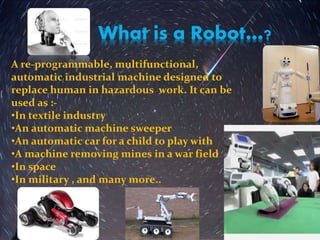
What is a Robot…?
A re-programmable, multifunctional,
automatic industrial machine designed to
replace human in hazardous work. It can be
used as :-
•In textile industry
•An automatic machine sweeper
•An automatic car for a child to play with
•A machine removing mines in a war field
•In space
•In military , and many more..
What is “ROBOTICS”?
 Robotics is a form of industrial
automation.
 These are machine systems
that can be conveniently directed
to change their mode and
sequence of operations by means
of software instructions.
 These programmable systems
requires high level of –
Consistency
Precision
Repeatability
Adaptability
Basic requirement of textile industry
Productivity :-The effectiveness with which
resources are consumed.
Efficiency:- Doing things rightly.
To achieve this, we need adaptive
manipulation systems having some…………
“ARTIFICIAL INTELLIGENCE”
Components of robot’s
1. Actuator - A robot system contains multiple
actuators which are essentially required for full
control of position and orientation.
2.Sensor- To give information regarding the
position and possibility, the velocity of the actuator,
to control on it.
3.Computation Objects- It requires a micro-
computer to perform work place analysis, servo,
kinematics and dynamic operations. In addition it
should perform supervisory operations such as
path planning and operator interaction.
Types of industrial robots
1.Mechanical Stop Control Robots :-
Here an actuator moves a joint until the joint runs up against a
mechanical stop. Programming of such robots is typically done
with a screw driver although some flexibility may be built in
by using several selectable stops on each axis.
2.Servo Controlled Robots :-
It is a point to point programming in which the actuator may be
controlled in such a way that it can stop at any point along its
path.
3.Continuous Path Control Robots :-
Here the robot may be required to interact continuously with its
environment in more complex work environment.
Some typical examples are welding, spray painting and performing
operations along a moving conveyor.
Applications of robotics in textile
Automation in spinning process :-
After passing the receiving station each bale will be moved
by the conveyor to a loading station where it will be picked
by robot and taken to storage.
When bale is selected for processing it will be removed from
the ware house by a robot on a” first-in, first-out basis”.
Auto Can Changing :-
In carding and draw frame process when a pre fixed
sliver length is filled in can Auto can changer actuated &
rotates the arm by 120 degree then full can is replaced by
empty one without stopping the machine.
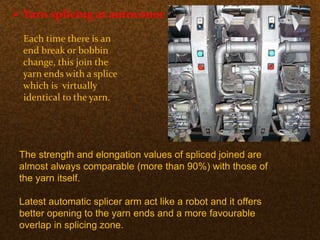
 Yarn splicing at autoconer :-
Each time there is an
end break or bobbin
change, this join the
yarn ends with a splice
which is virtually
identical to the yarn.
The strength and elongation values of spliced joined are
almost always comparable (more than 90%) with those of
the yarn itself.
Latest automatic splicer arm act like a robot and it offers
better opening to the yarn ends and a more favourable
overlap in splicing zone.
Auto Cone Changer :-
It changes a full cone by empty one when the predetermined
length is wound on it & resumes the winding at lowest starting time
automatically.
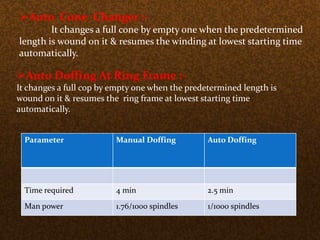
Auto Doffing At Ring Frame :-
It changes a full cop by empty one when the predetermined length is
wound on it & resumes the ring frame at lowest starting time
automatically.
Parameter Manual Doffing Auto Doffing
Time required 4 min 2.5 min
Man power 1.76/1000 spindles 1/1000 spindles
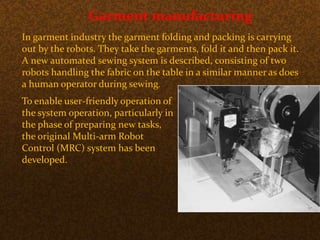
Garment manufacturing
In garment industry the garment folding and packing is carrying
out by the robots. They take the garments, fold it and then pack it.
A new automated sewing system is described, consisting of two
robots handling the fabric on the table in a similar manner as does
a human operator during sewing.
To enable user-friendly operation of
the system operation, particularly in
the phase of preparing new tasks,
the original Multi-arm Robot
Control (MRC) system has been
developed.
Yarn & fabric testing
An individual skilled operator may achieve a
reasonable degree of accuracy but
measurements vary from operator to
operator.
In the robotic test system, the tests cycles
are applied by the robot in addition to fabric
handling.
The fabric edge is detected by the two
infrared diffuse sensors . The digital status
of each sensor is communicated to robot
controller through DI (digital input) ports.
A fabric sample is aligned parallel to an edge
or a clamping device through a series of
translations and rotations.
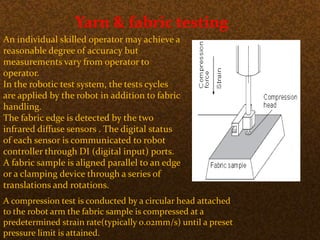
A compression test is conducted by a circular head attached
to the robot arm the fabric sample is compressed at a
predetermined strain rate(typically 0.02mm/s) until a preset
pressure limit is attained.
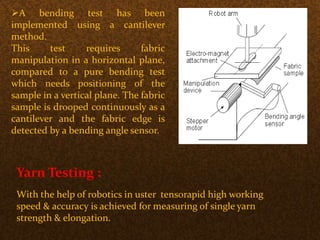
A bending test has been
implemented using a cantilever
method.
This test requires fabric
manipulation in a horizontal plane,
compared to a pure bending test
which needs positioning of the
sample in a vertical plane. The fabric
sample is drooped continuously as a
cantilever and the fabric edge is
detected by a bending angle sensor.
Yarn Testing :
With the help of robotics in uster tensorapid high working
speed & accuracy is achieved for measuring of single yarn
strength & elongation.
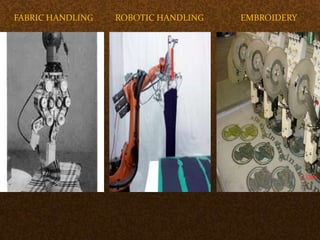
FABRIC HANDLING ROBOTIC HANDLING EMBROIDERY
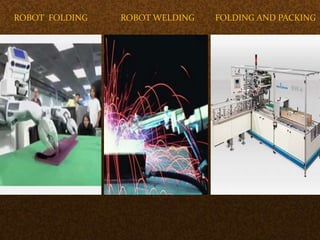
ROBOT FOLDING ROBOT WELDING FOLDING AND PACKING
Application of robotics automation
in the textile industry provides so
many benefits like……….
Labor savings
Reduced cycle time
Improved product
quality
Improved safety
Increase productivity
Increase in efficiency
Impact of “ROBOTICS” on the textile industry
Demand driven……..
Quick response to market/customer.
Increased capability to consumer requirements.
Increased capability to react to market changes.
A new market segment –customized garments-
to expand
Quality driven……
Increase in the final product quality(lower risk of
production rejects) and quality standardization.
Intelligent flexible highly re-configurable
manufacturing processes.
Increase in the process efficiency, speed and
reliability.
Reduced costs mainly for small batches.
Integration of human and technical resources.
Advantages & Disadvantages of “ROBOTICS”
Advantages…..
Robotics & automation can, in many situations,
increase productivity, safety, efficiency, quality and
consistency of products.
Can work in very critical situation i.e. in hazardous
environment without the need of life support.
It needs no environmental comfort such as lighting
, air conditioning etc.
Much more accurate than human.
Work consistently , tirelessly.
Speed of operation is fast.
Robot will not ignore the work.
Disadvantages……
Robot are more costlier.
Experts are required to maintain them.
Threat to employment in population crowed
country like India.
Conclusion…….
Robots are being used in textiles today and
substantial developments are already being made. Since
we operate in what may generally be described as free
enterprise economy, the future use of this new
technology will develop as the economics of each area
of manufacturing dictate . No doubt about it , all of us can
look forward to exciting developments in this field.
Sagar Mane B.Text. Textile Plant Engineer

Sagar Mane B.Text. Textile Plant Engineer

  • 1.
    PRESENTED BY SAGAR S. MANE FINALB.TEXT TPE 13DSTXPL14 APPLICATION OF IN TEXTILES
  • 2.
    Contents: Introduction Industrial robots Applications in textileindustry Importance of robots Impact of robotics Advantages & Disadvantages Conclusion
  • 3.
    What is aRobot…? A re-programmable, multifunctional, automatic industrial machine designed to replace human in hazardous work. It can be used as :- •In textile industry •An automatic machine sweeper •An automatic car for a child to play with •A machine removing mines in a war field •In space •In military , and many more..
  • 4.
    What is “ROBOTICS”? Robotics is a form of industrial automation.  These are machine systems that can be conveniently directed to change their mode and sequence of operations by means of software instructions.  These programmable systems requires high level of – Consistency Precision Repeatability Adaptability
  • 5.
    Basic requirement oftextile industry Productivity :-The effectiveness with which resources are consumed. Efficiency:- Doing things rightly. To achieve this, we need adaptive manipulation systems having some………… “ARTIFICIAL INTELLIGENCE”
  • 6.
    Components of robot’s 1.Actuator - A robot system contains multiple actuators which are essentially required for full control of position and orientation. 2.Sensor- To give information regarding the position and possibility, the velocity of the actuator, to control on it. 3.Computation Objects- It requires a micro- computer to perform work place analysis, servo, kinematics and dynamic operations. In addition it should perform supervisory operations such as path planning and operator interaction.
  • 7.
    Types of industrialrobots 1.Mechanical Stop Control Robots :- Here an actuator moves a joint until the joint runs up against a mechanical stop. Programming of such robots is typically done with a screw driver although some flexibility may be built in by using several selectable stops on each axis. 2.Servo Controlled Robots :- It is a point to point programming in which the actuator may be controlled in such a way that it can stop at any point along its path. 3.Continuous Path Control Robots :- Here the robot may be required to interact continuously with its environment in more complex work environment. Some typical examples are welding, spray painting and performing operations along a moving conveyor.
  • 8.
    Applications of roboticsin textile Automation in spinning process :- After passing the receiving station each bale will be moved by the conveyor to a loading station where it will be picked by robot and taken to storage. When bale is selected for processing it will be removed from the ware house by a robot on a” first-in, first-out basis”. Auto Can Changing :- In carding and draw frame process when a pre fixed sliver length is filled in can Auto can changer actuated & rotates the arm by 120 degree then full can is replaced by empty one without stopping the machine.
  • 9.
     Yarn splicingat autoconer :- Each time there is an end break or bobbin change, this join the yarn ends with a splice which is virtually identical to the yarn. The strength and elongation values of spliced joined are almost always comparable (more than 90%) with those of the yarn itself. Latest automatic splicer arm act like a robot and it offers better opening to the yarn ends and a more favourable overlap in splicing zone.
  • 10.
    Auto Cone Changer:- It changes a full cone by empty one when the predetermined length is wound on it & resumes the winding at lowest starting time automatically. Auto Doffing At Ring Frame :- It changes a full cop by empty one when the predetermined length is wound on it & resumes the ring frame at lowest starting time automatically. Parameter Manual Doffing Auto Doffing Time required 4 min 2.5 min Man power 1.76/1000 spindles 1/1000 spindles
  • 11.
    Garment manufacturing In garmentindustry the garment folding and packing is carrying out by the robots. They take the garments, fold it and then pack it. A new automated sewing system is described, consisting of two robots handling the fabric on the table in a similar manner as does a human operator during sewing. To enable user-friendly operation of the system operation, particularly in the phase of preparing new tasks, the original Multi-arm Robot Control (MRC) system has been developed.
  • 12.
    Yarn & fabrictesting An individual skilled operator may achieve a reasonable degree of accuracy but measurements vary from operator to operator. In the robotic test system, the tests cycles are applied by the robot in addition to fabric handling. The fabric edge is detected by the two infrared diffuse sensors . The digital status of each sensor is communicated to robot controller through DI (digital input) ports. A fabric sample is aligned parallel to an edge or a clamping device through a series of translations and rotations. A compression test is conducted by a circular head attached to the robot arm the fabric sample is compressed at a predetermined strain rate(typically 0.02mm/s) until a preset pressure limit is attained.
  • 13.
    A bending testhas been implemented using a cantilever method. This test requires fabric manipulation in a horizontal plane, compared to a pure bending test which needs positioning of the sample in a vertical plane. The fabric sample is drooped continuously as a cantilever and the fabric edge is detected by a bending angle sensor. Yarn Testing : With the help of robotics in uster tensorapid high working speed & accuracy is achieved for measuring of single yarn strength & elongation.
  • 14.
    FABRIC HANDLING ROBOTICHANDLING EMBROIDERY
  • 15.
    ROBOT FOLDING ROBOTWELDING FOLDING AND PACKING
  • 16.
    Application of roboticsautomation in the textile industry provides so many benefits like………. Labor savings Reduced cycle time Improved product quality Improved safety Increase productivity Increase in efficiency
  • 17.
    Impact of “ROBOTICS”on the textile industry Demand driven…….. Quick response to market/customer. Increased capability to consumer requirements. Increased capability to react to market changes. A new market segment –customized garments- to expand
  • 18.
    Quality driven…… Increase inthe final product quality(lower risk of production rejects) and quality standardization. Intelligent flexible highly re-configurable manufacturing processes. Increase in the process efficiency, speed and reliability. Reduced costs mainly for small batches. Integration of human and technical resources.
  • 19.
    Advantages & Disadvantagesof “ROBOTICS” Advantages….. Robotics & automation can, in many situations, increase productivity, safety, efficiency, quality and consistency of products. Can work in very critical situation i.e. in hazardous environment without the need of life support. It needs no environmental comfort such as lighting , air conditioning etc. Much more accurate than human. Work consistently , tirelessly. Speed of operation is fast. Robot will not ignore the work.
  • 20.
    Disadvantages…… Robot are morecostlier. Experts are required to maintain them. Threat to employment in population crowed country like India.
  • 21.
    Conclusion……. Robots are beingused in textiles today and substantial developments are already being made. Since we operate in what may generally be described as free enterprise economy, the future use of this new technology will develop as the economics of each area of manufacturing dictate . No doubt about it , all of us can look forward to exciting developments in this field.