
RUKHSANA QASIM CDTS.KHI.
1RUKHSNA QASIM CDTS.KHI18/1/2013
RUKHSANA QASIM CDTS.KHI.
18/1/2013RUKHSNA QASIM CDTS.KHI 2
FEDERAL CIVILDEFENCE TRAINING
SCHOOL KARACHI
RUKHSANA QASIM CDTS.KHI.
3RUKHSNA QASIM CDTS.KHI18/1/2013
RUKHSANA QASIM CDTS.KHI.
RUKHSANA QASIM CIVIL DEFENCE TRAINING SCHOOL KARACHI
Can you
save a life ?
In an emergency, when every
second is critical,
RUKHSANA QASIM CDTS.KHI.
RUKHSANA QASIM CIVIL DEFENCE TRAINING SCHOOL KARACHI
RUKHSANA QASIM CDTS.KHI.
According to recent
statistics sudden cardiac
arrest is rapidly
becoming the leading
cause of death
6RUKHSNA QASIM CDTS.KHI18/1/2013
RUKHSANA QASIM CDTS.KHI.
Once the heart ceases to
function, a healthy human
brain may survive without
oxygen for up to 4 minutes
without suffering any
permanent damage.
7RUKHSNA QASIM CDTS.KHI18/1/2013
RUKHSANA QASIM CDTS.KHI.
Unfortunately, a typical
EMS response may take
20 ,30 or even 50 minutes
in Pakistan.
8RUKHSNA QASIM CDTS.KHI18/1/2013
RUKHSANA QASIM CDTS.KHI.
It is during those critical
minutes that CPR can provide
oxygenated blood to the
victim's brain and the heart,
dramatically increasing his
chance of survival. 55
9RUKHSNA QASIM CDTS.KHI18/1/2013
RUKHSANA QASIM CDTS.KHI.
TIM E LINE
0-4 minutes. brain damage
unlikely.
4-6 minutes. brain damage
possible.
6-10 minutes. brain damage
probable.
RUKHSANA QASIM CDTS.KHI.
RUKHSANA QASIM CIVIL DEFENCE TRAINING SCHOOL KARACHI
Rukhsana Qasim
CARDIOPULMO
NARY
RESUSCITATION
RUKHSANA QASIM CDTS.KHI.
DEFINITION
 Cardiopulmonary
resuscitation (CPR) is a
procedure to support and
maintain breathing and
circulation on a person
who has stopped
breathing (respiratory 13RUKHSNA QASIM CDTS.KHI18/1/2013CPR
RUKHSANA QASIM CDTS.KHI.
RUKHSANA QASIM CIVIL DEFENCE TRAINING SCHOOL KARACHIRukhsana Qasim
It is a two-part
procedure that involves
rescue breathing and
external chest
compressions.
RUKHSANA QASIM CDTS.KHI.
• Allergic Reactions,
• Asphyxiation,
• Breathing Passages Blocked,
• Choking,
• Drowning,
• Drug Reactions
• Overdoses,
• Electric Shock,
• Exposure To Cold,
• Severe Shock
RESPIRATORY AND CARDIAC ARREST
CAN BE CAUSED BY
15RUKHSNA QASIM CDTS.KHI18/1/2013CPR
RUKHSANA QASIM CDTS.KHI.
 CPR can be performed by trained
bystanders or healthcare professionals
 It should always be performed on the
scene
 CPR must be performed within 4-6
minutes of when breathing stopped to
prevent brain damage or death .
 CPR is a skill that must be practiced
 Call first your local emergency
medical assistance. before providing
CPR
16RUKHSNA QASIM CDTS.KHI18/1/2013CPR
RUKHSANA QASIM CDTS.KHI.
 CPR should never be
performed on a healthy person
since it can cause serious injury to
a beating heart.
 DO NOT begin the
chest compressions of CPR
until the airway is cleared.
PRECAUTIONS
17RUKHSNA QASIM CDTS.KHI18/1/2013CPR
RUKHSANA QASIM CDTS.KHI.
RUKHSANA QASIM CIVIL DEFENCE TRAINING SCHOOL KARACHI
Adul
tCPR
RUKHSANA QASIM CDTS.KHI.
RUKHSANA QASIM CIVIL DEFENCE TRAINING SCHOOL KARACHI
CPR
RUKHSANA QASIM CDTS.KHI.
18/1/2013 20 RUKHSNA QASIM CDTS.KHI
Open Airway.
If head/spinal injuries are not
suspected, use head tilt, chin
lift.
CPR
RUKHSANA QASIM CDTS.KHI.
18/1/2013 21 RUKHSNA QASIM CDTS.KHI
Check for Breathing
(10 seconds).
Assess quality and rate of
breathing
CPR
RUKHSANA QASIM CDTS.KHI.
18/1/2013 22RUKHSNA QASIM CDTS.KHI
If casualty is not
breathing, give 2 slow
ventilations.
CPR
RUKHSANA QASIM CDTS.KHI.
18/1/2013 23
RUKHSNA QASIM CDTS.KHI
If air will not go
in, even after
readjusting
airway, begin first
aid for CHOKING
CPR
RUKHSANA QASIM CDTS.KHI.
18/1/2013 24
RUKHSNA QASIM CDTS.KHI
If air does go in, check
Circulation/pulse
(10 seconds).
CPR
RUKHSANA QASIM CDTS.KHI.
18/1/2013 25RUKHSNA QASIM CDTS.KHI
If casualty is not breathing,
but has a pulse, Begin
Artificial Respiration.
CPR
RUKHSANA QASIM CDTS.KHI.
18/1/2013 26 RUKHSNA QASIM CDTS.KHI
If casualty is not breathing
and has no pulse,
begin CPR.
CPR
RUKHSANA QASIM CDTS.KHI.
PERFORMING CPR
27RUKHSNA QASIM CDTS.KHI18/1/2013CPR
RUKHSANA QASIM CDTS.KHI.
Roll the victim onto his
back on a hard surface,
keeping his back in a
straight line,
28RUKHSNA QASIM CDTS.KHI18/1/2013CPR
RUKHSANA QASIM CDTS.KHI.
check for signs of life
listening for breath sounds,
feeling for air motion on your
cheek and ear, and looking for
chest motion.
29RUKHSNA QASIM CDTS.KHI18/1/2013CPR
RUKHSANA QASIM CDTS.KHI.
CLEAR THE AIR WAY
30RUKHSNA QASIM CDTS.KHI18/1/2013CPR
RUKHSANA QASIM CDTS.KHI.
begin rescue
breathing.
If the victim is not breathing,
31RUKHSNA QASIM CDTS.KHI18/1/2013CPR
RUKHSANA QASIM CDTS.KHI.
The rescuer opens the
person's airway by placing
the head face up, with the
forehead tilted back and
the chin lifted
RUKHSANA QASIM CDTS.KHI.
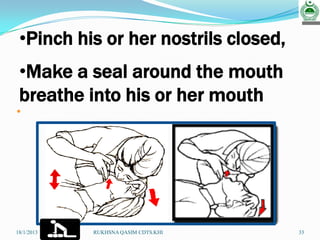
•Pinch his or her nostrils closed,
•Make a seal around the mouth
breathe into his or her mouth
•
33RUKHSNA QASIM CDTS.KHI18/1/2013
RUKHSANA QASIM CDTS.KHI.
• Give one breath every five seconds
• 12 breaths each minute
• Completely refill your lungs after each
breath.
• The rescuer breaks away for an instant
and then repeats.
• The person's head is repositioned
after each mouth-to-mouth breath.
RUKHSANA QASIM CDTS.KHI.
 After two
breaths, the rescuer
checks the person's
pulse by moving the
hand that was under
the person's chin to
the artery in the neck
(carotid artery).
RUKHSANA QASIM CDTS.KHI.
If the person has a heart-
beat, the rescuer continues
rescue breathing until the
help arrives or the person
begins breathing on his or
her own.
CPR
RUKHSANA QASIM CDTS.KHI.
If the person is
breathing, the rescuer
turns the person onto his
or her side
37RUKHSNA QASIM CDTS.KHI18/1/2013CPR
RUKHSANA QASIM CDTS.KHI.
RUKHSANA QASIM CIVIL DEFENCE TRAINING SCHOOL KARACHI
1.No response
2.No movement
3.No breathing
CPR
RUKHSANA QASIM CDTS.KHI.
Begin chest compressions.
CPR
RUKHSANA QASIM CDTS.KHI.
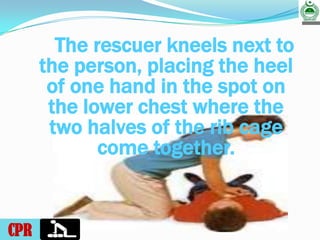
The rescuer kneels next to
the person, placing the heel
of one hand in the spot on
the lower chest where the
two halves of the rib cage
come together.
CPR
RUKHSANA QASIM CDTS.KHI.
41RUKHSNA QASIM CDTS.KHI18/1/2013
The rescuer puts his
other hand on top of the one
on the chest and interlocks
the fingers.
CPR
RUKHSANA QASIM CDTS.KHI.
forward to position the shoulders
directly above the hands on the
person's chest, and presses
down, using only the palms, so that
the person's breastbone sinks in
about 1½-2 in.
The rescuer releases without
removing the hands, then repeats
about 30 times
CPR
RUKHSANA QASIM CDTS.KHI.
 Push down 1 1/2 to 2
inches. The pushing down and
letting up phase of each cycle
should be equal in duration.
Don't jab down and relax. After
30 compressions, breathe into
the person's mouth twice.
CPR
RUKHSANA QASIM CDTS.KHI.
The rescuer tilts the person's
head and returns to rescue
breathing for two quick
breaths.
Then he alternates breathing
and heart compress presses
for one minute, and checks for
a pulse.
CPR
RUKHSANA QASIM CDTS.KHI.
 After each cycles of 30
compressions and two
breaths,
 Re-check for signs of life.
Continue the rescue
maneuvers as long as
there are no signs of life.
CPR
RUKHSANA QASIM CDTS.KHI.
if
If the rescuer finds signs of a
heartbeat and breathing, CPR is
stopped.
 If the person is breathing but
has no pulse the heart press is
continued.
if the person has a pulse but is not
46RUKHSNA QASIM CDTS.KHI18/1/2013
RUKHSANA QASIM CDTS.KHI.
MEDICAL HELP
47RUKHSNA QASIM CDTS.KHI18/1/2013CPR
RUKHSANA QASIM CDTS.KHI.
WISH YOU A HAPPY
LIFE
48RUKHSNA QASIM CDTS.KHI18/1/2013
RUKHSANA QASIM CDTS.KHI.
Rukhsana
QasimINSTRUCTOR
FEDERAL CIVIL DEFENCE TRAINING SCHOOL KARACHI

Adult cpr