Admin Best Practices:
Reports & Dashboards
Forward-Looking Statements
"Safe harbor" statement under the Private Securities Litigation Reform Act of 1995: This presentation contains forward-looking statements about the company's financial and
operating results, which may include expected GAAP and non-GAAP financial and other operating and non-operating results, including revenue, net income, diluted earnings
per share, operating cash flow growth, operating margin improvement, expected revenue growth, expected current remaining performance obligation growth, expected tax
rates, stock-based compensation expenses, amortization of purchased intangibles, shares outstanding, market growth, environmental, social and governance goals and
expected capital allocation, including mergers and acquisitions, capital expenditures and other investments. The achievement or success of the matters covered by such
forward-looking statements involves risks, uncertainties and assumptions. If any such risks or uncertainties materialize or if any of the assumptions prove incorrect, the
company’s results could differ materially from the results expressed or implied by the forward-looking statements it makes.
The risks and uncertainties referred to above include -- but are not limited to -- risks associated with the effect of general economic and market conditions; the impact of
geopolitical events, natural disasters and actual or threatened public health emergencies, such as the ongoing Coronavirus pandemic; the impact of foreign currency exchange
rate and interest rate fluctuations on our results; our business strategy and our plan to build our business, including our strategy to be the leading provider of enterprise cloud
computing applications and platforms; the pace of change and innovation in enterprise cloud computing services; the seasonal nature of our sales cycles; the competitive
nature of the market in which we participate; our international expansion strategy; the demands on our personnel and infrastructure resulting from significant growth in our
customer base and operations, including as a result of acquisitions; our service performance and security, including the resources and costs required to avoid unanticipated
downtime and prevent, detect and remediate potential security breaches; the expenses associated with our data centers and third-party infrastructure providers; additional
data center capacity; real estate and office facilities space; our operating results and cash flows; new services and product features, including any efforts to expand our services
beyond the CRM market; our strategy of acquiring or making investments in complementary businesses, joint ventures, services, technologies and intellectual property rights;
the performance and fair value of our investments in complementary businesses through our strategic investment portfolio; our ability to realize the benefits from strategic
partnerships, joint ventures and investments; the impact of future gains or losses from our strategic investment portfolio, including gains or losses from overall market
conditions that may affect the publicly traded companies within our strategic investment portfolio; our ability to execute our business plans; our ability to successfully integrate
acquired businesses and technologies; our ability to continue to grow unearned revenue and remaining performance obligation; our ability to protect our intellectual property
rights; our ability to develop our brands; our reliance on third-party hardware, software and platform providers; our dependency on the development and maintenance of the
infrastructure of the Internet; the effect of evolving domestic and foreign government regulations, including those related to the provision of services on the Internet, those
related to accessing the Internet, and those addressing data privacy, cross-border data transfers and import and export controls; the valuation of our deferred tax assets and the
release of related valuation allowances; the potential availability of additional tax assets in the future; the impact of new accounting pronouncements and tax laws;
uncertainties affecting our ability to estimate our tax rate; uncertainties regarding our tax obligations in connection with potential jurisdictional transfers of intellectual
property, including the tax rate, the timing of the transfer and the value of such transferred intellectual property; the impact of expensing stock options and other equity
awards; the sufficiency of our capital resources; factors related to our outstanding debt, revolving credit facility and loan associated with 50 Fremont; compliance with our debt
covenants and lease obligations; current and potential litigation involving us; and the impact of climate change.
Further information on these and other factors that could affect the company’s financial results is included in the reports on Forms 10-K, 10-Q and 8-K and in other filings it
makes with the Securities and Exchange Commission from time to time. These documents are available on the SEC Filings section of the Investor Information section of the
company’s website at.
Salesforce.com, inc. assumes no obligation and does not intend to update these forward-looking statements, except as required by law.
LeeAnne Rimel
@leeanndroid
Connect With Us
@SalesforceAdmns
#AwesomeAdmin
admin.salesforce.com
Salesforce Admins
Watch the Recording
This is being recorded!
Find it right here on:
trailhead.com/live
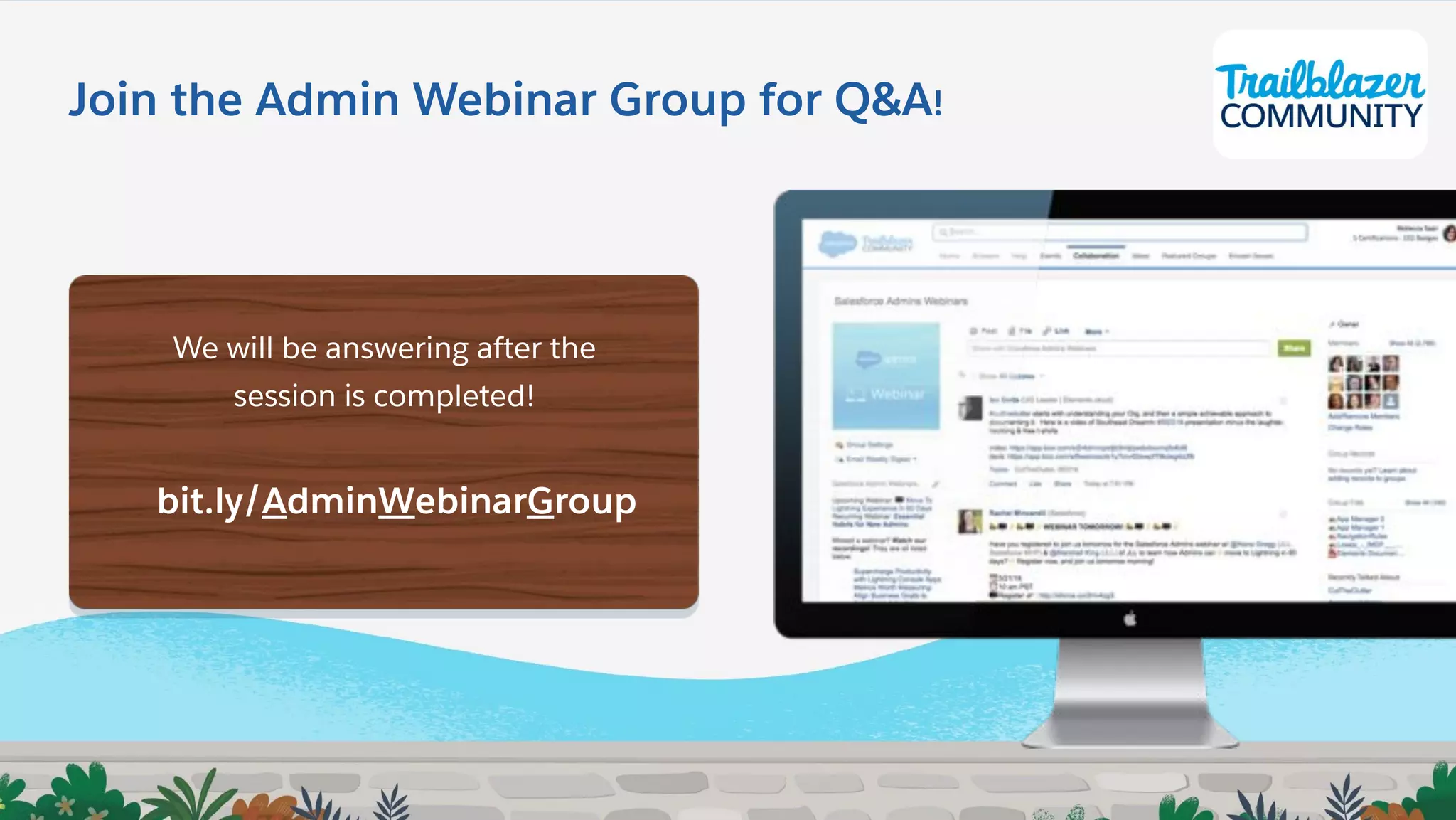
Join the Admin Webinar Group for Q&A!
We will be answering after the
session is completed!
bit.ly/AdminWebinarGroup
Today’s Agenda
The Why & What of Reporting
Building Reports & Dashboards
Troubleshooting Your Reports
Resources
The Why & What of Reporting
Reporting is a Fundamental Part of Your Company
Insight into trends and data
Look across business units, segments, and geographies
Provide the insight you need to take action
Review data quality and find potential issues
Share goals and priorities
Provide visibility and transparency
The right report can provide critical insights
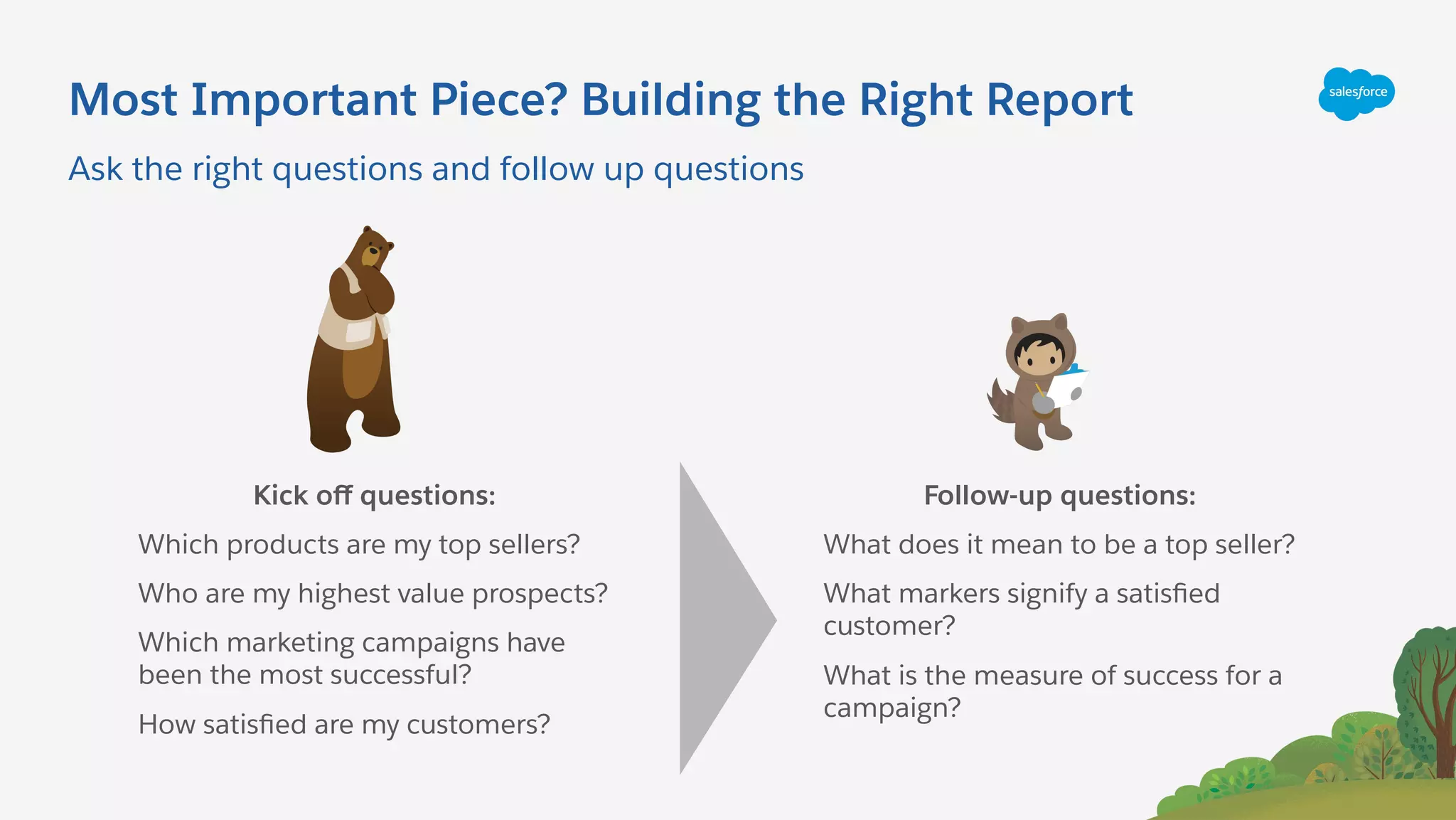
Most Important Piece? Building the Right Report
Kick off questions:
Which products are my top sellers?
Who are my highest value prospects?
Which marketing campaigns have
been the most successful?
How satisfied are my customers?
Follow-up questions:
What does it mean to be a top seller?
What markers signify a satisfied
customer?
What is the measure of success for a
campaign?
Ask the right questions and follow up questions
Building Reports & Dashboards
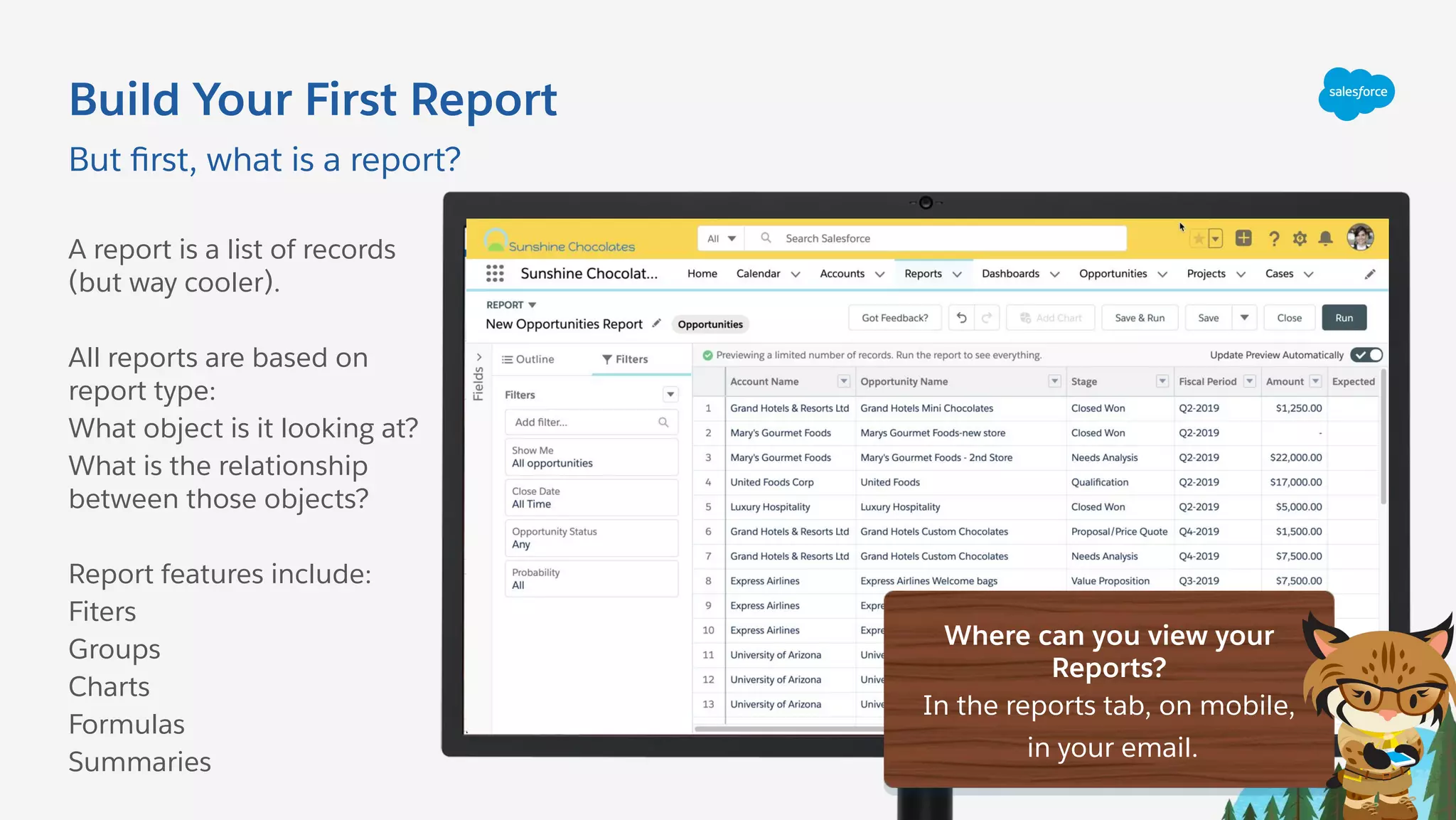
Build Your First Report
A report is a list of records
(but way cooler).
All reports are based on
report type:
What object is it looking at?
What is the relationship
between those objects?
Report features include:
Fiters
Groups
Charts
Formulas
Summaries
But first, what is a report?
Where can you view your
Reports?
In the reports tab, on mobile,
in your email.
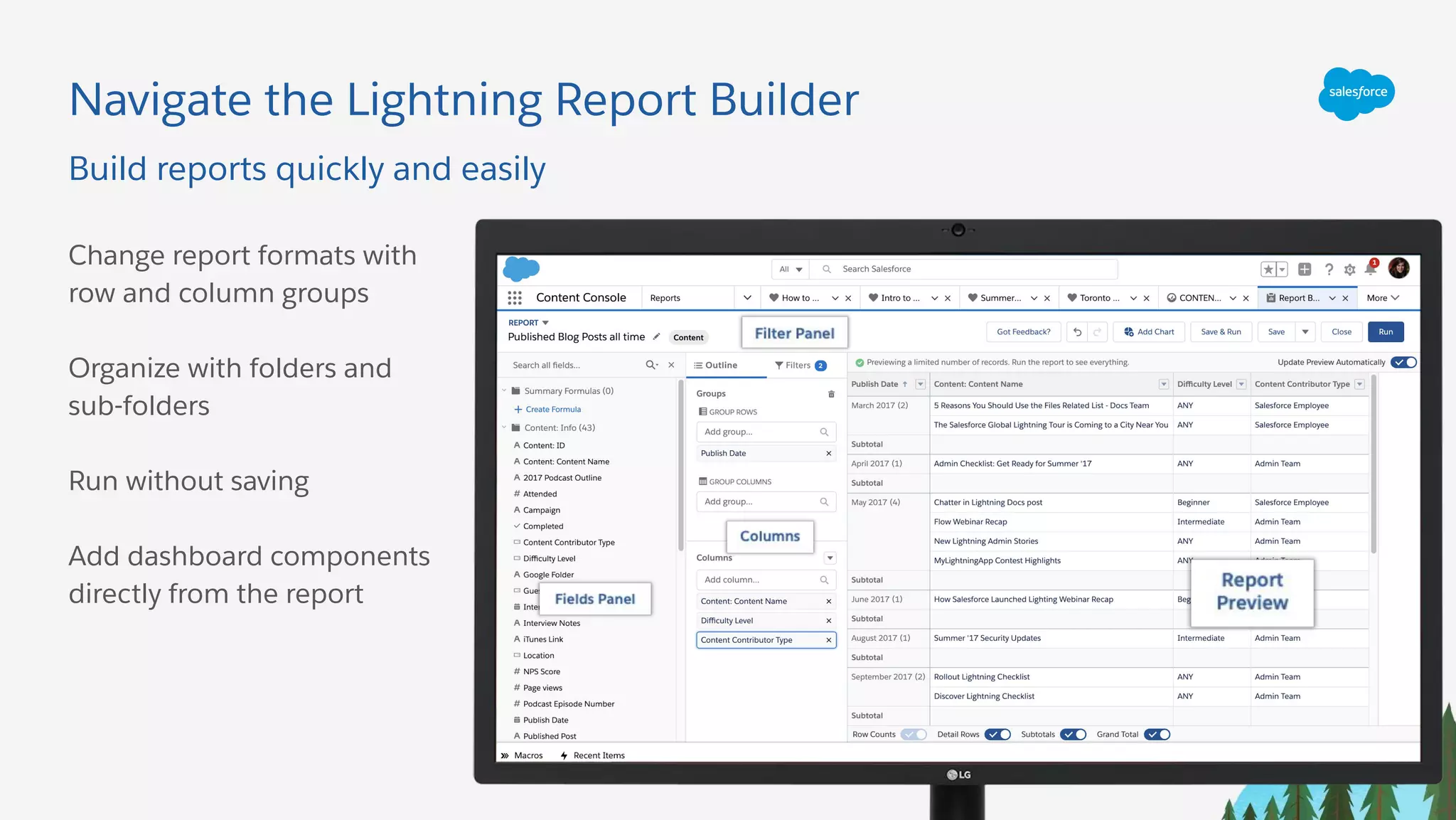
Navigate the Lightning Report Builder
Change report formats with
row and column groups
Organize with folders and
sub-folders
Run without saving
Add dashboard components
directly from the report
Build reports quickly and easily
Demo
Build a Report
Build Your First Dashboard
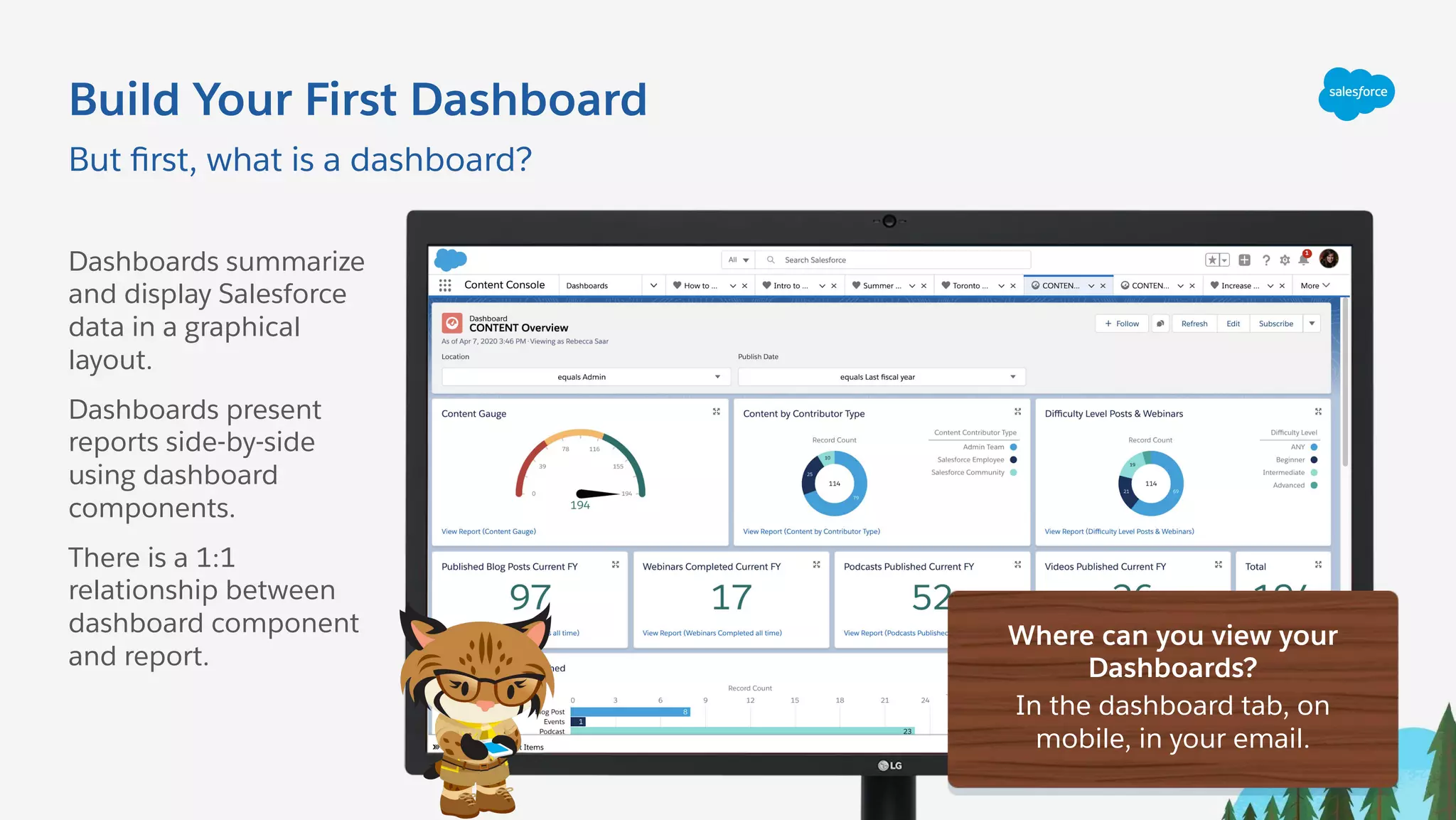
Dashboards summarize
and display Salesforce
data in a graphical
layout.
Dashboards present
reports side-by-side
using dashboard
components.
There is a 1:1
relationship between
dashboard component
and report.
But first, what is a dashboard?
Where can you view your
Dashboards?
In the dashboard tab, on
mobile, in your email.
Build Your First Dashboard
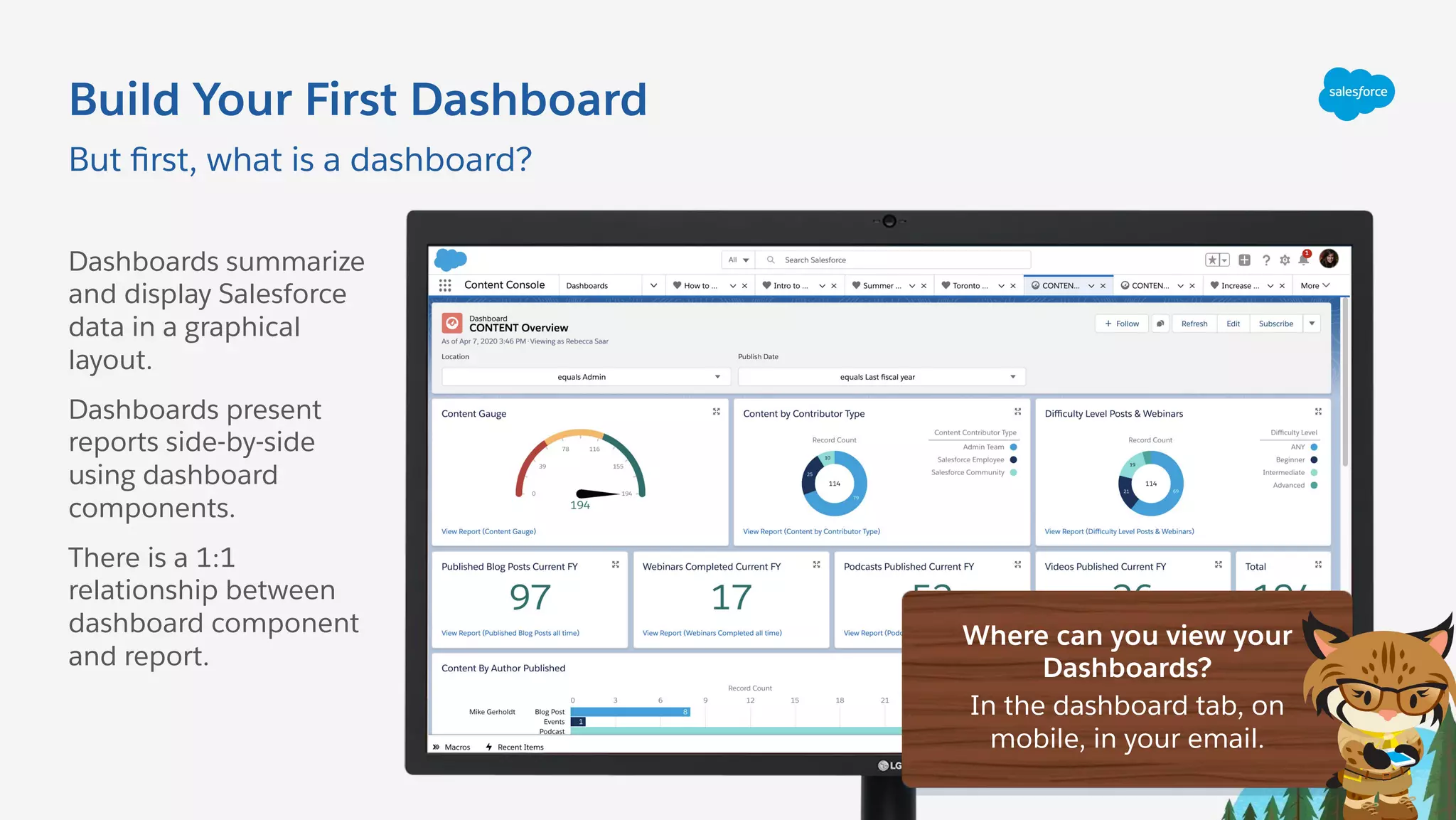
Dashboards summarize
and display Salesforce
data in a graphical
layout.
Dashboards present
reports side-by-side
using dashboard
components.
There is a 1:1
relationship between
dashboard component
and report.
But first, what is a dashboard?
Where can you view your
Dashboards?
In the dashboard tab, on
mobile, in your email.
Dashboards Drive Insight, Alignment and Productivity
Executives, groups, and project leaders 💙 dashboards
Gain high-level view of
the business
Group together
similar information
Drive team & goal
alignment
Take These Key Steps To Increase Usability & Visibility
Partner with your stakeholder to build the right dashboard for their
project.
Determine the data/report level access for all the components on the
dashboard with Running User.
Grant access through dashboard folders.
Turn on Chatter Feed Tracking to collaborate and communicate even
more on dashboards.
Show end users how to access dashboards on Salesforce Mobile &
schedule email deliveries.
Demo
Build a Dashboard
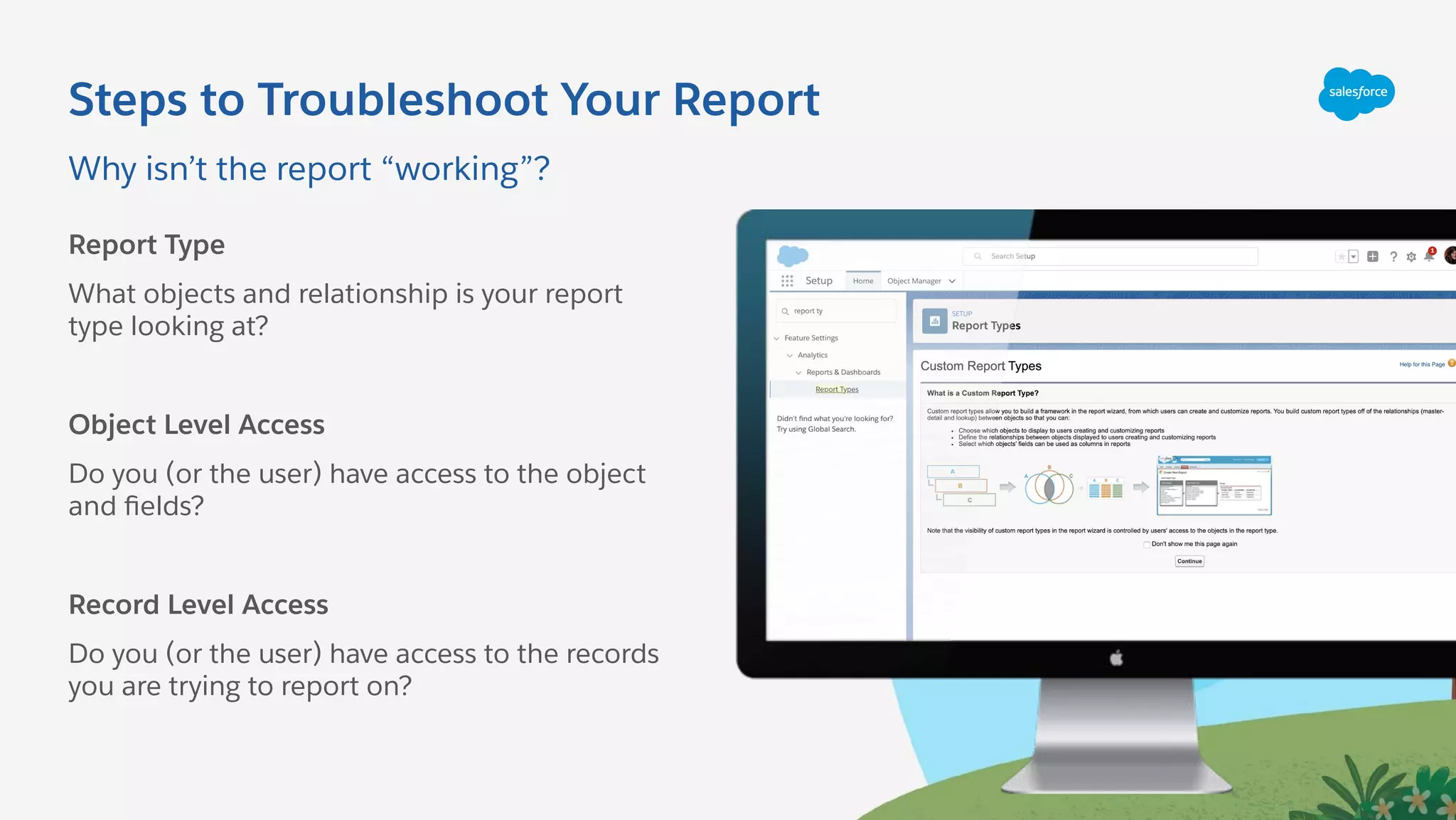
Why isn’t the report “working”?
Steps to Troubleshoot Your Report
Report Type
What objects and relationship is your report
type looking at?
Object Level Access
Do you (or the user) have access to the object
and fields?
Record Level Access
Do you (or the user) have access to the records
you are trying to report on?
Resources to Learn More
Get hands-on, get the latest best practices, and connect with others
Find blog posts, videos and
podcasts under the Reports
& Dashboards Topic Filter
Get questions answered
in the Admin Trailblazers
Group
Take the Reports &
Dashboards for Lightning
Experience Module
trailhead.salesforce.com admin.salesforce.com trailblazer.salesforce.com
Survey
bit.ly/adminreportingsession
survey
Slides
bit.ly/adminreportingsession
slides
Q&A
bit.ly/AdminWebinarGroup
Admin Best Practices: Reports & Dashboards

Admin Best Practices: Reports & Dashboards

  • 1.
  • 2.
    Forward-Looking Statements "Safe harbor"statement under the Private Securities Litigation Reform Act of 1995: This presentation contains forward-looking statements about the company's financial and operating results, which may include expected GAAP and non-GAAP financial and other operating and non-operating results, including revenue, net income, diluted earnings per share, operating cash flow growth, operating margin improvement, expected revenue growth, expected current remaining performance obligation growth, expected tax rates, stock-based compensation expenses, amortization of purchased intangibles, shares outstanding, market growth, environmental, social and governance goals and expected capital allocation, including mergers and acquisitions, capital expenditures and other investments. The achievement or success of the matters covered by such forward-looking statements involves risks, uncertainties and assumptions. If any such risks or uncertainties materialize or if any of the assumptions prove incorrect, the company’s results could differ materially from the results expressed or implied by the forward-looking statements it makes. The risks and uncertainties referred to above include -- but are not limited to -- risks associated with the effect of general economic and market conditions; the impact of geopolitical events, natural disasters and actual or threatened public health emergencies, such as the ongoing Coronavirus pandemic; the impact of foreign currency exchange rate and interest rate fluctuations on our results; our business strategy and our plan to build our business, including our strategy to be the leading provider of enterprise cloud computing applications and platforms; the pace of change and innovation in enterprise cloud computing services; the seasonal nature of our sales cycles; the competitive nature of the market in which we participate; our international expansion strategy; the demands on our personnel and infrastructure resulting from significant growth in our customer base and operations, including as a result of acquisitions; our service performance and security, including the resources and costs required to avoid unanticipated downtime and prevent, detect and remediate potential security breaches; the expenses associated with our data centers and third-party infrastructure providers; additional data center capacity; real estate and office facilities space; our operating results and cash flows; new services and product features, including any efforts to expand our services beyond the CRM market; our strategy of acquiring or making investments in complementary businesses, joint ventures, services, technologies and intellectual property rights; the performance and fair value of our investments in complementary businesses through our strategic investment portfolio; our ability to realize the benefits from strategic partnerships, joint ventures and investments; the impact of future gains or losses from our strategic investment portfolio, including gains or losses from overall market conditions that may affect the publicly traded companies within our strategic investment portfolio; our ability to execute our business plans; our ability to successfully integrate acquired businesses and technologies; our ability to continue to grow unearned revenue and remaining performance obligation; our ability to protect our intellectual property rights; our ability to develop our brands; our reliance on third-party hardware, software and platform providers; our dependency on the development and maintenance of the infrastructure of the Internet; the effect of evolving domestic and foreign government regulations, including those related to the provision of services on the Internet, those related to accessing the Internet, and those addressing data privacy, cross-border data transfers and import and export controls; the valuation of our deferred tax assets and the release of related valuation allowances; the potential availability of additional tax assets in the future; the impact of new accounting pronouncements and tax laws; uncertainties affecting our ability to estimate our tax rate; uncertainties regarding our tax obligations in connection with potential jurisdictional transfers of intellectual property, including the tax rate, the timing of the transfer and the value of such transferred intellectual property; the impact of expensing stock options and other equity awards; the sufficiency of our capital resources; factors related to our outstanding debt, revolving credit facility and loan associated with 50 Fremont; compliance with our debt covenants and lease obligations; current and potential litigation involving us; and the impact of climate change. Further information on these and other factors that could affect the company’s financial results is included in the reports on Forms 10-K, 10-Q and 8-K and in other filings it makes with the Securities and Exchange Commission from time to time. These documents are available on the SEC Filings section of the Investor Information section of the company’s website at. Salesforce.com, inc. assumes no obligation and does not intend to update these forward-looking statements, except as required by law.
  • 3.
  • 4.
  • 5.
    Watch the Recording Thisis being recorded! Find it right here on: trailhead.com/live
  • 6.
    Join the AdminWebinar Group for Q&A! We will be answering after the session is completed! bit.ly/AdminWebinarGroup
  • 7.
    Today’s Agenda The Why& What of Reporting Building Reports & Dashboards Troubleshooting Your Reports Resources
  • 8.
    The Why &What of Reporting
  • 9.
    Reporting is aFundamental Part of Your Company Insight into trends and data Look across business units, segments, and geographies Provide the insight you need to take action Review data quality and find potential issues Share goals and priorities Provide visibility and transparency The right report can provide critical insights
  • 10.
    Most Important Piece?Building the Right Report Kick off questions: Which products are my top sellers? Who are my highest value prospects? Which marketing campaigns have been the most successful? How satisfied are my customers? Follow-up questions: What does it mean to be a top seller? What markers signify a satisfied customer? What is the measure of success for a campaign? Ask the right questions and follow up questions
  • 11.
  • 12.
    Build Your FirstReport A report is a list of records (but way cooler). All reports are based on report type: What object is it looking at? What is the relationship between those objects? Report features include: Fiters Groups Charts Formulas Summaries But first, what is a report? Where can you view your Reports? In the reports tab, on mobile, in your email.
  • 13.
    Navigate the LightningReport Builder Change report formats with row and column groups Organize with folders and sub-folders Run without saving Add dashboard components directly from the report Build reports quickly and easily
  • 14.
  • 15.
    Build Your FirstDashboard Dashboards summarize and display Salesforce data in a graphical layout. Dashboards present reports side-by-side using dashboard components. There is a 1:1 relationship between dashboard component and report. But first, what is a dashboard? Where can you view your Dashboards? In the dashboard tab, on mobile, in your email.
  • 16.
    Build Your FirstDashboard Dashboards summarize and display Salesforce data in a graphical layout. Dashboards present reports side-by-side using dashboard components. There is a 1:1 relationship between dashboard component and report. But first, what is a dashboard? Where can you view your Dashboards? In the dashboard tab, on mobile, in your email.
  • 17.
    Dashboards Drive Insight,Alignment and Productivity Executives, groups, and project leaders 💙 dashboards Gain high-level view of the business Group together similar information Drive team & goal alignment
  • 18.
    Take These KeySteps To Increase Usability & Visibility Partner with your stakeholder to build the right dashboard for their project. Determine the data/report level access for all the components on the dashboard with Running User. Grant access through dashboard folders. Turn on Chatter Feed Tracking to collaborate and communicate even more on dashboards. Show end users how to access dashboards on Salesforce Mobile & schedule email deliveries.
  • 19.
  • 20.
    Why isn’t thereport “working”? Steps to Troubleshoot Your Report Report Type What objects and relationship is your report type looking at? Object Level Access Do you (or the user) have access to the object and fields? Record Level Access Do you (or the user) have access to the records you are trying to report on?
  • 21.
    Resources to LearnMore Get hands-on, get the latest best practices, and connect with others Find blog posts, videos and podcasts under the Reports & Dashboards Topic Filter Get questions answered in the Admin Trailblazers Group Take the Reports & Dashboards for Lightning Experience Module trailhead.salesforce.com admin.salesforce.com trailblazer.salesforce.com
  • 22.