




Lightning Components 101
An Apex Developer’s Guide
Salesforce Engineer,
Adam Olshansky
600 14X
Adam Olshansky
Salesforce Engineer, Google
​ @adam17amo
​ adam@adamtoarchitect.com
​ bit.ly/lightningmigration
Speaker Logo
Forward Looking Statement
Statement under the Private Securities Litigation Reform Act of 1995:
This presentation contains forward-looking statements about the company’s financial and operating results, which may include expected GAAP and non-GAAP financial and other operating and non-
operating results, including revenue, net income, diluted earnings per share, operating cash flow growth, operating margin improvement, expected revenue growth, expected current remaining
performance obligation growth, expected tax rates, the one-time accounting non-cash charge that was incurred in connection with the Salesforce.org combination; stock-based compensation expenses,
amortization of purchased intangibles, shares outstanding, market growth and sustainability goals. The achievement or success of the matters covered by such forward-looking statements involves
risks, uncertainties and assumptions. If any such risks or uncertainties materialize or if any of the assumptions prove incorrect, the company’s results could differ materially from the results expressed or
implied by the forward-looking statements we make.
The risks and uncertainties referred to above include -- but are not limited to -- risks associated with the effect of general economic and market conditions; the impact of geopolitical events; the impact
of foreign currency exchange rate and interest rate fluctuations on our results; our business strategy and our plan to build our business, including our strategy to be the leading provider of enterprise
cloud computing applications and platforms; the pace of change and innovation in enterprise cloud computing services; the seasonal nature of our sales cycles; the competitive nature of the market in
which we participate; our international expansion strategy; the demands on our personnel and infrastructure resulting from significant growth in our customer base and operations, including as a result
of acquisitions; our service performance and security, including the resources and costs required to avoid unanticipated downtime and prevent, detect and remediate potential security breaches; the
expenses associated with new data centers and third-party infrastructure providers; additional data center capacity; real estate and office facilities space; our operating results and cash flows; new
services and product features, including any efforts to expand our services beyond the CRM market; our strategy of acquiring or making investments in complementary businesses, joint ventures,
services, technologies and intellectual property rights; the performance and fair value of our investments in complementary businesses through our strategic investment portfolio; our ability to realize
the benefits from strategic partnerships, joint ventures and investments; the impact of future gains or losses from our strategic investment portfolio, including gains or losses from overall market
conditions that may affect the publicly traded companies within the company's strategic investment portfolio; our ability to execute our business plans; our ability to successfully integrate acquired
businesses and technologies, including delays related to the integration of Tableau due to regulatory review by the United Kingdom Competition and Markets Authority; our ability to continue to grow
unearned revenue and remaining performance obligation; our ability to protect our intellectual property rights; our ability to develop our brands; our reliance on third-party hardware, software and
platform providers; our dependency on the development and maintenance of the infrastructure of the Internet; the effect of evolving domestic and foreign government regulations, including those related
to the provision of services on the Internet, those related to accessing the Internet, and those addressing data privacy, cross-border data transfers and import and export controls; the valuation of our
deferred tax assets and the release of related valuation allowances; the potential availability of additional tax assets in the future; the impact of new accounting pronouncements and tax laws;
uncertainties affecting our ability to estimate our tax rate; the impact of expensing stock options and other equity awards; the sufficiency of our capital resources; factors related to our outstanding debt,
revolving credit facility, term loan and loan associated with 50 Fremont; compliance with our debt covenants and lease obligations; current and potential litigation involving us; and the impact of climate
change.
Further information on these and other factors that could affect the company’s financial results is included in the reports on Forms 10-K, 10-Q and 8-K and in other filings it makes with the Securities
and Exchange Commission from time to time. These documents are available on the SEC Filings section of the Investor Information section of the company’s website at www.salesforce.com/investor.
Salesforce.com, inc. assumes no obligation and does not intend to update these forward-looking statements, except as required by law.
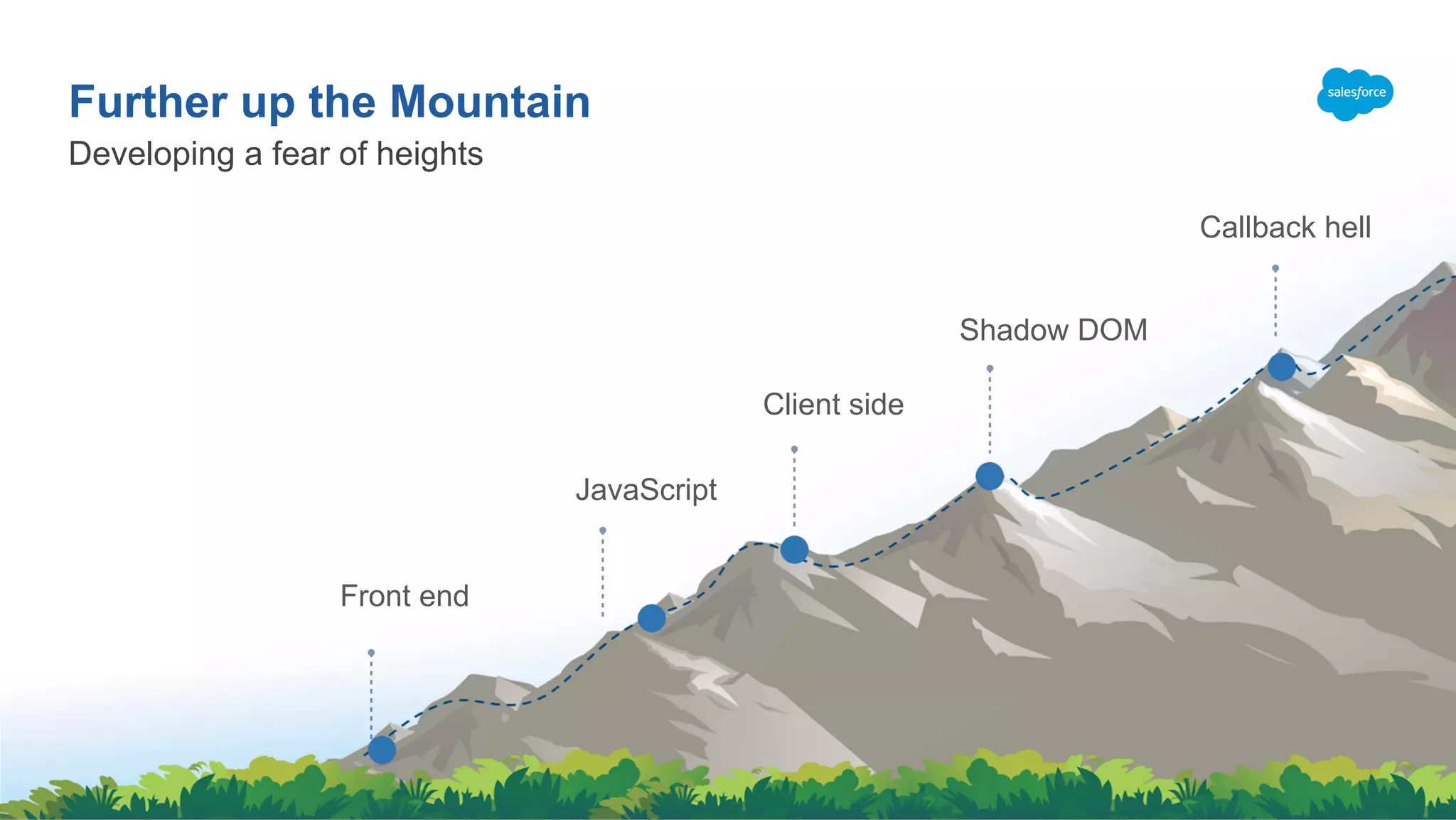
Developing a fear of heights
Further up the Mountain
Front end
JavaScript
Client side
Shadow DOM
Callback hell
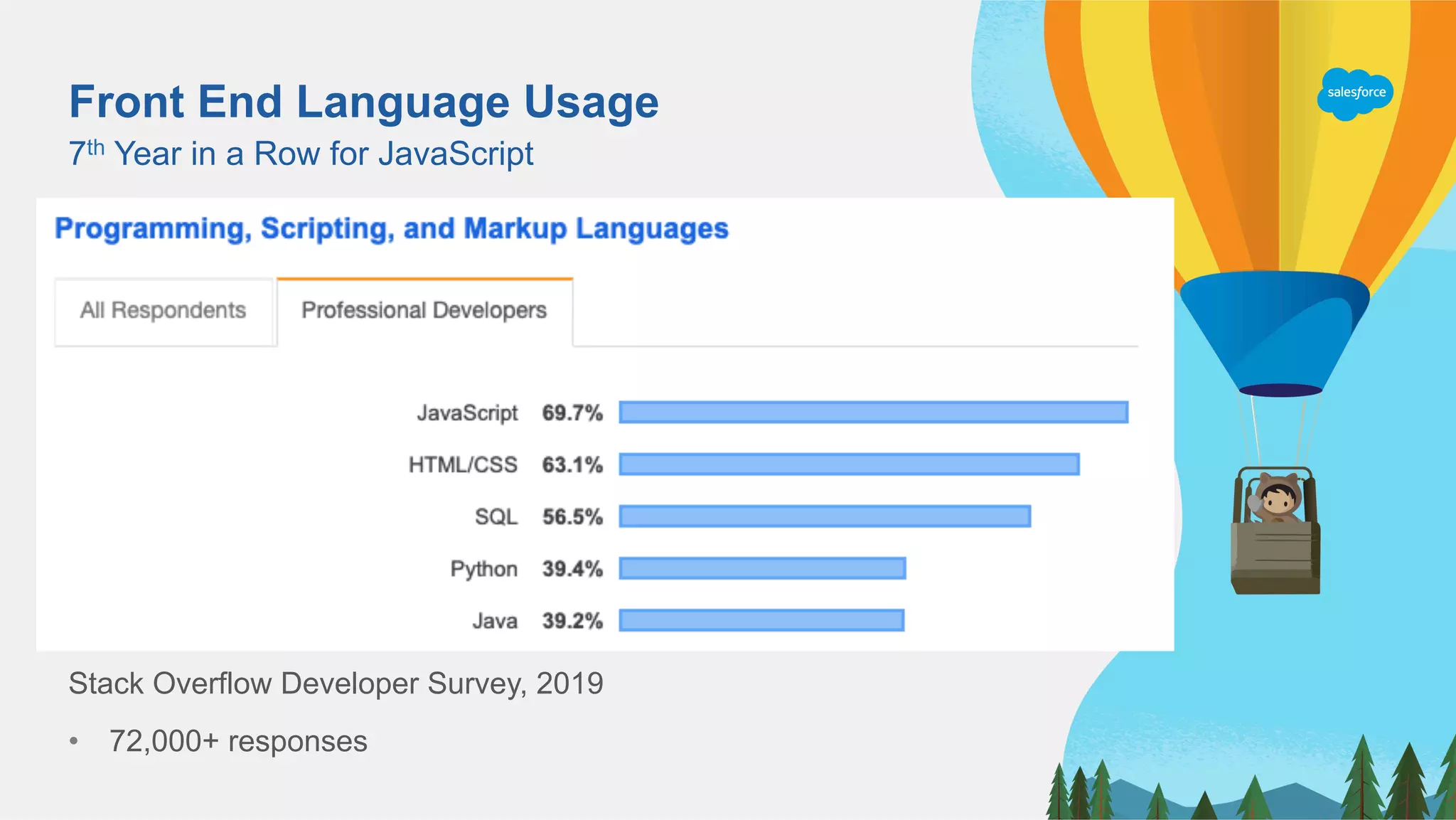
Front End Language Usage
Stack Overflow Developer Survey, 2019
•  72,000+ responses
7th Year in a Row for JavaScript
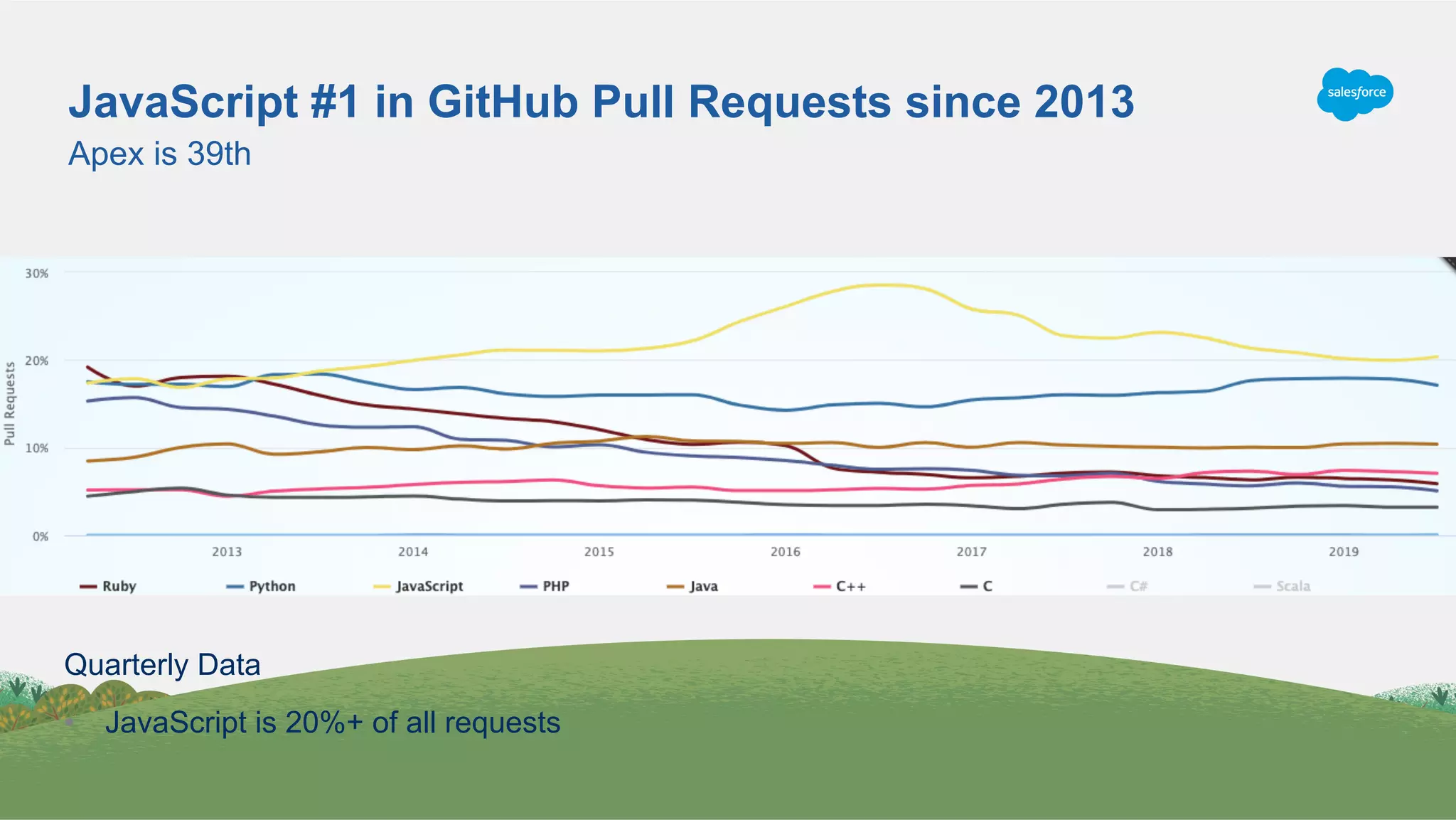
Quarterly Data
•  JavaScript is 20%+ of all requests
Apex is 39th
JavaScript #1 in GitHub Pull Requests since 2013
A Little Overwhelming
Backend is safe
Expectations
You’re an Apex Developer
Can’t learn JavaScript in 40 mins
Understand common patterns
Gain confidence to start building components
The First Step
Agenda
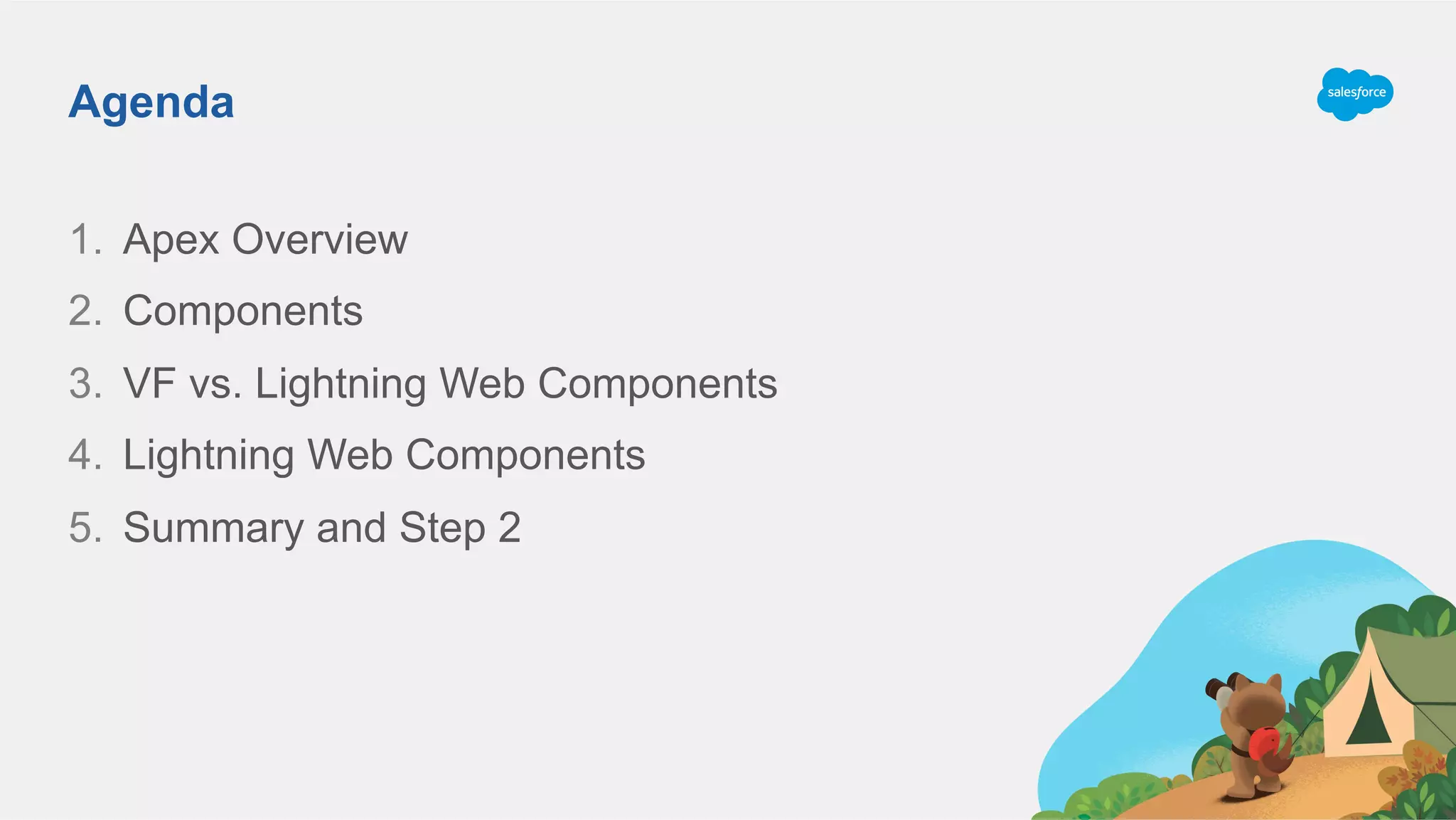
1.  Apex Overview
2.  Components
3.  VF vs. Lightning Web Components
4.  Lightning Web Components
5.  Summary and Step 2
Apex Overview
Review of what we know
Apex Overview
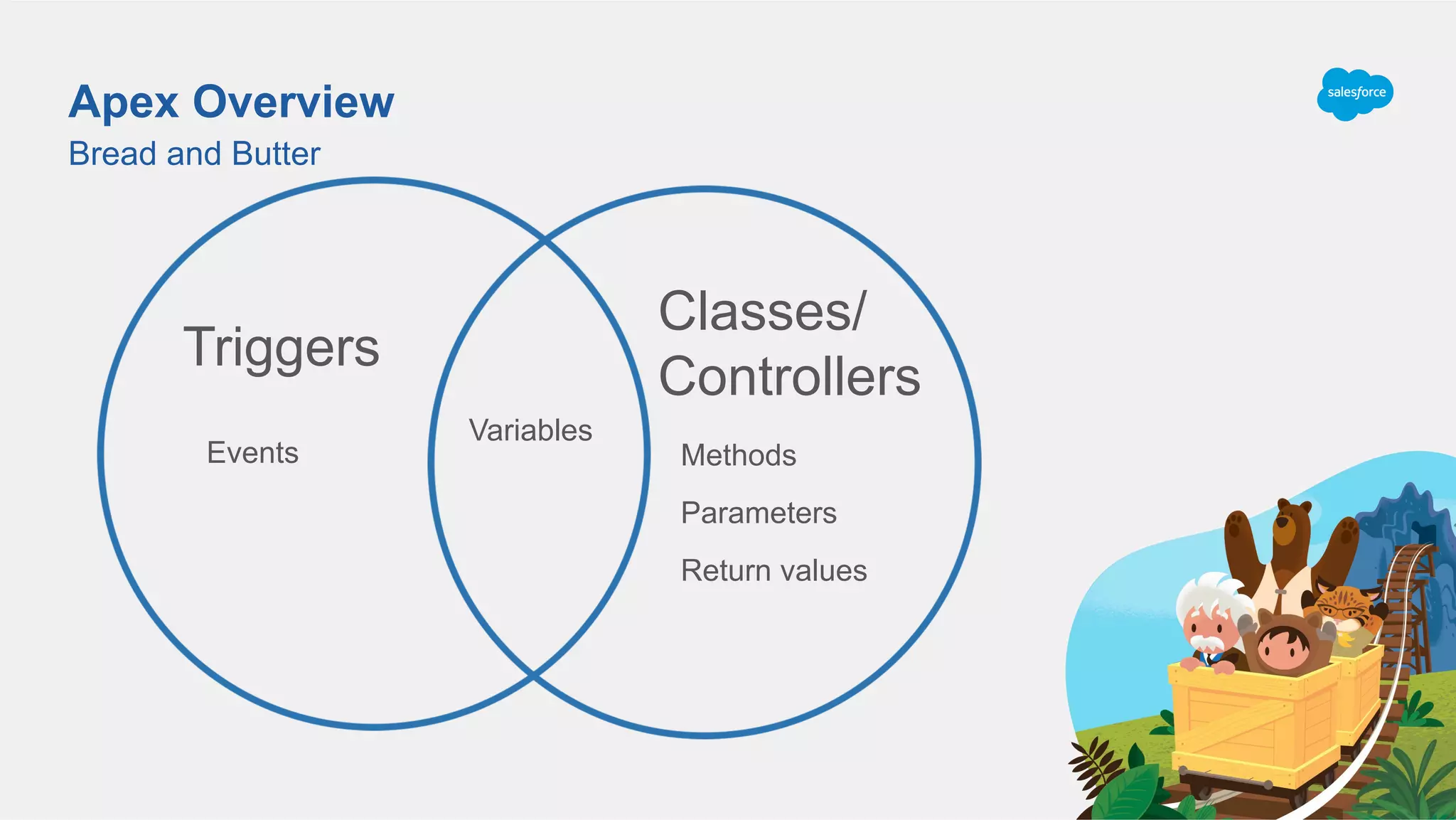
Bread and Butter
Triggers
Classes/
Controllers
Variables
Methods
Parameters
Return values
Events
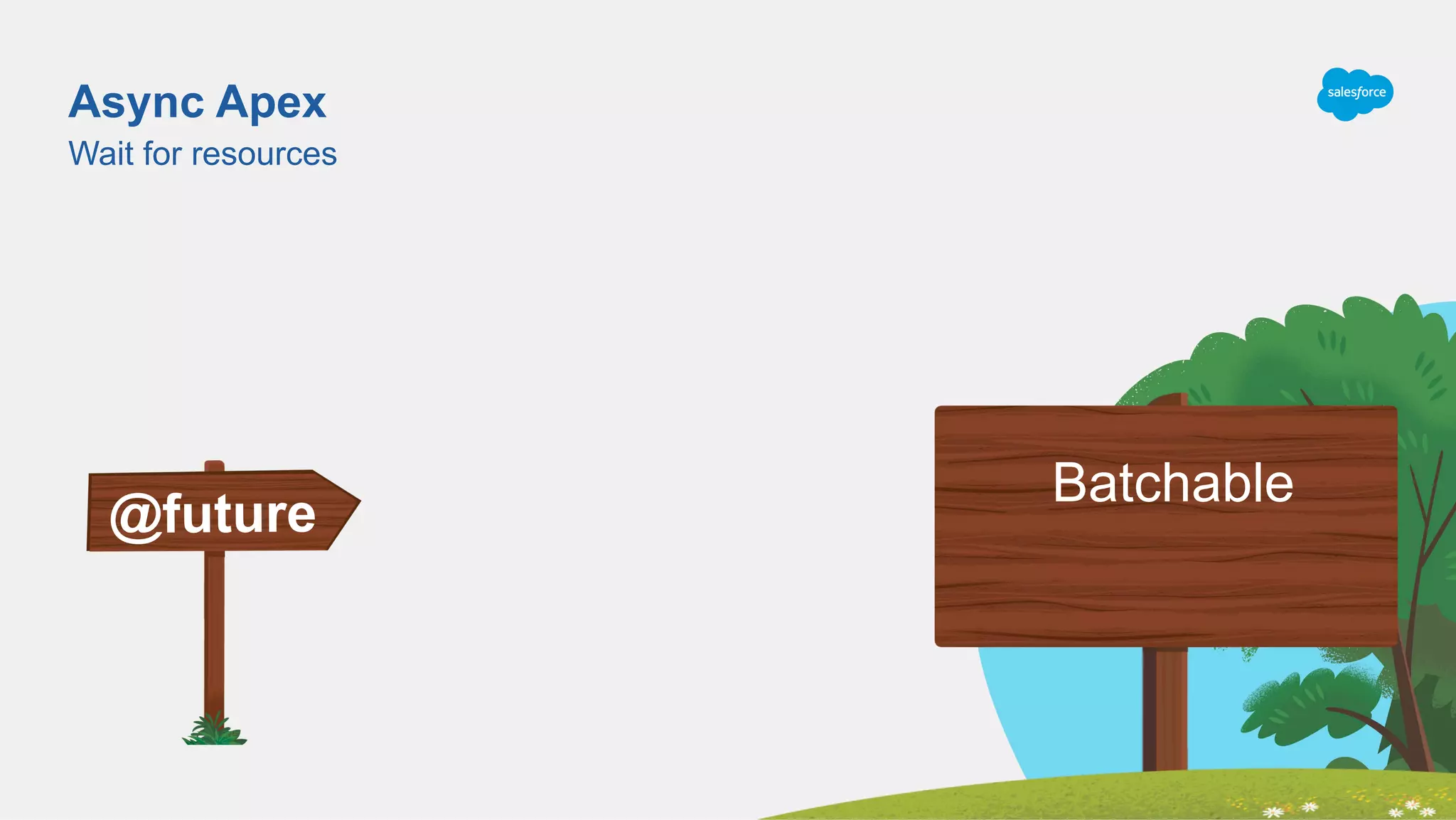
Async Apex
Wait for resources
Batchable
@future
MVC Model
HTML style tags
Bind Variables
Bind Methods
Button based UI
Visualforce
Governor limits
Button click based
Poor Performance
Hacky solutions
Limitations
Apex and VF Gaps
A New Programming Model
MVC++
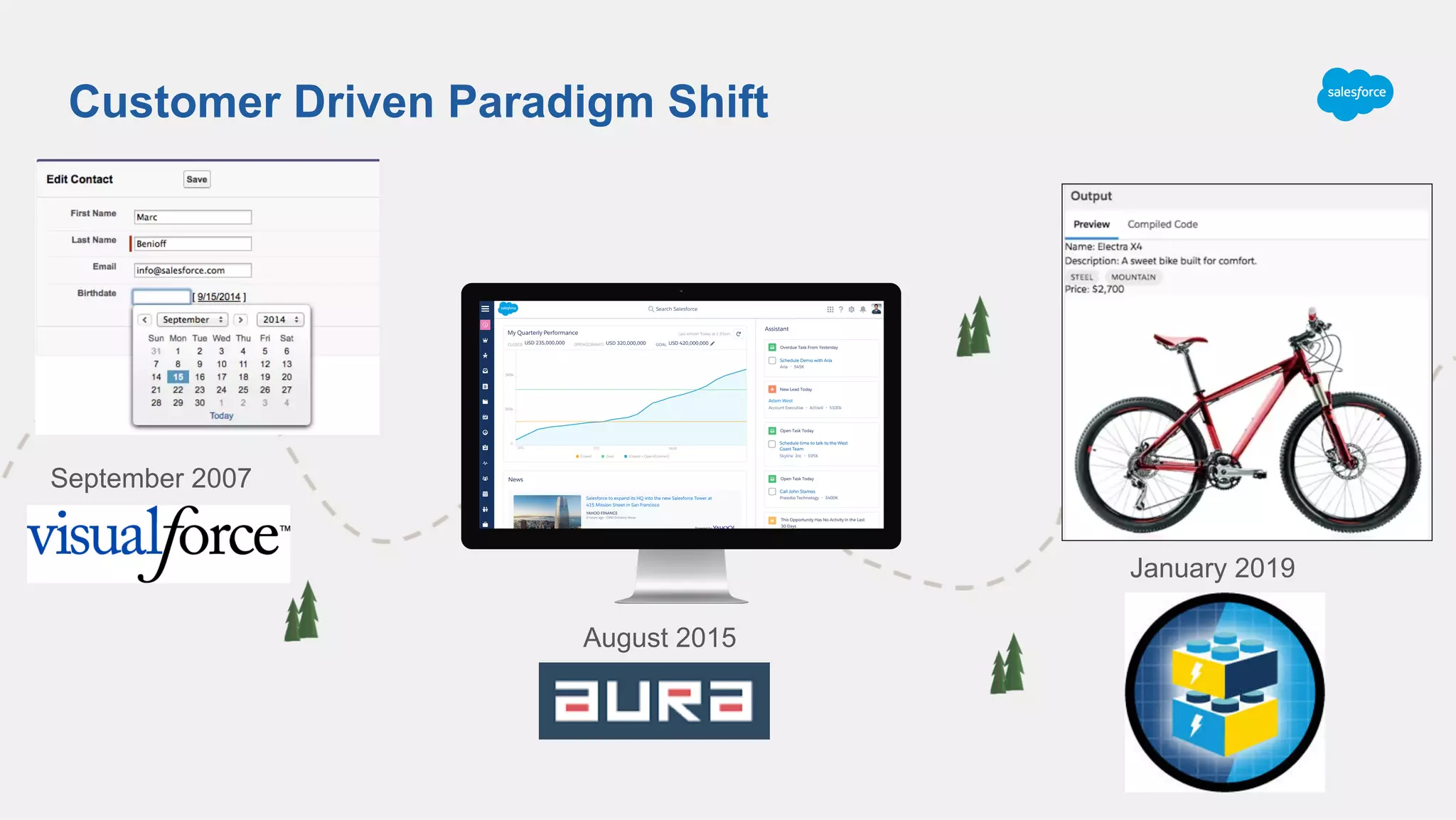
Customer Driven Paradigm Shift
August 2015
September 2007
January 2019
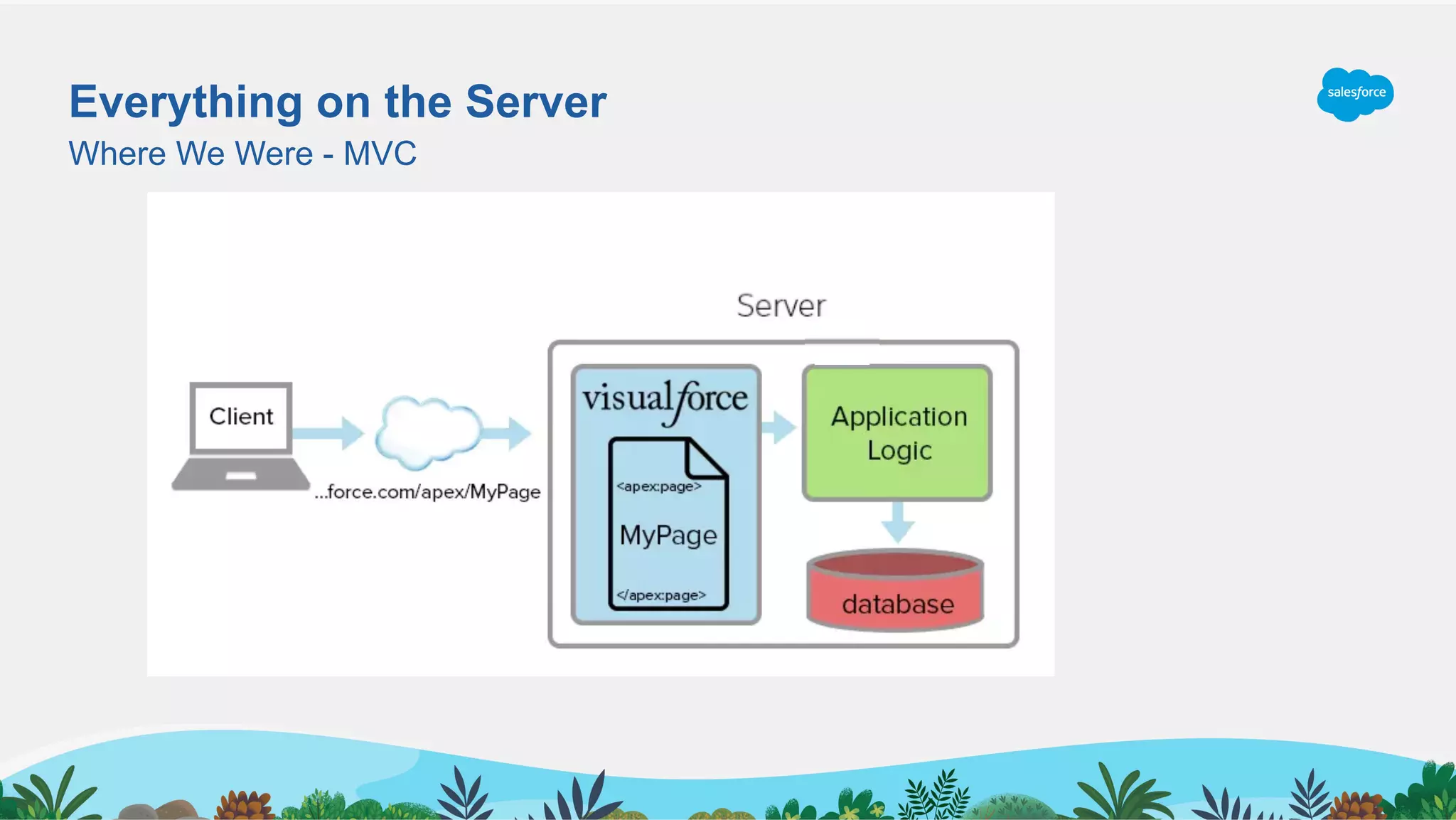
Everything on the Server
Where We Were - MVC
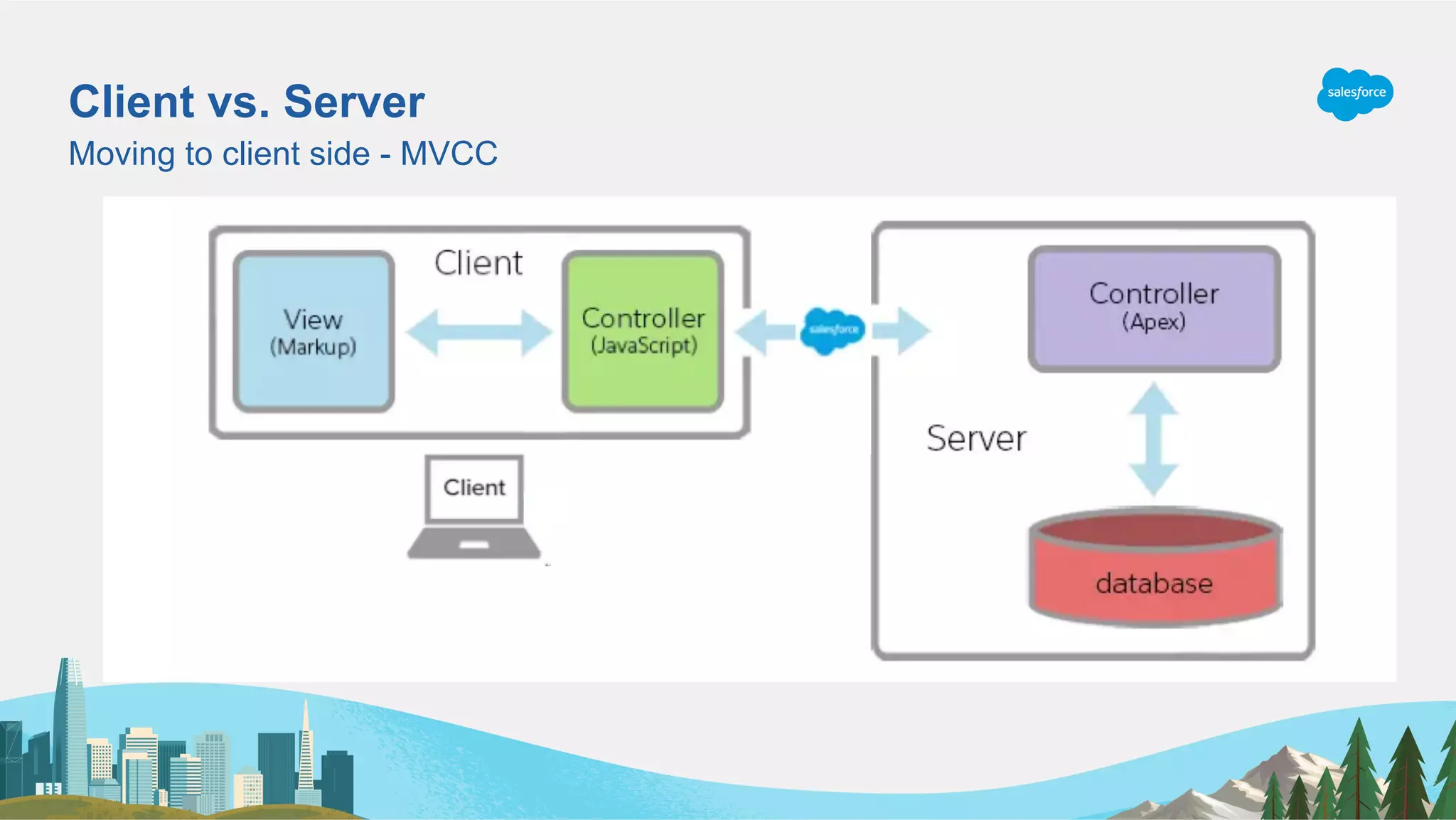
Client vs. Server
Moving to client side - MVCC
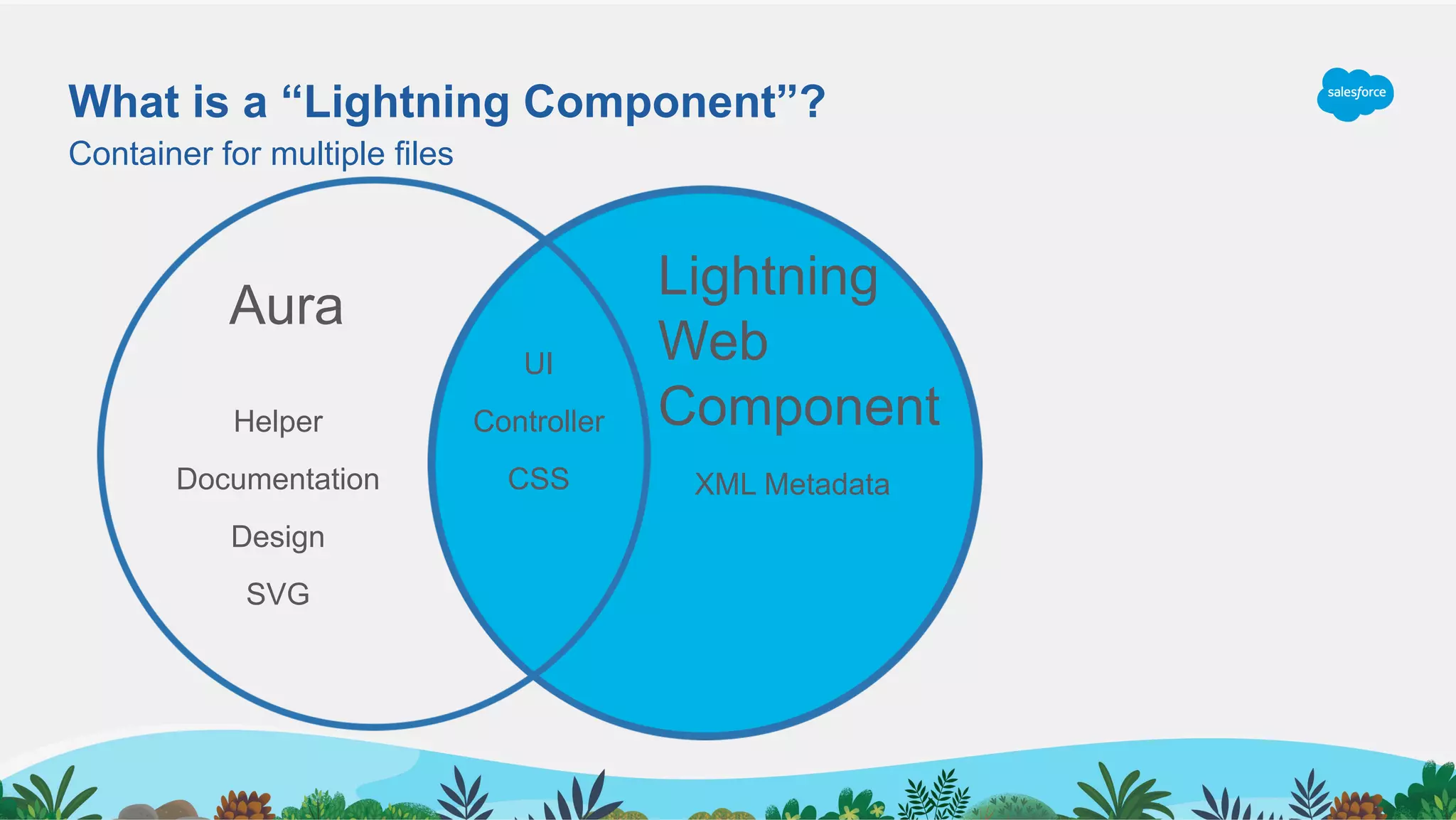
What is a “Lightning Component”?
Container for multiple files
Aura
Lightning
Web
Component
UI
Controller
CSS XML Metadata
Helper
Documentation
Design
SVG
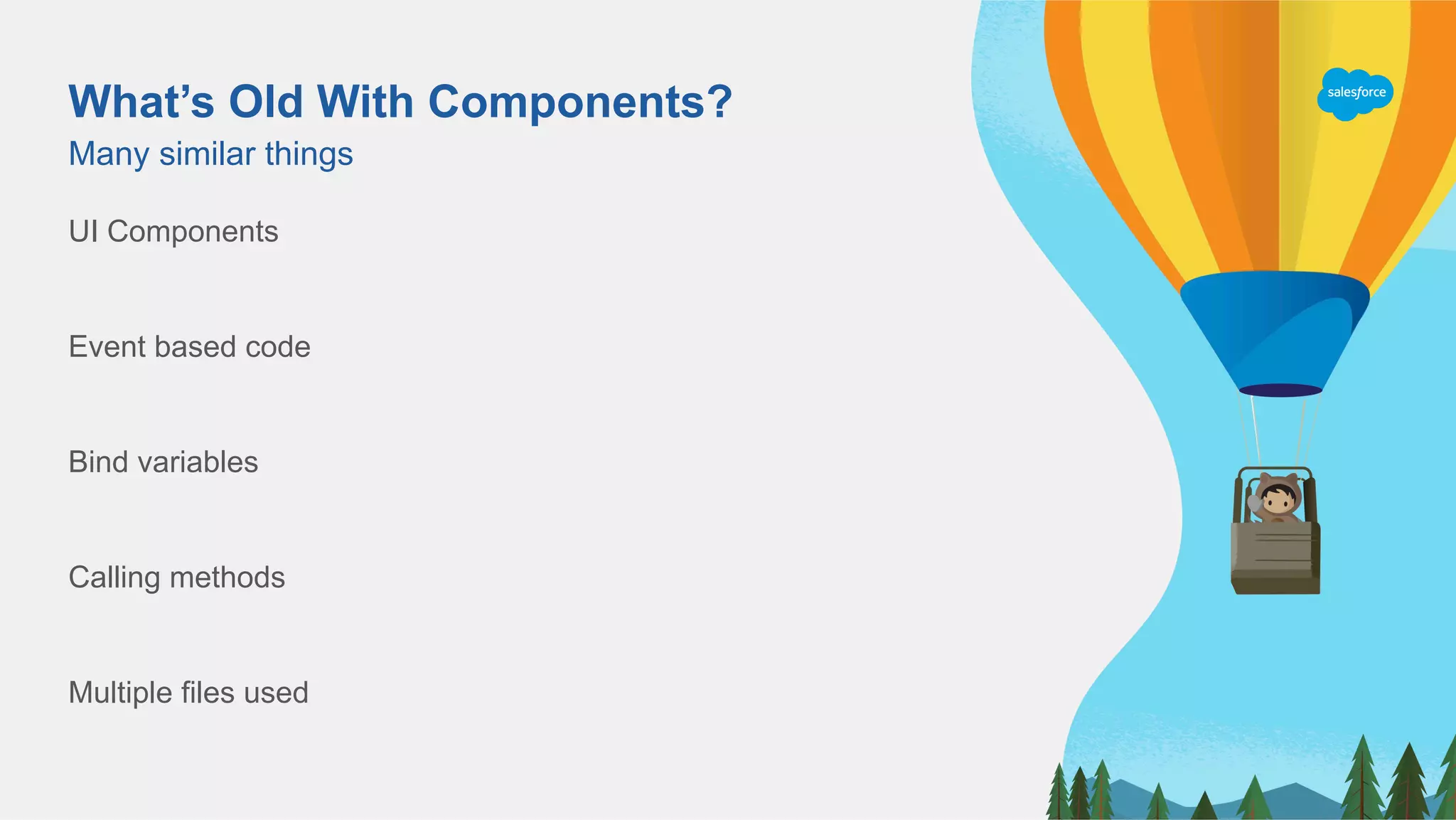
What’s Old With Components?
Many similar things
UI Components
Event based code
Bind variables
Calling methods
Multiple files used
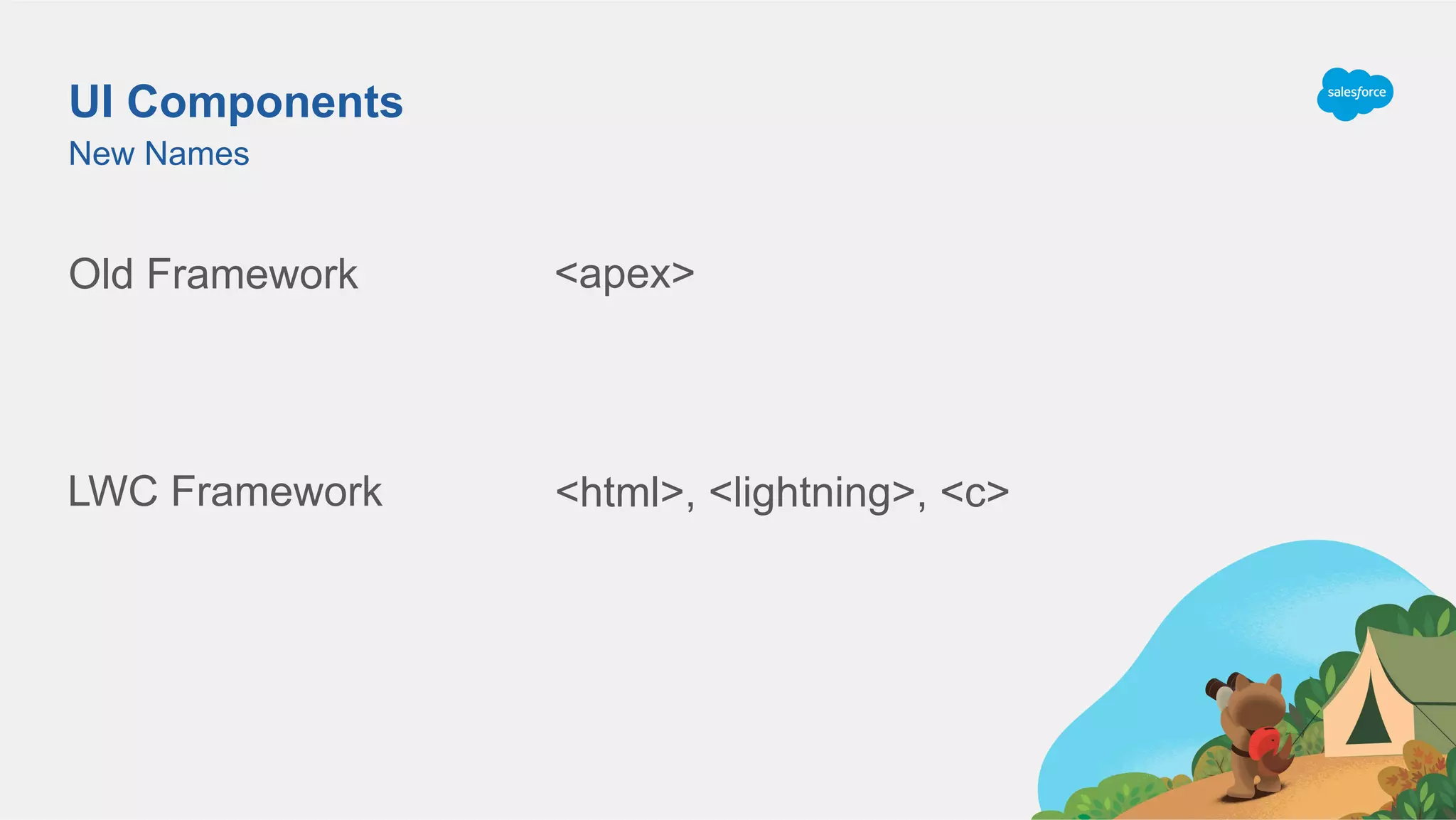
UI Components
Old Framework
New Names
<apex>
LWC Framework <html>, <lightning>, <c>
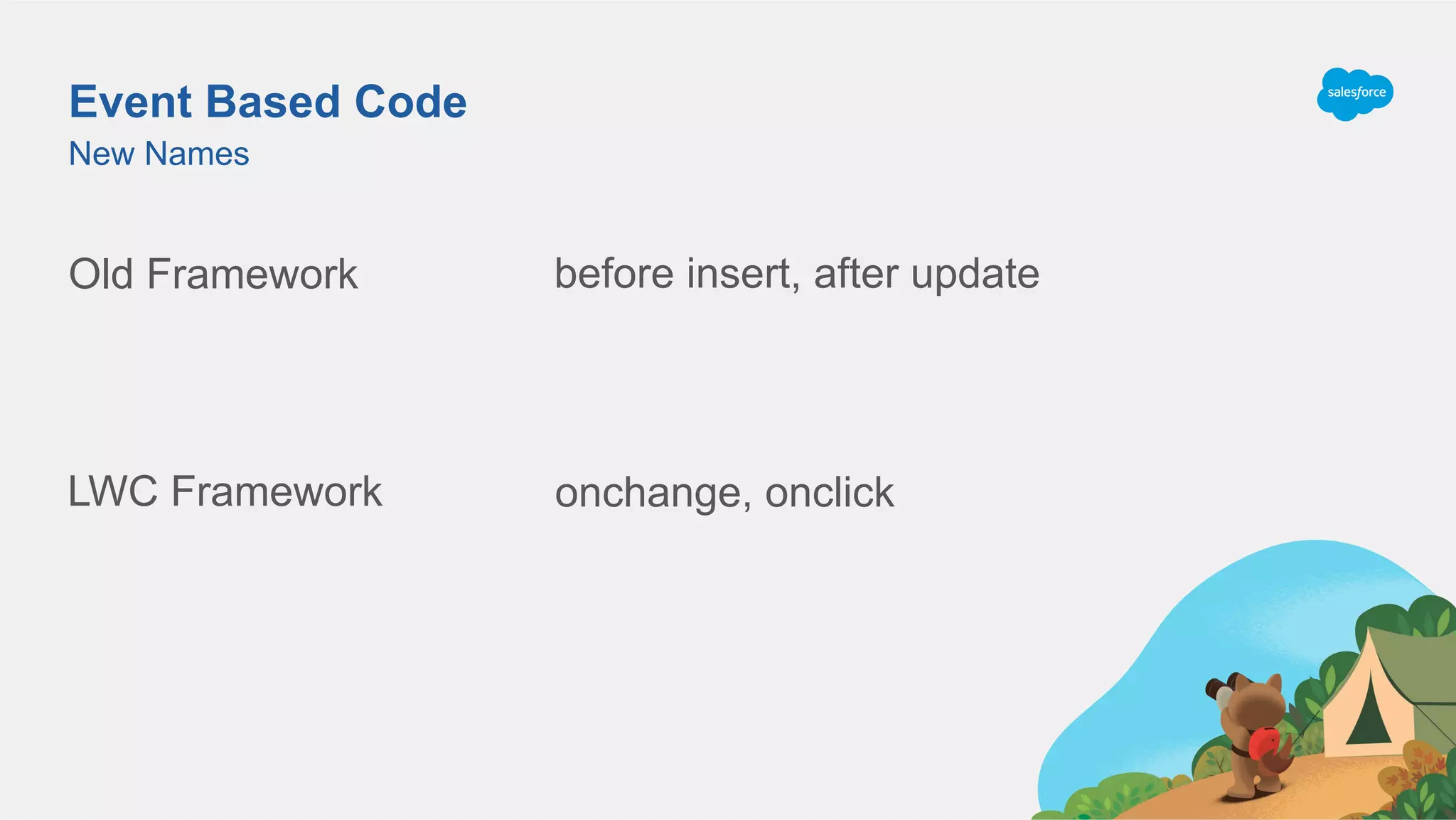
Event Based Code
Old Framework
New Names
before insert, after update
LWC Framework onchange, onclick
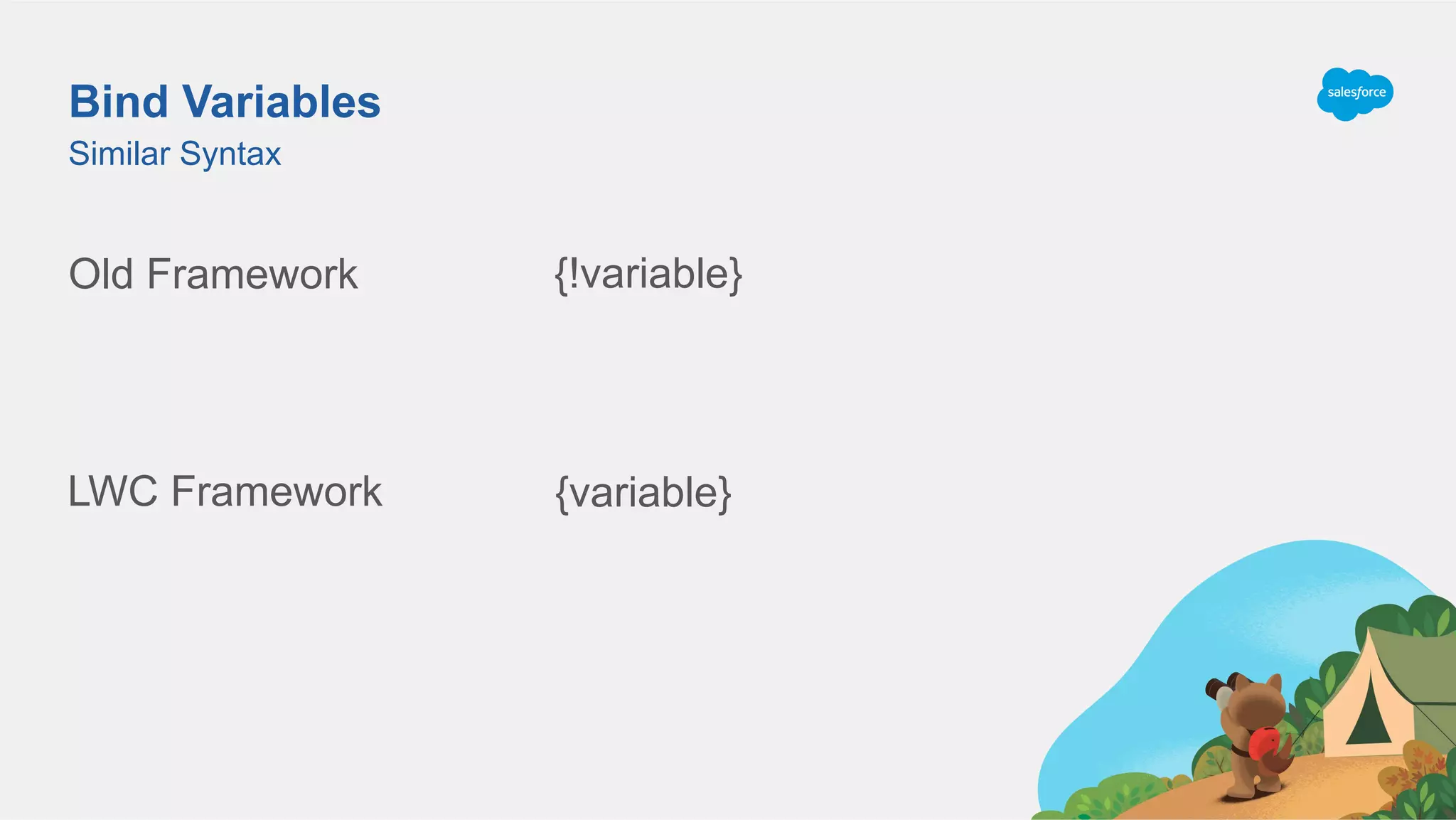
Bind Variables
Old Framework
Similar Syntax
{!variable}
LWC Framework {variable}
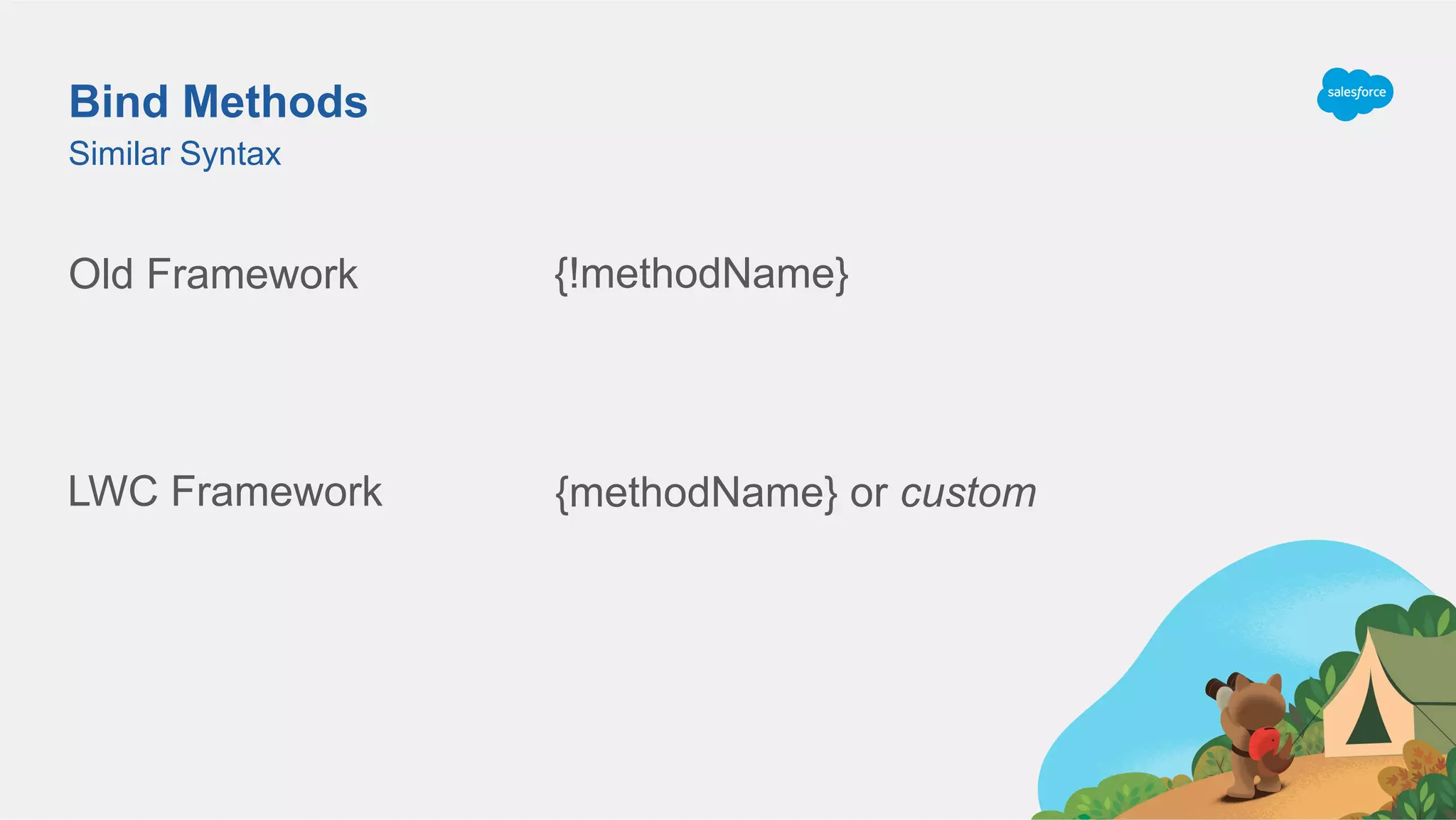
Bind Methods
Old Framework
Similar Syntax
{!methodName}
LWC Framework {methodName} or custom
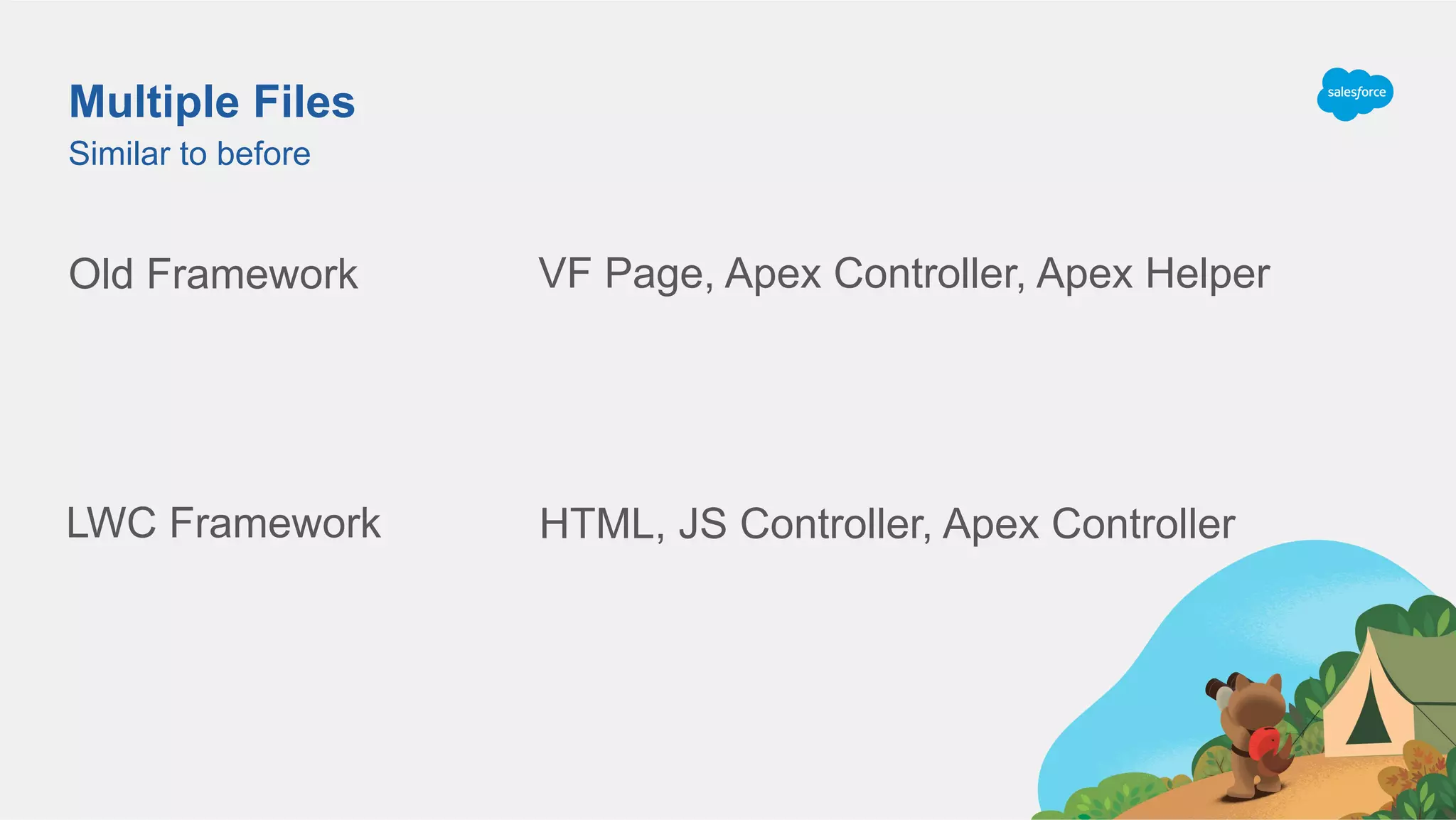
Multiple Files
Old Framework
Similar to before
VF Page, Apex Controller, Apex Helper
LWC Framework HTML, JS Controller, Apex Controller
Let’s Compare
VF vs. LWC
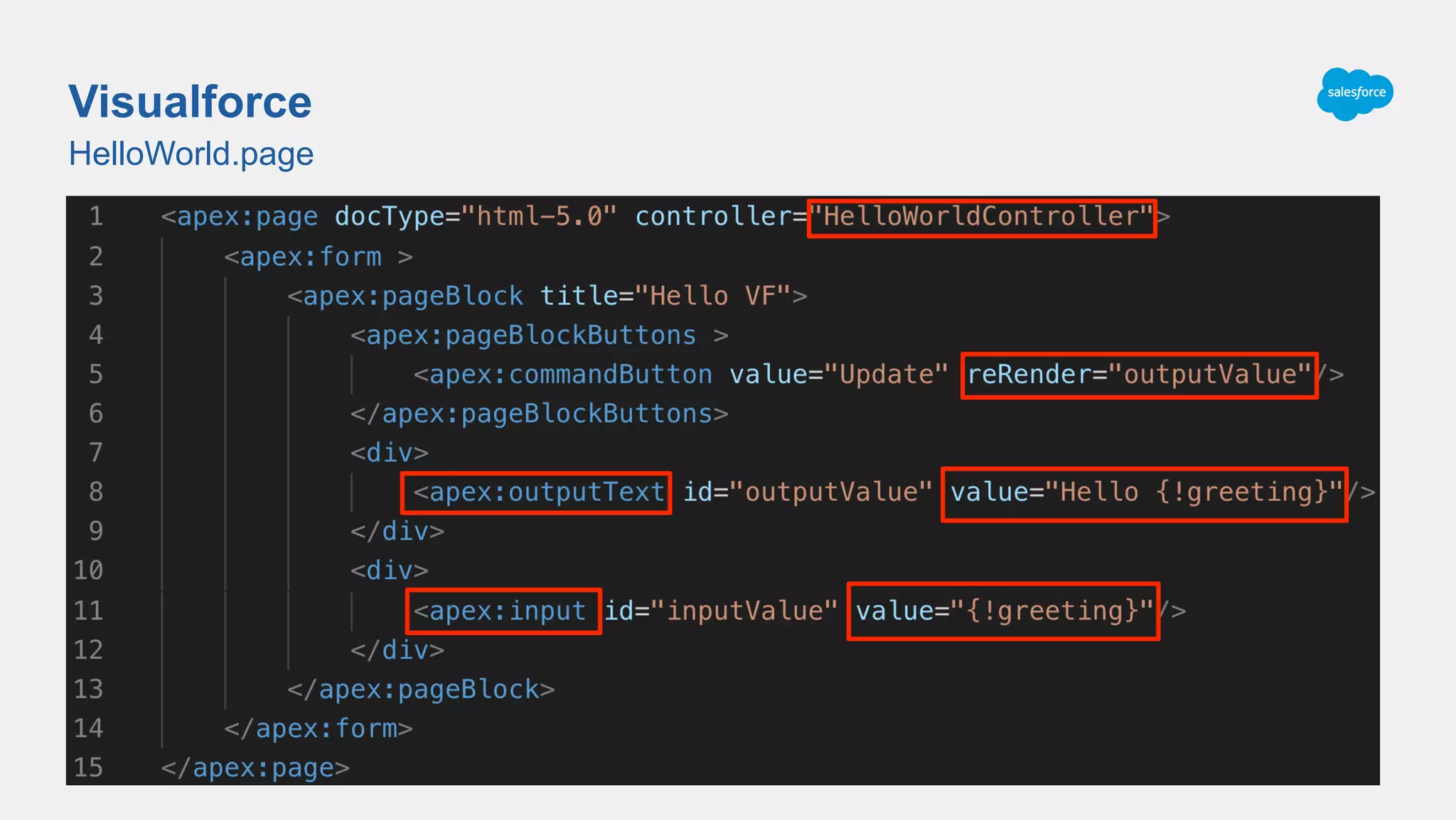
Visualforce
HelloWorld.page
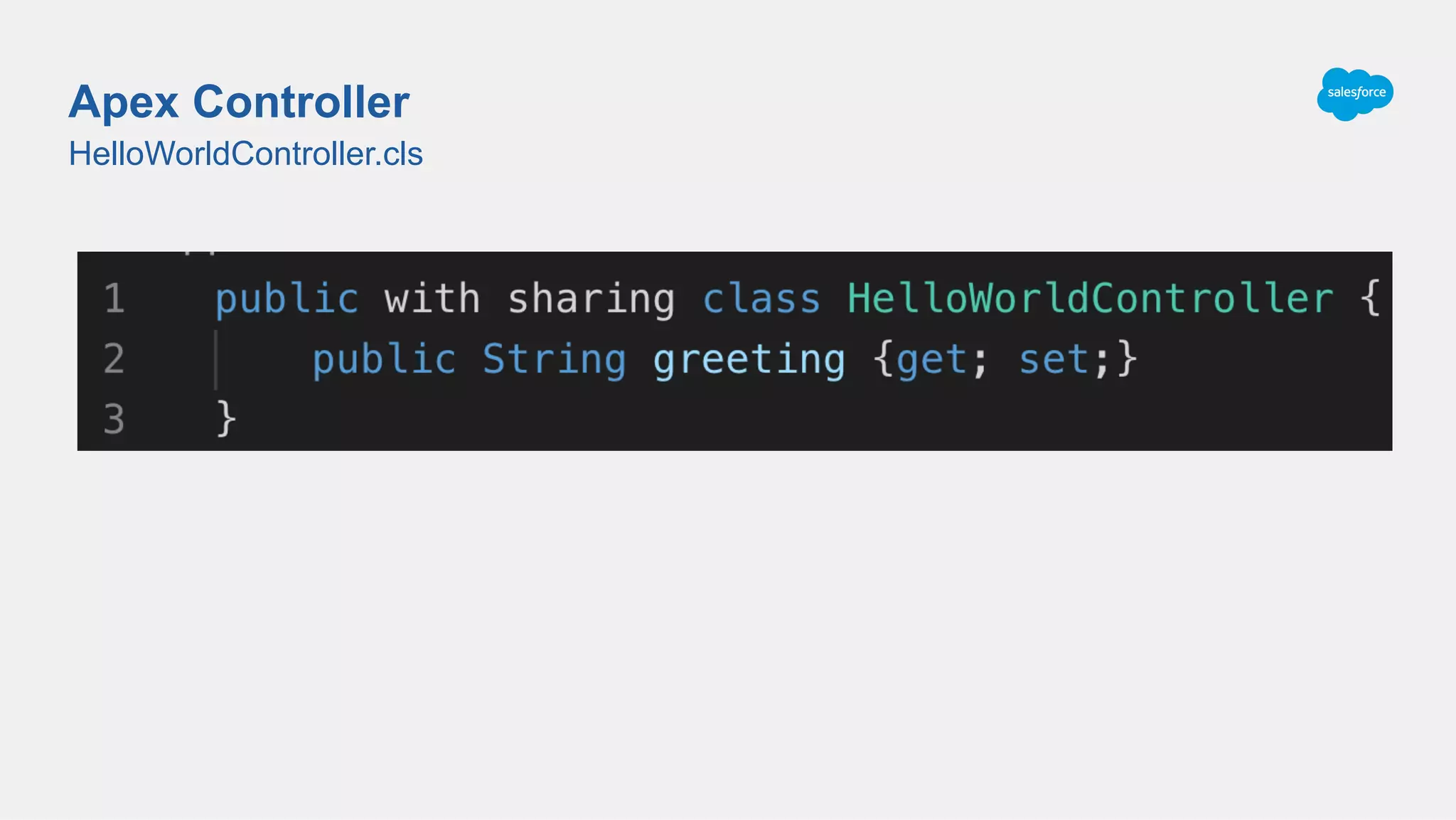
HelloWorldController.cls
Apex Controller
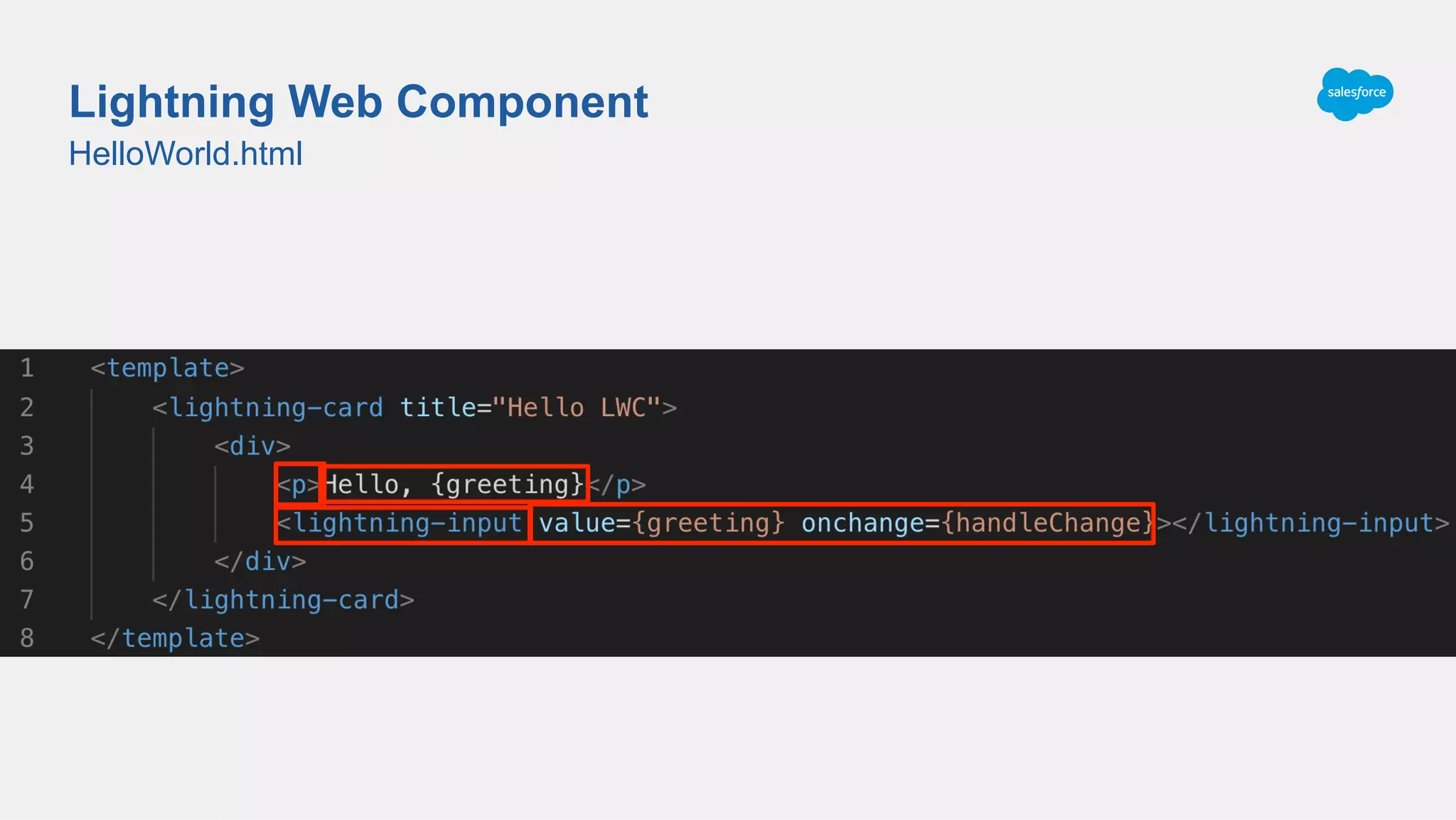
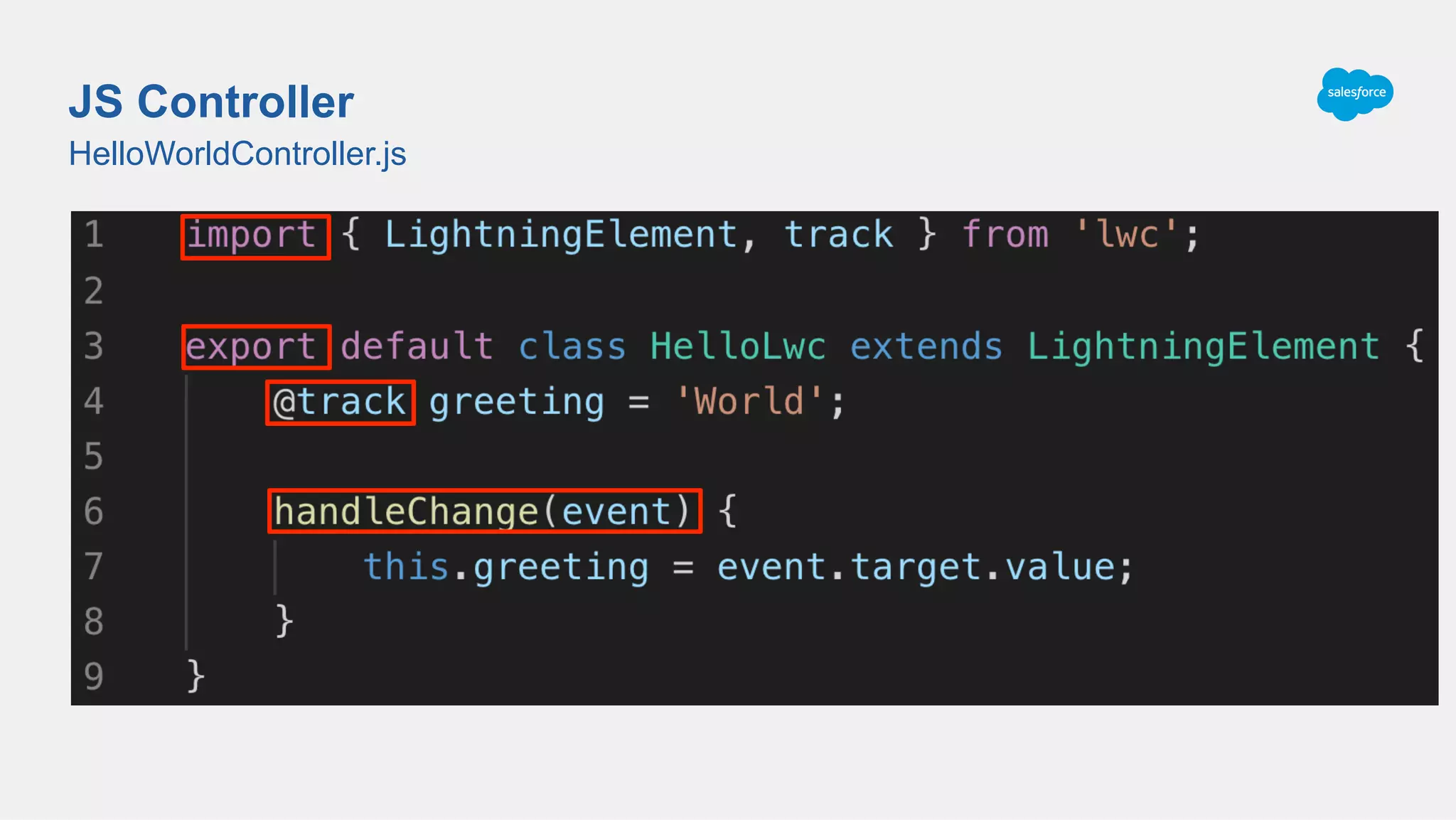
Lightning Web Component
HelloWorld.html
HelloWorldController.js
JS Controller
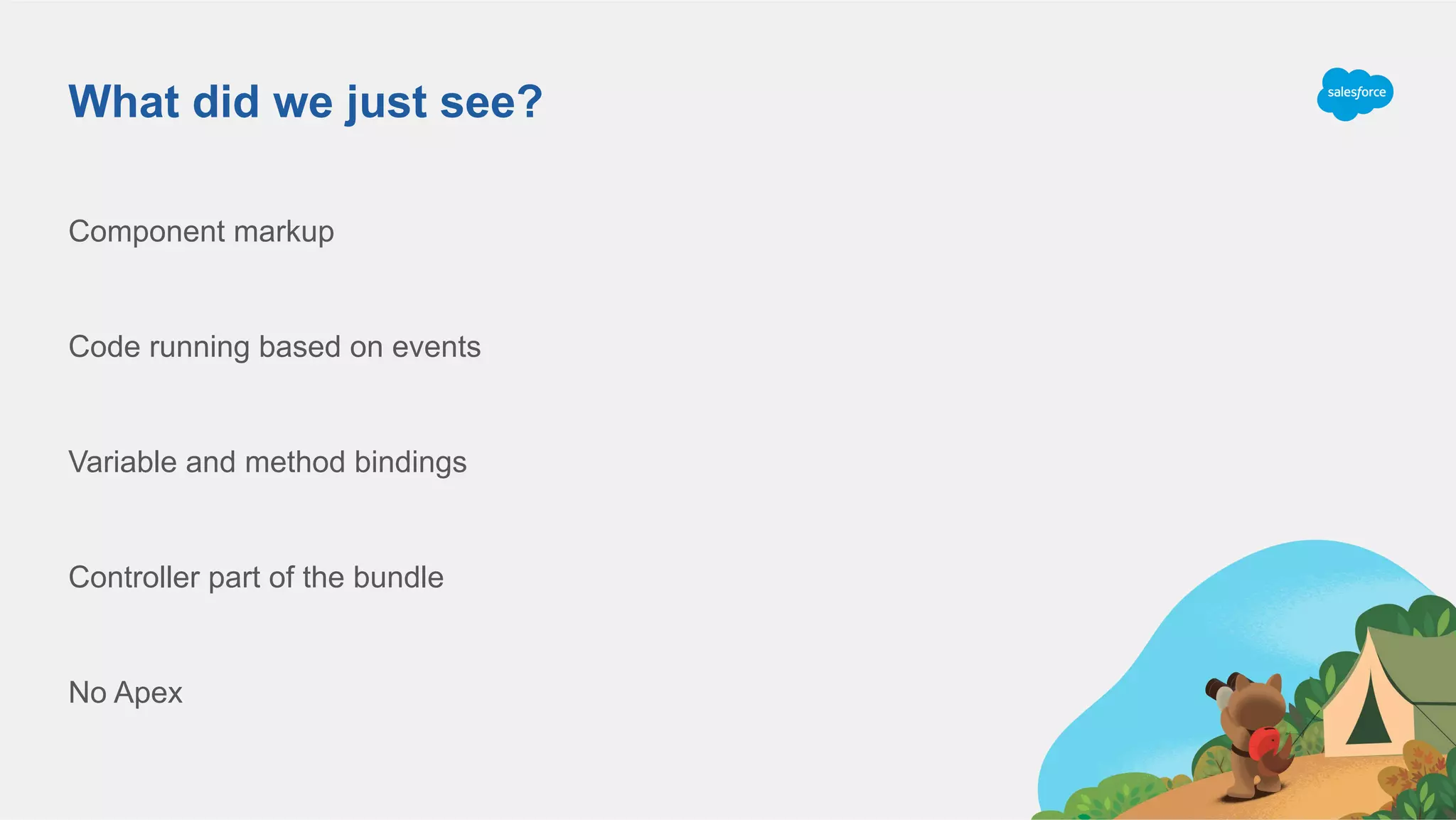
What did we just see?
Component markup
Code running based on events
Variable and method bindings
Controller part of the bundle
No Apex
Lightning Web Components
Embrace Standards
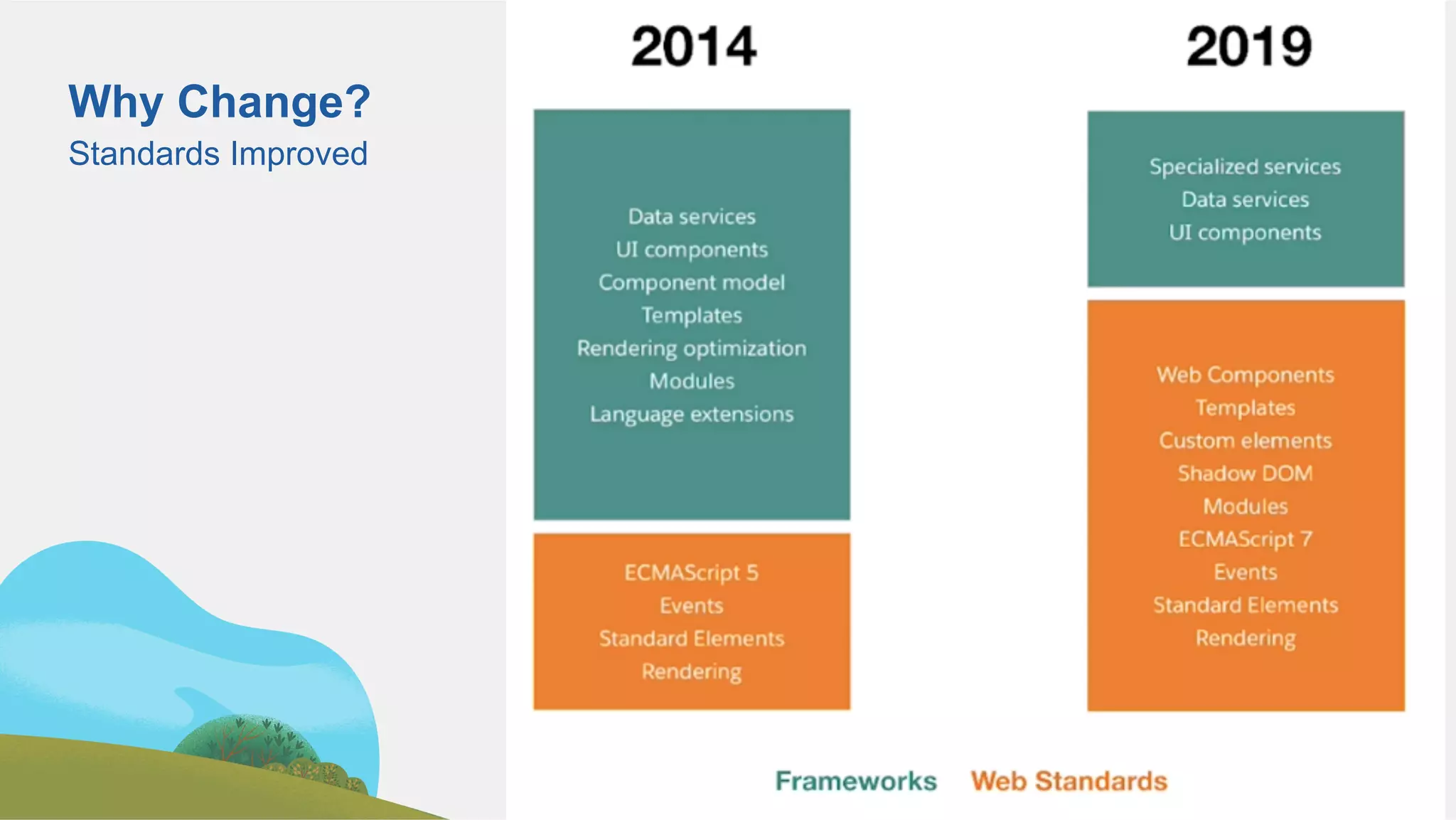
Standards Improved
Why Change?
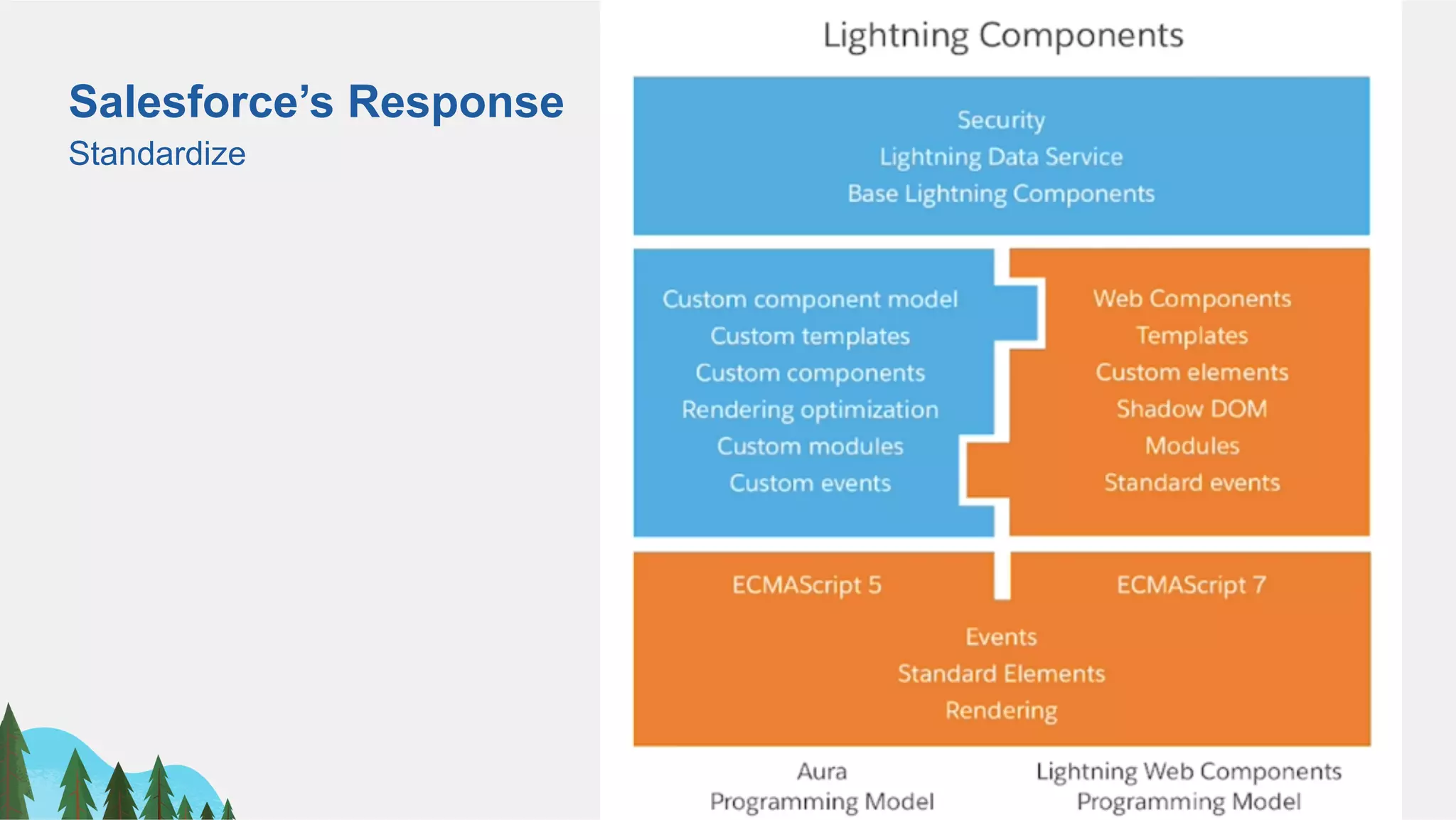
Salesforce’s Response
Standardize
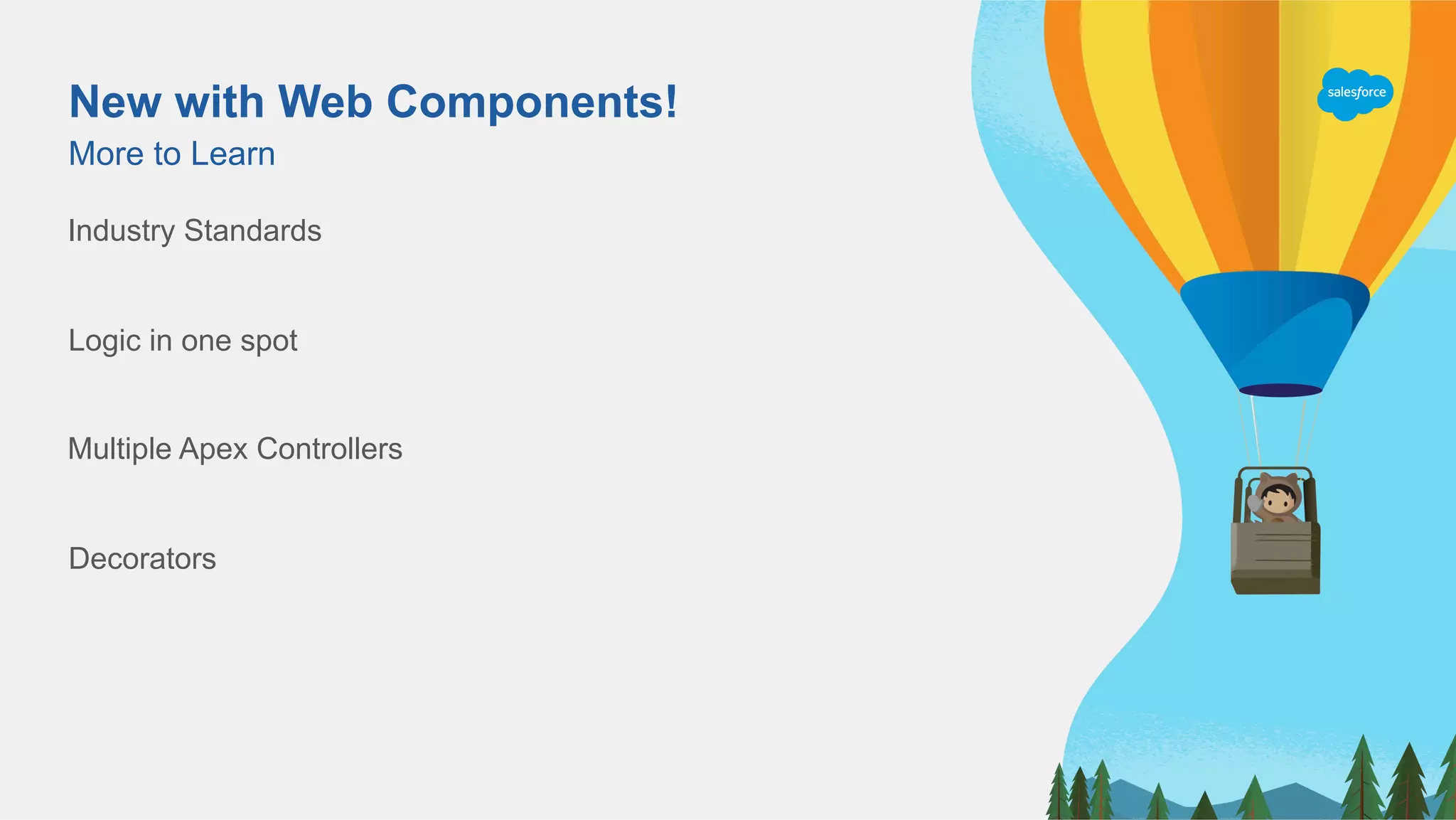
New with Web Components!
More to Learn
Industry Standards
Logic in one spot
Multiple Apex Controllers
Decorators
DEMO TIME
Focus on Concepts
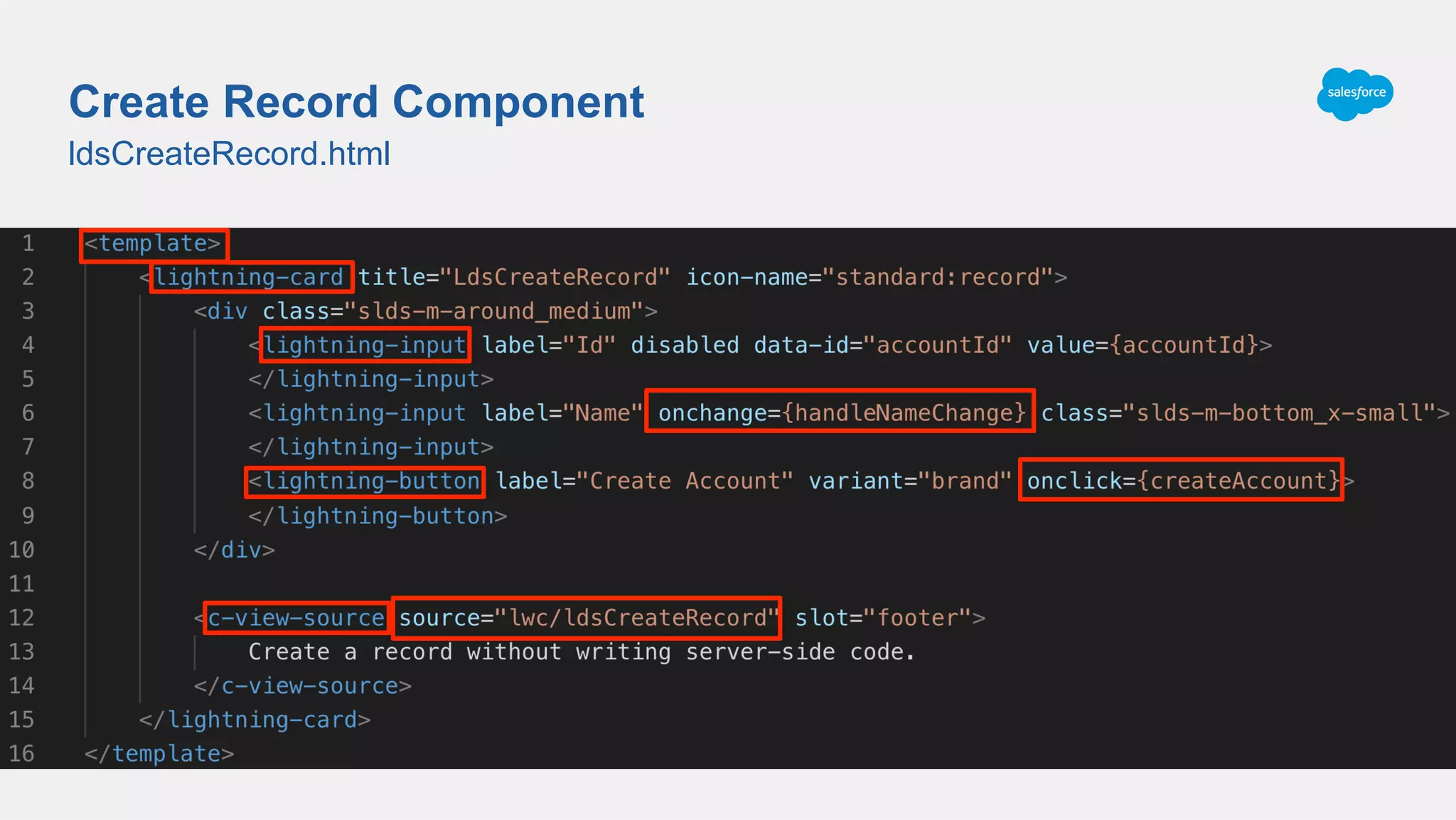
ldsCreateRecord.html
Create Record Component
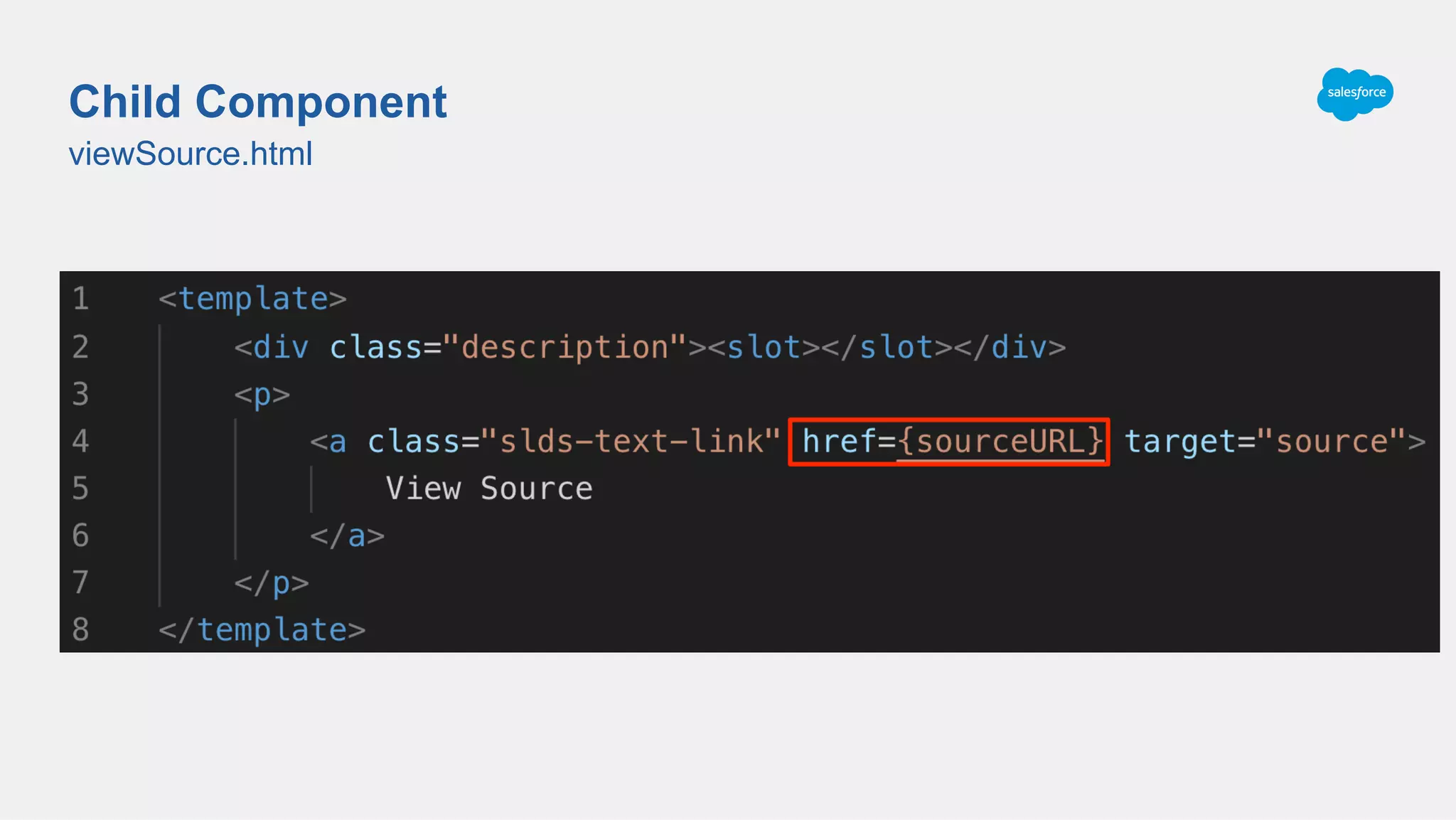
viewSource.html
Child Component
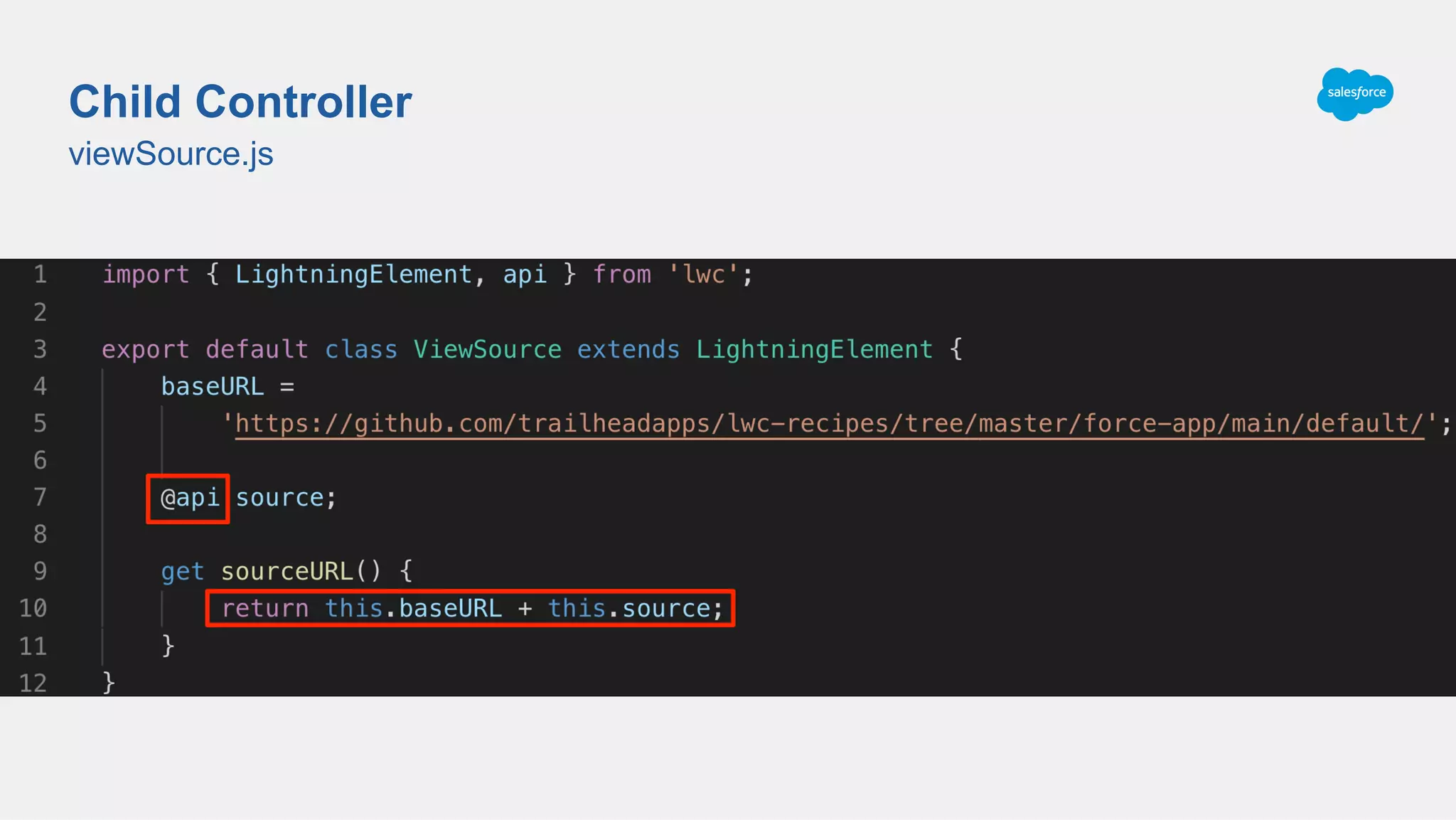
viewSource.js
Child Controller
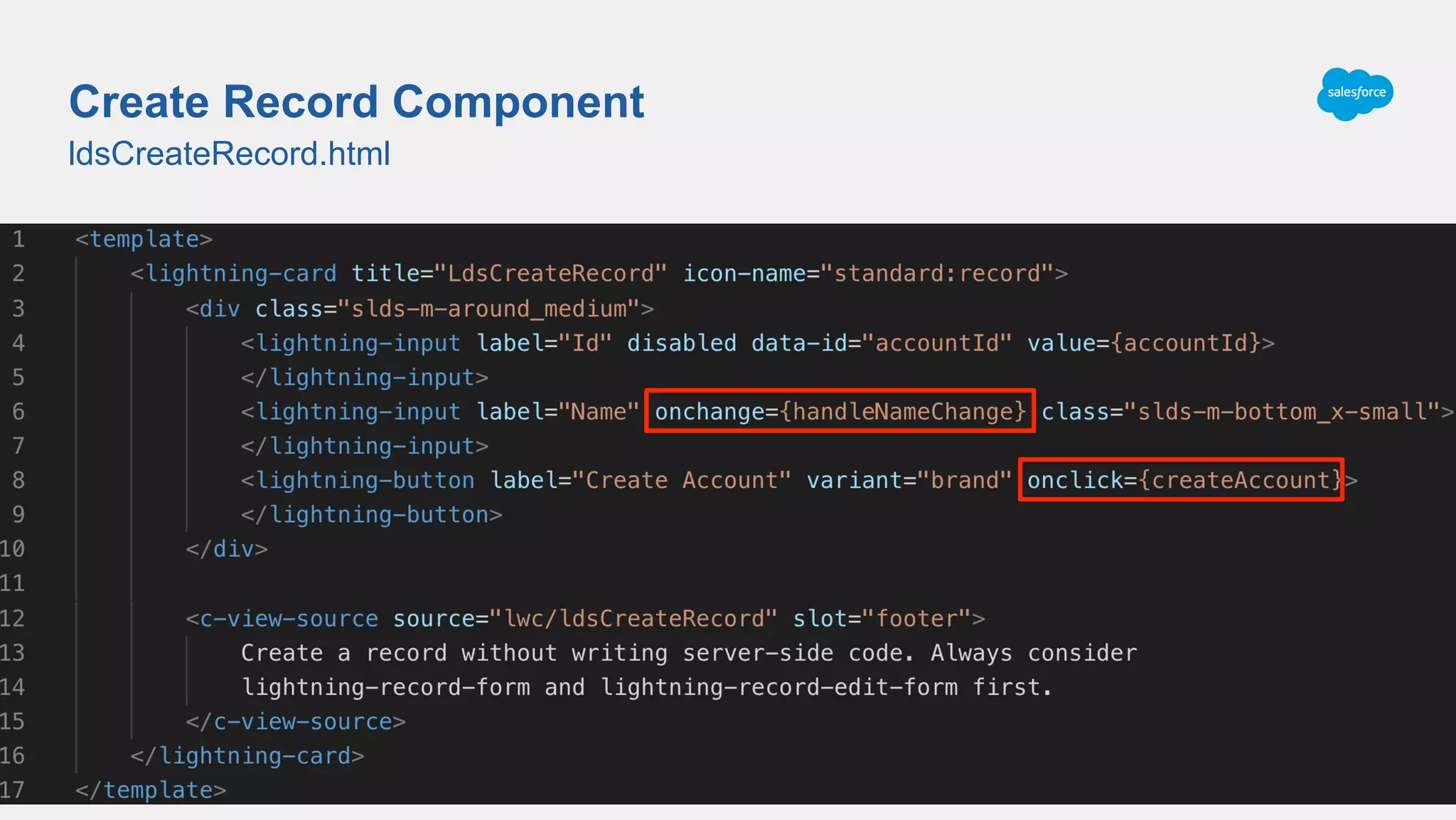
ldsCreateRecord.html
Create Record Component
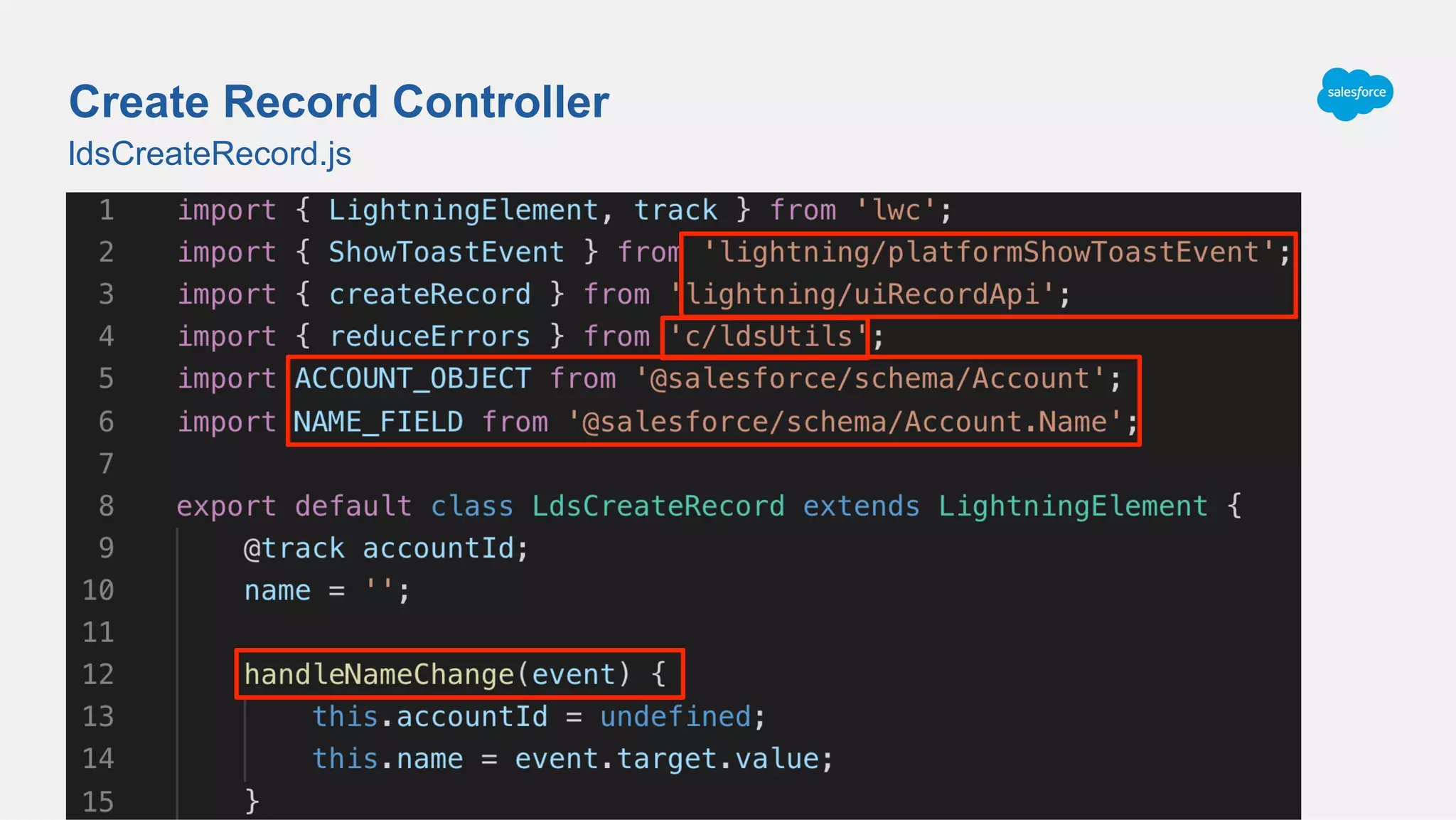
ldsCreateRecord.js
Create Record Controller
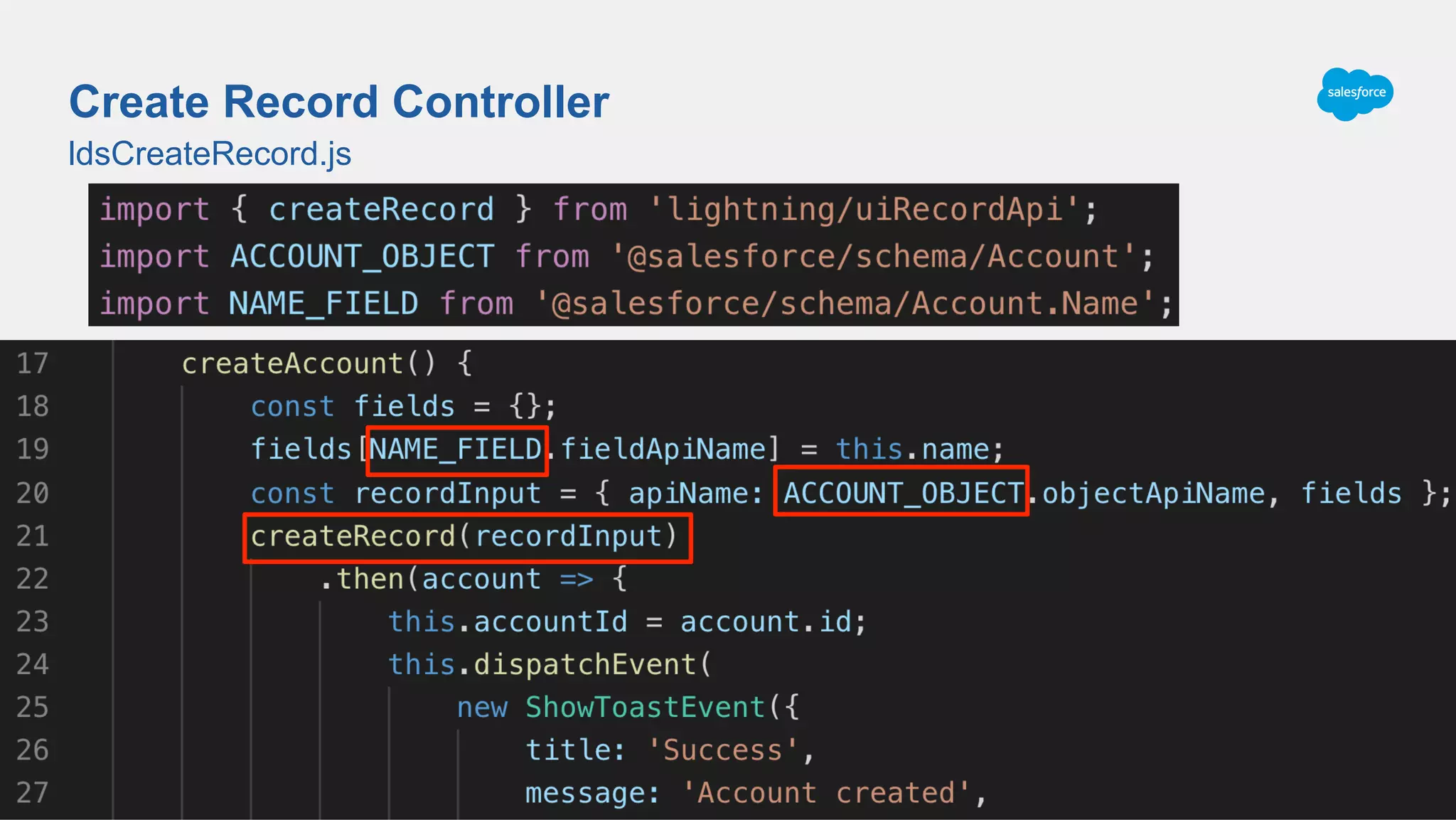
ldsCreateRecord.js
Create Record Controller
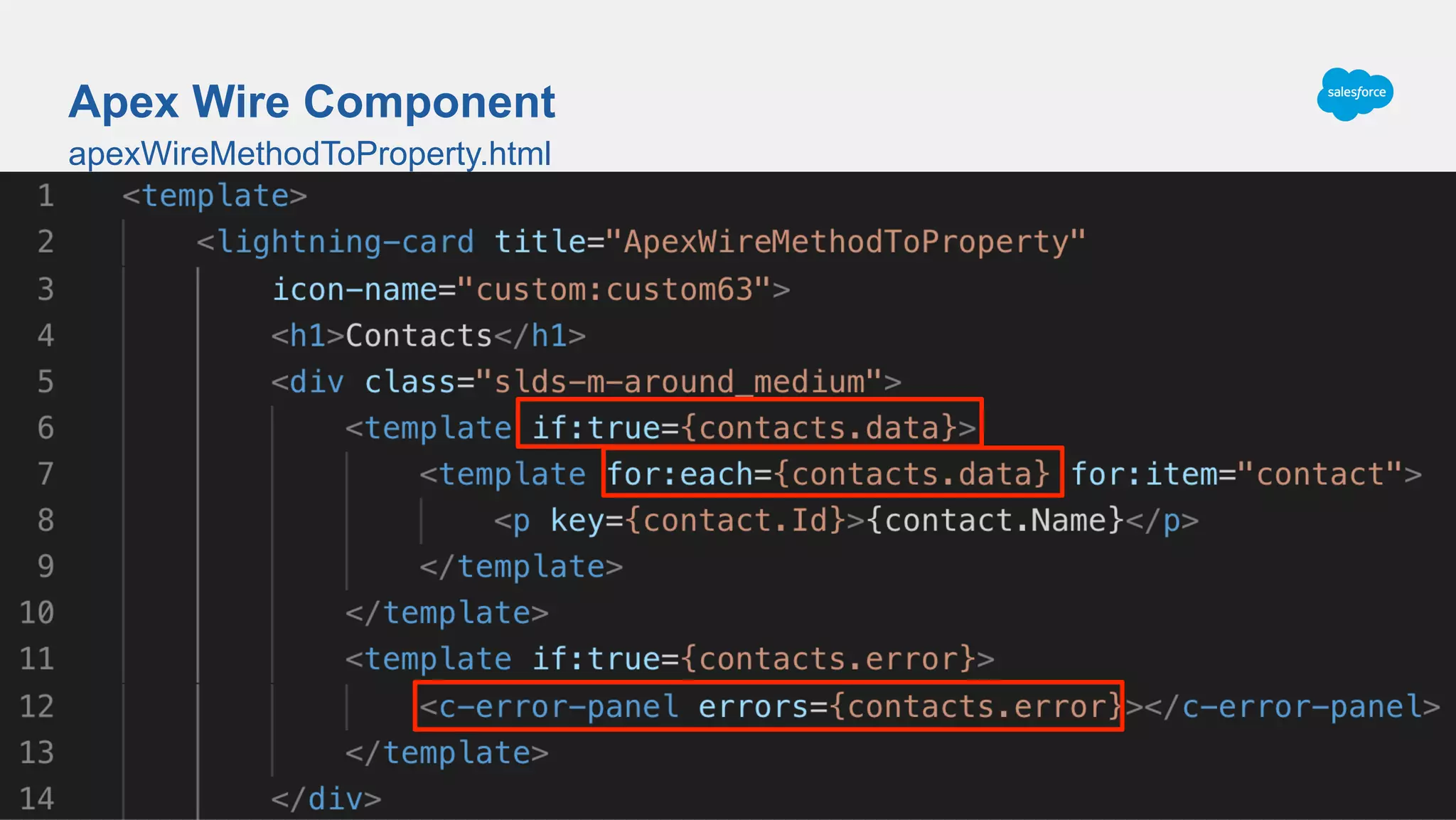
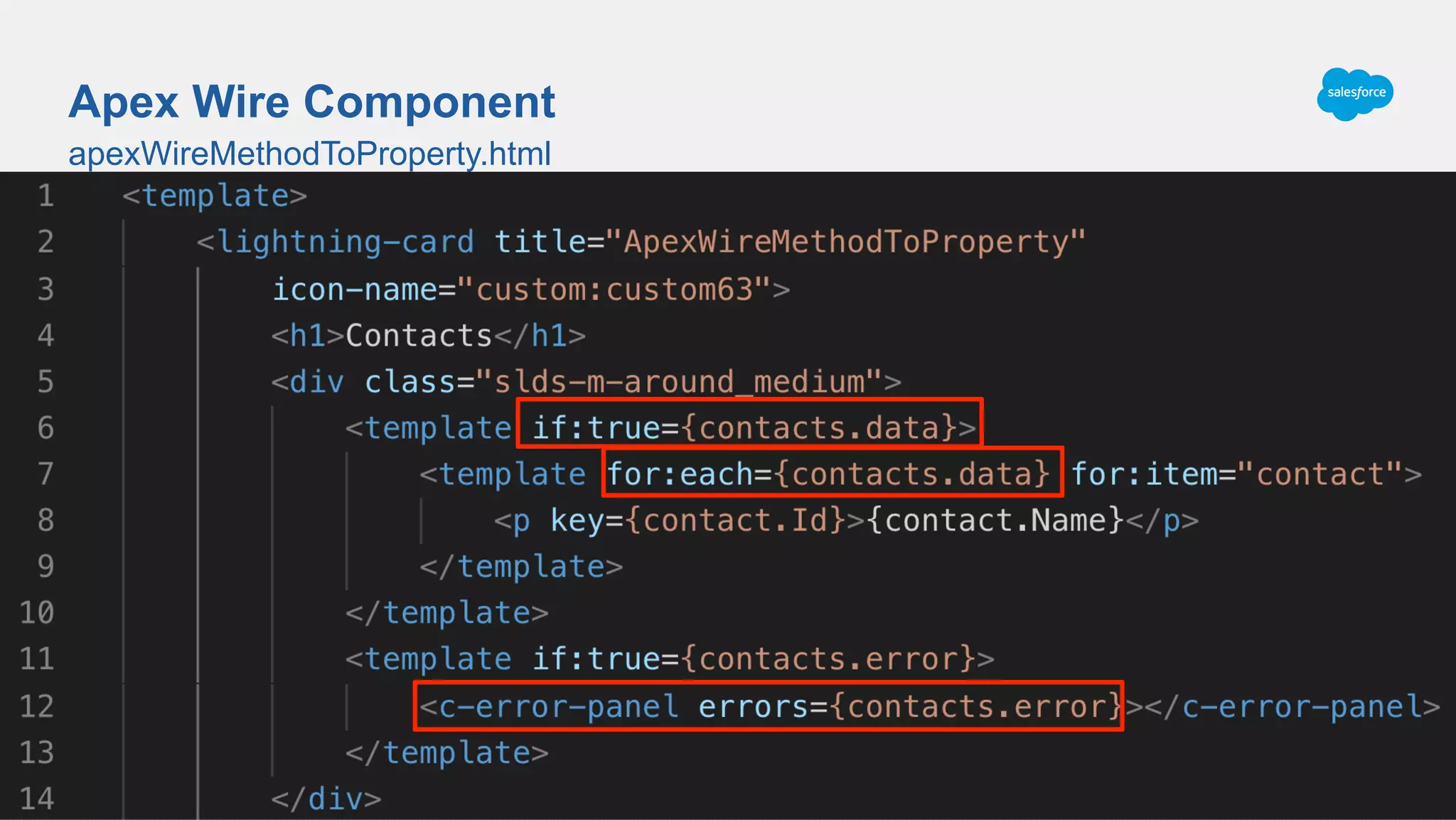
apexWireMethodToProperty.html
Apex Wire Component
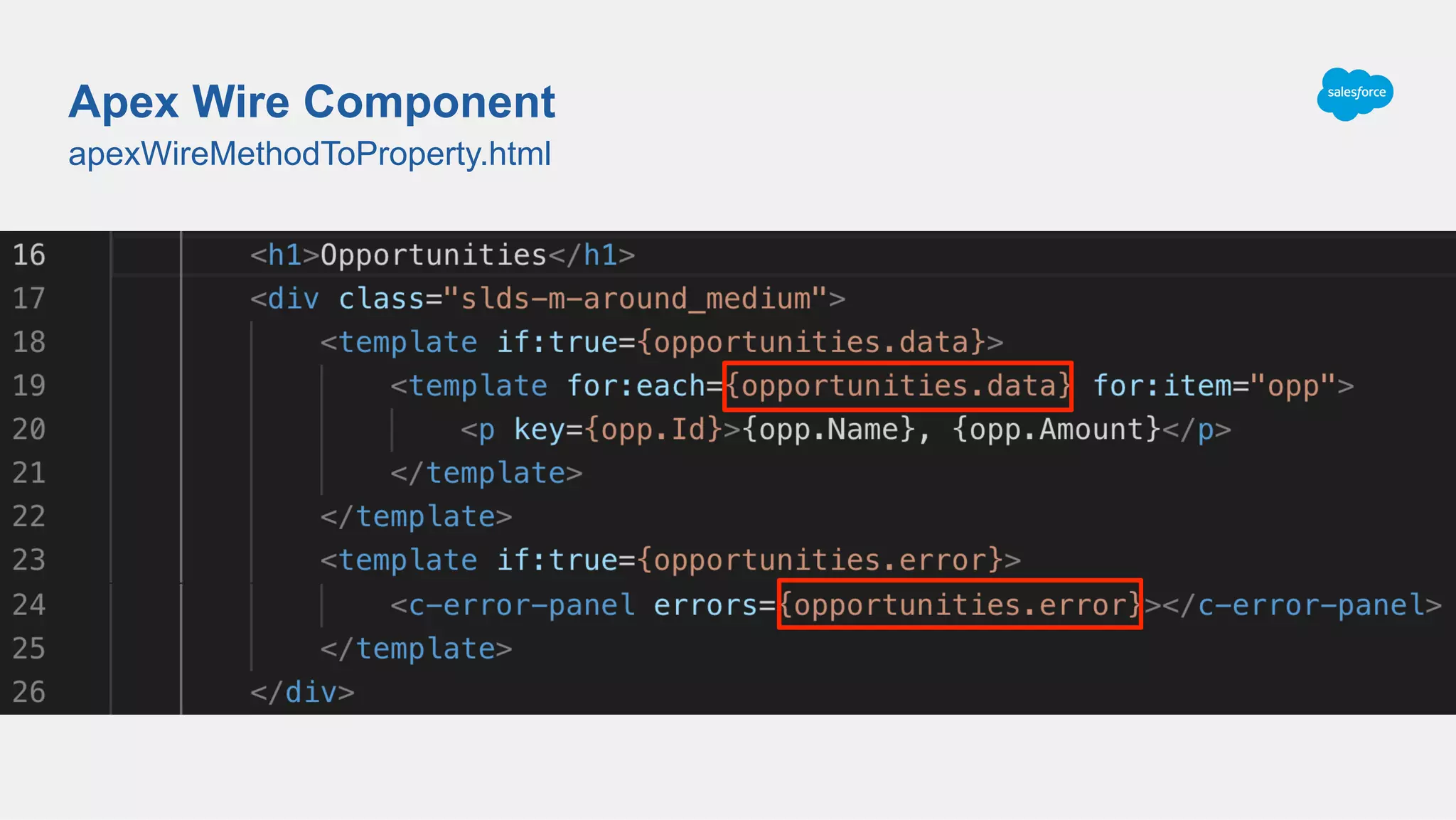
apexWireMethodToProperty.html
Apex Wire Component
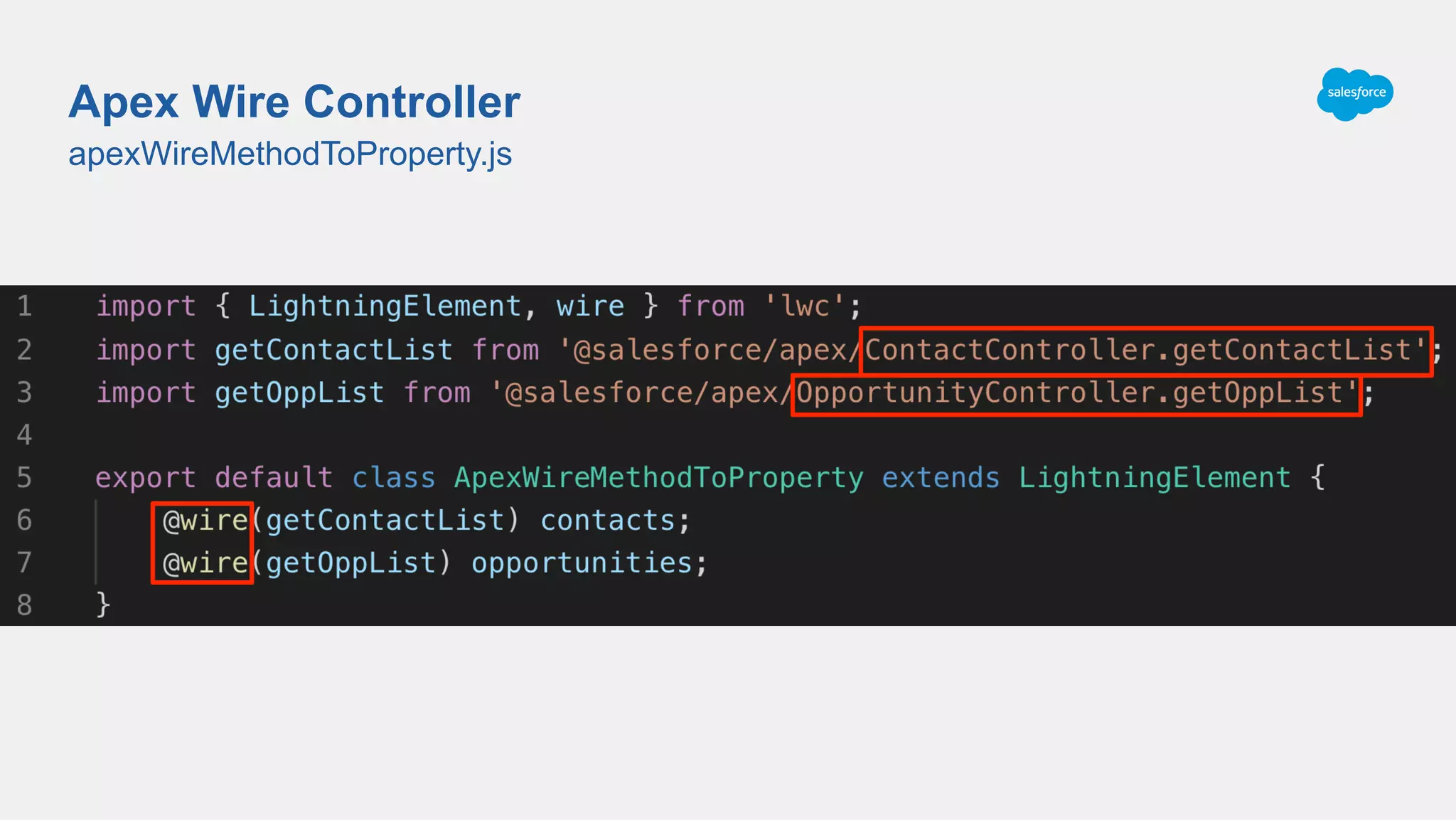
apexWireMethodToProperty.js
Apex Wire Controller
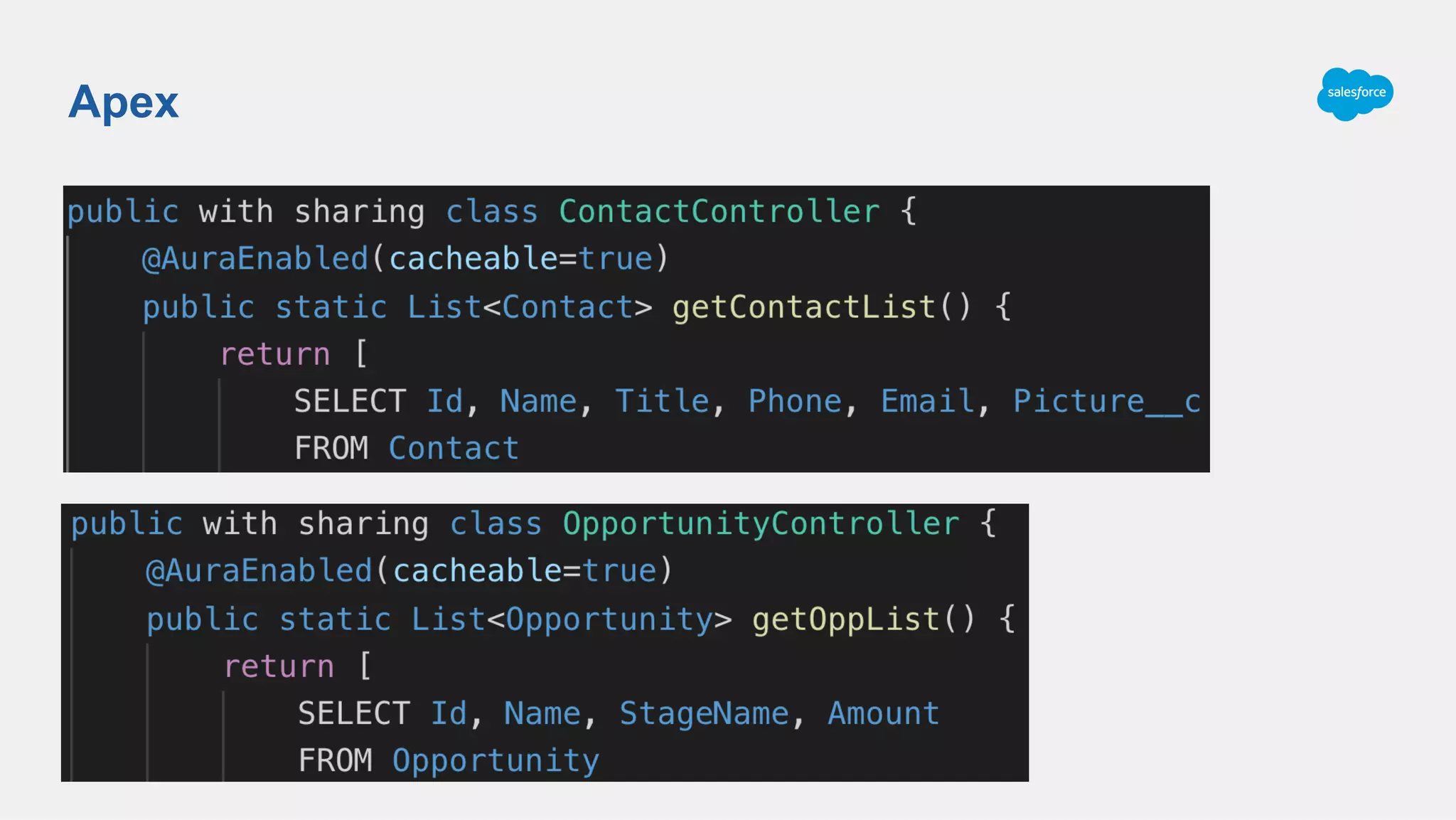
Apex
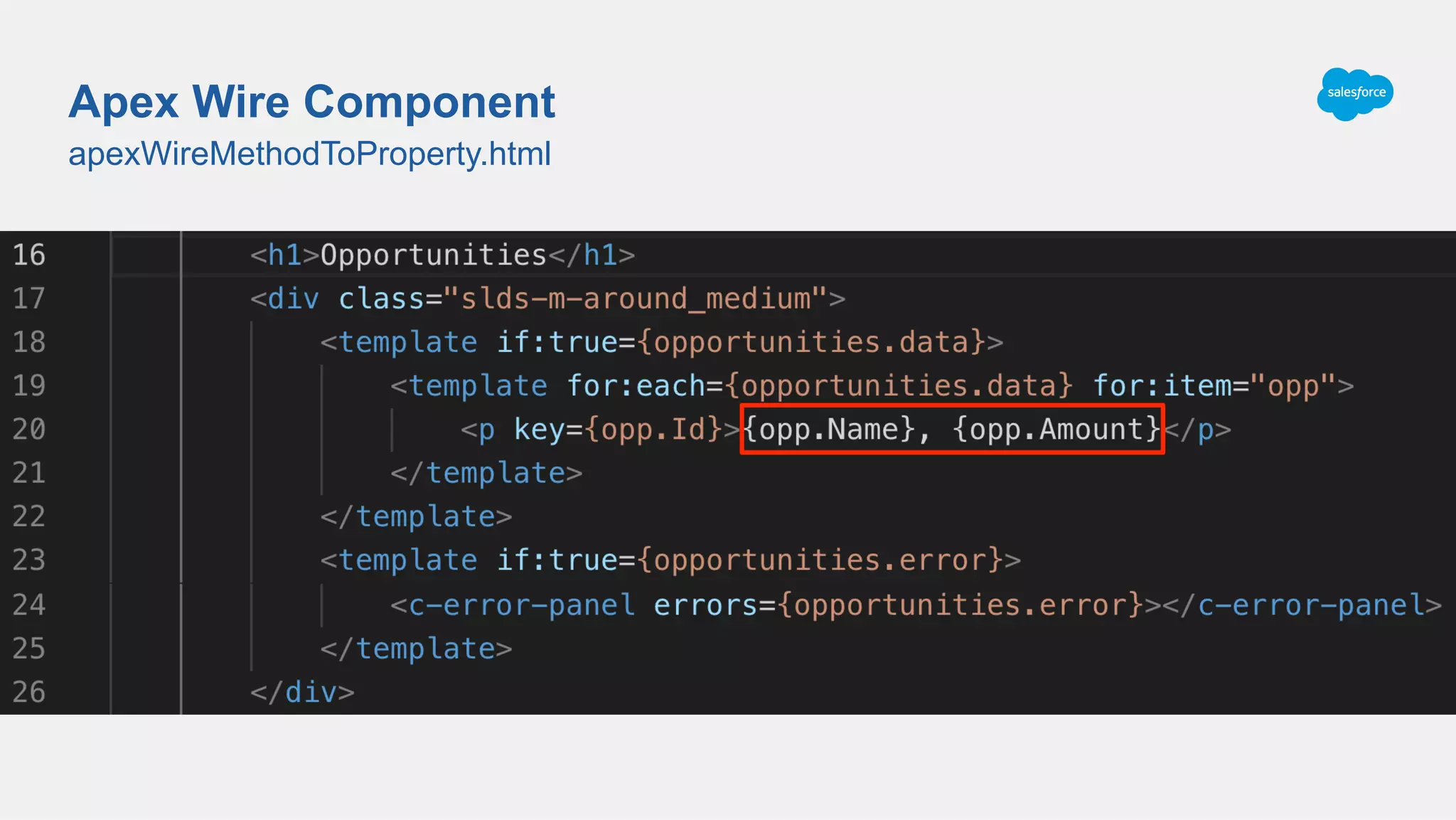
apexWireMethodToProperty.html
Apex Wire Component
apexWireMethodToProperty.html
Apex Wire Component
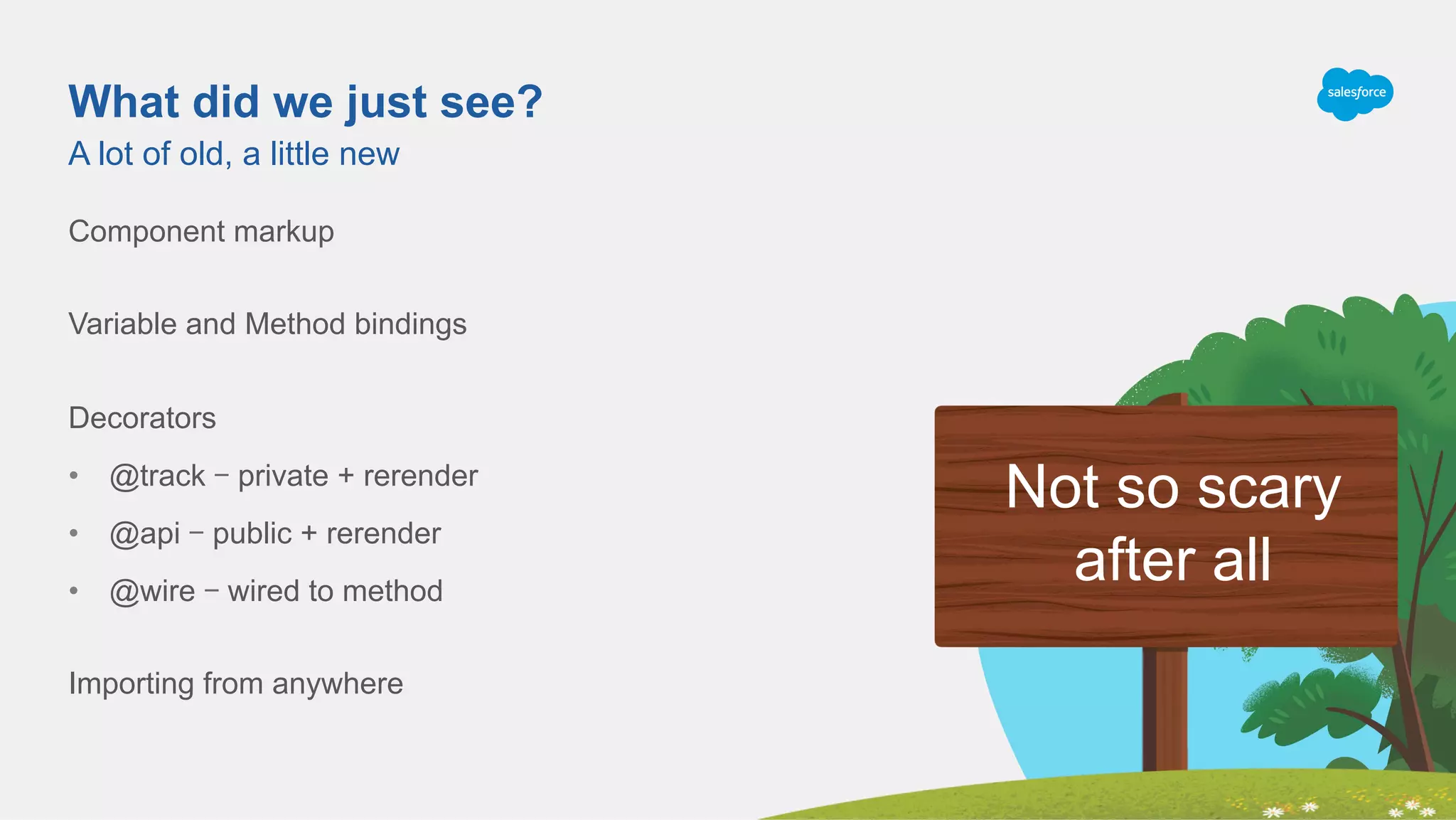
What did we just see?
Component markup
Variable and Method bindings
Decorators
•  @track – private + rerender
•  @api – public + rerender
•  @wire – wired to method
Importing from anywhere
A lot of old, a little new
Not so scary
after all
Recap
How to take Step 2
Recap
Web development already popular
Salesforce evolves to meet demands
Front end has similarities to backend
LWC are the present and future
This is Step 1
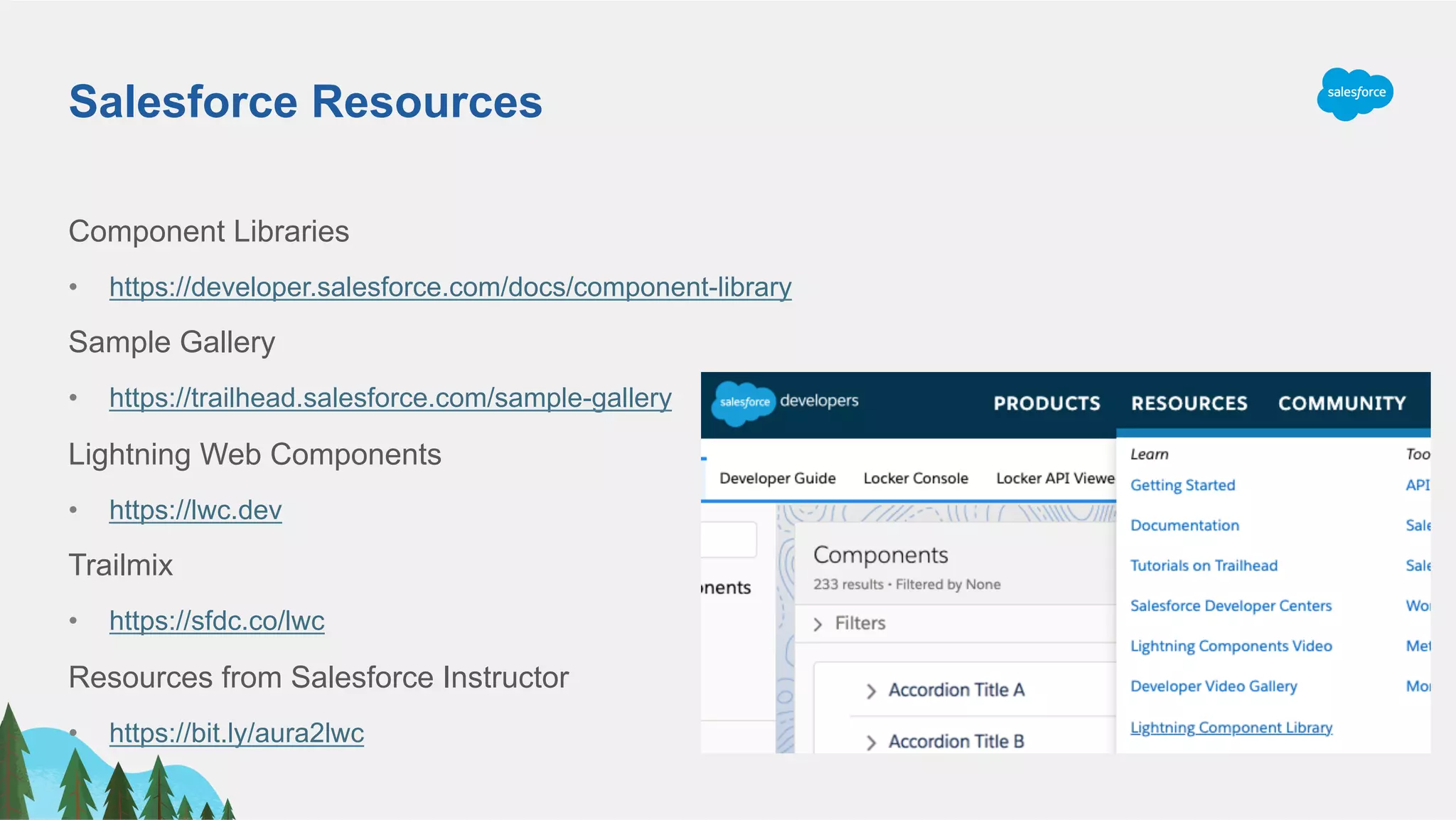
Salesforce Resources
Component Libraries
•  https://developer.salesforce.com/docs/component-library
Sample Gallery
•  https://trailhead.salesforce.com/sample-gallery
Lightning Web Components
•  https://lwc.dev
Trailmix
•  https://sfdc.co/lwc
Resources from Salesforce Instructor
•  https://bit.ly/aura2lwc
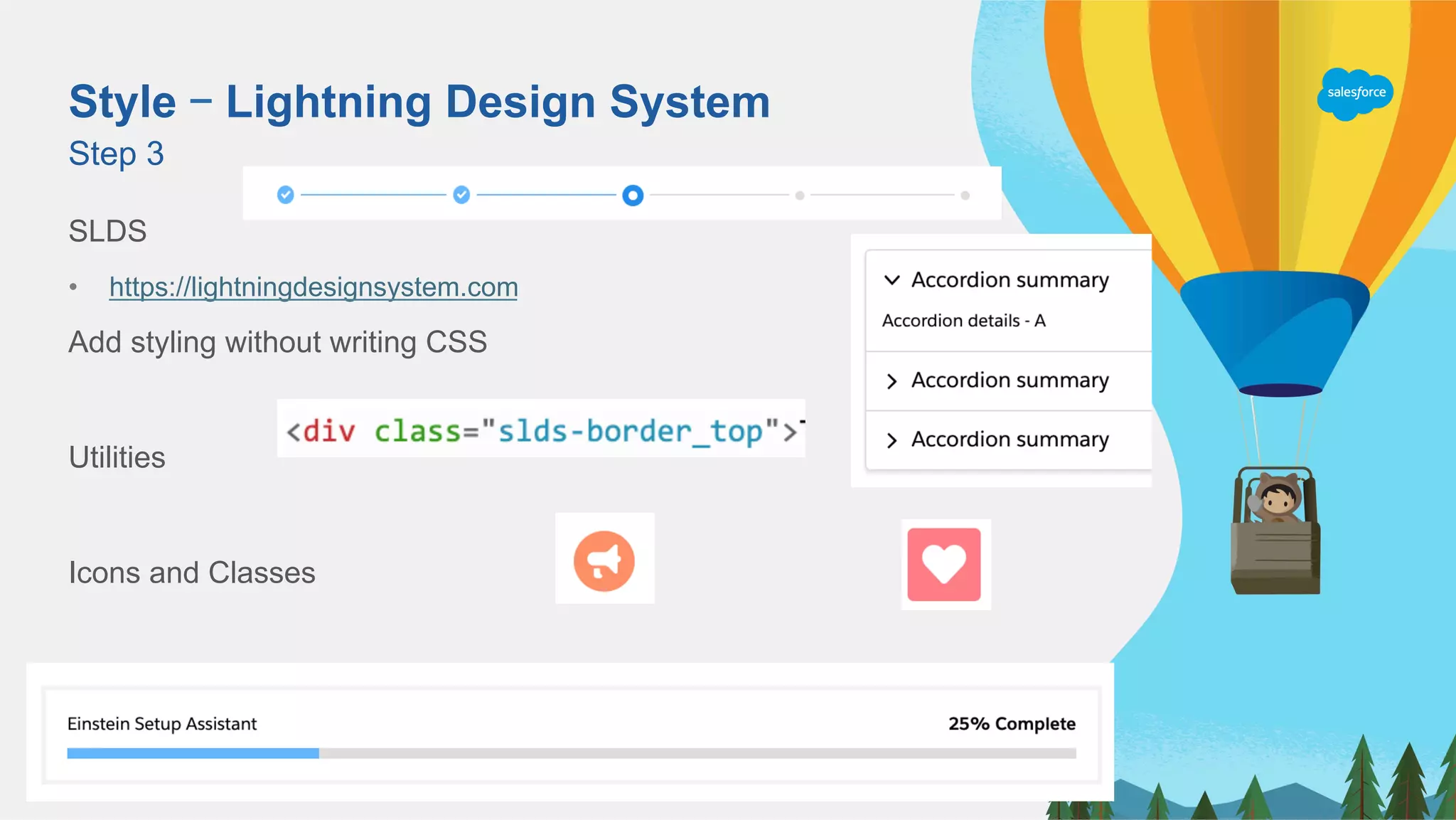
Style – Lightning Design System
SLDS
•  https://lightningdesignsystem.com
Add styling without writing CSS
Utilities
Icons and Classes
Step 3
@adam17amo
adam@adamtoarchitect.com
bit.ly/lightningmigration

Lightning Components 101: An Apex Developer's Guide

  • 1.
    Lightning Components 101 AnApex Developer’s Guide Salesforce Engineer, Adam Olshansky
  • 2.
    600 14X Adam Olshansky SalesforceEngineer, Google ​ @adam17amo ​ adam@adamtoarchitect.com ​ bit.ly/lightningmigration Speaker Logo
  • 3.
    Forward Looking Statement Statementunder the Private Securities Litigation Reform Act of 1995: This presentation contains forward-looking statements about the company’s financial and operating results, which may include expected GAAP and non-GAAP financial and other operating and non- operating results, including revenue, net income, diluted earnings per share, operating cash flow growth, operating margin improvement, expected revenue growth, expected current remaining performance obligation growth, expected tax rates, the one-time accounting non-cash charge that was incurred in connection with the Salesforce.org combination; stock-based compensation expenses, amortization of purchased intangibles, shares outstanding, market growth and sustainability goals. The achievement or success of the matters covered by such forward-looking statements involves risks, uncertainties and assumptions. If any such risks or uncertainties materialize or if any of the assumptions prove incorrect, the company’s results could differ materially from the results expressed or implied by the forward-looking statements we make. The risks and uncertainties referred to above include -- but are not limited to -- risks associated with the effect of general economic and market conditions; the impact of geopolitical events; the impact of foreign currency exchange rate and interest rate fluctuations on our results; our business strategy and our plan to build our business, including our strategy to be the leading provider of enterprise cloud computing applications and platforms; the pace of change and innovation in enterprise cloud computing services; the seasonal nature of our sales cycles; the competitive nature of the market in which we participate; our international expansion strategy; the demands on our personnel and infrastructure resulting from significant growth in our customer base and operations, including as a result of acquisitions; our service performance and security, including the resources and costs required to avoid unanticipated downtime and prevent, detect and remediate potential security breaches; the expenses associated with new data centers and third-party infrastructure providers; additional data center capacity; real estate and office facilities space; our operating results and cash flows; new services and product features, including any efforts to expand our services beyond the CRM market; our strategy of acquiring or making investments in complementary businesses, joint ventures, services, technologies and intellectual property rights; the performance and fair value of our investments in complementary businesses through our strategic investment portfolio; our ability to realize the benefits from strategic partnerships, joint ventures and investments; the impact of future gains or losses from our strategic investment portfolio, including gains or losses from overall market conditions that may affect the publicly traded companies within the company's strategic investment portfolio; our ability to execute our business plans; our ability to successfully integrate acquired businesses and technologies, including delays related to the integration of Tableau due to regulatory review by the United Kingdom Competition and Markets Authority; our ability to continue to grow unearned revenue and remaining performance obligation; our ability to protect our intellectual property rights; our ability to develop our brands; our reliance on third-party hardware, software and platform providers; our dependency on the development and maintenance of the infrastructure of the Internet; the effect of evolving domestic and foreign government regulations, including those related to the provision of services on the Internet, those related to accessing the Internet, and those addressing data privacy, cross-border data transfers and import and export controls; the valuation of our deferred tax assets and the release of related valuation allowances; the potential availability of additional tax assets in the future; the impact of new accounting pronouncements and tax laws; uncertainties affecting our ability to estimate our tax rate; the impact of expensing stock options and other equity awards; the sufficiency of our capital resources; factors related to our outstanding debt, revolving credit facility, term loan and loan associated with 50 Fremont; compliance with our debt covenants and lease obligations; current and potential litigation involving us; and the impact of climate change. Further information on these and other factors that could affect the company’s financial results is included in the reports on Forms 10-K, 10-Q and 8-K and in other filings it makes with the Securities and Exchange Commission from time to time. These documents are available on the SEC Filings section of the Investor Information section of the company’s website at www.salesforce.com/investor. Salesforce.com, inc. assumes no obligation and does not intend to update these forward-looking statements, except as required by law.
  • 4.
    Developing a fearof heights Further up the Mountain Front end JavaScript Client side Shadow DOM Callback hell
  • 5.
    Front End LanguageUsage Stack Overflow Developer Survey, 2019 •  72,000+ responses 7th Year in a Row for JavaScript
  • 6.
    Quarterly Data •  JavaScriptis 20%+ of all requests Apex is 39th JavaScript #1 in GitHub Pull Requests since 2013
  • 7.
  • 8.
    Expectations You’re an ApexDeveloper Can’t learn JavaScript in 40 mins Understand common patterns Gain confidence to start building components The First Step
  • 9.
    Agenda 1.  Apex Overview 2. Components 3.  VF vs. Lightning Web Components 4.  Lightning Web Components 5.  Summary and Step 2
  • 10.
  • 11.
    Apex Overview Bread andButter Triggers Classes/ Controllers Variables Methods Parameters Return values Events
  • 12.
    Async Apex Wait forresources Batchable @future
  • 13.
    MVC Model HTML styletags Bind Variables Bind Methods Button based UI Visualforce
  • 14.
    Governor limits Button clickbased Poor Performance Hacky solutions Limitations Apex and VF Gaps
  • 15.
    A New ProgrammingModel MVC++
  • 16.
    Customer Driven ParadigmShift August 2015 September 2007 January 2019
  • 17.
    Everything on theServer Where We Were - MVC
  • 18.
    Client vs. Server Movingto client side - MVCC
  • 19.
    What is a“Lightning Component”? Container for multiple files Aura Lightning Web Component UI Controller CSS XML Metadata Helper Documentation Design SVG
  • 20.
    What’s Old WithComponents? Many similar things UI Components Event based code Bind variables Calling methods Multiple files used
  • 21.
    UI Components Old Framework NewNames <apex> LWC Framework <html>, <lightning>, <c>
  • 22.
    Event Based Code OldFramework New Names before insert, after update LWC Framework onchange, onclick
  • 23.
    Bind Variables Old Framework SimilarSyntax {!variable} LWC Framework {variable}
  • 24.
    Bind Methods Old Framework SimilarSyntax {!methodName} LWC Framework {methodName} or custom
  • 25.
    Multiple Files Old Framework Similarto before VF Page, Apex Controller, Apex Helper LWC Framework HTML, JS Controller, Apex Controller
  • 26.
  • 27.
  • 28.
  • 29.
  • 30.
  • 31.
    What did wejust see? Component markup Code running based on events Variable and method bindings Controller part of the bundle No Apex
  • 32.
  • 33.
  • 34.
  • 35.
    New with WebComponents! More to Learn Industry Standards Logic in one spot Multiple Apex Controllers Decorators
  • 36.
  • 37.
  • 38.
  • 39.
  • 40.
  • 41.
  • 42.
  • 43.
  • 44.
  • 45.
  • 46.
  • 47.
  • 48.
  • 49.
    What did wejust see? Component markup Variable and Method bindings Decorators •  @track – private + rerender •  @api – public + rerender •  @wire – wired to method Importing from anywhere A lot of old, a little new Not so scary after all
  • 50.
  • 51.
    Recap Web development alreadypopular Salesforce evolves to meet demands Front end has similarities to backend LWC are the present and future This is Step 1
  • 52.
    Salesforce Resources Component Libraries • https://developer.salesforce.com/docs/component-library Sample Gallery •  https://trailhead.salesforce.com/sample-gallery Lightning Web Components •  https://lwc.dev Trailmix •  https://sfdc.co/lwc Resources from Salesforce Instructor •  https://bit.ly/aura2lwc
  • 53.
    Style – LightningDesign System SLDS •  https://lightningdesignsystem.com Add styling without writing CSS Utilities Icons and Classes Step 3
  • 54.