Managing the Role Hierarchy at
Enterprise Scale
Bud Vieira, Salesforce, CCE Technical Enablement
@aavra

Sean Regan, Salesforce, CCE Technical Enablement
@sfdcsregan

Robert Kraynak, Symantec Corporation, Sr. Director Change and Cloud Enablement
Safe Harbor
 Safe harbor statement under the Private Securities Litigation Reform Act of 1995:

 This presentation may contain forward-looking statements that involve risks, uncertainties, and assumptions. If any such uncertainties materialize or if
 any of the assumptions proves incorrect, the results of salesforce.com, inc. could differ materially from the results expressed or implied by the forward-
 looking statements we make. All statements other than statements of historical fact could be deemed forward-looking, including any projections of
 product or service availability, subscriber growth, earnings, revenues, or other financial items and any statements regarding strategies or plans of
 management for future operations, statements of belief, any statements concerning new, planned, or upgraded services or technology developments
 and customer contracts or use of our services.

 The risks and uncertainties referred to above include – but are not limited to – risks associated with developing and delivering new functionality for our
 service, new products and services, our new business model, our past operating losses, possible fluctuations in our operating results and rate of growth,
 interruptions or delays in our Web hosting, breach of our security measures, the outcome of intellectual property and other litigation, risks associated
 with possible mergers and acquisitions, the immature market in which we operate, our relatively limited operating history, our ability to expand, retain,
 and motivate our employees and manage our growth, new releases of our service and successful customer deployment, our limited history reselling
 non-salesforce.com products, and utilization and selling to larger enterprise customers. Further information on potential factors that could affect the
 financial results of salesforce.com, inc. is included in our annual report on Form 10-Q for the most recent fiscal quarter ended July 31, 2012. This
 documents and others containing important disclosures are available on the SEC Filings section of the Investor Information section of our Web site.

 Any unreleased services or features referenced in this or other presentations, press releases or public statements are not currently available and may
 not be delivered on time or at all. Customers who purchase our services should make the purchase decisions based upon features that are currently
 available. Salesforce.com, inc. assumes no obligation and does not intend to update these forward-looking statements.
Collaborate!


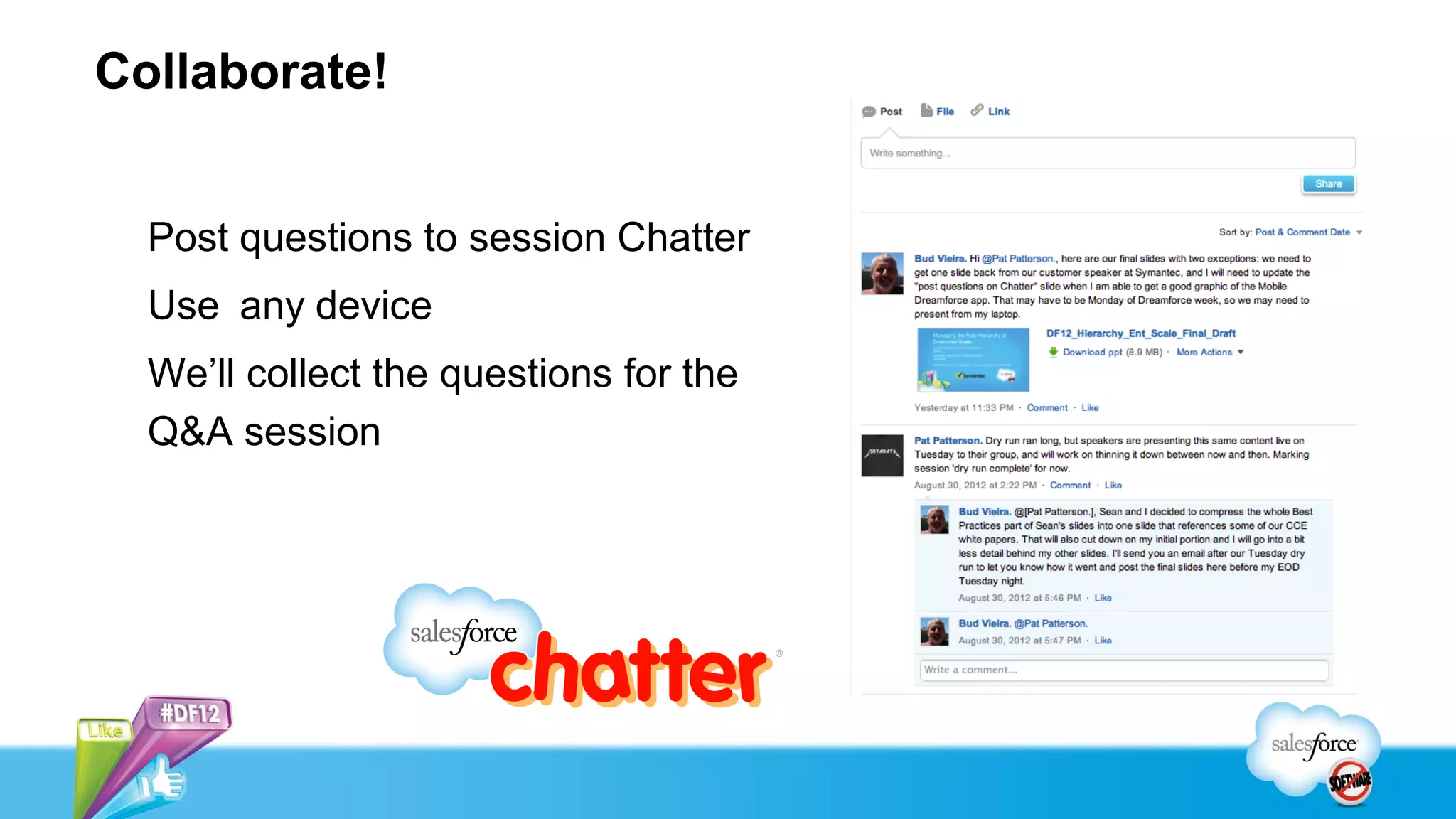
  Post questions to session Chatter
  Use any device
  We’ll collect the questions for the
  Q&A session
Agenda

Role Hierarchy at Enterprise Scale – the Challenge
Role Management Success – Tools and Strategies
Customer Success – Role Management at Symantec
Key Take Aways
Q&A
Bud Vieira
Senior Member of Technical Staff
CCE Technical Enablement
@aavra
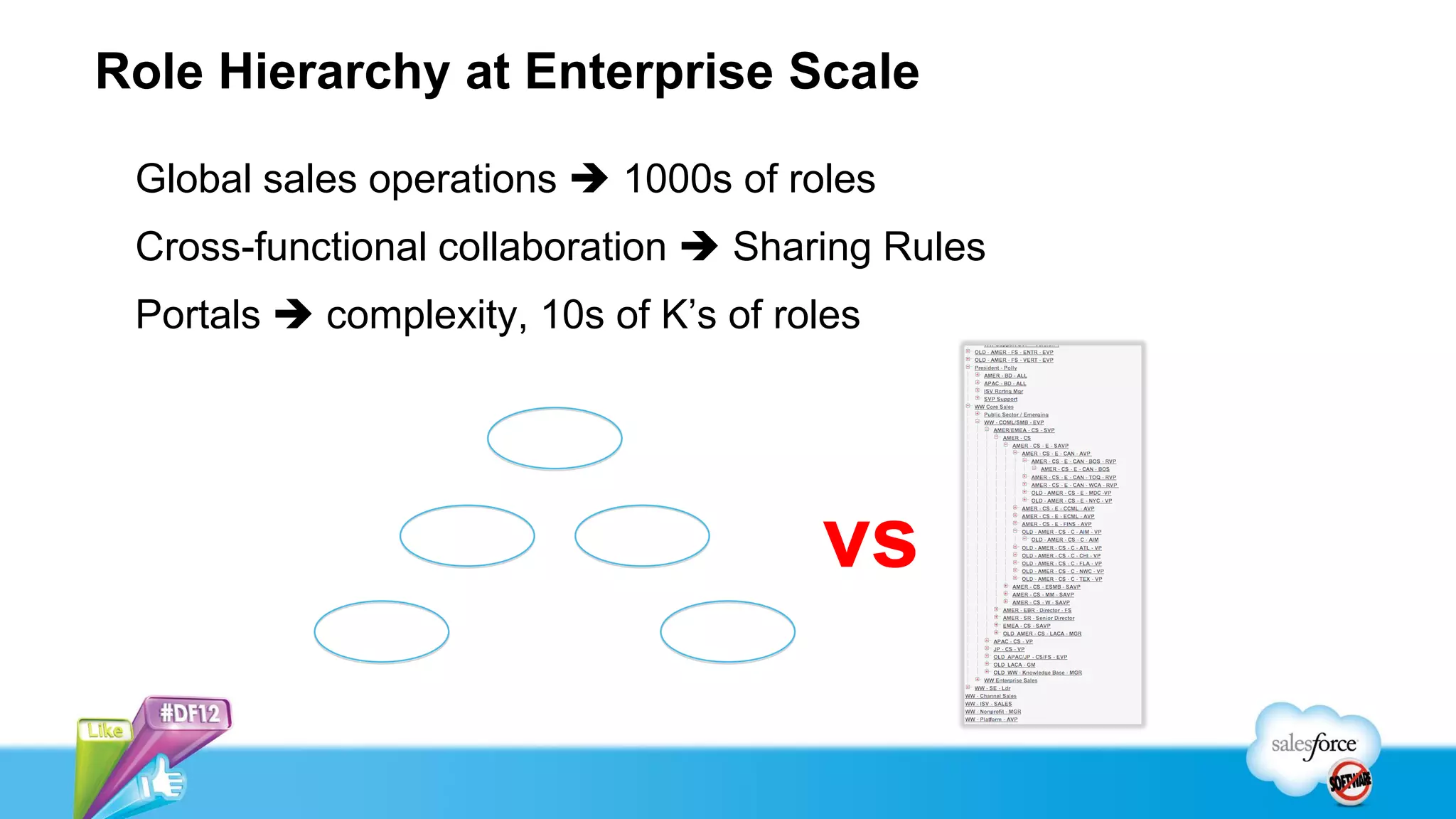
Role Hierarchy at Enterprise Scale

 Global sales operations  1000s of roles
 Cross-functional collaboration  Sharing Rules
 Portals  complexity, 10s of K’s of roles


                                       vs
What is Sharing Maintenance?

 Sharing is optimized for end user performance
 Access is calculated as configuration changes
 Sharing Rules
 Role Hierarchy Structure
 User Role Changes
 Large Data Loads
 Big Changes + Big Data *may* = Big Calc
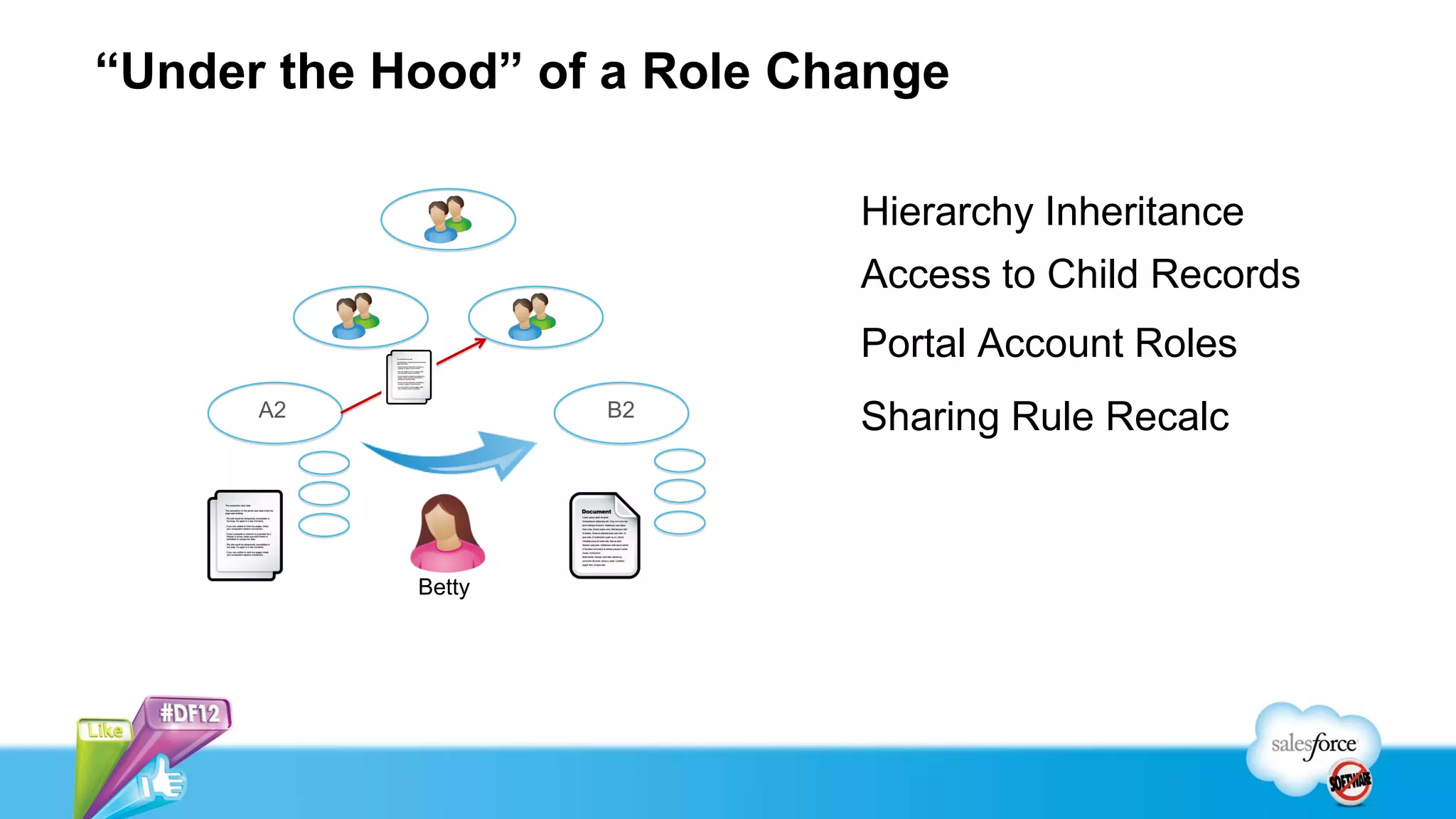
“Under the Hood” of a Role Change

                             Hierarchy Inheritance
                             Access to Child Records
                             Portal Account Roles
      A2            B2
                             Sharing Rule Recalc


            Betty
Example: Salesforce.com Realignment ‘11
 Basic Stats
 ~19M Accounts and Related Records
 ~60K Roles
 ~700 Sharing Rules on Accounts and Children

 Scope of the Changes
 New executive role
 Child record access settings
 1M Accounts changed owners
 2000 Users changed roles
Key Take-Aways

 Security is calculated in advance to optimize user experience
 Changes that seem simple can involve a lot of recalculation
 Actively manage complex orgs to optimize performance
Sean Regan
Senior Member of Technical Staff
CCE Technical Enablement
@sfdcsregan
Role Management Success

 Managing Role Growth
   Role defaults for Portals
   Deleting unused Roles via API


 Best Practices for Major Sharing Changes
   CCE Publications on Sharing
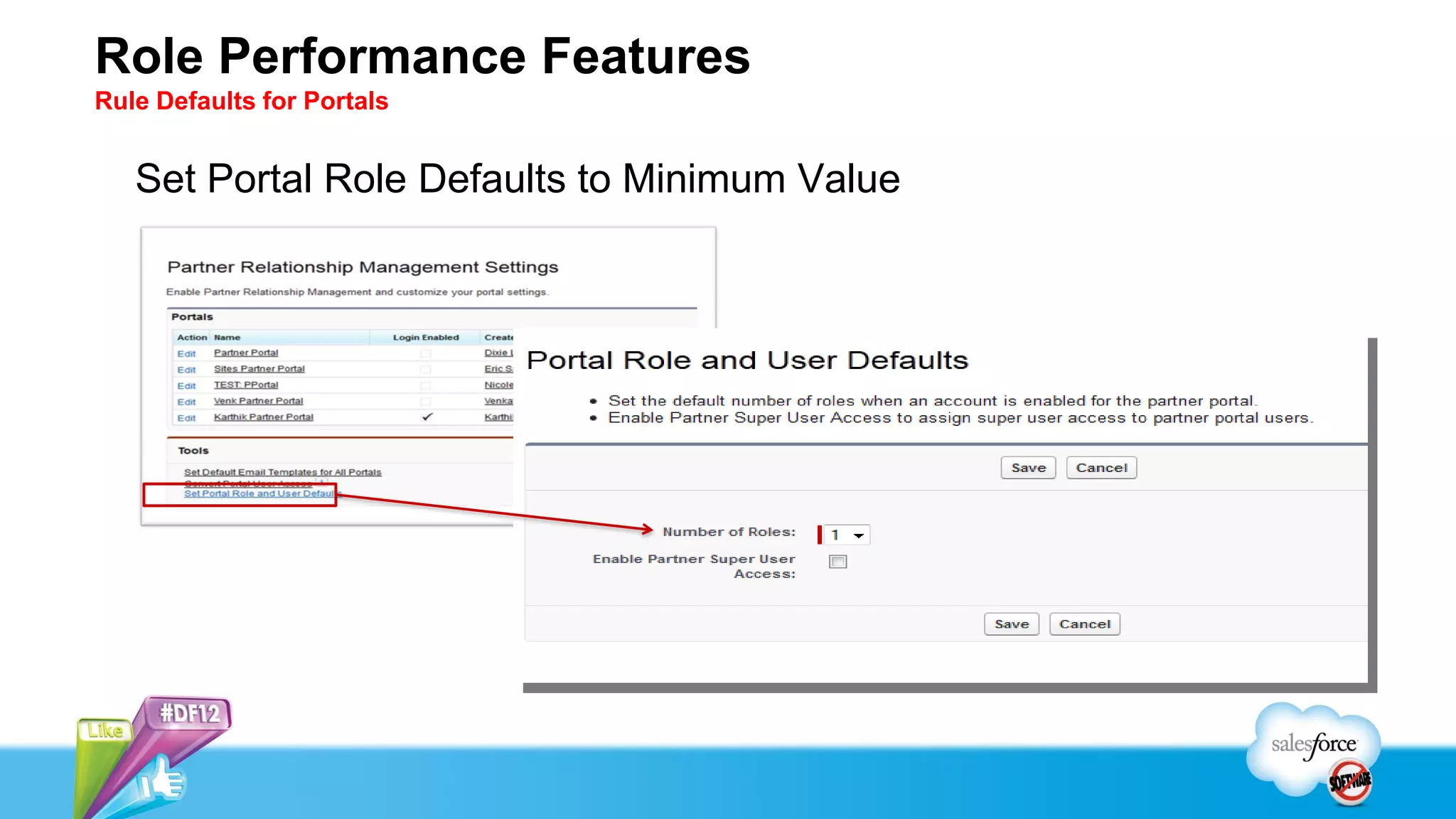
Role Performance Features
Rule Defaults for Portals


   Set Portal Role Defaults to Minimum Value
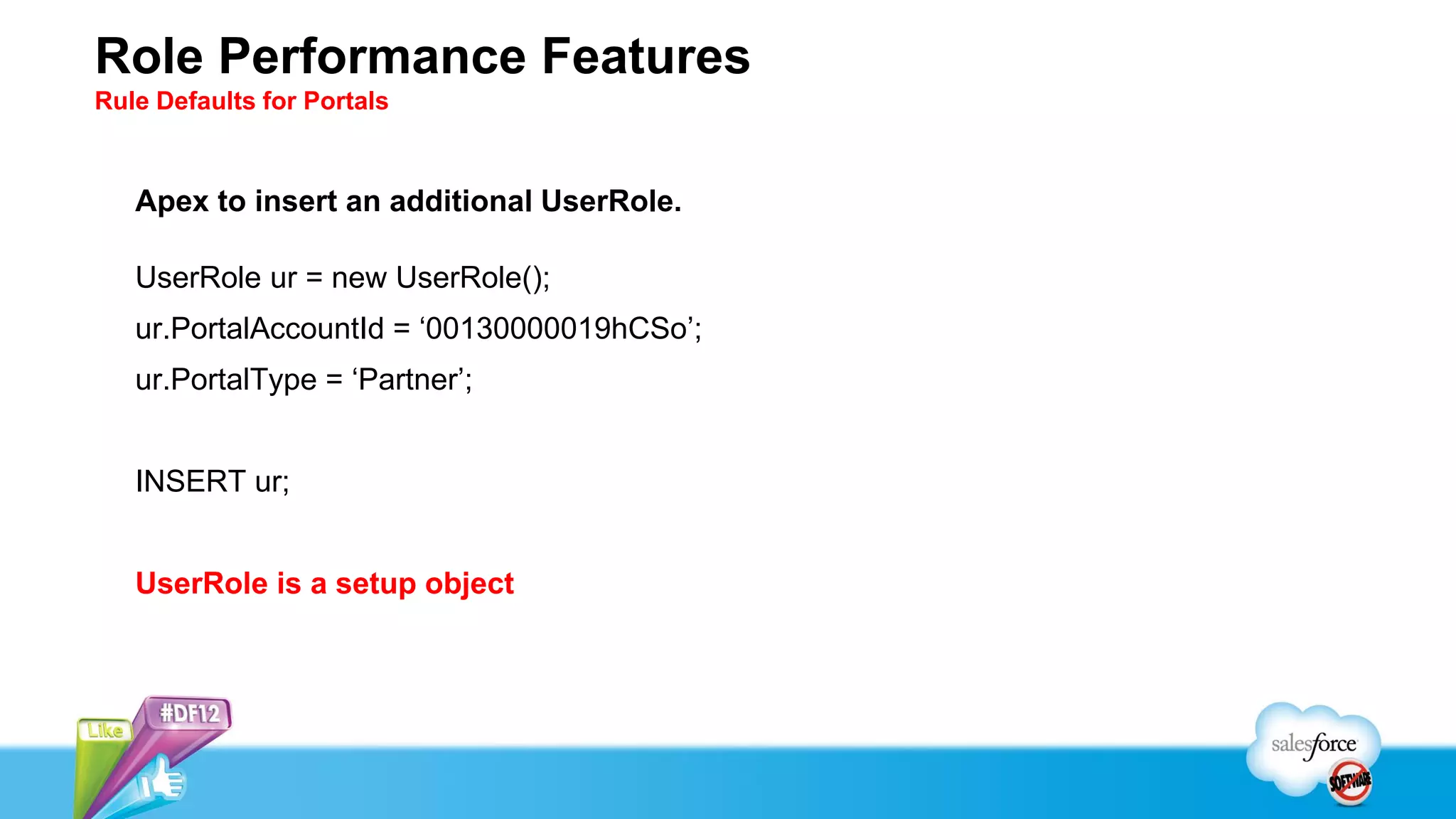
Role Performance Features
Rule Defaults for Portals


   Apex to insert an additional UserRole.

   UserRole ur = new UserRole();
   ur.PortalAccountId = ‘00130000019hCSo’;
   ur.PortalType = ‘Partner’;


   INSERT ur;


   UserRole is a setup object
Role Performance Features
Deleting Unused Roles


   Determine what roles to delete
      Unused
      All inactive users
      Last login timeframe
   Move users to a different role
   Delete the target roles
Deleting Roles – Step 1
Find the Empty Roles

   Back Up Your DATA!!!

   SOQL Query to extract the Partner roles not assigned to any user.

   SELECT
    CaseAccessForAccountOwner, ContactAccessForAccountOwner, ForecastUserId, Id,
    MayForecastManagerShare, Name, OpportunityAccessForAccountOwner, ParentRoleId, PortalAccountId,
    PortalAccountOwnerId, PortalRole, PortalType,RollupDescription

   FROM
    UserRole

   WHERE
    PortalType = 'Partner' and PortalRole in (‘Executive’,’Manager’) and Id not in(select UserRoleId from User)
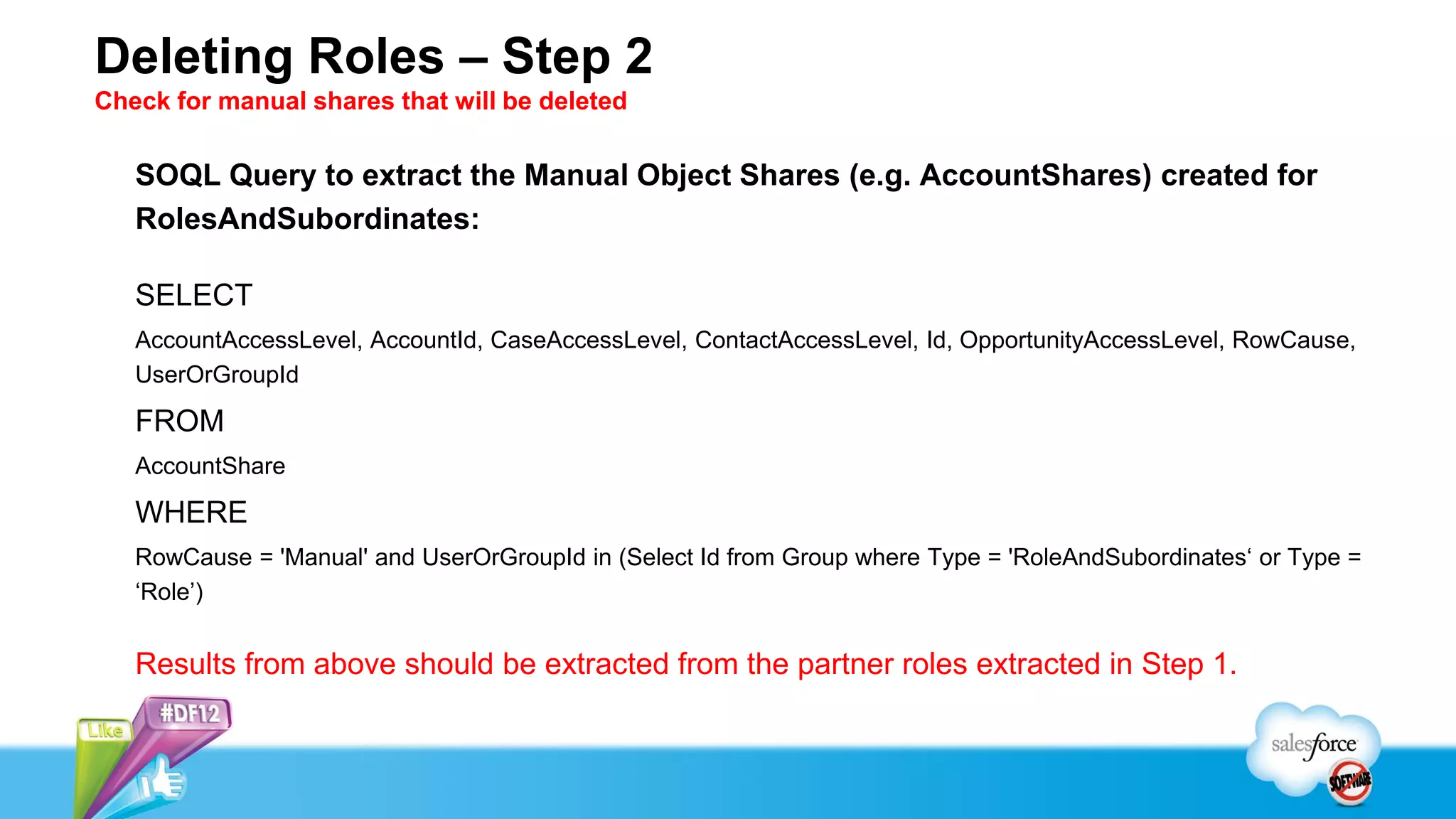
Deleting Roles – Step 2
Check for manual shares that will be deleted

   SOQL Query to extract the Manual Object Shares (e.g. AccountShares) created for
   RolesAndSubordinates:

   SELECT
   AccountAccessLevel, AccountId, CaseAccessLevel, ContactAccessLevel, Id, OpportunityAccessLevel, RowCause,
   UserOrGroupId

   FROM
   AccountShare

   WHERE
   RowCause = 'Manual' and UserOrGroupId in (Select Id from Group where Type = 'RoleAndSubordinates‘ or Type =
   ‘Role’)


   Results from above should be extracted from the partner roles extracted in Step 1.
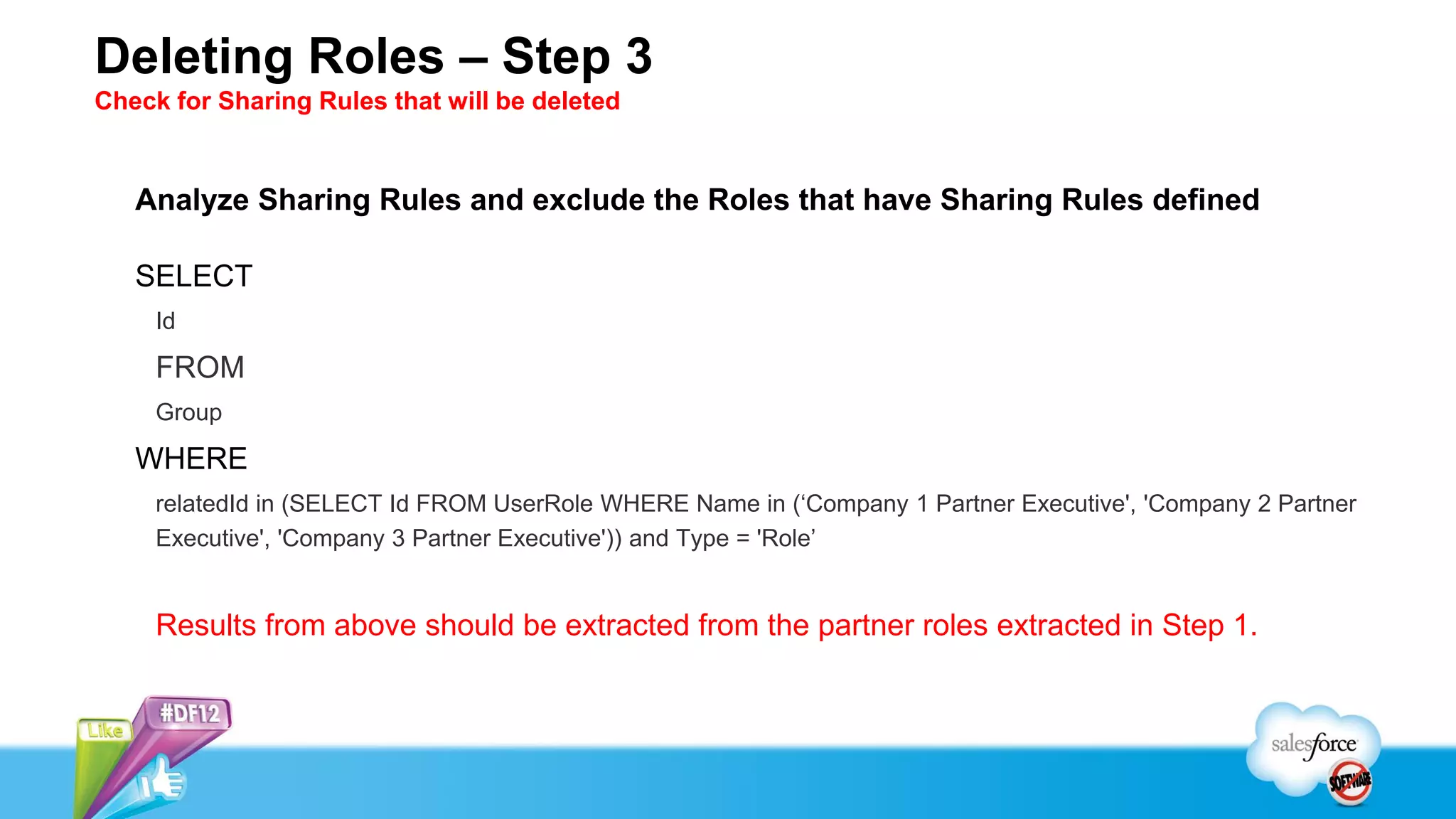
Deleting Roles – Step 3
Check for Sharing Rules that will be deleted


   Analyze Sharing Rules and exclude the Roles that have Sharing Rules defined

   SELECT
     Id

     FROM
     Group

   WHERE
     relatedId in (SELECT Id FROM UserRole WHERE Name in (‘Company 1 Partner Executive', 'Company 2 Partner
     Executive', 'Company 3 Partner Executive')) and Type = 'Role’


     Results from above should be extracted from the partner roles extracted in Step 1.
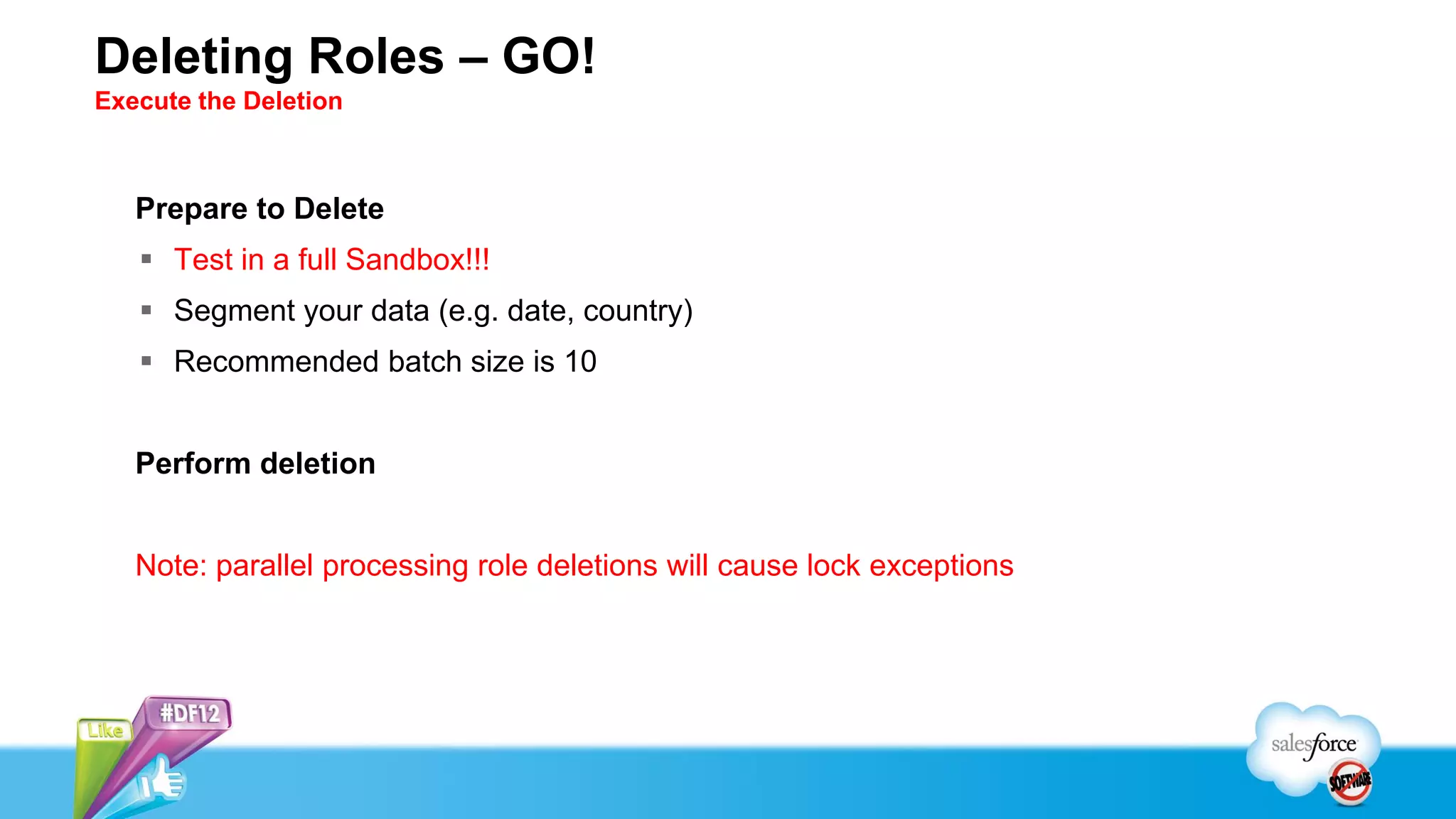
Deleting Roles – GO!
Execute the Deletion


   Prepare to Delete
    Test in a full Sandbox!!!
    Segment your data (e.g. date, country)
    Recommended batch size is 10


   Perform deletion


   Note: parallel processing role deletions will cause lock exceptions
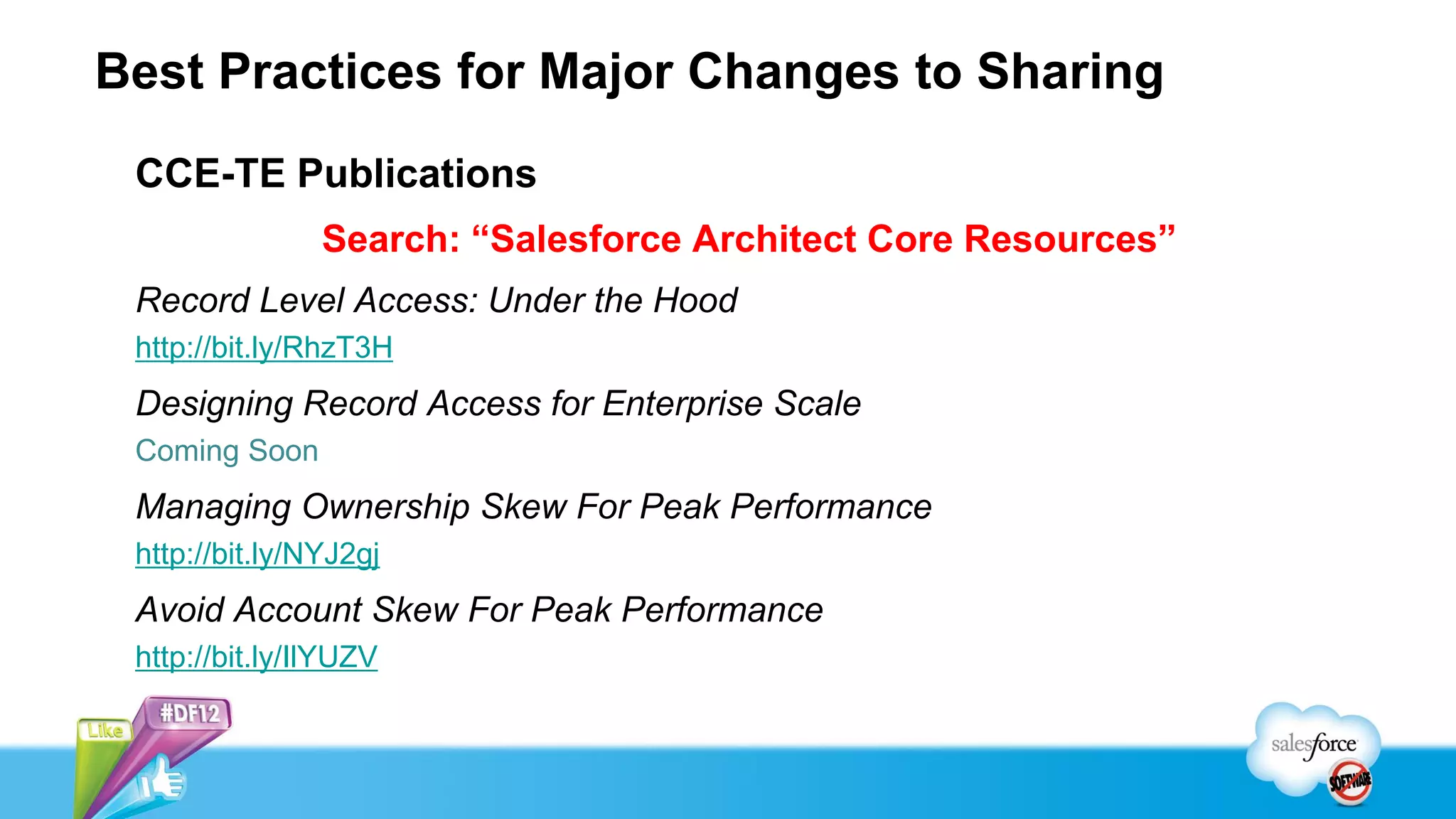
Best Practices for Major Changes to Sharing
 CCE-TE Publications
                Search: “Salesforce Architect Core Resources”
 Record Level Access: Under the Hood
 http://bit.ly/RhzT3H
 Designing Record Access for Enterprise Scale
 Coming Soon
 Managing Ownership Skew For Peak Performance
 http://bit.ly/NYJ2gj
 Avoid Account Skew For Peak Performance
 http://bit.ly/IlYUZV
Key Take-Aways
 Only create the portal roles you need
 Periodically query and delete unneeded roles
 Learn and follow best practices for large scale sharing changes
 Contact Support or Services for assistance on any large scale organization
  realignments
Robert Kraynak
Sr. Director Cloud Enablement
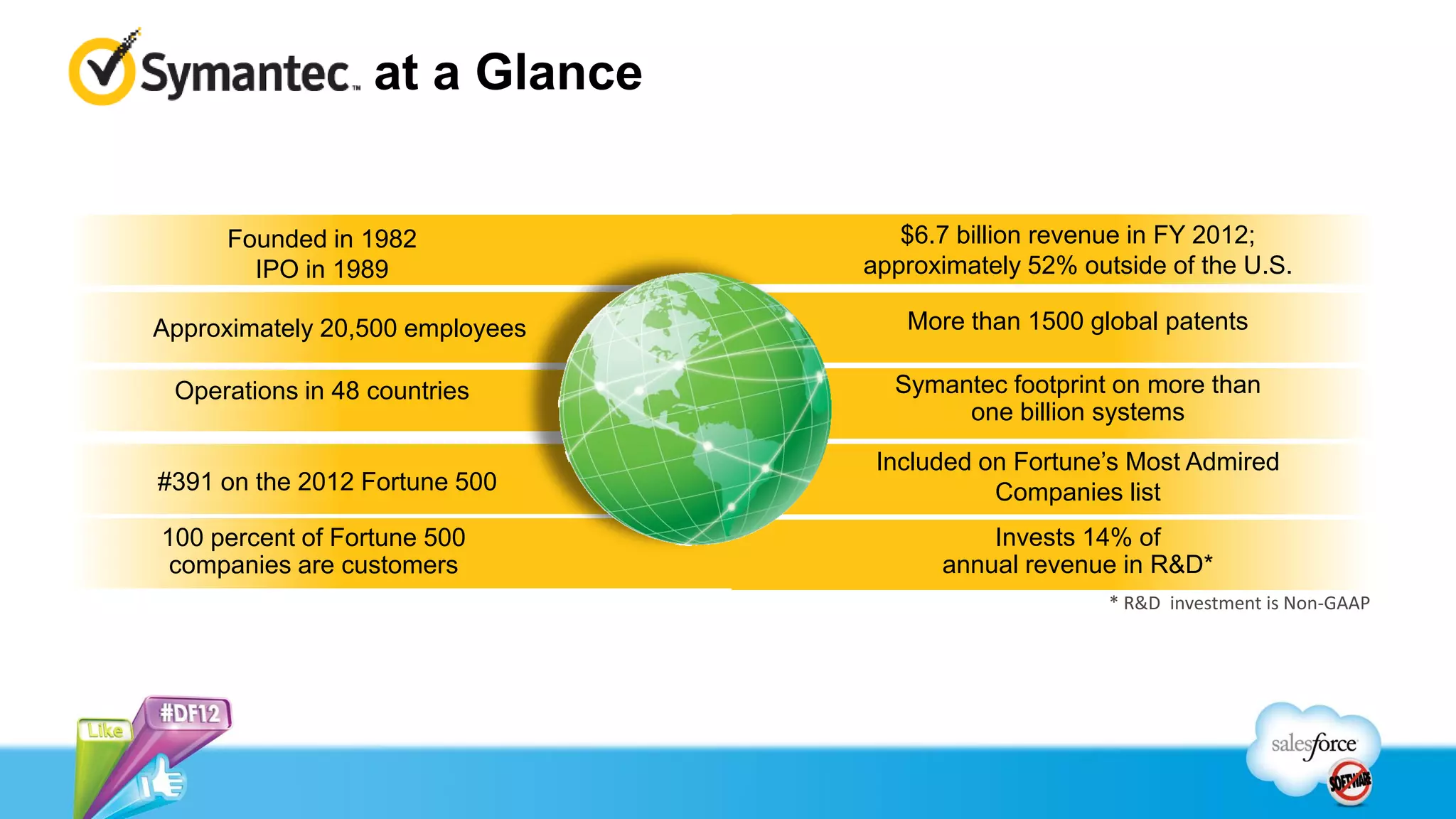
at a Glance


     Founded in 1982                $6.7 billion revenue in FY 2012;
       IPO in 1989               approximately 52% outside of the U.S.

Approximately 20,500 employees      More than 1500 global patents

 Operations in 48 countries        Symantec footprint on more than
                                        one billion systems
                                  Included on Fortune’s Most Admired
#391 on the 2012 Fortune 500                Companies list
100 percent of Fortune 500                 Invests 14% of
 companies are customers               annual revenue in R&D*
                                                      * R&D investment is Non-GAAP
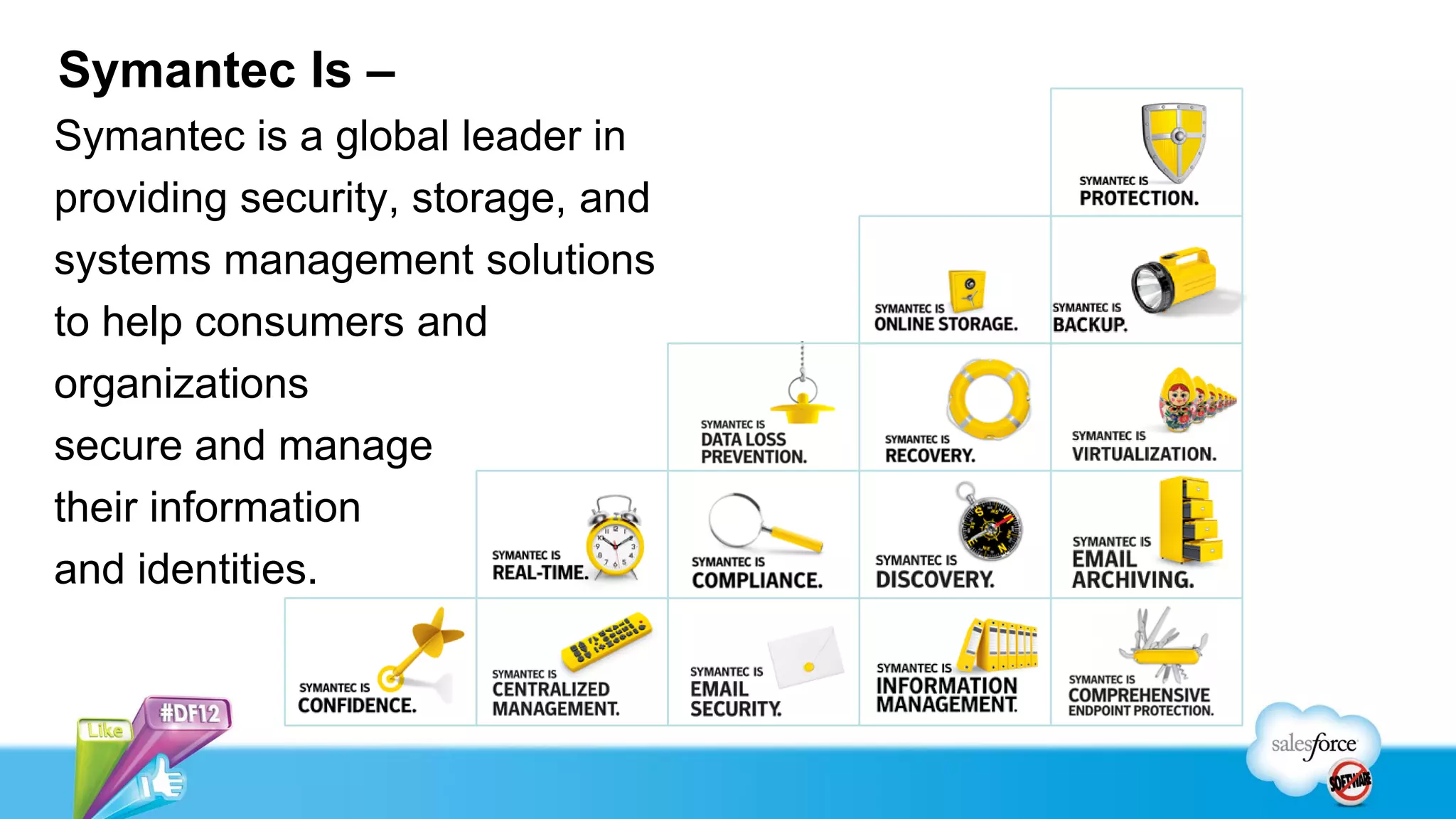
Symantec Is –
Symantec is a global leader in
providing security, storage, and
systems management solutions
to help consumers and
organizations
secure and manage
their information
and identities.
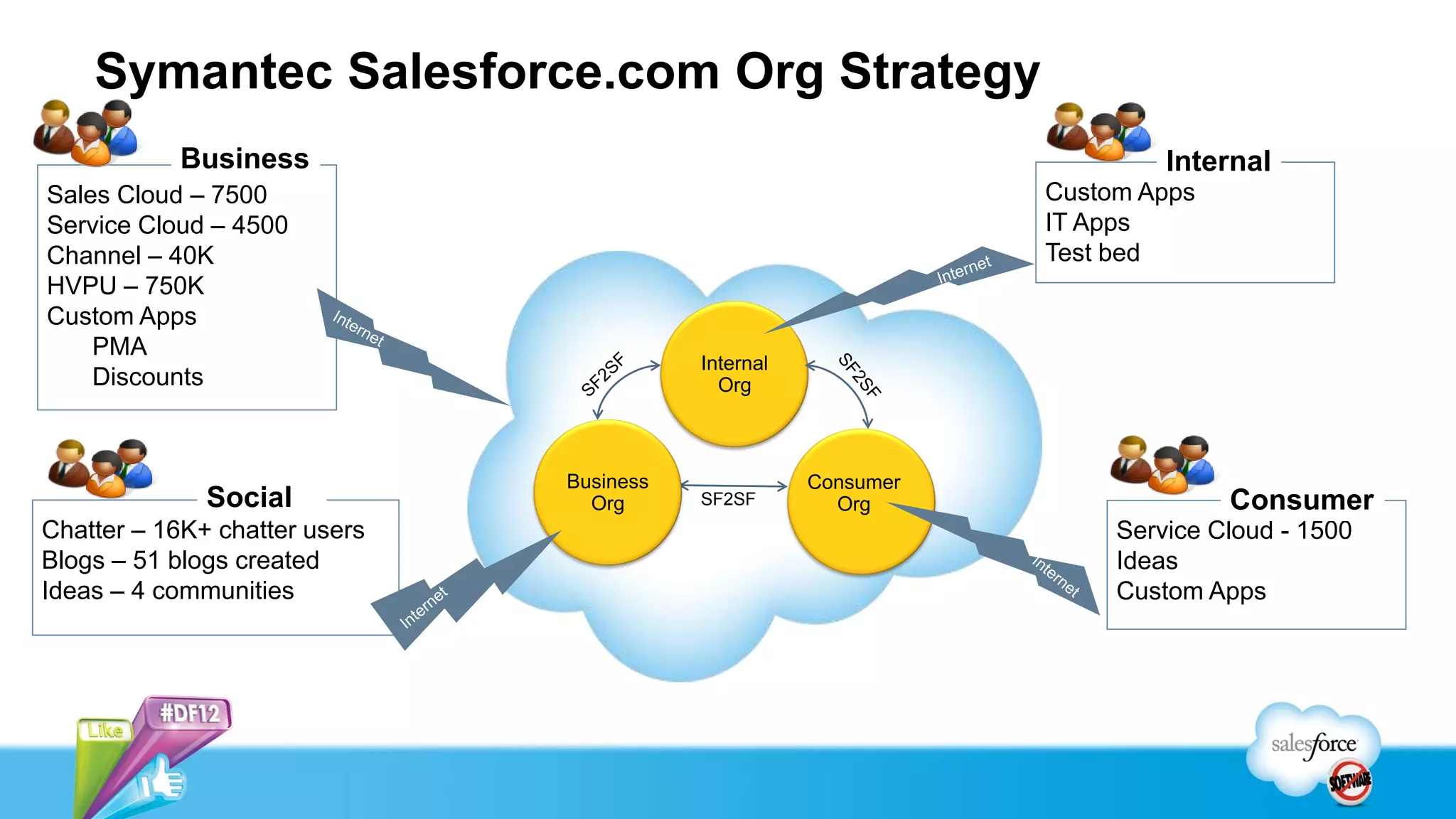
Symantec Salesforce.com Org Strategy
            Business                                                     Internal
Sales Cloud – 7500                                              Custom Apps
Service Cloud – 4500                                            IT Apps
Channel – 40K                                                   Test bed
HVPU – 750K
Custom Apps
    PMA
                                          Internal
    Discounts                               Org


                               Business              Consumer
              Social             Org      SF2SF        Org                    Consumer
Chatter – 16K+ chatter users                                         Service Cloud - 1500
Blogs – 51 blogs created                                             Ideas
Ideas – 4 communities                                                Custom Apps
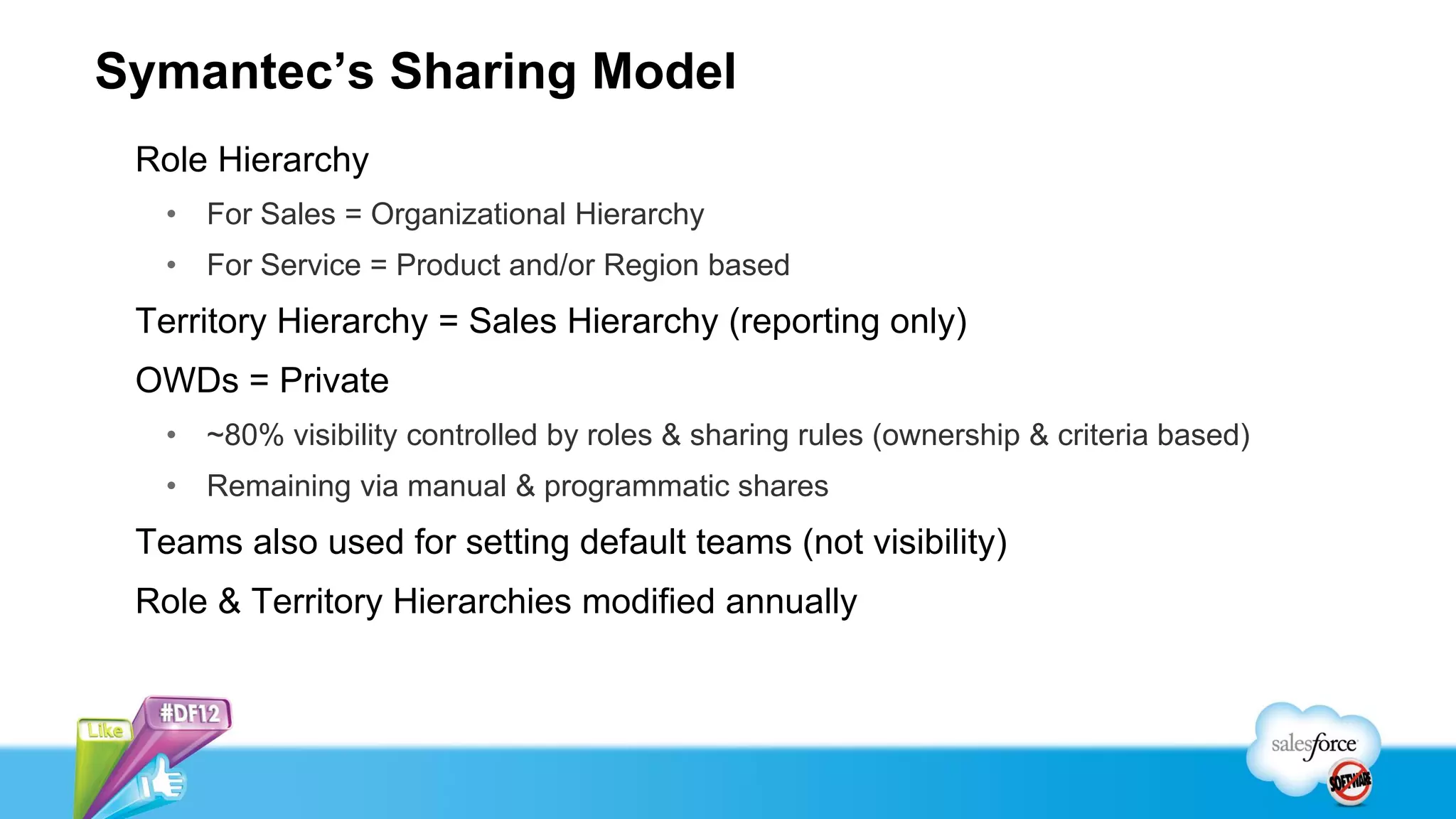
Symantec’s Sharing Model
 Role Hierarchy
   • For Sales = Organizational Hierarchy
   • For Service = Product and/or Region based
 Territory Hierarchy = Sales Hierarchy (reporting only)
 OWDs = Private
   • ~80% visibility controlled by roles & sharing rules (ownership & criteria based)
   • Remaining via manual & programmatic shares
 Teams also used for setting default teams (not visibility)
 Role & Territory Hierarchies modified annually
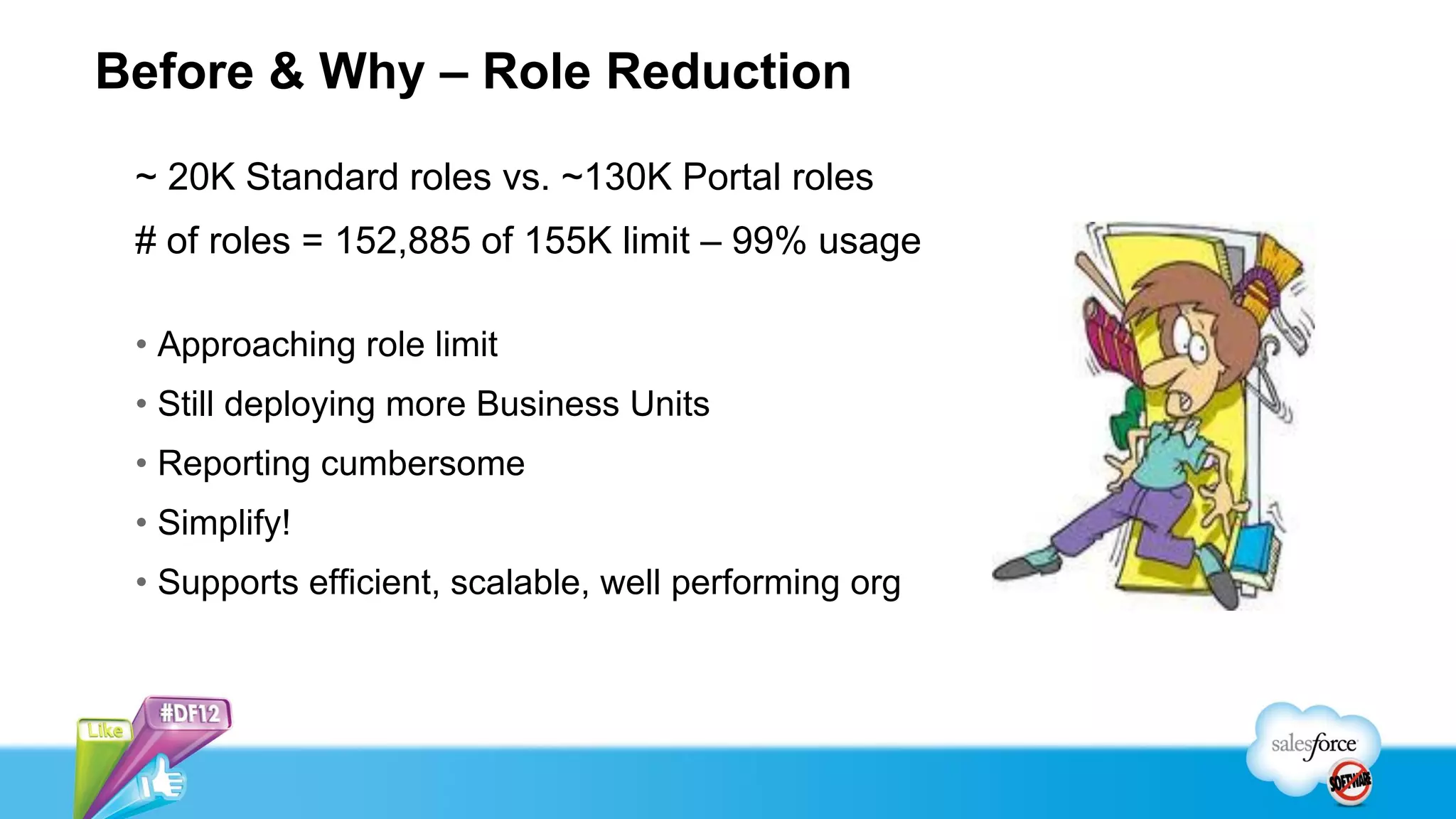
Before & Why – Role Reduction

 ~ 20K Standard roles vs. ~130K Portal roles
 # of roles = 152,885 of 155K limit – 99% usage

 • Approaching role limit
 • Still deploying more Business Units
 • Reporting cumbersome
 • Simplify!
 • Supports efficient, scalable, well performing org
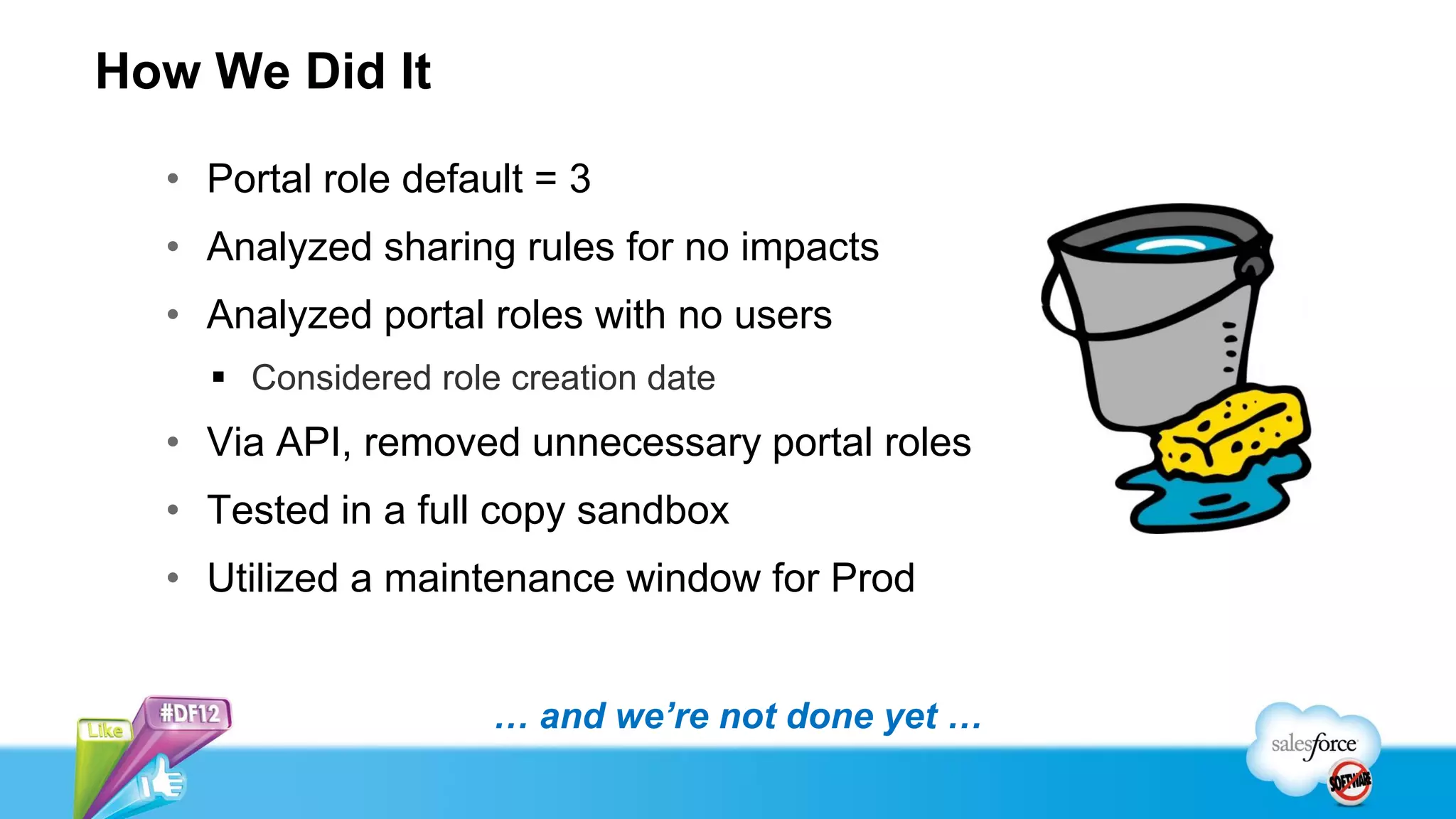
How We Did It

  • Portal role default = 3
  • Analyzed sharing rules for no impacts
  • Analyzed portal roles with no users
     Considered role creation date
  • Via API, removed unnecessary portal roles
  • Tested in a full copy sandbox
  • Utilized a maintenance window for Prod


                     … and we’re not done yet …
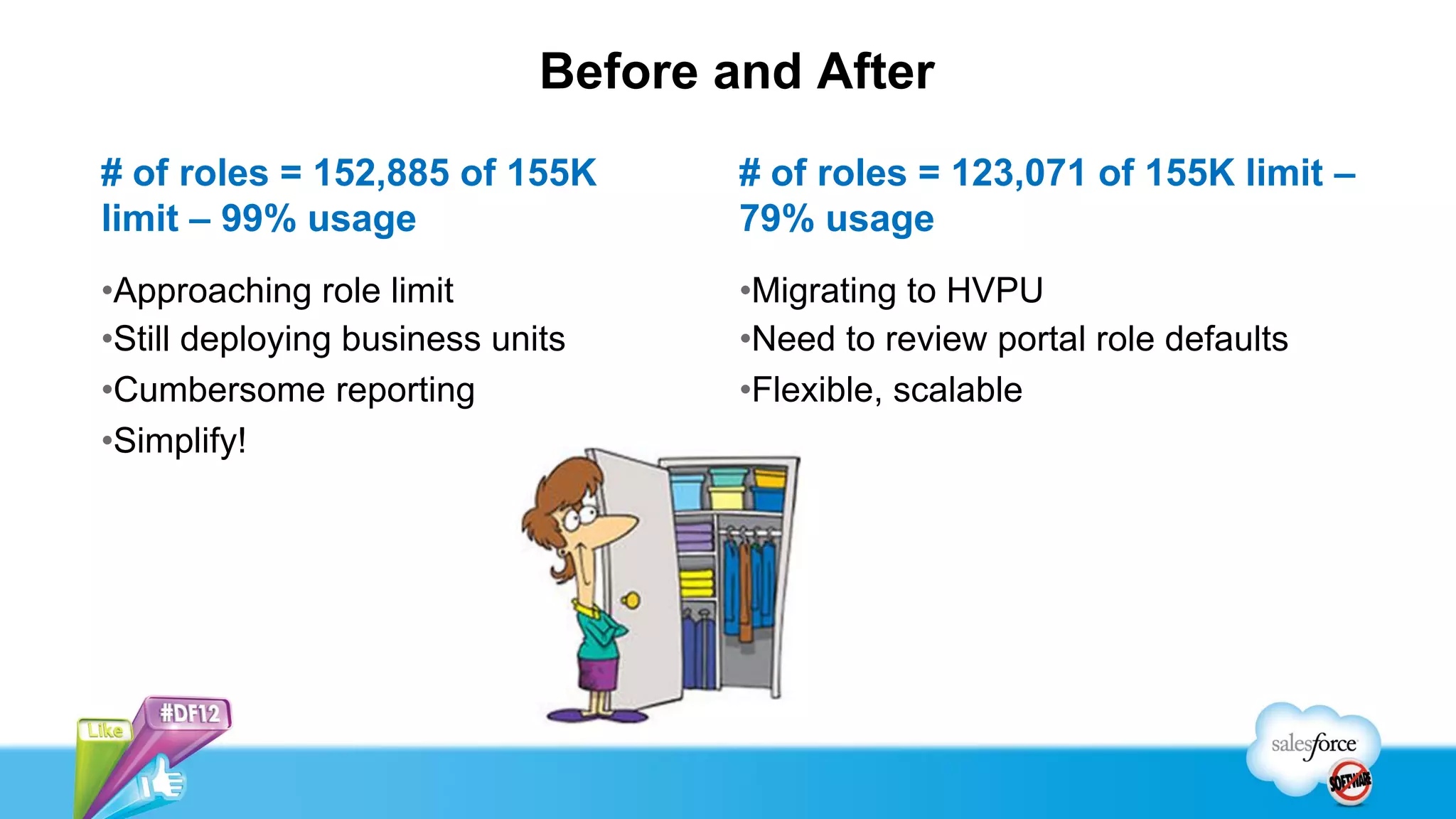
Before and After
# of roles = 152,885 of 155K         # of roles = 123,071 of 155K limit –
limit – 99% usage                    79% usage
•Approaching role limit              •Migrating to HVPU
•Still deploying business units      •Need to review portal role defaults
•Cumbersome reporting                •Flexible, scalable
•Simplify!
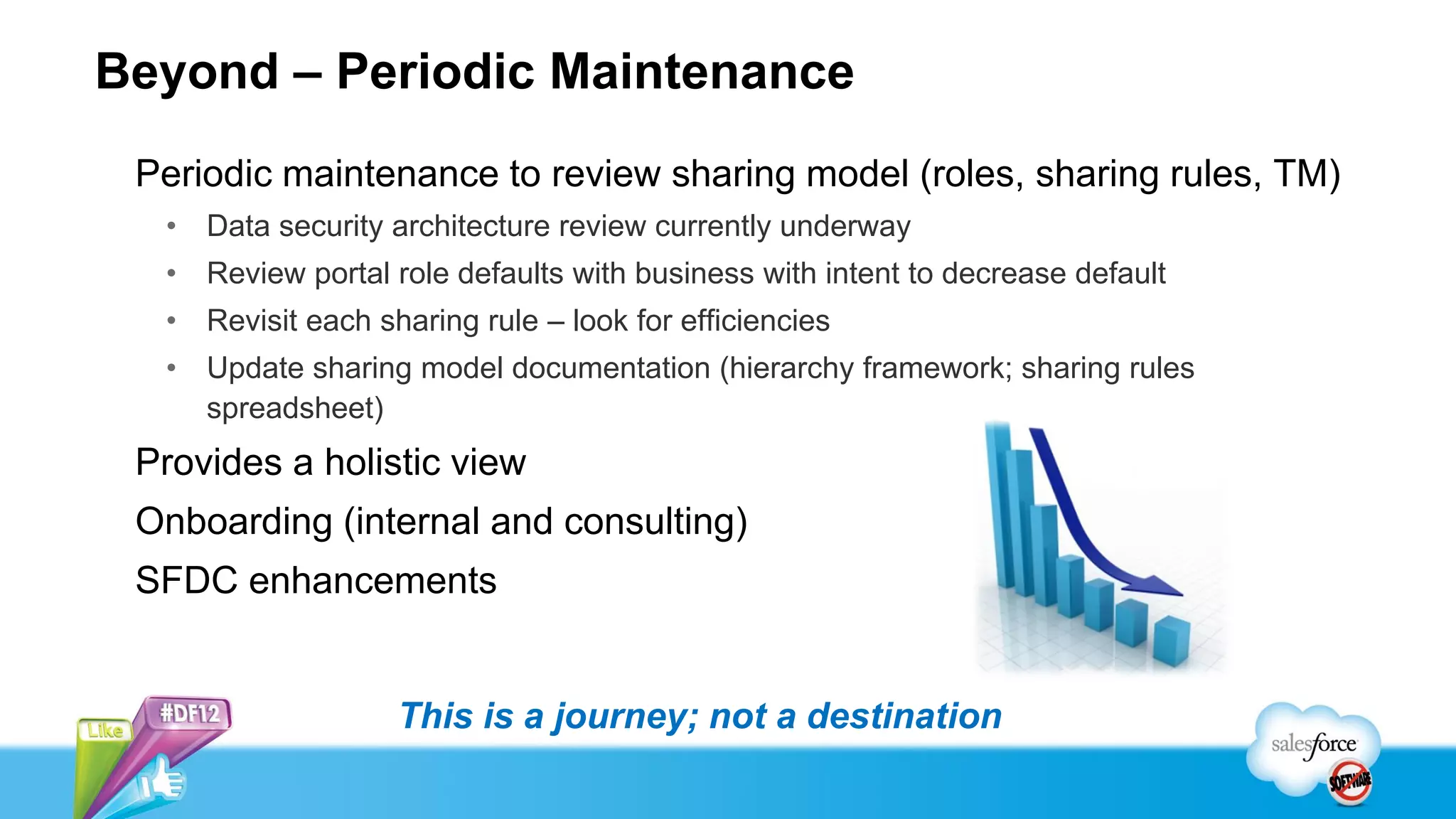
Beyond – Periodic Maintenance
 Periodic maintenance to review sharing model (roles, sharing rules, TM)
  • Data security architecture review currently underway
  • Review portal role defaults with business with intent to decrease default
  • Revisit each sharing rule – look for efficiencies
  • Update sharing model documentation (hierarchy framework; sharing rules
    spreadsheet)
 Provides a holistic view
 Onboarding (internal and consulting)
 SFDC enhancements


                   This is a journey; not a destination
Key Take-Aways
 • Have as simple a sharing model as possible
 • Continuously look for efficiencies – keep roles trimmed
 • Your sharing model is foundational to your platform
 • Follow best practices for large scale org changes and sales team
   realignments
 • Take the time to read and understand the CCE white papers on sharing
Bud Vieira                Sean Regan                 Robert Kraynak
CCE Technical Enablement   CCE Technical Enablement           Sr. Director
      Salesforce                 Salesforce           Change and Cloud Enablement
        @aavra                  @sfdcsregan              Symantec Corporation
Managing the Role Hierarchy at Enterprise Scale

Managing the Role Hierarchy at Enterprise Scale

  • 1.
    Managing the RoleHierarchy at Enterprise Scale Bud Vieira, Salesforce, CCE Technical Enablement @aavra Sean Regan, Salesforce, CCE Technical Enablement @sfdcsregan Robert Kraynak, Symantec Corporation, Sr. Director Change and Cloud Enablement
  • 2.
    Safe Harbor Safeharbor statement under the Private Securities Litigation Reform Act of 1995: This presentation may contain forward-looking statements that involve risks, uncertainties, and assumptions. If any such uncertainties materialize or if any of the assumptions proves incorrect, the results of salesforce.com, inc. could differ materially from the results expressed or implied by the forward- looking statements we make. All statements other than statements of historical fact could be deemed forward-looking, including any projections of product or service availability, subscriber growth, earnings, revenues, or other financial items and any statements regarding strategies or plans of management for future operations, statements of belief, any statements concerning new, planned, or upgraded services or technology developments and customer contracts or use of our services. The risks and uncertainties referred to above include – but are not limited to – risks associated with developing and delivering new functionality for our service, new products and services, our new business model, our past operating losses, possible fluctuations in our operating results and rate of growth, interruptions or delays in our Web hosting, breach of our security measures, the outcome of intellectual property and other litigation, risks associated with possible mergers and acquisitions, the immature market in which we operate, our relatively limited operating history, our ability to expand, retain, and motivate our employees and manage our growth, new releases of our service and successful customer deployment, our limited history reselling non-salesforce.com products, and utilization and selling to larger enterprise customers. Further information on potential factors that could affect the financial results of salesforce.com, inc. is included in our annual report on Form 10-Q for the most recent fiscal quarter ended July 31, 2012. This documents and others containing important disclosures are available on the SEC Filings section of the Investor Information section of our Web site. Any unreleased services or features referenced in this or other presentations, press releases or public statements are not currently available and may not be delivered on time or at all. Customers who purchase our services should make the purchase decisions based upon features that are currently available. Salesforce.com, inc. assumes no obligation and does not intend to update these forward-looking statements.
  • 3.
    Collaborate! Postquestions to session Chatter Use any device We’ll collect the questions for the Q&A session
  • 4.
    Agenda Role Hierarchy atEnterprise Scale – the Challenge Role Management Success – Tools and Strategies Customer Success – Role Management at Symantec Key Take Aways Q&A
  • 5.
    Bud Vieira Senior Memberof Technical Staff CCE Technical Enablement @aavra
  • 6.
    Role Hierarchy atEnterprise Scale Global sales operations  1000s of roles Cross-functional collaboration  Sharing Rules Portals  complexity, 10s of K’s of roles vs
  • 7.
    What is SharingMaintenance? Sharing is optimized for end user performance Access is calculated as configuration changes Sharing Rules Role Hierarchy Structure User Role Changes Large Data Loads Big Changes + Big Data *may* = Big Calc
  • 8.
    “Under the Hood”of a Role Change Hierarchy Inheritance Access to Child Records Portal Account Roles A2 B2 Sharing Rule Recalc Betty
  • 9.
    Example: Salesforce.com Realignment‘11 Basic Stats ~19M Accounts and Related Records ~60K Roles ~700 Sharing Rules on Accounts and Children Scope of the Changes New executive role Child record access settings 1M Accounts changed owners 2000 Users changed roles
  • 10.
    Key Take-Aways  Securityis calculated in advance to optimize user experience  Changes that seem simple can involve a lot of recalculation  Actively manage complex orgs to optimize performance
  • 11.
    Sean Regan Senior Memberof Technical Staff CCE Technical Enablement @sfdcsregan
  • 12.
    Role Management Success Managing Role Growth  Role defaults for Portals  Deleting unused Roles via API Best Practices for Major Sharing Changes  CCE Publications on Sharing
  • 13.
    Role Performance Features RuleDefaults for Portals Set Portal Role Defaults to Minimum Value
  • 14.
    Role Performance Features RuleDefaults for Portals Apex to insert an additional UserRole. UserRole ur = new UserRole(); ur.PortalAccountId = ‘00130000019hCSo’; ur.PortalType = ‘Partner’; INSERT ur; UserRole is a setup object
  • 15.
    Role Performance Features DeletingUnused Roles Determine what roles to delete  Unused  All inactive users  Last login timeframe Move users to a different role Delete the target roles
  • 16.
    Deleting Roles –Step 1 Find the Empty Roles Back Up Your DATA!!! SOQL Query to extract the Partner roles not assigned to any user. SELECT CaseAccessForAccountOwner, ContactAccessForAccountOwner, ForecastUserId, Id, MayForecastManagerShare, Name, OpportunityAccessForAccountOwner, ParentRoleId, PortalAccountId, PortalAccountOwnerId, PortalRole, PortalType,RollupDescription FROM UserRole WHERE PortalType = 'Partner' and PortalRole in (‘Executive’,’Manager’) and Id not in(select UserRoleId from User)
  • 17.
    Deleting Roles –Step 2 Check for manual shares that will be deleted SOQL Query to extract the Manual Object Shares (e.g. AccountShares) created for RolesAndSubordinates: SELECT AccountAccessLevel, AccountId, CaseAccessLevel, ContactAccessLevel, Id, OpportunityAccessLevel, RowCause, UserOrGroupId FROM AccountShare WHERE RowCause = 'Manual' and UserOrGroupId in (Select Id from Group where Type = 'RoleAndSubordinates‘ or Type = ‘Role’) Results from above should be extracted from the partner roles extracted in Step 1.
  • 18.
    Deleting Roles –Step 3 Check for Sharing Rules that will be deleted Analyze Sharing Rules and exclude the Roles that have Sharing Rules defined SELECT Id FROM Group WHERE relatedId in (SELECT Id FROM UserRole WHERE Name in (‘Company 1 Partner Executive', 'Company 2 Partner Executive', 'Company 3 Partner Executive')) and Type = 'Role’ Results from above should be extracted from the partner roles extracted in Step 1.
  • 19.
    Deleting Roles –GO! Execute the Deletion Prepare to Delete  Test in a full Sandbox!!!  Segment your data (e.g. date, country)  Recommended batch size is 10 Perform deletion Note: parallel processing role deletions will cause lock exceptions
  • 20.
    Best Practices forMajor Changes to Sharing CCE-TE Publications Search: “Salesforce Architect Core Resources” Record Level Access: Under the Hood http://bit.ly/RhzT3H Designing Record Access for Enterprise Scale Coming Soon Managing Ownership Skew For Peak Performance http://bit.ly/NYJ2gj Avoid Account Skew For Peak Performance http://bit.ly/IlYUZV
  • 21.
    Key Take-Aways  Onlycreate the portal roles you need  Periodically query and delete unneeded roles  Learn and follow best practices for large scale sharing changes  Contact Support or Services for assistance on any large scale organization realignments
  • 22.
  • 23.
    at a Glance Founded in 1982 $6.7 billion revenue in FY 2012; IPO in 1989 approximately 52% outside of the U.S. Approximately 20,500 employees More than 1500 global patents Operations in 48 countries Symantec footprint on more than one billion systems Included on Fortune’s Most Admired #391 on the 2012 Fortune 500 Companies list 100 percent of Fortune 500 Invests 14% of companies are customers annual revenue in R&D* * R&D investment is Non-GAAP
  • 24.
    Symantec Is – Symantecis a global leader in providing security, storage, and systems management solutions to help consumers and organizations secure and manage their information and identities.
  • 25.
    Symantec Salesforce.com OrgStrategy Business Internal Sales Cloud – 7500 Custom Apps Service Cloud – 4500 IT Apps Channel – 40K Test bed HVPU – 750K Custom Apps PMA Internal Discounts Org Business Consumer Social Org SF2SF Org Consumer Chatter – 16K+ chatter users Service Cloud - 1500 Blogs – 51 blogs created Ideas Ideas – 4 communities Custom Apps
  • 26.
    Symantec’s Sharing Model Role Hierarchy • For Sales = Organizational Hierarchy • For Service = Product and/or Region based Territory Hierarchy = Sales Hierarchy (reporting only) OWDs = Private • ~80% visibility controlled by roles & sharing rules (ownership & criteria based) • Remaining via manual & programmatic shares Teams also used for setting default teams (not visibility) Role & Territory Hierarchies modified annually
  • 27.
    Before & Why– Role Reduction ~ 20K Standard roles vs. ~130K Portal roles # of roles = 152,885 of 155K limit – 99% usage • Approaching role limit • Still deploying more Business Units • Reporting cumbersome • Simplify! • Supports efficient, scalable, well performing org
  • 28.
    How We DidIt • Portal role default = 3 • Analyzed sharing rules for no impacts • Analyzed portal roles with no users  Considered role creation date • Via API, removed unnecessary portal roles • Tested in a full copy sandbox • Utilized a maintenance window for Prod … and we’re not done yet …
  • 29.
    Before and After #of roles = 152,885 of 155K # of roles = 123,071 of 155K limit – limit – 99% usage 79% usage •Approaching role limit •Migrating to HVPU •Still deploying business units •Need to review portal role defaults •Cumbersome reporting •Flexible, scalable •Simplify!
  • 30.
    Beyond – PeriodicMaintenance Periodic maintenance to review sharing model (roles, sharing rules, TM) • Data security architecture review currently underway • Review portal role defaults with business with intent to decrease default • Revisit each sharing rule – look for efficiencies • Update sharing model documentation (hierarchy framework; sharing rules spreadsheet) Provides a holistic view Onboarding (internal and consulting) SFDC enhancements This is a journey; not a destination
  • 31.
    Key Take-Aways •Have as simple a sharing model as possible • Continuously look for efficiencies – keep roles trimmed • Your sharing model is foundational to your platform • Follow best practices for large scale org changes and sales team realignments • Take the time to read and understand the CCE white papers on sharing
  • 32.
    Bud Vieira Sean Regan Robert Kraynak CCE Technical Enablement CCE Technical Enablement Sr. Director Salesforce Salesforce Change and Cloud Enablement @aavra @sfdcsregan Symantec Corporation