Adverbs and
Interjection
Group 5 Presentation
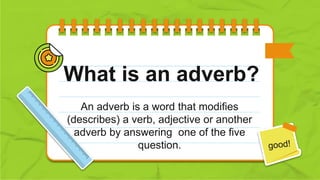
What is an adverb?
An adverb is a word that modifies
(describes) a verb, adjective or another
adverb by answering one of the five
question.
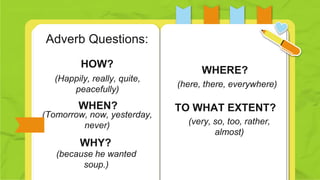
(Happily, really, quite,
peacefully)
(here, there, everywhere)
HOW?
(Tomorrow, now, yesterday,
never) (very, so, too, rather,
almost)
WHEN? TO WHAT EXTENT?
Adverb Questions:
WHERE?
WHY?
(because he wanted
soup.)
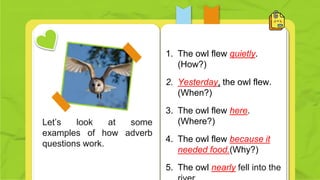
Let’s look at some
examples of how adverb
questions work.
1. The owl flew quietly.
(How?)
2. Yesterday, the owl flew.
(When?)
3. The owl flew here.
(Where?)
4. The owl flew because it
needed food.(Why?)
5. The owl nearly fell into the
TYPES OF
ADVERBS
 Are words that
answer the
questions “how
much” or “to
what extent”.
Example:
• My calculus
homework is very
difficult.
• Nick thinks English
history is pretty
interesting.
1. Adverbs of
Degree
 Are words answer
the question “how
often does
something
happen.”
Example:
• I never go
shopping.
• Patrick always
watches television
after work.
• My mom
occasionally let us
order dinner.
2. Adverbs of
Frequency
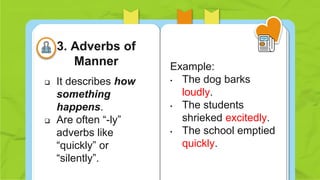
 It describes how
something
happens.
 Are often “-ly”
adverbs like
“quickly” or
“silently”.
Example:
• The dog barks
loudly.
• The students
shrieked excitedly.
• The school emptied
quickly.
3. Adverbs of
Manner
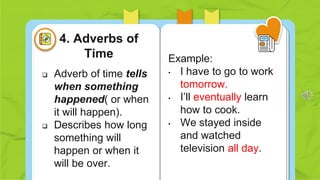
 Adverb of time tells
when something
happened( or when
it will happen).
 Describes how long
something will
happen or when it
will be over.
Example:
• I have to go to work
tomorrow.
• I’ll eventually learn
how to cook.
• We stayed inside
and watched
television all day.
4. Adverbs of
Time
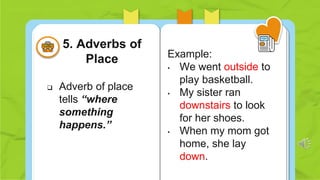
 Adverb of place
tells “where
something
happens.”
Example:
• We went outside to
play basketball.
• My sister ran
downstairs to look
for her shoes.
• When my mom got
home, she lay
down.
5. Adverbs of
Place
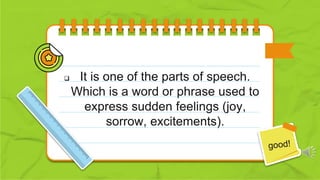
What is interjection?
 It is one of the parts of speech.
Which is a word or phrase used to
express sudden feelings (joy,
sorrow, excitements).
TYPES OF
INTERJECTIONS
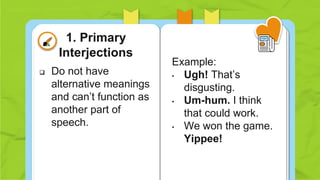
 Do not have
alternative meanings
and can’t function as
another part of
speech.
Example:
• Ugh! That’s
disgusting.
• Um-hum. I think
that could work.
• We won the game.
Yippee!
1. Primary
Interjections
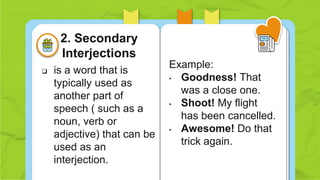
 is a word that is
typically used as
another part of
speech ( such as a
noun, verb or
adjective) that can be
used as an
interjection.
Example:
• Goodness! That
was a close one.
• Shoot! My flight
has been cancelled.
• Awesome! Do that
trick again.
2. Secondary
Interjections
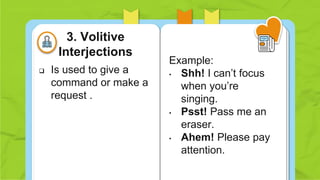
 Is used to give a
command or make a
request .
Example:
• Shh! I can’t focus
when you’re
singing.
• Psst! Pass me an
eraser.
• Ahem! Please pay
attention.
3. Volitive
Interjections
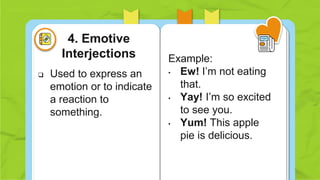
 Used to express an
emotion or to indicate
a reaction to
something.
Example:
• Ew! I’m not eating
that.
• Yay! I’m so excited
to see you.
• Yum! This apple
pie is delicious.
4. Emotive
Interjections
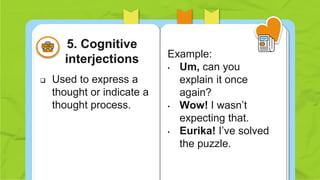
 Used to express a
thought or indicate a
thought process.
Example:
• Um, can you
explain it once
again?
• Wow! I wasn’t
expecting that.
• Eurika! I’ve solved
the puzzle.
5. Cognitive
interjections
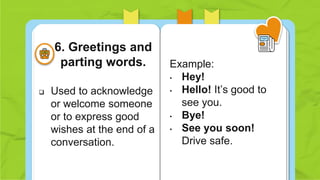
 Used to acknowledge
or welcome someone
or to express good
wishes at the end of a
conversation.
Example:
• Hey!
• Hello! It’s good to
see you.
• Bye!
• See you soon!
Drive safe.
6. Greetings and
parting words.
CREDITS: This presentation template was created by Slidesgo, and
includes icons by Flaticon, and infographics & images by Freepik
Do you have any questions?
Thanks!

Adjectives and adverbs

  • 1.
  • 2.
    What is anadverb? An adverb is a word that modifies (describes) a verb, adjective or another adverb by answering one of the five question.
  • 3.
    (Happily, really, quite, peacefully) (here,there, everywhere) HOW? (Tomorrow, now, yesterday, never) (very, so, too, rather, almost) WHEN? TO WHAT EXTENT? Adverb Questions: WHERE? WHY? (because he wanted soup.)
  • 4.
    Let’s look atsome examples of how adverb questions work. 1. The owl flew quietly. (How?) 2. Yesterday, the owl flew. (When?) 3. The owl flew here. (Where?) 4. The owl flew because it needed food.(Why?) 5. The owl nearly fell into the
  • 5.
  • 6.
     Are wordsthat answer the questions “how much” or “to what extent”. Example: • My calculus homework is very difficult. • Nick thinks English history is pretty interesting. 1. Adverbs of Degree
  • 7.
     Are wordsanswer the question “how often does something happen.” Example: • I never go shopping. • Patrick always watches television after work. • My mom occasionally let us order dinner. 2. Adverbs of Frequency
  • 8.
     It describeshow something happens.  Are often “-ly” adverbs like “quickly” or “silently”. Example: • The dog barks loudly. • The students shrieked excitedly. • The school emptied quickly. 3. Adverbs of Manner
  • 9.
     Adverb oftime tells when something happened( or when it will happen).  Describes how long something will happen or when it will be over. Example: • I have to go to work tomorrow. • I’ll eventually learn how to cook. • We stayed inside and watched television all day. 4. Adverbs of Time
  • 10.
     Adverb ofplace tells “where something happens.” Example: • We went outside to play basketball. • My sister ran downstairs to look for her shoes. • When my mom got home, she lay down. 5. Adverbs of Place
  • 11.
  • 12.
     It isone of the parts of speech. Which is a word or phrase used to express sudden feelings (joy, sorrow, excitements).
  • 13.
  • 14.
     Do nothave alternative meanings and can’t function as another part of speech. Example: • Ugh! That’s disgusting. • Um-hum. I think that could work. • We won the game. Yippee! 1. Primary Interjections
  • 15.
     is aword that is typically used as another part of speech ( such as a noun, verb or adjective) that can be used as an interjection. Example: • Goodness! That was a close one. • Shoot! My flight has been cancelled. • Awesome! Do that trick again. 2. Secondary Interjections
  • 16.
     Is usedto give a command or make a request . Example: • Shh! I can’t focus when you’re singing. • Psst! Pass me an eraser. • Ahem! Please pay attention. 3. Volitive Interjections
  • 17.
     Used toexpress an emotion or to indicate a reaction to something. Example: • Ew! I’m not eating that. • Yay! I’m so excited to see you. • Yum! This apple pie is delicious. 4. Emotive Interjections
  • 18.
     Used toexpress a thought or indicate a thought process. Example: • Um, can you explain it once again? • Wow! I wasn’t expecting that. • Eurika! I’ve solved the puzzle. 5. Cognitive interjections
  • 19.
     Used toacknowledge or welcome someone or to express good wishes at the end of a conversation. Example: • Hey! • Hello! It’s good to see you. • Bye! • See you soon! Drive safe. 6. Greetings and parting words.
  • 20.
    CREDITS: This presentationtemplate was created by Slidesgo, and includes icons by Flaticon, and infographics & images by Freepik Do you have any questions? Thanks!