INTERJECTION
By: Alexandra G. Catimabang
Thomas Vincent N. Peñaserada
What is Interjection?
•is a word or expression that occurs
as an utterance on its own and
expresses a spontaneous feeling or
reaction.
It is a diverse category,
encompassing many different
parts of speech, such as
exclamations, curses, greetings,
response particles, hesitation
markers, and other words.
Main type of Interjection
Primary interjections
•Are single words that are used only
as interjections. These words do not
belong to any other word class.
Example
•Wow
•Brr
•Oh
•Whoa
•Eww
•Ouch
Secondary Interjection
•Are words or groups of words that
belong to other word classes. These
words are usually have meaning
other than the interjective meaning
as well.
Example
•Congratulations
•My God
•Bless you
•Goodness gracious
Mild and Strong Interjection
Mild Interjection
•The relatively mild expression of feelings
and emotions is usually called Mild
Interjections. These types are typically
separated from the rest of the sentence
by commas.
Example
•Oh, I was looking for you.
•Well, it wasn't very easy.
•Hmm, I'm doing well.
Strong Interjection
•The strong outbursts of expression are
determined as Strong Interjections. These
types are typically separated from the
rest of the sentence by exclamation
marks.
Example
•Yay! I finally passed.
•Bingo! Found it.
•Ouch! That hurt.
Categories of Interjection
Volitive interjection
•Are the words or phrases used to
express sudden feelings.
•Do not need a response from the
person you are talking to.
Example
•Ouch! That hurt.
•Wow! That’s amazing.
Emotive interjection
•Emotive interjections are the words
or phrases used to express an
emotion.
•Usually need a response from the
person you are talking to.
Example
•I’m so happy for you!
•I’m so sorry about that.
Cognitive interjection
•Are the words or phrases used to
express a thought.
•Usually need a response from the
person you are talking to.
Example
•Hmm, I don’t know about that.
•I see. What do you think?
Types of Interjection
based on Emotions
Interjection of Greetings
•Are use to greet a person or
express the sense of concern
Example
•Hello! Is anybody listening?
•Hi! Where have you been for so
long?
•Hey! Where have you been?
Interjection of Surprise
•Are used to express surprise over
an incident.
Example
•Eek! A scorpion!
•Booh! Scared you!
•Eep! I didn’t intend to hurt you!
•Oh no! I spilled the juice!
•Gee! That’s so nice of you!
•Oops! Did it hurt?
Interjection of Joy
•Are used to express happiness or joy on
an incident, news or pleasant surprise.
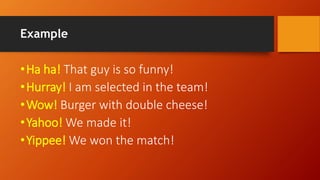
Example
•Ha ha! That guy is so funny!
•Hurray! I am selected in the team!
•Wow! Burger with double cheese!
•Yahoo! We made it!
•Yippee! We won the match!
Interjection of Approval
• Is used to express a strong sense of
approval for something
Example
• Bravo! To your success!
• Absolutely! That’s exactly what I want!
• Good! Keep it up!
• Cheers! To our team’s success!
• Great! We will meet as scheduled.
• Brilliant! You did a wonderful job!
• Splendid! You performed best than others.
Interjection of Attention
•Are used to draw the attention of someone.
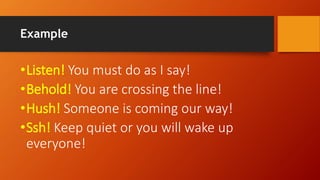
Example
•Listen! You must do as I say!
•Behold! You are crossing the line!
•Hush! Someone is coming our way!
•Ssh! Keep quiet or you will wake up
everyone!
Interjection of Sorrow
•Are used to express sadness or pity about
an incident or someone or even pain felt
by one self.
Example
•Aah! I lost my purse!
•Aww! Poor boy! (pity)
•Ouch! I sprained my ankle!
•Boohoo! I am crying inside! (Boohoo is often used
to imitate crying)
•Oww! That hurts!
•Alas! His ordeal ended!
Thank you.

INTERJECTION.pptx