MULTIDISCIPLINARY FLIPPED LEARNING WITH ICT
ERASMUS+ KA2 PROJECT
2015-2017
Daugavpils Saskaņas School/Latvia
Introduction
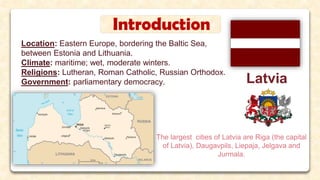
Location: Eastern Europe, bordering the Baltic Sea,
between Estonia and Lithuania.
Climate: maritime; wet, moderate winters.
Religions: Lutheran, Roman Catholic, Russian Orthodox.
Government: parliamentary democracy. Latvia
The largest cities of Latvia are Riga (the capital
of Latvia), Daugavpils, Liepaja, Jelgava and
Jurmala.
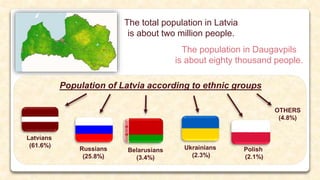
The total population in Latvia
is about two million people.
Population of Latvia according to ethnic groups
Latvians
(61.6%)
Russians
(25.8%)
Polish
(2.1%)
Belarusians
(3.4%)
OTHERS
(4.8%)
Ukrainians
(2.3%)
The population in Daugavpils
is about eighty thousand people.
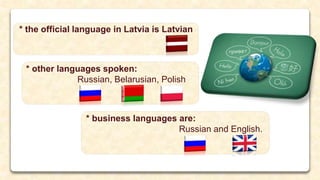
* other languages spoken:
Russian, Belarusian, Polish
* business languages are:
Russian and English.
* the official language in Latvia is Latvian
Greeting in Latvia
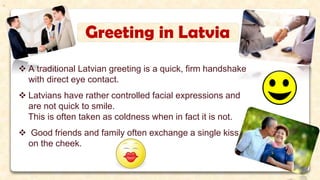
 A traditional Latvian greeting is a quick, firm handshake
with direct eye contact.
 Latvians have rather controlled facial expressions and
are not quick to smile.
This is often taken as coldness when in fact it is not.
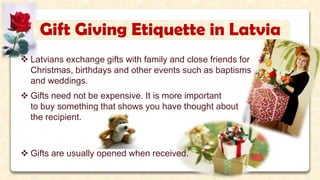
 Good friends and family often exchange a single kiss
on the cheek.
.
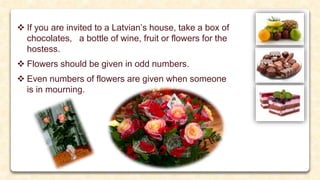
 Official titles are very important and denote respect and regard to
the person.
 When introducing someone, use the honorary title
"kungs" for a man and "kundze" for a woman.
 You should not call a person by their first name no to sound rude.
Wait until the person invites you to do so.
Gift Giving Etiquette in Latvia
 Latvians exchange gifts with family and close friends for
Christmas, birthdays and other events such as baptisms
and weddings.
 Gifts need not be expensive. It is more important
to buy something that shows you have thought about
the recipient.
 Gifts are usually opened when received.
 If you are invited to a Latvian’s house, take a box of
chocolates, a bottle of wine, fruit or flowers for the
hostess.
 Flowers should be given in odd numbers.
 Even numbers of flowers are given when someone
is in mourning.
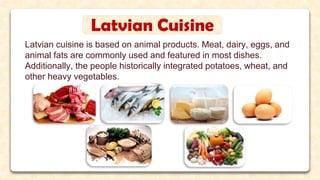
Latvian cuisine is based on animal products. Meat, dairy, eggs, and
animal fats are commonly used and featured in most dishes.
Additionally, the people historically integrated potatoes, wheat, and
other heavy vegetables.
Latvian Cuisine
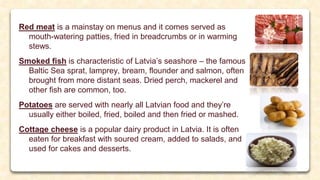
Red meat is a mainstay on menus and it comes served as
mouth-watering patties, fried in breadcrumbs or in warming
stews.
Smoked fish is characteristic of Latvia’s seashore – the famous
Baltic Sea sprat, lamprey, bream, flounder and salmon, often
brought from more distant seas. Dried perch, mackerel and
other fish are common, too.
Potatoes are served with nearly all Latvian food and they’re
usually either boiled, fried, boiled and then fried or mashed.
Cottage cheese is a popular dairy product in Latvia. It is often
eaten for breakfast with soured cream, added to salads, and
used for cakes and desserts.
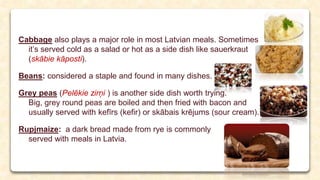
Cabbage also plays a major role in most Latvian meals. Sometimes
it’s served cold as a salad or hot as a side dish like sauerkraut
(skābie kāposti).
Beans: considered a staple and found in many dishes.
Grey peas (Pelēkie zirņi ) is another side dish worth trying.
Big, grey round peas are boiled and then fried with bacon and
usually served with kefīrs (kefir) or skābais krējums (sour cream).
Rupjmaize: a dark bread made from rye is commonly
served with meals in Latvia.
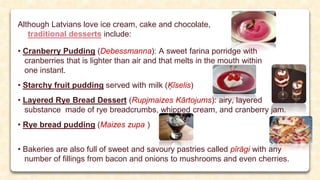
Although Latvians love ice cream, cake and chocolate,
traditional desserts include:
• Cranberry Pudding (Debessmanna): A sweet farina porridge with
cranberries that is lighter than air and that melts in the mouth within
one instant.
• Starchy fruit pudding served with milk (Ķīselis)
• Layered Rye Bread Dessert (Rupjmaizes Kārtojums): airy, layered
substance made of rye breadcrumbs, whipped cream, and cranberry jam.
• Rye bread pudding (Maizes zupa )
• Bakeries are also full of sweet and savoury pastries called pīrāgi with any
number of fillings from bacon and onions to mushrooms and even cherries.
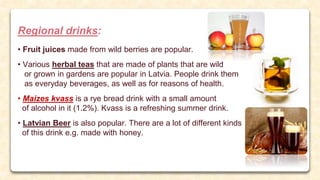
Regional drinks:
• Fruit juices made from wild berries are popular.
• Various herbal teas that are made of plants that are wild
or grown in gardens are popular in Latvia. People drink them
as everyday beverages, as well as for reasons of health.
• Maizes kvass is a rye bread drink with a small amount
of alcohol in it (1.2%). Kvass is a refreshing summer drink.
• Latvian Beer is also popular. There are a lot of different kinds
of this drink e.g. made with honey.
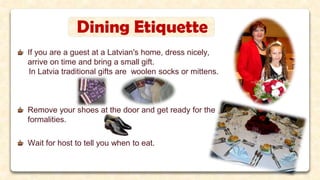
Dining Etiquette
If you are a guest at a Latvian's home, dress nicely,
arrive on time and bring a small gift.
In Latvia traditional gifts are woolen socks or mittens.
Remove your shoes at the door and get ready for the
formalities.
Wait for host to tell you when to eat.
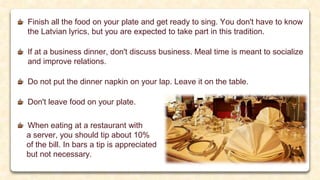
Finish all the food on your plate and get ready to sing. You don't have to know
the Latvian lyrics, but you are expected to take part in this tradition.
If at a business dinner, don't discuss business. Meal time is meant to socialize
and improve relations.
Do not put the dinner napkin on your lap. Leave it on the table.
Don't leave food on your plate.
When eating at a restaurant with
a server, you should tip about 10%
of the bill. In bars a tip is appreciated
but not necessary.
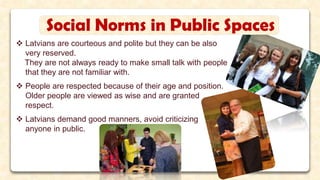
Social Norms in Public Spaces
 Latvians are courteous and polite but they can be also
very reserved.
They are not always ready to make small talk with people
that they are not familiar with.
 People are respected because of their age and position.
Older people are viewed as wise and are granted
respect.
 Latvians demand good manners, avoid criticizing
anyone in public.
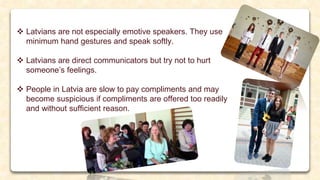
 Latvians are not especially emotive speakers. They use
minimum hand gestures and speak softly.
 Latvians are direct communicators but try not to hurt
someone’s feelings.
 People in Latvia are slow to pay compliments and may
become suspicious if compliments are offered too readily
and without sufficient reason.
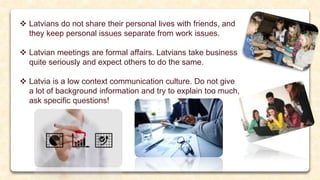
 Latvians do not share their personal lives with friends, and
they keep personal issues separate from work issues.
 Latvian meetings are formal affairs. Latvians take business
quite seriously and expect others to do the same.
 Latvia is a low context communication culture. Do not give
a lot of background information and try to explain too much,
ask specific questions!
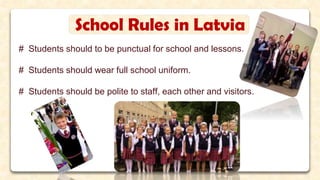
School Rules in Latvia
# Students should to be punctual for school and lessons.
# Students should wear full school uniform.
# Students should be polite to staff, each other and visitors.
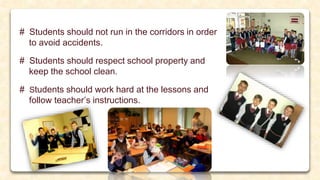
# Students should not run in the corridors in order
to avoid accidents.
# Students should respect school property and
keep the school clean.
# Students should work hard at the lessons and
follow teacher’s instructions.
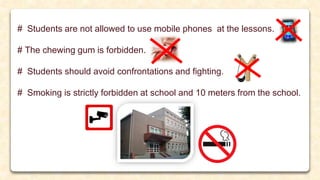
# Students are not allowed to use mobile phones at the lessons.
# The chewing gum is forbidden.
# Students should avoid confrontations and fighting.
# Smoking is strictly forbidden at school and 10 meters from the school.
http://www.kwintessential.co.uk/resources/global-etiquette/latvia.html
http://www.suddefrance-developpement.com/en/country-
profiles/latvia/presentation.htm
http://www.therussianabroad.com/traditional-latvian-cuisine/
http://www.inyourpocket.com/riga/Latvian-cooking_71628f
http://www.worldtravelguide.net/latvia/food-and-drink
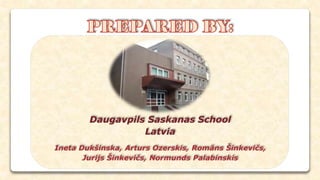
Daugavpils Saskanas School
Latvia
Ineta Dukšinska, Arturs Ozerskis, Romāns Šinkevičs,
Jurijs Šinkevičs, Normunds Palabinskis

Customs and Etiquette in Latvia

  • 1.
    MULTIDISCIPLINARY FLIPPED LEARNINGWITH ICT ERASMUS+ KA2 PROJECT 2015-2017 Daugavpils Saskaņas School/Latvia
  • 2.
    Introduction Location: Eastern Europe,bordering the Baltic Sea, between Estonia and Lithuania. Climate: maritime; wet, moderate winters. Religions: Lutheran, Roman Catholic, Russian Orthodox. Government: parliamentary democracy. Latvia The largest cities of Latvia are Riga (the capital of Latvia), Daugavpils, Liepaja, Jelgava and Jurmala.
  • 3.
    The total populationin Latvia is about two million people. Population of Latvia according to ethnic groups Latvians (61.6%) Russians (25.8%) Polish (2.1%) Belarusians (3.4%) OTHERS (4.8%) Ukrainians (2.3%) The population in Daugavpils is about eighty thousand people.
  • 4.
    * other languagesspoken: Russian, Belarusian, Polish * business languages are: Russian and English. * the official language in Latvia is Latvian
  • 5.
    Greeting in Latvia A traditional Latvian greeting is a quick, firm handshake with direct eye contact.  Latvians have rather controlled facial expressions and are not quick to smile. This is often taken as coldness when in fact it is not.  Good friends and family often exchange a single kiss on the cheek. .
  • 6.
     Official titlesare very important and denote respect and regard to the person.  When introducing someone, use the honorary title "kungs" for a man and "kundze" for a woman.  You should not call a person by their first name no to sound rude. Wait until the person invites you to do so.
  • 7.
    Gift Giving Etiquettein Latvia  Latvians exchange gifts with family and close friends for Christmas, birthdays and other events such as baptisms and weddings.  Gifts need not be expensive. It is more important to buy something that shows you have thought about the recipient.  Gifts are usually opened when received.
  • 8.
     If youare invited to a Latvian’s house, take a box of chocolates, a bottle of wine, fruit or flowers for the hostess.  Flowers should be given in odd numbers.  Even numbers of flowers are given when someone is in mourning.
  • 9.
    Latvian cuisine isbased on animal products. Meat, dairy, eggs, and animal fats are commonly used and featured in most dishes. Additionally, the people historically integrated potatoes, wheat, and other heavy vegetables. Latvian Cuisine
  • 10.
    Red meat isa mainstay on menus and it comes served as mouth-watering patties, fried in breadcrumbs or in warming stews. Smoked fish is characteristic of Latvia’s seashore – the famous Baltic Sea sprat, lamprey, bream, flounder and salmon, often brought from more distant seas. Dried perch, mackerel and other fish are common, too. Potatoes are served with nearly all Latvian food and they’re usually either boiled, fried, boiled and then fried or mashed. Cottage cheese is a popular dairy product in Latvia. It is often eaten for breakfast with soured cream, added to salads, and used for cakes and desserts.
  • 11.
    Cabbage also playsa major role in most Latvian meals. Sometimes it’s served cold as a salad or hot as a side dish like sauerkraut (skābie kāposti). Beans: considered a staple and found in many dishes. Grey peas (Pelēkie zirņi ) is another side dish worth trying. Big, grey round peas are boiled and then fried with bacon and usually served with kefīrs (kefir) or skābais krējums (sour cream). Rupjmaize: a dark bread made from rye is commonly served with meals in Latvia.
  • 12.
    Although Latvians loveice cream, cake and chocolate, traditional desserts include: • Cranberry Pudding (Debessmanna): A sweet farina porridge with cranberries that is lighter than air and that melts in the mouth within one instant. • Starchy fruit pudding served with milk (Ķīselis) • Layered Rye Bread Dessert (Rupjmaizes Kārtojums): airy, layered substance made of rye breadcrumbs, whipped cream, and cranberry jam. • Rye bread pudding (Maizes zupa ) • Bakeries are also full of sweet and savoury pastries called pīrāgi with any number of fillings from bacon and onions to mushrooms and even cherries.
  • 13.
    Regional drinks: • Fruitjuices made from wild berries are popular. • Various herbal teas that are made of plants that are wild or grown in gardens are popular in Latvia. People drink them as everyday beverages, as well as for reasons of health. • Maizes kvass is a rye bread drink with a small amount of alcohol in it (1.2%). Kvass is a refreshing summer drink. • Latvian Beer is also popular. There are a lot of different kinds of this drink e.g. made with honey.
  • 14.
    Dining Etiquette If youare a guest at a Latvian's home, dress nicely, arrive on time and bring a small gift. In Latvia traditional gifts are woolen socks or mittens. Remove your shoes at the door and get ready for the formalities. Wait for host to tell you when to eat.
  • 15.
    Finish all thefood on your plate and get ready to sing. You don't have to know the Latvian lyrics, but you are expected to take part in this tradition. If at a business dinner, don't discuss business. Meal time is meant to socialize and improve relations. Do not put the dinner napkin on your lap. Leave it on the table. Don't leave food on your plate. When eating at a restaurant with a server, you should tip about 10% of the bill. In bars a tip is appreciated but not necessary.
  • 16.
    Social Norms inPublic Spaces  Latvians are courteous and polite but they can be also very reserved. They are not always ready to make small talk with people that they are not familiar with.  People are respected because of their age and position. Older people are viewed as wise and are granted respect.  Latvians demand good manners, avoid criticizing anyone in public.
  • 17.
     Latvians arenot especially emotive speakers. They use minimum hand gestures and speak softly.  Latvians are direct communicators but try not to hurt someone’s feelings.  People in Latvia are slow to pay compliments and may become suspicious if compliments are offered too readily and without sufficient reason.
  • 18.
     Latvians donot share their personal lives with friends, and they keep personal issues separate from work issues.  Latvian meetings are formal affairs. Latvians take business quite seriously and expect others to do the same.  Latvia is a low context communication culture. Do not give a lot of background information and try to explain too much, ask specific questions!
  • 19.
    School Rules inLatvia # Students should to be punctual for school and lessons. # Students should wear full school uniform. # Students should be polite to staff, each other and visitors.
  • 20.
    # Students shouldnot run in the corridors in order to avoid accidents. # Students should respect school property and keep the school clean. # Students should work hard at the lessons and follow teacher’s instructions.
  • 21.
    # Students arenot allowed to use mobile phones at the lessons. # The chewing gum is forbidden. # Students should avoid confrontations and fighting. # Smoking is strictly forbidden at school and 10 meters from the school.
  • 23.
  • 24.
    Daugavpils Saskanas School Latvia InetaDukšinska, Arturs Ozerskis, Romāns Šinkevičs, Jurijs Šinkevičs, Normunds Palabinskis