ARTICLES IN ENGLISH
A, AN, THE, and the ZERO ARTICLE
Prepared by Alp Kaan Gökçe
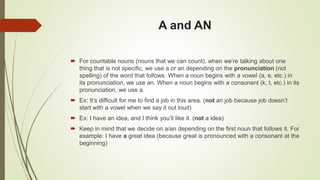
A and AN
 For countable nouns (nouns that we can count), when we’re talking about one
thing that is not specific, we use a or an depending on the pronunciation (not
spelling) of the word that follows. When a noun begins with a vowel (a, e, etc.) in
its pronunciation, we use an. When a noun begins with a consonant (k, t, etc.) in its
pronunciation, we use a.
 Ex: It’s difficult for me to find a job in this area. (not an job because job doesn’t
start with a vowel when we say it out loud)
 Ex: I have an idea, and I think you’ll like it. (not a idea)
 Keep in mind that we decide on a/an depending on the first noun that follows it. For
example: I have a great idea (because great is pronounced with a consonant at the
beginning)
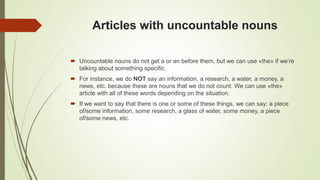
Articles with uncountable nouns
 Uncountable nouns do not get a or an before them, but we can use «the» if we’re
talking about something specific.
 For instance, we do NOT say an information, a research, a water, a money, a
news, etc. because these are nouns that we do not count. We can use «the»
article with all of these words depending on the situation.
 If we want to say that there is one or some of these things, we can say: a piece
of/some information, some research, a glass of water, some money, a piece
of/some news, etc.
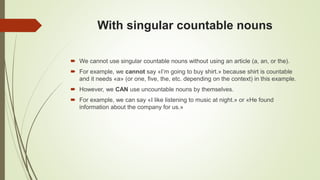
With singular countable nouns
 We cannot use singular countable nouns without using an article (a, an, or the).
 For example, we cannot say «I’m going to buy shirt.» because shirt is countable
and it needs «a» (or one, five, the, etc. depending on the context) in this example.
 However, we CAN use uncountable nouns by themselves.
 For example, we can say «I like listening to music at night.» or «He found
information about the company for us.»
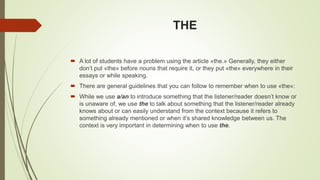
THE
 A lot of students have a problem using the article «the.» Generally, they either
don’t put «the» before nouns that require it, or they put «the» everywhere in their
essays or while speaking.
 There are general guidelines that you can follow to remember when to use «the»:
 While we use a/an to introduce something that the listener/reader doesn’t know or
is unaware of, we use the to talk about something that the listener/reader already
knows about or can easily understand from the context because it refers to
something already mentioned or when it’s shared knowledge between us. The
context is very important in determining when to use the.
THE
 Compare the following examples:
 I want to buy a new computer. (I’m not talking about a specific computer; I just
want to buy one that’s suitable for me.)
 I want to buy the computer we talked about. (I’m talking about a specific computer.
We talked about buying it before, so my friend knows which computer I’m referring
to.)
 Please stop using the computer! You need to start working! (Here, the person I’m
speaking with and I know which computer I’m talking about. So, it’s shared
knowledge between the speaker and the listener.)
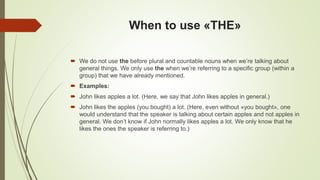
When to use «THE»
 We do not use the before plural and countable nouns when we’re talking about
general things. We only use the when we’re referring to a specific group (within a
group) that we have already mentioned.
 Examples:
 John likes apples a lot. (Here, we say that John likes apples in general.)
 John likes the apples (you bought) a lot. (Here, even without «you bought», one
would understand that the speaker is talking about certain apples and not apples in
general. We don’t know if John normally likes apples a lot. We only know that he
likes the ones the speaker is referring to.)
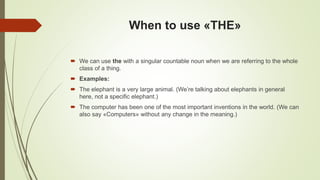
When to use «THE»
 We can use the with a singular countable noun when we are referring to the whole
class of a thing.
 Examples:
 The elephant is a very large animal. (We’re talking about elephants in general
here, not a specific elephant.)
 The computer has been one of the most important inventions in the world. (We can
also say «Computers» without any change in the meaning.)
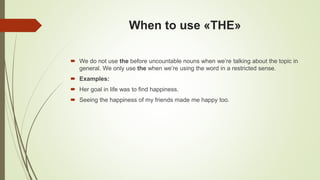
When to use «THE»
 We do not use the before uncountable nouns when we’re talking about the topic in
general. We only use the when we’re using the word in a restricted sense.
 Examples:
 Her goal in life was to find happiness.
 Seeing the happiness of my friends made me happy too.
THE
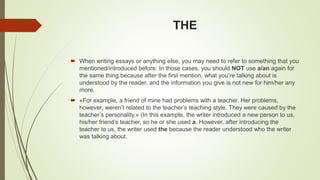
 When writing essays or anything else, you may need to refer to something that you
mentioned/introduced before. In those cases, you should NOT use a/an again for
the same thing because after the first mention, what you’re talking about is
understood by the reader, and the information you give is not new for him/her any
more.
 «For example, a friend of mine had problems with a teacher. Her problems,
however, weren’t related to the teacher’s teaching style. They were caused by the
teacher’s personality.» (In this example, the writer introduced a new person to us,
his/her friend’s teacher, so he or she used a. However, after introducing the
teacher to us, the writer used the because the reader understood who the writer
was talking about.
THE
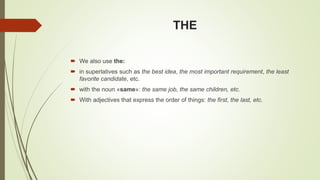
 We also use the:
 in superlatives such as the best idea, the most important requirement, the least
favorite candidate, etc.
 with the noun «same»: the same job, the same children, etc.
 With adjectives that express the order of things: the first, the last, etc.
THE
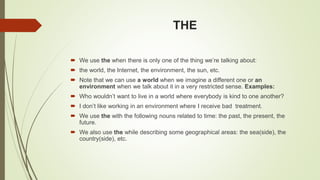
 We use the when there is only one of the thing we’re talking about:
 the world, the Internet, the environment, the sun, etc.
 Note that we can use a world when we imagine a different one or an
environment when we talk about it in a very restricted sense. Examples:
 Who wouldn’t want to live in a world where everybody is kind to one another?
 I don’t like working in an environment where I receive bad treatment.
 We use the with the following nouns related to time: the past, the present, the
future.
 We also use the while describing some geographical areas: the sea(side), the
country(side), etc.
WHEN NOT TO USE «THE»
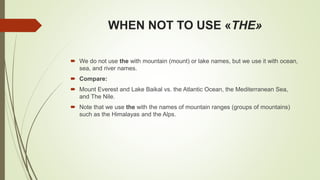
 We do not use the with mountain (mount) or lake names, but we use it with ocean,
sea, and river names.
 Compare:
 Mount Everest and Lake Baikal vs. the Atlantic Ocean, the Mediterranean Sea,
and The Nile.
 Note that we use the with the names of mountain ranges (groups of mountains)
such as the Himalayas and the Alps.
THE
 We often use the when the meaning is restricted with a prepositional phrase
beginning with «of».
 Examples:
 The problems of the people living in Istanbul
 The ideas of Descartes
 The computers of the university
When to use «THE»
 We use the with cinema, theatre, and the radio.
 Examples:
 I went to the cinema/the theater the other day. (We use the even though we don’t
mean that we went to a specific cinema.)
 A lot of people listen to the radio while driving.
 We do not use the with television unless we’re talking about it as an appliance.
 Compare:
 Watching television is one of her favorite hobbies.
 Please turn off the television before you go to sleep.
THE
 You can use the + adjective combination to refer to groups of people. Common
examples of this kind of usage include:
 The rich, the poor, the elderly, the young, the blind, the unemployed, etc.
 For example, rich people and the rich means the same thing.
 We can also use the before nationality adjectives that end with –ese, -ch, and –sh
to talk about the people of that country. For example, the Japanese, the French,
the Spanish, etc. When we use the before these adjectives, we’re NOT talking
about a single person; the meaning is plural.
WHEN NOT TO USE «THE»
 One of the most common mistakes that students make regarding articles is with
country names and place names. We normally do not use articles with these types
of names, but there are exceptions, which will be explained on the next slide.
 Countries: Germany, Argentina, Turkey, etc.
 Continents: Europe, North America, Africa, etc.
 Cities: Beijing, Los Angeles, Rome, etc.
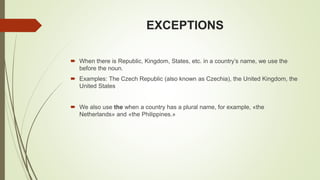
EXCEPTIONS
 When there is Republic, Kingdom, States, etc. in a country’s name, we use the
before the noun.
 Examples: The Czech Republic (also known as Czechia), the United Kingdom, the
United States
 We also use the when a country has a plural name, for example, «the
Netherlands» and «the Philippines.»
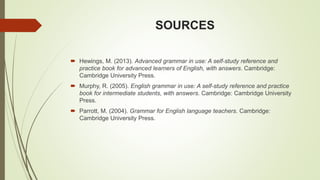
SOURCES
 Hewings, M. (2013). Advanced grammar in use: A self-study reference and
practice book for advanced learners of English, with answers. Cambridge:
Cambridge University Press.
 Murphy, R. (2005). English grammar in use: A self-study reference and practice
book for intermediate students, with answers. Cambridge: Cambridge University
Press.
 Parrott, M. (2004). Grammar for English language teachers. Cambridge:
Cambridge University Press.

Articles in English (A, and, the, and the zero article)

  • 1.
    ARTICLES IN ENGLISH A,AN, THE, and the ZERO ARTICLE Prepared by Alp Kaan Gökçe
  • 2.
    A and AN For countable nouns (nouns that we can count), when we’re talking about one thing that is not specific, we use a or an depending on the pronunciation (not spelling) of the word that follows. When a noun begins with a vowel (a, e, etc.) in its pronunciation, we use an. When a noun begins with a consonant (k, t, etc.) in its pronunciation, we use a.  Ex: It’s difficult for me to find a job in this area. (not an job because job doesn’t start with a vowel when we say it out loud)  Ex: I have an idea, and I think you’ll like it. (not a idea)  Keep in mind that we decide on a/an depending on the first noun that follows it. For example: I have a great idea (because great is pronounced with a consonant at the beginning)
  • 3.
    Articles with uncountablenouns  Uncountable nouns do not get a or an before them, but we can use «the» if we’re talking about something specific.  For instance, we do NOT say an information, a research, a water, a money, a news, etc. because these are nouns that we do not count. We can use «the» article with all of these words depending on the situation.  If we want to say that there is one or some of these things, we can say: a piece of/some information, some research, a glass of water, some money, a piece of/some news, etc.
  • 4.
    With singular countablenouns  We cannot use singular countable nouns without using an article (a, an, or the).  For example, we cannot say «I’m going to buy shirt.» because shirt is countable and it needs «a» (or one, five, the, etc. depending on the context) in this example.  However, we CAN use uncountable nouns by themselves.  For example, we can say «I like listening to music at night.» or «He found information about the company for us.»
  • 5.
    THE  A lotof students have a problem using the article «the.» Generally, they either don’t put «the» before nouns that require it, or they put «the» everywhere in their essays or while speaking.  There are general guidelines that you can follow to remember when to use «the»:  While we use a/an to introduce something that the listener/reader doesn’t know or is unaware of, we use the to talk about something that the listener/reader already knows about or can easily understand from the context because it refers to something already mentioned or when it’s shared knowledge between us. The context is very important in determining when to use the.
  • 6.
    THE  Compare thefollowing examples:  I want to buy a new computer. (I’m not talking about a specific computer; I just want to buy one that’s suitable for me.)  I want to buy the computer we talked about. (I’m talking about a specific computer. We talked about buying it before, so my friend knows which computer I’m referring to.)  Please stop using the computer! You need to start working! (Here, the person I’m speaking with and I know which computer I’m talking about. So, it’s shared knowledge between the speaker and the listener.)
  • 7.
    When to use«THE»  We do not use the before plural and countable nouns when we’re talking about general things. We only use the when we’re referring to a specific group (within a group) that we have already mentioned.  Examples:  John likes apples a lot. (Here, we say that John likes apples in general.)  John likes the apples (you bought) a lot. (Here, even without «you bought», one would understand that the speaker is talking about certain apples and not apples in general. We don’t know if John normally likes apples a lot. We only know that he likes the ones the speaker is referring to.)
  • 8.
    When to use«THE»  We can use the with a singular countable noun when we are referring to the whole class of a thing.  Examples:  The elephant is a very large animal. (We’re talking about elephants in general here, not a specific elephant.)  The computer has been one of the most important inventions in the world. (We can also say «Computers» without any change in the meaning.)
  • 9.
    When to use«THE»  We do not use the before uncountable nouns when we’re talking about the topic in general. We only use the when we’re using the word in a restricted sense.  Examples:  Her goal in life was to find happiness.  Seeing the happiness of my friends made me happy too.
  • 10.
    THE  When writingessays or anything else, you may need to refer to something that you mentioned/introduced before. In those cases, you should NOT use a/an again for the same thing because after the first mention, what you’re talking about is understood by the reader, and the information you give is not new for him/her any more.  «For example, a friend of mine had problems with a teacher. Her problems, however, weren’t related to the teacher’s teaching style. They were caused by the teacher’s personality.» (In this example, the writer introduced a new person to us, his/her friend’s teacher, so he or she used a. However, after introducing the teacher to us, the writer used the because the reader understood who the writer was talking about.
  • 11.
    THE  We alsouse the:  in superlatives such as the best idea, the most important requirement, the least favorite candidate, etc.  with the noun «same»: the same job, the same children, etc.  With adjectives that express the order of things: the first, the last, etc.
  • 12.
    THE  We usethe when there is only one of the thing we’re talking about:  the world, the Internet, the environment, the sun, etc.  Note that we can use a world when we imagine a different one or an environment when we talk about it in a very restricted sense. Examples:  Who wouldn’t want to live in a world where everybody is kind to one another?  I don’t like working in an environment where I receive bad treatment.  We use the with the following nouns related to time: the past, the present, the future.  We also use the while describing some geographical areas: the sea(side), the country(side), etc.
  • 13.
    WHEN NOT TOUSE «THE»  We do not use the with mountain (mount) or lake names, but we use it with ocean, sea, and river names.  Compare:  Mount Everest and Lake Baikal vs. the Atlantic Ocean, the Mediterranean Sea, and The Nile.  Note that we use the with the names of mountain ranges (groups of mountains) such as the Himalayas and the Alps.
  • 14.
    THE  We oftenuse the when the meaning is restricted with a prepositional phrase beginning with «of».  Examples:  The problems of the people living in Istanbul  The ideas of Descartes  The computers of the university
  • 15.
    When to use«THE»  We use the with cinema, theatre, and the radio.  Examples:  I went to the cinema/the theater the other day. (We use the even though we don’t mean that we went to a specific cinema.)  A lot of people listen to the radio while driving.  We do not use the with television unless we’re talking about it as an appliance.  Compare:  Watching television is one of her favorite hobbies.  Please turn off the television before you go to sleep.
  • 16.
    THE  You canuse the + adjective combination to refer to groups of people. Common examples of this kind of usage include:  The rich, the poor, the elderly, the young, the blind, the unemployed, etc.  For example, rich people and the rich means the same thing.  We can also use the before nationality adjectives that end with –ese, -ch, and –sh to talk about the people of that country. For example, the Japanese, the French, the Spanish, etc. When we use the before these adjectives, we’re NOT talking about a single person; the meaning is plural.
  • 17.
    WHEN NOT TOUSE «THE»  One of the most common mistakes that students make regarding articles is with country names and place names. We normally do not use articles with these types of names, but there are exceptions, which will be explained on the next slide.  Countries: Germany, Argentina, Turkey, etc.  Continents: Europe, North America, Africa, etc.  Cities: Beijing, Los Angeles, Rome, etc.
  • 18.
    EXCEPTIONS  When thereis Republic, Kingdom, States, etc. in a country’s name, we use the before the noun.  Examples: The Czech Republic (also known as Czechia), the United Kingdom, the United States  We also use the when a country has a plural name, for example, «the Netherlands» and «the Philippines.»
  • 19.
    SOURCES  Hewings, M.(2013). Advanced grammar in use: A self-study reference and practice book for advanced learners of English, with answers. Cambridge: Cambridge University Press.  Murphy, R. (2005). English grammar in use: A self-study reference and practice book for intermediate students, with answers. Cambridge: Cambridge University Press.  Parrott, M. (2004). Grammar for English language teachers. Cambridge: Cambridge University Press.