ADJECTIVE CLAUSE
English for Tourism 4
Pancasila University Jakarta
Wasi Widayadi, ST., MBA.
ADJECTIVE CLAUSE
I meet a woman. She can speak three
languages.
I meet a woman who / that can speak three
languages.
Jack was wearing a hat. It was too big for
him.
Jack was wearing a hat which / that was too
big for him.
Functions:
To combine two sentences.
To explain a noun.
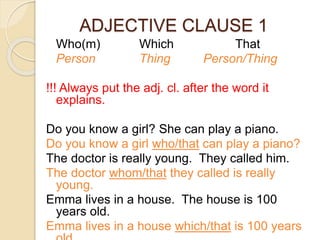
ADJECTIVE CLAUSE 1
Who(m) Which That
Person Thing Person/Thing
!!! Always put the adj. cl. after the word it
explains.
Do you know a girl? She can play a piano.
Do you know a girl who/that can play a piano?
The doctor is really young. They called him.
The doctor whom/that they called is really
young.
Emma lives in a house. The house is 100
years old.
Emma lives in a house which/that is 100 years
PRACTICE 2
Combine the two sentences. Use the second
sentence as the adjective clause.
1. The police finally caught the thieves. The
thieves had broken into several houses.
2. The musicians came late. The company had
hired them for an office party.
3. The car had to stop many times. The
president was riding in it.
4. The bank is very reliable. I borrowed some
money from it.
5. My uncle lent me money to build a house. I
always depend on him for help.
ADJECTIVE CLAUSE 2
I know a girl. Her brother is a movie star.
I know a girl whose brother is a movie star.
Every year we go to Medan. My parents were
born there.
Every year we go to Medan where my parents
were born.
You can see me on Sunday morning. At that
time I’m not busy.
You can see me on Sunday morning when I’m
not busy.
ADJECTIVE CLAUSE 2
Where When Whose
Place Time Possession
Combine the two sentences. Use the second
sentence as the adjective clause.
1. The student got an A in writing essay. The student’s
essay was read in class.
2. The garage is very expensive. The company
executive park their cars there.
3. They take a short holiday in January. In this month
there are only a few customers.
4. There’s a beautiful view from the hilltop. Hikers can
stop there to have lunch.
5. I have a neighbor. His dog barks all night long.
PRACTICE 3
Combine the two sentences. Use the second
sentence as the adjective clause.
1. Most students look forward to the Christmas
holidays. At this time they can relax after months of
hard work.
2. The town has been very much in the news these
days. The university is located there.
3. He made some notes on a piece of paper. He then
quickly put it in his pocket.
4. Suddenly a man appeared at the back door. She
knew the man was wanted by the police.
5. The applicants will not be accepted by the university.
Their abilities are below the requirements.
6. The workers were dismissed by the company. They
had gone on strike for higher payment.

Adjective Clause

  • 1.
    ADJECTIVE CLAUSE English forTourism 4 Pancasila University Jakarta Wasi Widayadi, ST., MBA.
  • 2.
    ADJECTIVE CLAUSE I meeta woman. She can speak three languages. I meet a woman who / that can speak three languages. Jack was wearing a hat. It was too big for him. Jack was wearing a hat which / that was too big for him. Functions: To combine two sentences. To explain a noun.
  • 3.
    ADJECTIVE CLAUSE 1 Who(m)Which That Person Thing Person/Thing !!! Always put the adj. cl. after the word it explains. Do you know a girl? She can play a piano. Do you know a girl who/that can play a piano? The doctor is really young. They called him. The doctor whom/that they called is really young. Emma lives in a house. The house is 100 years old. Emma lives in a house which/that is 100 years
  • 4.
    PRACTICE 2 Combine thetwo sentences. Use the second sentence as the adjective clause. 1. The police finally caught the thieves. The thieves had broken into several houses. 2. The musicians came late. The company had hired them for an office party. 3. The car had to stop many times. The president was riding in it. 4. The bank is very reliable. I borrowed some money from it. 5. My uncle lent me money to build a house. I always depend on him for help.
  • 5.
    ADJECTIVE CLAUSE 2 Iknow a girl. Her brother is a movie star. I know a girl whose brother is a movie star. Every year we go to Medan. My parents were born there. Every year we go to Medan where my parents were born. You can see me on Sunday morning. At that time I’m not busy. You can see me on Sunday morning when I’m not busy.
  • 6.
    ADJECTIVE CLAUSE 2 WhereWhen Whose Place Time Possession Combine the two sentences. Use the second sentence as the adjective clause. 1. The student got an A in writing essay. The student’s essay was read in class. 2. The garage is very expensive. The company executive park their cars there. 3. They take a short holiday in January. In this month there are only a few customers. 4. There’s a beautiful view from the hilltop. Hikers can stop there to have lunch. 5. I have a neighbor. His dog barks all night long.
  • 7.
    PRACTICE 3 Combine thetwo sentences. Use the second sentence as the adjective clause. 1. Most students look forward to the Christmas holidays. At this time they can relax after months of hard work. 2. The town has been very much in the news these days. The university is located there. 3. He made some notes on a piece of paper. He then quickly put it in his pocket. 4. Suddenly a man appeared at the back door. She knew the man was wanted by the police. 5. The applicants will not be accepted by the university. Their abilities are below the requirements. 6. The workers were dismissed by the company. They had gone on strike for higher payment.