ADHD
PRESENTED BY: HIRA JAVED
MSC IV SEMESTER
UNIVERSITY OF GUJRAT SIALKOT SUB
CAMPUS
ATTENTION DEFICIT
HYPERACTIVITY
DISORDER (ADHD)
It is a mental disorder of the neurodevelopmental type. It is
characterized by problems paying attention, excessive activity,
or difficulty controlling behavior. The symptoms appear before a
person is 12 years old, are present for more than six months,
and cause problems in at least two settings (such as school,
home, or recreational activities). In children, problems paying
attention may result in poor school performance. Although it
causes impairment, particularly in modern society, many
children with ADHD have a good attention span for tasks they
find interesting.
CONT…
• Despite being the most commonly studied and
diagnosed mental disorder in children and
adolescents, the exact cause is unknown in the
majority of cases.
• ADHD is diagnosed approximately three times
more often in boys than in girls, although the
disorder is often overlooked in girls due to their
symptoms differing from those of boys. About
30–50% of people diagnosed in childhood
continue to have symptoms into adulthood.
SYMPTOMS
• Be easily distracted, miss details, forget things, and
frequently switch from one activity to another
• Have difficulty maintaining focus on one task
• Become bored with a task after only a few minutes, unless
doing something they find enjoyable
• Have difficulty focusing attention on organizing or
completing a task
• Have trouble completing or turning in homework
assignments, often losing things (e.g., pencils, toys,
assignments) needed to complete tasks or activities
CONT…
• Appear not to be listening when spoken to
• Daydream, become easily confused, and move slowly
• Have difficulty processing information as quickly and
accurately as others
• Struggle to follow instructions
• Have trouble understanding details; overlooks details
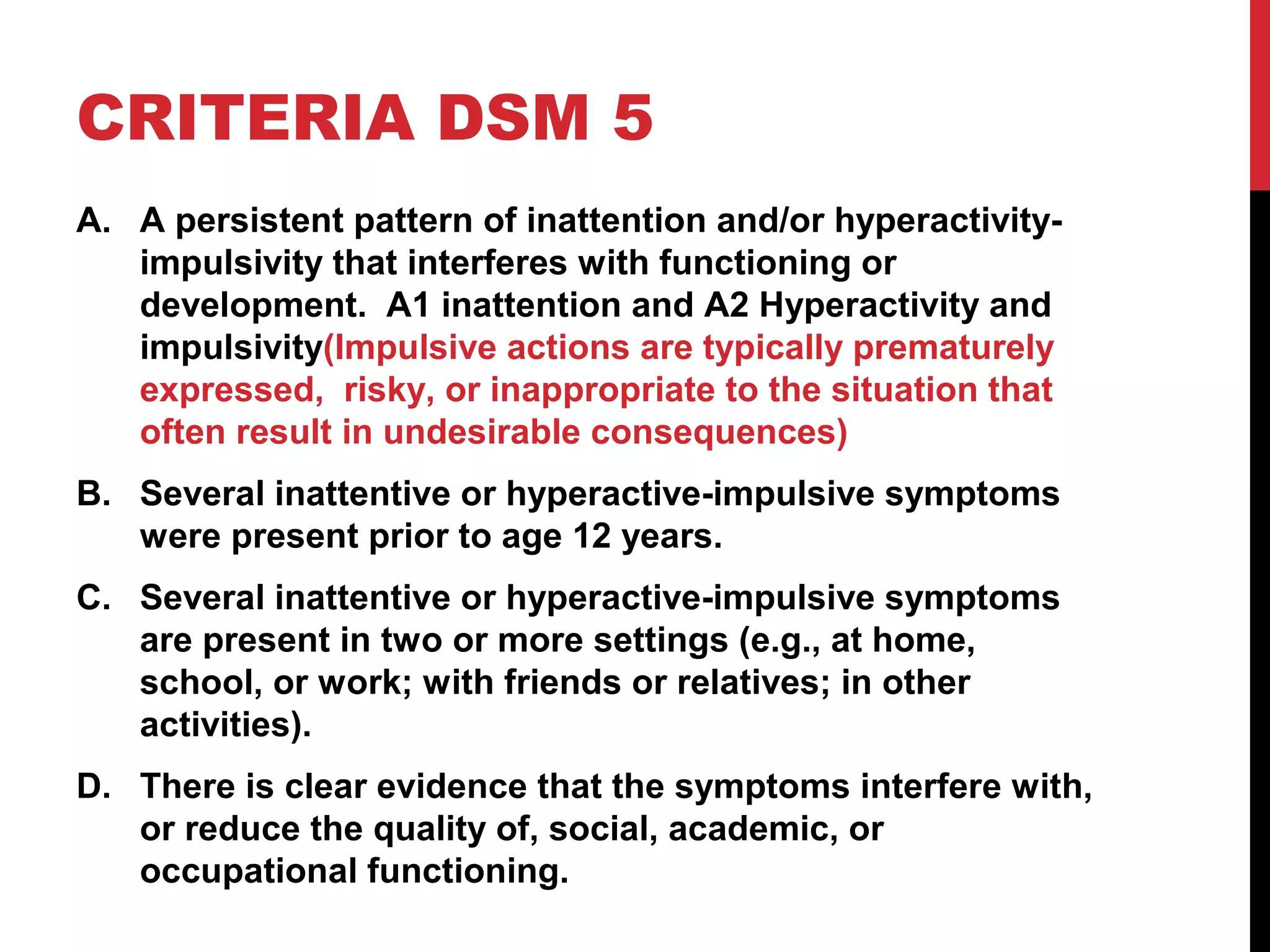
CRITERIA DSM 5
A. A persistent pattern of inattention and/or hyperactivity-
impulsivity that interferes with functioning or
development. A1 inattention and A2 Hyperactivity and
impulsivity(Impulsive actions are typically prematurely
expressed, risky, or inappropriate to the situation that
often result in undesirable consequences)
B. Several inattentive or hyperactive-impulsive symptoms
were present prior to age 12 years.
C. Several inattentive or hyperactive-impulsive symptoms
are present in two or more settings (e.g., at home,
school, or work; with friends or relatives; in other
activities).
D. There is clear evidence that the symptoms interfere with,
or reduce the quality of, social, academic, or
occupational functioning.
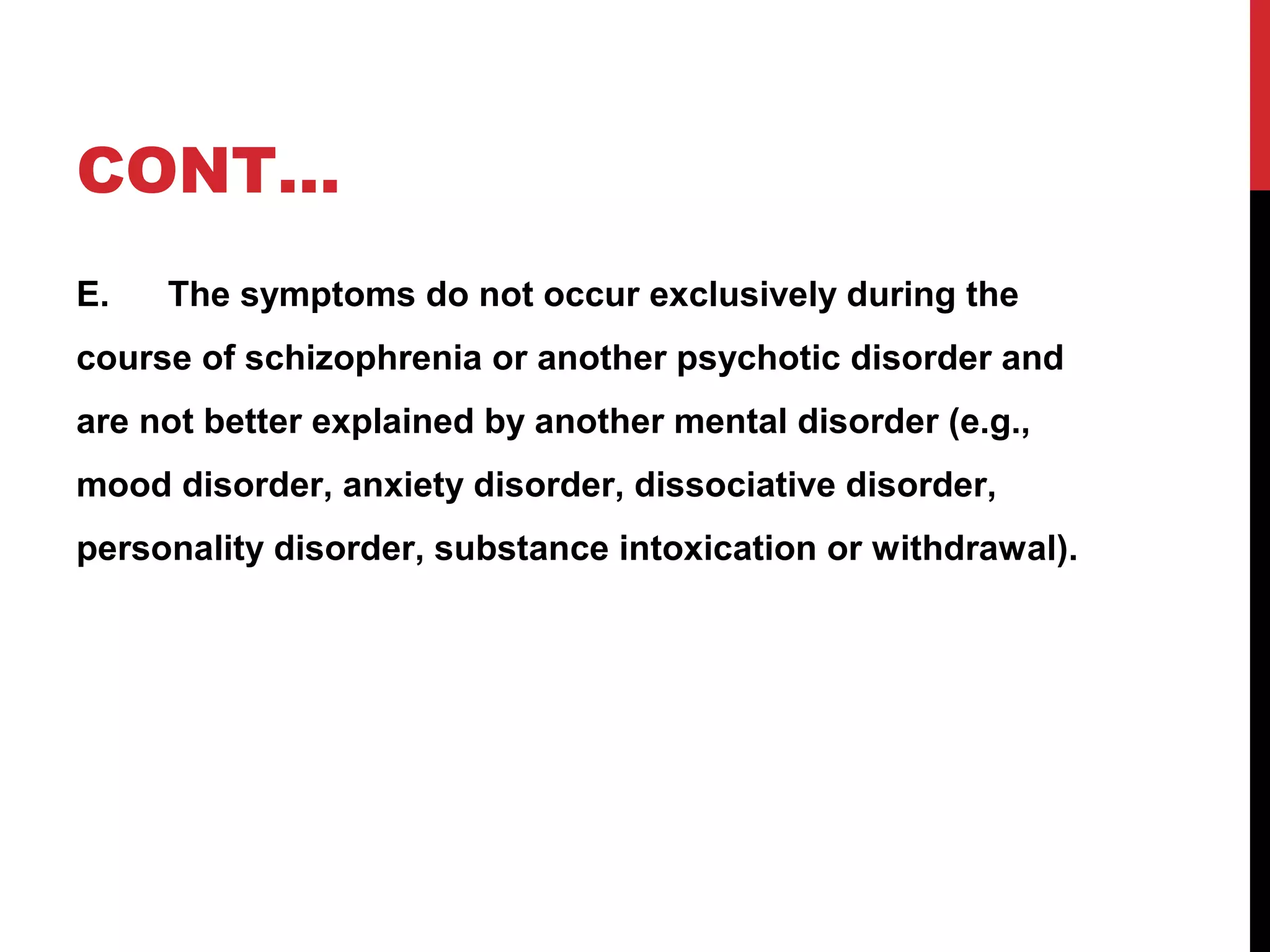
CONT…
E. The symptoms do not occur exclusively during the
course of schizophrenia or another psychotic disorder and
are not better explained by another mental disorder (e.g.,
mood disorder, anxiety disorder, dissociative disorder,
personality disorder, substance intoxication or withdrawal).
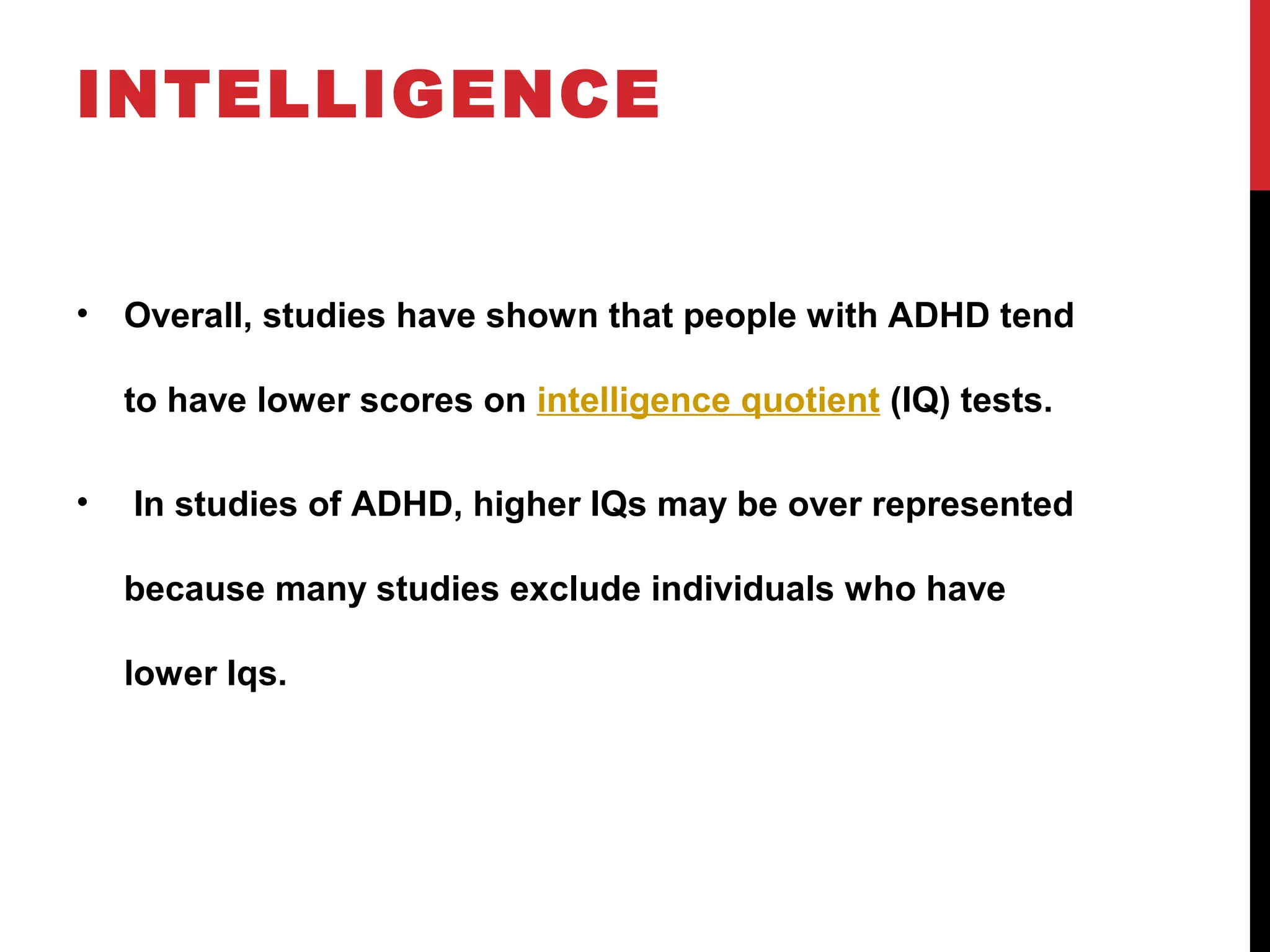
INTELLIGENCE
• Overall, studies have shown that people with ADHD tend
to have lower scores on intelligence quotient (IQ) tests.
• In studies of ADHD, higher IQs may be over represented
because many studies exclude individuals who have
lower Iqs.
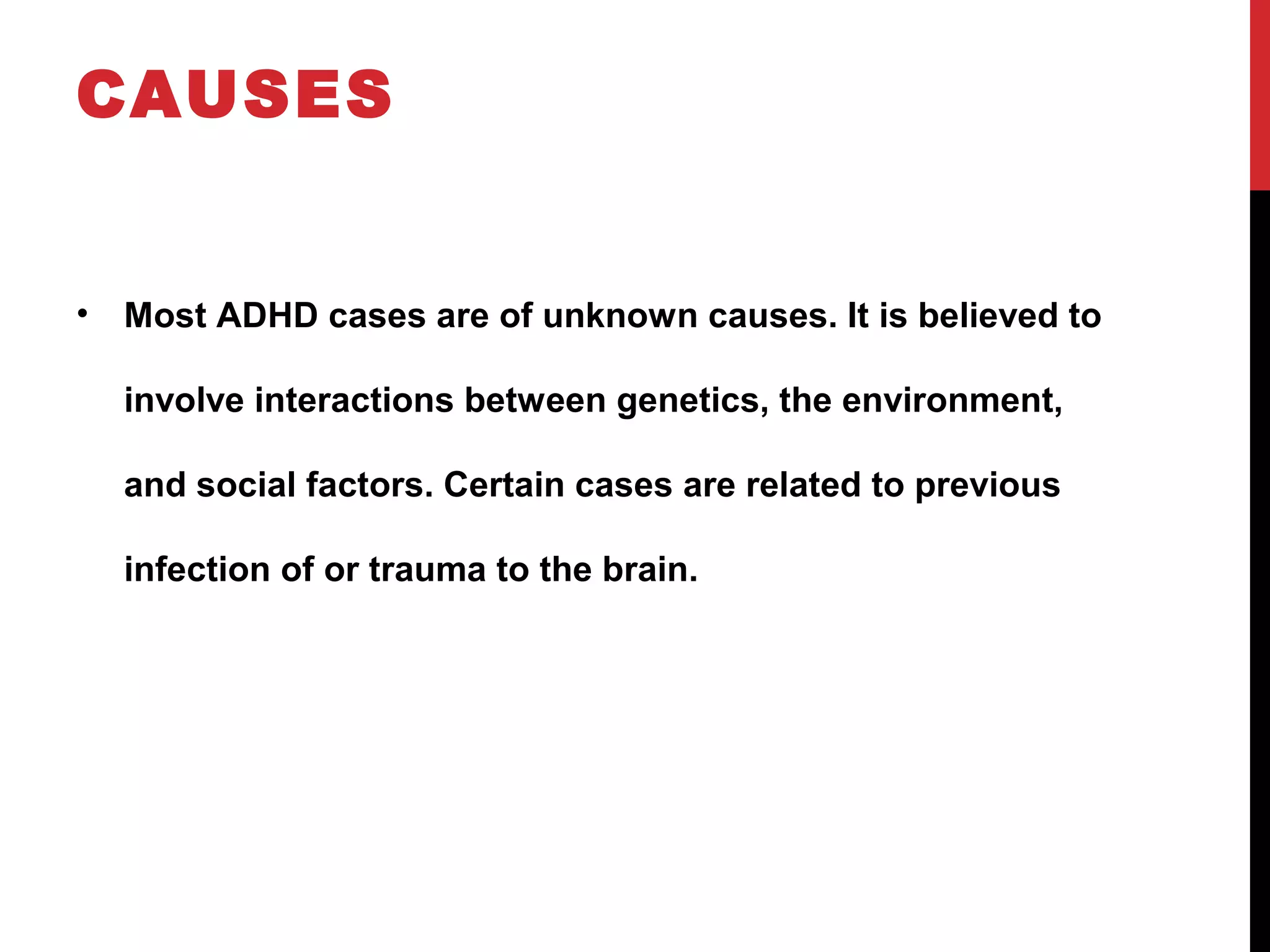
CAUSES
• Most ADHD cases are of unknown causes. It is believed to
involve interactions between genetics, the environment,
and social factors. Certain cases are related to previous
infection of or trauma to the brain.
GENETICS
• Twin studies indicate that the disorder is often inherited
from one's parents with genetics determining about 75%
of cases. Siblings of children with ADHD are three to four
times more likely to develop the disorder than siblings of
children without the disorder. Genetic factors are also
believed to be involved in determining whether ADHD
persists into adulthood.
ENVIRONMENT
• In addition to genetics, some environmental factors might
play a role in causing ADHD. Alcohol intake during
pregnancy can cause fetal alcohol spectrum disorders
which can include ADHD or symptoms like it.
• Extreme premature birth, very low birth weight, and
extreme neglect, abuse, or social deprivation also
increase the risk as do certain infections during
pregnancy, at birth, and in early childhood.
CONT…
• At least 30% of children with a traumatic brain injury later
develop ADHDand about 5% of cases are due to brain
damage.
• Research does not support popular beliefs that ADHD is
caused by eating too much refined sugar, watching too
much television, parenting, poverty or family chaos;
however, they might worsen ADHD symptoms in certain
people.
PSYCHOPHYSIOLO
GY
• Current models of ADHD suggest that it is associated with
functional impairments in some of the brain's
neurotransmitter systems, particularly those involving
dopamine and norepinephrine.
• Brain structure
• In children with ADHD, there is a general reduction of
volume in certain brain structures, with a proportionally
greater decrease in the volume in the left-sided
prefrontal cortex. The posterior parietal cortex also shows
thinning in ADHD individuals compared to controls.
NEUROTRANSMITTER
PATHWAYS
• Previously it was thought that the elevated number of
dopamine transporters in people with ADHD was part of the
pathophysiology but it appears that the elevated numbers are
due to adaptation to exposure to stimulants.
• Current models involve the
mesocorticolimbic dopamine pathway and the
locus coeruleus-noradrenergic system. ADHD
psychostimulants possess treatment efficacy because they
increase neurotransmitter activity in these systems. There may
additionally be abnormalities in serotoninergic, glutamatergic
(learning and memory), or cholinergic (arousal, attention,
EXECUTIVE FUNCTION AND
MOTIVATION
• The symptoms of ADHD arise from a deficiency in
certain executive functions (e.g., attentional
control, inhibitory control, and working memory).
• Executive functions are a set of cognitive processes that
are required to successfully select and monitor
behaviors.
• The executive function impairments that occur in ADHD
individuals result in problems with staying organized, time
keeping, excessive procrastination, maintaining
concentration, paying attention, ignoring distractions,
regulating emotions, and remembering details.
CONT…
• People with ADHD appear to have unimpaired long-term
memory, and deficits in long-term recall appear to be attributed
to impairments in working memory. The criteria for an executive
function deficit are met in 30–50% of children and adolescents
with ADHD. One study found that 80% of individuals with ADHD
were impaired in at least one executive function task, compared
to 50% for individuals without ADHD. Due to the rates of brain
maturation and the increasing demands for executive control as
a person gets older, ADHD impairments may not fully manifest
themselves until adolescence or even early adulthood.
ADHD (attention deficit and hyperactivity disorder)

ADHD (attention deficit and hyperactivity disorder)

  • 1.
    ADHD PRESENTED BY: HIRAJAVED MSC IV SEMESTER UNIVERSITY OF GUJRAT SIALKOT SUB CAMPUS
  • 2.
    ATTENTION DEFICIT HYPERACTIVITY DISORDER (ADHD) It isa mental disorder of the neurodevelopmental type. It is characterized by problems paying attention, excessive activity, or difficulty controlling behavior. The symptoms appear before a person is 12 years old, are present for more than six months, and cause problems in at least two settings (such as school, home, or recreational activities). In children, problems paying attention may result in poor school performance. Although it causes impairment, particularly in modern society, many children with ADHD have a good attention span for tasks they find interesting.
  • 3.
    CONT… • Despite beingthe most commonly studied and diagnosed mental disorder in children and adolescents, the exact cause is unknown in the majority of cases. • ADHD is diagnosed approximately three times more often in boys than in girls, although the disorder is often overlooked in girls due to their symptoms differing from those of boys. About 30–50% of people diagnosed in childhood continue to have symptoms into adulthood.
  • 4.
    SYMPTOMS • Be easilydistracted, miss details, forget things, and frequently switch from one activity to another • Have difficulty maintaining focus on one task • Become bored with a task after only a few minutes, unless doing something they find enjoyable • Have difficulty focusing attention on organizing or completing a task • Have trouble completing or turning in homework assignments, often losing things (e.g., pencils, toys, assignments) needed to complete tasks or activities
  • 5.
    CONT… • Appear notto be listening when spoken to • Daydream, become easily confused, and move slowly • Have difficulty processing information as quickly and accurately as others • Struggle to follow instructions • Have trouble understanding details; overlooks details
  • 6.
    CRITERIA DSM 5 A.A persistent pattern of inattention and/or hyperactivity- impulsivity that interferes with functioning or development. A1 inattention and A2 Hyperactivity and impulsivity(Impulsive actions are typically prematurely expressed, risky, or inappropriate to the situation that often result in undesirable consequences) B. Several inattentive or hyperactive-impulsive symptoms were present prior to age 12 years. C. Several inattentive or hyperactive-impulsive symptoms are present in two or more settings (e.g., at home, school, or work; with friends or relatives; in other activities). D. There is clear evidence that the symptoms interfere with, or reduce the quality of, social, academic, or occupational functioning.
  • 7.
    CONT… E. The symptomsdo not occur exclusively during the course of schizophrenia or another psychotic disorder and are not better explained by another mental disorder (e.g., mood disorder, anxiety disorder, dissociative disorder, personality disorder, substance intoxication or withdrawal).
  • 8.
    INTELLIGENCE • Overall, studieshave shown that people with ADHD tend to have lower scores on intelligence quotient (IQ) tests. • In studies of ADHD, higher IQs may be over represented because many studies exclude individuals who have lower Iqs.
  • 9.
    CAUSES • Most ADHDcases are of unknown causes. It is believed to involve interactions between genetics, the environment, and social factors. Certain cases are related to previous infection of or trauma to the brain.
  • 10.
    GENETICS • Twin studiesindicate that the disorder is often inherited from one's parents with genetics determining about 75% of cases. Siblings of children with ADHD are three to four times more likely to develop the disorder than siblings of children without the disorder. Genetic factors are also believed to be involved in determining whether ADHD persists into adulthood.
  • 11.
    ENVIRONMENT • In additionto genetics, some environmental factors might play a role in causing ADHD. Alcohol intake during pregnancy can cause fetal alcohol spectrum disorders which can include ADHD or symptoms like it. • Extreme premature birth, very low birth weight, and extreme neglect, abuse, or social deprivation also increase the risk as do certain infections during pregnancy, at birth, and in early childhood.
  • 12.
    CONT… • At least30% of children with a traumatic brain injury later develop ADHDand about 5% of cases are due to brain damage. • Research does not support popular beliefs that ADHD is caused by eating too much refined sugar, watching too much television, parenting, poverty or family chaos; however, they might worsen ADHD symptoms in certain people.
  • 13.
    PSYCHOPHYSIOLO GY • Current modelsof ADHD suggest that it is associated with functional impairments in some of the brain's neurotransmitter systems, particularly those involving dopamine and norepinephrine. • Brain structure • In children with ADHD, there is a general reduction of volume in certain brain structures, with a proportionally greater decrease in the volume in the left-sided prefrontal cortex. The posterior parietal cortex also shows thinning in ADHD individuals compared to controls.
  • 14.
    NEUROTRANSMITTER PATHWAYS • Previously itwas thought that the elevated number of dopamine transporters in people with ADHD was part of the pathophysiology but it appears that the elevated numbers are due to adaptation to exposure to stimulants. • Current models involve the mesocorticolimbic dopamine pathway and the locus coeruleus-noradrenergic system. ADHD psychostimulants possess treatment efficacy because they increase neurotransmitter activity in these systems. There may additionally be abnormalities in serotoninergic, glutamatergic (learning and memory), or cholinergic (arousal, attention,
  • 15.
    EXECUTIVE FUNCTION AND MOTIVATION •The symptoms of ADHD arise from a deficiency in certain executive functions (e.g., attentional control, inhibitory control, and working memory). • Executive functions are a set of cognitive processes that are required to successfully select and monitor behaviors. • The executive function impairments that occur in ADHD individuals result in problems with staying organized, time keeping, excessive procrastination, maintaining concentration, paying attention, ignoring distractions, regulating emotions, and remembering details.
  • 16.
    CONT… • People withADHD appear to have unimpaired long-term memory, and deficits in long-term recall appear to be attributed to impairments in working memory. The criteria for an executive function deficit are met in 30–50% of children and adolescents with ADHD. One study found that 80% of individuals with ADHD were impaired in at least one executive function task, compared to 50% for individuals without ADHD. Due to the rates of brain maturation and the increasing demands for executive control as a person gets older, ADHD impairments may not fully manifest themselves until adolescence or even early adulthood.