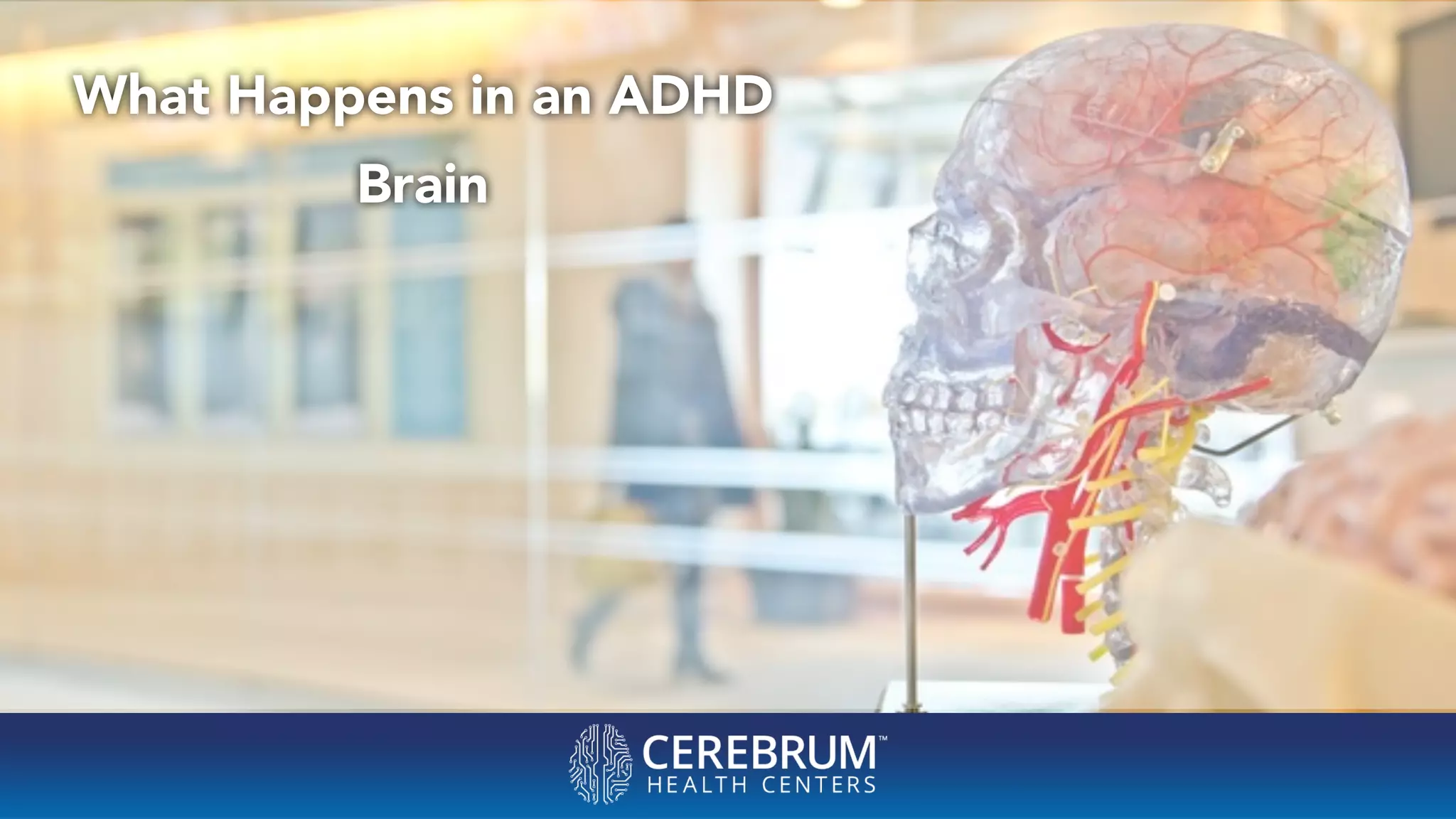
What Happens in an ADHD
Brain

You, or someone you know, has been
diagnosed with ADHD and you’re struggling to
understand what that diagnosis actually means.
Is ADHD behavioral or neurological? Does it
really exist and, if so, how is the brain of
someone with ADHD different than neurotypical
brains?
Below, we’ll take a look at this disorder from
both inside and out, and discuss how the telltale
behavioral signs of ADHD originate within the
brain.
What is ADHD?
ADHD is short for Attention Deficit
Hyperactivity Disorder. It’s a
neurobehavioral disorder. Some
people who receive this diagnosis
can display a tendency to be
hyperactive and impulsive. While
others may not be hyper at all and
instead have difficulty focusing.
ADHD is one of the most common childhood
neurological disorders. It affects an estimated
10% of all children in the US, and that number
is growing.
Research shows that cases of ADHD are on
the rise. In the last 13 years, cases have
skyrocketed by 43%.
While the majority of kids with ADHD outgrow
it, for up to 4% of adults ADHD is a lifelong
diagnosis.
What is ADHD?
What Causes ADHD?
No one knows for sure what causes some
people to develop this disorder. Studies indicate
that ADHD may be caused by the following:
Genetics – You’ll often hear a grandparent or
family friend say, “Timmy is hyper just like his
dad was at that age.” That’s because ADHD
often runs in families. If a parent has ADHD,
there’s a 50% likelihood that the child will as
well.
What Causes ADHD?
Environment – ADHD may develop in utero if
the pregnant mother smokes cigarettes or
consumes alcohol. Complications to mother or
baby during pregnancy, including premature
birth, can also become a contributing cause.
Lead exposure – Excessive exposure to lead,
especially in utero, can lead to ADHD.
What Causes ADHD?
Nutrition – There’s a debate on how
nutrition plays a role in ADHD. Some
research indicates a link between sugar
consumption and ADHD.
Brain Injury – Brain injury, especially to
the frontal lobes, can result in ADHD
behavior.
What is Typical ADHD Behavior?
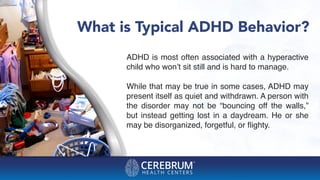
ADHD is most often associated with a hyperactive
child who won’t sit still and is hard to manage.
While that may be true in some cases, ADHD may
present itself as quiet and withdrawn. A person with
the disorder may not be “bouncing off the walls,”
but instead getting lost in a daydream. He or she
may be disorganized, forgetful, or flighty.
What is Typical ADHD Behavior?
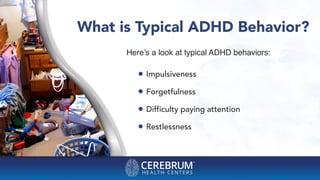
Here’s a look at typical ADHD behaviors:
• Impulsiveness
• Forgetfulness
• Difficulty paying attention
• Restlessness
What is Typical ADHD Behavior?
It’s important to note that people with ADHD aren’t
lazy or unmotivated. Those living with this
diagnosis must struggle hard to pay attention and
stay engaged. ADHD is tied to how the brain
processes information, as we’ll discuss further in
this article.
ADHD and Gender
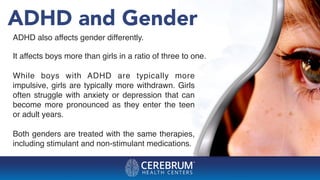
ADHD also affects gender differently.
It affects boys more than girls in a ratio of three to one.
While boys with ADHD are typically more
impulsive, girls are typically more withdrawn. Girls
often struggle with anxiety or depression that can
become more pronounced as they enter the teen
or adult years.
Both genders are treated with the same therapies,
including stimulant and non-stimulant medications.
How ADHD Affects the Brain
Please note that brain size is not linked to
intelligent. To underscore this, one of the
smartest brains in all of human history, Albert
Einstein, is thought to have had ADHD.
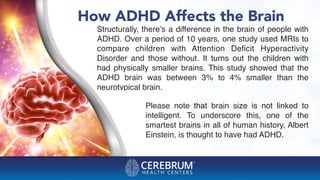
Structurally, there’s a difference in the brain of people with
ADHD. Over a period of 10 years, one study used MRIs to
compare children with Attention Deficit Hyperactivity
Disorder and those without. It turns out the children with
had physically smaller brains. This study showed that the
ADHD brain was between 3% to 4% smaller than the
neurotypical brain.
How ADHD Affects the Brain
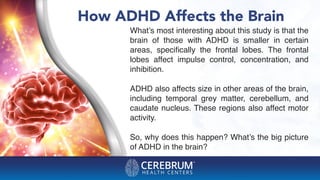
What’s most interesting about this study is that the
brain of those with ADHD is smaller in certain
areas, specifically the frontal lobes. The frontal
lobes affect impulse control, concentration, and
inhibition.
ADHD also affects size in other areas of the brain,
including temporal grey matter, cerebellum, and
caudate nucleus. These regions also affect motor
activity.
So, why does this happen? What’s the big picture
of ADHD in the brain?
How ADHD Affects the Brain
Those with ADHD have impaired executive
functioning. Executive functioning is the part of your
brain that sorts through all incoming information. It
decides what’s important and files away what’s not so
that you can focus on the task at hand, whether that’s
engaging in conversation, paying the bills, or reading
an article on the Internet.
How ADHD Affects the Brain
In the ADHD brain, executive functioning either
doesn’t function at all or to a limited extent. Instead
of being able to decide  what demands attention
immediately and what can wait, the hyperactive
brain greets all incoming information as important
and needing attention right away.
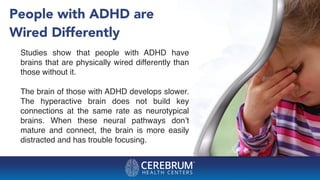
People with ADHD are
Wired Differently
Studies show that people with ADHD have
brains that are physically wired differently than
those without it.
The brain of those with ADHD develops slower.
The hyperactive brain does not build key
connections at the same rate as neurotypical
brains. When these neural pathways don’t
mature and connect, the brain is more easily
distracted and has trouble focusing.
How is ADHD Treated?
There is no cure for Attention Deficit
Hyperactivity Disorder, but it can be managed
through medication and therapy.
The most commonly prescribed medications are
Ritalin (methylphenidate) or Adderall
(amphetamine). Both of these drugs help with
concentration and focus, although they are
controversial because the long-term effects of
How is ADHD Treated?
Stimulants such as Ritalin and Adderall are effective for
up to 85% of people with ADHD. It may sound weird
that a stimulant can help calm hyperactive or impulsive
behavior, but it does so through rewarding the brain
with dopamine. Dopamine helps you stay focused and
on task.
For those who don’t react well to stimulants, a
non-stimulants may be the best solution. Non-
stimulants block norepinephrine reuptake in the
brain and helps regulate brain function.
How is ADHD Treated?
However, there’s exciting research that mental
exercises can dramatically improve attention
spans of those diagnosed with ADHD. It some
cases, mental exercises can eliminate the
need to use drug therapy altogether.
How is ADHD Treated?
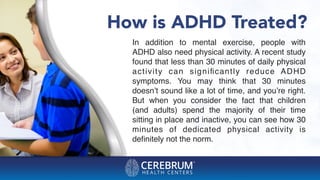
In addition to mental exercise, people with
ADHD also need physical activity. A recent study
found that less than 30 minutes of daily physical
activity can significantly reduce ADHD
symptoms. You may think that 30 minutes
doesn’t sound like a lot of time, and you’re right.
But when you consider the fact that children
(and adults) spend the majority of their time
sitting in place and inactive, you can see how 30
minutes of dedicated physical activity is
definitely not the norm.
Final Thoughts
ADHD is complicated. There’s still a lot of research that
needs to be done on how the disorder affects the brain.
That said, ADHD is not an insurmountable
handicap. In fact, some of the world’s brightest
minds and best athletes have used it to push the
boundaries of social norms in a positive way.
Among those with Attention Deficit Hyperactivity
Disorder are thought to include Thomas Edison,
Mozart, Leonardo da Vinci, Stephen Hawking, Sir
Richard Branson, Michael Jordan, and Michael
Phelps.
855-444-2724
info@cerebrum.com
www.cerebrum.com
Contact Cerebrum Health Centers to learn
more or schedule a free consultation

Cerebrum Dallas Tells You What Happens in an ADHD Brain

  • 1.
    What Happens inan ADHD Brain

  • 2.
    You, or someoneyou know, has been diagnosed with ADHD and you’re struggling to understand what that diagnosis actually means. Is ADHD behavioral or neurological? Does it really exist and, if so, how is the brain of someone with ADHD different than neurotypical brains? Below, we’ll take a look at this disorder from both inside and out, and discuss how the telltale behavioral signs of ADHD originate within the brain.
  • 3.
    What is ADHD? ADHDis short for Attention Deficit Hyperactivity Disorder. It’s a neurobehavioral disorder. Some people who receive this diagnosis can display a tendency to be hyperactive and impulsive. While others may not be hyper at all and instead have difficulty focusing.
  • 4.
    ADHD is oneof the most common childhood neurological disorders. It affects an estimated 10% of all children in the US, and that number is growing. Research shows that cases of ADHD are on the rise. In the last 13 years, cases have skyrocketed by 43%. While the majority of kids with ADHD outgrow it, for up to 4% of adults ADHD is a lifelong diagnosis. What is ADHD?
  • 5.
    What Causes ADHD? Noone knows for sure what causes some people to develop this disorder. Studies indicate that ADHD may be caused by the following: Genetics – You’ll often hear a grandparent or family friend say, “Timmy is hyper just like his dad was at that age.” That’s because ADHD often runs in families. If a parent has ADHD, there’s a 50% likelihood that the child will as well.
  • 6.
    What Causes ADHD? Environment– ADHD may develop in utero if the pregnant mother smokes cigarettes or consumes alcohol. Complications to mother or baby during pregnancy, including premature birth, can also become a contributing cause. Lead exposure – Excessive exposure to lead, especially in utero, can lead to ADHD.
  • 7.
    What Causes ADHD? Nutrition– There’s a debate on how nutrition plays a role in ADHD. Some research indicates a link between sugar consumption and ADHD. Brain Injury – Brain injury, especially to the frontal lobes, can result in ADHD behavior.
  • 8.
    What is TypicalADHD Behavior? ADHD is most often associated with a hyperactive child who won’t sit still and is hard to manage. While that may be true in some cases, ADHD may present itself as quiet and withdrawn. A person with the disorder may not be “bouncing off the walls,” but instead getting lost in a daydream. He or she may be disorganized, forgetful, or flighty.
  • 9.
    What is TypicalADHD Behavior? Here’s a look at typical ADHD behaviors: • Impulsiveness • Forgetfulness • Difficulty paying attention • Restlessness
  • 10.
    What is TypicalADHD Behavior? It’s important to note that people with ADHD aren’t lazy or unmotivated. Those living with this diagnosis must struggle hard to pay attention and stay engaged. ADHD is tied to how the brain processes information, as we’ll discuss further in this article.
  • 11.
    ADHD and Gender ADHDalso affects gender differently. It affects boys more than girls in a ratio of three to one. While boys with ADHD are typically more impulsive, girls are typically more withdrawn. Girls often struggle with anxiety or depression that can become more pronounced as they enter the teen or adult years. Both genders are treated with the same therapies, including stimulant and non-stimulant medications.
  • 12.
    How ADHD Affectsthe Brain Please note that brain size is not linked to intelligent. To underscore this, one of the smartest brains in all of human history, Albert Einstein, is thought to have had ADHD. Structurally, there’s a difference in the brain of people with ADHD. Over a period of 10 years, one study used MRIs to compare children with Attention Deficit Hyperactivity Disorder and those without. It turns out the children with had physically smaller brains. This study showed that the ADHD brain was between 3% to 4% smaller than the neurotypical brain.
  • 13.
    How ADHD Affectsthe Brain What’s most interesting about this study is that the brain of those with ADHD is smaller in certain areas, specifically the frontal lobes. The frontal lobes affect impulse control, concentration, and inhibition. ADHD also affects size in other areas of the brain, including temporal grey matter, cerebellum, and caudate nucleus. These regions also affect motor activity. So, why does this happen? What’s the big picture of ADHD in the brain?
  • 14.
    How ADHD Affectsthe Brain Those with ADHD have impaired executive functioning. Executive functioning is the part of your brain that sorts through all incoming information. It decides what’s important and files away what’s not so that you can focus on the task at hand, whether that’s engaging in conversation, paying the bills, or reading an article on the Internet.
  • 15.
    How ADHD Affectsthe Brain In the ADHD brain, executive functioning either doesn’t function at all or to a limited extent. Instead of being able to decide  what demands attention immediately and what can wait, the hyperactive brain greets all incoming information as important and needing attention right away.
  • 16.
    People with ADHDare Wired Differently Studies show that people with ADHD have brains that are physically wired differently than those without it. The brain of those with ADHD develops slower. The hyperactive brain does not build key connections at the same rate as neurotypical brains. When these neural pathways don’t mature and connect, the brain is more easily distracted and has trouble focusing.
  • 17.
    How is ADHDTreated? There is no cure for Attention Deficit Hyperactivity Disorder, but it can be managed through medication and therapy. The most commonly prescribed medications are Ritalin (methylphenidate) or Adderall (amphetamine). Both of these drugs help with concentration and focus, although they are controversial because the long-term effects of
  • 18.
    How is ADHDTreated? Stimulants such as Ritalin and Adderall are effective for up to 85% of people with ADHD. It may sound weird that a stimulant can help calm hyperactive or impulsive behavior, but it does so through rewarding the brain with dopamine. Dopamine helps you stay focused and on task. For those who don’t react well to stimulants, a non-stimulants may be the best solution. Non- stimulants block norepinephrine reuptake in the brain and helps regulate brain function.
  • 19.
    How is ADHDTreated? However, there’s exciting research that mental exercises can dramatically improve attention spans of those diagnosed with ADHD. It some cases, mental exercises can eliminate the need to use drug therapy altogether.
  • 20.
    How is ADHDTreated? In addition to mental exercise, people with ADHD also need physical activity. A recent study found that less than 30 minutes of daily physical activity can significantly reduce ADHD symptoms. You may think that 30 minutes doesn’t sound like a lot of time, and you’re right. But when you consider the fact that children (and adults) spend the majority of their time sitting in place and inactive, you can see how 30 minutes of dedicated physical activity is definitely not the norm.
  • 21.
    Final Thoughts ADHD iscomplicated. There’s still a lot of research that needs to be done on how the disorder affects the brain. That said, ADHD is not an insurmountable handicap. In fact, some of the world’s brightest minds and best athletes have used it to push the boundaries of social norms in a positive way. Among those with Attention Deficit Hyperactivity Disorder are thought to include Thomas Edison, Mozart, Leonardo da Vinci, Stephen Hawking, Sir Richard Branson, Michael Jordan, and Michael Phelps.
  • 22.
    855-444-2724 info@cerebrum.com www.cerebrum.com Contact Cerebrum HealthCenters to learn more or schedule a free consultation