The Many Faces
   of ADHD
       Jenna Knight
   ADHD Coach/Advocate
      October 16, 2012
About Presenter
•   Jenna Knight, ADHD Coach & founder of Never Defeated Coaching.
•   Coach Training
     o Coachville:
         • Introduced to the coaching dynamics
         • Underlying skills and strategies coaches need to make a positive difference in the
            lives of individuals with ADHD.
     o In the process of taking further coaching training through the ADD Coaching
       Academy.

•   Affiliations:
     o ADHD Coaching Organization
     o Children and Adults with Attention Deficit Hyperactivity Disorder (CHADD)
     o Attention Deficit Disorder Association (ADDA)

•   Other Activities:
     o Served as the chair of the Massachusetts Statewide Rehabilitation Council Learning
        Disabilities and Attention Deficit Hyperactivity Disorder (LD/ADHD) Task Force.
          • Task Force worked with the M.R.C. on the unidentified and unaddressed
            employment needs of consumers
ADHD: What It is & Is
            Not
What is ADHD?
•ADHD - Attention Deficit Hyperactivity Disorder.
•ADHD is a neurobehavioral disorder that manifests as a persistent pattern of
inattention and/or hyperactivity/impulsivity in two or more settings, that is more
frequently displayed and is more serve than is typically seen in other people at a
comparable level
•The three core symptoms are
     o Inattention – Unable to pay attention and/or
     o Hyperactivity – Being more active than usual and/or
     o Impulsivity – Acting suddenly without control
•Only a trained health care provider can accurately diagnose ADHD
ADHD: What It is & Is Not
What ADHD Is Not
•ADHD is not caused by anything you have done and is not caused by bad
parenting
•ADHD is not a measure of how smart a person is
•ADHD is not a lack of willpower or desire
ADHD Symptoms
Children – (Ages 6-12)
•Easily distracted
•Homework poorly organized, contains errors and often not completed
•Often disruptive in class, blurts out answers before the answer is completed
•Fails to wait turn in games
•Often out of seat

Adolescents (Ages 13-17)
•Displays inner restlessness
•Schoolwork disorganized, shows poor follow through
•Fails to work independently
•Has difficulties in school setting with peers
ADHD Symptoms
Adults
•Inattention/concentration problem
•Disorganized and fails to plan ahead
•Difficulty initiating and completing projects/tasks
•Shifts activities prematurely
•Midjudges available time
•Forgetful, looses things
•Has difficulty at work with concentration, focus, etc.
•Problems with social interactions
What causes ADHD
The exact origin of ADHD is unknown, but researchers believe the disorder may
be caused by one or more of the following factors

1.Genetics
2.Brain Chemistry
3.Environment
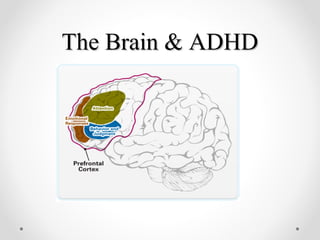
The Brain & ADHD
ADHD & Co-existing
            Conditions
Common Conditions that often co-exist with ADHD
•Oppositional Defiant Disorder
•Learning Disabilities
•Anxiety
•Obsessive Compulsive Disorder
•Depression
•Drug Abuse
•Bipolar Disorder
•Sleep Problems
•Tourette's Syndrome
Treatment
Treatment for ADHD is multifaceted. ADHD treatment should be
tailored to meet the unique needs of individuals with ADHD

•Education
•Medication
•Coaching
•Therapy
How Common is ADHD?
Children
•The prevalence of ADHD among U.S. school aged children (aged 3-17) is up to 9%
(up to 5 million children)
•ADHD is more common in boys (13.2%) than girls (5.6%) and is more common in
non Hispanic White and African American children than Hispanic children.
•Diagnoses rates varied by geographical region
•Higher rates are found in the Southeastern United States with North Carolina and
Louisiana having the highest rates
•Lower rates were generally found in the Western and Southwestern United States
with Nevada and New Mexico having the lowest rates

Adults
•A recent National Institute Mental Health survey found that an estimated 4.4% of
adults ages 18-44% in the United States
•Adult ADHD is more common in adult males (64.1%) than females (35.9%)
•Adult ADHD is more common by race in Caucasians (73.5%), African Americans
(6.2%), Hispanic (15%) and other (5.3%)
Challenges with ADHD
Children/Adolescents
•Children with ADHD were more likely to have major injuries (59%) vs. children
without ADHD (49%)
•Young people with ADHD are at greater risk of involvement in motor vehicle
crashes, drinking and driving and traffic violations

Parents
•Parents of children with a history of ADHD report almost 3 times as many peer
problems as those of without a history of ADHD (21.1% vs. 7.3%)
•Parents report that children with a history of ADHD are 10 times more likely to
have difficulties that interfere with friendships (20.6% vs.2.0%)

Adults
•Research shows that adults with ADHD are 2 - 4 times more likely to be
terminated from their job
•Workers with ADHD were more likely to have at least one sick day in the past
month compared to workers without ADHD
Challenges with ADHD
                continued
Costs

•According to new research, ADHD cost the U.S. economy between
$143 billion and $266 billion in 2010, or roughly $2,000 per
household.
   o    Lost work productivity (62 percent)
   o    Expenditures related to health care (26 percent)
   o    Education (10 percent)
   o    Criminal justice system (2 percent).
Positive Aspects of ADHD
•   Sensitive              •   Down to Earth
•   Compassionate          •   Loyal
•   Empathetic             •   Great Sense of Humor
•   Charming personality   •   Spontaneous
•   Open- Minded           •   Energetic
•   Trusting               •   Difficult to Fool
•   Intuitive              •   Humble
Strategies for Managing
      ADHD for the ADHD’er
•   Ask for repeated instructions

•   Break large assignments or job tasks into small, simple tasks.

•   Set a deadline for each task and reward yourself as you complete each one.

•   Each day, make a list of what you need to do. Plan the best order for doing
    each task. Then make a schedule for doing them. Use a calendar or daily
    planner to keep yourself on track.
Strategies for Managing
      ADHD for the ADHD’er
•   Work in a quiet area. Do one thing at a time. Give yourself short breaks.

•   Write things you need to remember in a notebook with dividers. Keep the
    book with you all of the time.

•   Post notes to yourself to help remind yourself of things you need to do.
    Tape notes -wherever you're likely to need the reminder.

•   Create a routine.

•   Exercise, eat a balanced diet, and get enough sleep.
Strategies for Managing
            ADHD for Parents
•   Adjust your disciplinary methods

•   Adjust family routines and lifestyles to be more predictable and consistent
    both for yourself and for your child

•   Distinguish between the things your child does that are annoying but harmless
    and are just part of who they are

•   Make a concerted effort to not get overly involved in the child with ADHD
    leading to interacting less with the other children in the household

•   Plan ahead when possible

•   Seek social support from people who are experiencing similar problems
Resources
Children & Adults with Attention Deficit Hyperactivity Disorder
www.chadd.org

Attention Deficit Disorder Association
www.add.org

National Resource Center on ADHD
www.help4adhd.org

ADDitude Maganize
www.additudemag.com
Bibliography
Understanding ADHD: A Guide to Help Answer Your Questions
http://www.adhdandyou.com/documents/understanding-adhd-adult.pdf
ADHD: What Do Symptoms Look Like At Different Ages?
http://www.adhdandyou.com/adhd-patients/symptoms-of-adhd/signs.aspx
ADHD in Children
http://www.helpguide.org/mental/adhd_add_signs_symptoms.htm
ADD/ADHD Parenting Tips
http://www.helpguide.org/mental/adhd_add_parenting_strategies.htm
Adult ADD/ADHD
http://www.helpguide.org/mental/adhd_add_adult_symptoms.htm
ADHD Statistics
http://www.addrc.org/adhd-statistics
Bibliography
Center for Disease Control and Prevention: Data and Statistics
http://www.cdc.gov/ncbddd/adhd/data.hmtl
ADHD Awareness Week: The Many Faces of ADHD: ADHD in the U.S. Population
http://www.adhdawarenessweek.org/content/wp-content/uploads/2012/06/ADHD-in-
the-US-Population-FINAL-English.pdf
Contact Information
Jenna Knight
ADHD Coach/Advocate
Cell – 508-663-9732
jenna@neverdefeatedcoaching.net
www.neverdefeatedcoaching.net
www.facebook.com/nvrdefeatedcoaching
www.twitter.com/adhdcoach1854

The Many Faces of ADHD

  • 1.
    The Many Faces of ADHD Jenna Knight ADHD Coach/Advocate October 16, 2012
  • 2.
    About Presenter • Jenna Knight, ADHD Coach & founder of Never Defeated Coaching. • Coach Training o Coachville: • Introduced to the coaching dynamics • Underlying skills and strategies coaches need to make a positive difference in the lives of individuals with ADHD. o In the process of taking further coaching training through the ADD Coaching Academy. • Affiliations: o ADHD Coaching Organization o Children and Adults with Attention Deficit Hyperactivity Disorder (CHADD) o Attention Deficit Disorder Association (ADDA) • Other Activities: o Served as the chair of the Massachusetts Statewide Rehabilitation Council Learning Disabilities and Attention Deficit Hyperactivity Disorder (LD/ADHD) Task Force. • Task Force worked with the M.R.C. on the unidentified and unaddressed employment needs of consumers
  • 3.
    ADHD: What Itis & Is Not What is ADHD? •ADHD - Attention Deficit Hyperactivity Disorder. •ADHD is a neurobehavioral disorder that manifests as a persistent pattern of inattention and/or hyperactivity/impulsivity in two or more settings, that is more frequently displayed and is more serve than is typically seen in other people at a comparable level •The three core symptoms are o Inattention – Unable to pay attention and/or o Hyperactivity – Being more active than usual and/or o Impulsivity – Acting suddenly without control •Only a trained health care provider can accurately diagnose ADHD
  • 4.
    ADHD: What Itis & Is Not What ADHD Is Not •ADHD is not caused by anything you have done and is not caused by bad parenting •ADHD is not a measure of how smart a person is •ADHD is not a lack of willpower or desire
  • 5.
    ADHD Symptoms Children –(Ages 6-12) •Easily distracted •Homework poorly organized, contains errors and often not completed •Often disruptive in class, blurts out answers before the answer is completed •Fails to wait turn in games •Often out of seat Adolescents (Ages 13-17) •Displays inner restlessness •Schoolwork disorganized, shows poor follow through •Fails to work independently •Has difficulties in school setting with peers
  • 6.
    ADHD Symptoms Adults •Inattention/concentration problem •Disorganizedand fails to plan ahead •Difficulty initiating and completing projects/tasks •Shifts activities prematurely •Midjudges available time •Forgetful, looses things •Has difficulty at work with concentration, focus, etc. •Problems with social interactions
  • 7.
    What causes ADHD Theexact origin of ADHD is unknown, but researchers believe the disorder may be caused by one or more of the following factors 1.Genetics 2.Brain Chemistry 3.Environment
  • 8.
  • 9.
    ADHD & Co-existing Conditions Common Conditions that often co-exist with ADHD •Oppositional Defiant Disorder •Learning Disabilities •Anxiety •Obsessive Compulsive Disorder •Depression •Drug Abuse •Bipolar Disorder •Sleep Problems •Tourette's Syndrome
  • 10.
    Treatment Treatment for ADHDis multifaceted. ADHD treatment should be tailored to meet the unique needs of individuals with ADHD •Education •Medication •Coaching •Therapy
  • 11.
    How Common isADHD? Children •The prevalence of ADHD among U.S. school aged children (aged 3-17) is up to 9% (up to 5 million children) •ADHD is more common in boys (13.2%) than girls (5.6%) and is more common in non Hispanic White and African American children than Hispanic children. •Diagnoses rates varied by geographical region •Higher rates are found in the Southeastern United States with North Carolina and Louisiana having the highest rates •Lower rates were generally found in the Western and Southwestern United States with Nevada and New Mexico having the lowest rates Adults •A recent National Institute Mental Health survey found that an estimated 4.4% of adults ages 18-44% in the United States •Adult ADHD is more common in adult males (64.1%) than females (35.9%) •Adult ADHD is more common by race in Caucasians (73.5%), African Americans (6.2%), Hispanic (15%) and other (5.3%)
  • 12.
    Challenges with ADHD Children/Adolescents •Childrenwith ADHD were more likely to have major injuries (59%) vs. children without ADHD (49%) •Young people with ADHD are at greater risk of involvement in motor vehicle crashes, drinking and driving and traffic violations Parents •Parents of children with a history of ADHD report almost 3 times as many peer problems as those of without a history of ADHD (21.1% vs. 7.3%) •Parents report that children with a history of ADHD are 10 times more likely to have difficulties that interfere with friendships (20.6% vs.2.0%) Adults •Research shows that adults with ADHD are 2 - 4 times more likely to be terminated from their job •Workers with ADHD were more likely to have at least one sick day in the past month compared to workers without ADHD
  • 13.
    Challenges with ADHD continued Costs •According to new research, ADHD cost the U.S. economy between $143 billion and $266 billion in 2010, or roughly $2,000 per household. o Lost work productivity (62 percent) o Expenditures related to health care (26 percent) o Education (10 percent) o Criminal justice system (2 percent).
  • 14.
    Positive Aspects ofADHD • Sensitive • Down to Earth • Compassionate • Loyal • Empathetic • Great Sense of Humor • Charming personality • Spontaneous • Open- Minded • Energetic • Trusting • Difficult to Fool • Intuitive • Humble
  • 15.
    Strategies for Managing ADHD for the ADHD’er • Ask for repeated instructions • Break large assignments or job tasks into small, simple tasks. • Set a deadline for each task and reward yourself as you complete each one. • Each day, make a list of what you need to do. Plan the best order for doing each task. Then make a schedule for doing them. Use a calendar or daily planner to keep yourself on track.
  • 16.
    Strategies for Managing ADHD for the ADHD’er • Work in a quiet area. Do one thing at a time. Give yourself short breaks. • Write things you need to remember in a notebook with dividers. Keep the book with you all of the time. • Post notes to yourself to help remind yourself of things you need to do. Tape notes -wherever you're likely to need the reminder. • Create a routine. • Exercise, eat a balanced diet, and get enough sleep.
  • 17.
    Strategies for Managing ADHD for Parents • Adjust your disciplinary methods • Adjust family routines and lifestyles to be more predictable and consistent both for yourself and for your child • Distinguish between the things your child does that are annoying but harmless and are just part of who they are • Make a concerted effort to not get overly involved in the child with ADHD leading to interacting less with the other children in the household • Plan ahead when possible • Seek social support from people who are experiencing similar problems
  • 18.
    Resources Children & Adultswith Attention Deficit Hyperactivity Disorder www.chadd.org Attention Deficit Disorder Association www.add.org National Resource Center on ADHD www.help4adhd.org ADDitude Maganize www.additudemag.com
  • 19.
    Bibliography Understanding ADHD: AGuide to Help Answer Your Questions http://www.adhdandyou.com/documents/understanding-adhd-adult.pdf ADHD: What Do Symptoms Look Like At Different Ages? http://www.adhdandyou.com/adhd-patients/symptoms-of-adhd/signs.aspx ADHD in Children http://www.helpguide.org/mental/adhd_add_signs_symptoms.htm ADD/ADHD Parenting Tips http://www.helpguide.org/mental/adhd_add_parenting_strategies.htm Adult ADD/ADHD http://www.helpguide.org/mental/adhd_add_adult_symptoms.htm ADHD Statistics http://www.addrc.org/adhd-statistics
  • 20.
    Bibliography Center for DiseaseControl and Prevention: Data and Statistics http://www.cdc.gov/ncbddd/adhd/data.hmtl ADHD Awareness Week: The Many Faces of ADHD: ADHD in the U.S. Population http://www.adhdawarenessweek.org/content/wp-content/uploads/2012/06/ADHD-in- the-US-Population-FINAL-English.pdf
  • 21.
    Contact Information Jenna Knight ADHDCoach/Advocate Cell – 508-663-9732 jenna@neverdefeatedcoaching.net www.neverdefeatedcoaching.net www.facebook.com/nvrdefeatedcoaching www.twitter.com/adhdcoach1854