Adaptation of HigherPlants to Different Habitats
Adaptations to Habitats
✓ An adaptation is just a mutation that worked out well for a plant
✓ Plants adapt in many ways to be able to survive or thrive in their
surroundings
Seed plants show adaptations to d/t environments (dry,
freshwater, salty, etc.) in:
➢Morphological (structural) characters of their organs &
➢Physiological (functional) behavior to different habitats
Angiosperms show wide adaptations including to the extremes:
dryness, excess moisture, excess salt, etc.
The Main plant adaptations include---Mesophytes:
Plants adapted to a habitat with adequate water and temperature
3
4.
Plant Adaptations: EcologicalClassification of Plants
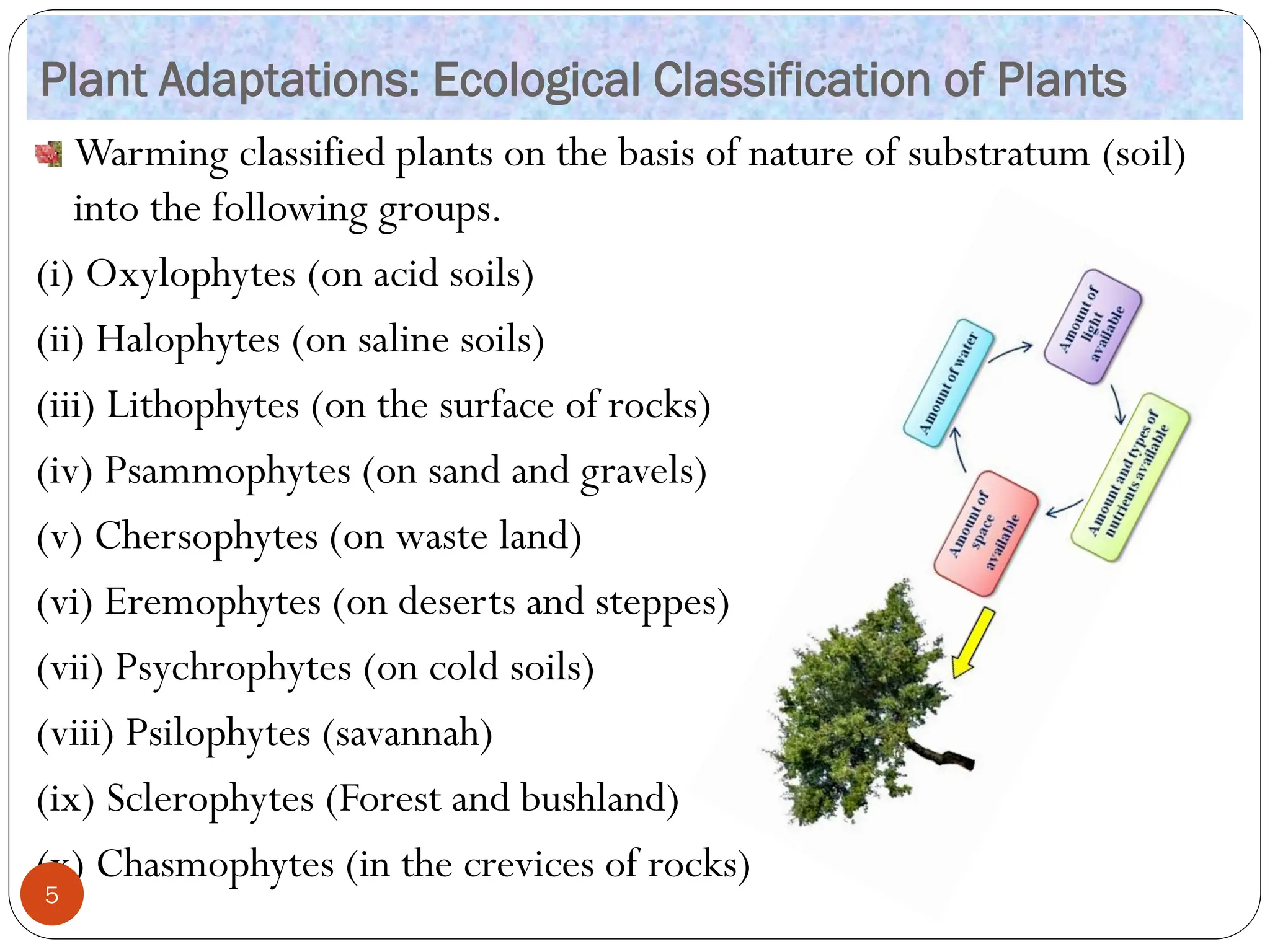
✓ Plants have several basic needs for better survival:
They need solar light, water, air, and nutrients for good growth
They also need to be able to reproduce in order to ensure that their
species survives
Some of the main threats to the survival of plants include a lack of
sunlight, lack of water, a lack of good soil, and proper space
In the same way an abundance of water, air, solar radiation (UV rays) and
the activities of animals are also harmful to plants
There are many challenges that plants face in order to survive
How well plants adapt to their changing environments will determine
their future.
4
5.
Plant Adaptations: EcologicalClassification of Plants
Warming classified plants on the basis of nature of substratum (soil)
into the following groups.
(i) Oxylophytes (on acid soils)
(ii) Halophytes (on saline soils)
(iii) Lithophytes (on the surface of rocks)
(iv) Psammophytes (on sand and gravels)
(v) Chersophytes (on waste land)
(vi) Eremophytes (on deserts and steppes)
(vii) Psychrophytes (on cold soils)
(viii) Psilophytes (savannah)
(ix) Sclerophytes (Forest and bushland)
(x) Chasmophytes (in the crevices of rocks)
5
6.
Examples of PlantAdaptations in Different Environments
Desert Plant Adaptations
Xerophyte (dryland plant), a plant species that have adaptations to life in
a dry (desert or ice) or physiologically dry habitat (salt marsh, saline soil, or
acid bog) by means of mechanisms to prevent water loss or to store
available water
Living in a desert environment poses unique challenges for plant life.
Desert plants have to adapt to harsh conditions characterized by extreme
temperatures and very little rainfall.
Root Structure
Plants that grow in the desert have adapted the structure of their roots to
be able to thrive with very little rainfall
I. Shallow root structure - Some desert plants have shallow roots that
spread out over a wide area
This allows them to get as much rainwater as possible during the rare occasions
that it rains.
6
7.
Examples of PlantAdaptations in Different Environments
II. Deep tap roots - Not all desert plants have shallow roots. Some develop
extremely long tap roots that go down very deep into the ground.
These deep tap roots are an adaptation that allows the plants to reach water
deep below the surface.
Leaf Waxing
Nearly all desert plants produce a waxy coating on their leaves or have
prickly spines.These features help keep water from evaporating out of the
leaves.This is an adaptation to help prevent dehydration in a desert climate.
Night Blooming
Some desert plants bloom only at night, which is an adaptation to the
extreme heat of the desert sun and certain animal adaptations.
Preventing dehydration - Blooming during the daytime in the desert
could cause plants to dehydrate very quickly.The adaptation to nighttime
blooming helps keep desert plants from losing a lot of water (dehydrating)
through their blooms.
7
8.
Examples of PlantAdaptations in Different Environments
Helping with pollination - Because many desert insects are nocturnal
(an example of an animal adaptation), blooming at night helps ensure that
desert plants get properly pollinated.
ReproducingWithout Seeds
While desert plants can reproduce by seeds, some don’t have to reproduce
that way. For example, some cacti will break off pieces of themselves.
These pieces can root and form new cacti rather than having to start from seeds.
Since seeds require water to sprout, there would not be as many cacti in the
desert without this adaptation.
Drought Resistance
Desert plants have roots that can handle drying out without dying.This
adaptation is also referred to as desiccation resistance.
8
9.
Examples of PlantAdaptations in Different Environments
Adaptations to Extreme Dryness: Plants have the opposite problem: how
to get and keep water.Their adaptations may help them increase water intake,
decrease water loss, or store water when it is available.
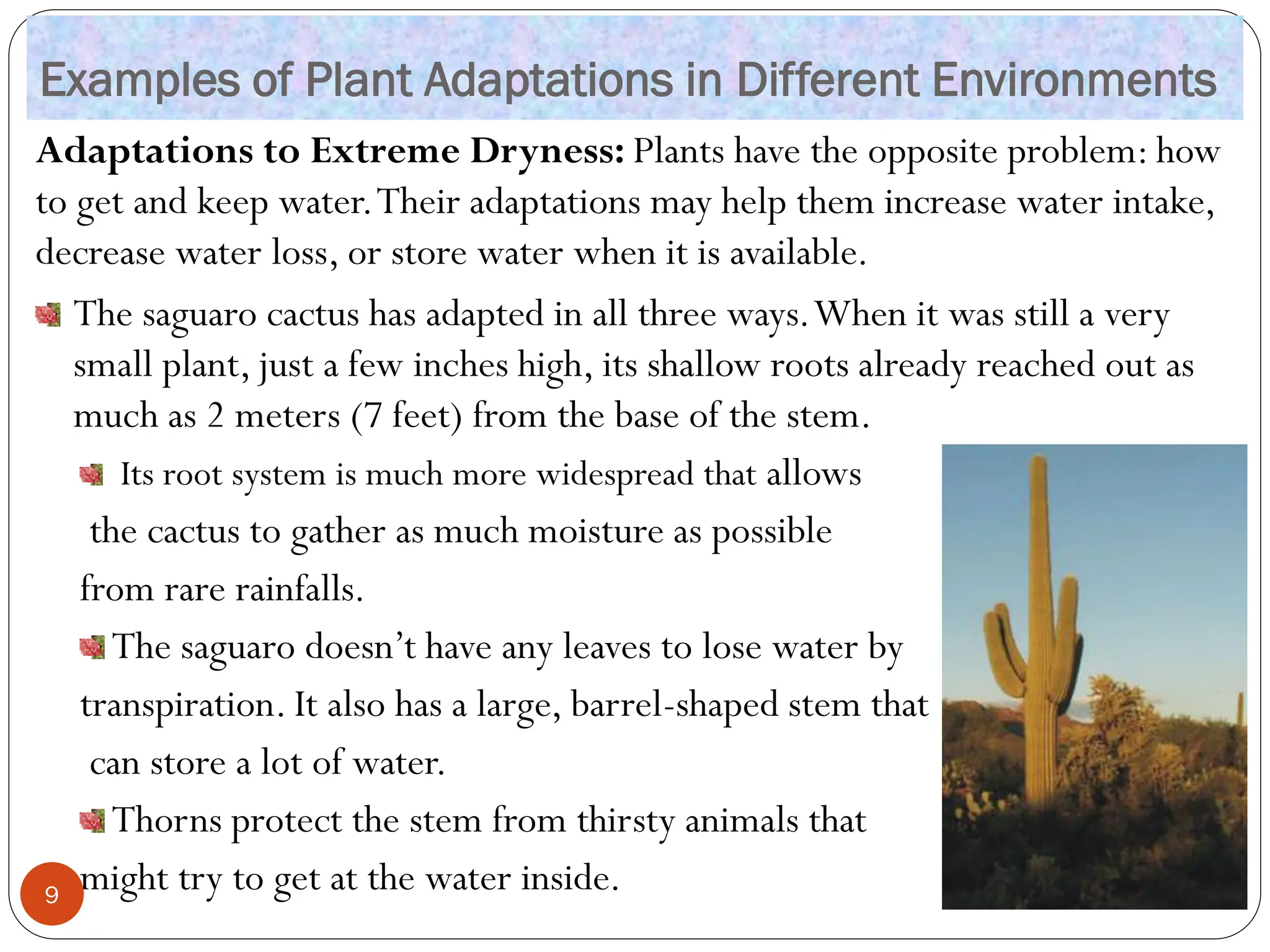
The saguaro cactus has adapted in all three ways.When it was still a very
small plant, just a few inches high, its shallow roots already reached out as
much as 2 meters (7 feet) from the base of the stem.
Its root system is much more widespread that allows
the cactus to gather as much moisture as possible
from rare rainfalls.
The saguaro doesn’t have any leaves to lose water by
transpiration. It also has a large, barrel-shaped stem that
can store a lot of water.
Thorns protect the stem from thirsty animals that
might try to get at the water inside.
9
10.
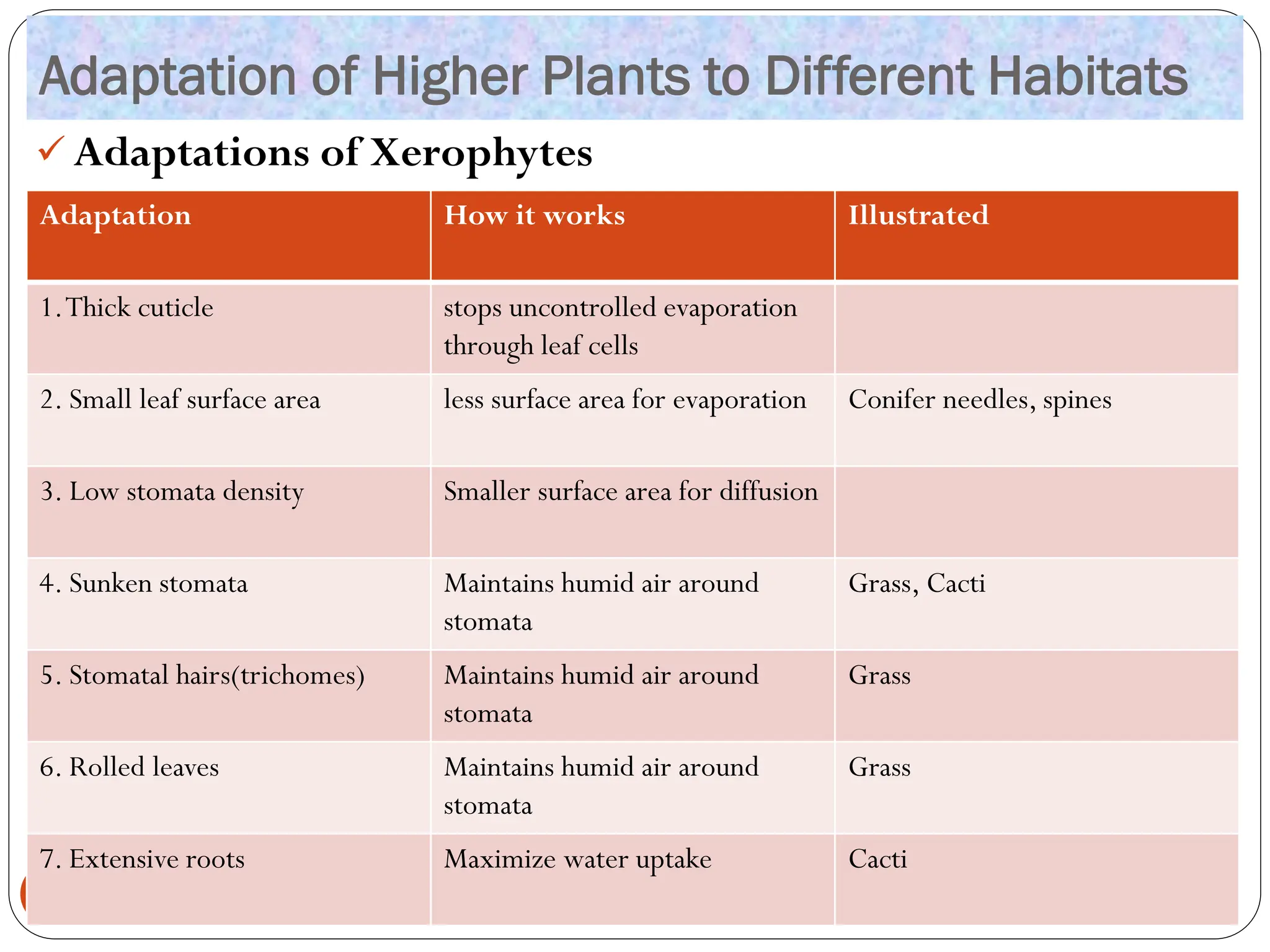
Adaptation of HigherPlants to Different Habitats
✓ Adaptations of Xerophytes
10
Adaptation How it works Illustrated
1.Thick cuticle stops uncontrolled evaporation
through leaf cells
2. Small leaf surface area less surface area for evaporation Conifer needles, spines
3. Low stomata density Smaller surface area for diffusion
4. Sunken stomata Maintains humid air around
stomata
Grass, Cacti
5. Stomatal hairs(trichomes) Maintains humid air around
stomata
Grass
6. Rolled leaves Maintains humid air around
stomata
Grass
7. Extensive roots Maximize water uptake Cacti
11.
Examples of PlantAdaptations in Different Environments
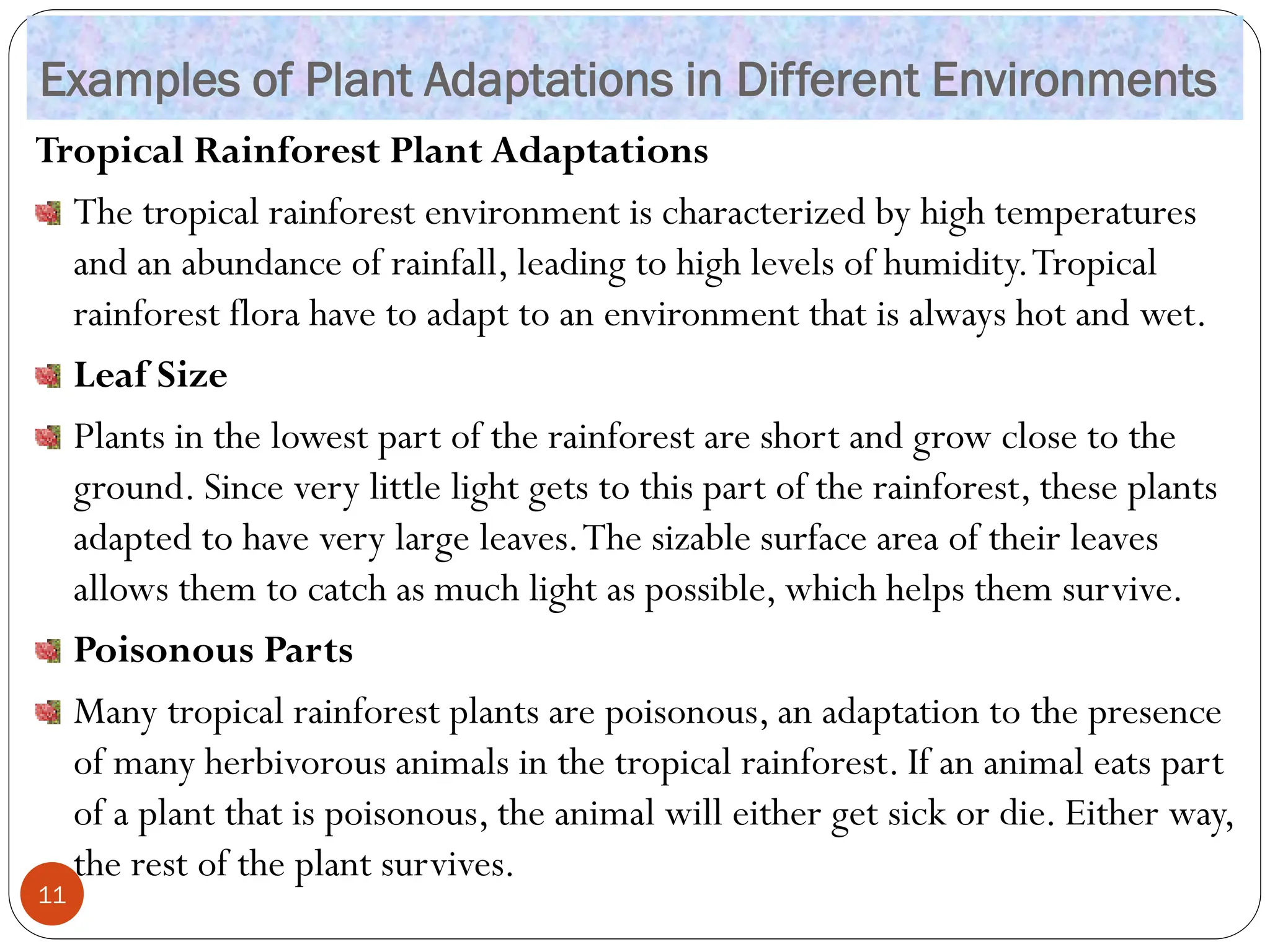
Tropical Rainforest Plant Adaptations
The tropical rainforest environment is characterized by high temperatures
and an abundance of rainfall, leading to high levels of humidity.Tropical
rainforest flora have to adapt to an environment that is always hot and wet.
Leaf Size
Plants in the lowest part of the rainforest are short and grow close to the
ground. Since very little light gets to this part of the rainforest, these plants
adapted to have very large leaves.The sizable surface area of their leaves
allows them to catch as much light as possible, which helps them survive.
Poisonous Parts
Many tropical rainforest plants are poisonous, an adaptation to the presence
of many herbivorous animals in the tropical rainforest. If an animal eats part
of a plant that is poisonous, the animal will either get sick or die. Either way,
the rest of the plant survives.
11
12.
Examples of PlantAdaptations in Different Environments
Tropical Rainforest Plant Adaptations
Brightly Colored Flowers
The floor of the rainforest is dimly lit, so flowers in muted tones would be
hard for insects to see.The brightly colored blooms of rainforest plants
allow bees and other pollinators to easily see and find them for pollination
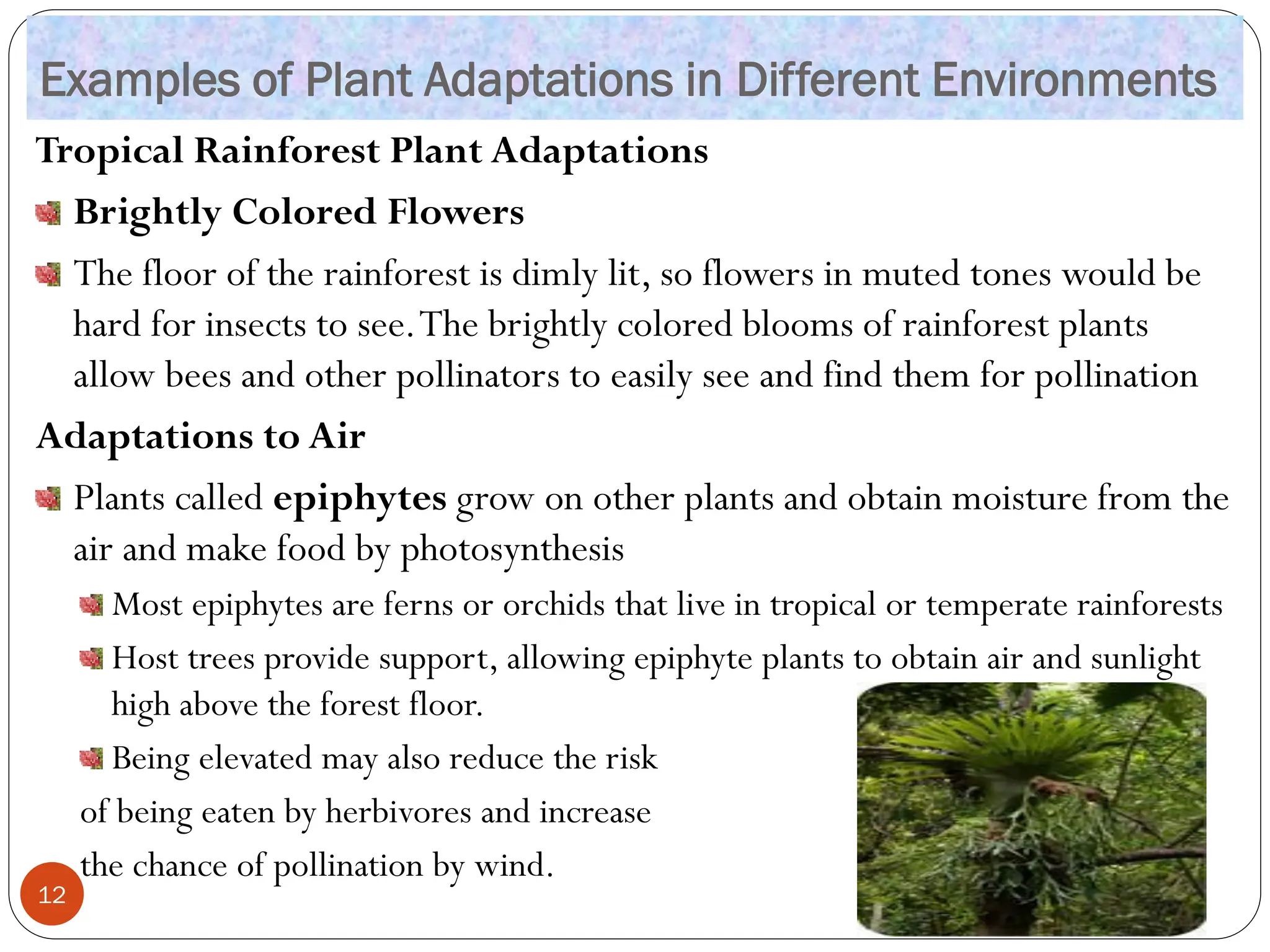
Adaptations to Air
Plants called epiphytes grow on other plants and obtain moisture from the
air and make food by photosynthesis
Most epiphytes are ferns or orchids that live in tropical or temperate rainforests
Host trees provide support, allowing epiphyte plants to obtain air and sunlight
high above the forest floor.
Being elevated may also reduce the risk
of being eaten by herbivores and increase
the chance of pollination by wind.
12
13.
Plant Adaptations: EcologicalClassification of Plants
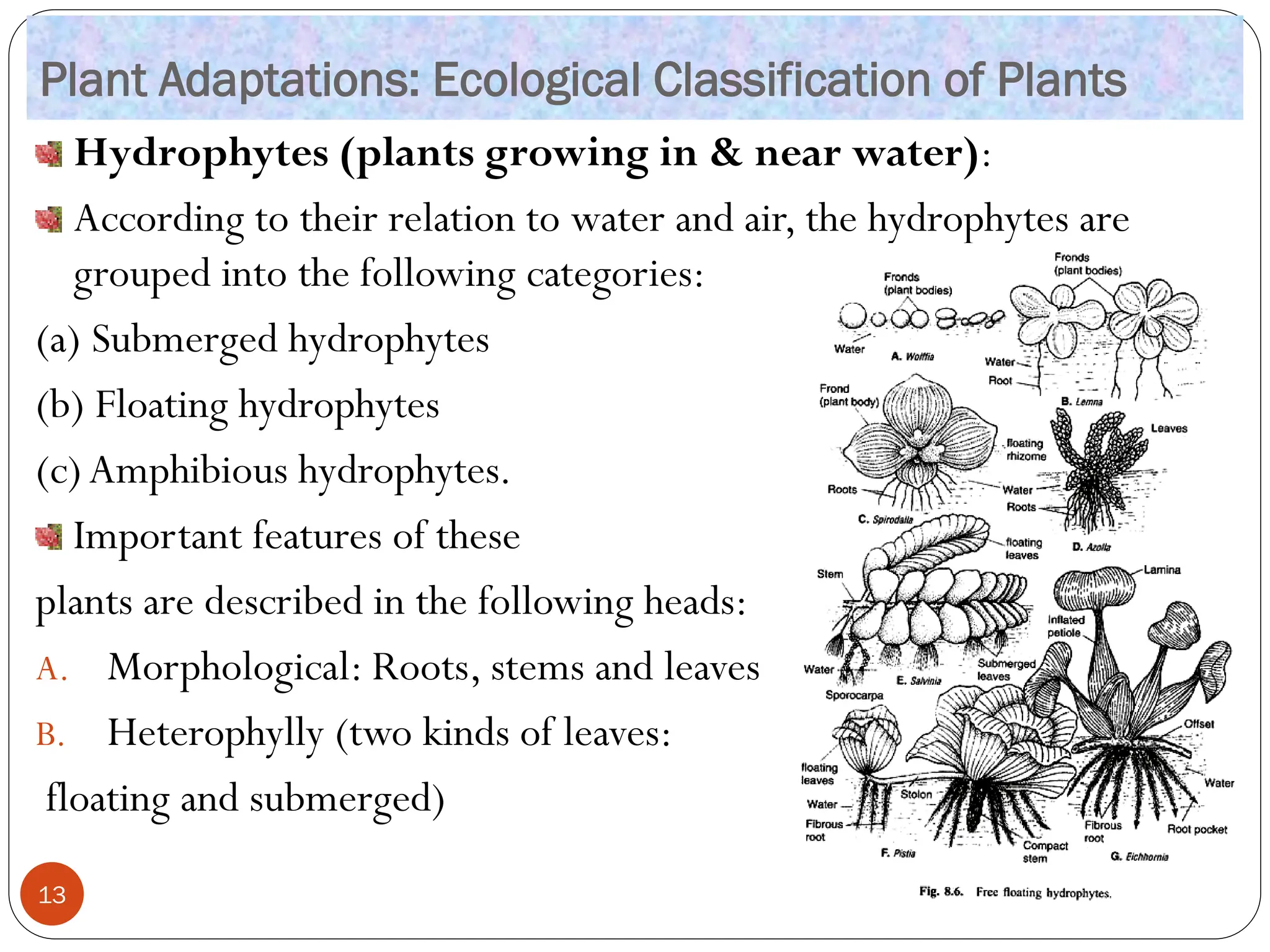
Hydrophytes (plants growing in & near water):
According to their relation to water and air, the hydrophytes are
grouped into the following categories:
(a) Submerged hydrophytes
(b) Floating hydrophytes
(c)Amphibious hydrophytes.
Important features of these
plants are described in the following heads:
A. Morphological: Roots, stems and leaves
B. Heterophylly (two kinds of leaves:
floating and submerged)
13
14.
Examples of PlantAdaptations in Different Environments
Adaptations toWater
Aquatic plants are plants that live in water.
Living in water has certain advantages for plants.
Therefore, most aquatic plants do not need adaptations for absorbing,
transporting, and conserving water.As a result, adaptations such as strong
woody stems and deep anchoring roots are not necessary for most aquatic
plants.
For pollination, aquatic plants may have adaptations that help them keep
their flowers above water.
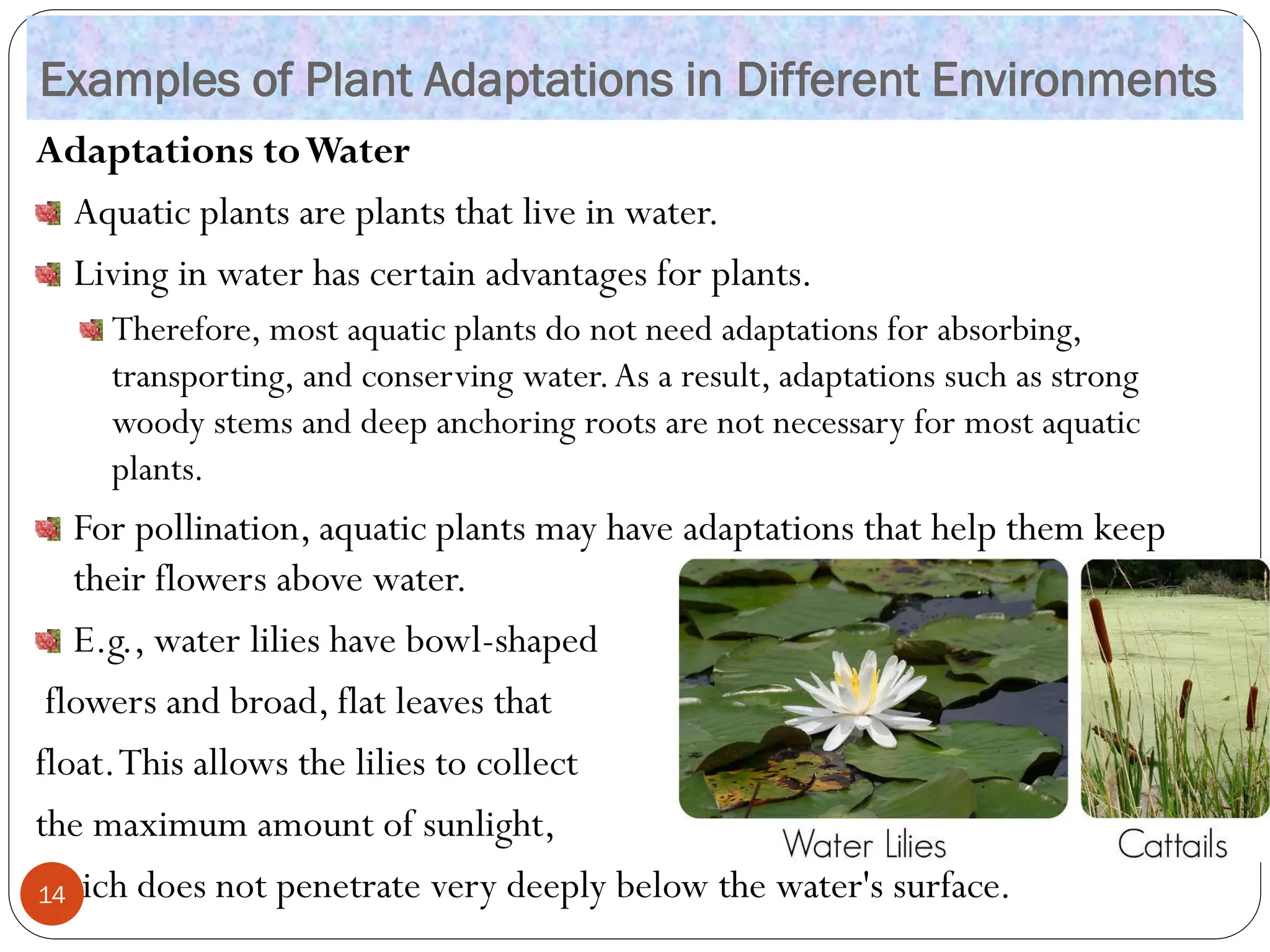
E.g., water lilies have bowl-shaped
flowers and broad, flat leaves that
float.This allows the lilies to collect
the maximum amount of sunlight,
which does not penetrate very deeply below the water's surface.
14
15.
15
.
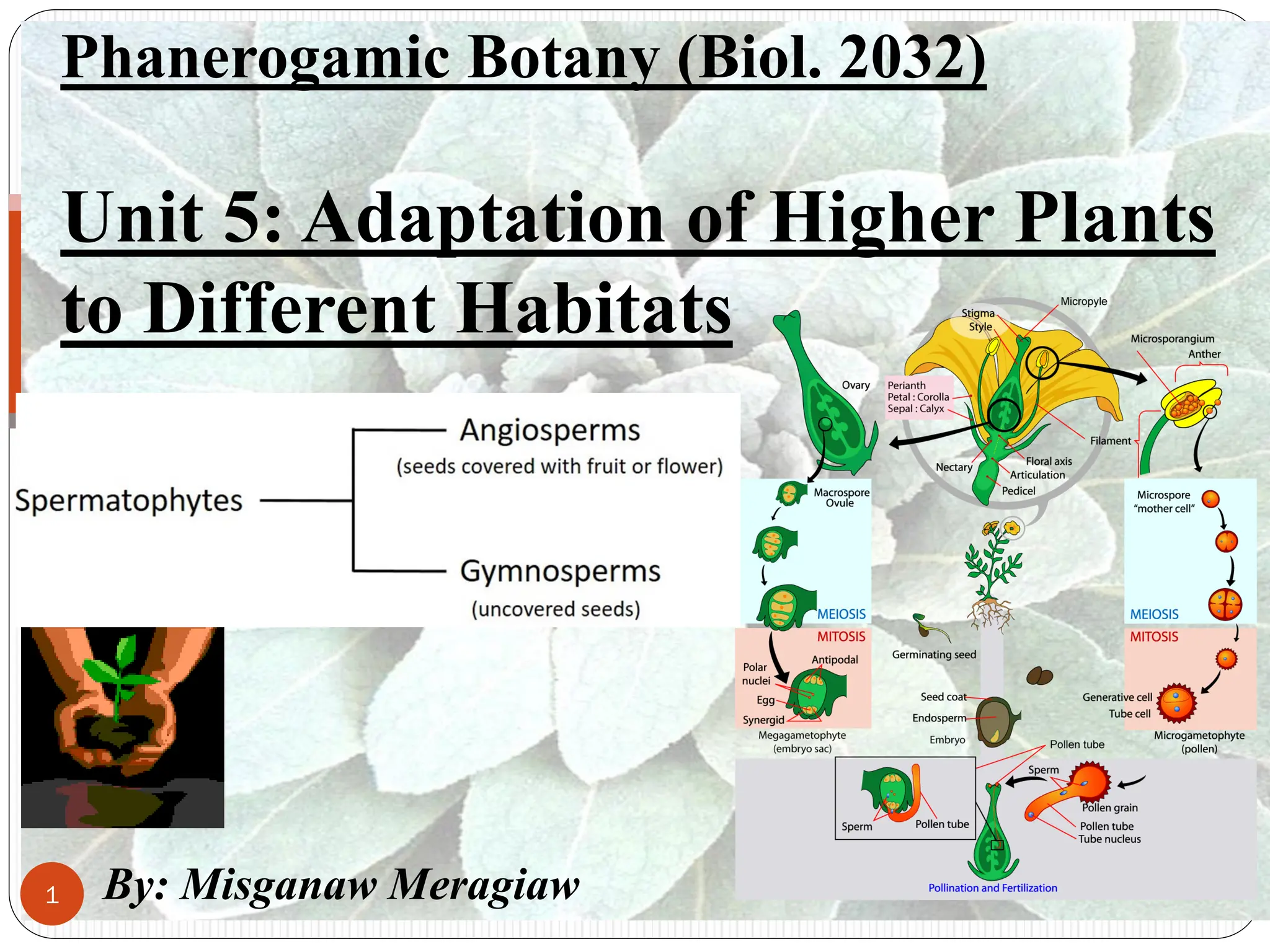
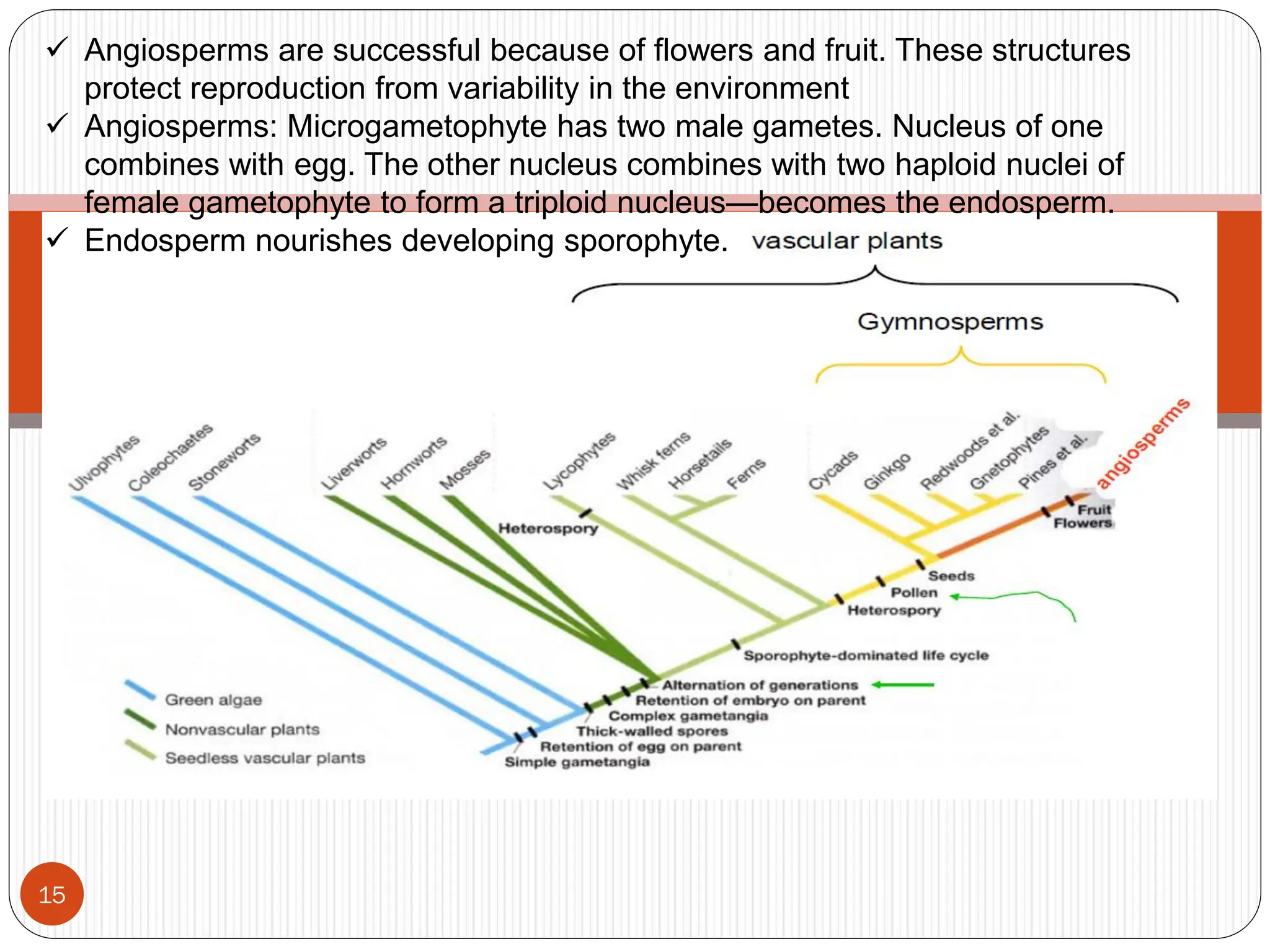
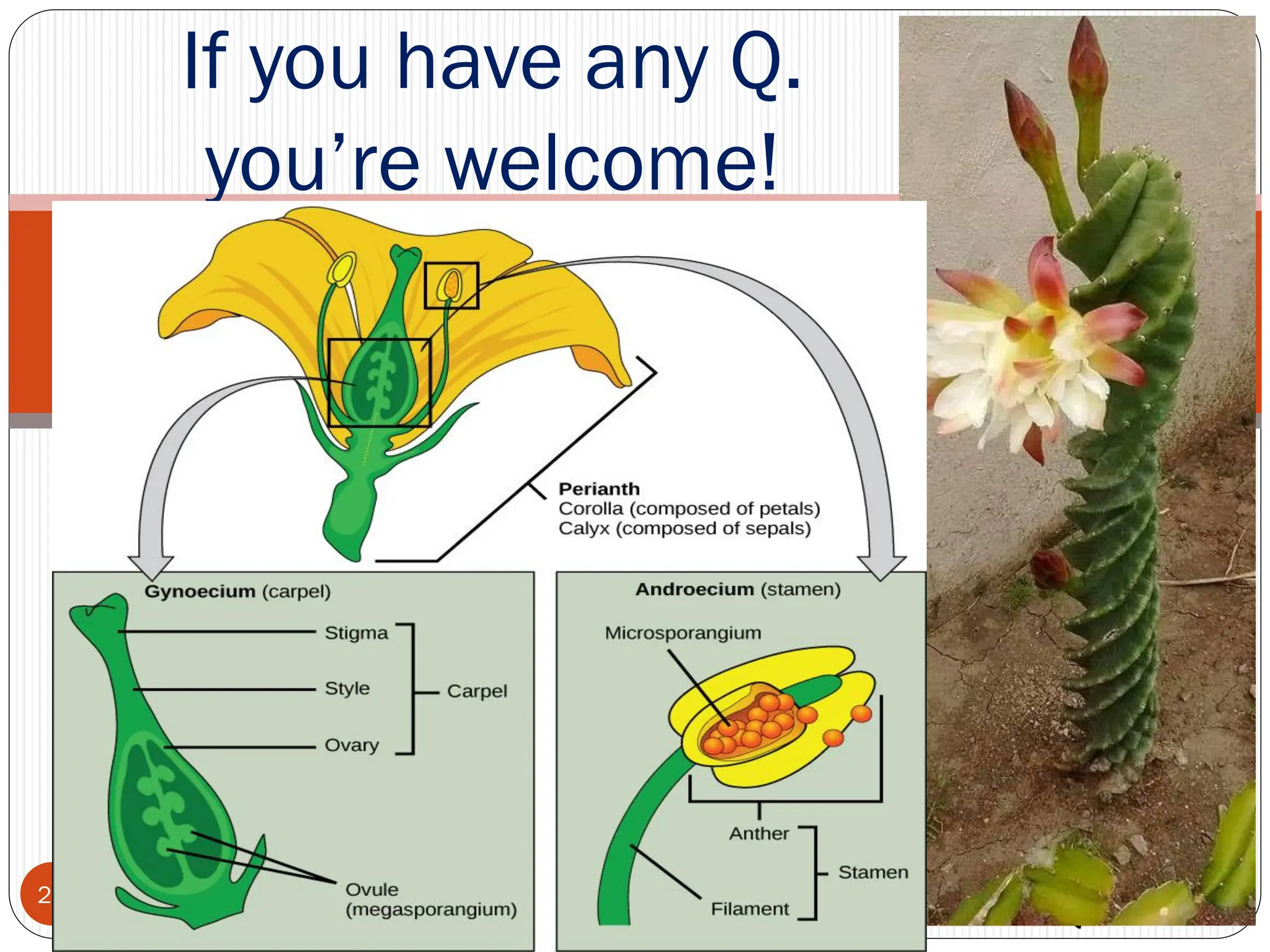
✓ Angiosperms aresuccessful because of flowers and fruit. These structures
protect reproduction from variability in the environment
✓ Angiosperms: Microgametophyte has two male gametes. Nucleus of one
combines with egg. The other nucleus combines with two haploid nuclei of
female gametophyte to form a triploid nucleus—becomes the endosperm.
✓ Endosperm nourishes developing sporophyte.
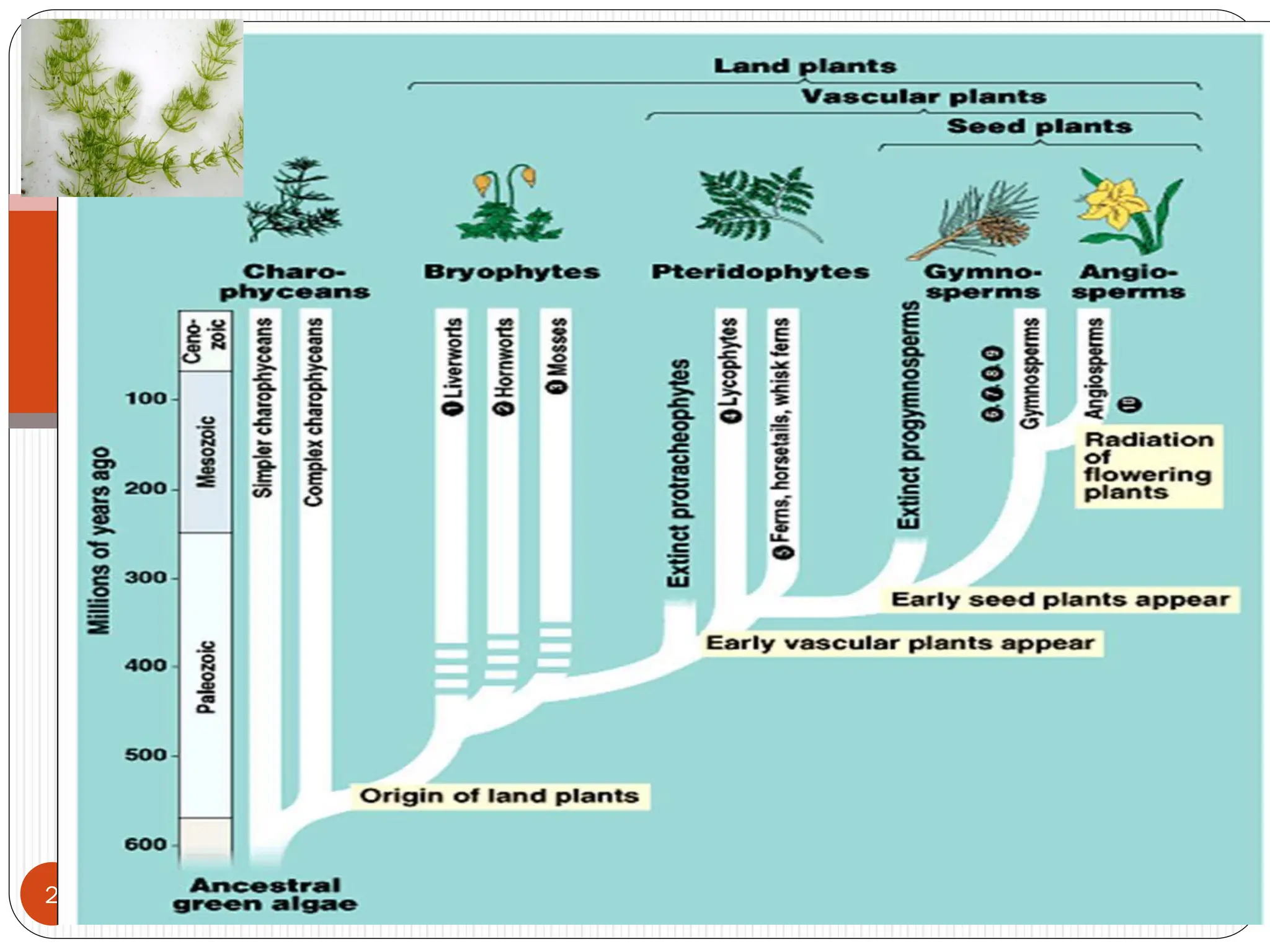
Evolutionary trends ofthe gametophyte in Higher Plants
In bryophytes and pteridophytes, fertilization is completely
dependent on water
In phanerogamic plants, such a dependency does not exist
Another tendency is the reduction in the size and duration of the
gametophyte
In bryophytes, the gametophyte is the lasting stage
In pteridophytes, gymnosperms and angiosperms, it became the
temporary stage and its relative size was successively reduced
A third evolutionary trend relates to the interdependency between
gametophytes and sporophytes. In bryophytes, the sporophyte is
entirely dependent on the gametophyte to survive.
In the remainder of plants, the sporophyte is the independent stage
and the once autotrophic gametophyte in bryophytes and pteridophytes
became dependent on the sporophyte in phanerogamic plants
17
18.
Reasons for successof angiosperms
From their humble and still obscure beginning during the early
Jurassic period, the angiosperms/flowering plants—have evolved
to dominate most terrestrial ecosystems
With more than 250,000 species, the angiosperm phylum
(Anthophyta) is second only to insects in terms of diversification.
The success of angiosperms is due to two novel reproductive
structures:
Flowers and
Fruit
The function of the flower is to ensure pollination. Flowers also
provide protection for the ovule and developing embryo in a receptacle
The function of the fruit is seed dispersal.They also protect the
developing seed. Different fruit structures or tissues on fruit—such as
sweet flesh, wings, parachutes, or spines that grab—reflect the dispersal
strategies that help spread seeds
18
19.
Reasons for successof angiosperms
The angiosperm life cycle is dominated by the sporophyte stage.
Double fertilization is an event unique to angiosperms.
One sperm in the pollen fertilizes the egg, forming a diploid zygote,
while the other combines with the two polar nuclei, forming a triploid
cell that develops into a food storage tissue called the endosperm.
Angiosperms have a huge amount of stomata (plural of stoma)
and veins which really makes the most of their photosynthesis.
These stomata bring in loads of CO2 and the veins move sugars around
very easily
This has helped angiosperms grow and spread way faster than other plants
and has pretty much led them to world domination!
Flowers play a role in the diversification, Brodribb and Feild argue that
more photosynthesis meant more carbon for
growth/productivity
19


![Ch_5_Agri Biotech.pdfpy5;y]]']we[l[5tt=[l[t;t[](https://cdn.slidesharecdn.com/ss_thumbnails/ch5agribiotech-250225152434-2d8e7718-thumbnail.jpg?width=640&height=640&fit=bounds)


![4_5958421195031319849.pptpe[e[];/[;wql,dmx](https://cdn.slidesharecdn.com/ss_thumbnails/45958421195031319849-250225152329-349fbdd2-thumbnail.jpg?width=640&height=640&fit=bounds)


