Adaptive Leadership for Results
                              Based on the work of Ron Heifetz and Marty Linsky
                                    From the book Leadership on the Line
                                   © Raj Chawla and Jolie Bain Pillsbury

Leadership is about achieving results. Leaders seek to create                  Contents
alignment around a common result and then work with others to 1. Telling the Difference
make aligned contributions to achieve the result. In this process 2. The Focus of Adaptive Leadership
both technical and adaptive challenges will emerge. To achieve 3. Strategies
results a leader must know the difference between technical and
adaptive challenges and be able to implement strategies
addressing both.
Technical challenges can be solved with existing knowledge, skills, and/or technologies. Adaptive
challenges are those where there is no readily available technical solution, and the exact nature of the
challenge may be unknown. Adaptive challenges are always present when striving for high alignment
and high action because facing them involves challenging existing modes of operating, examining deeply
held, often unconscious, values and beliefs, and exploring new ways of thinking or acting.

1. Telling the Difference Between Technical and Adaptive Challenges1
Does making progress on this problem require changes in people’s values, beliefs, attitudes and
behavior?
   • Whose values, beliefs, attitudes or behaviors must change in order to move forward?
   • What shifts in priorities, resources and power are necessary?
   •   What sacrifices would have to be made and by whom?

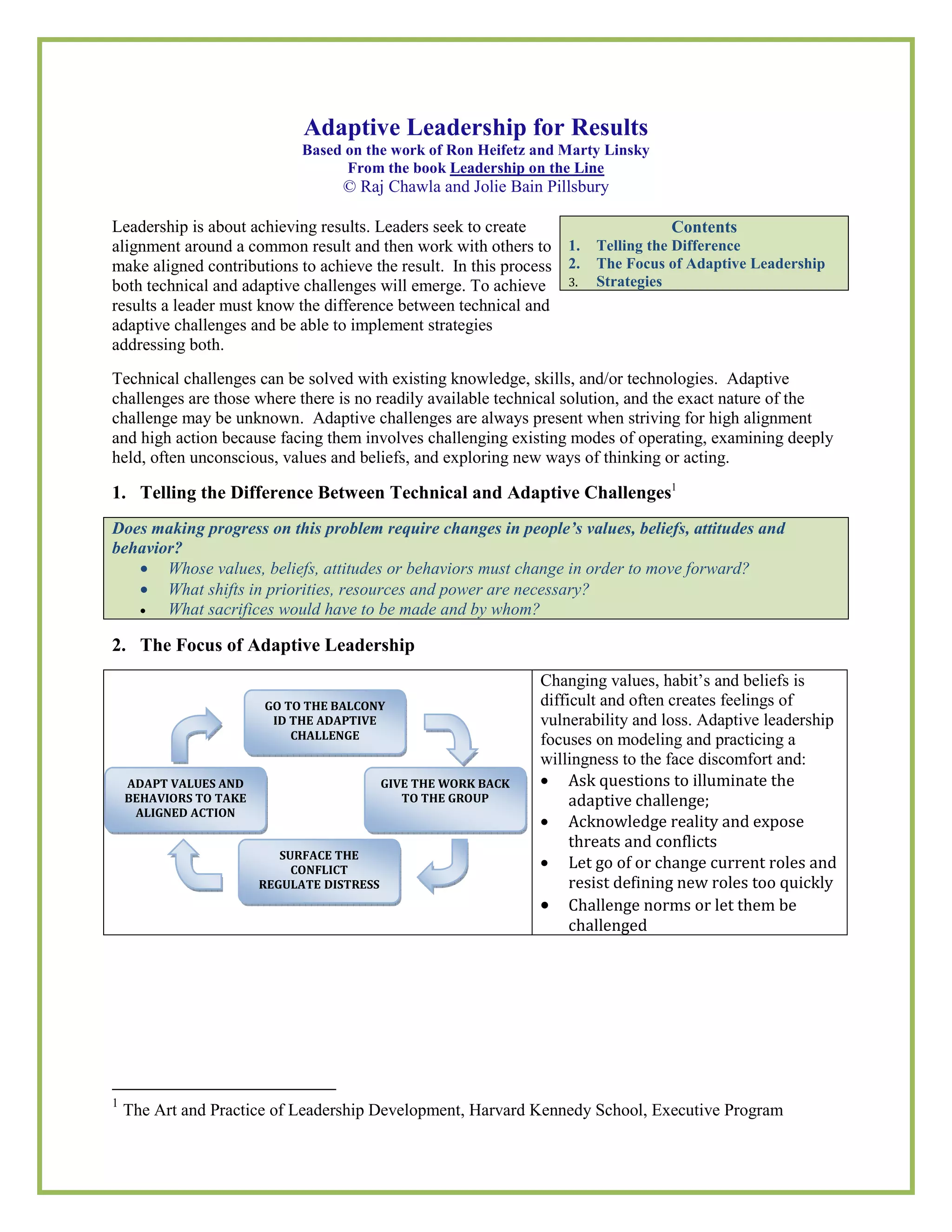
2. The Focus of Adaptive Leadership
                                                                 Changing values, habit’s and beliefs is
                        GO TO THE BALCONY                        difficult and often creates feelings of
                         ID THE ADAPTIVE                         vulnerability and loss. Adaptive leadership
                            CHALLENGE                            focuses on modeling and practicing a
                                                                 willingness to the face discomfort and:
    ADAPT VALUES AND                        GIVE THE WORK BACK   • Ask questions to illuminate the
    BEHAVIORS TO TAKE                          TO THE GROUP           adaptive challenge;
     ALIGNED ACTION
                                                                 • Acknowledge reality and expose
                                                                      threats and conflicts
                                                                 • Let go of or change current roles and
                           SURFACE THE
                             CONFLICT
                        REGULATE DISTRESS                             resist defining new roles too quickly
                                                                 • Challenge norms or let them be
                                                                      challenged


1
    The Art and Practice of Leadership Development, Harvard Kennedy School, Executive Program
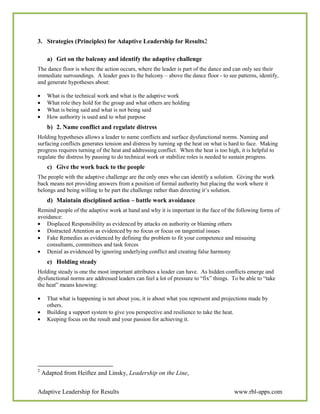
3. Strategies (Principles) for Adaptive Leadership for Results2

      a) Get on the balcony and identify the adaptive challenge
The dance floor is where the action occurs, where the leader is part of the dance and can only see their
immediate surroundings. A leader goes to the balcony – above the dance floor - to see patterns, identify,
and generate hypotheses about:

•     What is the technical work and what is the adaptive work
•     What role they hold for the group and what others are holding
•     What is being said and what is not being said
•     How authority is used and to what purpose
      b) 2. Name conflict and regulate distress
Holding hypotheses allows a leader to name conflicts and surface dysfunctional norms. Naming and
surfacing conflicts generates tension and distress by turning up the heat on what is hard to face. Making
progress requires turning of the heat and addressing conflict. When the heat is too high, it is helpful to
regulate the distress by pausing to do technical work or stabilize roles is needed to sustain progress.
      c) Give the work back to the people
The people with the adaptive challenge are the only ones who can identify a solution. Giving the work
back means not providing answers from a position of formal authority but placing the work where it
belongs and being willing to be part the challenge rather than directing it’s solution.
      d) Maintain disciplined action – battle work avoidance
Remind people of the adaptive work at hand and why it is important in the face of the following forms of
avoidance:
• Displaced Responsibility as evidenced by attacks on authority or blaming others
• Distracted Attention as evidenced by no focus or focus on tangential issues
• Fake Remedies as evidenced by defining the problem to fit your competence and misusing
    consultants, committees and task forces
• Denial as evidenced by ignoring underlying conflict and creating false harmony
      e) Holding steady
Holding steady is one the most important attributes a leader can have. As hidden conflicts emerge and
dysfunctional norms are addressed leaders can feel a lot of pressure to “fix” things. To be able to “take
the heat” means knowing:

•     That what is happening is not about you, it is about what you represent and projections made by
      others.
•     Building a support system to give you perspective and resilience to take the heat.
•     Keeping focus on the result and your passion for achieving it.


2
    Adapted from Heiftez and Linsky, Leadership on the Line,

Adaptive Leadership for Results                                                       www.rbl-apps.com

Adaptive leadership for results

  • 1.
    Adaptive Leadership forResults Based on the work of Ron Heifetz and Marty Linsky From the book Leadership on the Line © Raj Chawla and Jolie Bain Pillsbury Leadership is about achieving results. Leaders seek to create Contents alignment around a common result and then work with others to 1. Telling the Difference make aligned contributions to achieve the result. In this process 2. The Focus of Adaptive Leadership both technical and adaptive challenges will emerge. To achieve 3. Strategies results a leader must know the difference between technical and adaptive challenges and be able to implement strategies addressing both. Technical challenges can be solved with existing knowledge, skills, and/or technologies. Adaptive challenges are those where there is no readily available technical solution, and the exact nature of the challenge may be unknown. Adaptive challenges are always present when striving for high alignment and high action because facing them involves challenging existing modes of operating, examining deeply held, often unconscious, values and beliefs, and exploring new ways of thinking or acting. 1. Telling the Difference Between Technical and Adaptive Challenges1 Does making progress on this problem require changes in people’s values, beliefs, attitudes and behavior? • Whose values, beliefs, attitudes or behaviors must change in order to move forward? • What shifts in priorities, resources and power are necessary? • What sacrifices would have to be made and by whom? 2. The Focus of Adaptive Leadership Changing values, habit’s and beliefs is GO TO THE BALCONY difficult and often creates feelings of ID THE ADAPTIVE vulnerability and loss. Adaptive leadership CHALLENGE focuses on modeling and practicing a willingness to the face discomfort and: ADAPT VALUES AND GIVE THE WORK BACK • Ask questions to illuminate the BEHAVIORS TO TAKE TO THE GROUP adaptive challenge; ALIGNED ACTION • Acknowledge reality and expose threats and conflicts • Let go of or change current roles and SURFACE THE CONFLICT REGULATE DISTRESS resist defining new roles too quickly • Challenge norms or let them be challenged 1 The Art and Practice of Leadership Development, Harvard Kennedy School, Executive Program
  • 2.
    3. Strategies (Principles)for Adaptive Leadership for Results2 a) Get on the balcony and identify the adaptive challenge The dance floor is where the action occurs, where the leader is part of the dance and can only see their immediate surroundings. A leader goes to the balcony – above the dance floor - to see patterns, identify, and generate hypotheses about: • What is the technical work and what is the adaptive work • What role they hold for the group and what others are holding • What is being said and what is not being said • How authority is used and to what purpose b) 2. Name conflict and regulate distress Holding hypotheses allows a leader to name conflicts and surface dysfunctional norms. Naming and surfacing conflicts generates tension and distress by turning up the heat on what is hard to face. Making progress requires turning of the heat and addressing conflict. When the heat is too high, it is helpful to regulate the distress by pausing to do technical work or stabilize roles is needed to sustain progress. c) Give the work back to the people The people with the adaptive challenge are the only ones who can identify a solution. Giving the work back means not providing answers from a position of formal authority but placing the work where it belongs and being willing to be part the challenge rather than directing it’s solution. d) Maintain disciplined action – battle work avoidance Remind people of the adaptive work at hand and why it is important in the face of the following forms of avoidance: • Displaced Responsibility as evidenced by attacks on authority or blaming others • Distracted Attention as evidenced by no focus or focus on tangential issues • Fake Remedies as evidenced by defining the problem to fit your competence and misusing consultants, committees and task forces • Denial as evidenced by ignoring underlying conflict and creating false harmony e) Holding steady Holding steady is one the most important attributes a leader can have. As hidden conflicts emerge and dysfunctional norms are addressed leaders can feel a lot of pressure to “fix” things. To be able to “take the heat” means knowing: • That what is happening is not about you, it is about what you represent and projections made by others. • Building a support system to give you perspective and resilience to take the heat. • Keeping focus on the result and your passion for achieving it. 2 Adapted from Heiftez and Linsky, Leadership on the Line, Adaptive Leadership for Results www.rbl-apps.com