

College of Engineering, Wayne State University

LAWS
&
ACCESSIBILITY
Part 1. Overview
and
Americans with Disabilities Act (ADA)

Support for this work cam from NSF grant DUE 0088807 for the development of accessible design curriculum material. (Any
opinions, findings, and conclusions or recommendations expressed in this material are those of the author and do not necessarily
reflect the views of the National Science Foundation.)
© Robert Erlandson, 2003
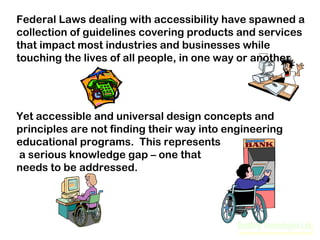
Federal Laws dealing with accessibility have spawned a
collection of guidelines covering products and services
that impact most industries and businesses while
touching the lives of all people, in one way or another.

Yet accessible and universal design concepts and
principles are not finding their way into engineering
educational programs. This represents
a serious knowledge gap – one that
needs to be addressed.
Laws:
Accessible
Design
Laws
The three laws which deal most directly with the accessibility of
products and services are:
•Americans with Disabilities Act a major civil rights law
prohibiting discrimination on the basis of disability in the private
and public sectors.
•Telecommunications Act (Section 255) requires access to new
telecommunications and customer premises equipment where
"readily achievable."
•Rehabilitation Act Amendments amends section 508 of the
Rehabilitation Act to ensure access to electronic and information
technology in the Federal sector.
http://www.access-board.gov/indexes/aboutindex.htm
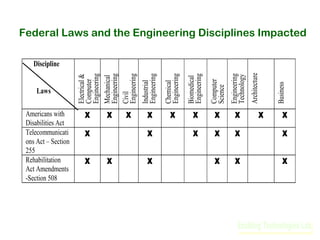
Federal Laws and the Engineering Disciplines Impacted

X
X

X

X

X

X

X
X

X

X

Business

X

Architecture

Engineering
Technology

X

Computer
Science

X

Biomedical
Engineering

X

Chemical
Engineering

Americans with
Disabilities Act
Telecommunicati
ons Act – Section
255
Rehabilitation
Act Amendments
-Section 508

Industrial
Engineering

Laws

Electrical &
Computer
Engineering
Mechanical
Engineering
Civil
Engineering

Discipline

X

X

X

X

X

X

X

X
The Americans with Disabilities Act
(ADA) of 1990
“The ADA recognizes and protects the civil rights of
people with disabilities … prohibiting discrimination
on the basis of race and gender.
The ADA covers a wide range of disability, from
physical conditions affecting mobility, stamina, sight,
hearing, and speech to conditions such as emotional
illness and learning disorders.”

http://www.access-board.gov/about/ADA.htm
The ADA addresses:
•Title I - access to the workplace
•Title II - State and local government services
•Title III - places of public accommodation and
commercial facilities
•Title IV - requires phone companies to provide
telecommunications relay services for people who
have hearing or speech impairments (title IV)
http://www.access-board.gov/about/ADA.htm
ADA Jobs & Workplace
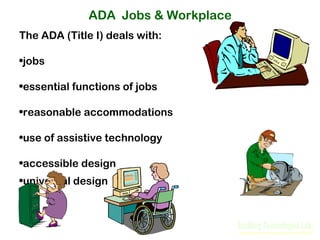
The ADA (Title I) deals with:
•jobs
•essential functions of jobs
•reasonable accommodations
•use of assistive technology
•accessible design
•universal design
Americans with Disabilities Act: Jobs &
Workplace
Title I of the Americans with Disabilities Act of 1990

prohibits
private employers, state and local governments, employment
agencies and labor unions

From discriminating against
qualified individuals with disabilities in job application procedures,
hiring, firing, advancement, compensation, job training, and other
terms, conditions and privileges of employment.

http://www.eeoc.gov/facts/fs-ada.html
An individual with a disability
is a person who:
Has a physical or mental impairment that
substantially limits one or more major life
activities
Has a record of such an impairment
Is regarded as having such an impairment
A qualified employee or applicant
with a disability
is an individual who,
with or without
reasonable accommodation,
can perform the essential functions of the job
in question.
What is a Disability? cont’d.
Impairment that substantially limits one major
life activity need not limit other major life
activities to be considered a disability.
Definition of a “major life activity” includes:

12

– caring for oneself
– performing manual
tasks
– seeing
– hearing
– eating
– sleeping
– walking
– standing
– lifting

–
–
–
–
–
–
–
–
–

bending
speaking
breathing
learning
reading
concentrating
thinking
communicating
working
What is a Disability? cont’d.
Major bodily functions:
–
–
–
–
–

14

immune system
digestive
bowel
bladder
neurological (dyslexia – brain and learning
disabilities)
– respiratory
– circulatory
Reasonable accommodation
may include, but is not limited to:
•Making existing facilities used by employees readily
accessible to and usable by persons with disabilities
•Job restructuring, modifying work schedules,
reassignment to a vacant position
•Acquiring or modifying equipment or devices,
adjusting modifying examinations, training materials,
or policies, and providing qualified readers or
interpreters
Disabilities & Substance Abuse
Alcohol

An alcoholic is protected by the ADA as
having a disability.
• [A] person who currently uses alcohol is not
automatically denied protection simply because
of the alcohol use. An alcoholic is a person with
a disability under the ADA and may be entitled
to consideration of accommodation, if s/he is
qualified to perform the essential functions of a
job. However, a[n] employer may discipline,
discharge or deny employment to an alcoholic
whose use of alcohol adversely affects job
performance or conduct to the extent that s/he is
not “qualified.”

17
Drugs
A drug addict is protected as having a
disability only if he or she is receiving
recovery treatment and is not a current user.
Persons addicted to drugs, but who are no longer
using drugs illegally and are receiving treatment for
drug addiction or who have been rehabilitated
successfully, are protected by the ADA from
discrimination on the basis of past drug addiction.
An employer is required
to make an accommodation
to the known disability of a qualified applicant or
employee
if
it would not impose an "undue hardship" on the
operation of the employer's business.
Undue hardship
is defined as
an action requiring significant difficulty or expense
when considered in light of factors such as an
employer's size, financial resources and the nature
and structure of its operation.
An employer is not required

·to lower quality or production standards to make
an accommodation

·nor is an employer obligated to provide personal
use items such as glasses or hearing aids
The Americans with Disabilities Act (ADA)
of 1990
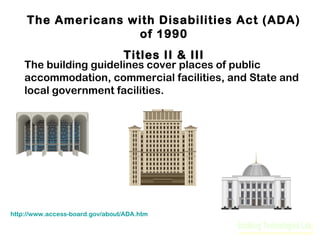
Titles II & III

The building guidelines cover places of public
accommodation, commercial facilities, and State and
local government facilities.

http://www.access-board.gov/about/ADA.htm
The Americans with Disabilities Act (ADA)
The ADA mandates that information sources be
accessible.
In the past, this need was met with Braille texts,
large print, captioning, and other types of aides.
With the introduction of the World Wide Web and other
telecommunications-related information sources,
however, many businesses and communities
are falling short of meeting their ADA obligations for the
accessibility of information sources including
web-based resources.

ADA Workplace Presentation: Dealing with the Americans With Disabilities Act

  • 1.
    College of Engineering,Wayne State University LAWS & ACCESSIBILITY Part 1. Overview and Americans with Disabilities Act (ADA) Support for this work cam from NSF grant DUE 0088807 for the development of accessible design curriculum material. (Any opinions, findings, and conclusions or recommendations expressed in this material are those of the author and do not necessarily reflect the views of the National Science Foundation.) © Robert Erlandson, 2003
  • 2.
    Federal Laws dealingwith accessibility have spawned a collection of guidelines covering products and services that impact most industries and businesses while touching the lives of all people, in one way or another. Yet accessible and universal design concepts and principles are not finding their way into engineering educational programs. This represents a serious knowledge gap – one that needs to be addressed.
  • 3.
  • 4.
    Laws The three lawswhich deal most directly with the accessibility of products and services are: •Americans with Disabilities Act a major civil rights law prohibiting discrimination on the basis of disability in the private and public sectors. •Telecommunications Act (Section 255) requires access to new telecommunications and customer premises equipment where "readily achievable." •Rehabilitation Act Amendments amends section 508 of the Rehabilitation Act to ensure access to electronic and information technology in the Federal sector. http://www.access-board.gov/indexes/aboutindex.htm
  • 5.
    Federal Laws andthe Engineering Disciplines Impacted X X X X X X X X X X Business X Architecture Engineering Technology X Computer Science X Biomedical Engineering X Chemical Engineering Americans with Disabilities Act Telecommunicati ons Act – Section 255 Rehabilitation Act Amendments -Section 508 Industrial Engineering Laws Electrical & Computer Engineering Mechanical Engineering Civil Engineering Discipline X X X X X X X X
  • 6.
    The Americans withDisabilities Act (ADA) of 1990 “The ADA recognizes and protects the civil rights of people with disabilities … prohibiting discrimination on the basis of race and gender. The ADA covers a wide range of disability, from physical conditions affecting mobility, stamina, sight, hearing, and speech to conditions such as emotional illness and learning disorders.” http://www.access-board.gov/about/ADA.htm
  • 7.
    The ADA addresses: •TitleI - access to the workplace •Title II - State and local government services •Title III - places of public accommodation and commercial facilities •Title IV - requires phone companies to provide telecommunications relay services for people who have hearing or speech impairments (title IV) http://www.access-board.gov/about/ADA.htm
  • 8.
    ADA Jobs &Workplace The ADA (Title I) deals with: •jobs •essential functions of jobs •reasonable accommodations •use of assistive technology •accessible design •universal design
  • 9.
    Americans with DisabilitiesAct: Jobs & Workplace Title I of the Americans with Disabilities Act of 1990 prohibits private employers, state and local governments, employment agencies and labor unions From discriminating against qualified individuals with disabilities in job application procedures, hiring, firing, advancement, compensation, job training, and other terms, conditions and privileges of employment. http://www.eeoc.gov/facts/fs-ada.html
  • 10.
    An individual witha disability is a person who: Has a physical or mental impairment that substantially limits one or more major life activities Has a record of such an impairment Is regarded as having such an impairment
  • 11.
    A qualified employeeor applicant with a disability is an individual who, with or without reasonable accommodation, can perform the essential functions of the job in question.
  • 12.
    What is aDisability? cont’d. Impairment that substantially limits one major life activity need not limit other major life activities to be considered a disability. Definition of a “major life activity” includes: 12 – caring for oneself – performing manual tasks – seeing – hearing – eating – sleeping – walking – standing – lifting – – – – – – – – – bending speaking breathing learning reading concentrating thinking communicating working
  • 14.
    What is aDisability? cont’d. Major bodily functions: – – – – – 14 immune system digestive bowel bladder neurological (dyslexia – brain and learning disabilities) – respiratory – circulatory
  • 15.
    Reasonable accommodation may include,but is not limited to: •Making existing facilities used by employees readily accessible to and usable by persons with disabilities •Job restructuring, modifying work schedules, reassignment to a vacant position •Acquiring or modifying equipment or devices, adjusting modifying examinations, training materials, or policies, and providing qualified readers or interpreters
  • 17.
    Disabilities & SubstanceAbuse Alcohol An alcoholic is protected by the ADA as having a disability. • [A] person who currently uses alcohol is not automatically denied protection simply because of the alcohol use. An alcoholic is a person with a disability under the ADA and may be entitled to consideration of accommodation, if s/he is qualified to perform the essential functions of a job. However, a[n] employer may discipline, discharge or deny employment to an alcoholic whose use of alcohol adversely affects job performance or conduct to the extent that s/he is not “qualified.” 17
  • 18.
    Drugs A drug addictis protected as having a disability only if he or she is receiving recovery treatment and is not a current user. Persons addicted to drugs, but who are no longer using drugs illegally and are receiving treatment for drug addiction or who have been rehabilitated successfully, are protected by the ADA from discrimination on the basis of past drug addiction.
  • 19.
    An employer isrequired to make an accommodation to the known disability of a qualified applicant or employee if it would not impose an "undue hardship" on the operation of the employer's business.
  • 20.
    Undue hardship is definedas an action requiring significant difficulty or expense when considered in light of factors such as an employer's size, financial resources and the nature and structure of its operation.
  • 21.
    An employer isnot required ·to lower quality or production standards to make an accommodation ·nor is an employer obligated to provide personal use items such as glasses or hearing aids
  • 22.
    The Americans withDisabilities Act (ADA) of 1990 Titles II & III The building guidelines cover places of public accommodation, commercial facilities, and State and local government facilities. http://www.access-board.gov/about/ADA.htm
  • 23.
    The Americans withDisabilities Act (ADA) The ADA mandates that information sources be accessible. In the past, this need was met with Braille texts, large print, captioning, and other types of aides. With the introduction of the World Wide Web and other telecommunications-related information sources, however, many businesses and communities are falling short of meeting their ADA obligations for the accessibility of information sources including web-based resources.

Editor's Notes

  • #3 Architectural firms, telecommunications firms and businesses involved with electronic and information technology are working hard to comply with a variety of legal mandates covering accessibility for individuals with disabilities. Market forces are also at work – the “baby-boomers” being the most visible example. Given the scope and breadth of the Federal laws and growing market pressures it is necessary to introduce design principles and concepts that address increased accessibility for all individuals. This presentation is designed to provide background information on the major Federal laws that cover accessibility.
  • #4 There are a growing number of reasons to accelerate the movement of accessible design into mainstream engineering. Historically, ethical concerns have dominated this movement, but now we must include market pressures and a growing number of federal laws and regulations mandating the accessibility of products and services for individuals with disabilities. This presentation will focus on the legal imperatives.
  • #7 The Americans with Disabilities Act (ADA) of 1990 is a major milestone with respect to accessible design. It established definitions and mandates that are dominating accessibility issues.
  • #8 The various titles (I to V) of the ADA cover everything from access to the workplace, to State and local government services, to public places and commercial facilities, to telecommunications. It also covers monitoring and enforcement of the law’s mandates.
  • #24 . United States Department of Justice Policy Ruling, 9/9/96: ADA Accessibility Requirements Apply to Internet Web Pages 10 NDLR 240 The Americans with Disabilities Act (ADA) requires covered entities to furnish appropriate auxiliary aids and services where necessary to ensure effective communication with individuals with disabilities, unless doing so would result in a fundamental alteration to the program or service or in an undue burden. See 28 C.F.R. 36.303; 28 C.F.R. 35.160. Auxiliary aids include taped texts, Brailled materials, large print materials, captioning and other methods of making audio and visual media available to people with disabilities. The policy ruling states that ADA Titles II and III require State and local governments and the business sector to provide effective communication whenever they communicate through the Internet. The effective communication rule applies to covered entities using the Internet for communications regarding their programs, goods or services since they must be prepared to offer those communications via an accessible medium. Specifically addressing the needs of people with visual disabilities, this policy ruling points out that providing a text format rather than a graphical format assures accessibility to the Internet for individuals using screenreaders. Without special coding, a text browser will only display the word "image" when it reads a graphic image. Moreover, if the graphic is essential to navigating the site (such as a navigational button or arrow) or if it imparts vital information (such as a table or image map) the user can get stuck and not be able to move or understand the information provided. As one user put it: When blind people use the internet and come across unfriendly sites, we aren't surfing, we are crawling ....Imagine hearing pages that say, 'Welcome to ...[image].' 'This is the home of ... [image].' 'Link, link, link.' It is like trying to use Netscape with your monitor off and the mouse unplugged. See how far you'll get. http://www.rit.edu/~easi/law/weblaw1.htm