
Americans with Disabilities Act General Distributive Fairness vs. Individual Legal Entitlement? Selected Issues in ADR:  Employment Straus Institute for Dispute Resolution Spring Semester 2007
An individual with a disability  is defined by the ADA as a person who has a physical or mental impairment that substantially limits one or more major life activities.  employers with 15 or more employees  must provide qualified individuals with an equal opportunity to benefit from the full range of employment-related opportunities available to others (including religious organizations). The Act prohibits discrimination  in recruitment, hiring, promotions, training, pay, social activities, and other privileges of employment   restricts questions that can be asked  about an applicant's disability before a job offer is made   requires that employers make reasonable accommodation  to the known physical or mental limitations of otherwise qualified individuals with disabilities, unless it results in undue hardship.
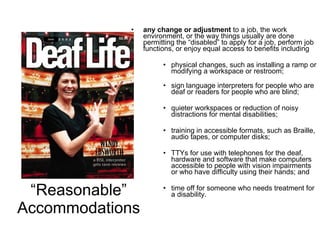
“ Reasonable” Accommodations any change or adjustment  to a job, the work environment, or the way things usually are done permitting the “disabled” to apply for a job, perform job functions, or enjoy equal access to benefits including physical changes, such as installing a ramp or modifying a workspace or restroom; sign language interpreters for people who are deaf or readers for people who are blind; quieter workspaces or reduction of noisy distractions for mental disabilities; training in accessible formats, such as Braille, audio tapes, or computer disks; TTYs for use with telephones for the deaf, hardware and software that make computers accessible to people with vision impairments or who have difficulty using their hands; and time off for someone who needs treatment for a disability.
MYTH:  The ADA requires businesses to spend lots of money to make their existing facilities accessible.  FACT:  The law only requires that public accommodations (e.g. stores, banks, hotels, and restaurants) remove architectural barriers in existing facilities when it is "readily achievable", i.e., it can be done "without much difficulty or expense."  MYTH:  The ADA requires extensive renovation of all state and local government buildings to make them accessible. FACT:  The ADA requires all government programs, not all government buildings, to be accessible. Structural modifications are required only when there is no alternative available for providing program access. MYTH:  Accommodating workers with disabilities costs too much.  FACT:  Reasonable accommodation is less costly than people think.  MYTH:  The ADA is being misused for frivolous reasons.  FACT:  Trivial complaints do not make it through the system.  U.S. Dept. of Justice Web Site   http://www.usdoj.gov/crt/ada/pubs/mythfct.txt
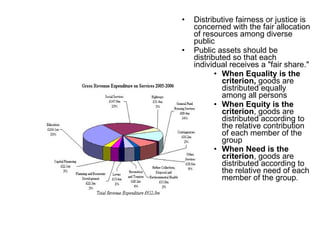
Distributive fairness or justice is concerned with the fair allocation of resources among diverse public Public assets should be distributed so that each individual receives a "fair share." When Equality is the criterion,  goods are distributed equally among all persons  When Equity is the criterion , goods are distributed according to the relative contribution of each member of the group When Need is the criterion , goods are distributed according to the relative need of each member of the group .
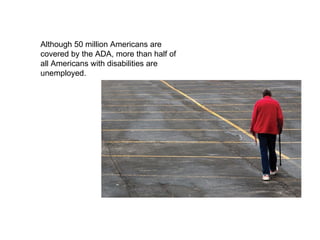
Although 50 million Americans are covered by the ADA, more than half of all Americans with disabilities are unemployed.
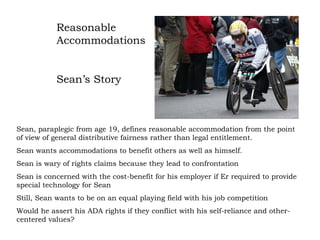
Reasonable Accommodations Sean’s Story Sean, paraplegic from age 19, defines reasonable accommodation from the point of view of general distributive fairness rather than legal entitlement. Sean wants accommodations to benefit others as well as himself. Sean is wary of rights claims because they lead to confrontation Sean is concerned with the cost-benefit for his employer if Er required to provide special technology for Sean Still, Sean wants to be on an equal playing field with his job competition Would he assert his ADA rights if they conflict with his self-reliance and other-centered values?
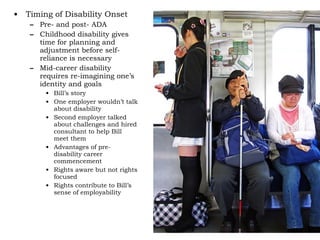
Timing of Disability Onset Pre- and post- ADA Childhood disability gives time for planning and adjustment before self-reliance is necessary Mid-career disability requires re-imagining one’s identity and goals Bill’s story One employer wouldn’t talk about disability Second employer talked about challenges and hired consultant to help Bill meet them Advantages of pre-disability career commencement Rights aware but not rights focused Rights contribute to Bill’s sense of employability
 

Americans With Disabilities Act

  • 1.
    Americans with DisabilitiesAct General Distributive Fairness vs. Individual Legal Entitlement? Selected Issues in ADR: Employment Straus Institute for Dispute Resolution Spring Semester 2007
  • 2.
    An individual witha disability is defined by the ADA as a person who has a physical or mental impairment that substantially limits one or more major life activities. employers with 15 or more employees must provide qualified individuals with an equal opportunity to benefit from the full range of employment-related opportunities available to others (including religious organizations). The Act prohibits discrimination in recruitment, hiring, promotions, training, pay, social activities, and other privileges of employment restricts questions that can be asked about an applicant's disability before a job offer is made requires that employers make reasonable accommodation to the known physical or mental limitations of otherwise qualified individuals with disabilities, unless it results in undue hardship.
  • 3.
    “ Reasonable” Accommodationsany change or adjustment to a job, the work environment, or the way things usually are done permitting the “disabled” to apply for a job, perform job functions, or enjoy equal access to benefits including physical changes, such as installing a ramp or modifying a workspace or restroom; sign language interpreters for people who are deaf or readers for people who are blind; quieter workspaces or reduction of noisy distractions for mental disabilities; training in accessible formats, such as Braille, audio tapes, or computer disks; TTYs for use with telephones for the deaf, hardware and software that make computers accessible to people with vision impairments or who have difficulty using their hands; and time off for someone who needs treatment for a disability.
  • 4.
    MYTH: TheADA requires businesses to spend lots of money to make their existing facilities accessible. FACT: The law only requires that public accommodations (e.g. stores, banks, hotels, and restaurants) remove architectural barriers in existing facilities when it is "readily achievable", i.e., it can be done "without much difficulty or expense." MYTH: The ADA requires extensive renovation of all state and local government buildings to make them accessible. FACT: The ADA requires all government programs, not all government buildings, to be accessible. Structural modifications are required only when there is no alternative available for providing program access. MYTH: Accommodating workers with disabilities costs too much. FACT: Reasonable accommodation is less costly than people think. MYTH: The ADA is being misused for frivolous reasons. FACT: Trivial complaints do not make it through the system. U.S. Dept. of Justice Web Site http://www.usdoj.gov/crt/ada/pubs/mythfct.txt
  • 5.
    Distributive fairness orjustice is concerned with the fair allocation of resources among diverse public Public assets should be distributed so that each individual receives a "fair share." When Equality is the criterion, goods are distributed equally among all persons When Equity is the criterion , goods are distributed according to the relative contribution of each member of the group When Need is the criterion , goods are distributed according to the relative need of each member of the group .
  • 6.
    Although 50 millionAmericans are covered by the ADA, more than half of all Americans with disabilities are unemployed.
  • 7.
    Reasonable Accommodations Sean’sStory Sean, paraplegic from age 19, defines reasonable accommodation from the point of view of general distributive fairness rather than legal entitlement. Sean wants accommodations to benefit others as well as himself. Sean is wary of rights claims because they lead to confrontation Sean is concerned with the cost-benefit for his employer if Er required to provide special technology for Sean Still, Sean wants to be on an equal playing field with his job competition Would he assert his ADA rights if they conflict with his self-reliance and other-centered values?
  • 8.
    Timing of DisabilityOnset Pre- and post- ADA Childhood disability gives time for planning and adjustment before self-reliance is necessary Mid-career disability requires re-imagining one’s identity and goals Bill’s story One employer wouldn’t talk about disability Second employer talked about challenges and hired consultant to help Bill meet them Advantages of pre-disability career commencement Rights aware but not rights focused Rights contribute to Bill’s sense of employability
  • 9.