Differently AbledChanging Attitudes with Information
Presented ByThe Settlement Library Project Promoting an Eclectic Librarianship in Rural Appalachia
Serving People,Changing AttitudesandSharing ResourcesinLibraries
What is a “Disability?”The Americans with Disabilities Act of 1990 (ADA) defines disability as “a physical or mental impairment that substantially limits 	one or more of the major life activities of an individual.”Who are “Disabled?”The Rehabilitation Act of 1973 describes handicapped people as “individuals who have a physical or mental impairment that substantially limits one or more major life function such as caring for oneself, performing manual tasks, etc. “
Does Your Library Serve Any of These People?More than 8 million Americans have hearing problems
More than 8.1 million have vision problems
More than 1.8 million use wheelchairs
More than 1.1 million are blind
More than 1 million are deaf
The National Institute of Health now estimates that more than 39 million Americans have learning disabilities. Differently AbledMyths and Facts
MYTH: People with disabilities have a hard time and deserve special treatment.FACT: Most people with disabilities don’t consider themselves victims and don’t want pity. Most people with disabilities don’t consider themselves as heroes and ordinarily do not want admiration. These individuals live lives which have simply adapted to their limitations or uniqueness because most disabilities are invisible.
MYTH: Persons with disabilities need to be protected from failing.FACT: Persons with disabilities have a right to participate in the full range of human experiences including success and failure. Employers should have the same expectations of, and work requirements for, disabled employees.
MYTH: People with disabilities create a lot of problems for libraries.FACT: Focus on people with disabilities has stimulated libraries to examine their missions and to reach a new or previously underserved client group. Staff training has improved staff skills and service provision for all library users. For the most part, staff may never notice that an individual is disabled. 
MYTH: Employees with disabilities have a higher absentee rate than employees without disabilities.FACT: Studies by firms such as DuPont show that employees with disabilities are not absent any more than employees without disabilities.
MYTH: Considerable expense is necessary to accommodate workers or library patrons with disabilities.FACT: Most workers or patrons with disabilities require no special accommodations. The cost for those who do is minimal or much lower than many believe. Studies by the Office of Disability Employment Policy's Job Accommodation Network have shown that 15% of accommodations cost nothing, 51% cost between $1 and $500, 12% cost between $501 and $1,000, and 22% cost more than $1,000.
Differently AbledLibrary Responsibility
There are disabled individuals all around us: people who are mentally or physically challenged. Don't count on being able to identify these people. Many disabilities are invisible: deafness; hearing problems; heart and breathing problems; learning disabilities and more. A fundamental philosophy of library services is to serve the disabled.The challenge of providing excellent service to all patrons, including those with disabilities, is paramount to fulfilling the library’s mission.Library staff can make a difference in the lives of persons with obvious or invisible  disabilities.
Individuals with disabilities are people first, and like all people they want to be accepted and understood. They want other people to know that their disability is not all that they are.They have the same information needs as any other segment of the population but often require innovative strategies for access.
Library Compliance to the Americans with Disabilities ActThe American Library Association states that people with disabilities are a large and neglected minority and are severely underrepresented in the library profession. Libraries can play a catalytic role in the lives of people with disabilities by facilitating their full participation in society. And libraries should use strategies based upon the principles of universal design to ensure that library policy, resources and services meet the needs of all people.
ASCLA: Library Services for People with Disabilities Policy for ADA Compliance#1.  All libraries must provide equitable access for persons with disabilities to library facilitiesand services as required by Section 504 of the Rehabilitation Act of 1973, applicable state and local statutes and the Americans with Disabilities Act of 1990 (ADA).
#2.  Libraries must not discriminate against individuals with disabilities and ensure that individuals with disabilities have equal access to library resources.#3.  Architectural barriers in the library building and existing facilities, and communication barriers that are structural in nature, be removed as long as such removal is “readily achievable.”
#4.  Library materials should be accessible to all patrons, including people with disabilities, in a variety of formats and with accommodations. The modified formats and accommodations should be “reasonable,” which do not “fundamentally alter” the library’s services, and does not place an “undue burden” on the library.
#5.  Library staff should be aware of how available technologies address disabilities and know how to assist all users with library technology. #6.  Libraries must provide reasonable accommodations for qualified individuals with disabilities unless the library can show that the accommodations would impose an “undue hardship” on its operations.
#7.  Libraries should provide training opportunities for all library employees and volunteers in order to sensitize them to issues affecting people with disabilities and to teach effective techniques for providing services for users with disabilities and for working with colleagues with disabilities.
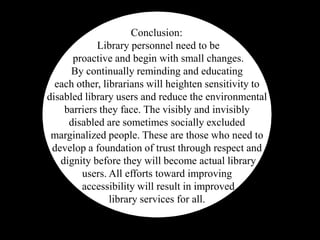
As many librarians have discovered, being ADA compliant is important, however, it does not ensure that disabled patrons will be able to use your library.Many remedies simply require educating library personnel about accessibility problems and training them to make appropriate responses. The good news is that many obstacles within the library are readily and inexpensively correctable.
    It is necessary for the library    to develop a plan that    would allow the library    to purchase the    essential tools which     will help the most    people.     It is also necessary to    ensure that the staff is     aware of available    tools and trained to    use them.
Differently AbledWhat’s the Plan?
Does your mission statement and library policies relate to goals for providing for this population?
Are your facilities architecturally accessible?
Do you possess materials in appropriate alternative formats?
Does your collection address the information needs of this group?
Do you offer an enhanced or extended service for this group?
Do you offer accessible equipment and adaptations needed for this group?
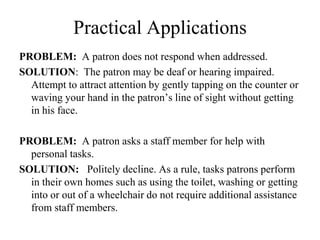
Is your staff trained in providing services for this population?The Ten Point ProcessEducate Yourself and Gather InformationAbout the LibraryAbout the CommunityAbout individual users and non-usersCome Together and Talk About ItPeople with disabilities, their families and caregiversRelated agencies and organizationsLibrary staff do’s and don’ts
Identify your Key IssuesCommunity strengths and weaknessesAnalyze and prioritize the issuesSelect the issues the library can best addressAnalyze the Library’s Current PlanIs each section inclusive for the disabled?Are identified issues being addressed?What are other libraries doing?
Draft goals and objectivesDevelop objectives and activities of special interest to people with disabilities.Determine available resources Position the library as an information access point for people with disabilities, their relatives and their service providers.Finalize goals and objectivesGuarantee that library services are available on an equal basis to all members of the community.Draft it and Get it doneAttract people with disabilities to use the library.
Differently Abled  Goals
Services Improve AccessExtended loan periods
Waived late fines
Extended reserve periods
Library cards for proxies
Books by mail
Reference services by fax or email

The Settlement Library Project Presents: Differently Abled

  • 1.
  • 2.
    Presented ByThe SettlementLibrary Project Promoting an Eclectic Librarianship in Rural Appalachia
  • 3.
  • 4.
    What is a“Disability?”The Americans with Disabilities Act of 1990 (ADA) defines disability as “a physical or mental impairment that substantially limits one or more of the major life activities of an individual.”Who are “Disabled?”The Rehabilitation Act of 1973 describes handicapped people as “individuals who have a physical or mental impairment that substantially limits one or more major life function such as caring for oneself, performing manual tasks, etc. “
  • 5.
    Does Your LibraryServe Any of These People?More than 8 million Americans have hearing problems
  • 6.
    More than 8.1million have vision problems
  • 7.
    More than 1.8million use wheelchairs
  • 8.
    More than 1.1million are blind
  • 9.
    More than 1million are deaf
  • 10.
    The National Instituteof Health now estimates that more than 39 million Americans have learning disabilities. Differently AbledMyths and Facts
  • 11.
    MYTH: People withdisabilities have a hard time and deserve special treatment.FACT: Most people with disabilities don’t consider themselves victims and don’t want pity. Most people with disabilities don’t consider themselves as heroes and ordinarily do not want admiration. These individuals live lives which have simply adapted to their limitations or uniqueness because most disabilities are invisible.
  • 12.
    MYTH: Persons withdisabilities need to be protected from failing.FACT: Persons with disabilities have a right to participate in the full range of human experiences including success and failure. Employers should have the same expectations of, and work requirements for, disabled employees.
  • 13.
    MYTH: People withdisabilities create a lot of problems for libraries.FACT: Focus on people with disabilities has stimulated libraries to examine their missions and to reach a new or previously underserved client group. Staff training has improved staff skills and service provision for all library users. For the most part, staff may never notice that an individual is disabled. 
  • 14.
    MYTH: Employees withdisabilities have a higher absentee rate than employees without disabilities.FACT: Studies by firms such as DuPont show that employees with disabilities are not absent any more than employees without disabilities.
  • 15.
    MYTH: Considerable expenseis necessary to accommodate workers or library patrons with disabilities.FACT: Most workers or patrons with disabilities require no special accommodations. The cost for those who do is minimal or much lower than many believe. Studies by the Office of Disability Employment Policy's Job Accommodation Network have shown that 15% of accommodations cost nothing, 51% cost between $1 and $500, 12% cost between $501 and $1,000, and 22% cost more than $1,000.
  • 16.
  • 17.
    There are disabledindividuals all around us: people who are mentally or physically challenged. Don't count on being able to identify these people. Many disabilities are invisible: deafness; hearing problems; heart and breathing problems; learning disabilities and more. A fundamental philosophy of library services is to serve the disabled.The challenge of providing excellent service to all patrons, including those with disabilities, is paramount to fulfilling the library’s mission.Library staff can make a difference in the lives of persons with obvious or invisible disabilities.
  • 18.
    Individuals with disabilitiesare people first, and like all people they want to be accepted and understood. They want other people to know that their disability is not all that they are.They have the same information needs as any other segment of the population but often require innovative strategies for access.
  • 19.
    Library Compliance tothe Americans with Disabilities ActThe American Library Association states that people with disabilities are a large and neglected minority and are severely underrepresented in the library profession. Libraries can play a catalytic role in the lives of people with disabilities by facilitating their full participation in society. And libraries should use strategies based upon the principles of universal design to ensure that library policy, resources and services meet the needs of all people.
  • 20.
    ASCLA: Library Servicesfor People with Disabilities Policy for ADA Compliance#1. All libraries must provide equitable access for persons with disabilities to library facilitiesand services as required by Section 504 of the Rehabilitation Act of 1973, applicable state and local statutes and the Americans with Disabilities Act of 1990 (ADA).
  • 21.
    #2. Librariesmust not discriminate against individuals with disabilities and ensure that individuals with disabilities have equal access to library resources.#3. Architectural barriers in the library building and existing facilities, and communication barriers that are structural in nature, be removed as long as such removal is “readily achievable.”
  • 22.
    #4. Librarymaterials should be accessible to all patrons, including people with disabilities, in a variety of formats and with accommodations. The modified formats and accommodations should be “reasonable,” which do not “fundamentally alter” the library’s services, and does not place an “undue burden” on the library.
  • 23.
    #5. Librarystaff should be aware of how available technologies address disabilities and know how to assist all users with library technology. #6. Libraries must provide reasonable accommodations for qualified individuals with disabilities unless the library can show that the accommodations would impose an “undue hardship” on its operations.
  • 24.
    #7. Librariesshould provide training opportunities for all library employees and volunteers in order to sensitize them to issues affecting people with disabilities and to teach effective techniques for providing services for users with disabilities and for working with colleagues with disabilities.
  • 25.
    As many librarianshave discovered, being ADA compliant is important, however, it does not ensure that disabled patrons will be able to use your library.Many remedies simply require educating library personnel about accessibility problems and training them to make appropriate responses. The good news is that many obstacles within the library are readily and inexpensively correctable.
  • 26.
    It is necessary for the library to develop a plan that would allow the library to purchase the essential tools which will help the most people. It is also necessary to ensure that the staff is aware of available tools and trained to use them.
  • 27.
  • 28.
    Does your missionstatement and library policies relate to goals for providing for this population?
  • 29.
    Are your facilitiesarchitecturally accessible?
  • 30.
    Do you possessmaterials in appropriate alternative formats?
  • 31.
    Does your collectionaddress the information needs of this group?
  • 32.
    Do you offeran enhanced or extended service for this group?
  • 33.
    Do you offeraccessible equipment and adaptations needed for this group?
  • 34.
    Is your stafftrained in providing services for this population?The Ten Point ProcessEducate Yourself and Gather InformationAbout the LibraryAbout the CommunityAbout individual users and non-usersCome Together and Talk About ItPeople with disabilities, their families and caregiversRelated agencies and organizationsLibrary staff do’s and don’ts
  • 35.
    Identify your KeyIssuesCommunity strengths and weaknessesAnalyze and prioritize the issuesSelect the issues the library can best addressAnalyze the Library’s Current PlanIs each section inclusive for the disabled?Are identified issues being addressed?What are other libraries doing?
  • 36.
    Draft goals andobjectivesDevelop objectives and activities of special interest to people with disabilities.Determine available resources Position the library as an information access point for people with disabilities, their relatives and their service providers.Finalize goals and objectivesGuarantee that library services are available on an equal basis to all members of the community.Draft it and Get it doneAttract people with disabilities to use the library.
  • 37.
  • 38.
  • 39.
  • 40.
  • 41.
  • 42.
  • 43.