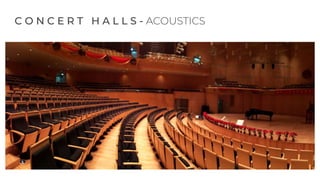
C O N C E R T H A L L S - ACOUSTICS
SOURCE: https://odeon.dk/learn/articles/concert-hall-acoustics/
Concert halls acoustics focuses in the design of spaces for live music events, typically
unamplified music. Concert halls are usually used for classical music performances.
BASIC SHAPES TO DESIGN A CONCERT HALL
A few shapes that serve as a start point for the design of a concert hall, and of these, the most
typical tend to be:
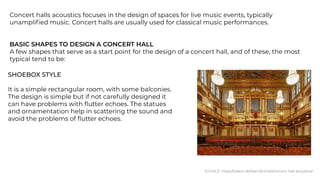
SHOEBOX STYLE
It is a simple rectangular room, with some balconies.
The design is simple but if not carefully designed it
can have problems with flutter echoes. The statues
and ornamentation help in scattering the sound and
avoid the problems of flutter echoes.
FAN-SHAPED STYLE
Fan shaped rooms can accommodate a large
number of attendants while keeping a frontal view
of the performers. At the same time they are not
prone to flutter echo because of the non-parallel
walls.
VINEYARD STYLE
Vineyard style rooms are named so because the
seating sections resemble slopes in a vineyard.This
type of room has many advantages. It is visually
interesting.The irregular pattern helps to avoid
issues like fluttering echoes and focusing.
GEOMETRICAL CONSIDERATIONS
● Suspended Roof- For uniform dispersion of sound
● Spaciousness/Envelopment- Not making sound unidirectional and more lateral
● Stage support- The performers should also be able to hear themselves
ROOM ACOUSTICS PARAMETERS
● Reverberation Time
The time a sound takes to decay and cease to an inaudible level after a loud source has been
switched off. For concert halls it is 1.7 to 2.3 secs.
● Sound strength
This factor is used to measure the amplification of the room to a sound source. The
typical value of Sound strength should be 3 to 10 dB.
● Clarity
This factor compares the energy of sound in the beginning and after a certain amount of time(
in ms). The range for this should be -1 to -3 dB.
● Lateral energy fraction
The energy gain in the actual sound due to reflection arriving from the sides. For
concert halls it is recommended to be greater than 0.25.
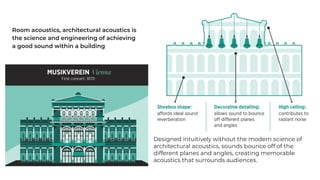
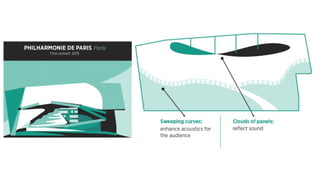
Room acoustics, architectural acoustics is
the science and engineering of achieving
a good sound within a building
Designed intuitively without the modern science of
architectural acoustics, sounds bounce off of the
different planes and angles, creating memorable
acoustics that surrounds audiences.
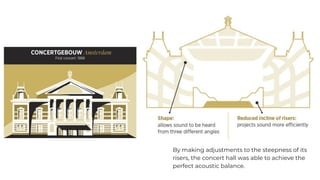
By making adjustments to the steepness of its
risers, the concert hall was able to achieve the
perfect acoustic balance.
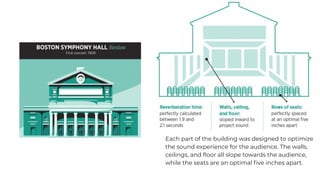
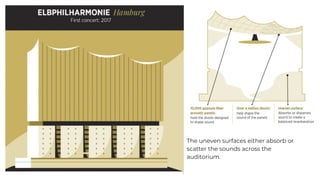
Each part of the building was designed to optimize
the sound experience for the audience. The walls,
ceilings, and floor all slope towards the audience,
while the seats are an optimal five inches apart.
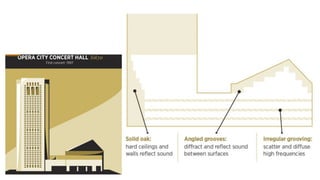
The uneven surfaces either absorb or
scatter the sounds across the
auditorium.
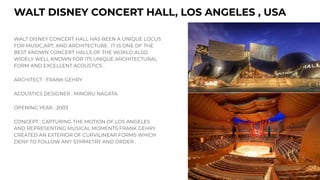
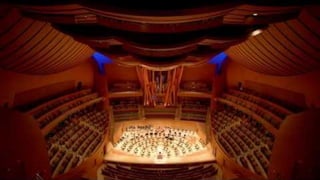
WALT DISNEY CONCERT HALL, LOS ANGELES , USA
WALT DISNEY CONCERT HALL HAS BEEN A UNIQUE LOCUS
FOR MUSIC,ART, AND ARCHITECTURE . IT IS ONE OF THE
BEST KNOWN CONCERT HALLS OF THE WORLD ALSO
WIDELY WELL KNOWN FOR ITS UNIQUE ARCHITECTURAL
FORM AND EXCELLENT ACOUSTICS .
ARCHITECT : FRANK GEHRY
ACOUSTICS DESIGNER : MINORU NAGATA
OPENING YEAR : 2003
CONCEPT : CAPTURING THE MOTION OF LOS ANGELES
AND REPRESENTING MUSICAL MOMENTS FRANK GEHRY
CREATED AN EXTERIOR OF CURVILINEAR FORMS WHICH
DENY TO FOLLOW ANY SYMMETRY AND ORDER .
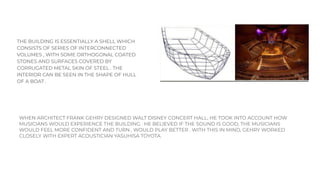
THE BUILDING IS ESSENTIALLY A SHELL WHICH
CONSISTS OF SERIES OF INTERCONNECTED
VOLUMES , WITH SOME ORTHOGONAL COATED
STONES AND SURFACES COVERED BY
CORRUGATED METAL SKIN OF STEEL . THE
INTERIOR CAN BE SEEN IN THE SHAPE OF HULL
OF A BOAT .
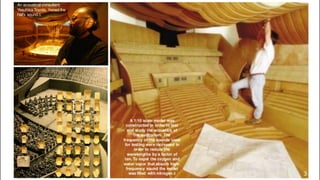
WHEN ARCHITECT FRANK GEHRY DESIGNED WALT DISNEY CONCERT HALL, HE TOOK INTO ACCOUNT HOW
MUSICIANS WOULD EXPERIENCE THE BUILDING . HE BELIEVED IF THE SOUND IS GOOD, THE MUSICIANS
WOULD FEEL MORE CONFIDENT AND TURN , WOULD PLAY BETTER . WITH THIS IN MIND, GEHRY WORKED
CLOSELY WITH EXPERT ACOUSTICIAN YASUHISA TOYOTA.
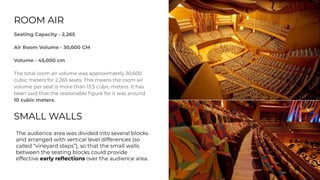
ROOM AIR
Seating Capacity - 2,265
Air Room Volume - 30,600 CM
Volume - 45,000 cm
The total room air volume was approximately 30,600
cubic meters for 2,265 seats. This means the room air
volume per seat is more than 13.5 cubic meters. It has
been said that the reasonable figure for it was around
10 cubic meters.
SMALL WALLS
The audience area was divided into several blocks
and arranged with vertical level differences (so
called “vineyard steps”), so that the small walls
between the seating blocks could provide
effective early reflections over the audience area.
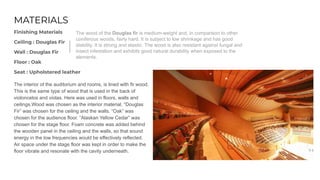
MATERIALS
Finishing Materials
Ceiling : Douglas Fir
Wall : Douglas Fir
Floor : Oak
Seat : Upholstered leather
The interior of the auditorium and rooms, is lined with fir wood.
This is the same type of wood that is used in the back of
violoncelos and violas. Here was used in floors, walls and
ceilings.Wood was chosen as the interior material. “Douglas
Fir” was chosen for the ceiling and the walls. “Oak” was
chosen for the audience floor. “Alaskan Yellow Cedar” was
chosen for the stage floor. Foam concrete was added behind
the wooden panel in the ceiling and the walls, so that sound
energy in the low frequencies would be effectively reflected.
Air space under the stage floor was kept in order to make the
floor vibrate and resonate with the cavity underneath.
The wood of the Douglas fir is medium-weight and, in comparison to other
coniferous woods, fairly hard. It is subject to low shrinkage and has good
stability. It is strong and elastic. The wood is also resistant against fungal and
insect infestation and exhibits good natural durability when exposed to the
elements.
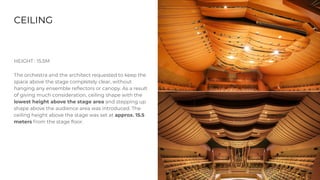
CEILING
HEIGHT : 15.5M
The orchestra and the architect requested to keep the
space above the stage completely clear, without
hanging any ensemble reflectors or canopy. As a result
of giving much consideration, ceiling shape with the
lowest height above the stage area and stepping up
shape above the audience area was introduced. The
ceiling height above the stage was set at approx. 15.5
meters from the stage floor.
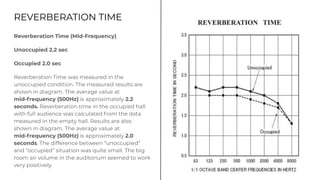
Reverberation Time (Mid-Frequency)
Unoccupied 2.2 sec
Occupied 2.0 sec
Reverberation Time was measured in the
unoccupied condition. The measured results are
shown in diagram. The average value at
mid-frequency (500Hz) is approximately 2.2
seconds. Reverberation time in the occupied hall
with full audience was calculated from the data
measured in the empty hall. Results are also
shown in diagram. The average value at
mid-frequency (500Hz) is approximately 2.0
seconds. The difference between “unoccupied”
and “occupied” situation was quite small. The big
room air volume in the auditorium seemed to work
very positively.
REVERBERATION TIME
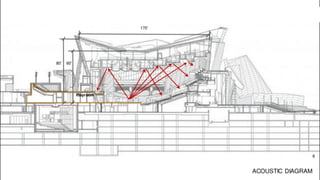
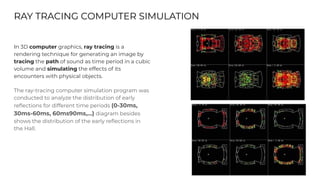
RAY TRACING COMPUTER SIMULATION
In 3D computer graphics, ray tracing is a
rendering technique for generating an image by
tracing the path of sound as time period in a cubic
volume and simulating the effects of its
encounters with physical objects.
The ray-tracing computer simulation program was
conducted to analyze the distribution of early
reflections for different time periods (0-30ms,
30ms-60ms, 60ms90ms,…) diagram besides
shows the distribution of the early reflections in
the Hall.
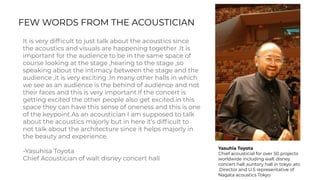
FEW WORDS FROM THE ACOUSTICIAN
It is very difficult to just talk about the acoustics since
the acoustics and visuals are happening together .It is
important for the audience to be in the same space of
course looking at the stage ,hearing to the stage ,so
speaking about the intimacy between the stage and the
audience ,it is very exciting .In many other halls in which
we see as an audience is the behind of audience and not
their faces and this is very important.If the concert is
getting excited the other people also get excited.in this
space they can have this sense of oneness and this is one
of the keypoint.As an acoustician I am supposed to talk
about the acoustics majorly but in here it's difficult to
not talk about the architecture since it helps majorly in
the beauty and experience.
-Yasuhisa Toyota
Chief Acoustician of walt disney concert hall
Yasuhia Toyota
Chief acousticial for over 50 projects
worldwide including walt disney
concert hall ,suntory hall in tokyo ,etc
.Director and U.S representative of
Nagata acoustics Tokyo
SOURCES
● https://odeon.dk/learn/articles/concert-hall-acoustics/
● https://interestingengineering.com/6-of-the-worlds-be
st-sounding-concert-halls-and-the-science-behind-th
eir-architectural-acoustics
● https://www.nagata-i.com/wp-content/uploads/2019/0
6/WaltDisney_NAGATA.pdf
● https://www.youtube.com/watch?v=MWbvq4QA-Hk&f
eature=youtu.be
BOOKS
Symphony: Frank Gehry's Walt Disney
Concert Hall
Book by Richard Koshalek
Walt Disney Concert Hall: The
Backstage Story
Book by Patricia MacKay and Richard Pilbrow
● Omkar bansode 1805
● Priya chauhan 1813
● Atharva salaskar 1854
● Suvidha tambe 1861
● Rashmi umate 1863
● Manasi wadekar 1865

_CONCERT HALL ACOUSTICS.pdf

  • 1.
    C O NC E R T H A L L S - ACOUSTICS
  • 2.
    SOURCE: https://odeon.dk/learn/articles/concert-hall-acoustics/ Concert hallsacoustics focuses in the design of spaces for live music events, typically unamplified music. Concert halls are usually used for classical music performances. BASIC SHAPES TO DESIGN A CONCERT HALL A few shapes that serve as a start point for the design of a concert hall, and of these, the most typical tend to be: SHOEBOX STYLE It is a simple rectangular room, with some balconies. The design is simple but if not carefully designed it can have problems with flutter echoes. The statues and ornamentation help in scattering the sound and avoid the problems of flutter echoes.
  • 3.
    FAN-SHAPED STYLE Fan shapedrooms can accommodate a large number of attendants while keeping a frontal view of the performers. At the same time they are not prone to flutter echo because of the non-parallel walls. VINEYARD STYLE Vineyard style rooms are named so because the seating sections resemble slopes in a vineyard.This type of room has many advantages. It is visually interesting.The irregular pattern helps to avoid issues like fluttering echoes and focusing.
  • 4.
    GEOMETRICAL CONSIDERATIONS ● SuspendedRoof- For uniform dispersion of sound ● Spaciousness/Envelopment- Not making sound unidirectional and more lateral ● Stage support- The performers should also be able to hear themselves ROOM ACOUSTICS PARAMETERS ● Reverberation Time The time a sound takes to decay and cease to an inaudible level after a loud source has been switched off. For concert halls it is 1.7 to 2.3 secs. ● Sound strength This factor is used to measure the amplification of the room to a sound source. The typical value of Sound strength should be 3 to 10 dB. ● Clarity This factor compares the energy of sound in the beginning and after a certain amount of time( in ms). The range for this should be -1 to -3 dB. ● Lateral energy fraction The energy gain in the actual sound due to reflection arriving from the sides. For concert halls it is recommended to be greater than 0.25.
  • 5.
    Room acoustics, architecturalacoustics is the science and engineering of achieving a good sound within a building Designed intuitively without the modern science of architectural acoustics, sounds bounce off of the different planes and angles, creating memorable acoustics that surrounds audiences.
  • 6.
    By making adjustmentsto the steepness of its risers, the concert hall was able to achieve the perfect acoustic balance.
  • 7.
    Each part ofthe building was designed to optimize the sound experience for the audience. The walls, ceilings, and floor all slope towards the audience, while the seats are an optimal five inches apart.
  • 10.
    The uneven surfaceseither absorb or scatter the sounds across the auditorium.
  • 11.
    WALT DISNEY CONCERTHALL, LOS ANGELES , USA WALT DISNEY CONCERT HALL HAS BEEN A UNIQUE LOCUS FOR MUSIC,ART, AND ARCHITECTURE . IT IS ONE OF THE BEST KNOWN CONCERT HALLS OF THE WORLD ALSO WIDELY WELL KNOWN FOR ITS UNIQUE ARCHITECTURAL FORM AND EXCELLENT ACOUSTICS . ARCHITECT : FRANK GEHRY ACOUSTICS DESIGNER : MINORU NAGATA OPENING YEAR : 2003 CONCEPT : CAPTURING THE MOTION OF LOS ANGELES AND REPRESENTING MUSICAL MOMENTS FRANK GEHRY CREATED AN EXTERIOR OF CURVILINEAR FORMS WHICH DENY TO FOLLOW ANY SYMMETRY AND ORDER .
  • 12.
    THE BUILDING ISESSENTIALLY A SHELL WHICH CONSISTS OF SERIES OF INTERCONNECTED VOLUMES , WITH SOME ORTHOGONAL COATED STONES AND SURFACES COVERED BY CORRUGATED METAL SKIN OF STEEL . THE INTERIOR CAN BE SEEN IN THE SHAPE OF HULL OF A BOAT . WHEN ARCHITECT FRANK GEHRY DESIGNED WALT DISNEY CONCERT HALL, HE TOOK INTO ACCOUNT HOW MUSICIANS WOULD EXPERIENCE THE BUILDING . HE BELIEVED IF THE SOUND IS GOOD, THE MUSICIANS WOULD FEEL MORE CONFIDENT AND TURN , WOULD PLAY BETTER . WITH THIS IN MIND, GEHRY WORKED CLOSELY WITH EXPERT ACOUSTICIAN YASUHISA TOYOTA.
  • 14.
    ROOM AIR Seating Capacity- 2,265 Air Room Volume - 30,600 CM Volume - 45,000 cm The total room air volume was approximately 30,600 cubic meters for 2,265 seats. This means the room air volume per seat is more than 13.5 cubic meters. It has been said that the reasonable figure for it was around 10 cubic meters. SMALL WALLS The audience area was divided into several blocks and arranged with vertical level differences (so called “vineyard steps”), so that the small walls between the seating blocks could provide effective early reflections over the audience area.
  • 15.
    MATERIALS Finishing Materials Ceiling :Douglas Fir Wall : Douglas Fir Floor : Oak Seat : Upholstered leather The interior of the auditorium and rooms, is lined with fir wood. This is the same type of wood that is used in the back of violoncelos and violas. Here was used in floors, walls and ceilings.Wood was chosen as the interior material. “Douglas Fir” was chosen for the ceiling and the walls. “Oak” was chosen for the audience floor. “Alaskan Yellow Cedar” was chosen for the stage floor. Foam concrete was added behind the wooden panel in the ceiling and the walls, so that sound energy in the low frequencies would be effectively reflected. Air space under the stage floor was kept in order to make the floor vibrate and resonate with the cavity underneath. The wood of the Douglas fir is medium-weight and, in comparison to other coniferous woods, fairly hard. It is subject to low shrinkage and has good stability. It is strong and elastic. The wood is also resistant against fungal and insect infestation and exhibits good natural durability when exposed to the elements.
  • 16.
    CEILING HEIGHT : 15.5M Theorchestra and the architect requested to keep the space above the stage completely clear, without hanging any ensemble reflectors or canopy. As a result of giving much consideration, ceiling shape with the lowest height above the stage area and stepping up shape above the audience area was introduced. The ceiling height above the stage was set at approx. 15.5 meters from the stage floor.
  • 17.
    Reverberation Time (Mid-Frequency) Unoccupied2.2 sec Occupied 2.0 sec Reverberation Time was measured in the unoccupied condition. The measured results are shown in diagram. The average value at mid-frequency (500Hz) is approximately 2.2 seconds. Reverberation time in the occupied hall with full audience was calculated from the data measured in the empty hall. Results are also shown in diagram. The average value at mid-frequency (500Hz) is approximately 2.0 seconds. The difference between “unoccupied” and “occupied” situation was quite small. The big room air volume in the auditorium seemed to work very positively. REVERBERATION TIME
  • 18.
    RAY TRACING COMPUTERSIMULATION In 3D computer graphics, ray tracing is a rendering technique for generating an image by tracing the path of sound as time period in a cubic volume and simulating the effects of its encounters with physical objects. The ray-tracing computer simulation program was conducted to analyze the distribution of early reflections for different time periods (0-30ms, 30ms-60ms, 60ms90ms,…) diagram besides shows the distribution of the early reflections in the Hall.
  • 20.
    FEW WORDS FROMTHE ACOUSTICIAN It is very difficult to just talk about the acoustics since the acoustics and visuals are happening together .It is important for the audience to be in the same space of course looking at the stage ,hearing to the stage ,so speaking about the intimacy between the stage and the audience ,it is very exciting .In many other halls in which we see as an audience is the behind of audience and not their faces and this is very important.If the concert is getting excited the other people also get excited.in this space they can have this sense of oneness and this is one of the keypoint.As an acoustician I am supposed to talk about the acoustics majorly but in here it's difficult to not talk about the architecture since it helps majorly in the beauty and experience. -Yasuhisa Toyota Chief Acoustician of walt disney concert hall Yasuhia Toyota Chief acousticial for over 50 projects worldwide including walt disney concert hall ,suntory hall in tokyo ,etc .Director and U.S representative of Nagata acoustics Tokyo
  • 22.
    SOURCES ● https://odeon.dk/learn/articles/concert-hall-acoustics/ ● https://interestingengineering.com/6-of-the-worlds-be st-sounding-concert-halls-and-the-science-behind-th eir-architectural-acoustics ●https://www.nagata-i.com/wp-content/uploads/2019/0 6/WaltDisney_NAGATA.pdf ● https://www.youtube.com/watch?v=MWbvq4QA-Hk&f eature=youtu.be BOOKS Symphony: Frank Gehry's Walt Disney Concert Hall Book by Richard Koshalek Walt Disney Concert Hall: The Backstage Story Book by Patricia MacKay and Richard Pilbrow ● Omkar bansode 1805 ● Priya chauhan 1813 ● Atharva salaskar 1854 ● Suvidha tambe 1861 ● Rashmi umate 1863 ● Manasi wadekar 1865