Autogenic Drainage
  Dr. Vinod Ravaliya, MPT (Cardiothoracic)
       KMPIP, Shree Krishna Hospital
                 Karamsad
Who developed it?

" Self drainage" developed in Belgium in the late
1960's by Chevaillier (asthmatic patients). During
1980's utilized throughout Europe to treat patients
with retention of secretions.
What is AD?
 Autogenic Drainage, or ‘AD’, is a breathing
 technique that uses controlled breathing and
 minimal coughing to clear secretions from your
 chest. It involves hearing and feeling your
 secretions as you breathe out and controlling the
 desire to cough until secretions are high up and
 easily reached with minimal effort.
How to Perform it?
 Begin with some gentle relaxed breaths known as
    breathing control.
   Take a very slow deep breath in through your nose, to
    your absolute maximum possible.
   Pause at the end of the full breath with your mouth
    slightly open and count for 3-4 seconds. Start by sitting in
    a comfortable upright position.
   Breathe out through your mouth. This should be active
    (you can feel your tummy muscles tighten) but should not
    be forced.
   You should listen and feel for secretions crackling as you
    breath out Are the crackles at the beginning, middle or end
    of your breath out? Beginning = high up in large tubes of
    your chest
    Middle       = in the middle sized tubes
    End = in the small tubes
3 Phases of AD Technique
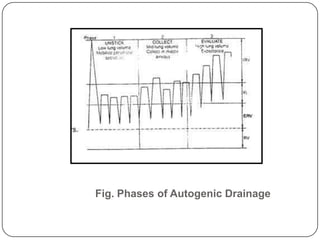
 UNSTICK SECRETIONS - breathe as much air out of your
 chest as you can then take a small breath in, using you
 tummy, feeling your breath at the bottom of your chest.
 You may hear secretions start to crackle. Resist any desire
 to cough.
 Repeat for at least 3 breaths.

 COLLECT SECRETIONS - as the crackle of secretions
 starts to get louder change to medium sized breaths in.
 Feel the breaths more in the middle of your chest.
 Repeat for at least 3 breaths.

 EVACUATE SECRETIONS - when the crackles are louder
 still, take long, slow, full breaths in to your absolute
 maximum.
 Repeat for at least 3 breaths.
Fig. Phases of Autogenic Drainage
 Level One: "Unsticking" of mucus by low lung
 level breathing. First, exhale completely; inhale a
 small to normal breath. Hold the breath for 1-3
 seconds, then exhale completely again. This step
 is repeated for 1-3 minutes. Repeat until crackles
 are heard when breathing out.
 Level Two: "Collecting" the mucus in larger or
 mid-sized airways. Take in a slightly larger
 breath. Hold for 1-3 seconds, and then
 exhale, but not as low as in level one. Repeat
 this step for 1-3 minutes. Listen for crackles at
 the end of exhaling. Continue for 2-3 more
 breaths. Then proceed to level III.
 Level Three: "Evacuating" the mucus in the
 central airways is achieved by breathing at
 normal to high volumes. Take in a slow deep
 breath. Hold the breath for 1-3 seconds. Exhale
 forcefully with open glottis. This moves the
 mucus into your mouth. Then spit it out into a
 container or tissue.
Each level requires about 2-3 minutes. The full
cycle takes 6-9 minutes. When mucus is felt in
the larger, central airways, do 2-3 effective "Huff"
type coughs. The Huff cough uses the mid to
high lung volumes of level III.
What not to do?
 Try to stop yourself from coughing until the
  last phase of AD when the secretions are
  higher up, and are more ready to be coughed
  up.

 Try to relax with breathing control if you feel the
  desire to cough or between cycles. AD breaths
  are very gentle so you should not start to feel
  tight or wheezy. AD should be done until your
  sputum is cleared, or you need a rest.
Flutter
Dr.Vinod K Ravaliya, MPT
(Cardiothoracic)
KMPIP, Shree Krishna Hospital
Karamsad
Flutter
 Developed in Switzerland, early 1990's.


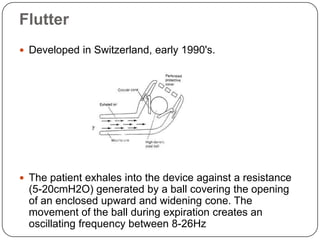
 The patient exhales into the device against a resistance
  (5-20cmH2O) generated by a ball covering the opening
  of an enclosed upward and widening cone. The
  movement of the ball during expiration creates an
  oscillating frequency between 8-26Hz
Theoretical Physiology

 Incorporates- positive expiratory pressure
  (adjusted by flow rate)
      - oral high frequency oscillation (angle of
         device)
      - active breathing exercises.
 Oscillating positive pressure prevents early
  airway collapse. The rhythmic variation of airway
  diameter and airflow promotes mucus
  mobilization. Oscillation approximates the cilia
  'beat' frequency of 12Hz.
Application

 Instructions say practice 2-3 times daily for 3-10
  minutes. Take a deep breath with a 2-3 second
  hold then exhale fully adjusting the angle and
  flowrate to attain optimal vibration. Perform 5-15
  then increase the depth of breath and speed of
  exhalation to precipitate cough and mucus
  expectoration.
 The Flutter can be incorporated into the ACBT
  during the thoracic expansion phase, but is
  difficult to combine with postural drainage.
  Appears to be less effective than postural
  drainage and manual techniques in large sputum
  producers.
Indications

 Retained secretions (particularly if sticky)
 Patients seeking freedom from postural drainage
  and assistance who prefer the upright posture for
  treatment, or where postural drainage and/or
  manual techniques are contra indicated.
 Good for children, stimulates cough.
Precautions

 Similar to those for PEP- untreated
 pneumothorax, severe haemoptysis, facial
 fractures/surgery, sinusitis or ear problems. Some
 clients report early uncontrolled coughing
 particularly in the presence of hyper-reactive
 airways
Thanks

Autogenic Drainage

  • 1.
    Autogenic Drainage Dr. Vinod Ravaliya, MPT (Cardiothoracic) KMPIP, Shree Krishna Hospital Karamsad
  • 2.
    Who developed it? "Self drainage" developed in Belgium in the late 1960's by Chevaillier (asthmatic patients). During 1980's utilized throughout Europe to treat patients with retention of secretions.
  • 3.
    What is AD? Autogenic Drainage, or ‘AD’, is a breathing technique that uses controlled breathing and minimal coughing to clear secretions from your chest. It involves hearing and feeling your secretions as you breathe out and controlling the desire to cough until secretions are high up and easily reached with minimal effort.
  • 4.
    How to Performit?  Begin with some gentle relaxed breaths known as breathing control.  Take a very slow deep breath in through your nose, to your absolute maximum possible.  Pause at the end of the full breath with your mouth slightly open and count for 3-4 seconds. Start by sitting in a comfortable upright position.  Breathe out through your mouth. This should be active (you can feel your tummy muscles tighten) but should not be forced.  You should listen and feel for secretions crackling as you breath out Are the crackles at the beginning, middle or end of your breath out? Beginning = high up in large tubes of your chest Middle = in the middle sized tubes End = in the small tubes
  • 5.
    3 Phases ofAD Technique  UNSTICK SECRETIONS - breathe as much air out of your chest as you can then take a small breath in, using you tummy, feeling your breath at the bottom of your chest. You may hear secretions start to crackle. Resist any desire to cough. Repeat for at least 3 breaths.  COLLECT SECRETIONS - as the crackle of secretions starts to get louder change to medium sized breaths in. Feel the breaths more in the middle of your chest. Repeat for at least 3 breaths.  EVACUATE SECRETIONS - when the crackles are louder still, take long, slow, full breaths in to your absolute maximum. Repeat for at least 3 breaths.
  • 6.
    Fig. Phases ofAutogenic Drainage
  • 7.
     Level One:"Unsticking" of mucus by low lung level breathing. First, exhale completely; inhale a small to normal breath. Hold the breath for 1-3 seconds, then exhale completely again. This step is repeated for 1-3 minutes. Repeat until crackles are heard when breathing out.
  • 8.
     Level Two:"Collecting" the mucus in larger or mid-sized airways. Take in a slightly larger breath. Hold for 1-3 seconds, and then exhale, but not as low as in level one. Repeat this step for 1-3 minutes. Listen for crackles at the end of exhaling. Continue for 2-3 more breaths. Then proceed to level III.
  • 9.
     Level Three:"Evacuating" the mucus in the central airways is achieved by breathing at normal to high volumes. Take in a slow deep breath. Hold the breath for 1-3 seconds. Exhale forcefully with open glottis. This moves the mucus into your mouth. Then spit it out into a container or tissue.
  • 10.
    Each level requiresabout 2-3 minutes. The full cycle takes 6-9 minutes. When mucus is felt in the larger, central airways, do 2-3 effective "Huff" type coughs. The Huff cough uses the mid to high lung volumes of level III.
  • 11.
    What not todo?  Try to stop yourself from coughing until the last phase of AD when the secretions are higher up, and are more ready to be coughed up.  Try to relax with breathing control if you feel the desire to cough or between cycles. AD breaths are very gentle so you should not start to feel tight or wheezy. AD should be done until your sputum is cleared, or you need a rest.
  • 14.
    Flutter Dr.Vinod K Ravaliya,MPT (Cardiothoracic) KMPIP, Shree Krishna Hospital Karamsad
  • 15.
    Flutter  Developed inSwitzerland, early 1990's.  The patient exhales into the device against a resistance (5-20cmH2O) generated by a ball covering the opening of an enclosed upward and widening cone. The movement of the ball during expiration creates an oscillating frequency between 8-26Hz
  • 16.
    Theoretical Physiology  Incorporates-positive expiratory pressure (adjusted by flow rate) - oral high frequency oscillation (angle of device) - active breathing exercises.  Oscillating positive pressure prevents early airway collapse. The rhythmic variation of airway diameter and airflow promotes mucus mobilization. Oscillation approximates the cilia 'beat' frequency of 12Hz.
  • 17.
    Application  Instructions saypractice 2-3 times daily for 3-10 minutes. Take a deep breath with a 2-3 second hold then exhale fully adjusting the angle and flowrate to attain optimal vibration. Perform 5-15 then increase the depth of breath and speed of exhalation to precipitate cough and mucus expectoration.  The Flutter can be incorporated into the ACBT during the thoracic expansion phase, but is difficult to combine with postural drainage. Appears to be less effective than postural drainage and manual techniques in large sputum producers.
  • 18.
    Indications  Retained secretions(particularly if sticky)  Patients seeking freedom from postural drainage and assistance who prefer the upright posture for treatment, or where postural drainage and/or manual techniques are contra indicated.  Good for children, stimulates cough.
  • 19.
    Precautions  Similar tothose for PEP- untreated pneumothorax, severe haemoptysis, facial fractures/surgery, sinusitis or ear problems. Some clients report early uncontrolled coughing particularly in the presence of hyper-reactive airways
  • 20.