Mohamed Elghazawy
EEAA / GEF Projects – The World Bank
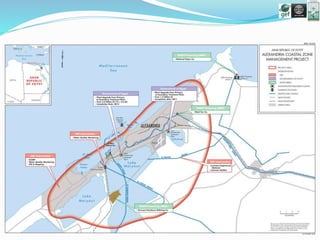
Alexandria Integrated Coastal Zone Management
And
Pollution Reduction Measures for Lake Maryute
Egyptian Environmental Affairs Agency
Alexandria Coastal Zone Management Project
IW- GEF Projects – The World Bank
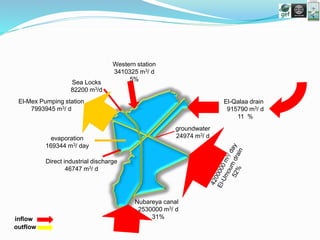
El-Qalaa drain
915790 m3/ d
11 %
Nubareya canal
2530000 m3/ d
31%
Western station
3410325 m3/ d
5%
Sea Locks
82200 m3/d
groundwater
24974 m3/ d
El-Mex Pumping station
7993945 m3/ d
evaporation
169344 m3/ day
inflow
outflow
Direct industrial discharge
46747 m3/ d
2014
USD 7.15 M
Ministry of state for environmental affairs
Egyptian Pollution Abatement Project
(Second Phase)
Background:
 The Egyptian Pollution Abatement Project (EPAP II) is one
of the main projects managed by Ministry of State for
Environmental Affairs (MSEA). Its main goals are to assist
the Egyptian industry to comply with the environmental
regulation, as well as improving its environmental
performance altogether.
 EPAP II is a project financed jointly by World Bank (WB),
the European Investment Bank (EIB), the Japanese Bank
for International Cooperation (JBIC) and the French
Development Agency, In addition to European
Commission (EC), the Government of Finland, and the
Government of Egypt.
6
Objectives of EPAP II:
 To provide soft financing package to support industrial
pollution abatement projects in industrial establishments
from both public & private sectors.
 To develop sustainable financial, technical and
institutional mechanisms for pollution abatement to
decrease the pollution loads in selected hot-spots areas in
greater Cairo and Alexandria governorates in order to
improve local environmental conditions.

 To introduce suitable environmental management
approaches, improve the quality of inspection activities,
develop technical capacity of environmental institutions
as well as participating banks and improve public
information, awareness and activity relating to industrial
environmental affairs in Egypt, particularly in Greater
Cairo and Alexandria Governorates.
7
Investment Component:
8
EPAP Co
financiers
Mission
Feb 09
The investment component provides soft financing package
to support industrial pollution abatement projects in
industrial establishments from both public and private
sectors.
The National Bank of Egypt (NBE) is the Apex bank
through which resources provided by the Co-financers will be
made available for financing environmental projects in
industrial establishments. The company should provide at
least 10% of the total investment to cover civil works, custom
& taxes.
The Co-financers package consists of a grant of 20% of the
total investments cost and 80% loan on commercial terms
with 1-2 years grace period and up to 8 years total repayment
period.
EPAP II Eligible Projects:
 Industrial investment projects in Greater Cairo and
Alexandria areas in all industrial sectors for:
 Pollution prevention projects: air emissions reduction,
work environment improvement and waste water
treatment and management.
 In process modification, in plant modification and end of
pipe treatment.
 Adoption of cleaner technology
 Improvement of energy efficiency and other resources in
addition to conversion to cleaner fuels.
 Hazardous Waste management projects.
 Environmental services projects.
9
Sub-project status:
Active projects and current status:
 At March 2014 there were 37 active project applications from 27
companies with a total value of US$ 175 million.
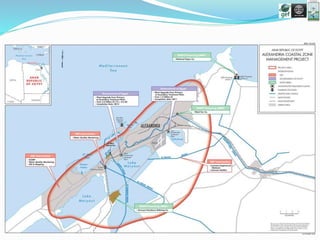
Alexandria Coastal Zone
Management Project (ACZMP)
2010 - 2015
Introduction
 The project is financed by a Grant from the Global
Environment Facility (GEF)) in the amount of US$ 7.15
million. Managed by the WB, and implemented by the
EEAA during the period of 2010-2015
 The main objective of the project is to reduce water
pollution reaches the Mediterranean from Lake
Maryout.
Current Environmental Problems
• Most of the lake area is covered by reeds which lead to a
decrease in the rates of dissolved oxygen and in fish
quantities in the lake.
• Decrease in the annual fish production which leads to social
and economic problems
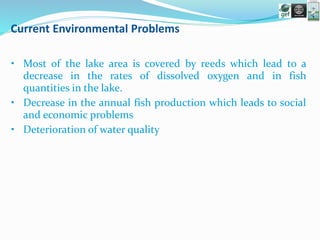
• Deterioration of water quality
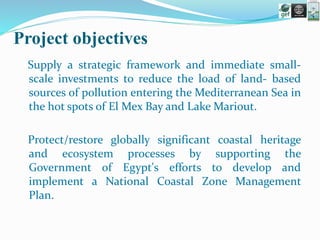
Project objectives
Supply a strategic framework and immediate small-
scale investments to reduce the load of land- based
sources of pollution entering the Mediterranean Sea in
the hot spots of El Mex Bay and Lake Mariout.
Protect/restore globally significant coastal heritage
and ecosystem processes by supporting the
Government of Egypt's efforts to develop and
implement a National Coastal Zone Management
Plan.
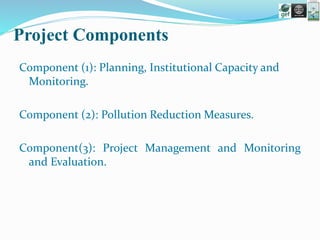
Project Components
Component (1): Planning, Institutional Capacity and
Monitoring.
Component (2): Pollution Reduction Measures.
Component(3): Project Management and Monitoring
and Evaluation.
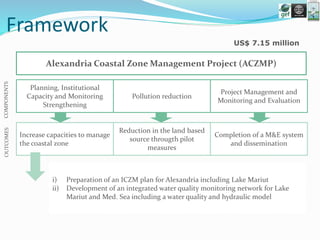
Framework
Alexandria Coastal Zone Management Project (ACZMP)
Planning, Institutional
Capacity and Monitoring
Strengthening
Pollution reduction
Project Management and
Monitoring and Evaluation
COMPONENTSOUTCOMES
Increase capacities to manage
the coastal zone
Reduction in the land based
source througth pilot
measures
Completion of a M&E system
and dissemination
i) Preparation of an ICZM plan for Alexandria including Lake Mariut
ii) Development of an integrated water quality monitoring network for Lake
Mariut and Med. Sea including a water quality and hydraulic model
US$ 7.15 million
Component (1): Planning, Institutional Capacity and
Monitoring.
The expected outcome is an increased capacity for various relevant
entities to manage the coastal zones in and around Alexandria .
The outputs for this component include
(i) A master plan for the management of the coastal zones of
Alexandria including Lake Mariout
(ii) Development of a water quality monitoring network for Lake
Mariout.
Component (1): Planning, Institutional Capacity and
Monitoring.
STATUS:
- ICZM Plan has been awarded to Spanish Institute (IH Cantapria)
for 24 months contract started in May 2013.
- Mariut Lake Hydrodynamic and WQ Mathematical Modeling
completed
- IT, GIS, and WQ equipment and materials
has been assessed for different partners and purchase is ongoing
- Comprehensive Social Baseline Study has been conducted for the
project area
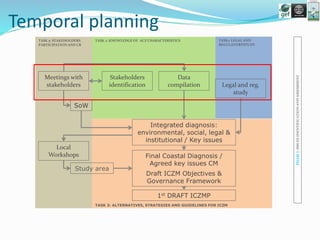
TASK1: LEGAL AND
REGULATORYSTUDY
TASK 2: KNOWLEDGE OF ACZ CHARACTERISTICSTASK 5: STAKEHOLDERS
PARTICIPATION AND CB
TASK 3: ALTERNATIVES, STRATEGIES AND GUIDELINES FOR ICZM
PHASEI:ISSUESIDENTIFICATIONANDASSESSMENT
Data
compilation
Local
Workshops
Legal and reg.
study
Stakeholders
identification
Meetings with
stakeholders
Temporal planning
SoW
Integrated diagnosis:
environmental, social, legal &
institutional / Key issues
Study area
Final Coastal Diagnosis /
Agreed key issues CM
Draft ICZM Objectives &
Governance Framework
1st DRAFT ICZMP
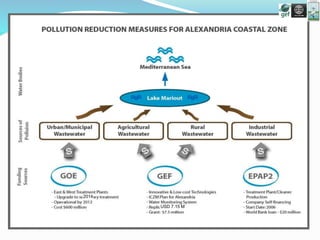
Component (2): Pollution Reduction Measures
The expected outcome is a reduction in the land based
source of pollution entering the Lake Mariout and
subsequently the Mediterranean Sea.
The output of this component is the completion of
small scale innovative pollution reduction measures
such as in-stream treatment (bio-films and aeration)
among others..
Component (2): Pollution Reduction Measures
STATUS:
- FS and DD has been awarded to Danish-Egyptian JV
(NYRAS & EcoConserv)
- FS completed and preferred pollution reduction
intervention has been determined and agreed upon
- DD is under going
January 2014 22
El MEX
EWTP
WWTP
Qalaa PS
1
1
2
Omoum
Nubaria
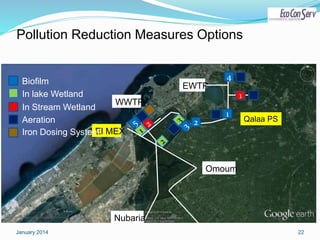
Pollution Reduction Measures Options
Biofilm
In lake Wetland
In Stream Wetland
4
Aeration
Iron Dosing System
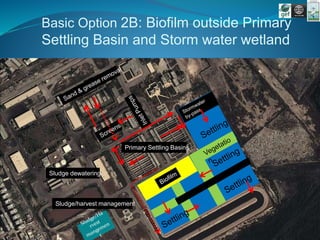
Sludge dewatering
Primary Settling Basins
Sludge/harvest management
Basic Option 2B: Biofilm outside Primary
Settling Basin and Storm water wetland
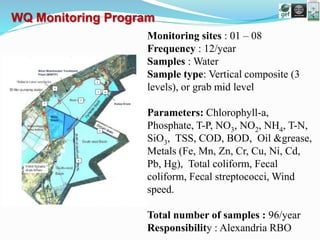
Monitoring sites : 01 – 08
Frequency : 12/year
Samples : Water
Sample type: Vertical composite (3
levels), or grab mid level
Parameters: Chlorophyll-a,
Phosphate, T-P, NO3, NO2, NH4, T-N,
SiO3, TSS, COD, BOD, Oil &grease,
Metals (Fe, Mn, Zn, Cr, Cu, Ni, Cd,
Pb, Hg), Total coliform, Fecal
coliform, Fecal streptococci, Wind
speed.
Total number of samples : 96/year
Responsibility : Alexandria RBO
WQ Monitoring Program
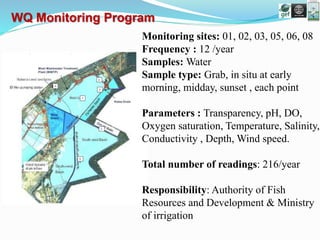
Monitoring sites: 01, 02, 03, 05, 06, 08
Frequency : 12 /year
Samples: Water
Sample type: Grab, in situ at early
morning, midday, sunset , each point
Parameters : Transparency, pH, DO,
Oxygen saturation, Temperature, Salinity,
Conductivity , Depth, Wind speed.
Total number of readings: 216/year
Responsibility: Authority of Fish
Resources and Development & Ministry
of irrigation
WQ Monitoring Program
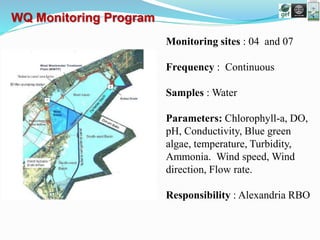
Monitoring sites : 04 and 07
Frequency : Continuous
Samples : Water
Parameters: Chlorophyll-a, DO,
pH, Conductivity, Blue green
algae, temperature, Turbidity,
Ammonia. Wind speed, Wind
direction, Flow rate.
Responsibility : Alexandria RBO
WQ Monitoring Program
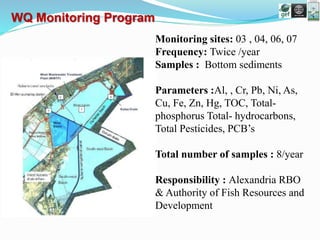
Monitoring sites: 03 , 04, 06, 07
Frequency: Twice /year
Samples : Bottom sediments
Parameters :Al, , Cr, Pb, Ni, As,
Cu, Fe, Zn, Hg, TOC, Total-
phosphorus Total- hydrocarbons,
Total Pesticides, PCB’s
Total number of samples : 8/year
Responsibility : Alexandria RBO
& Authority of Fish Resources and
Development
WQ Monitoring Program
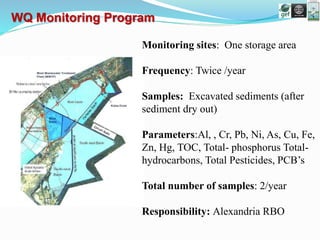
Monitoring sites: One storage area
Frequency: Twice /year
Samples: Excavated sediments (after
sediment dry out)
Parameters:Al, , Cr, Pb, Ni, As, Cu, Fe,
Zn, Hg, TOC, Total- phosphorus Total-
hydrocarbons, Total Pesticides, PCB’s
Total number of samples: 2/year
Responsibility: Alexandria RBO
WQ Monitoring Program
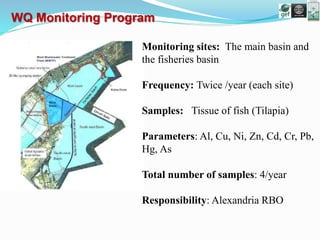
Monitoring sites: The main basin and
the fisheries basin
Frequency: Twice /year )each site)
Samples: Tissue of fish (Tilapia)
Parameters: Al, Cu, Ni, Zn, Cd, Cr, Pb,
Hg, As
Total number of samples: 4/year
Responsibility: Alexandria RBO
WQ Monitoring Program
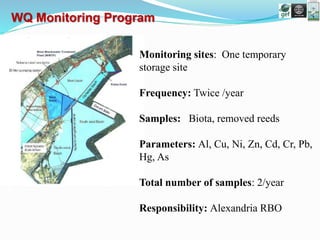
Monitoring sites: One temporary
storage site
Frequency: Twice /year
Samples: Biota, removed reeds
Parameters: Al, Cu, Ni, Zn, Cd, Cr, Pb,
Hg, As
Total number of samples: 2/year
Responsibility: Alexandria RBO
WQ Monitoring Program
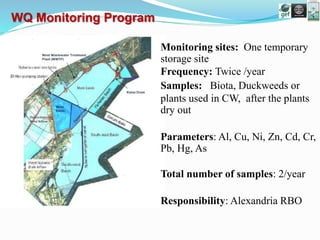
Monitoring sites: One temporary
storage site
Frequency: Twice /year
Samples: Biota, Duckweeds or
plants used in CW, after the plants
dry out
Parameters: Al, Cu, Ni, Zn, Cd, Cr,
Pb, Hg, As
Total number of samples: 2/year
Responsibility: Alexandria RBO
WQ Monitoring Program
Component (3): Project Management and Monitoring and
Evaluation
The expected outcome is the completion of a
comprehensive Monitoring and Evaluation scheme and the
documentation of the project results for the purpose of up-
scaling and replication.
Aczmp   athens, greece

Aczmp athens, greece

  • 1.
    Mohamed Elghazawy EEAA /GEF Projects – The World Bank Alexandria Integrated Coastal Zone Management And Pollution Reduction Measures for Lake Maryute Egyptian Environmental Affairs Agency Alexandria Coastal Zone Management Project IW- GEF Projects – The World Bank
  • 3.
    El-Qalaa drain 915790 m3/d 11 % Nubareya canal 2530000 m3/ d 31% Western station 3410325 m3/ d 5% Sea Locks 82200 m3/d groundwater 24974 m3/ d El-Mex Pumping station 7993945 m3/ d evaporation 169344 m3/ day inflow outflow Direct industrial discharge 46747 m3/ d
  • 4.
  • 5.
    Ministry of statefor environmental affairs Egyptian Pollution Abatement Project (Second Phase)
  • 6.
    Background:  The EgyptianPollution Abatement Project (EPAP II) is one of the main projects managed by Ministry of State for Environmental Affairs (MSEA). Its main goals are to assist the Egyptian industry to comply with the environmental regulation, as well as improving its environmental performance altogether.  EPAP II is a project financed jointly by World Bank (WB), the European Investment Bank (EIB), the Japanese Bank for International Cooperation (JBIC) and the French Development Agency, In addition to European Commission (EC), the Government of Finland, and the Government of Egypt. 6
  • 7.
    Objectives of EPAPII:  To provide soft financing package to support industrial pollution abatement projects in industrial establishments from both public & private sectors.  To develop sustainable financial, technical and institutional mechanisms for pollution abatement to decrease the pollution loads in selected hot-spots areas in greater Cairo and Alexandria governorates in order to improve local environmental conditions.  To introduce suitable environmental management approaches, improve the quality of inspection activities, develop technical capacity of environmental institutions as well as participating banks and improve public information, awareness and activity relating to industrial environmental affairs in Egypt, particularly in Greater Cairo and Alexandria Governorates. 7
  • 8.
    Investment Component: 8 EPAP Co financiers Mission Feb09 The investment component provides soft financing package to support industrial pollution abatement projects in industrial establishments from both public and private sectors. The National Bank of Egypt (NBE) is the Apex bank through which resources provided by the Co-financers will be made available for financing environmental projects in industrial establishments. The company should provide at least 10% of the total investment to cover civil works, custom & taxes. The Co-financers package consists of a grant of 20% of the total investments cost and 80% loan on commercial terms with 1-2 years grace period and up to 8 years total repayment period.
  • 9.
    EPAP II EligibleProjects:  Industrial investment projects in Greater Cairo and Alexandria areas in all industrial sectors for:  Pollution prevention projects: air emissions reduction, work environment improvement and waste water treatment and management.  In process modification, in plant modification and end of pipe treatment.  Adoption of cleaner technology  Improvement of energy efficiency and other resources in addition to conversion to cleaner fuels.  Hazardous Waste management projects.  Environmental services projects. 9
  • 10.
    Sub-project status: Active projectsand current status:  At March 2014 there were 37 active project applications from 27 companies with a total value of US$ 175 million.
  • 11.
    Alexandria Coastal Zone ManagementProject (ACZMP) 2010 - 2015
  • 12.
    Introduction  The projectis financed by a Grant from the Global Environment Facility (GEF)) in the amount of US$ 7.15 million. Managed by the WB, and implemented by the EEAA during the period of 2010-2015  The main objective of the project is to reduce water pollution reaches the Mediterranean from Lake Maryout.
  • 13.
    Current Environmental Problems •Most of the lake area is covered by reeds which lead to a decrease in the rates of dissolved oxygen and in fish quantities in the lake. • Decrease in the annual fish production which leads to social and economic problems • Deterioration of water quality
  • 14.
    Project objectives Supply astrategic framework and immediate small- scale investments to reduce the load of land- based sources of pollution entering the Mediterranean Sea in the hot spots of El Mex Bay and Lake Mariout. Protect/restore globally significant coastal heritage and ecosystem processes by supporting the Government of Egypt's efforts to develop and implement a National Coastal Zone Management Plan.
  • 15.
    Project Components Component (1):Planning, Institutional Capacity and Monitoring. Component (2): Pollution Reduction Measures. Component(3): Project Management and Monitoring and Evaluation.
  • 16.
    Framework Alexandria Coastal ZoneManagement Project (ACZMP) Planning, Institutional Capacity and Monitoring Strengthening Pollution reduction Project Management and Monitoring and Evaluation COMPONENTSOUTCOMES Increase capacities to manage the coastal zone Reduction in the land based source througth pilot measures Completion of a M&E system and dissemination i) Preparation of an ICZM plan for Alexandria including Lake Mariut ii) Development of an integrated water quality monitoring network for Lake Mariut and Med. Sea including a water quality and hydraulic model US$ 7.15 million
  • 17.
    Component (1): Planning,Institutional Capacity and Monitoring. The expected outcome is an increased capacity for various relevant entities to manage the coastal zones in and around Alexandria . The outputs for this component include (i) A master plan for the management of the coastal zones of Alexandria including Lake Mariout (ii) Development of a water quality monitoring network for Lake Mariout.
  • 18.
    Component (1): Planning,Institutional Capacity and Monitoring. STATUS: - ICZM Plan has been awarded to Spanish Institute (IH Cantapria) for 24 months contract started in May 2013. - Mariut Lake Hydrodynamic and WQ Mathematical Modeling completed - IT, GIS, and WQ equipment and materials has been assessed for different partners and purchase is ongoing - Comprehensive Social Baseline Study has been conducted for the project area
  • 19.
    TASK1: LEGAL AND REGULATORYSTUDY TASK2: KNOWLEDGE OF ACZ CHARACTERISTICSTASK 5: STAKEHOLDERS PARTICIPATION AND CB TASK 3: ALTERNATIVES, STRATEGIES AND GUIDELINES FOR ICZM PHASEI:ISSUESIDENTIFICATIONANDASSESSMENT Data compilation Local Workshops Legal and reg. study Stakeholders identification Meetings with stakeholders Temporal planning SoW Integrated diagnosis: environmental, social, legal & institutional / Key issues Study area Final Coastal Diagnosis / Agreed key issues CM Draft ICZM Objectives & Governance Framework 1st DRAFT ICZMP
  • 20.
    Component (2): PollutionReduction Measures The expected outcome is a reduction in the land based source of pollution entering the Lake Mariout and subsequently the Mediterranean Sea. The output of this component is the completion of small scale innovative pollution reduction measures such as in-stream treatment (bio-films and aeration) among others..
  • 21.
    Component (2): PollutionReduction Measures STATUS: - FS and DD has been awarded to Danish-Egyptian JV (NYRAS & EcoConserv) - FS completed and preferred pollution reduction intervention has been determined and agreed upon - DD is under going
  • 22.
    January 2014 22 ElMEX EWTP WWTP Qalaa PS 1 1 2 Omoum Nubaria Pollution Reduction Measures Options Biofilm In lake Wetland In Stream Wetland 4 Aeration Iron Dosing System
  • 23.
    Sludge dewatering Primary SettlingBasins Sludge/harvest management Basic Option 2B: Biofilm outside Primary Settling Basin and Storm water wetland
  • 24.
    Monitoring sites :01 – 08 Frequency : 12/year Samples : Water Sample type: Vertical composite (3 levels), or grab mid level Parameters: Chlorophyll-a, Phosphate, T-P, NO3, NO2, NH4, T-N, SiO3, TSS, COD, BOD, Oil &grease, Metals (Fe, Mn, Zn, Cr, Cu, Ni, Cd, Pb, Hg), Total coliform, Fecal coliform, Fecal streptococci, Wind speed. Total number of samples : 96/year Responsibility : Alexandria RBO WQ Monitoring Program
  • 25.
    Monitoring sites: 01,02, 03, 05, 06, 08 Frequency : 12 /year Samples: Water Sample type: Grab, in situ at early morning, midday, sunset , each point Parameters : Transparency, pH, DO, Oxygen saturation, Temperature, Salinity, Conductivity , Depth, Wind speed. Total number of readings: 216/year Responsibility: Authority of Fish Resources and Development & Ministry of irrigation WQ Monitoring Program
  • 26.
    Monitoring sites :04 and 07 Frequency : Continuous Samples : Water Parameters: Chlorophyll-a, DO, pH, Conductivity, Blue green algae, temperature, Turbidity, Ammonia. Wind speed, Wind direction, Flow rate. Responsibility : Alexandria RBO WQ Monitoring Program
  • 27.
    Monitoring sites: 03, 04, 06, 07 Frequency: Twice /year Samples : Bottom sediments Parameters :Al, , Cr, Pb, Ni, As, Cu, Fe, Zn, Hg, TOC, Total- phosphorus Total- hydrocarbons, Total Pesticides, PCB’s Total number of samples : 8/year Responsibility : Alexandria RBO & Authority of Fish Resources and Development WQ Monitoring Program
  • 28.
    Monitoring sites: Onestorage area Frequency: Twice /year Samples: Excavated sediments (after sediment dry out) Parameters:Al, , Cr, Pb, Ni, As, Cu, Fe, Zn, Hg, TOC, Total- phosphorus Total- hydrocarbons, Total Pesticides, PCB’s Total number of samples: 2/year Responsibility: Alexandria RBO WQ Monitoring Program
  • 29.
    Monitoring sites: Themain basin and the fisheries basin Frequency: Twice /year )each site) Samples: Tissue of fish (Tilapia) Parameters: Al, Cu, Ni, Zn, Cd, Cr, Pb, Hg, As Total number of samples: 4/year Responsibility: Alexandria RBO WQ Monitoring Program
  • 30.
    Monitoring sites: Onetemporary storage site Frequency: Twice /year Samples: Biota, removed reeds Parameters: Al, Cu, Ni, Zn, Cd, Cr, Pb, Hg, As Total number of samples: 2/year Responsibility: Alexandria RBO WQ Monitoring Program
  • 31.
    Monitoring sites: Onetemporary storage site Frequency: Twice /year Samples: Biota, Duckweeds or plants used in CW, after the plants dry out Parameters: Al, Cu, Ni, Zn, Cd, Cr, Pb, Hg, As Total number of samples: 2/year Responsibility: Alexandria RBO WQ Monitoring Program
  • 32.
    Component (3): ProjectManagement and Monitoring and Evaluation The expected outcome is the completion of a comprehensive Monitoring and Evaluation scheme and the documentation of the project results for the purpose of up- scaling and replication.