COASTAL AND MARINE
ENVIRONMENT PROTECTION
Ivica T
I i Trumbic, UNEP/MAP
        bi
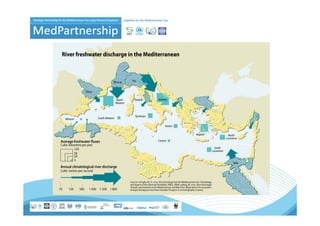
• The Mediterranean hydrologic drainage basin stretches over
  more than 5 million km2
                        km2.
• Rivers play a particular role in the water circulation,
  geochemistry and ultimately in sustaining the marine
  productivity in the Mediterranean Sea
• 10 largest rivers of the Mediterranean Sea are the Rhone,
  Po, D i Buna, Nile, N
  P Drin- B         Nil Neretva, Eb Tib Adi
                                   Ebro, Tiber, Adige, S h
                                                       Seyhan
  and Ceyhan
• Of the three continents (Europe, Asia, and Africa) which
                           (Europe Asia
  discharge into the Mediterranean Sea, dominant
  contributions are from Europe
• About 25% of total discharge occurs in the Adriatic
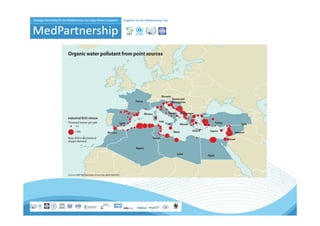
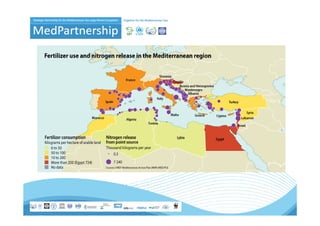
•   Many developed coastal areas of the Mediterranean suffer from the effects of an
    increased influx of dissolved nitrogen and phosphorous
•   Sources i l d untreated h
    S          include t t d human sewage, animal waste, t
                                                    i l       t transportation,
                                                                        t ti
    fertilizers, and industrial discharges
•   For nitrogen the largest emitters are urban wastewater treatment (31%),
    livestock farming (
                      g (19%), and the metal industry (11%)
                              ),                    y(     )
•   The main sources of phosphorus emissions are from fertilizer manufacturing
    (63%), livestock farming (20%), and urban wastewater treatment (8%)
•   Agriculture has been identified as the largest non-point source of pollutants to
    the
    th
•   The basins draining into the Mediterranean Sea cover a total area of about 1.9
    million km2 (excluding the upper Nile Basin) and include 24 countries
•   Nutrients in run-off reach the sea via transport through groundwater wetlands
                  run off                                     groundwater, wetlands,
    rivers and lakes..
•   While the overall inputs of nitrogen (about 1.5-4.5 million tonnes per year) and
    phosphorous (about 0.1-0.4 million tonnes per year) are relatively low compared
    to other seas (e.g., Black Sea), nonetheless, these nutrients are problematic in
                    (e g         Sea) nonetheless
    coastal areas.
• Barcelona Convention and its Protocols
• Pollution from Land-Based Sources and Activities
  (adopted 1980, in force 1983 (LBS Protocol,
  amended 1996, in force 2008)),
• Integrated Coastal Zone Management (
      g                          g       (ICZM
  Protocol, adopted 2008, in force 2011)
What is MedPartnership?
A collective effort for the protection of the
environmental resources of the Mediterranean

It is led by UNEP/MAP and the World Bank, co-
funded by GEF and involving other relevant
international cooperation Agencies, International
Financial Institutions (IFIs) and bilateral and
multilateral donors
Objectives
  j
Implement the Strategic Action Programmes and National
Action Plans

Implement ICZM Protocol

Leverage long-term financing for environmental protection

Ensure, through the replication process, that the follow-up
embedded in the Barcelona Convention and MAP system
What?
Partnership: UNEP/MAP and World Bank
12 countries and Palestine Authority
12 executing partners
6 big donors + countries’ and agencies co-financing
               countries      agencies’
2 major components: Regional Project and Investment
Fund
4 sub-components and more than 10 investment projects
46 demonstration projects
50 mil. USD Regional Project; 75 mil. USD Investment Fund
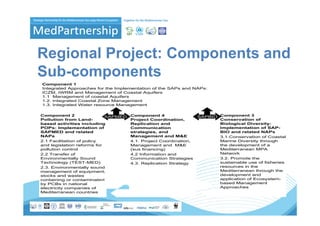
Regional Project: Components and
Sub-components
Component 1
Integrated Approaches for the Implementation of th SAP and NAPs:
I t     t d A      h    f  th I  l    t ti    f the SAPs d NAP
ICZM, IWRM and Management of Coastal Aquifers
1.1 Management of coastal Aquifers
1.2. Integrated Coastal Zone Management
1.3. Integrated Water resource Management


Component 2                  SAPMED   Component 4                  SAPBIO Component 3
Pollution from Land-                  Project Coordination,               Conservation of
based activities including            Replication and                     Biological Diversity:
POPs: Implementation of               Communication                       Implementation of SAP-
SAPMED and related                    strategies, and                     BIO and related NAPs
NAPs                                  Management and M&E                  3.1.Conservation of Coastal
2.1 Facilitation of policy            4.1. Project Coordination,          Marine Diversity through
and legislation reforms for           Management and M&E                  the development of a
pollution control                     (sus financing)                     Mediterranean MPA
2.2 Transfer of                       4.2 Information and                 Network
Environmentally Sound                 Communication Strategies            3.2. Promote the
Technology (TEST-MED)
           gy (            )          4.3. Replication Strategy           sustainable use of fisheries
2.3. Environmentally sound                                                resources in the
management of equipment,                                                  Mediterranean through the
stocks and wastes                                                         development and
containing or contaminated                                                application of Ecosystem-
by PCBs in national                                                       based Management
electricity companies of
          y     p                                                         Approaches
Mediterranean countries
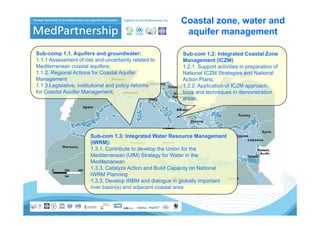
Coastal zone, water and
                                                           aquifer management
                                                            q           g

Sub-comp 1.1. Aquifers and groundwater:                    Sub-com 1.2: Integrated Coastal Zone
1.1.1 Assessment of risk and uncertainty related to        Management (ICZM)
Mediterranean coastal aquifers;                            1.2.1. Support activities in preparation of
1.1.2. Regional Actions for Coastal Aquifer                National ICZM Strategies and National
Management                                                 Action Plans;
1.1.3.Legislative, institutional and p
        g        ,                   policy reforms
                                          y                1.2.2. Application of ICZM approach,
for Coastal Aquifer Management;                            tools and techniques in demonstration
                                                           areas;


                       Sub-com 1.3: Integrated Water Resource Management
                                           g                             g
                       (IWRM):
                       1.3.1. Contribute to develop the Union for the
                       Mediterranean (UfM) Strategy for Water in the
                       Mediterranean
                       1.3.3. Catalyze Action and Build Capacity on National
                       IWRM Planning
                       1.3.3. Develop IRBM and dialogue in globally important
                       river basin(s) and adjacent coastal area
                                  ( )        j
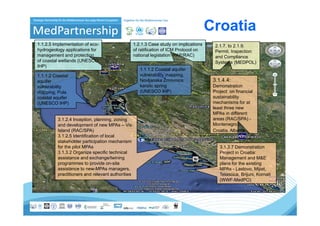
Croatia
1.1.2.5 Implementation of eco-                     1.2.1.3 Case study on implications     2.1.7. to 2.1.9.
hydrogeology applications for                      of ratification of ICM Protocol on     Permit, Inspection
management and protection                          national legislation (PAP/RAC)         and Compliance
of coastal wetlands (UNESCO                                                               Systems (MEDPOL)
IHP)
                                                      1.1.1.2 Coastal aquifer
1.1.1.2 Coastal                                       vulnerability mapping,
aquifer                                               Novljanska Žrnovnica               3.1.4.4:
vulnerability                                         karstic spring
                                                       a st c sp g                       Demonstration
mapping, Pula                                         (UNESCO IHP)                       Project on financial
coastal aquifer                                                                          sustainability
(UNESCO IHP)                                                                             mechanisms for at
                                                                                         least three new
                                                                                         MPAs in different
          3.1.2.4 Inception, planning, zoning                                            areas (RAC/SPA) -
          and development of new MPAs – Vis                                              Montenegro,
          Island (RAC/SPA)                                                               Croatia, Albania
          3.1.2.5 Identification of local
          stakeholder participation mechanism
          for the pilot MPAs                                                                3.1.3.7 Demonstration
          3.1.3.2 Organize specific technical                                               Project in Croatia:
          assistance and exchange/twining                                                   Management and M&E
          programmes to provide on-site
                                     on site                                                plans for the existing
          assistance to new-MPAs managers,                                                  MPAs - Lastovo, Mijiet,
          practitioners and relevant authorities                                            Telascica, Brijuni, Kornati
                                                                                            (WWF-MedPO)
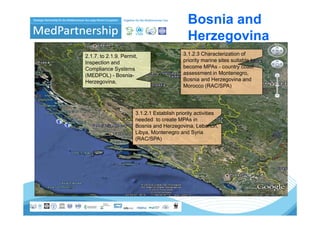
Bosnia and
                                              Herzegovina
2.1.7. to 2.1.9. Permit,                    3.1.2.3 Characterization of
Inspection and                              priority marine sites suitable to
Compliance Systems                          become MPAs - country coast
(MEDPOL) - Bosnia-                          assessment in Montenegro,
Herzegovina,                                Bosnia and Herzegovina and
                                            Morocco (RAC/SPA)


                       3.1.2.1
                       3 1 2 1 Establish priority activities
                       needed to create MPAs in
                       Bosnia and Herzegovina, Lebanon,
                       Libya, Montenegro and Syria
                       (RAC/SPA)
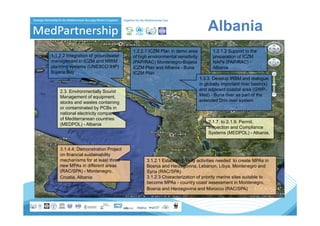
Albania
                                     1.2.2.1 ICZM Plan in demo area             1.2.1.2 Support to the
1.1.2.2 Integration of groundwater   of high environmental sensitivity          preparation of ICZM
management in ICZM and IWRM          (PAP/RAC) Montenegro-Bojana
                                                 Montenegro Bojana              NAPs (PAP/RAC) -
planning systems (UNESCO IHP)        ICZM Plan and Albania - Buna               Albania
Bojana Bay                           ICZM Plan
                                                                         1.3.3. Develop IRBM and dialogue
                                                                         in globally important river basin(s)
    2.3. Environmentally Sound                                           and adjacent coastal area (GWP-
    Management of equipment,                                             Med) - Buna river as part of the
    stocks and wastes containing                                         extended Drin river system
    or contaminated by PCBs in
    national electricity companies
    of Mediterranean countries
                                                                             2.1.7. to 2.1.9. Permit,
    (MEDPOL) - Albania
                                                                             Inspection and Compliance
                                                                             Systems (MEDPOL) - Albania,


    3.1.4.4: Demonstration Project
    on financial sustainability
    mechanisms for at least three          3.1.2.1 Establish priority activities needed to create MPAs in
    new MPA i diff
         MPAs in different areas
                          t                Bosnia and Herzegovina, Lebanon, Libya, Montenegro and
    (RAC/SPA) - Montenegro,                Syria (RAC/SPA)
    Croatia, Albania                       3.1.2.3 Characterization of priority marine sites suitable to
                                           become MPAs - country coast assessment in Montenegro,
                                           Bosnia and Herzegovina and Morocco (RAC/SPA)
Ecosystem Approach
•   Strategy for integrated management of land water and living resources
                                            land,
    that promotes conservation and sustainable use in an equitable way
    (CBD)
•   Places human needs at the centre of biodiversity management It aims
                                                      management.
    to manage the ecosystem, based on the multiple functions that
    ecosystem perform and the multiple uses that are made of these
    functions.
    functions The ecosystem aproach does not aim for short-term economic
                                                       short term
    gains, but aims to optimize the use of an ecosystem without damaging it
    (IUCN)
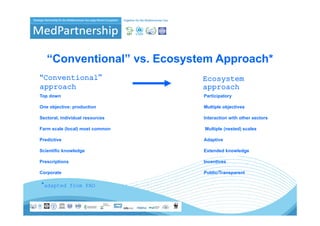
“Conventional” vs. Ecosystem Approach*
    Conventional                Approach
“Conventional”                   Ecosystem
approach                         approach
Top down                         Participatory

One objective: production        Multiple objectives

Sectoral, individual resources   Interaction with other sectors

Farm scale (local) most common   Multiple (nested) scales

Predictive
P di ti                          Adaptive
                                 Ad ti

Scientific knowledge             Extended knowledge

Prescriptions                    Incentives

Corporate                        Public/Transparent

*adapted        from FAO
MAP Project: Road Map
1. Definition f
1 D fi iti of an ecological Vi i f th M dit
                        l i l Vision for the Mediterranean.
2. Setting of common Mediterranean strategic goals.
3. Identification of important ecosystem properties and assessment of
   ecological status and pressures.
       l i l t t         d
4. Development of a set of ecological objectives corresponding to the
   Vision and strategic goals.
5. Derivation f
5 D i ti of operational objectives with i di t
                        ti   l bj ti      ith indicators and t
                                                           d target l
                                                                  t levels.
                                                                        l
6. Revision of existing monitoring programmes for ongoing
   assessment and regular updating of targets.
7. Development
7 De elopment and review of rele ant action plans and programmes
                       re ie     relevant
Vision
“ A healthy Mediterranean with marine and coastal
  ecosystems that are productive and biologically
  diverse for the benefit of present and future
  generations”
Integrated Coastal Zone
                    Management
                    M          t
•   ICZM is a continuous proactive and adaptive process of resource
               continuous,
    management for environmentally sustainable development in coastal
    areas
•   ICZM requires a multidisciplinary approach, solution of problems within
                i         ltidi i li              h     l ti   f   bl     ithi
    “sectors” instead of transferring the problems to other “sectors”,
    participation of all interested parties, as well as integration among
    sectors, institutions and government levels
•   ICZM requires a comprehensive understanding of the relationships
    between coastal resources, their uses and the mutual impacts of
                                                                 p
    development on the economy and the environment
Guidelines
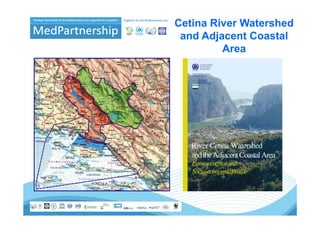
Cetina River Watershed
 and Adjacent Coastal
         Area
Basic Principles of ICARM
                p
Respect the integrity of river basin and coastal ecosystems
accepting limits on the use of resources
    p g
Ensure the strategic importance of renewable resources for
socio-economic development
Allow f the multiple use of resources integrating
All   for h   li l        f           i       i
complementary activities and regulating/separating conflicting
ones
Ensure multi-sectoral and multi-level integration in decision
making linking broad scale management to local level
interventions
Allow for participation of all actors particularly local population
in the planning p
       p      g process to assure effective management
                                                     g
Focus for ICARM
At the local scale ICARM would be focused on:
     • controlling key processes especially water and material/ sediment
       flows
     • managing critical socio-economic issues/factors;
     • controlling waste/pollution
     • assuring quantity and quality of water arriving downstream which is
       important for coastal sediment budgets and for the conservation of
       habitats, wetlands, deltas, estuaries
     • protecting areas of high ecological value of mutual interest such as
       wetlands, river d l
            l d i       deltas and estuaries
                                 d       i
     • siting of projects and structures
At the national scale ICARM would be focused on:
     • establishing a mechanism for co-ordinating goals and decisions of
       all stakeholders
     • integrating socio-economic considerations with natural and
       environmental ones
     • identifying and evaluating human pressures
     • linking broader issues/changes with river basin and coastal
       systems
At the international scale ICARM would focus on:
     • establishing resource monitoring schemes
          t bli hi               it i     h
     • establishing large ecosystem management schemes
Ivica Trumbic
               Project Manager
               UNEP/MAP GEF
    Strategic Partnership for the
          g             p
    Mediterranean Large Marine
                     Ecosystem
              MedPartnership
                           p
              Athens, GREECE

www.medpartnership.org


            Thank you!

Int. Roundtable on Transboundary Waters Management, 15-16.12.2011, Ivica Trumbic

  • 1.
    COASTAL AND MARINE ENVIRONMENTPROTECTION Ivica T I i Trumbic, UNEP/MAP bi
  • 3.
    • The Mediterraneanhydrologic drainage basin stretches over more than 5 million km2 km2. • Rivers play a particular role in the water circulation, geochemistry and ultimately in sustaining the marine productivity in the Mediterranean Sea • 10 largest rivers of the Mediterranean Sea are the Rhone, Po, D i Buna, Nile, N P Drin- B Nil Neretva, Eb Tib Adi Ebro, Tiber, Adige, S h Seyhan and Ceyhan • Of the three continents (Europe, Asia, and Africa) which (Europe Asia discharge into the Mediterranean Sea, dominant contributions are from Europe • About 25% of total discharge occurs in the Adriatic
  • 5.
    • Many developed coastal areas of the Mediterranean suffer from the effects of an increased influx of dissolved nitrogen and phosphorous • Sources i l d untreated h S include t t d human sewage, animal waste, t i l t transportation, t ti fertilizers, and industrial discharges • For nitrogen the largest emitters are urban wastewater treatment (31%), livestock farming ( g (19%), and the metal industry (11%) ), y( ) • The main sources of phosphorus emissions are from fertilizer manufacturing (63%), livestock farming (20%), and urban wastewater treatment (8%) • Agriculture has been identified as the largest non-point source of pollutants to the th • The basins draining into the Mediterranean Sea cover a total area of about 1.9 million km2 (excluding the upper Nile Basin) and include 24 countries • Nutrients in run-off reach the sea via transport through groundwater wetlands run off groundwater, wetlands, rivers and lakes.. • While the overall inputs of nitrogen (about 1.5-4.5 million tonnes per year) and phosphorous (about 0.1-0.4 million tonnes per year) are relatively low compared to other seas (e.g., Black Sea), nonetheless, these nutrients are problematic in (e g Sea) nonetheless coastal areas.
  • 8.
    • Barcelona Conventionand its Protocols • Pollution from Land-Based Sources and Activities (adopted 1980, in force 1983 (LBS Protocol, amended 1996, in force 2008)), • Integrated Coastal Zone Management ( g g (ICZM Protocol, adopted 2008, in force 2011)
  • 9.
    What is MedPartnership? Acollective effort for the protection of the environmental resources of the Mediterranean It is led by UNEP/MAP and the World Bank, co- funded by GEF and involving other relevant international cooperation Agencies, International Financial Institutions (IFIs) and bilateral and multilateral donors
  • 10.
    Objectives j Implementthe Strategic Action Programmes and National Action Plans Implement ICZM Protocol Leverage long-term financing for environmental protection Ensure, through the replication process, that the follow-up embedded in the Barcelona Convention and MAP system
  • 11.
    What? Partnership: UNEP/MAP andWorld Bank 12 countries and Palestine Authority 12 executing partners 6 big donors + countries’ and agencies co-financing countries agencies’ 2 major components: Regional Project and Investment Fund 4 sub-components and more than 10 investment projects 46 demonstration projects 50 mil. USD Regional Project; 75 mil. USD Investment Fund
  • 12.
    Regional Project: Componentsand Sub-components Component 1 Integrated Approaches for the Implementation of th SAP and NAPs: I t t d A h f th I l t ti f the SAPs d NAP ICZM, IWRM and Management of Coastal Aquifers 1.1 Management of coastal Aquifers 1.2. Integrated Coastal Zone Management 1.3. Integrated Water resource Management Component 2 SAPMED Component 4 SAPBIO Component 3 Pollution from Land- Project Coordination, Conservation of based activities including Replication and Biological Diversity: POPs: Implementation of Communication Implementation of SAP- SAPMED and related strategies, and BIO and related NAPs NAPs Management and M&E 3.1.Conservation of Coastal 2.1 Facilitation of policy 4.1. Project Coordination, Marine Diversity through and legislation reforms for Management and M&E the development of a pollution control (sus financing) Mediterranean MPA 2.2 Transfer of 4.2 Information and Network Environmentally Sound Communication Strategies 3.2. Promote the Technology (TEST-MED) gy ( ) 4.3. Replication Strategy sustainable use of fisheries 2.3. Environmentally sound resources in the management of equipment, Mediterranean through the stocks and wastes development and containing or contaminated application of Ecosystem- by PCBs in national based Management electricity companies of y p Approaches Mediterranean countries
  • 13.
    Coastal zone, waterand aquifer management q g Sub-comp 1.1. Aquifers and groundwater: Sub-com 1.2: Integrated Coastal Zone 1.1.1 Assessment of risk and uncertainty related to Management (ICZM) Mediterranean coastal aquifers; 1.2.1. Support activities in preparation of 1.1.2. Regional Actions for Coastal Aquifer National ICZM Strategies and National Management Action Plans; 1.1.3.Legislative, institutional and p g , policy reforms y 1.2.2. Application of ICZM approach, for Coastal Aquifer Management; tools and techniques in demonstration areas; Sub-com 1.3: Integrated Water Resource Management g g (IWRM): 1.3.1. Contribute to develop the Union for the Mediterranean (UfM) Strategy for Water in the Mediterranean 1.3.3. Catalyze Action and Build Capacity on National IWRM Planning 1.3.3. Develop IRBM and dialogue in globally important river basin(s) and adjacent coastal area ( ) j
  • 14.
    Croatia 1.1.2.5 Implementation ofeco- 1.2.1.3 Case study on implications 2.1.7. to 2.1.9. hydrogeology applications for of ratification of ICM Protocol on Permit, Inspection management and protection national legislation (PAP/RAC) and Compliance of coastal wetlands (UNESCO Systems (MEDPOL) IHP) 1.1.1.2 Coastal aquifer 1.1.1.2 Coastal vulnerability mapping, aquifer Novljanska Žrnovnica 3.1.4.4: vulnerability karstic spring a st c sp g Demonstration mapping, Pula (UNESCO IHP) Project on financial coastal aquifer sustainability (UNESCO IHP) mechanisms for at least three new MPAs in different 3.1.2.4 Inception, planning, zoning areas (RAC/SPA) - and development of new MPAs – Vis Montenegro, Island (RAC/SPA) Croatia, Albania 3.1.2.5 Identification of local stakeholder participation mechanism for the pilot MPAs 3.1.3.7 Demonstration 3.1.3.2 Organize specific technical Project in Croatia: assistance and exchange/twining Management and M&E programmes to provide on-site on site plans for the existing assistance to new-MPAs managers, MPAs - Lastovo, Mijiet, practitioners and relevant authorities Telascica, Brijuni, Kornati (WWF-MedPO)
  • 15.
    Bosnia and Herzegovina 2.1.7. to 2.1.9. Permit, 3.1.2.3 Characterization of Inspection and priority marine sites suitable to Compliance Systems become MPAs - country coast (MEDPOL) - Bosnia- assessment in Montenegro, Herzegovina, Bosnia and Herzegovina and Morocco (RAC/SPA) 3.1.2.1 3 1 2 1 Establish priority activities needed to create MPAs in Bosnia and Herzegovina, Lebanon, Libya, Montenegro and Syria (RAC/SPA)
  • 16.
    Albania 1.2.2.1 ICZM Plan in demo area 1.2.1.2 Support to the 1.1.2.2 Integration of groundwater of high environmental sensitivity preparation of ICZM management in ICZM and IWRM (PAP/RAC) Montenegro-Bojana Montenegro Bojana NAPs (PAP/RAC) - planning systems (UNESCO IHP) ICZM Plan and Albania - Buna Albania Bojana Bay ICZM Plan 1.3.3. Develop IRBM and dialogue in globally important river basin(s) 2.3. Environmentally Sound and adjacent coastal area (GWP- Management of equipment, Med) - Buna river as part of the stocks and wastes containing extended Drin river system or contaminated by PCBs in national electricity companies of Mediterranean countries 2.1.7. to 2.1.9. Permit, (MEDPOL) - Albania Inspection and Compliance Systems (MEDPOL) - Albania, 3.1.4.4: Demonstration Project on financial sustainability mechanisms for at least three 3.1.2.1 Establish priority activities needed to create MPAs in new MPA i diff MPAs in different areas t Bosnia and Herzegovina, Lebanon, Libya, Montenegro and (RAC/SPA) - Montenegro, Syria (RAC/SPA) Croatia, Albania 3.1.2.3 Characterization of priority marine sites suitable to become MPAs - country coast assessment in Montenegro, Bosnia and Herzegovina and Morocco (RAC/SPA)
  • 17.
    Ecosystem Approach • Strategy for integrated management of land water and living resources land, that promotes conservation and sustainable use in an equitable way (CBD) • Places human needs at the centre of biodiversity management It aims management. to manage the ecosystem, based on the multiple functions that ecosystem perform and the multiple uses that are made of these functions. functions The ecosystem aproach does not aim for short-term economic short term gains, but aims to optimize the use of an ecosystem without damaging it (IUCN)
  • 18.
    “Conventional” vs. EcosystemApproach* Conventional Approach “Conventional” Ecosystem approach approach Top down Participatory One objective: production Multiple objectives Sectoral, individual resources Interaction with other sectors Farm scale (local) most common Multiple (nested) scales Predictive P di ti Adaptive Ad ti Scientific knowledge Extended knowledge Prescriptions Incentives Corporate Public/Transparent *adapted from FAO
  • 19.
    MAP Project: RoadMap 1. Definition f 1 D fi iti of an ecological Vi i f th M dit l i l Vision for the Mediterranean. 2. Setting of common Mediterranean strategic goals. 3. Identification of important ecosystem properties and assessment of ecological status and pressures. l i l t t d 4. Development of a set of ecological objectives corresponding to the Vision and strategic goals. 5. Derivation f 5 D i ti of operational objectives with i di t ti l bj ti ith indicators and t d target l t levels. l 6. Revision of existing monitoring programmes for ongoing assessment and regular updating of targets. 7. Development 7 De elopment and review of rele ant action plans and programmes re ie relevant
  • 20.
    Vision “ A healthyMediterranean with marine and coastal ecosystems that are productive and biologically diverse for the benefit of present and future generations”
  • 21.
    Integrated Coastal Zone Management M t • ICZM is a continuous proactive and adaptive process of resource continuous, management for environmentally sustainable development in coastal areas • ICZM requires a multidisciplinary approach, solution of problems within i ltidi i li h l ti f bl ithi “sectors” instead of transferring the problems to other “sectors”, participation of all interested parties, as well as integration among sectors, institutions and government levels • ICZM requires a comprehensive understanding of the relationships between coastal resources, their uses and the mutual impacts of p development on the economy and the environment
  • 22.
  • 23.
    Cetina River Watershed and Adjacent Coastal Area
  • 24.
    Basic Principles ofICARM p Respect the integrity of river basin and coastal ecosystems accepting limits on the use of resources p g Ensure the strategic importance of renewable resources for socio-economic development Allow f the multiple use of resources integrating All for h li l f i i complementary activities and regulating/separating conflicting ones Ensure multi-sectoral and multi-level integration in decision making linking broad scale management to local level interventions Allow for participation of all actors particularly local population in the planning p p g process to assure effective management g
  • 25.
    Focus for ICARM Atthe local scale ICARM would be focused on: • controlling key processes especially water and material/ sediment flows • managing critical socio-economic issues/factors; • controlling waste/pollution • assuring quantity and quality of water arriving downstream which is important for coastal sediment budgets and for the conservation of habitats, wetlands, deltas, estuaries • protecting areas of high ecological value of mutual interest such as wetlands, river d l l d i deltas and estuaries d i • siting of projects and structures
  • 26.
    At the nationalscale ICARM would be focused on: • establishing a mechanism for co-ordinating goals and decisions of all stakeholders • integrating socio-economic considerations with natural and environmental ones • identifying and evaluating human pressures • linking broader issues/changes with river basin and coastal systems
  • 27.
    At the internationalscale ICARM would focus on: • establishing resource monitoring schemes t bli hi it i h • establishing large ecosystem management schemes
  • 28.
    Ivica Trumbic Project Manager UNEP/MAP GEF Strategic Partnership for the g p Mediterranean Large Marine Ecosystem MedPartnership p Athens, GREECE www.medpartnership.org Thank you!