TEMPOROMANDIBULAR JOINT
PRESENTED BY: Dr. HARDI GANDHI
GUIDED BY: Dr. MONALI SHAH
INDEX:
 INTODUCTION
 PECULARITY OF TMJ
 DEVELOPMENT
 STRUCTURAL ANATOMY
 RELATIONS OF TMJ
 MOVEMENTS OF TMJ
 AGE CHANGES AND DISORDERS
 EXAMINATION AND PALPATION OF TMJ
 CONCLUSION
 REFERENCES
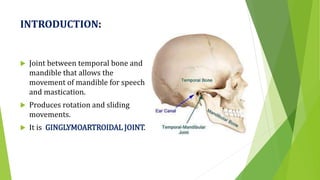
INTRODUCTION:
 Joint between temporal bone and
mandible that allows the
movement of mandible for speech
and mastication.
 Produces rotation and sliding
movements.
 It is GINGLYMOARTROIDAL JOINT.
TMJ IS UNIQUE!
 Bilateral diarthrosis – right & left function together
 Articular surface covered by fibrocartilage instead of hyaline
cartilage
 Only joint in human body to have a rigid endpoint of closure
(that of the teeth making occlusal contact).
 Only mobile joint of skull.
DEVELOPMENT:
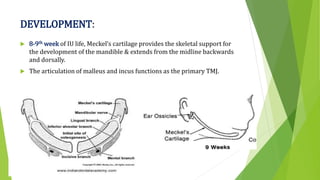
 8-9th week of IU life, Meckel’s cartilage provides the skeletal support for
the development of the mandible & extends from the midline backwards
and dorsally.
 The articulation of malleus and incus functions as the primary TMJ.
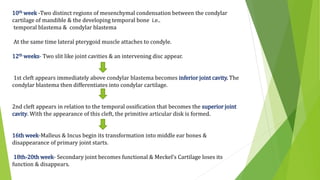
10th week -Two distinct regions of mesenchymal condensation between the condylar
cartilage of mandible & the developing temporal bone i.e..
temporal blastema & condylar blastema
At the same time lateral pterygoid muscle attaches to condyle.
12th weeks- Two slit like joint cavities & an intervening disc appear.
1st cleft appears immediately above condylar blastema becomes inferior joint cavity. The
condylar blastema then differentiates into condylar cartilage.
2nd cleft appears in relation to the temporal ossification that becomes the superior joint
cavity. With the appearance of this cleft, the primitive articular disk is formed.
16th week-Malleus & Incus begin its transformation into middle ear bones &
disappearance of primary joint starts.
18th-20th week- Secondary joint becomes functional & Meckel’s Cartilage loses its
function & disappears.
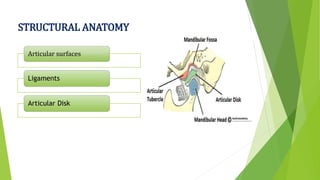
STRUCTURAL ANATOMY
Articular surfaces
Ligaments
Articular Disk
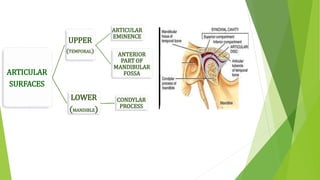
ARTICULAR
SURFACES
UPPER
(TEMPORAL)
ARTICULAR
EMINENCE
ANTERIOR
PART OF
MANDIBULAR
FOSSA
LOWER
(MANDIBLE)
CONDYLAR
PROCESS
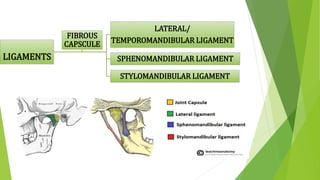
LIGAMENTS
LATERAL/
TEMPOROMANDIBULAR LIGAMENT
SPHENOMANDIBULAR LIGAMENT
STYLOMANDIBULAR LIGAMENT
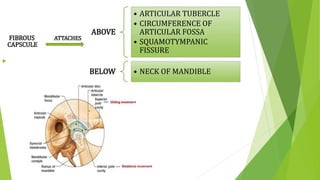
FIBROUS
CAPSCULE

ABOVE
• ARTICULAR TUBERCLE
• CIRCUMFERENCE OF
ARTICULAR FOSSA
• SQUAMOTYMPANIC
FISSURE
BELOW • NECK OF MANDIBLE
CAPSCULE
FIBROUS ATTACHES
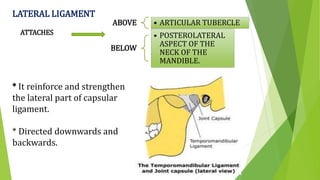
LATERAL LIGAMENT
ATTACHES
* It reinforce and strengthen
the lateral part of capsular
ligament.
* Directed downwards and
backwards.
ABOVE • ARTICULAR TUBERCLE
BELOW
• POSTEROLATERAL
ASPECT OF THE
NECK OF THE
MANDIBLE.
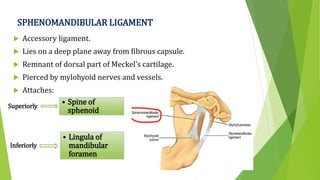
SPHENOMANDIBULAR LIGAMENT
 Accessory ligament.
 Lies on a deep plane away from fibrous capsule.
 Remnant of dorsal part of Meckel’s cartilage.
 Pierced by mylohyoid nerves and vessels.
 Attaches:
Superiorly
• Spine of
sphenoid
Inferiorly
• Lingula of
mandibular
foramen
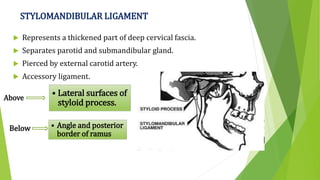
STYLOMANDIBULAR LIGAMENT
 Represents a thickened part of deep cervical fascia.
 Separates parotid and submandibular gland.
 Pierced by external carotid artery.
 Accessory ligament.
Above
• Lateral surfaces of
styloid process.
Below • Angle and posterior
border of ramus
ARTICULAR DISC
 Oval fibrous plates divides joint into:
Upper compartment – Gliding movement
Lower compartment – Rotatory + Gliding movement
 Composed of Dense connective fibrous tissues devoid of blood
vessels and nerve fibres.
 Consist : Type 1 & 2 collagen fibres, few elastic fibres.
 Stabilises the joint.
 Aids lubrication.
RELATIONS OF TMJ
LATERAL
• Skin & fascia
• Parotid gland
• Temporal branches of the facial
nerve
MEDIAL
• The tympanic plate separates the
joint from the internal carotid artery
• Spine of the sphenoid with upper
end of the sphenomandibular
ligament attached to it.
• Auriculotemporal and chorda
tympani nerves
• Middle meningeal artery
ANTERIOR
• Lateral pterygoid
• Masseteric nerve and artery
POSTERIOR
• The parotid gland
separates the joint from the
external auditory meatus
• Superficial temporal
vessels
• Auriculotemporal nerve
SUPERIOR
• Middle cranial fossa
• Middle meningeal vessels
INFERIOR • Maxillary artery and vein
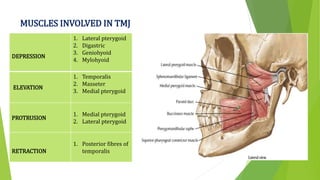
MUSCLES INVOLVED IN TMJ
DEPRESSION
1. Lateral pterygoid
2. Digastric
3. Geniohyoid
4. Mylohyoid
ELEVATION
1. Temporalis
2. Masseter
3. Medial pterygoid
PROTRUSION
1. Medial pterygoid
2. Lateral pterygoid
RETRACTION
1. Posterior fibres of
temporalis
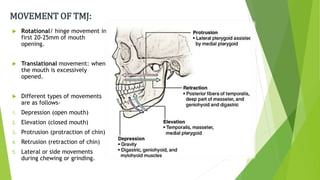
MOVEMENT OF TMJ:
 Rotational/ hinge movement in
first 20-25mm of mouth
opening.
 Translational movement: when
the mouth is excessively
opened.
 Different types of movements
are as follows-
1. Depression (open mouth)
2. Elevation (closed mouth)
3. Protrusion (protraction of chin)
4. Retrusion (retraction of chin)
5. Lateral or side movements
during chewing or grinding.
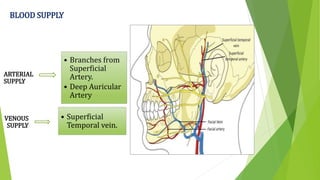
BLOOD SUPPLY
ARTERIAL
SUPPLY
• Branches from
Superficial
Artery.
• Deep Auricular
Artery
VENOUS
SUPPLY
• Superficial
Temporal vein.
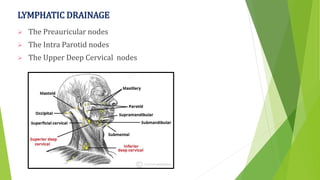
LYMPHATIC DRAINAGE
 The Preauricular nodes
 The Intra Parotid nodes
 The Upper Deep Cervical nodes
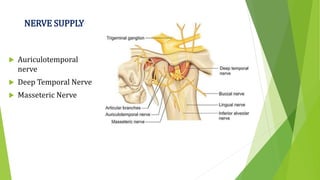
NERVE SUPPLY
 Auriculotemporal
nerve
 Deep Temporal Nerve
 Masseteric Nerve
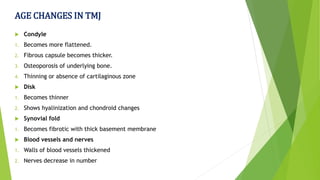
AGE CHANGES IN TMJ
 Condyle
1. Becomes more flattened.
2. Fibrous capsule becomes thicker.
3. Osteoporosis of underlying bone.
4. Thinning or absence of cartilaginous zone
 Disk
1. Becomes thinner
2. Shows hyalinization and chondroid changes
 Synovial fold
1. Becomes fibrotic with thick basement membrane
 Blood vessels and nerves
1. Walls of blood vessels thickened
2. Nerves decrease in number
AGE CHANGES LEAD TO:
Decrease in synovial fluid formation.
Impairment of motion due to decrease in disc and
capsule extensibility.
 Decrease the resilience during mastication due to
chondroid changes into collagenous elements.
 Dysfunction in older people.
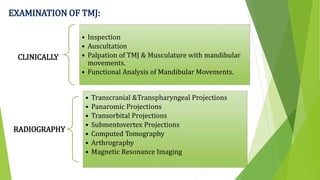
EXAMINATION OF TMJ:
CLINICALLY
• Inspection
• Auscultation
• Palpation of TMJ & Musculature with mandibular
movements.
• Functional Analysis of Mandibular Movements.
RADIOGRAPHY
• Transcranial &Transpharyngeal Projections
• Panaromic Projections
• Transorbital Projections
• Submentovertex Projections
• Computed Tomography
• Arthrography
• Magnetic Resonance Imaging
INSPECTION OF TMJ:
 Area surrounding TMJ is inspected for any signs of inflammation.
 Any Gross Asymmetry
 Any Swelling/Growth
 Depression
 Discharge
 Color change of skin over TMJ
 Surface of the overlying skin in Pre-Auricular area.
 Mouth Opening: Normal/Restricted
 Deviation/Deflection
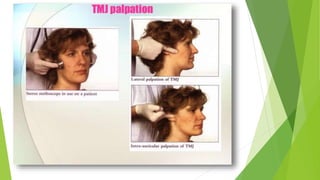
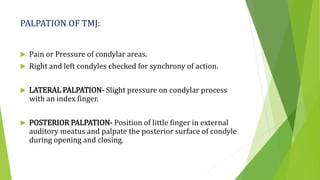
PALPATION OF TMJ:
 Pain or Pressure of condylar areas.
 Right and left condyles checked for synchrony of action.
 LATERAL PALPATION- Slight pressure on condylar process
with an index finger.
 POSTERIOR PALPATION- Position of little finger in external
auditory meatus and palpate the posterior surface of condyle
during opening and closing.
AUSCULATIONS:
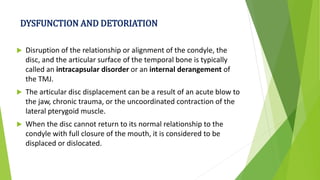
 Sounds made by TMJ can be examined with a stethoscope.
 CREPITATIONS: A grafting or scalping noise that occurs on jaw
movements. Sound is like when sand paper is rubbed against a surface.
 It is very uncommon and asymptomatic. It may caused by roughened,
irregular anterior surface.
 May be early sign of degenerative joint disease.
 CLICKING: occurs due to uncoordinated movement of condylar head and
TMJ disc.
CLICK • Single sound of short duration
POP • Loud Click
Etiologic considerations for TMD.
 5 major factors associated with TMD
 Occlusal condition
 Trauma
 Emotional stress
 Deep pain input
 Para-functional activities
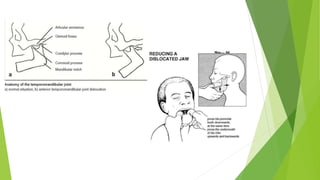
TMJ DISLOCATION:
 The mandible can dislocate in the anterior, posterior, lateral, or
superior position.
 Anterior dislocations are the most common These dislocations are
classified as acute, chronic recurrent, or chronic.
 It may occur with trauma, extreme opening of the mouth during
yawning, laughing, singing, vomiting, or dental treatment .
 Symmetric mandibular dislocation is most common, but unilateral
dislocation with the jaw deviating to the opposite side also can occur.
 Painful and frightening for the patient.
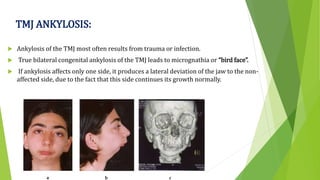
TMJ ANKYLOSIS:
 Ankylosis of the TMJ most often results from trauma or infection.
 True bilateral congenital ankylosis of the TMJ leads to micrognathia or “bird face”.
 If ankylosis affects only one side, it produces a lateral deviation of the jaw to the non-
affected side, due to the fact that this side continues its growth normally.
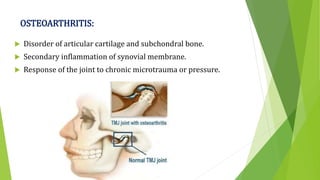
OSTEOARTHRITIS:
 Disorder of articular cartilage and subchondral bone.
 Secondary inflammation of synovial membrane.
 Response of the joint to chronic microtrauma or pressure.
DYSFUNCTION AND DETORIATION
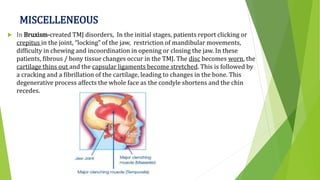
 Disruption of the relationship or alignment of the condyle, the
disc, and the articular surface of the temporal bone is typically
called an intracapsular disorder or an internal derangement of
the TMJ.
 The articular disc displacement can be a result of an acute blow to
the jaw, chronic trauma, or the uncoordinated contraction of the
lateral pterygoid muscle.
 When the disc cannot return to its normal relationship to the
condyle with full closure of the mouth, it is considered to be
displaced or dislocated.
MISCELLENEOUS
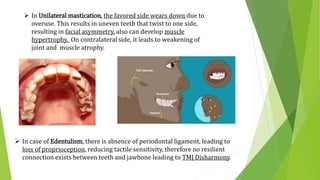
 In Bruxism-created TMJ disorders, In the initial stages, patients report clicking or
crepitus in the joint, “locking” of the jaw, restriction of mandibular movements,
difficulty in chewing and incoordination in opening or closing the jaw. In these
patients, fibrous / bony tissue changes occur in the TMJ. The disc becomes worn, the
cartilage thins out and the capsular ligaments become stretched. This is followed by
a cracking and a fibrillation of the cartilage, leading to changes in the bone. This
degenerative process affects the whole face as the condyle shortens and the chin
recedes.
 In Unilateral mastication, the favored side wears down due to
overuse. This results in uneven teeth that twist to one side,
resulting in facial asymmetry, also can develop muscle
hypertrophy. On contralateral side, it leads to weakening of
joint and muscle atrophy.
 In case of Edentulism, there is absence of periodontal ligament, leading to
loss of proprioception, reducing tactile sensitivity, therefore no resilient
connection exists between teeth and jawbone leading to TMJ Disharmony.
CONCLUSION:
 Nature has blessed us with a marvelously dynamic
masticatory system , allowing us to function and therefore
exist.
 Articulatory system is an important part of the masticatory
system of our body.
 So as a dental care provider to treat the patients of TMDs
before knowing the pathology, this is essential to know the
normal anatomy and physiology of TMJ.
REFERENCES:
 TEXTBOOK OF ORAL MEDICINE.
A GOVINDRAO, G LODAM, AG SAVITA - 2019 - JAYPEE BROTHERS MEDICAL P
 Textbook of Oral & Maxillofacial Surgery-
SM Balaji, Padma Preetha Balaji
 Human anatomy
BD Chaurasia - 2004 - CBS Publisher
 Gray's anatomy : the anatomical basis of clinical practice
Susan Standring Elsevier Health Sciences, 2015
 Text Book of Carranza’s Clinical Periodontology
MG Newman, HH Takei
Temporomandibular joint

Temporomandibular joint

  • 1.
    TEMPOROMANDIBULAR JOINT PRESENTED BY:Dr. HARDI GANDHI GUIDED BY: Dr. MONALI SHAH
  • 2.
    INDEX:  INTODUCTION  PECULARITYOF TMJ  DEVELOPMENT  STRUCTURAL ANATOMY  RELATIONS OF TMJ  MOVEMENTS OF TMJ  AGE CHANGES AND DISORDERS  EXAMINATION AND PALPATION OF TMJ  CONCLUSION  REFERENCES
  • 3.
    INTRODUCTION:  Joint betweentemporal bone and mandible that allows the movement of mandible for speech and mastication.  Produces rotation and sliding movements.  It is GINGLYMOARTROIDAL JOINT.
  • 4.
    TMJ IS UNIQUE! Bilateral diarthrosis – right & left function together  Articular surface covered by fibrocartilage instead of hyaline cartilage  Only joint in human body to have a rigid endpoint of closure (that of the teeth making occlusal contact).  Only mobile joint of skull.
  • 5.
    DEVELOPMENT:  8-9th weekof IU life, Meckel’s cartilage provides the skeletal support for the development of the mandible & extends from the midline backwards and dorsally.  The articulation of malleus and incus functions as the primary TMJ.
  • 6.
    10th week -Twodistinct regions of mesenchymal condensation between the condylar cartilage of mandible & the developing temporal bone i.e.. temporal blastema & condylar blastema At the same time lateral pterygoid muscle attaches to condyle. 12th weeks- Two slit like joint cavities & an intervening disc appear. 1st cleft appears immediately above condylar blastema becomes inferior joint cavity. The condylar blastema then differentiates into condylar cartilage. 2nd cleft appears in relation to the temporal ossification that becomes the superior joint cavity. With the appearance of this cleft, the primitive articular disk is formed. 16th week-Malleus & Incus begin its transformation into middle ear bones & disappearance of primary joint starts. 18th-20th week- Secondary joint becomes functional & Meckel’s Cartilage loses its function & disappears.
  • 7.
  • 8.
  • 9.
  • 10.
     ABOVE • ARTICULAR TUBERCLE •CIRCUMFERENCE OF ARTICULAR FOSSA • SQUAMOTYMPANIC FISSURE BELOW • NECK OF MANDIBLE CAPSCULE FIBROUS ATTACHES
  • 11.
    LATERAL LIGAMENT ATTACHES * Itreinforce and strengthen the lateral part of capsular ligament. * Directed downwards and backwards. ABOVE • ARTICULAR TUBERCLE BELOW • POSTEROLATERAL ASPECT OF THE NECK OF THE MANDIBLE.
  • 12.
    SPHENOMANDIBULAR LIGAMENT  Accessoryligament.  Lies on a deep plane away from fibrous capsule.  Remnant of dorsal part of Meckel’s cartilage.  Pierced by mylohyoid nerves and vessels.  Attaches: Superiorly • Spine of sphenoid Inferiorly • Lingula of mandibular foramen
  • 13.
    STYLOMANDIBULAR LIGAMENT  Representsa thickened part of deep cervical fascia.  Separates parotid and submandibular gland.  Pierced by external carotid artery.  Accessory ligament. Above • Lateral surfaces of styloid process. Below • Angle and posterior border of ramus
  • 14.
    ARTICULAR DISC  Ovalfibrous plates divides joint into: Upper compartment – Gliding movement Lower compartment – Rotatory + Gliding movement  Composed of Dense connective fibrous tissues devoid of blood vessels and nerve fibres.  Consist : Type 1 & 2 collagen fibres, few elastic fibres.  Stabilises the joint.  Aids lubrication.
  • 15.
    RELATIONS OF TMJ LATERAL •Skin & fascia • Parotid gland • Temporal branches of the facial nerve MEDIAL • The tympanic plate separates the joint from the internal carotid artery • Spine of the sphenoid with upper end of the sphenomandibular ligament attached to it. • Auriculotemporal and chorda tympani nerves • Middle meningeal artery ANTERIOR • Lateral pterygoid • Masseteric nerve and artery
  • 16.
    POSTERIOR • The parotidgland separates the joint from the external auditory meatus • Superficial temporal vessels • Auriculotemporal nerve SUPERIOR • Middle cranial fossa • Middle meningeal vessels INFERIOR • Maxillary artery and vein
  • 17.
    MUSCLES INVOLVED INTMJ DEPRESSION 1. Lateral pterygoid 2. Digastric 3. Geniohyoid 4. Mylohyoid ELEVATION 1. Temporalis 2. Masseter 3. Medial pterygoid PROTRUSION 1. Medial pterygoid 2. Lateral pterygoid RETRACTION 1. Posterior fibres of temporalis
  • 18.
    MOVEMENT OF TMJ: Rotational/ hinge movement in first 20-25mm of mouth opening.  Translational movement: when the mouth is excessively opened.  Different types of movements are as follows- 1. Depression (open mouth) 2. Elevation (closed mouth) 3. Protrusion (protraction of chin) 4. Retrusion (retraction of chin) 5. Lateral or side movements during chewing or grinding.
  • 20.
    BLOOD SUPPLY ARTERIAL SUPPLY • Branchesfrom Superficial Artery. • Deep Auricular Artery VENOUS SUPPLY • Superficial Temporal vein.
  • 21.
    LYMPHATIC DRAINAGE  ThePreauricular nodes  The Intra Parotid nodes  The Upper Deep Cervical nodes
  • 22.
    NERVE SUPPLY  Auriculotemporal nerve Deep Temporal Nerve  Masseteric Nerve
  • 23.
    AGE CHANGES INTMJ  Condyle 1. Becomes more flattened. 2. Fibrous capsule becomes thicker. 3. Osteoporosis of underlying bone. 4. Thinning or absence of cartilaginous zone  Disk 1. Becomes thinner 2. Shows hyalinization and chondroid changes  Synovial fold 1. Becomes fibrotic with thick basement membrane  Blood vessels and nerves 1. Walls of blood vessels thickened 2. Nerves decrease in number
  • 24.
    AGE CHANGES LEADTO: Decrease in synovial fluid formation. Impairment of motion due to decrease in disc and capsule extensibility.  Decrease the resilience during mastication due to chondroid changes into collagenous elements.  Dysfunction in older people.
  • 25.
    EXAMINATION OF TMJ: CLINICALLY •Inspection • Auscultation • Palpation of TMJ & Musculature with mandibular movements. • Functional Analysis of Mandibular Movements. RADIOGRAPHY • Transcranial &Transpharyngeal Projections • Panaromic Projections • Transorbital Projections • Submentovertex Projections • Computed Tomography • Arthrography • Magnetic Resonance Imaging
  • 26.
    INSPECTION OF TMJ: Area surrounding TMJ is inspected for any signs of inflammation.  Any Gross Asymmetry  Any Swelling/Growth  Depression  Discharge  Color change of skin over TMJ  Surface of the overlying skin in Pre-Auricular area.  Mouth Opening: Normal/Restricted  Deviation/Deflection
  • 28.
    PALPATION OF TMJ: Pain or Pressure of condylar areas.  Right and left condyles checked for synchrony of action.  LATERAL PALPATION- Slight pressure on condylar process with an index finger.  POSTERIOR PALPATION- Position of little finger in external auditory meatus and palpate the posterior surface of condyle during opening and closing.
  • 29.
    AUSCULATIONS:  Sounds madeby TMJ can be examined with a stethoscope.  CREPITATIONS: A grafting or scalping noise that occurs on jaw movements. Sound is like when sand paper is rubbed against a surface.  It is very uncommon and asymptomatic. It may caused by roughened, irregular anterior surface.  May be early sign of degenerative joint disease.  CLICKING: occurs due to uncoordinated movement of condylar head and TMJ disc. CLICK • Single sound of short duration POP • Loud Click
  • 30.
    Etiologic considerations forTMD.  5 major factors associated with TMD  Occlusal condition  Trauma  Emotional stress  Deep pain input  Para-functional activities
  • 31.
    TMJ DISLOCATION:  Themandible can dislocate in the anterior, posterior, lateral, or superior position.  Anterior dislocations are the most common These dislocations are classified as acute, chronic recurrent, or chronic.  It may occur with trauma, extreme opening of the mouth during yawning, laughing, singing, vomiting, or dental treatment .  Symmetric mandibular dislocation is most common, but unilateral dislocation with the jaw deviating to the opposite side also can occur.  Painful and frightening for the patient.
  • 33.
    TMJ ANKYLOSIS:  Ankylosisof the TMJ most often results from trauma or infection.  True bilateral congenital ankylosis of the TMJ leads to micrognathia or “bird face”.  If ankylosis affects only one side, it produces a lateral deviation of the jaw to the non- affected side, due to the fact that this side continues its growth normally.
  • 34.
    OSTEOARTHRITIS:  Disorder ofarticular cartilage and subchondral bone.  Secondary inflammation of synovial membrane.  Response of the joint to chronic microtrauma or pressure.
  • 35.
    DYSFUNCTION AND DETORIATION Disruption of the relationship or alignment of the condyle, the disc, and the articular surface of the temporal bone is typically called an intracapsular disorder or an internal derangement of the TMJ.  The articular disc displacement can be a result of an acute blow to the jaw, chronic trauma, or the uncoordinated contraction of the lateral pterygoid muscle.  When the disc cannot return to its normal relationship to the condyle with full closure of the mouth, it is considered to be displaced or dislocated.
  • 36.
    MISCELLENEOUS  In Bruxism-createdTMJ disorders, In the initial stages, patients report clicking or crepitus in the joint, “locking” of the jaw, restriction of mandibular movements, difficulty in chewing and incoordination in opening or closing the jaw. In these patients, fibrous / bony tissue changes occur in the TMJ. The disc becomes worn, the cartilage thins out and the capsular ligaments become stretched. This is followed by a cracking and a fibrillation of the cartilage, leading to changes in the bone. This degenerative process affects the whole face as the condyle shortens and the chin recedes.
  • 37.
     In Unilateralmastication, the favored side wears down due to overuse. This results in uneven teeth that twist to one side, resulting in facial asymmetry, also can develop muscle hypertrophy. On contralateral side, it leads to weakening of joint and muscle atrophy.  In case of Edentulism, there is absence of periodontal ligament, leading to loss of proprioception, reducing tactile sensitivity, therefore no resilient connection exists between teeth and jawbone leading to TMJ Disharmony.
  • 38.
    CONCLUSION:  Nature hasblessed us with a marvelously dynamic masticatory system , allowing us to function and therefore exist.  Articulatory system is an important part of the masticatory system of our body.  So as a dental care provider to treat the patients of TMDs before knowing the pathology, this is essential to know the normal anatomy and physiology of TMJ.
  • 39.
    REFERENCES:  TEXTBOOK OFORAL MEDICINE. A GOVINDRAO, G LODAM, AG SAVITA - 2019 - JAYPEE BROTHERS MEDICAL P  Textbook of Oral & Maxillofacial Surgery- SM Balaji, Padma Preetha Balaji  Human anatomy BD Chaurasia - 2004 - CBS Publisher  Gray's anatomy : the anatomical basis of clinical practice Susan Standring Elsevier Health Sciences, 2015  Text Book of Carranza’s Clinical Periodontology MG Newman, HH Takei

Editor's Notes

  • #13 Assist lat. Pte in trans n rot. mvt
  • #14 Limits the excessive protrusive mvt of mandible.
  • #20 Disc is biconcave, located in sup. Position. The central thin part is consistently lying between the condyle and tubercle. Opening: rot in upper. More of trans in lower