Acute Chest Syndrome
Atul Jindal (MD, DM)
Assistant Professor
AIIMS, Raipur
Overview
Definition
Pathophysiology
Clinical features
Challenges in the diagnosis of ACS
Course & Outcome
Monitoring & Investigations
Treatment of ACS
Chronic complications & Prevention
Definition
Acute Chest Syndrome (ACS) is defined as
an acute illness characterised by fever
and/or respiratory symptoms,
accompanied by a new pulmonary
infiltrate on chest X-ray.
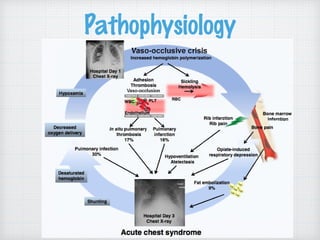
Pathophysiology
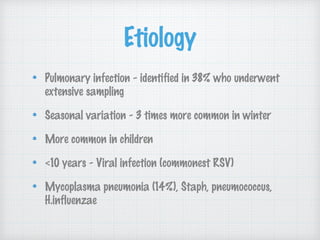
Etiology
Pulmonary infection - identified in 38% who underwent
extensive sampling
Seasonal variation - 3 times more common in winter
More common in children
<10 years - Viral infection (commonest RSV)
Mycoplasma pneumonia (14%), Staph, pneumococcus,
H.influenzae
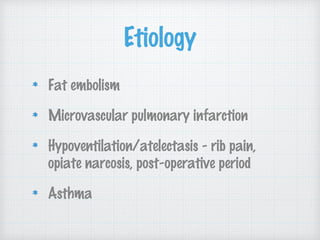
Etiology
Fat embolism
Microvascular pulmonary infarction
Hypoventilation/atelectasis - rib pain,
opiate narcosis, post-operative period
Asthma
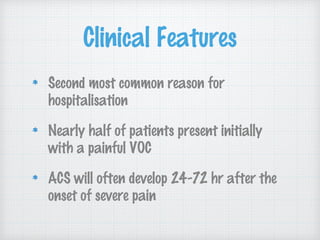
Clinical Features
Second most common reason for
hospitalisation
Nearly half of patients present initially
with a painful VOC
ACS will often develop 24-72 hr after the
onset of severe pain
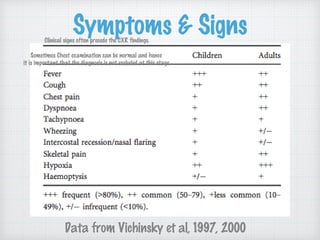
Symptoms & Signs
Data from Vichinsky et al, 1997, 2000
Clinical signs often precede the CXR findings.
Sometimes Chest examination can be normal and hence
it is important that the diagnosis is not excluded at this stage.
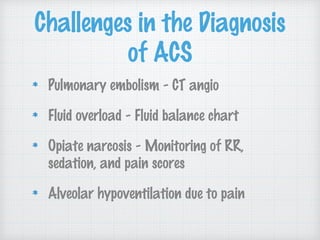
Challenges in the Diagnosis
of ACS
Pulmonary embolism - CT angio
Fluid overload - Fluid balance chart
Opiate narcosis - Monitoring of RR,
sedation, and pain scores
Alveolar hypoventilation due to pain
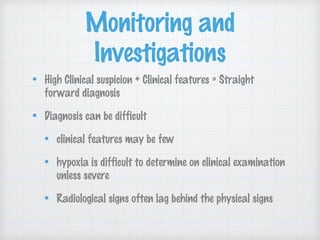
Monitoring and
Investigations
High Clinical suspicion + Clinical features = Straight
forward diagnosis
Diagnosis can be difficult
clinical features may be few
hypoxia is difficult to determine on clinical examination
unless severe
Radiological signs often lag behind the physical signs
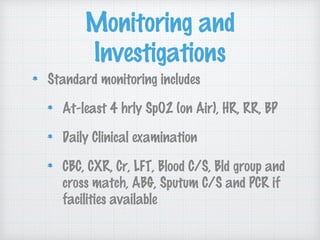
Monitoring and
Investigations
Standard monitoring includes
At-least 4 hrly SpO2 (on Air), HR, RR, BP
Daily Clinical examination
CBC, CXR, Cr, LFT, Blood C/S, Bld group and
cross match, ABG, Sputum C/S and PCR if
facilities available
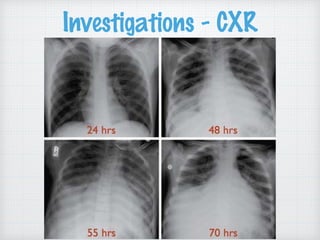
Investigations - CXR
Investigations - CBC
Acute fall in Hb conc. or Platelet count are often
seen
Decreasing platelet count to <2lac is an
independent risk factor for neurological
complications and the need for mechanical
ventilation
Reticulocyte count - normal count excludes red
cell aplasia by parvo B 19.
Investigations -
Biochemical tests
RFT & LFT - MODS as a consequence of Systemic fat
embolism
CRP - monitor progress
ABG - on room air (if SpO2<94%)
Patients in clear resp. distress or in whom SpO2 falls
rapidly to <85% when O2 is removed need escalation of
therapy.
PaO2 < 82 mm hg (70% of cases)
Investigations - other
Investigations
CT - high sensitivity and specificity (84%
and 97%)
High radiation dose - not recommended
Use in Pulm. Embolism
Secretory Phospholipase A2 (sPLA2) -
levels elevated in ACS
ACS - Treatment
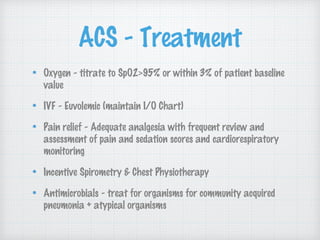
Oxygen - titrate to SpO2>95% or within 3% of patient baseline
value
IVF - Euvolemic (maintain I/O Chart)
Pain relief - Adequate analgesia with frequent review and
assessment of pain and sedation scores and cardiorespiratory
monitoring
Incentive Spirometry & Chest Physiotherapy
Antimicrobials - treat for organisms for community acquired
pneumonia + atypical organisms
ACS - Treatment
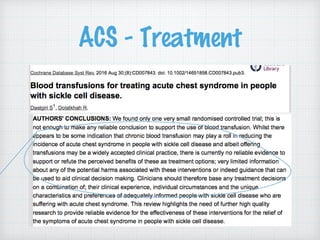
Blood Transfusion -
ACS - Treatment
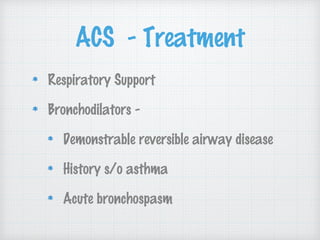
Respiratory Support
Bronchodilators -
Demonstrable reversible airway disease
History s/o asthma
Acute bronchospasm
ACS - Treatment
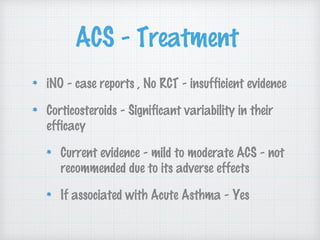
iNO - case reports , No RCT - insufficient evidence
Corticosteroids - Significant variability in their
efficacy
Current evidence - mild to moderate ACS - not
recommended due to its adverse effects
If associated with Acute Asthma - Yes
ACS - Chronic
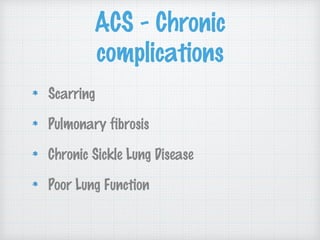
complications
Scarring
Pulmonary fibrosis
Chronic Sickle Lung Disease
Poor Lung Function
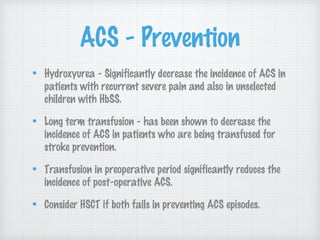
ACS - Prevention
Hydroxyurea - Significantly decrease the incidence of ACS in
patients with recurrent severe pain and also in unselected
children with HbSS.
Long term transfusion - has been shown to decrease the
incidence of ACS in patients who are being transfused for
stroke prevention.
Transfusion in preoperative period significantly reduces the
incidence of post-operative ACS.
Consider HSCT if both fails in preventing ACS episodes.
SCD - Wheeze or Asthma?
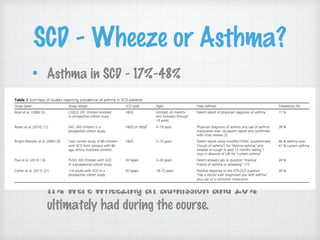
Asthma in SCD - 17%-48%
Challenge - Asthma or SCD?
Wheezing: common in SCD and independently
associated with morbidity
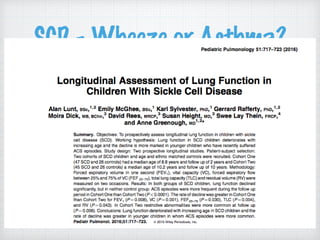
Cooperative Study - out of 1722 ACS episodes -
11% were wheezing at admission and 26%
ultimately had during the course.
SCD - Wheeze or Asthma?
Episode of wheezing producing shortness of
breath is associated increased risk of future
episode of ACS (IRR 1.7, p=0.04)
SCD - Wheeze or Asthma?
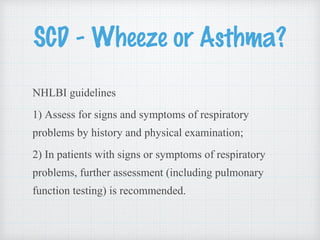
NHLBI guidelines
1) Assess for signs and symptoms of respiratory
problems by history and physical examination;
2) In patients with signs or symptoms of respiratory
problems, further assessment (including pulmonary
function testing) is recommended.
SCD - Wheeze or Asthma?
Knight-Madden and Greenough have termed “Recurrent
Wheezing in Sickle Cell Disease (RWIS)”.
Once we have a better understanding of the mechanisms
underlying airway abnormalities in SCD we can begin to
explore the impact of therapeutic interventions on recurrent
wheezing, airway obstruction, and/or asthma on short and
long term SCD outcomes.
This is an important, understudied area that warrants further
investigation in an attempt to reduce morbidity and mortality
in these patients.
Acute chest syndrome (sickle cell)

Acute chest syndrome (sickle cell)

  • 1.
    Acute Chest Syndrome AtulJindal (MD, DM) Assistant Professor AIIMS, Raipur
  • 2.
    Overview Definition Pathophysiology Clinical features Challenges inthe diagnosis of ACS Course & Outcome Monitoring & Investigations Treatment of ACS Chronic complications & Prevention
  • 3.
    Definition Acute Chest Syndrome(ACS) is defined as an acute illness characterised by fever and/or respiratory symptoms, accompanied by a new pulmonary infiltrate on chest X-ray.
  • 4.
  • 5.
    Etiology Pulmonary infection -identified in 38% who underwent extensive sampling Seasonal variation - 3 times more common in winter More common in children <10 years - Viral infection (commonest RSV) Mycoplasma pneumonia (14%), Staph, pneumococcus, H.influenzae
  • 6.
    Etiology Fat embolism Microvascular pulmonaryinfarction Hypoventilation/atelectasis - rib pain, opiate narcosis, post-operative period Asthma
  • 7.
    Clinical Features Second mostcommon reason for hospitalisation Nearly half of patients present initially with a painful VOC ACS will often develop 24-72 hr after the onset of severe pain
  • 8.
    Symptoms & Signs Datafrom Vichinsky et al, 1997, 2000 Clinical signs often precede the CXR findings. Sometimes Chest examination can be normal and hence it is important that the diagnosis is not excluded at this stage.
  • 9.
    Challenges in theDiagnosis of ACS Pulmonary embolism - CT angio Fluid overload - Fluid balance chart Opiate narcosis - Monitoring of RR, sedation, and pain scores Alveolar hypoventilation due to pain
  • 10.
    Monitoring and Investigations High Clinicalsuspicion + Clinical features = Straight forward diagnosis Diagnosis can be difficult clinical features may be few hypoxia is difficult to determine on clinical examination unless severe Radiological signs often lag behind the physical signs
  • 11.
    Monitoring and Investigations Standard monitoringincludes At-least 4 hrly SpO2 (on Air), HR, RR, BP Daily Clinical examination CBC, CXR, Cr, LFT, Blood C/S, Bld group and cross match, ABG, Sputum C/S and PCR if facilities available
  • 12.
  • 13.
    Investigations - CBC Acutefall in Hb conc. or Platelet count are often seen Decreasing platelet count to <2lac is an independent risk factor for neurological complications and the need for mechanical ventilation Reticulocyte count - normal count excludes red cell aplasia by parvo B 19.
  • 14.
    Investigations - Biochemical tests RFT& LFT - MODS as a consequence of Systemic fat embolism CRP - monitor progress ABG - on room air (if SpO2<94%) Patients in clear resp. distress or in whom SpO2 falls rapidly to <85% when O2 is removed need escalation of therapy. PaO2 < 82 mm hg (70% of cases)
  • 15.
    Investigations - other Investigations CT- high sensitivity and specificity (84% and 97%) High radiation dose - not recommended Use in Pulm. Embolism Secretory Phospholipase A2 (sPLA2) - levels elevated in ACS
  • 16.
    ACS - Treatment Oxygen- titrate to SpO2>95% or within 3% of patient baseline value IVF - Euvolemic (maintain I/O Chart) Pain relief - Adequate analgesia with frequent review and assessment of pain and sedation scores and cardiorespiratory monitoring Incentive Spirometry & Chest Physiotherapy Antimicrobials - treat for organisms for community acquired pneumonia + atypical organisms
  • 17.
    ACS - Treatment BloodTransfusion -
  • 18.
    ACS - Treatment RespiratorySupport Bronchodilators - Demonstrable reversible airway disease History s/o asthma Acute bronchospasm
  • 19.
    ACS - Treatment iNO- case reports , No RCT - insufficient evidence Corticosteroids - Significant variability in their efficacy Current evidence - mild to moderate ACS - not recommended due to its adverse effects If associated with Acute Asthma - Yes
  • 20.
    ACS - Chronic complications Scarring Pulmonaryfibrosis Chronic Sickle Lung Disease Poor Lung Function
  • 21.
    ACS - Prevention Hydroxyurea- Significantly decrease the incidence of ACS in patients with recurrent severe pain and also in unselected children with HbSS. Long term transfusion - has been shown to decrease the incidence of ACS in patients who are being transfused for stroke prevention. Transfusion in preoperative period significantly reduces the incidence of post-operative ACS. Consider HSCT if both fails in preventing ACS episodes.
  • 22.
    SCD - Wheezeor Asthma? Asthma in SCD - 17%-48% Challenge - Asthma or SCD? Wheezing: common in SCD and independently associated with morbidity Cooperative Study - out of 1722 ACS episodes - 11% were wheezing at admission and 26% ultimately had during the course.
  • 24.
    SCD - Wheezeor Asthma? Episode of wheezing producing shortness of breath is associated increased risk of future episode of ACS (IRR 1.7, p=0.04)
  • 25.
    SCD - Wheezeor Asthma? NHLBI guidelines 1) Assess for signs and symptoms of respiratory problems by history and physical examination; 2) In patients with signs or symptoms of respiratory problems, further assessment (including pulmonary function testing) is recommended.
  • 26.
    SCD - Wheezeor Asthma? Knight-Madden and Greenough have termed “Recurrent Wheezing in Sickle Cell Disease (RWIS)”. Once we have a better understanding of the mechanisms underlying airway abnormalities in SCD we can begin to explore the impact of therapeutic interventions on recurrent wheezing, airway obstruction, and/or asthma on short and long term SCD outcomes. This is an important, understudied area that warrants further investigation in an attempt to reduce morbidity and mortality in these patients.