RECREATION
Recreation – something people do to relax or
have fun. These are activities done for
enjoyment purposes.
ACTIVE RECREATION
Active Recreation - refers to the structured
individual or team activity that requires the use
of special facilities, courses, fields, or
equipment.
PASSIVE RECREATION
Passive Recreation - activities that do not
require prepared facilities like sports field or
pavilions.
FITNESS
• It is the condition of being physically fit
and healthy.
• It is a universal concern.
WEIGHT LOSS STRATEGIES
1. Make a commitment to change
2. Incorporate exercise into a program
3 . Eat slowly and at the table
4. Cut unnecessary items from your diet
5. Do not serve more food than you should eat
6. Think positive
DEFINITTION OF LEISURE,
PLAY AND RECREATION
1. Leisure - is a set of activities that people engage
in during free time.
2. Play - is an imaginative, intrinsically motivated,
non-serious, freely chosen and actively engaging
activity.
3. Recreation - is an activity that people engage in
during their free time, that people enjoy, and that
people recognize as having socially redeeming
values and generates a general sense of well-being.
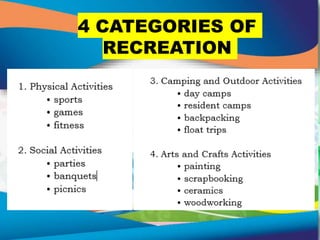
4 CATEGORIES OF
RECREATION
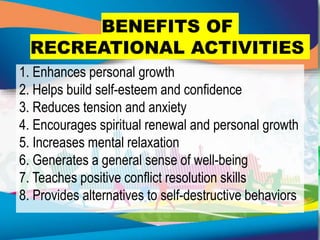
BENEFITS OF
RECREATIONAL ACTIVITIES
1. Enhances personal growth
2. Helps build self-esteem and confidence
3. Reduces tension and anxiety
4. Encourages spiritual renewal and personal growth
5. Increases mental relaxation
6. Generates a general sense of well-being
7. Teaches positive conflict resolution skills
8. Provides alternatives to self-destructive behaviors
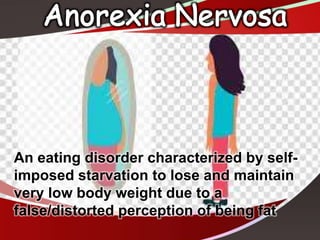
An eating disorder characterized by self-
imposed starvation to lose and maintain
very low body weight due to a
false/distorted perception of being fat
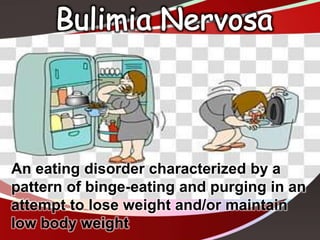
An eating disorder characterized by a
pattern of binge-eating and purging in an
attempt to lose weight and/or maintain
low body weight
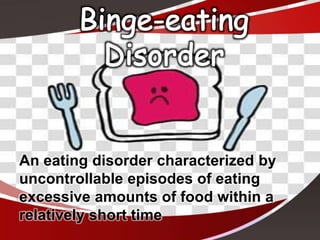
An eating disorder characterized by
uncontrollable episodes of eating
excessive amounts of food within a
relatively short time
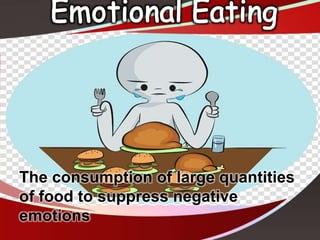
The consumption of large quantities
of food to suppress negative
emotions
FITT Principle
It refers to HOW OFTEN you involve
yourself in regular physical activity or
exercise.
It refers to HOW HARD you should
exercise or the level of difficulty of your
physical activity.
It refers to HOW LONG you should
engage in a specific physical activity
It refers to WHAT KIND of exercise or
physical activity you should engage in.
1. Select exercises that will involve all major
muscle groups: chest, shoulders, back, legs,
arms, hip and trunk
2. Select exercises that will strengthen the core.
Use controlled movements and start with the
light-to moderate resistance
3. Never lift weights alone. Always have someone
work out with you in case you need a spotter or
help with an injury.
4. Warp-up properly before performing to light-to
moderate intensity aerobic activity (5 to 7
minutes) and some gentle stretches for a few
minutes
5. Maintain proper body balance that
involves good posture, a stable body
position and correct posture in sitting,
lying and other exercise positions
6. Breath naturally. Inhale during the
eccentric phase (bringing the weight
down) and exhale during the concentric
phase (lifting or pushing the weight up.)
7. At the end of each strength-training
workout, stretch out for a few minutes to
help your muscles return to their normal
resting length and to minimize muscle
soreness and risk of injury

ACTIVE RECREATION (FITNESS)_PE.pptx

  • 3.
    RECREATION Recreation – somethingpeople do to relax or have fun. These are activities done for enjoyment purposes.
  • 4.
    ACTIVE RECREATION Active Recreation- refers to the structured individual or team activity that requires the use of special facilities, courses, fields, or equipment.
  • 5.
    PASSIVE RECREATION Passive Recreation- activities that do not require prepared facilities like sports field or pavilions.
  • 8.
    FITNESS • It isthe condition of being physically fit and healthy. • It is a universal concern.
  • 9.
    WEIGHT LOSS STRATEGIES 1.Make a commitment to change 2. Incorporate exercise into a program 3 . Eat slowly and at the table 4. Cut unnecessary items from your diet 5. Do not serve more food than you should eat 6. Think positive
  • 10.
    DEFINITTION OF LEISURE, PLAYAND RECREATION 1. Leisure - is a set of activities that people engage in during free time. 2. Play - is an imaginative, intrinsically motivated, non-serious, freely chosen and actively engaging activity. 3. Recreation - is an activity that people engage in during their free time, that people enjoy, and that people recognize as having socially redeeming values and generates a general sense of well-being.
  • 11.
  • 12.
    BENEFITS OF RECREATIONAL ACTIVITIES 1.Enhances personal growth 2. Helps build self-esteem and confidence 3. Reduces tension and anxiety 4. Encourages spiritual renewal and personal growth 5. Increases mental relaxation 6. Generates a general sense of well-being 7. Teaches positive conflict resolution skills 8. Provides alternatives to self-destructive behaviors
  • 14.
    An eating disordercharacterized by self- imposed starvation to lose and maintain very low body weight due to a false/distorted perception of being fat
  • 15.
    An eating disordercharacterized by a pattern of binge-eating and purging in an attempt to lose weight and/or maintain low body weight
  • 16.
    An eating disordercharacterized by uncontrollable episodes of eating excessive amounts of food within a relatively short time
  • 17.
    The consumption oflarge quantities of food to suppress negative emotions
  • 18.
  • 19.
    It refers toHOW OFTEN you involve yourself in regular physical activity or exercise.
  • 20.
    It refers toHOW HARD you should exercise or the level of difficulty of your physical activity.
  • 21.
    It refers toHOW LONG you should engage in a specific physical activity
  • 22.
    It refers toWHAT KIND of exercise or physical activity you should engage in.
  • 23.
    1. Select exercisesthat will involve all major muscle groups: chest, shoulders, back, legs, arms, hip and trunk 2. Select exercises that will strengthen the core. Use controlled movements and start with the light-to moderate resistance 3. Never lift weights alone. Always have someone work out with you in case you need a spotter or help with an injury. 4. Warp-up properly before performing to light-to moderate intensity aerobic activity (5 to 7 minutes) and some gentle stretches for a few minutes
  • 24.
    5. Maintain properbody balance that involves good posture, a stable body position and correct posture in sitting, lying and other exercise positions 6. Breath naturally. Inhale during the eccentric phase (bringing the weight down) and exhale during the concentric phase (lifting or pushing the weight up.) 7. At the end of each strength-training workout, stretch out for a few minutes to help your muscles return to their normal resting length and to minimize muscle soreness and risk of injury