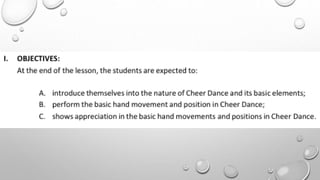
4th Quarter - Physical Education 10
Cheerdance is coined from the words,
cheer and dance. To cheer is to shout
out words or phrases that may help
motivate and boost the morale of a
playing team and perform better during
a game. Dance, on the other hand, is a
physical activity where one expresses
emotions or gestures while performing
bodily movements usually in time with
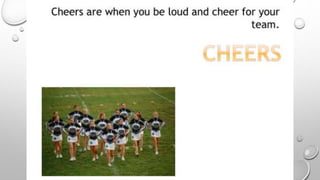
Cheerdancing rooted from cheerleading.
Cheerleading is the performance of a routine, usually
dominated by gymnastic skills such as jumps,
tumbling skills, lifts and tosses combined with
shouting of cheers and yells to lead the crowd to
cheer for a certain team during a game or sport. It
originated in the United States. Due to Filipinos’ love
for dancing, they added more dance routines to their
cheers and came up with the term cheerdance
wherein it is a routine composed of yells and cheers,
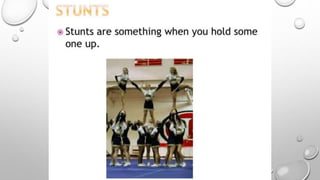
gymnastic skills (pyramids and tosses, stunts,
tumbling skills, arm and hand positions and jumps),
Today, cheer dancing is identified
as one of the most spectacular
events in one of the biggest
collegiate sports events in the
country, the UAAP (University
Athletic Association of the
Philippines).
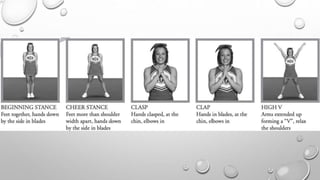
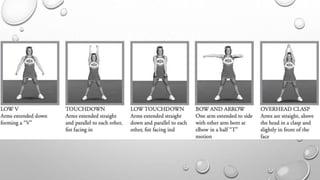
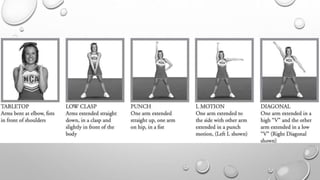
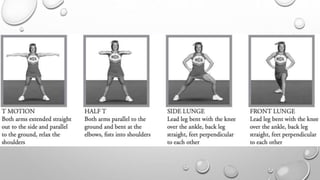
Hand Movements and
Positions in Cheerdance
CHEERDANCE BASICS
(Dance Side)
Remember:
1) All moves should be performed sharply. Imagine hitting a brick
wall that is behind you.
2) Wrists should not be cocked, but in a straight line with your
arms. Thumbs should be on the outside of your fists, with your
pinky fingers in back. Show your swirlies!
3) Although you want to hit a brick wall, your arms should not be
way behind you. You should be able to just barely see them out
of the corner of your eyes when looking straight ahead.
4) Shoulders should be relaxed for every motion, not up at your
ears.
5) Shortest distance- rather than swinging your arms around, up
into your High V, bring your arms straight forward in front of
yourself and hit. This is true for any motion.
6) Practice in front of a mirror. You may feel like you're doing
the moves correctly, but you may not be.

P.e lesson 4th quarter

  • 1.
    4th Quarter -Physical Education 10
  • 3.
    Cheerdance is coinedfrom the words, cheer and dance. To cheer is to shout out words or phrases that may help motivate and boost the morale of a playing team and perform better during a game. Dance, on the other hand, is a physical activity where one expresses emotions or gestures while performing bodily movements usually in time with
  • 4.
    Cheerdancing rooted fromcheerleading. Cheerleading is the performance of a routine, usually dominated by gymnastic skills such as jumps, tumbling skills, lifts and tosses combined with shouting of cheers and yells to lead the crowd to cheer for a certain team during a game or sport. It originated in the United States. Due to Filipinos’ love for dancing, they added more dance routines to their cheers and came up with the term cheerdance wherein it is a routine composed of yells and cheers, gymnastic skills (pyramids and tosses, stunts, tumbling skills, arm and hand positions and jumps),
  • 5.
    Today, cheer dancingis identified as one of the most spectacular events in one of the biggest collegiate sports events in the country, the UAAP (University Athletic Association of the Philippines).
  • 6.
  • 19.
  • 22.
    Remember: 1) All movesshould be performed sharply. Imagine hitting a brick wall that is behind you. 2) Wrists should not be cocked, but in a straight line with your arms. Thumbs should be on the outside of your fists, with your pinky fingers in back. Show your swirlies! 3) Although you want to hit a brick wall, your arms should not be way behind you. You should be able to just barely see them out of the corner of your eyes when looking straight ahead. 4) Shoulders should be relaxed for every motion, not up at your ears. 5) Shortest distance- rather than swinging your arms around, up into your High V, bring your arms straight forward in front of yourself and hit. This is true for any motion. 6) Practice in front of a mirror. You may feel like you're doing the moves correctly, but you may not be.