Objectives:
1. Assess physical activities, exercises and eating habits.
2. Engage in moderate to vigorous physical activities for
at least 60 minutes a day in and out of school.
3. Express a sense of purpose and belongingness by
participating in physical activity-related community
services and programs through aerobic dancing - high
and low impact.
FITNESS
It is a planned exercise using standard
guidelines with the goal of changing
body composition in a following areas.
Are you living in a
healthy Life?
Title and Content Layout with SmartArt
•The six areas of wellness lifestyle are:
physical, emotional, intellectual, spiritual,
interpersonal and environmental.
DOYOU HAVE AN IDEA?
Recreational Activities
•Those activities held during one’s
leisure time.Their purpose is to refresh
oneself by doing activities that are
considered by an individual as
enjoyable.
Active recreational activities
•Involves strenuous physical activity requires
more exertion and competition. However
athletics and sports may also be
participated in more for enjoyment they
bring rather than competitive play.
Types of Recreational Activities
Active Recreation - refers to activities that
require physical exertion, such as playing
sports or hiking.
Passive Recreation - is generally more
sedentary in nature and includes activities
like reading or watching television.
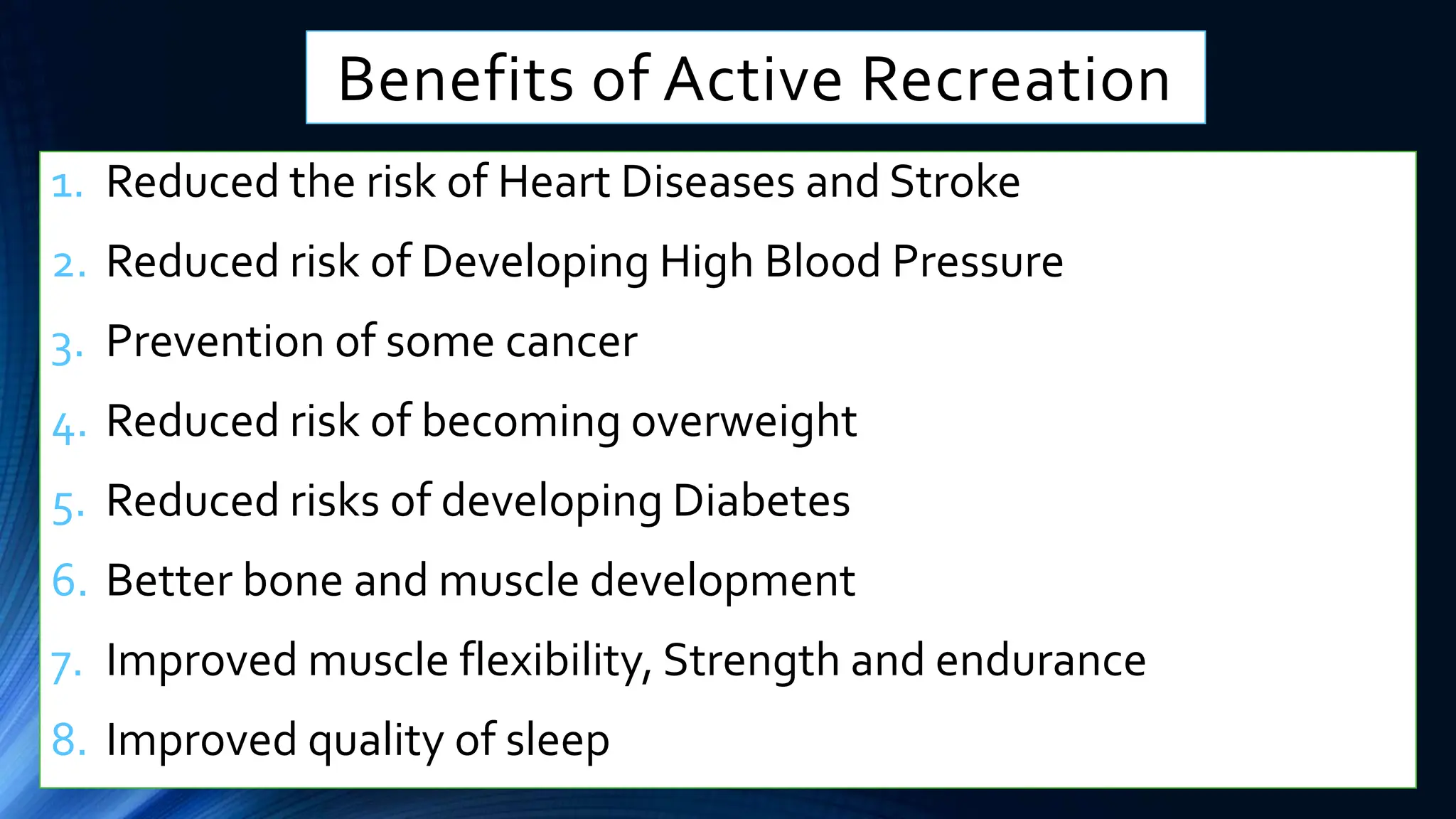
Benefits of Active Recreation
1. Reduced the risk of Heart Diseases and Stroke
2. Reduced risk of Developing High Blood Pressure
3. Prevention of some cancer
4. Reduced risk of becoming overweight
5. Reduced risks of developing Diabetes
6. Better bone and muscle development
7. Improved muscle flexibility, Strength and endurance
8. Improved quality of sleep
ACTIVE
RECREATION
RELATES TO HEALTH
DIMENSIONS
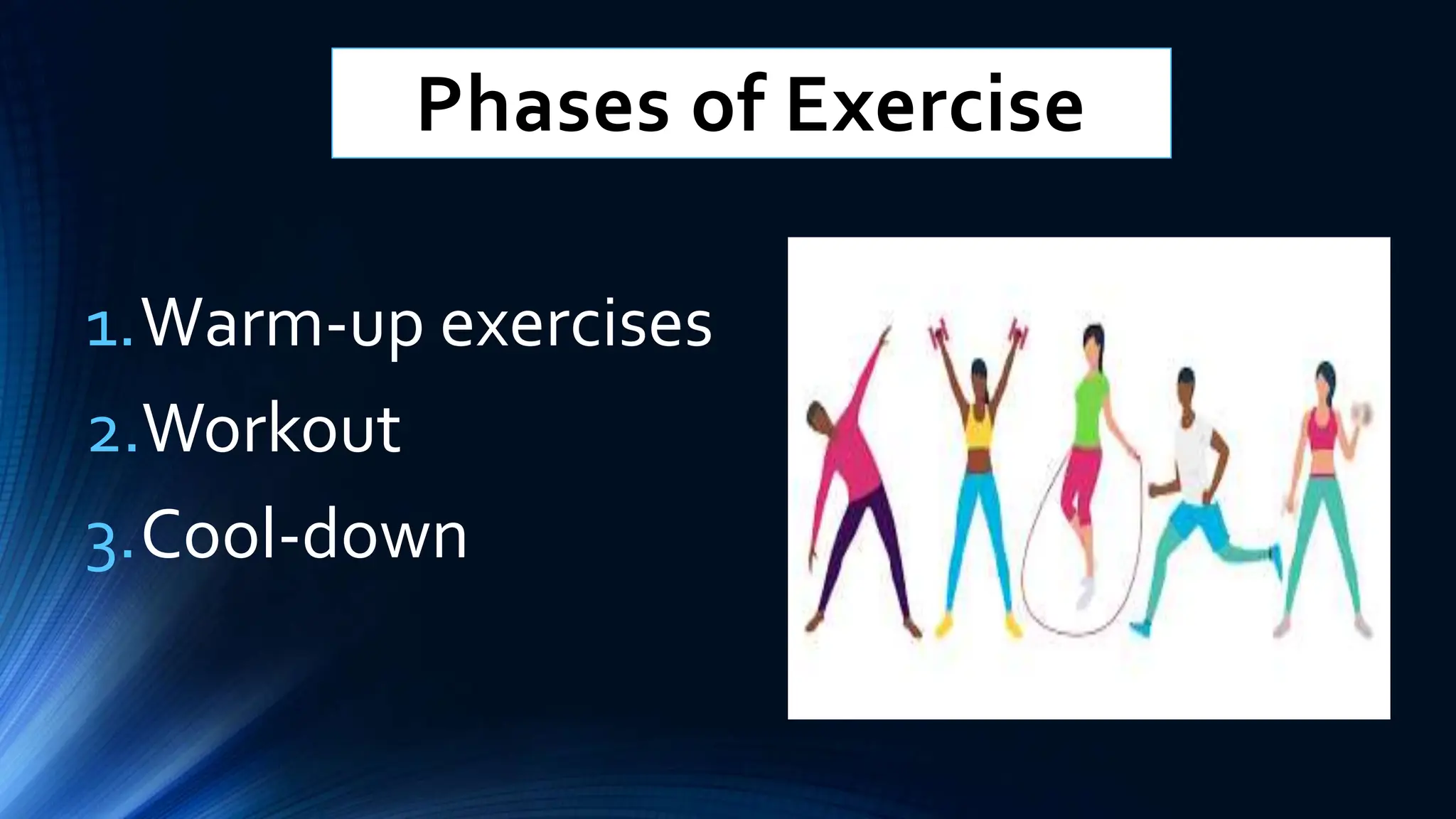
Phases of Exercise
1.Warm-up exercises
2.Workout
3.Cool-down
The Principle of Exercise
A. Frequency refers to how often you involve yourself in
regular physical activity or exercise.
B. Intensity refers to how hard you should exercise or the
level of difficulty of your physical activity.
C.Time Refers to how long you should engage in a specific
physical activity.
D.Type refers to the kind of exercise or physical activity
you should engage in.
Are you into…?
•Walking/jogging
•Biking
•Hip hop dancing
•Playing Badminton
•Playing
Volleyball/basketball
•Swimming
•StrengthTraining
•Ballroom Dancing
•Hiking
•Yoga exercise
•Zumba Exercise
•Malling
Reflective Questions:
•How do you feel about the different activities you are
engage in?
• What influences your choice of physical activity?
•What challenges do you encounter in performing the
activity?
•How these activities affect your lifestyle?
•List some of its benefits from engaging in these
activities?
Activity: Identify whether the following
statements are Fallacy or Fact.
1. All fats are bad for you.
2. Skipping meals will help you lose weight.
3. Sweating is a part of the physical activity process.
4. As long as people work out, they can eat whatever they
want.
5. Regular exercise and a balance diet go hand in hand.
6. Exercise can turn fat into muscles.
7.Fat is the main fuel of the body.
8.The best time of the day to exercise is one that
fits one’s schedule.
9.Warm up must be done before engaging physical
activity.
10.Healthy young individuals do not require
physical activity.
TILT HEAD
BACK STRETCH
HEAD DROP
STRETCH
NECK RIGHT
SIDE STRETCH
NECK LEFT
STRETCH
ARM STRETCH ARM STRETCH LEFT
ARM BACK
STRETCH
RIGHT
ARM BACK
STRETCH
FORWARD
LUNGE RIGHT
FORWARD
LUNGE LEFT
ANKLE
ROTATION
RIGHT
ANKLE
ROTATION
LEFT
Hamstring Stretch Right
Active Recreation
HI-LO WORKOUT
PURPOSE DIRECTION
1. RESTING HEART RATE Locate your pulse, take the rate in 15
seconds and multiply it by 4 to complete
the 1 minute requirement.
2. MAXIMUM HEART RATE (MHR) Subtract your age from 220
3. TARGET HEART RATE ZONE Get your maximum heart rate.
Lower limit: 0.60 (60%)
Upper limit: 0.90 (90%)
AEROBIC FITNESS
•The word aerobic means “with oxygen,”
meaning that your breathing determines the
amount of oxygen that gets to your muscles.
•Aerobic exercise is cardiovascular exercise, or
cardio, that gets your heart pumping. During
aerobic exercise, your blood pumps quickly
throughout your body and your lungs take in
more oxygen.
Some examples of aerobic exercise
•Running or jogging
•Biking
•Swimming
•Walking
•Hiking
•Stair climbing
•Dancing
•Jumping rope
•Playing sports like
basketball, soccer, hockey,
volleyball, or other games
HI-LO AEROBICS
•Hi Lo is a dynamic cardiovascular training
program that combines a mix of high and low
impact aerobics which will keep your heart rate up
and your body moving.
•there will be coordinated moves involved and
some of the exercises will be choreographed.
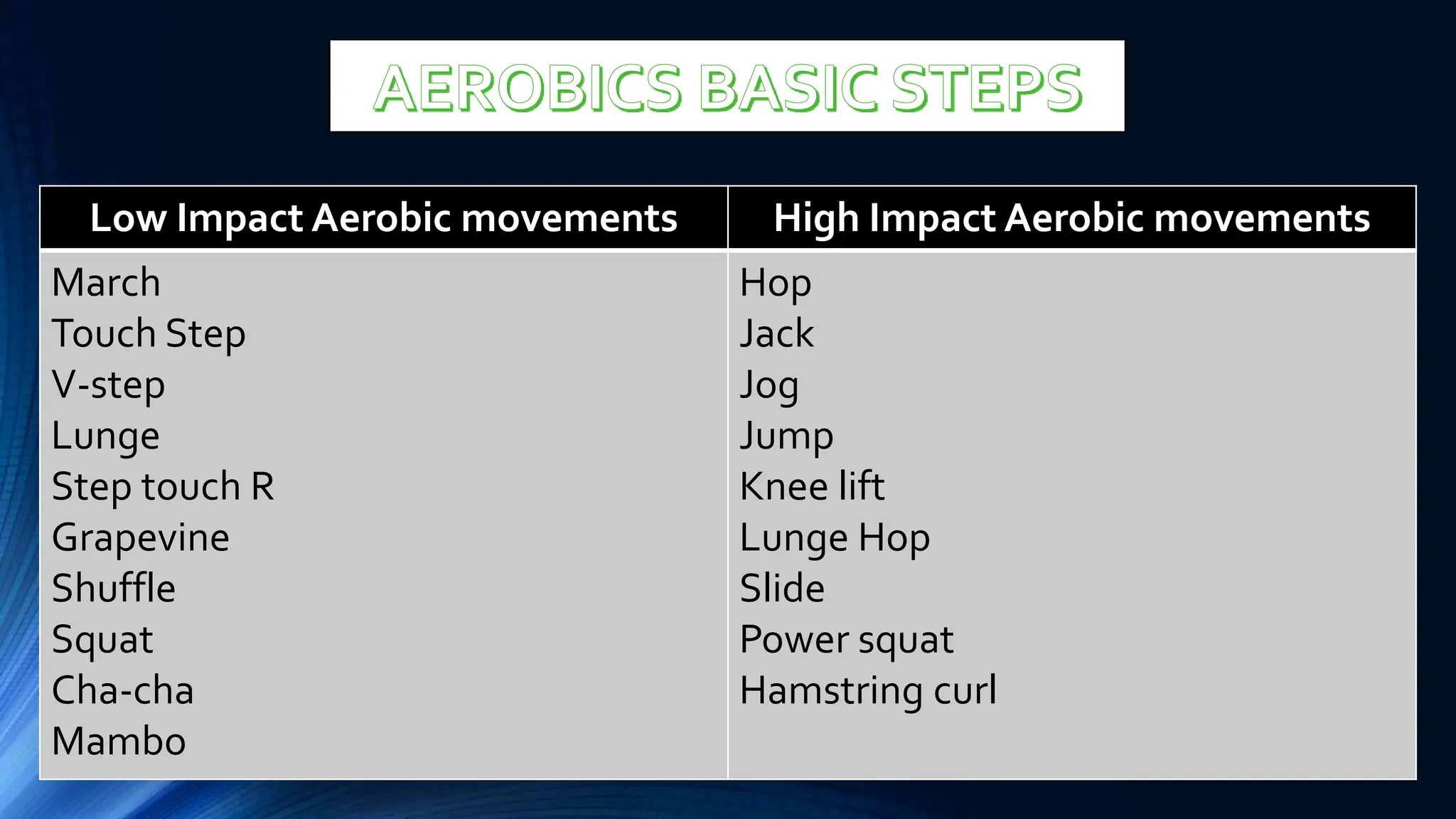
Low Impact Aerobic movements High Impact Aerobic movements
March
Touch Step
V-step
Lunge
Step touch R
Grapevine
Shuffle
Squat
Cha-cha
Mambo
Hop
Jack
Jog
Jump
Knee lift
Lunge Hop
Slide
Power squat
Hamstring curl
Add a Slide Title - 1
Add a Slide Title - 2
Add a Slide Title - 3
Add a Slide Title
- 4
Add a Slide Title
- 5

ACTIVE RECREATION PE10 Q2.pptx For learners

  • 3.
    Objectives: 1. Assess physicalactivities, exercises and eating habits. 2. Engage in moderate to vigorous physical activities for at least 60 minutes a day in and out of school. 3. Express a sense of purpose and belongingness by participating in physical activity-related community services and programs through aerobic dancing - high and low impact.
  • 5.
    FITNESS It is aplanned exercise using standard guidelines with the goal of changing body composition in a following areas.
  • 6.
    Are you livingin a healthy Life?
  • 7.
    Title and ContentLayout with SmartArt
  • 9.
    •The six areasof wellness lifestyle are: physical, emotional, intellectual, spiritual, interpersonal and environmental.
  • 11.
  • 12.
    Recreational Activities •Those activitiesheld during one’s leisure time.Their purpose is to refresh oneself by doing activities that are considered by an individual as enjoyable.
  • 13.
    Active recreational activities •Involvesstrenuous physical activity requires more exertion and competition. However athletics and sports may also be participated in more for enjoyment they bring rather than competitive play.
  • 14.
    Types of RecreationalActivities Active Recreation - refers to activities that require physical exertion, such as playing sports or hiking. Passive Recreation - is generally more sedentary in nature and includes activities like reading or watching television.
  • 16.
    Benefits of ActiveRecreation 1. Reduced the risk of Heart Diseases and Stroke 2. Reduced risk of Developing High Blood Pressure 3. Prevention of some cancer 4. Reduced risk of becoming overweight 5. Reduced risks of developing Diabetes 6. Better bone and muscle development 7. Improved muscle flexibility, Strength and endurance 8. Improved quality of sleep
  • 17.
  • 22.
    Phases of Exercise 1.Warm-upexercises 2.Workout 3.Cool-down
  • 26.
    The Principle ofExercise A. Frequency refers to how often you involve yourself in regular physical activity or exercise. B. Intensity refers to how hard you should exercise or the level of difficulty of your physical activity. C.Time Refers to how long you should engage in a specific physical activity. D.Type refers to the kind of exercise or physical activity you should engage in.
  • 31.
    Are you into…? •Walking/jogging •Biking •Hiphop dancing •Playing Badminton •Playing Volleyball/basketball •Swimming •StrengthTraining •Ballroom Dancing •Hiking •Yoga exercise •Zumba Exercise •Malling
  • 32.
    Reflective Questions: •How doyou feel about the different activities you are engage in? • What influences your choice of physical activity? •What challenges do you encounter in performing the activity? •How these activities affect your lifestyle? •List some of its benefits from engaging in these activities?
  • 33.
    Activity: Identify whetherthe following statements are Fallacy or Fact. 1. All fats are bad for you. 2. Skipping meals will help you lose weight. 3. Sweating is a part of the physical activity process. 4. As long as people work out, they can eat whatever they want. 5. Regular exercise and a balance diet go hand in hand. 6. Exercise can turn fat into muscles.
  • 34.
    7.Fat is themain fuel of the body. 8.The best time of the day to exercise is one that fits one’s schedule. 9.Warm up must be done before engaging physical activity. 10.Healthy young individuals do not require physical activity.
  • 38.
    TILT HEAD BACK STRETCH HEADDROP STRETCH NECK RIGHT SIDE STRETCH
  • 39.
  • 40.
  • 41.
  • 42.
  • 50.
  • 51.
    PURPOSE DIRECTION 1. RESTINGHEART RATE Locate your pulse, take the rate in 15 seconds and multiply it by 4 to complete the 1 minute requirement. 2. MAXIMUM HEART RATE (MHR) Subtract your age from 220 3. TARGET HEART RATE ZONE Get your maximum heart rate. Lower limit: 0.60 (60%) Upper limit: 0.90 (90%)
  • 52.
    AEROBIC FITNESS •The wordaerobic means “with oxygen,” meaning that your breathing determines the amount of oxygen that gets to your muscles. •Aerobic exercise is cardiovascular exercise, or cardio, that gets your heart pumping. During aerobic exercise, your blood pumps quickly throughout your body and your lungs take in more oxygen.
  • 53.
    Some examples ofaerobic exercise •Running or jogging •Biking •Swimming •Walking •Hiking •Stair climbing •Dancing •Jumping rope •Playing sports like basketball, soccer, hockey, volleyball, or other games
  • 54.
    HI-LO AEROBICS •Hi Lois a dynamic cardiovascular training program that combines a mix of high and low impact aerobics which will keep your heart rate up and your body moving. •there will be coordinated moves involved and some of the exercises will be choreographed.
  • 55.
    Low Impact Aerobicmovements High Impact Aerobic movements March Touch Step V-step Lunge Step touch R Grapevine Shuffle Squat Cha-cha Mambo Hop Jack Jog Jump Knee lift Lunge Hop Slide Power squat Hamstring curl
  • 70.
    Add a SlideTitle - 1
  • 71.
    Add a SlideTitle - 2
  • 72.
    Add a SlideTitle - 3
  • 74.
    Add a SlideTitle - 4
  • 75.
    Add a SlideTitle - 5