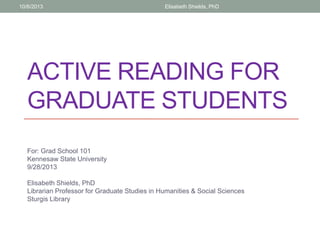
ACTIVE READING FOR
GRADUATE STUDENTS
For: Grad School 101
Kennesaw State University
9/28/2013
Elisabeth Shields, PhD
Librarian Professor for Graduate Studies in Humanities & Social Sciences
Sturgis Library
10/6/2013 Elisabeth Shields, PhD
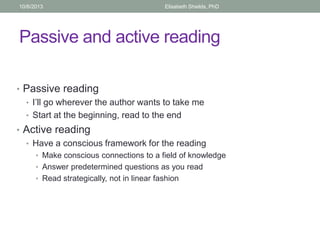
Passive and active reading
• Passive reading
• I’ll go wherever the author wants to take me
• Start at the beginning, read to the end
• Active reading
• Have a conscious framework for the reading
• Make conscious connections to a field of knowledge
• Answer predetermined questions as you read
• Read strategically, not in linear fashion
10/6/2013 Elisabeth Shields, PhD
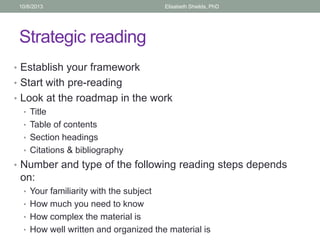
Strategic reading
• Establish your framework
• Start with pre-reading
• Look at the roadmap in the work
• Title
• Table of contents
• Section headings
• Citations & bibliography
• Number and type of the following reading steps depends
on:
• Your familiarity with the subject
• How much you need to know
• How complex the material is
• How well written and organized the material is
10/6/2013 Elisabeth Shields, PhD
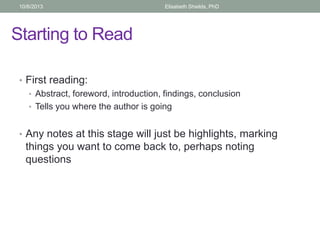
Starting to Read
• First reading:
• Abstract, foreword, introduction, findings, conclusion
• Tells you where the author is going
• Any notes at this stage will just be highlights, marking
things you want to come back to, perhaps noting
questions
10/6/2013 Elisabeth Shields, PhD
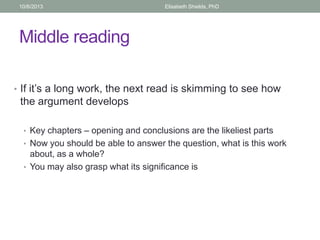
Middle reading
• If it’s a long work, the next read is skimming to see how
the argument develops
• Key chapters – opening and conclusions are the likeliest parts
• Now you should be able to answer the question, what is this work
about, as a whole?
• You may also grasp what its significance is
10/6/2013 Elisabeth Shields, PhD
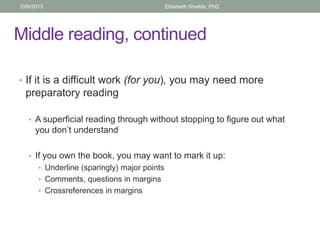
Middle reading, continued
• If it is a difficult work (for you), you may need more
preparatory reading
• A superficial reading through without stopping to figure out what
you don’t understand
• If you own the book, you may want to mark it up:
• Underline (sparingly) major points
• Comments, questions in margins
• Crossreferences in margins
10/6/2013 Elisabeth Shields, PhD
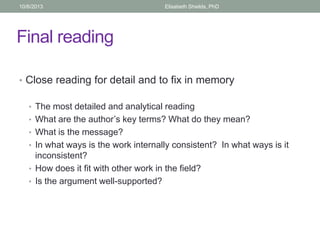
Final reading
• Close reading for detail and to fix in memory
• The most detailed and analytical reading
• What are the author’s key terms? What do they mean?
• What is the message?
• In what ways is the work internally consistent? In what ways is it
inconsistent?
• How does it fit with other work in the field?
• Is the argument well-supported?
10/6/2013 Elisabeth Shields, PhD
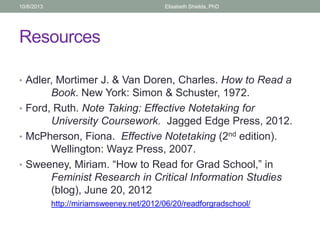
Resources
• Adler, Mortimer J. & Van Doren, Charles. How to Read a
Book. New York: Simon & Schuster, 1972.
• Ford, Ruth. Note Taking: Effective Notetaking for
University Coursework. Jagged Edge Press, 2012.
• McPherson, Fiona. Effective Notetaking (2nd edition).
Wellington: Wayz Press, 2007.
• Sweeney, Miriam. “How to Read for Grad School,” in
Feminist Research in Critical Information Studies
(blog), June 20, 2012
http://miriamsweeney.net/2012/06/20/readforgradschool/
10/6/2013 Elisabeth Shields, PhD

Active reading for graduate students

  • 1.
    ACTIVE READING FOR GRADUATESTUDENTS For: Grad School 101 Kennesaw State University 9/28/2013 Elisabeth Shields, PhD Librarian Professor for Graduate Studies in Humanities & Social Sciences Sturgis Library 10/6/2013 Elisabeth Shields, PhD
  • 2.
    Passive and activereading • Passive reading • I’ll go wherever the author wants to take me • Start at the beginning, read to the end • Active reading • Have a conscious framework for the reading • Make conscious connections to a field of knowledge • Answer predetermined questions as you read • Read strategically, not in linear fashion 10/6/2013 Elisabeth Shields, PhD
  • 3.
    Strategic reading • Establishyour framework • Start with pre-reading • Look at the roadmap in the work • Title • Table of contents • Section headings • Citations & bibliography • Number and type of the following reading steps depends on: • Your familiarity with the subject • How much you need to know • How complex the material is • How well written and organized the material is 10/6/2013 Elisabeth Shields, PhD
  • 4.
    Starting to Read •First reading: • Abstract, foreword, introduction, findings, conclusion • Tells you where the author is going • Any notes at this stage will just be highlights, marking things you want to come back to, perhaps noting questions 10/6/2013 Elisabeth Shields, PhD
  • 5.
    Middle reading • Ifit’s a long work, the next read is skimming to see how the argument develops • Key chapters – opening and conclusions are the likeliest parts • Now you should be able to answer the question, what is this work about, as a whole? • You may also grasp what its significance is 10/6/2013 Elisabeth Shields, PhD
  • 6.
    Middle reading, continued •If it is a difficult work (for you), you may need more preparatory reading • A superficial reading through without stopping to figure out what you don’t understand • If you own the book, you may want to mark it up: • Underline (sparingly) major points • Comments, questions in margins • Crossreferences in margins 10/6/2013 Elisabeth Shields, PhD
  • 7.
    Final reading • Closereading for detail and to fix in memory • The most detailed and analytical reading • What are the author’s key terms? What do they mean? • What is the message? • In what ways is the work internally consistent? In what ways is it inconsistent? • How does it fit with other work in the field? • Is the argument well-supported? 10/6/2013 Elisabeth Shields, PhD
  • 8.
    Resources • Adler, MortimerJ. & Van Doren, Charles. How to Read a Book. New York: Simon & Schuster, 1972. • Ford, Ruth. Note Taking: Effective Notetaking for University Coursework. Jagged Edge Press, 2012. • McPherson, Fiona. Effective Notetaking (2nd edition). Wellington: Wayz Press, 2007. • Sweeney, Miriam. “How to Read for Grad School,” in Feminist Research in Critical Information Studies (blog), June 20, 2012 http://miriamsweeney.net/2012/06/20/readforgradschool/ 10/6/2013 Elisabeth Shields, PhD