The research proposal
EDGT991: Researching TESOL perspectives and practices
Dr Mark Fraser
Autumn session
2017
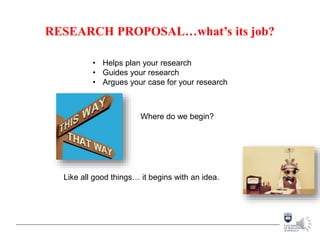
RESEARCH PROPOSAL…what’s its job?
• Helps plan your research
• Guides your research
• Argues your case for your research
Where do we begin?
Like all good things… it begins with an idea.
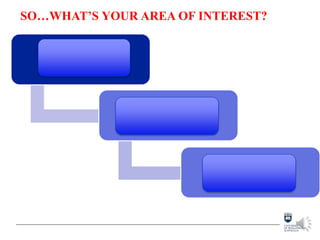
SO…WHAT’S YOUR AREA OF INTEREST?
Area of interest
Bias, beliefs, values
Research questions
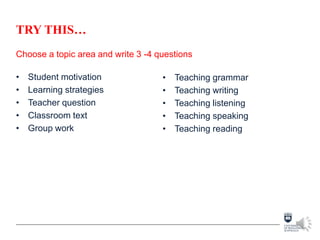
TRY THIS…
Choose a topic area and write 3 -4 questions
• Student motivation
• Learning strategies
• Teacher question
• Classroom text
• Group work
• Teaching grammar
• Teaching writing
• Teaching listening
• Teaching speaking
• Teaching reading
TIME TO GET PERSONAL
• Your task
– One person to explain their research idea to the others in the group
– As the research idea is being explained, the others take notes
– Now the others provide the speaker with a summary of what they
heard; the speaker takes notes
– Repeat with the others in the group
• Now spend 5 minutes on your own to complete the following:
– The aim of my project is …
– I’m interested in this area because ...
– Theory/ies that may help is/are ...
– The question that I want to answer is ...
• Share with the class
5
THE RESEARCH QUESTION
According to Punch (2005, p.37), research questions:
• Organise the project, and give it direction and coherence.
• Delimit the project, showing its boundaries.
• Keep the researcher focused during the project.
• Provide a framework for writing up the project.
• Point to the data that will be needed.
6
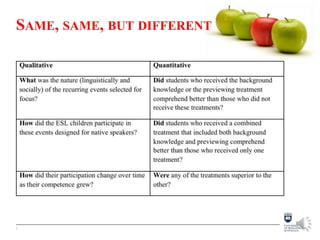
SAME, SAME, BUT DIFFERENT
7
MAPPING THE PROJECT
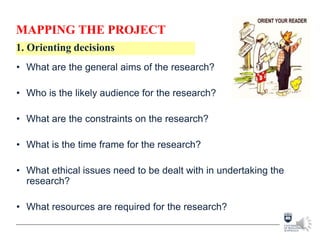
• What are the general aims of the research?
• Who is the likely audience for the research?
• What are the constraints on the research?
• What is the time frame for the research?
• What ethical issues need to be dealt with in undertaking the
research?
• What resources are required for the research?
1. Orienting decisions
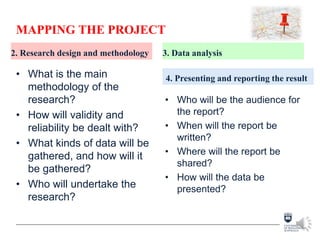
2. Research design and methodology
• What is the main
methodology of the
research?
• How will validity and
reliability be dealt with?
• What kinds of data will be
gathered, and how will it
be gathered?
• Who will undertake the
research?
3. Data analysis
• Who will be the audience for
the report?
• When will the report be
written?
• Where will the report be
shared?
• How will the data be
presented?
MAPPING THE PROJECT
4. Presenting and reporting the result
OVER TO YOU
• Spend this time to work on
developing your proposal.
• You should have a clearer idea of
your research area and draft of
your research questions.
Time to work on your proposal
Nextweek:Approachestoqualitativeresearch

Edgt991 week2 aut_2017

  • 1.
    The research proposal EDGT991:Researching TESOL perspectives and practices Dr Mark Fraser Autumn session 2017
  • 2.
    RESEARCH PROPOSAL…what’s itsjob? • Helps plan your research • Guides your research • Argues your case for your research Where do we begin? Like all good things… it begins with an idea.
  • 3.
    SO…WHAT’S YOUR AREAOF INTEREST? Area of interest Bias, beliefs, values Research questions
  • 4.
    TRY THIS… Choose atopic area and write 3 -4 questions • Student motivation • Learning strategies • Teacher question • Classroom text • Group work • Teaching grammar • Teaching writing • Teaching listening • Teaching speaking • Teaching reading
  • 5.
    TIME TO GETPERSONAL • Your task – One person to explain their research idea to the others in the group – As the research idea is being explained, the others take notes – Now the others provide the speaker with a summary of what they heard; the speaker takes notes – Repeat with the others in the group • Now spend 5 minutes on your own to complete the following: – The aim of my project is … – I’m interested in this area because ... – Theory/ies that may help is/are ... – The question that I want to answer is ... • Share with the class 5
  • 6.
    THE RESEARCH QUESTION Accordingto Punch (2005, p.37), research questions: • Organise the project, and give it direction and coherence. • Delimit the project, showing its boundaries. • Keep the researcher focused during the project. • Provide a framework for writing up the project. • Point to the data that will be needed. 6
  • 7.
    SAME, SAME, BUTDIFFERENT 7
  • 8.
    MAPPING THE PROJECT •What are the general aims of the research? • Who is the likely audience for the research? • What are the constraints on the research? • What is the time frame for the research? • What ethical issues need to be dealt with in undertaking the research? • What resources are required for the research? 1. Orienting decisions
  • 9.
    2. Research designand methodology • What is the main methodology of the research? • How will validity and reliability be dealt with? • What kinds of data will be gathered, and how will it be gathered? • Who will undertake the research? 3. Data analysis • Who will be the audience for the report? • When will the report be written? • Where will the report be shared? • How will the data be presented? MAPPING THE PROJECT 4. Presenting and reporting the result
  • 10.
    OVER TO YOU •Spend this time to work on developing your proposal. • You should have a clearer idea of your research area and draft of your research questions. Time to work on your proposal
  • 11.

Editor's Notes

  • #4 From experience, perception, knowledge What are your thoughts on teaching and learning? Now you start to focus
  • #5 Work individually then groups of 3
  • #9 Orienting decisions: this refers to setting up the project and making strategic decisions about the project and its operation. Questions that frame this stage include: What are the general aims of the research? Who is the likely audience for the research? What are the constraints on the research? What is the time frame for the research? What ethical issues need to be dealt with in undertaking the research? What resources are required for the research?
  • #10 Research design and methodology: basically how will you collect data to answer your research questions. What is the main methodology of the research? How will validity and reliability be dealt with? What kinds of data will be gathered, and how will it be gathered? Who will undertake the research? Data analysis: inductive by nature in qualitative research. That is drawing conclusions from observations. Looking for patterns and trends. Presenting and reporting the result Who will be the audience for the report? When will the report be written? Where will the report be shared? How will the data be presented?