-- B. Kedhar Guhan-
-- X D-
-- 34-
   Introduction
   Active voice
   Passive voice
   When to use Passive voice
   Caution
   Types of Passive Voices
   Verb: in a sentence, the word used to describe
    an action, state or occurrence is called a Verb.

Voice: It is the form a verb takes to indicate
 whether the subject of the verb performs or
 receives the action.
There are mainly two types of voices: Active and
Passive.
   Active voice is said to be used when the Subject
    acts in a sentence.
   Because the subject does the action, it is called
    Active voice.
   Examples:
•   I(s) completed(v) my homework. [ Here, the subject I
    does the work ]
•   Aaditya is riding the bicycle.
•   Everybody is seeing Kedhar’s PPT.
   Passive voice is said to be used when the Recipent
    is acted upon by the Subject.
   Because the Subject is passive(is being acted upon),
    such sentences are said to be in passive voice.

•   Kedhar’s PPT is being viewed by the class.[Here, the
    recipient PPT is being acted upon by the subject the class ]
•   My CD was broken(v) when I(s) saw it this morning.
•   The culprits have been caught red-handed.
   We use passive when we are most interested in the
    action than the person who does it, or when we don’t
    know the active subject.
   We generally use passive voice in Descriptive text
    types, like:
•   Formal reports.
•   Description of some process.
•   Academic writings (like Reporting of scientefic
    experiments)
   Though transformation of active to passive voice is
    possible, we must remember certain sentences
    shouldn’t be transformed.
   Example:
•   He is drinking water  Water is being drunk by him.
•   She is eating food  food is being eaten by her.

   Though both the transformed sentence are grammatically
    correct, such sentences are very unnatural and sound
    awkward when spoken.
   Passive voice, as well as active voice can be divided
    into various verb forms, according to tense used in
    the sentence.

  In this PPT, we’ll discuss about the passive voice
   forms given in the book, namely-
1.   Present Passive
2.   Simple Past Passive
3.   Present Perfect Passive
4.   Future Passive
5.   Modals with the Passive
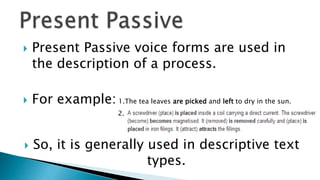
   Present Passive voice forms are used in
    the description of a process.

   For example: 1.The tea leaves are picked and left to dry in the sun.
                          2.


   So, it is generally used in descriptive text
                        types.
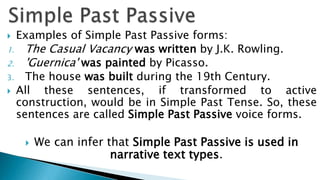
 Examples of Simple Past Passive forms:
1. The Casual Vacancy was written by J.K. Rowling.
2. 'Guernica' was painted by Picasso.
3. The house was built during the 19th Century.
 All  these sentences, if transformed to active
  construction, would be in Simple Past Tense. So, these
  sentences are called Simple Past Passive voice forms.

       We can infer that Simple Past Passive is used in
                      narrative text types.
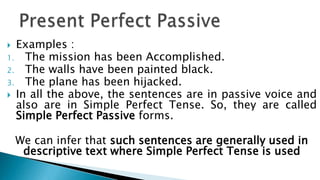
 Examples :
1. The mission has been Accomplished.
2. The walls have been painted black.
3. The plane has been hijacked.
 In all the above, the sentences are in passive voice and
  also are in Simple Perfect Tense. So, they are called
  Simple Perfect Passive forms.

    We can infer that such sentences are generally used in
     descriptive text where Simple Perfect Tense is used
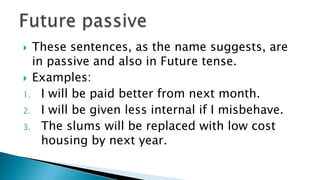
 These sentences, as the name suggests, are
  in passive and also in Future tense.
 Examples:
1. I will be paid better from next month.
2. I will be given less internal if I misbehave.
3. The slums will be replaced with low cost
    housing by next year.
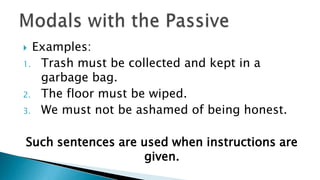
 Examples:
1. Trash must be collected and kept in a
   garbage bag.
2. The floor must be wiped.
3. We must not be ashamed of being honest.


Such sentences are used when instructions are
                    given.
 Consider the following example:
(my car was damaged in an accident)
1. A mechanic repaired my car.
2. I got my car repaired.
3. I had my car repaired.


In such cases, sentences 2 and 3 are more
natural, and is also very clear.
 Q.1) Complete the following sentences by using
  passive form of verbs:
1)There is somebody behind us. I think we
_____________ (follow)
Ans. Are being followed

2)A mystery is something that _______ (cannot/
explain)
Ans. Can’t be explained
 Q.2) Transform the following to passive voice:
a) Place the screw driver inside the tool box.(convert
   to Present Passive)
  Ans. The screw driver is placed inside the tool box.

b)   I am drinking water.
Ans. Water is being drunk by me [awkward/unnatural]

c) Some college students injured a policeman
Ans. A policeman was injured by some college students.
-- B. Kedhar Guhan--
       -- X D--
       -- 34--

Active and passive voice

  • 1.
    -- B. KedharGuhan- -- X D- -- 34-
  • 2.
    Introduction  Active voice  Passive voice  When to use Passive voice  Caution  Types of Passive Voices
  • 3.
    Verb: in a sentence, the word used to describe an action, state or occurrence is called a Verb. Voice: It is the form a verb takes to indicate whether the subject of the verb performs or receives the action. There are mainly two types of voices: Active and Passive.
  • 4.
    Active voice is said to be used when the Subject acts in a sentence.  Because the subject does the action, it is called Active voice.  Examples: • I(s) completed(v) my homework. [ Here, the subject I does the work ] • Aaditya is riding the bicycle. • Everybody is seeing Kedhar’s PPT.
  • 5.
    Passive voice is said to be used when the Recipent is acted upon by the Subject.  Because the Subject is passive(is being acted upon), such sentences are said to be in passive voice. • Kedhar’s PPT is being viewed by the class.[Here, the recipient PPT is being acted upon by the subject the class ] • My CD was broken(v) when I(s) saw it this morning. • The culprits have been caught red-handed.
  • 6.
    We use passive when we are most interested in the action than the person who does it, or when we don’t know the active subject.  We generally use passive voice in Descriptive text types, like: • Formal reports. • Description of some process. • Academic writings (like Reporting of scientefic experiments)
  • 7.
    Though transformation of active to passive voice is possible, we must remember certain sentences shouldn’t be transformed.  Example: • He is drinking water  Water is being drunk by him. • She is eating food  food is being eaten by her.  Though both the transformed sentence are grammatically correct, such sentences are very unnatural and sound awkward when spoken.
  • 8.
    Passive voice, as well as active voice can be divided into various verb forms, according to tense used in the sentence.  In this PPT, we’ll discuss about the passive voice forms given in the book, namely- 1. Present Passive 2. Simple Past Passive 3. Present Perfect Passive 4. Future Passive 5. Modals with the Passive
  • 9.
    Present Passive voice forms are used in the description of a process.  For example: 1.The tea leaves are picked and left to dry in the sun. 2.  So, it is generally used in descriptive text types.
  • 10.
     Examples ofSimple Past Passive forms: 1. The Casual Vacancy was written by J.K. Rowling. 2. 'Guernica' was painted by Picasso. 3. The house was built during the 19th Century.  All these sentences, if transformed to active construction, would be in Simple Past Tense. So, these sentences are called Simple Past Passive voice forms.  We can infer that Simple Past Passive is used in narrative text types.
  • 11.
     Examples : 1.The mission has been Accomplished. 2. The walls have been painted black. 3. The plane has been hijacked.  In all the above, the sentences are in passive voice and also are in Simple Perfect Tense. So, they are called Simple Perfect Passive forms. We can infer that such sentences are generally used in descriptive text where Simple Perfect Tense is used
  • 12.
     These sentences,as the name suggests, are in passive and also in Future tense.  Examples: 1. I will be paid better from next month. 2. I will be given less internal if I misbehave. 3. The slums will be replaced with low cost housing by next year.
  • 13.
     Examples: 1. Trashmust be collected and kept in a garbage bag. 2. The floor must be wiped. 3. We must not be ashamed of being honest. Such sentences are used when instructions are given.
  • 14.
     Consider thefollowing example: (my car was damaged in an accident) 1. A mechanic repaired my car. 2. I got my car repaired. 3. I had my car repaired. In such cases, sentences 2 and 3 are more natural, and is also very clear.
  • 15.
     Q.1) Completethe following sentences by using passive form of verbs: 1)There is somebody behind us. I think we _____________ (follow) Ans. Are being followed 2)A mystery is something that _______ (cannot/ explain) Ans. Can’t be explained
  • 16.
     Q.2) Transformthe following to passive voice: a) Place the screw driver inside the tool box.(convert to Present Passive) Ans. The screw driver is placed inside the tool box. b) I am drinking water. Ans. Water is being drunk by me [awkward/unnatural] c) Some college students injured a policeman Ans. A policeman was injured by some college students.
  • 17.
    -- B. KedharGuhan-- -- X D-- -- 34--