-- B. Kedhar Guhan --
       -- X D --
        -- 34 --
 The years following 1919 saw a huge spread of nationalism among the
  people of India , and new modes of struggle were used.

 First of all, let us know what nationalism is:
  Nationalism: It is basically the feeling of patriotism, i.e., affection
towards the country. It also implies a significant unity among the people.

 In this presentation, we will study the non-cooperation and Civil
  Disobedience Movements, and explore how congress developed a
  national movement, mobilised the people, and also how different
  social groups participated in the movements differently…
 It created to an economical and political crisis:
 Due to huge increase in defence expenditure, customs
  duties were raised and income tax was introduced.
 Through the years prices were increases significantly-
  doubling between 1913 and 1918.
 Demand for soldiers increased and forced recruitment
  took place in rural areas.
 This led to an extreme hardship of for the common man and
  also caused widespread anger.
 In 1918-19 and 1920-21, crops failed in many parts of
  India, resulting to acute shortage of food.

 Then came an influenza epidemic. In 1921, nearly 12-13
  million perished as a result of plague epidemic.

 People hoped that their hardships would end after the
  war was over. But that did not happen.
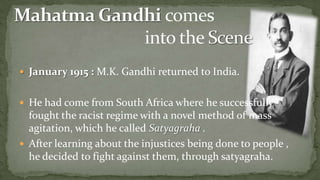
 January 1915 : M.K. Gandhi returned to India.


 He had come from South Africa where he successfully
  fought the racist regime with a novel method of mass
  agitation, which he called Satyagraha .
 After learning about the injustices being done to people ,
  he decided to fight against them, through satyagraha.
 It promotes the idea of truth and Non-Violence.
 The idea of satyagraha emphasised the power of truth and the
    need to search for it.
   It suggests that if cause is true, and if the struggle was against
    injustice, a satyagrahi could win the battle with Non-Violence.
   Without using violence of any form, a satyagrahi could win the
    battle by appealing to the conscience of the oppressor
   This can be done by persuading the people(including the
    oppressor) to see the truth, instead of being forced to accept
    the truth
   Gandhi believed that this idea could unite the Indians.
 1916: Gandhi Travelled to Champaran in Bihar to inspire the
  peasants to struggle against the oppressive plantation system.

 1917: He organised a satyagraha to support the peasants of Kheda
  district of Gujrat.
Affected by crop failure and a plague epidemic, the peasants couldn’t
pay the revenue and demanded relaxation.

 1918: He went to Ahmedabad to organise a satyagraha      movement
  amongst cotton mill workers.
       Gandhi had a great success in all of the above
 1919: After gaining popularity, Gandhi decided to launch a
  nation-wide satyagraha against the proposed Rowlatt Act.
 Rowlatt Act: it gave the Govt.. enormous powers to
  repress political activities, and allowed detention of
  political prisoners without trial.
 Gandhi wanted to fight this by adopting non-violence by
  oragnising activities like hartas( bandh).
 Rallies were organised in various cities, workers went on
  strike in railway workshops, and shops closed down.
 This scared the British. So it decided to clamp down on nationalists.

 Local leaders were picked from Amritsar and Gandhi was barred
  from Delhi.

 10 April: The police in Amritsar fired upon a peaceful procession,
  provoking widespread attacks on banks, post offices, and railway
  stations

 13 April :because of the April 10 incident, strict martial law had been
  imposed, General Dyer took command and the infamous
  Jallianwalla Bagh incident took place.
 On April 13th , a crowd of villagers who had come to Amritsar
  to attend a fair had gathered in the enclosed ground of
  Jallianwalla Bagh.
 Being from outside the city, they were unaware of the martial
  law that had been imposed.
 Dyer entered the area, blocked the exit points, and opened
  fire on the crowd, killing hundreds.
 His object, as he declared later, was to ‘produce a moral
  effect’, to create in the minds of satyagrahis a feeling of terror
  and awe
 As the Jallianwalla Bagh news spread, there were
 strikes, clashes with the police and attacks on Govt
 buildings

 The Govt.. countered this with brutal repression,
 seeking to humiliate and terrorise people

 Seeing the violence spread, Mahatma Gandhi called
 off the movement.
 Though the Rowlatt Act was wide-spread and broad,
  Gandhi felt it wasn’t broad enough to bring about a
  change.
 The only way to launch a more wide-spread and
  effective movement was to bring the Hindus and
  Muslims closer together.
 So, he decided to take advantage of the Khalifat issue.
 As the first world war ended with Ottoman’s defeat, rumours
  spread that a harsh treaty was going to be imposed on the
  Ottoman emperor, the Khalifa (spiritual head of the Islamic
  world)
 To defend the Khalifa’s temporal powers, a Khilafat
  Committee was formed in Bombay in March 1919.
 Young Muslim leaders began discussing with Gandhi about
  the possibility of a united mass action on the issue.
 He took the advantage and in 1920, he convinced other leaders
  of the Congress to start a Non-Cooperation movement in
  support of Khalifat along with Swaraj.
 Gandhi felt that British rule had survived in India only because of
  the natives’ cooperation, and without our cooperation it would
  soon collapse.
 He declared that the movement should begin with the surrender of
  the Govt.-awarded titles, and a boycott of civil services, army,
  police, courts and legislative councils, schools and foreign goods.
  Then a full civil disobedience campaign would be launched should
  the Govt.. use repression.
 This non cooperation movement began in January 1921.
 Various social groups participated in this movement, each with its
  own specific aspiration. All of them responded to the call of Swaraj,
  but the term meant different things to different people.
 Thousands of students left the Govt.. schools and colleges,
  headmasters and teachers resigned, and lawyers gave up their legal
  practices.
 The council elections were boycotted in most of the provinces,
  except Madras.
 The effects of non-cooperation on the economic front were more
  dramatic - Foreign goods were boycotted, liquor shops picketed,
  and foreign cloth burnt in huge bonfires. The import of foreign
  cloth halved between 1921 and 1922, its value dropping from Rs.102
  crore to Rs 57 crore.
 As the boycott movement spread, and people began discarding
  imported clothes and wearing only Indian ones, production of
  Indian textile mills and handlooms went up.
But this movement in the cities gradually slowed down for a
variety of reasons:
 Khadi cloth was often more expensive than mass produced
  mill cloth and poor people could not afford to buy it.
 Similarly the boycott of British institutions posed a problem:
  For the movement to be successful, alternative Indian
  institutions had to be set up so that they could be used in
  place of the British ones. These were slow to come up.
 So students and teachers began trickling back to government
  schools and lawyers joined back work in government courts.
The people in the countryside took the meaning od swaraj in
a different way. For example,
 In Awadh, before 1920, peasants were suffering a lot
  because of the oppressive landlords and talukdars.
 When Nehru came across this, he set up Oudha Kisan
  Sabha to help them, and soon 300 branches of it was set up.
 In June 1920n Jawaharlal Nehru came across all this and
    decided to set up Oudh Kisan Sabha. Within a month, over
    300 branches were set up in various villages.
   So when the Non Cooperation Movement began the
    following year, the effort of the Congress was to integrate the
    Awadh peasant struggle into the wider struggle.
   So when the Non-Cooperation Movement began the
    following year, the effort of the Congress integrated the
    Awadh peasant struggle into the wider struggle.
   As the movement spread, the landlords were attacked, shops
    looted, and grain hoards were taken over.
   The name of Mahatma was being invoked to sanction all
    action and aspirations.
Tribal peasants interpreted the message of Mahatma Gandhi and the idea of swaraj in yet
another way.
 In the Gudem Hills of Andhra Pradesh a militant guerrilla movement spread in the early
   1920s.
 Here, the colonial government had closed large forest areas, preventing people from
   entering the forests to graze their cattle, or to collect fuel wood and fruits.
 This enraged the hill people.
 When the government began forcing them to contribute begar for road building, the
   hill people revolted.
 Their leader, who was thought to be an incarnation of god, said he was inspired by the
   Non-Cooperation Movement, and persuaded people to wear khadi and give up drinking.
 But at the same time he asserted that India could be liberated only by the use of force,
   not non-violence.
 This led to total destruction of Non Violence.
For plantation workers in Assam, freedom meant the right to move freely
in and out of the confined space in which they were enclosed, and it
meant retaining a link with the village from which they had come.
 Under the act of 1859, plantation workers were not permitted to leave
   the tea gardens without permission, and were rarely given such
   permission.
 When they heard of the Non-Cooperation Movement, thousands of
   workers defied the authorities, left the plantations and headed home.
 They, however, never reached their destination. Stranded on the way by
   a railway and steamer strike, they were caught by the police and
   brutally beaten up.
 The visions of these movements were not defined by the
  Congress programme. They interpreted the term swaraj in
  their own ways, imagining it to be a time when all suffering
  and all troubles would be over.
 Yet, when the tribals chanted Gandhiji’s name and raised
  slogans demanding ‘Swatantra Bharat’, they were also
  emotionally relating to an all-India agitation.
 When they acted in the name of Mahatma Gandhi, or linked
  their movement to that of the Congress, they were identifying
  with a movement which went beyond the limits of their
  immediate locality.
 In Feb 1922, Gandhi withdrew the non-cooperation
  Movement.
 He felt the current satyagrahis weren’t properly trained and
  hence turned violent in many places.
 Within the Congress, some leaders were by now tired of mass
  struggles and wanted to participate in election. They felt that
  it was important to oppose British policies within the
  councils, argue for reform and also demonstrate that these
  councils were not truly democratic.
 C. R. Das and Motilal Nehru formed the Swaraj Party within
  the Congress to argue for a return to council politics.
 In such a situation, two factors shaped the Indian Politics in the
  1920s :
1. The effect of worldwide economic depression: In the 1930s,
    as the demand for agricultural goods fell and exports declined,
    peasants found it difficult to sell their harvests and pay their
    revenue. By 1930, the countryside was in turmoil.
2. The new tory Government in Britain constituted
    a Statutory Commission, which contained NO
    Indian member, under Sir John Simon, was to
    look into the functioning of the constitutional
    system in India and suggest changes. But when               the
    Simon Commission arrived in India in 1928, it              was
    greeted with a slogan GO BACK SIMON .
 All the major Indian parties had took pat in the demonstration.
 In an effort to win them over, the viceroy, Lord Irwin, announced in
  October 1929, a vague offer of ‘dominion status’ for India in an
  unspecified future, and a Round Table Conference to discuss a future
  constitution.
 This did not satisfy the Congress leaders- the radicals within the
  congress became more assertive :
 In December 1929, under the presidency of Jawaharlal Nehru, the
  Lahore Congress formalised the demand of ‘Purna Swaraj’ or full
  independence for India. It was declared that 26 January 1930, would
  be celebrated as the Independence Day when people were to take a
  pledge to struggle for complete independence.
 But this attracted very little attention. So Mahatma Gandhi decided
  to relate the idea of freedom to more concrete issues of everyday life.
 ON 31 Jan 1930, Gandhi sent a letter to viceroy Irwin stating 11
  demands: some of them of general interest and some of specific.
  The most stirring of all was the demand to abolish salt tax.
 His letter stated that if the demands weren’t fulfilled by 11 march,
  the congress would launch a civil disobedience movement. But
  Irwin didn’t negotiate.
 So Mahatma Gandhi started his famous salt march accompanied
  by 78 of his trusted volunteers.
 The march was over 240 miles, from Gandhiji’s ashram in
  Sabarmati to the Gujarati coastal town of Dandi. The volunteers
  walked for 24 days, about 10 miles a day.
 Salt was something that was consumed by the rich and
    poor alike, as it was the most essential items of food.
   The tax on salt and the government monopoly over its
    production, Mahatma Gandhi declared, revealed the most
    oppressive face of British rule.
   So this movement attracted people in large numbers.
   Thousands came to hear Mahatma Gandhi wherever he
    stopped, and he told them what he meant by swaraj and
    urged them to peacefully defy the British.
   On 6 April he reached Dandi, and ceremonially violated
    the law, manufacturing salt by boiling sea water.
 This Dandi March marked the beginning of Civil Disobedience
    Movement.
   The of Civil Disobedience was different from Non-Cooperation
    movement in the sense that it not only asked people to refuse
    cooperation with British (as in non cooperation movement), but
    also asked them to break the rules.
   As the movement spread, foreign cloth was boycotted, and liquor
    shops were picketed.
   Peasants refused to pay revenue and chaukidari taxes, village
    officials resigned, and in many places forest people violated forest
    laws – going into Reserved Forests to collect wood and graze cattle.
    Worried by the developments, the colonial government began
    arresting the Congress leaders one by one.
 This led to violent clashes in many palaces. When Abdul Ghaffar
  Khan, a devout disciple of Mahatma Gandhi, was arrested in
  April 1930, angry crowds demonstrated in the streets of
  Peshawar, facing armoured cars and police firing. Many were
  killed.
 A month later, when Mahatma Gandhi himself was arrested,
  industrial workers in Sholapur attacked police posts, municipal
  buildings, law courts and railway stations – all structures that
  symbolised British rule.
 A frightened government responded with a policy of brutal
  repression. Peaceful satyagrahis were attacked, women and
  children were beaten, and about 100,000 people were arrested.
 In such a situation, Gandhi once again called off the movement
  and entered into a pact with Irwin on 5 march 1931, and consented
  to participate in a Round-Table conference in London and the
  Govt. agreed to release the political prisoners.
 In Dec 1937, Gandhi went to London for the conference, but
  returned disappointed as the negotiations broke down.
 Whilst all this, in India, the Govt. had begun a new cycle of
  repression: Ghaffar Khan and Nehru were both in jail, the
  Congress had been declared illegal, and a series of measures had
  been imposed to prevent meetings, demonstrations and boycotts.
 With great apprehension, Mahatma Gandhi relaunched the Civil
  Disobedience Movement, but it had clearly lost its momentum.
Different Communities participated in the movement for different reason, and saw
                       Swaraj in a different perspective

 In the countryside, rich peasant communities, being producers of commercial
  crops, were very hard hit by the trade depression and falling prices, and found it
  impossible to pay the government’s revenue demand.
 The refusal of the government to reduce the revenue demand led to widespread
  resentment. These rich peasants became enthusiastic supporters of the Civil
  Disobedience Movement, organising their communities, and at times forcing
  reluctant members, to participate in the boycott programmes.
 For them the fight for swaraj was a struggle against high revenues.
 But they were deeply disappointed when the movement was called off in 1931
  without the revenue rates being revised. So when the movement was restarted in
  1932, many of them refused to participate.
 Many of them were small tenants cultivating land they had rented
  from landlords. As the Depression continued and cash incomes
  dwindled, the small tenants found it difficult to pay their rent.
 They wanted the unpaid rent to the landlord to be remitted. They
  joined a variety of radical movements, often led by Socialists and
  Communists.
 Apprehensive of raising issues that might upset the rich peasants
  and landlords, the Congress was unwilling to support ‘no rent’
  campaigns in most places.
 So the relationship between the poor peasants and the Congress
  remained uncertain.
 Keen on expanding their business, Indian merchants and industrialists now reacted
  against colonial policies that restricted business activities.
 They wanted protection against imports of foreign goods, and a rupee-sterling foreign
  exchange ratio that would discourage imports.
 To organise business interests, they formed the Indian industrial and Commercial
  Congress in 1920 and the Federation of the Indian Chamber of Commerce and Industries
  (FICCI) in 1927, and also attacked colonial control over the Indian economy, and
  supported the Civil Disobedience Movement when it was first launched.
 They gave financial assistance and refused to buy or sell imported goods. Most
  businessmen came to see swaraj as a time when colonial restrictions on business
  would no longer exist and trade and industry would flourish without constraints.
 But after the failure of the Round Table Conference, they were apprehensive of the
  spread of militant activities, and worried about prolonged disruption of business, as well
  as of the growing influence of socialism amongst the younger members of the Congress.
 Only in the Nagpur region, there was active participation of
  the working class in the Movement.
 They organised movements against low wages and poor
  working conditions. There were strikes by the railway and
  dock workers.
 But the Congress was reluctant to include workers’ demands
  as part of its programme of struggle. It felt that this would
  alienate industrialists and divide the anti-imperial forces.
 Not all social groups were moved by the abstract concept of Swaraj, like the Dalits and
  the Muslims.
                        The Untouchables (Dalits):
For long the Congress had ignored the dalits, for fear of offending the conservative high-
caste Hindus. But Mahatma Gandhi declared that swaraj was impossible if untouchability
wasn’t eliminated.
He called the dalit the children of god, and organised satyagrahas to secure them entry into
temples, and access to public wells, tanks, roads and schools, etc. to gain popularity among
them and drag them into the movement.
But many dalit leaders were keen on a different political solution to the problems of the
community. They began organising themselves and placing their demands.
Therefore Dalit participation in the Movement was limited, particularly in the
Maharashtra and Nagpur region where their organisation was quite strong.
The Muslims
 After the decline of the Non-Cooperation-Khilafat
 movement, a large section of Muslims felt alienated from the
 Congress.

 Gradually , each community organised religious processions
 with militant fervour, provoking Hindu-Muslim communal
 clashes and riots in various cities. Every riot deepened the
 distance between the two communities
 To forge unity, Mohammad Ali Jinnah (a leader of the
 Muslim League), was willing to give up the demand for
 separate electorates, if Muslims were assured reserved
 seats in the Central Assembly and representation in
 proportion to population in the Muslim-dominated
 provinces.

 But all hope of resolving the issue disappeared
 when M.R. Jayakar of the Hindu Mahasabha strongly
 opposed the efforts at compromise at the All Parties
 Conference in 1928 .
 When the Civil Disobedience Movement started there was thus
  an atmosphere of suspicion and distrust between communities.

 Alienated from the Congress, large sections of Muslims could not
  respond to the call for a united struggle.

 Many Muslim leaders and intellectuals expressed their concern
  about the status of Muslims as a minority within India.

 They feared that the culture and identity of minorities would be
  submerged under the domination of a Hindu majority.
( Nationalism )
 The sense of collective belonging gradually came
  partly through the experience of united struggles.
 Even the media: Folklore, fictions, songs, popular
  prints and symbols, played a major role in the making
  of nationalism.
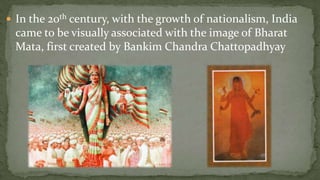
 In the 20th century, with the growth of nationalism, India
 came to be visually associated with the image of Bharat
 Mata, first created by Bankim Chandra Chattopadhyay
 Bankim then wrote Vande Mataram as a hymn to the mother land.
 Later it was included in his novel Anandamath and widely sung during
  the Swadeshi movement in Bengal.
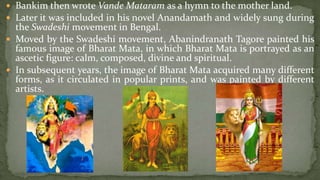
 Moved by the Swadeshi movement, Abanindranath Tagore painted his
  famous image of Bharat Mata, in which Bharat Mata is portrayed as an
  ascetic figure: calm, composed, divine and spiritual.
 In subsequent years, the image of Bharat Mata acquired many different
  forms, as it circulated in popular prints, and was painted by different
  artists.
 Ideas of nationalism also developed through a movement to revive
  Indian folklore. In late-nineteenth-century India, nationalists
  began recording folk tales sung by bards and they toured villages
  to gather folk songs and legends. These tales, they believed, gave a
  true picture of traditional culture that had been corrupted and
  damaged by outside forces.

 In Bengal, Rabindranath Tagore himself began collecting ballads,
  nursery rhymes and myths, and led the movement for folk revival.

 In Madras, Natesa Sastri published a massive four-volume
  collection of Tamil folk tales, The Folklore of Southern India. He
  believed that folklore was national literature; it was ‘the most
  trustworthy manifestation of people’s real thoughts and
  characteristics.’
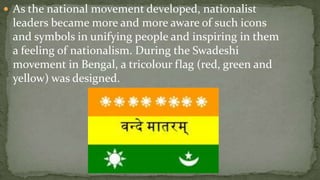
 As the national movement developed, nationalist
 leaders became more and more aware of such icons
 and symbols in unifying people and inspiring in them
 a feeling of nationalism. During the Swadeshi
 movement in Bengal, a tricolour flag (red, green and
 yellow) was designed.
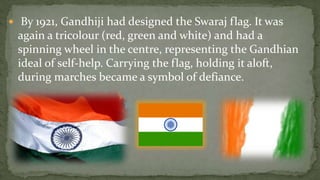
 By 1921, Gandhiji had designed the Swaraj flag. It was
 again a tricolour (red, green and white) and had a
 spinning wheel in the centre, representing the Gandhian
 ideal of self-help. Carrying the flag, holding it aloft,
 during marches became a symbol of defiance.
 Another means of creating a feeling of nationalism was through
  reinterpretation of history.
 The British saw Indians as backward and primitive, incapable of
  governing themselves. In response, Indians began looking into the
  past to discover India’s great achievements. They wrote about the
  glorious developments in ancient times when art and architecture,
  science and mathematics, religion and culture, law and
  philosophy, crafts and trade had flourished.
 These nationalist histories urged the readers to take pride in
  India’s great achievements in the past and struggle to change the
  miserable conditions of life under British rule.
 A growing anger against the colonial government was thus bringing together various
  groups and classes of Indians into a common struggle for freedom in the first half of
  the twentieth century.
 The Congress under the leadership of Mahatma Gandhi tried to channel people’s
  grievances into united organised movements for independence.
 But as diverse groups and classes participated in these movements with varied
  aspirations and expectations, their grievances were wide-ranging, and freedom from
  colonial rule also meant different things to different people.
 The Congress continuously attempted to resolve differences, and ensure that the
  demands of one group did not alienate another. This is why the unity within the
  movement often broke down.
 The high points of Congress activity and nationalist unity were followed by phases of
  disunity and inner conflict between groups. In other words, what was emerging was a
  nation with many voices wanting freedom from colonial rule.
-- B. Kedhar Guhan --
       -- X D --
        -- 34 --

Nationalism in india

  • 1.
    -- B. KedharGuhan -- -- X D -- -- 34 --
  • 2.
     The yearsfollowing 1919 saw a huge spread of nationalism among the people of India , and new modes of struggle were used.  First of all, let us know what nationalism is: Nationalism: It is basically the feeling of patriotism, i.e., affection towards the country. It also implies a significant unity among the people.  In this presentation, we will study the non-cooperation and Civil Disobedience Movements, and explore how congress developed a national movement, mobilised the people, and also how different social groups participated in the movements differently…
  • 3.
     It createdto an economical and political crisis:  Due to huge increase in defence expenditure, customs duties were raised and income tax was introduced.  Through the years prices were increases significantly- doubling between 1913 and 1918.  Demand for soldiers increased and forced recruitment took place in rural areas.  This led to an extreme hardship of for the common man and also caused widespread anger.
  • 4.
     In 1918-19and 1920-21, crops failed in many parts of India, resulting to acute shortage of food.  Then came an influenza epidemic. In 1921, nearly 12-13 million perished as a result of plague epidemic.  People hoped that their hardships would end after the war was over. But that did not happen.
  • 5.
     January 1915: M.K. Gandhi returned to India.  He had come from South Africa where he successfully fought the racist regime with a novel method of mass agitation, which he called Satyagraha .  After learning about the injustices being done to people , he decided to fight against them, through satyagraha.
  • 6.
     It promotesthe idea of truth and Non-Violence.  The idea of satyagraha emphasised the power of truth and the need to search for it.  It suggests that if cause is true, and if the struggle was against injustice, a satyagrahi could win the battle with Non-Violence.  Without using violence of any form, a satyagrahi could win the battle by appealing to the conscience of the oppressor  This can be done by persuading the people(including the oppressor) to see the truth, instead of being forced to accept the truth  Gandhi believed that this idea could unite the Indians.
  • 7.
     1916: GandhiTravelled to Champaran in Bihar to inspire the peasants to struggle against the oppressive plantation system.  1917: He organised a satyagraha to support the peasants of Kheda district of Gujrat. Affected by crop failure and a plague epidemic, the peasants couldn’t pay the revenue and demanded relaxation.  1918: He went to Ahmedabad to organise a satyagraha movement amongst cotton mill workers. Gandhi had a great success in all of the above
  • 8.
     1919: Aftergaining popularity, Gandhi decided to launch a nation-wide satyagraha against the proposed Rowlatt Act.  Rowlatt Act: it gave the Govt.. enormous powers to repress political activities, and allowed detention of political prisoners without trial.  Gandhi wanted to fight this by adopting non-violence by oragnising activities like hartas( bandh).  Rallies were organised in various cities, workers went on strike in railway workshops, and shops closed down.
  • 9.
     This scaredthe British. So it decided to clamp down on nationalists.  Local leaders were picked from Amritsar and Gandhi was barred from Delhi.  10 April: The police in Amritsar fired upon a peaceful procession, provoking widespread attacks on banks, post offices, and railway stations  13 April :because of the April 10 incident, strict martial law had been imposed, General Dyer took command and the infamous Jallianwalla Bagh incident took place.
  • 10.
     On April13th , a crowd of villagers who had come to Amritsar to attend a fair had gathered in the enclosed ground of Jallianwalla Bagh.  Being from outside the city, they were unaware of the martial law that had been imposed.  Dyer entered the area, blocked the exit points, and opened fire on the crowd, killing hundreds.  His object, as he declared later, was to ‘produce a moral effect’, to create in the minds of satyagrahis a feeling of terror and awe
  • 11.
     As theJallianwalla Bagh news spread, there were strikes, clashes with the police and attacks on Govt buildings  The Govt.. countered this with brutal repression, seeking to humiliate and terrorise people  Seeing the violence spread, Mahatma Gandhi called off the movement.
  • 12.
     Though theRowlatt Act was wide-spread and broad, Gandhi felt it wasn’t broad enough to bring about a change.  The only way to launch a more wide-spread and effective movement was to bring the Hindus and Muslims closer together.  So, he decided to take advantage of the Khalifat issue.
  • 13.
     As thefirst world war ended with Ottoman’s defeat, rumours spread that a harsh treaty was going to be imposed on the Ottoman emperor, the Khalifa (spiritual head of the Islamic world)  To defend the Khalifa’s temporal powers, a Khilafat Committee was formed in Bombay in March 1919.  Young Muslim leaders began discussing with Gandhi about the possibility of a united mass action on the issue.  He took the advantage and in 1920, he convinced other leaders of the Congress to start a Non-Cooperation movement in support of Khalifat along with Swaraj.
  • 14.
     Gandhi feltthat British rule had survived in India only because of the natives’ cooperation, and without our cooperation it would soon collapse.  He declared that the movement should begin with the surrender of the Govt.-awarded titles, and a boycott of civil services, army, police, courts and legislative councils, schools and foreign goods. Then a full civil disobedience campaign would be launched should the Govt.. use repression.  This non cooperation movement began in January 1921.  Various social groups participated in this movement, each with its own specific aspiration. All of them responded to the call of Swaraj, but the term meant different things to different people.
  • 15.
     Thousands ofstudents left the Govt.. schools and colleges, headmasters and teachers resigned, and lawyers gave up their legal practices.  The council elections were boycotted in most of the provinces, except Madras.  The effects of non-cooperation on the economic front were more dramatic - Foreign goods were boycotted, liquor shops picketed, and foreign cloth burnt in huge bonfires. The import of foreign cloth halved between 1921 and 1922, its value dropping from Rs.102 crore to Rs 57 crore.  As the boycott movement spread, and people began discarding imported clothes and wearing only Indian ones, production of Indian textile mills and handlooms went up.
  • 16.
    But this movementin the cities gradually slowed down for a variety of reasons:  Khadi cloth was often more expensive than mass produced mill cloth and poor people could not afford to buy it.  Similarly the boycott of British institutions posed a problem: For the movement to be successful, alternative Indian institutions had to be set up so that they could be used in place of the British ones. These were slow to come up.  So students and teachers began trickling back to government schools and lawyers joined back work in government courts.
  • 17.
    The people inthe countryside took the meaning od swaraj in a different way. For example,  In Awadh, before 1920, peasants were suffering a lot because of the oppressive landlords and talukdars.  When Nehru came across this, he set up Oudha Kisan Sabha to help them, and soon 300 branches of it was set up.
  • 18.
     In June1920n Jawaharlal Nehru came across all this and decided to set up Oudh Kisan Sabha. Within a month, over 300 branches were set up in various villages.  So when the Non Cooperation Movement began the following year, the effort of the Congress was to integrate the Awadh peasant struggle into the wider struggle.  So when the Non-Cooperation Movement began the following year, the effort of the Congress integrated the Awadh peasant struggle into the wider struggle.  As the movement spread, the landlords were attacked, shops looted, and grain hoards were taken over.  The name of Mahatma was being invoked to sanction all action and aspirations.
  • 19.
    Tribal peasants interpretedthe message of Mahatma Gandhi and the idea of swaraj in yet another way.  In the Gudem Hills of Andhra Pradesh a militant guerrilla movement spread in the early 1920s.  Here, the colonial government had closed large forest areas, preventing people from entering the forests to graze their cattle, or to collect fuel wood and fruits.  This enraged the hill people.  When the government began forcing them to contribute begar for road building, the hill people revolted.  Their leader, who was thought to be an incarnation of god, said he was inspired by the Non-Cooperation Movement, and persuaded people to wear khadi and give up drinking.  But at the same time he asserted that India could be liberated only by the use of force, not non-violence.  This led to total destruction of Non Violence.
  • 20.
    For plantation workersin Assam, freedom meant the right to move freely in and out of the confined space in which they were enclosed, and it meant retaining a link with the village from which they had come.  Under the act of 1859, plantation workers were not permitted to leave the tea gardens without permission, and were rarely given such permission.  When they heard of the Non-Cooperation Movement, thousands of workers defied the authorities, left the plantations and headed home.  They, however, never reached their destination. Stranded on the way by a railway and steamer strike, they were caught by the police and brutally beaten up.
  • 21.
     The visionsof these movements were not defined by the Congress programme. They interpreted the term swaraj in their own ways, imagining it to be a time when all suffering and all troubles would be over.  Yet, when the tribals chanted Gandhiji’s name and raised slogans demanding ‘Swatantra Bharat’, they were also emotionally relating to an all-India agitation.  When they acted in the name of Mahatma Gandhi, or linked their movement to that of the Congress, they were identifying with a movement which went beyond the limits of their immediate locality.
  • 23.
     In Feb1922, Gandhi withdrew the non-cooperation Movement.  He felt the current satyagrahis weren’t properly trained and hence turned violent in many places.  Within the Congress, some leaders were by now tired of mass struggles and wanted to participate in election. They felt that it was important to oppose British policies within the councils, argue for reform and also demonstrate that these councils were not truly democratic.  C. R. Das and Motilal Nehru formed the Swaraj Party within the Congress to argue for a return to council politics.
  • 24.
     In sucha situation, two factors shaped the Indian Politics in the 1920s : 1. The effect of worldwide economic depression: In the 1930s, as the demand for agricultural goods fell and exports declined, peasants found it difficult to sell their harvests and pay their revenue. By 1930, the countryside was in turmoil. 2. The new tory Government in Britain constituted a Statutory Commission, which contained NO Indian member, under Sir John Simon, was to look into the functioning of the constitutional system in India and suggest changes. But when the Simon Commission arrived in India in 1928, it was greeted with a slogan GO BACK SIMON .
  • 25.
     All themajor Indian parties had took pat in the demonstration.  In an effort to win them over, the viceroy, Lord Irwin, announced in October 1929, a vague offer of ‘dominion status’ for India in an unspecified future, and a Round Table Conference to discuss a future constitution.  This did not satisfy the Congress leaders- the radicals within the congress became more assertive :  In December 1929, under the presidency of Jawaharlal Nehru, the Lahore Congress formalised the demand of ‘Purna Swaraj’ or full independence for India. It was declared that 26 January 1930, would be celebrated as the Independence Day when people were to take a pledge to struggle for complete independence.  But this attracted very little attention. So Mahatma Gandhi decided to relate the idea of freedom to more concrete issues of everyday life.
  • 26.
     ON 31Jan 1930, Gandhi sent a letter to viceroy Irwin stating 11 demands: some of them of general interest and some of specific. The most stirring of all was the demand to abolish salt tax.  His letter stated that if the demands weren’t fulfilled by 11 march, the congress would launch a civil disobedience movement. But Irwin didn’t negotiate.  So Mahatma Gandhi started his famous salt march accompanied by 78 of his trusted volunteers.  The march was over 240 miles, from Gandhiji’s ashram in Sabarmati to the Gujarati coastal town of Dandi. The volunteers walked for 24 days, about 10 miles a day.
  • 27.
     Salt wassomething that was consumed by the rich and poor alike, as it was the most essential items of food.  The tax on salt and the government monopoly over its production, Mahatma Gandhi declared, revealed the most oppressive face of British rule.  So this movement attracted people in large numbers.  Thousands came to hear Mahatma Gandhi wherever he stopped, and he told them what he meant by swaraj and urged them to peacefully defy the British.  On 6 April he reached Dandi, and ceremonially violated the law, manufacturing salt by boiling sea water.
  • 28.
     This DandiMarch marked the beginning of Civil Disobedience Movement.  The of Civil Disobedience was different from Non-Cooperation movement in the sense that it not only asked people to refuse cooperation with British (as in non cooperation movement), but also asked them to break the rules.  As the movement spread, foreign cloth was boycotted, and liquor shops were picketed.  Peasants refused to pay revenue and chaukidari taxes, village officials resigned, and in many places forest people violated forest laws – going into Reserved Forests to collect wood and graze cattle.  Worried by the developments, the colonial government began arresting the Congress leaders one by one.
  • 29.
     This ledto violent clashes in many palaces. When Abdul Ghaffar Khan, a devout disciple of Mahatma Gandhi, was arrested in April 1930, angry crowds demonstrated in the streets of Peshawar, facing armoured cars and police firing. Many were killed.  A month later, when Mahatma Gandhi himself was arrested, industrial workers in Sholapur attacked police posts, municipal buildings, law courts and railway stations – all structures that symbolised British rule.  A frightened government responded with a policy of brutal repression. Peaceful satyagrahis were attacked, women and children were beaten, and about 100,000 people were arrested.
  • 30.
     In sucha situation, Gandhi once again called off the movement and entered into a pact with Irwin on 5 march 1931, and consented to participate in a Round-Table conference in London and the Govt. agreed to release the political prisoners.  In Dec 1937, Gandhi went to London for the conference, but returned disappointed as the negotiations broke down.  Whilst all this, in India, the Govt. had begun a new cycle of repression: Ghaffar Khan and Nehru were both in jail, the Congress had been declared illegal, and a series of measures had been imposed to prevent meetings, demonstrations and boycotts.  With great apprehension, Mahatma Gandhi relaunched the Civil Disobedience Movement, but it had clearly lost its momentum.
  • 31.
    Different Communities participatedin the movement for different reason, and saw Swaraj in a different perspective  In the countryside, rich peasant communities, being producers of commercial crops, were very hard hit by the trade depression and falling prices, and found it impossible to pay the government’s revenue demand.  The refusal of the government to reduce the revenue demand led to widespread resentment. These rich peasants became enthusiastic supporters of the Civil Disobedience Movement, organising their communities, and at times forcing reluctant members, to participate in the boycott programmes.  For them the fight for swaraj was a struggle against high revenues.  But they were deeply disappointed when the movement was called off in 1931 without the revenue rates being revised. So when the movement was restarted in 1932, many of them refused to participate.
  • 32.
     Many ofthem were small tenants cultivating land they had rented from landlords. As the Depression continued and cash incomes dwindled, the small tenants found it difficult to pay their rent.  They wanted the unpaid rent to the landlord to be remitted. They joined a variety of radical movements, often led by Socialists and Communists.  Apprehensive of raising issues that might upset the rich peasants and landlords, the Congress was unwilling to support ‘no rent’ campaigns in most places.  So the relationship between the poor peasants and the Congress remained uncertain.
  • 33.
     Keen onexpanding their business, Indian merchants and industrialists now reacted against colonial policies that restricted business activities.  They wanted protection against imports of foreign goods, and a rupee-sterling foreign exchange ratio that would discourage imports.  To organise business interests, they formed the Indian industrial and Commercial Congress in 1920 and the Federation of the Indian Chamber of Commerce and Industries (FICCI) in 1927, and also attacked colonial control over the Indian economy, and supported the Civil Disobedience Movement when it was first launched.  They gave financial assistance and refused to buy or sell imported goods. Most businessmen came to see swaraj as a time when colonial restrictions on business would no longer exist and trade and industry would flourish without constraints.  But after the failure of the Round Table Conference, they were apprehensive of the spread of militant activities, and worried about prolonged disruption of business, as well as of the growing influence of socialism amongst the younger members of the Congress.
  • 34.
     Only inthe Nagpur region, there was active participation of the working class in the Movement.  They organised movements against low wages and poor working conditions. There were strikes by the railway and dock workers.  But the Congress was reluctant to include workers’ demands as part of its programme of struggle. It felt that this would alienate industrialists and divide the anti-imperial forces.
  • 35.
     Not allsocial groups were moved by the abstract concept of Swaraj, like the Dalits and the Muslims. The Untouchables (Dalits): For long the Congress had ignored the dalits, for fear of offending the conservative high- caste Hindus. But Mahatma Gandhi declared that swaraj was impossible if untouchability wasn’t eliminated. He called the dalit the children of god, and organised satyagrahas to secure them entry into temples, and access to public wells, tanks, roads and schools, etc. to gain popularity among them and drag them into the movement. But many dalit leaders were keen on a different political solution to the problems of the community. They began organising themselves and placing their demands. Therefore Dalit participation in the Movement was limited, particularly in the Maharashtra and Nagpur region where their organisation was quite strong.
  • 36.
    The Muslims  Afterthe decline of the Non-Cooperation-Khilafat movement, a large section of Muslims felt alienated from the Congress.  Gradually , each community organised religious processions with militant fervour, provoking Hindu-Muslim communal clashes and riots in various cities. Every riot deepened the distance between the two communities
  • 37.
     To forgeunity, Mohammad Ali Jinnah (a leader of the Muslim League), was willing to give up the demand for separate electorates, if Muslims were assured reserved seats in the Central Assembly and representation in proportion to population in the Muslim-dominated provinces.  But all hope of resolving the issue disappeared when M.R. Jayakar of the Hindu Mahasabha strongly opposed the efforts at compromise at the All Parties Conference in 1928 .
  • 38.
     When theCivil Disobedience Movement started there was thus an atmosphere of suspicion and distrust between communities.  Alienated from the Congress, large sections of Muslims could not respond to the call for a united struggle.  Many Muslim leaders and intellectuals expressed their concern about the status of Muslims as a minority within India.  They feared that the culture and identity of minorities would be submerged under the domination of a Hindu majority.
  • 39.
  • 40.
     The senseof collective belonging gradually came partly through the experience of united struggles.  Even the media: Folklore, fictions, songs, popular prints and symbols, played a major role in the making of nationalism.
  • 41.
     In the20th century, with the growth of nationalism, India came to be visually associated with the image of Bharat Mata, first created by Bankim Chandra Chattopadhyay
  • 42.
     Bankim thenwrote Vande Mataram as a hymn to the mother land.  Later it was included in his novel Anandamath and widely sung during the Swadeshi movement in Bengal.  Moved by the Swadeshi movement, Abanindranath Tagore painted his famous image of Bharat Mata, in which Bharat Mata is portrayed as an ascetic figure: calm, composed, divine and spiritual.  In subsequent years, the image of Bharat Mata acquired many different forms, as it circulated in popular prints, and was painted by different artists.
  • 43.
     Ideas ofnationalism also developed through a movement to revive Indian folklore. In late-nineteenth-century India, nationalists began recording folk tales sung by bards and they toured villages to gather folk songs and legends. These tales, they believed, gave a true picture of traditional culture that had been corrupted and damaged by outside forces.  In Bengal, Rabindranath Tagore himself began collecting ballads, nursery rhymes and myths, and led the movement for folk revival.  In Madras, Natesa Sastri published a massive four-volume collection of Tamil folk tales, The Folklore of Southern India. He believed that folklore was national literature; it was ‘the most trustworthy manifestation of people’s real thoughts and characteristics.’
  • 44.
     As thenational movement developed, nationalist leaders became more and more aware of such icons and symbols in unifying people and inspiring in them a feeling of nationalism. During the Swadeshi movement in Bengal, a tricolour flag (red, green and yellow) was designed.
  • 45.
     By 1921,Gandhiji had designed the Swaraj flag. It was again a tricolour (red, green and white) and had a spinning wheel in the centre, representing the Gandhian ideal of self-help. Carrying the flag, holding it aloft, during marches became a symbol of defiance.
  • 46.
     Another meansof creating a feeling of nationalism was through reinterpretation of history.  The British saw Indians as backward and primitive, incapable of governing themselves. In response, Indians began looking into the past to discover India’s great achievements. They wrote about the glorious developments in ancient times when art and architecture, science and mathematics, religion and culture, law and philosophy, crafts and trade had flourished.  These nationalist histories urged the readers to take pride in India’s great achievements in the past and struggle to change the miserable conditions of life under British rule.
  • 47.
     A growinganger against the colonial government was thus bringing together various groups and classes of Indians into a common struggle for freedom in the first half of the twentieth century.  The Congress under the leadership of Mahatma Gandhi tried to channel people’s grievances into united organised movements for independence.  But as diverse groups and classes participated in these movements with varied aspirations and expectations, their grievances were wide-ranging, and freedom from colonial rule also meant different things to different people.  The Congress continuously attempted to resolve differences, and ensure that the demands of one group did not alienate another. This is why the unity within the movement often broke down.  The high points of Congress activity and nationalist unity were followed by phases of disunity and inner conflict between groups. In other words, what was emerging was a nation with many voices wanting freedom from colonial rule.
  • 48.
    -- B. KedharGuhan -- -- X D -- -- 34 --