Effects of Addition of Clopidogrel to Aspirin in Patients with Atrial Fibrillation who are Unsuitable for Vitamin K Antagonists
Disclosures The presenter has the following relationships: Research grants from, Portola, AstraZeneca, Boston Scientific, St. Jude Medical Lecture and or consulting fees from Sanofi-Aventis, Bristol Myers Squibb, Behringer-Ingelheim, St. Jude Medical
Vitamin K Antagonists in AF Reduce stroke by 38%, compared to aspirin  Recommended in high risk patients with AF Only 40-50% of ideal patients receive VKA in Western countries Many patients considered unsuitable Due to poor INR control, concern about bleeding Patient preference
Antiplatelet Therapy in AF Increased platelet activation in AF Aspirin reduces stroke in AF by 22%  Addition of clopidogrel to aspirin achieves greater suppression of  platelet activity Addition of clopidogrel to aspirin reduces vascular events in ACS, with acceptable risk of bleeding
In patients with AF, unsuitable for VKA therapy, addition of clopidogrel to aspirin will reduce the risk of major vascular events, at acceptable risk of major bleeding Hypothesis of ACTIVE A
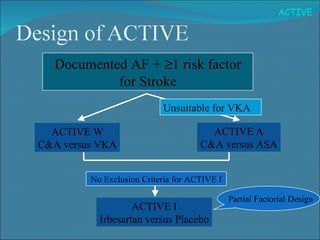
Documented AF +   1 risk factor for Stroke Unsuitable for VKA No Exclusion Criteria for ACTIVE I Partial Factorial Design ACTIVE W C&A versus VKA ACTIVE A C&A versus ASA ACTIVE I Irbesartan versus Placebo
Eligibility criteria for ACTIVE A and ACTIVE W were identical Documented AF One or more risk factors for stroke Absence of major risk factor for bleeding Investigators selected patients for either study based on assessment of suitability for VKA Patient Eligibility
All patients received aspirin at a recommended daily dose of 75-100 mgs Patients were randomized, double blind, to clopidogrel, 75 mg per day, or matching placebo ACTIVE A Study Treatments
Outcomes and Statistical Power Primary outcome was a composite of major vascular events: Stroke, myocardial infarction, non-CNS systemic embolism or vascular death Secondary outcomes Stroke Major hemorrhage 7500 patients planned to achieve 88% power to detect 15% reduction in primary outcome (1600 events)
Study Conduct 33 Countries, 580 centers 7554 patients enrolled between June 2003 and May 2006 Final follow up in November 2008 Median follow up 3.6 years Follow up was complete in 99.4% of patients
Reasons for Enrolment in ACTIVE A *  Inability to comply with INR monitoring, predisposition to falling or  head trauma,  persistent BP >160/100, previous serious bleeding on VKA,  severe alcohol abuse <2 years, peptic ulcer disease, thrombocytopenia, need for chronic NSAID Relative risk factor for bleeding* 23% Physician assessment that patient is inappropriate for VKA 50% Patient Preference Only 26%
Baseline Demographics ACTIVE A ACTIVE W N 7554 6706 Mean age (years) 71 ± 10 70 ± 9 Male 58% 66% Mean systolic BP (mmHg) 136 ± 19 133 ± 19 Permanent AF 64% 68% Baseline VKA use 8.5% 77% Baseline aspirin use 83% 26% Prior MI 14% 18% Prior stroke or TIA 13% 15% Mean CHADS2 score 2.0 ± 1.1 2.0 ± 1.1


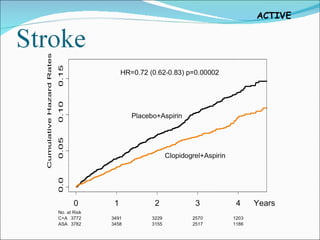
Components of the Primary Outcome Outcome Clopidogrel + Aspirin Aspirin Clopidogrel + Aspirin versus Aspirin # rate/ year # rate/ year RR 95% CI P Primary 832 6.8 924 7.6 0.89 0.81-0.98 0.014 Stroke 296 2.4 408 3.3 0.72 0.62-0.83 <0.001 MI 90 0.7 115 0.9 0.78 0.59-1.03 0.08 Vascular Death 600 4.7 599 4.7 1.0 0.89-1.12 0.97 Non-CNS systemic embolism 54 0.4 56 0.4 0.96 0.66-1.40 0.84
 
Outcome Clopidogrel + Aspirin Aspirin Clopidogrel + Aspirin versus Aspirin # rate/ year # rate/ year RR 95% CI P Ischemic/Uncertain 268 2.1 388 3.2 0.68 0.59-0.80 <0.001 Hemorrhagic 30 0.2 22 0.2 1.37 0.79-2.37 0.27 Non-disabling (mod. Rankin 0-2) 107 0.9 153 1.2 0.70 0.54-0.89 0.004 Disabling or fatal (mod. Rankin 3-6) 198 1.6 267 2.1 0.74 0.62-0.89 0.001
 
ACTIVE Bleeding Definitions Major Bleed an overt bleed requiring ≥2 unit transfusion OR severe Bleed drop in hemoglobin of ≥ 5.0 gm/dL hypotension requiring inotropic agents intraocular bleeding leading to substantial vision loss requirement for surgical intervention symptomatic intracranial  ≥ 4 unit transfusion fatal
Bleeding Outcome Clopidogrel + Aspirin Aspirin Clopidogrel + Aspirin versus Aspirin # rate/ year # rate/ year RR 95% CI P Major 251 2.0 162 1.3 1.57 1.29-1.92 <0.001 Severe 190 1.5 122 1.0 1.57 1.25-1.98 <0.001 Fatal 42 0.3 27 0.2 1.56 0.96-2.53 0.07 Intra-cranial 54 0.4 29 0.2 1.87 1.19-1.94 0.006 Extra-cranial 200 1.6 134 1.1 1.51 1.21-1.88 <0.001
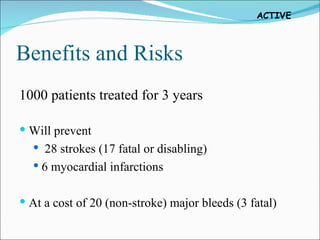
Benefits and Risks 1000 patients treated for 3 years Will prevent 28 strokes (17 fatal or disabling) 6 myocardial infarctions At a cost of 20 (non-stroke) major bleeds (3 fatal)
Conclusions Addition of clopidogrel to aspirin in high risk AF patients, unsuitable for VKA: Reduces major  vascular  events Primarily due to a reduction in stroke With an increase in major bleeding It provides an important benefit to many patients, at an acceptable risk
 
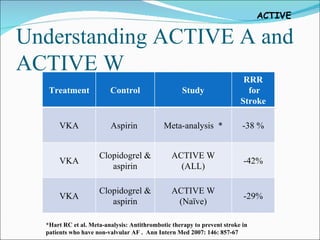
Understanding ACTIVE A and ACTIVE W *Hart RC et al. Meta-analysis: Antithrombotic therapy to prevent stroke in patients who have non-valvular AF .  Ann Intern Med 2007: 146: 857-67 Treatment Control Study RRR for Stroke VKA Aspirin  Meta-analysis  * -38 % VKA Clopidogrel & aspirin ACTIVE W (ALL) -42% VKA Clopidogrel & aspirin ACTIVE W (Naïve) -29%
Benefits and Risks:  Compared to Warfarin *Hart RC et al. Meta-analysis: Antithrombotic therapy to prevent stroke in patients who have non-valvular AF .  Ann Intern Med 2007: 146: 857-67 Effects Warfarin versus Aspirin Clopidogrel & Aspirin versus Aspirin Meta-analysis* (RRR) ACTIVE A (RRR) Reduction in stroke - 38% -28% Increase in intra-cranial bleed +128% +87% Increase in extra-cranial bleed +70% +51%
ACTIVE A and W: Stroke Rates and Risk Reductions Treatment VKA C+A Aspirin ACTIVE W (Rate per year) 1.4 2.4 -- ACTIVE A (Rate per year) -- 2.4 3.3 RRR versus Aspirin -58% -28% -- RRR versus C+A -42% --  --

Active A Connolly

  • 1.
    Effects of Additionof Clopidogrel to Aspirin in Patients with Atrial Fibrillation who are Unsuitable for Vitamin K Antagonists
  • 2.
    Disclosures The presenterhas the following relationships: Research grants from, Portola, AstraZeneca, Boston Scientific, St. Jude Medical Lecture and or consulting fees from Sanofi-Aventis, Bristol Myers Squibb, Behringer-Ingelheim, St. Jude Medical
  • 3.
    Vitamin K Antagonistsin AF Reduce stroke by 38%, compared to aspirin Recommended in high risk patients with AF Only 40-50% of ideal patients receive VKA in Western countries Many patients considered unsuitable Due to poor INR control, concern about bleeding Patient preference
  • 4.
    Antiplatelet Therapy inAF Increased platelet activation in AF Aspirin reduces stroke in AF by 22% Addition of clopidogrel to aspirin achieves greater suppression of platelet activity Addition of clopidogrel to aspirin reduces vascular events in ACS, with acceptable risk of bleeding
  • 5.
    In patients withAF, unsuitable for VKA therapy, addition of clopidogrel to aspirin will reduce the risk of major vascular events, at acceptable risk of major bleeding Hypothesis of ACTIVE A
  • 6.
    Documented AF +  1 risk factor for Stroke Unsuitable for VKA No Exclusion Criteria for ACTIVE I Partial Factorial Design ACTIVE W C&A versus VKA ACTIVE A C&A versus ASA ACTIVE I Irbesartan versus Placebo
  • 7.
    Eligibility criteria forACTIVE A and ACTIVE W were identical Documented AF One or more risk factors for stroke Absence of major risk factor for bleeding Investigators selected patients for either study based on assessment of suitability for VKA Patient Eligibility
  • 8.
    All patients receivedaspirin at a recommended daily dose of 75-100 mgs Patients were randomized, double blind, to clopidogrel, 75 mg per day, or matching placebo ACTIVE A Study Treatments
  • 9.
    Outcomes and StatisticalPower Primary outcome was a composite of major vascular events: Stroke, myocardial infarction, non-CNS systemic embolism or vascular death Secondary outcomes Stroke Major hemorrhage 7500 patients planned to achieve 88% power to detect 15% reduction in primary outcome (1600 events)
  • 10.
    Study Conduct 33Countries, 580 centers 7554 patients enrolled between June 2003 and May 2006 Final follow up in November 2008 Median follow up 3.6 years Follow up was complete in 99.4% of patients
  • 11.
    Reasons for Enrolmentin ACTIVE A * Inability to comply with INR monitoring, predisposition to falling or head trauma, persistent BP >160/100, previous serious bleeding on VKA, severe alcohol abuse <2 years, peptic ulcer disease, thrombocytopenia, need for chronic NSAID Relative risk factor for bleeding* 23% Physician assessment that patient is inappropriate for VKA 50% Patient Preference Only 26%
  • 12.
    Baseline Demographics ACTIVEA ACTIVE W N 7554 6706 Mean age (years) 71 ± 10 70 ± 9 Male 58% 66% Mean systolic BP (mmHg) 136 ± 19 133 ± 19 Permanent AF 64% 68% Baseline VKA use 8.5% 77% Baseline aspirin use 83% 26% Prior MI 14% 18% Prior stroke or TIA 13% 15% Mean CHADS2 score 2.0 ± 1.1 2.0 ± 1.1
  • 13.
  • 14.
  • 15.
  • 16.
    Components of thePrimary Outcome Outcome Clopidogrel + Aspirin Aspirin Clopidogrel + Aspirin versus Aspirin # rate/ year # rate/ year RR 95% CI P Primary 832 6.8 924 7.6 0.89 0.81-0.98 0.014 Stroke 296 2.4 408 3.3 0.72 0.62-0.83 <0.001 MI 90 0.7 115 0.9 0.78 0.59-1.03 0.08 Vascular Death 600 4.7 599 4.7 1.0 0.89-1.12 0.97 Non-CNS systemic embolism 54 0.4 56 0.4 0.96 0.66-1.40 0.84
  • 17.
  • 18.
    Outcome Clopidogrel +Aspirin Aspirin Clopidogrel + Aspirin versus Aspirin # rate/ year # rate/ year RR 95% CI P Ischemic/Uncertain 268 2.1 388 3.2 0.68 0.59-0.80 <0.001 Hemorrhagic 30 0.2 22 0.2 1.37 0.79-2.37 0.27 Non-disabling (mod. Rankin 0-2) 107 0.9 153 1.2 0.70 0.54-0.89 0.004 Disabling or fatal (mod. Rankin 3-6) 198 1.6 267 2.1 0.74 0.62-0.89 0.001
  • 19.
  • 20.
    ACTIVE Bleeding DefinitionsMajor Bleed an overt bleed requiring ≥2 unit transfusion OR severe Bleed drop in hemoglobin of ≥ 5.0 gm/dL hypotension requiring inotropic agents intraocular bleeding leading to substantial vision loss requirement for surgical intervention symptomatic intracranial ≥ 4 unit transfusion fatal
  • 21.
    Bleeding Outcome Clopidogrel+ Aspirin Aspirin Clopidogrel + Aspirin versus Aspirin # rate/ year # rate/ year RR 95% CI P Major 251 2.0 162 1.3 1.57 1.29-1.92 <0.001 Severe 190 1.5 122 1.0 1.57 1.25-1.98 <0.001 Fatal 42 0.3 27 0.2 1.56 0.96-2.53 0.07 Intra-cranial 54 0.4 29 0.2 1.87 1.19-1.94 0.006 Extra-cranial 200 1.6 134 1.1 1.51 1.21-1.88 <0.001
  • 22.
    Benefits and Risks1000 patients treated for 3 years Will prevent 28 strokes (17 fatal or disabling) 6 myocardial infarctions At a cost of 20 (non-stroke) major bleeds (3 fatal)
  • 23.
    Conclusions Addition ofclopidogrel to aspirin in high risk AF patients, unsuitable for VKA: Reduces major vascular events Primarily due to a reduction in stroke With an increase in major bleeding It provides an important benefit to many patients, at an acceptable risk
  • 24.
  • 25.
    Understanding ACTIVE Aand ACTIVE W *Hart RC et al. Meta-analysis: Antithrombotic therapy to prevent stroke in patients who have non-valvular AF . Ann Intern Med 2007: 146: 857-67 Treatment Control Study RRR for Stroke VKA Aspirin Meta-analysis * -38 % VKA Clopidogrel & aspirin ACTIVE W (ALL) -42% VKA Clopidogrel & aspirin ACTIVE W (Naïve) -29%
  • 26.
    Benefits and Risks: Compared to Warfarin *Hart RC et al. Meta-analysis: Antithrombotic therapy to prevent stroke in patients who have non-valvular AF . Ann Intern Med 2007: 146: 857-67 Effects Warfarin versus Aspirin Clopidogrel & Aspirin versus Aspirin Meta-analysis* (RRR) ACTIVE A (RRR) Reduction in stroke - 38% -28% Increase in intra-cranial bleed +128% +87% Increase in extra-cranial bleed +70% +51%
  • 27.
    ACTIVE A andW: Stroke Rates and Risk Reductions Treatment VKA C+A Aspirin ACTIVE W (Rate per year) 1.4 2.4 -- ACTIVE A (Rate per year) -- 2.4 3.3 RRR versus Aspirin -58% -28% -- RRR versus C+A -42% -- --