BY: ZAMAN IMTIAZ
PRESENTED TO:
 NAME: REGISTRATION NUMBER:
 ZAMAN IMTIAZ.
L4F16MCOM0035
PRESENTED BY:
 PROF; GULL MUHAMMAD:
 Financial reporting is the financial results of an
organization that are released to the public. This
reporting is a key function of the controller, who
may be assisted by the investor relation
officer investor relations officer if an
 organization is publicly held.
 Financial analysis is the process of
evaluating financial and other
information for decision-making.
DEFINING FINANCIAL REPORTING
AND ANALYSIS:
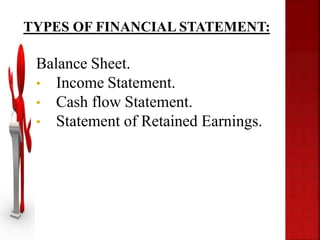
Balance Sheet.
• Income Statement.
• Cash flow Statement.
• Statement of Retained Earnings.
TYPES OF FINANCIAL STATEMENT:
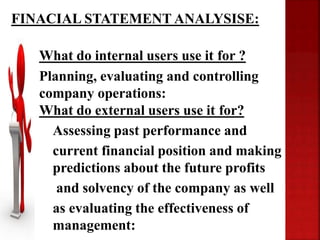
• What do internal users use it for ?
• Planning, evaluating and controlling
company operations:
• What do external users use it for?
Assessing past performance and
current financial position and making
predictions about the future profits
and solvency of the company as well
as evaluating the effectiveness of
management:
FINACIAL STATEMENT ANALYSISE:
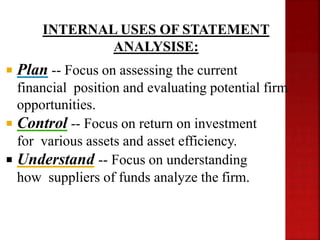
 Plan -- Focus on assessing the current
financial position and evaluating potential firm
opportunities.
 Control -- Focus on return on investment
for various assets and asset efficiency.
 Understand -- Focus on understanding
how suppliers of funds analyze the firm.
INTERNAL USES OF STATEMENT
ANALYSISE:
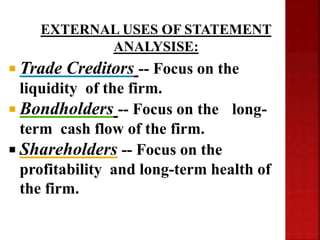
 Trade Creditors -- Focus on the
liquidity of the firm.
 Bondholders -- Focus on the long-
term cash flow of the firm.
 Shareholders -- Focus on the
profitability and long-term health of
the firm.
EXTERNAL USES OF STATEMENT
ANALYSISE:
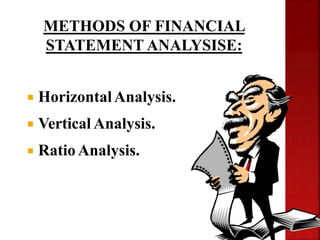
 HorizontalAnalysis.
 Vertical Analysis.
 Ratio Analysis.
METHODS OF FINANCIAL
STATEMENT ANALYSISE:
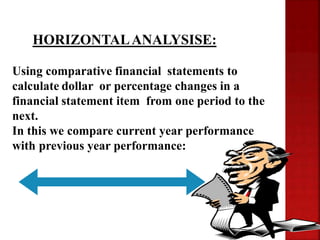
Using comparative financial statements to
calculate dollar or percentage changes in a
financial statement item from one period to the
next.
In this we compare current year performance
with previous year performance:
HORIZONTALANALYSISE:
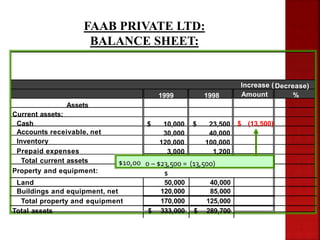
163,000 164,700
Assets
Current assets:
Cash
Accounts receivable, net
Inventory
Prepaid expenses
Total current assets $10,00
Property and equipment:
1999
$ 10,000
30,000
120,000
3,000
0 – $23,500 =
$
1998
$ 23,500
40,000
100,000
1,200
(13,500)
Increase (
Amount
$ (13,500)
Decrease)
%
Land 50,000 40,000
Buildings and equipment, net 120,000 85,000
Total property and equipment 170,000 125,000
Total assets $ 333,000 $ 289,700
FAAB PRIVATE LTD:
BALANCE SHEET:
For a single financial statement,
each item is expressed as a
percentage of a significant total,
e.g., all income statement items are
expressed as a percentage of sales
VERTICALANALYSISE:
ntory 97,000 82,000 18% 21
d 110,000 90,000 20% 23
pment 125,000 100,000 23% 26
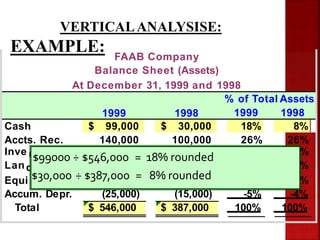
FAAB Company
Balance Sheet (Assets)
At December 31, 1999 and 1998
1999 1998
% of Total Assets
1999 1998
Cash $ 99,000 $ 30,000 18% 8%
Accts. Rec. 140,000 100,000 26% 26%
Inve
$99000 ÷ $546,000 = 18% rounded %
Lan %
Equi $30,000 ÷ $387,000 = 8% rounded %
Accum. Depr. (25,000) (15,000) -5% -4%
Total $ 546,000 $ 387,000 100% 100%
VERTICALANALYSISE:
EXAMPLE:
Expression of logical relationships
between items in a financial statement of a
single period
(e.g., percentage relationship between
revenue and net income)
RATIO ANALYSISE:
For example if net profit is Rs.25,000/- and the sales is
Rs.1,00,000/- then the net profit can be said to be 25% of the
sales.
 AS PROPORTION -
 The above figures may be expressed in terms of the
relationship between net profit to sales as 1 : 4.
 AS PURE NUMBER /TIMES –
 The same can also be expressed in an alternatively way such as
the sale is 4 times of the net profit or profit is 1/4th of the sales.
 AS PERCENTAGE-
such as 25% or 50% .
HOW RATIO IS EXPRESSED ?
• Statutory financial reports—primarily the financial
statements—are the most important product of the financial
reporting environment.
• Information in financial statements is judged relative to
(1) the information needs of financial statement users;
(2) alternative sources of information such as economic and industry data,
analyst
reports, and voluntary disclosures by managers.
• It is important to understand the factors that affect the
nature and content of financial reports to appreciate the
financial accounting information reported in them.
• The primary factors are accounting rules (GAAP), manager
motivations, monitoring and enforcement mechanisms,
regulators, industry practices, and other information
sources.
• We described the financial statement in previous
slides.
• the annual report is not a statutory document. It
often serves to publicize a company’s products,
services, and achievements to its shareholders and
others.
• The statutory equivalent to the annual report is the
Form 10-K, which public companies must file with
the SEC.
• The annual report includes most of the information in
the Form 10-K. Still, because the Form10-K usually
contains relevant information beyond that in the
annual report.
• A Form 10-K is an annual report required by the
U.S. Securities and Exchange Commission (SEC),
that gives a comprehensive summary of a
company's financial performance: such as
company history, organizational structure,
executive compensation, equity, subsidiaries, and
audited financial statements, among other
information.
• Although similarly named, the annual report
on Form 10-K is distinct from the often
glossy "annual report to shareholders,"
which a company must send to its
shareholders when it holds an annual
meeting to elect directors (though some
companies combine the annual report and
the 10-K into one document).
2-6
Form 10-K (Annual Report)
10-Q (Quarterly Report)
20-F (Registration Statement/ Annual Report
[Foreign])
8-K (Current Report)
14-A (Proxy Statement/Prospectus)
Other SEC Filings
• GAAP are a collection of standards,
pronouncements, opinions, interpretations, and
practice guidelines. Various professional and quasi-
statutory bodies such as the Financial Accounting
Standards Board (FASB), the SEC, and the
American Institute of Certified Public Accountants
(AICPA) set GAAP.
• Financial statements are prepared in
accordance with GAAP, which are the rules
and guidelines of financial accounting.
• These rules determine measurement and
recognition policies such as how assets are
measured, when liabilities are incurred,
when revenues and gains are recognized,
and when expenses and losses are
incurred. They also dictate what
information must be provided in the notes.
2-10
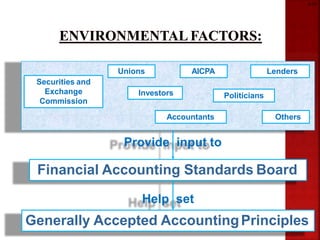
Financial Accounting Standards Board
Generally Accepted AccountingPrinciples
Provide input to
Help set
Securities and
Exchange
Commission
Unions
Investors
Accountants
Politicians
Lenders
Others
AICPA
2-16
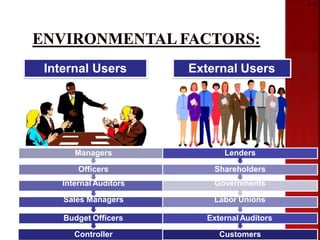
Internal Users External Users
Controller
Budget Officers
Managers
Officers
Internal Auditors
Sales Managers
Customers
External Auditors
Lenders
Shareholders
Governments
Labor Unions
BY: STARS OF BUSINESS.
THANKYOU:
ANY QUESTION?
BY: STARS OF BUSINESS:
Financial Reporting & Analysis Environment( By;Zaman).pptx

Financial Reporting & Analysis Environment( By;Zaman).pptx

  • 1.
  • 2.
    PRESENTED TO:  NAME:REGISTRATION NUMBER:  ZAMAN IMTIAZ. L4F16MCOM0035 PRESENTED BY:  PROF; GULL MUHAMMAD:
  • 4.
     Financial reportingis the financial results of an organization that are released to the public. This reporting is a key function of the controller, who may be assisted by the investor relation officer investor relations officer if an  organization is publicly held.  Financial analysis is the process of evaluating financial and other information for decision-making. DEFINING FINANCIAL REPORTING AND ANALYSIS:
  • 5.
    Balance Sheet. • IncomeStatement. • Cash flow Statement. • Statement of Retained Earnings. TYPES OF FINANCIAL STATEMENT:
  • 6.
    • What dointernal users use it for ? • Planning, evaluating and controlling company operations: • What do external users use it for? Assessing past performance and current financial position and making predictions about the future profits and solvency of the company as well as evaluating the effectiveness of management: FINACIAL STATEMENT ANALYSISE:
  • 7.
     Plan --Focus on assessing the current financial position and evaluating potential firm opportunities.  Control -- Focus on return on investment for various assets and asset efficiency.  Understand -- Focus on understanding how suppliers of funds analyze the firm. INTERNAL USES OF STATEMENT ANALYSISE:
  • 8.
     Trade Creditors-- Focus on the liquidity of the firm.  Bondholders -- Focus on the long- term cash flow of the firm.  Shareholders -- Focus on the profitability and long-term health of the firm. EXTERNAL USES OF STATEMENT ANALYSISE:
  • 9.
     HorizontalAnalysis.  VerticalAnalysis.  Ratio Analysis. METHODS OF FINANCIAL STATEMENT ANALYSISE:
  • 10.
    Using comparative financialstatements to calculate dollar or percentage changes in a financial statement item from one period to the next. In this we compare current year performance with previous year performance: HORIZONTALANALYSISE:
  • 11.
    163,000 164,700 Assets Current assets: Cash Accountsreceivable, net Inventory Prepaid expenses Total current assets $10,00 Property and equipment: 1999 $ 10,000 30,000 120,000 3,000 0 – $23,500 = $ 1998 $ 23,500 40,000 100,000 1,200 (13,500) Increase ( Amount $ (13,500) Decrease) % Land 50,000 40,000 Buildings and equipment, net 120,000 85,000 Total property and equipment 170,000 125,000 Total assets $ 333,000 $ 289,700 FAAB PRIVATE LTD: BALANCE SHEET:
  • 12.
    For a singlefinancial statement, each item is expressed as a percentage of a significant total, e.g., all income statement items are expressed as a percentage of sales VERTICALANALYSISE:
  • 13.
    ntory 97,000 82,00018% 21 d 110,000 90,000 20% 23 pment 125,000 100,000 23% 26 FAAB Company Balance Sheet (Assets) At December 31, 1999 and 1998 1999 1998 % of Total Assets 1999 1998 Cash $ 99,000 $ 30,000 18% 8% Accts. Rec. 140,000 100,000 26% 26% Inve $99000 ÷ $546,000 = 18% rounded % Lan % Equi $30,000 ÷ $387,000 = 8% rounded % Accum. Depr. (25,000) (15,000) -5% -4% Total $ 546,000 $ 387,000 100% 100% VERTICALANALYSISE: EXAMPLE:
  • 14.
    Expression of logicalrelationships between items in a financial statement of a single period (e.g., percentage relationship between revenue and net income) RATIO ANALYSISE:
  • 15.
    For example ifnet profit is Rs.25,000/- and the sales is Rs.1,00,000/- then the net profit can be said to be 25% of the sales.  AS PROPORTION -  The above figures may be expressed in terms of the relationship between net profit to sales as 1 : 4.  AS PURE NUMBER /TIMES –  The same can also be expressed in an alternatively way such as the sale is 4 times of the net profit or profit is 1/4th of the sales.  AS PERCENTAGE- such as 25% or 50% . HOW RATIO IS EXPRESSED ?
  • 16.
    • Statutory financialreports—primarily the financial statements—are the most important product of the financial reporting environment. • Information in financial statements is judged relative to (1) the information needs of financial statement users; (2) alternative sources of information such as economic and industry data, analyst reports, and voluntary disclosures by managers. • It is important to understand the factors that affect the nature and content of financial reports to appreciate the financial accounting information reported in them. • The primary factors are accounting rules (GAAP), manager motivations, monitoring and enforcement mechanisms, regulators, industry practices, and other information sources.
  • 17.
    • We describedthe financial statement in previous slides. • the annual report is not a statutory document. It often serves to publicize a company’s products, services, and achievements to its shareholders and others. • The statutory equivalent to the annual report is the Form 10-K, which public companies must file with the SEC. • The annual report includes most of the information in the Form 10-K. Still, because the Form10-K usually contains relevant information beyond that in the annual report.
  • 18.
    • A Form10-K is an annual report required by the U.S. Securities and Exchange Commission (SEC), that gives a comprehensive summary of a company's financial performance: such as company history, organizational structure, executive compensation, equity, subsidiaries, and audited financial statements, among other information.
  • 19.
    • Although similarlynamed, the annual report on Form 10-K is distinct from the often glossy "annual report to shareholders," which a company must send to its shareholders when it holds an annual meeting to elect directors (though some companies combine the annual report and the 10-K into one document).
  • 20.
    2-6 Form 10-K (AnnualReport) 10-Q (Quarterly Report) 20-F (Registration Statement/ Annual Report [Foreign]) 8-K (Current Report) 14-A (Proxy Statement/Prospectus) Other SEC Filings
  • 21.
    • GAAP area collection of standards, pronouncements, opinions, interpretations, and practice guidelines. Various professional and quasi- statutory bodies such as the Financial Accounting Standards Board (FASB), the SEC, and the American Institute of Certified Public Accountants (AICPA) set GAAP.
  • 22.
    • Financial statementsare prepared in accordance with GAAP, which are the rules and guidelines of financial accounting. • These rules determine measurement and recognition policies such as how assets are measured, when liabilities are incurred, when revenues and gains are recognized, and when expenses and losses are incurred. They also dictate what information must be provided in the notes.
  • 23.
    2-10 Financial Accounting StandardsBoard Generally Accepted AccountingPrinciples Provide input to Help set Securities and Exchange Commission Unions Investors Accountants Politicians Lenders Others AICPA
  • 24.
    2-16 Internal Users ExternalUsers Controller Budget Officers Managers Officers Internal Auditors Sales Managers Customers External Auditors Lenders Shareholders Governments Labor Unions
  • 25.
    BY: STARS OFBUSINESS. THANKYOU: ANY QUESTION? BY: STARS OF BUSINESS: