Financial Statement Analysis I Session 1: Overview Instructor Paul Beretz, CICE
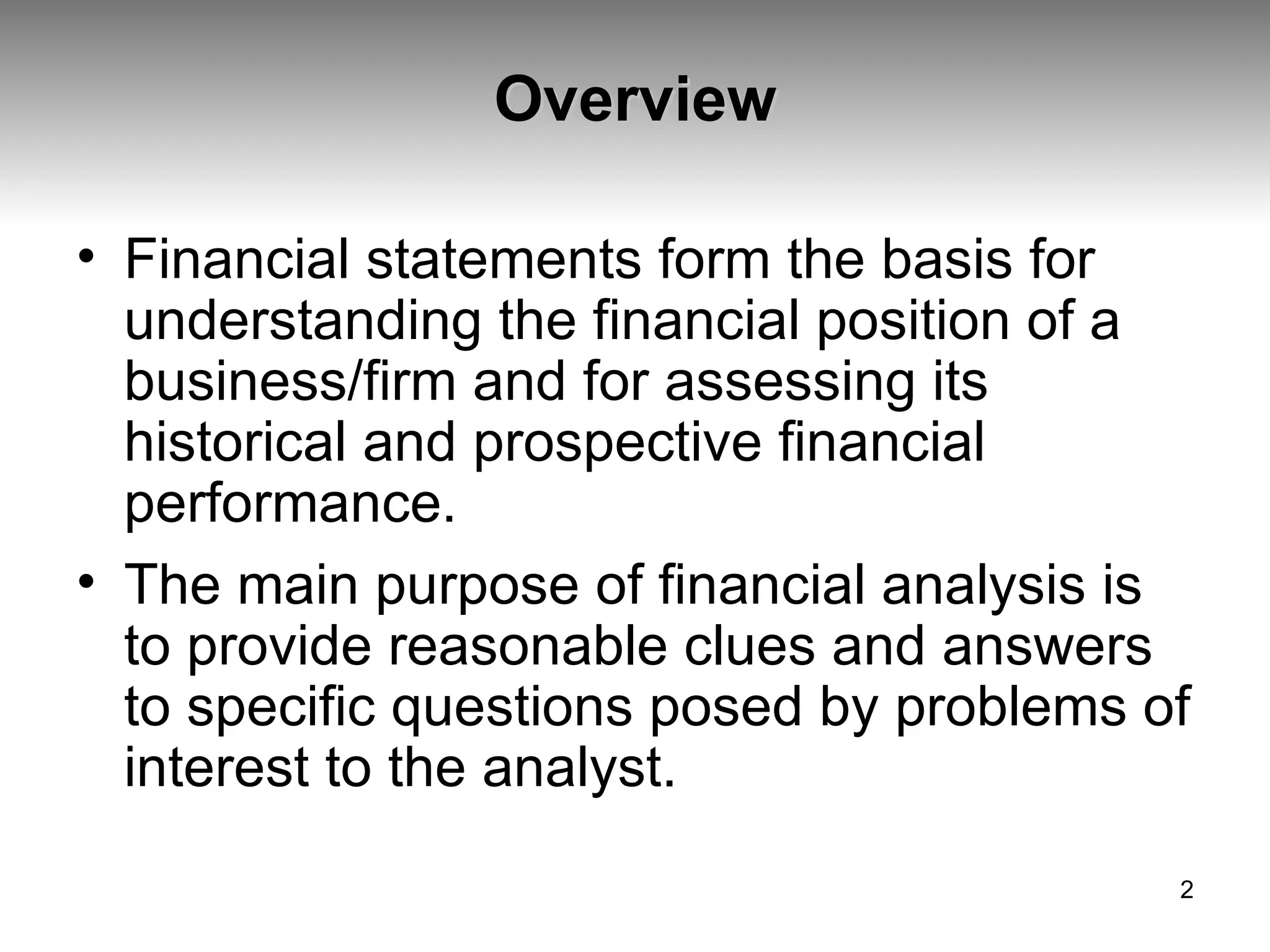
Overview Financial statements form the basis for understanding the financial position of a business/firm and for assessing its historical and prospective financial performance.  The main purpose of financial analysis is to provide reasonable clues and answers to specific questions posed by problems of interest to the analyst.
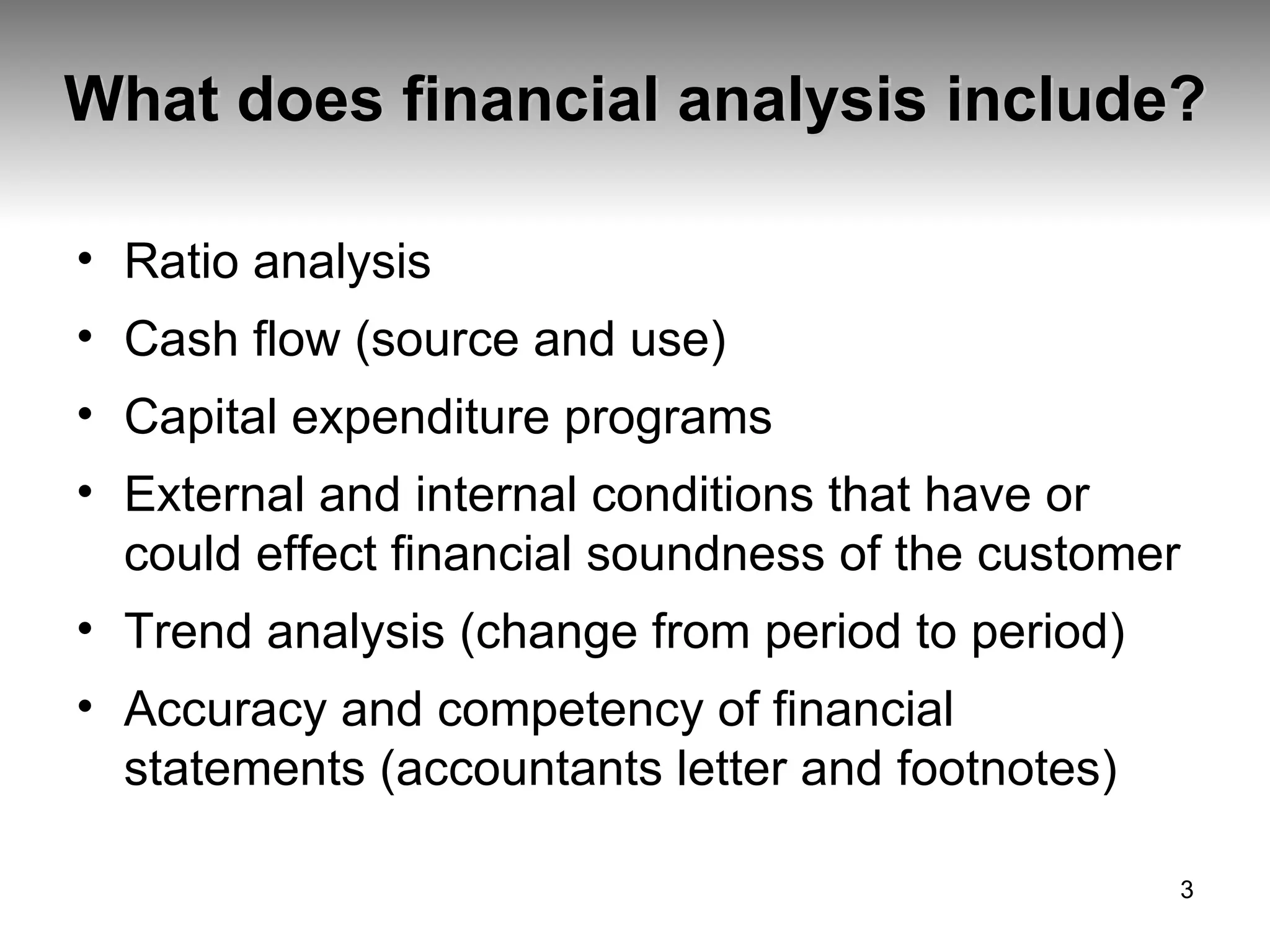
What does financial analysis include? Ratio analysis Cash flow (source and use) Capital expenditure programs External and internal conditions that have or could effect financial soundness of the customer Trend analysis (change from period to period) Accuracy and competency of financial statements (accountants letter and footnotes)
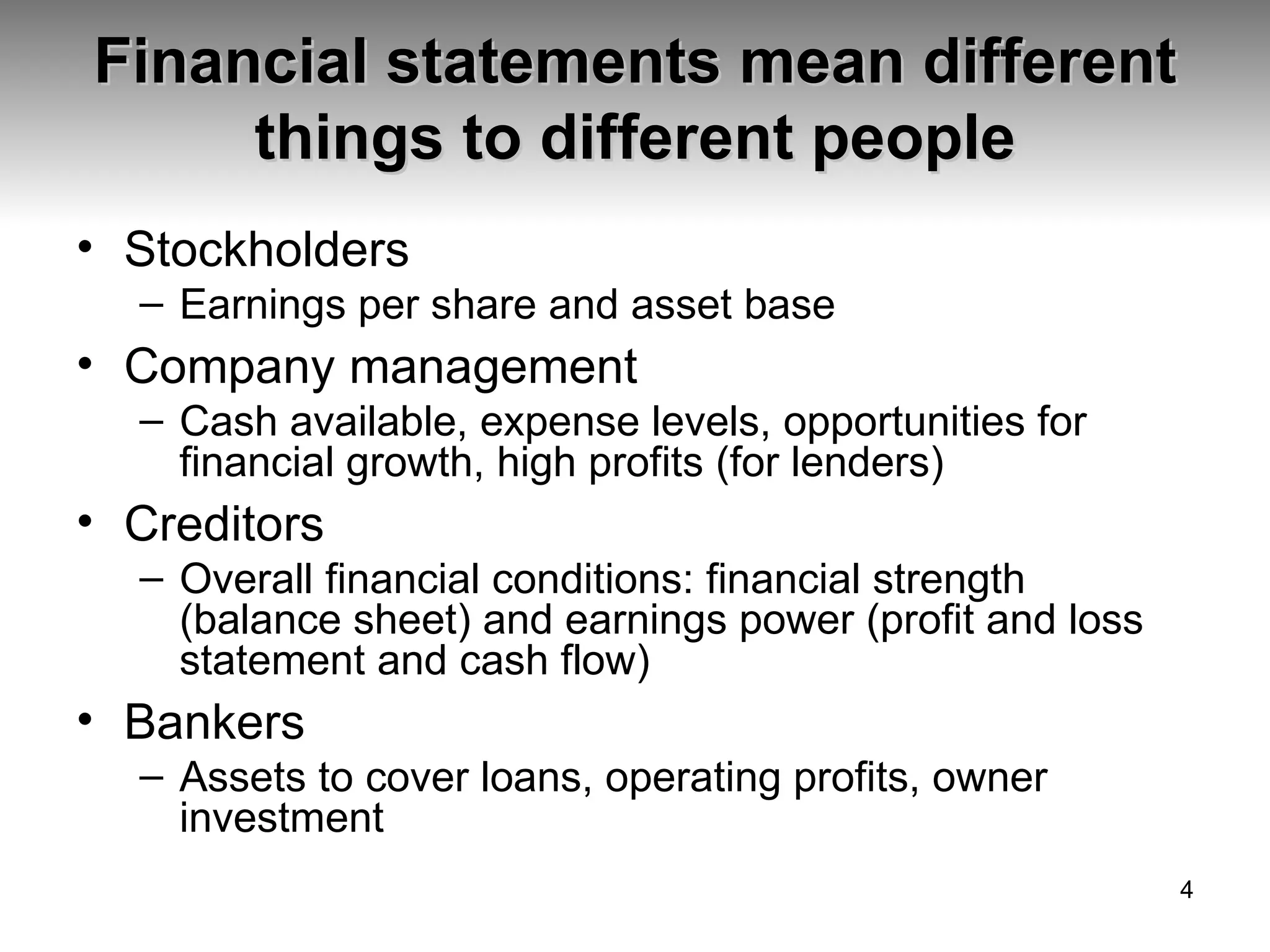
Financial statements mean different things to different people Stockholders Earnings per share and asset base Company management Cash available, expense levels, opportunities for financial growth, high profits (for lenders) Creditors Overall financial conditions: financial strength (balance sheet) and earnings power (profit and loss statement and cash flow) Bankers Assets to cover loans, operating profits, owner investment
Where to find financial statements Sources Customer Credit agencies Lenders Public Records
What comprises a set of financial statements? Income statement/statement of stockholders’ equity (more in Session 3) Balance sheet (Session 2) Statement of retained earnings (Session 2) Statement of shareholders’ equity (Session 2) Statement of cash flows (a.k.a. Source and Use of Fund, Session 4) Footnotes and Mgmt. Discussion (Session 1)
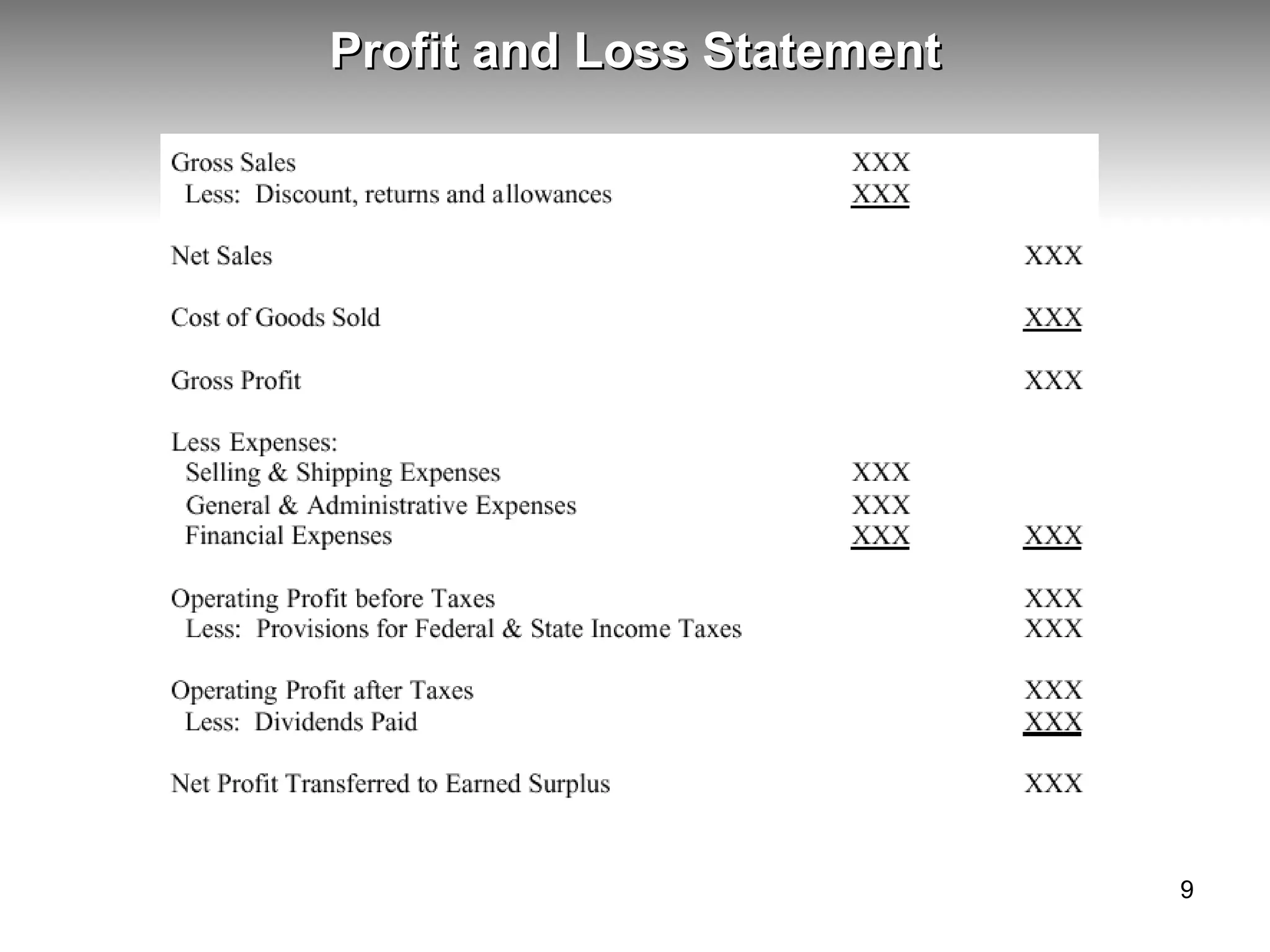
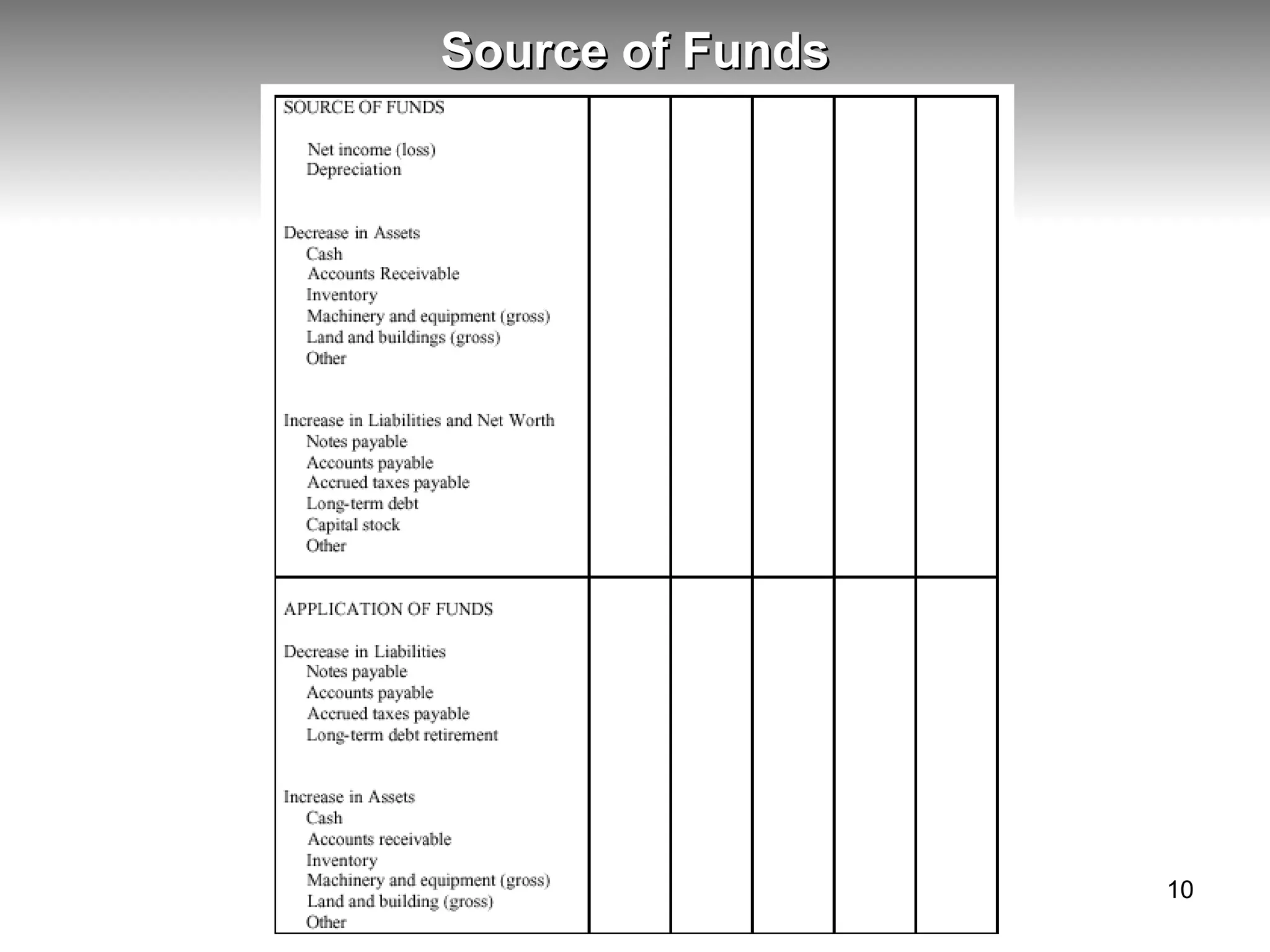
Samples of three financial statements Balance Sheet Profit and Loss Funds Flow Refer to samples in PDF document:  Sample Financial Statements  (statement_samples.pdf), available in the online classroom.
Balance Sheet
Profit and Loss Statement
Source of Funds
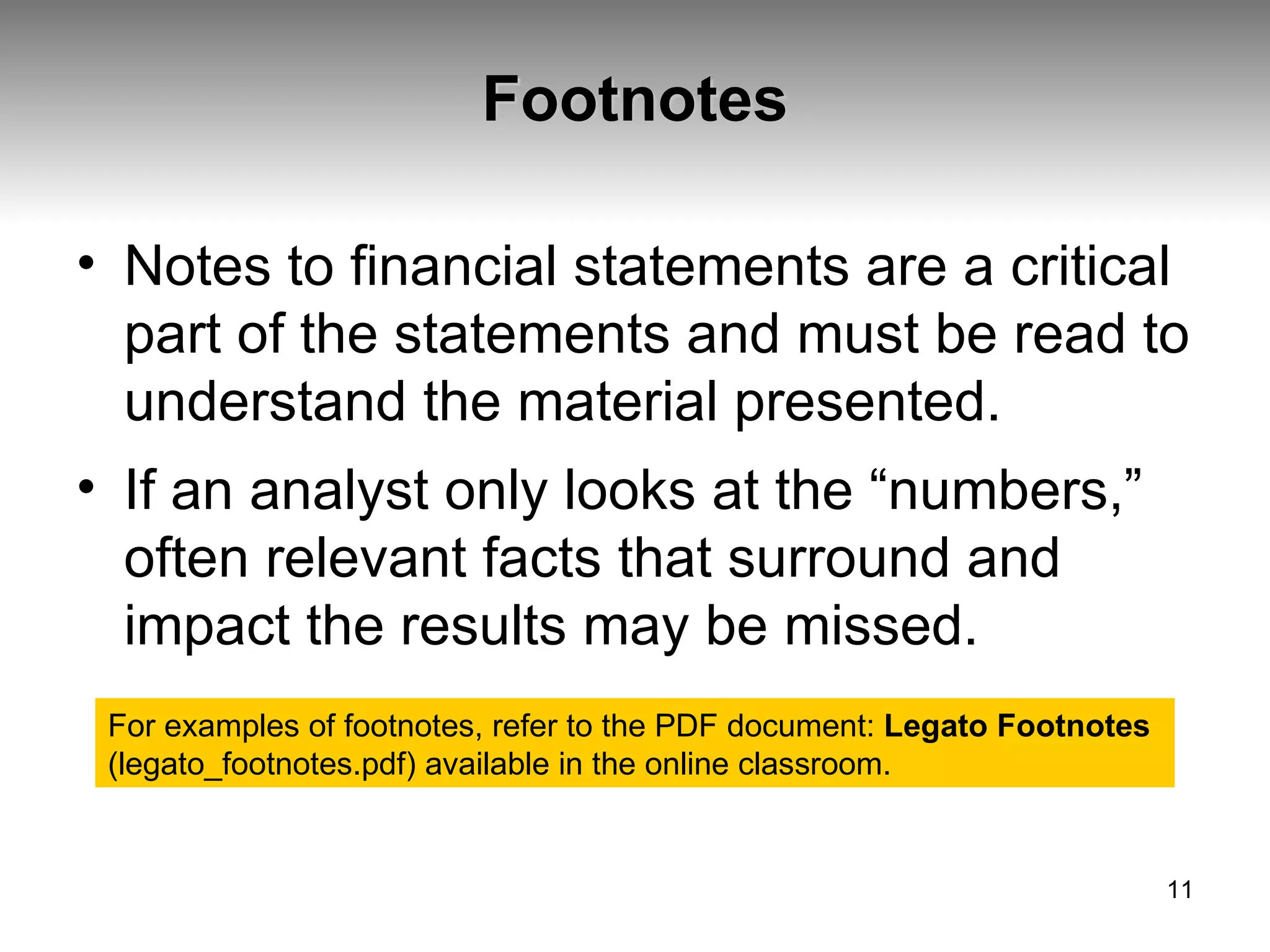
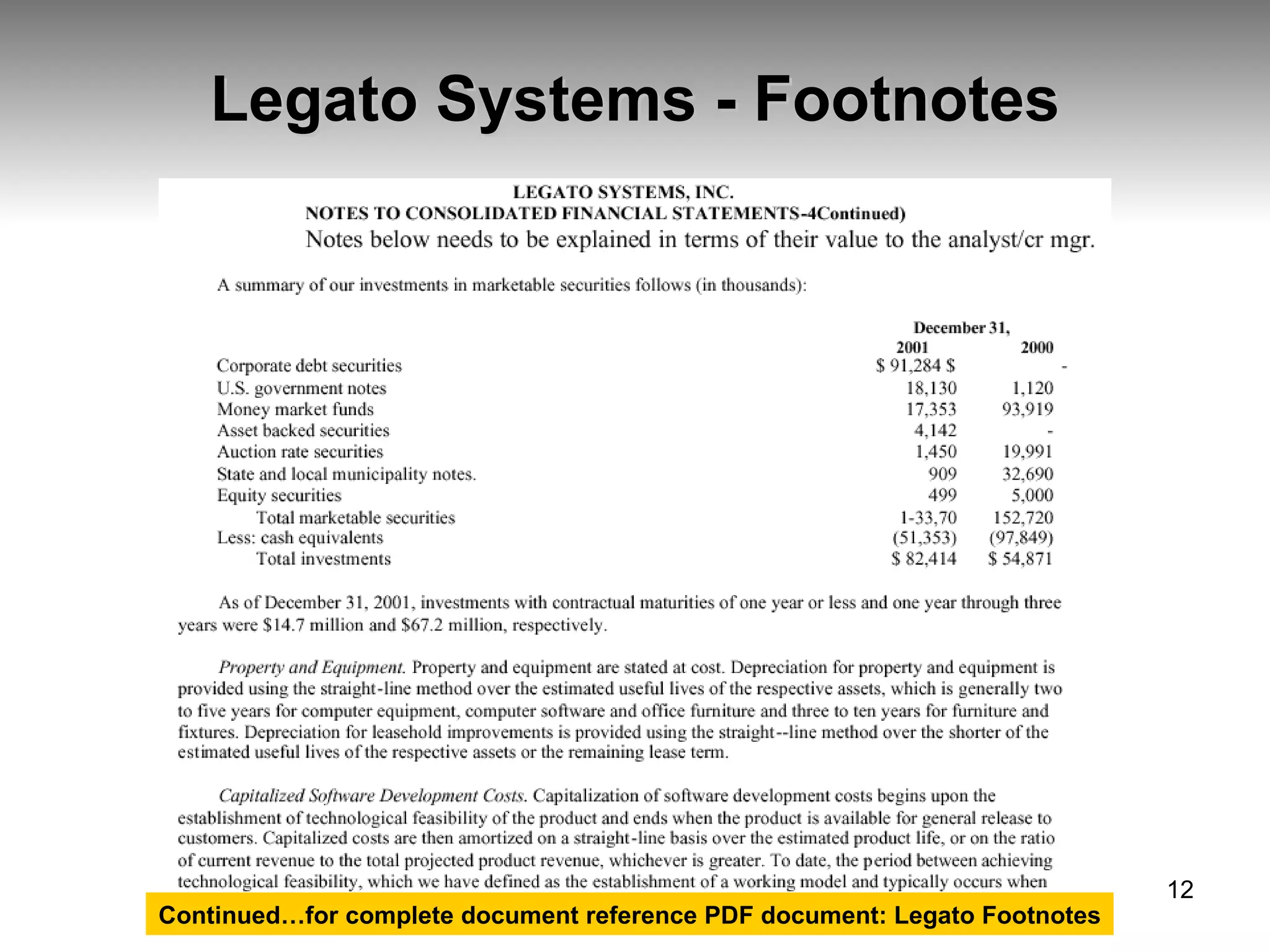
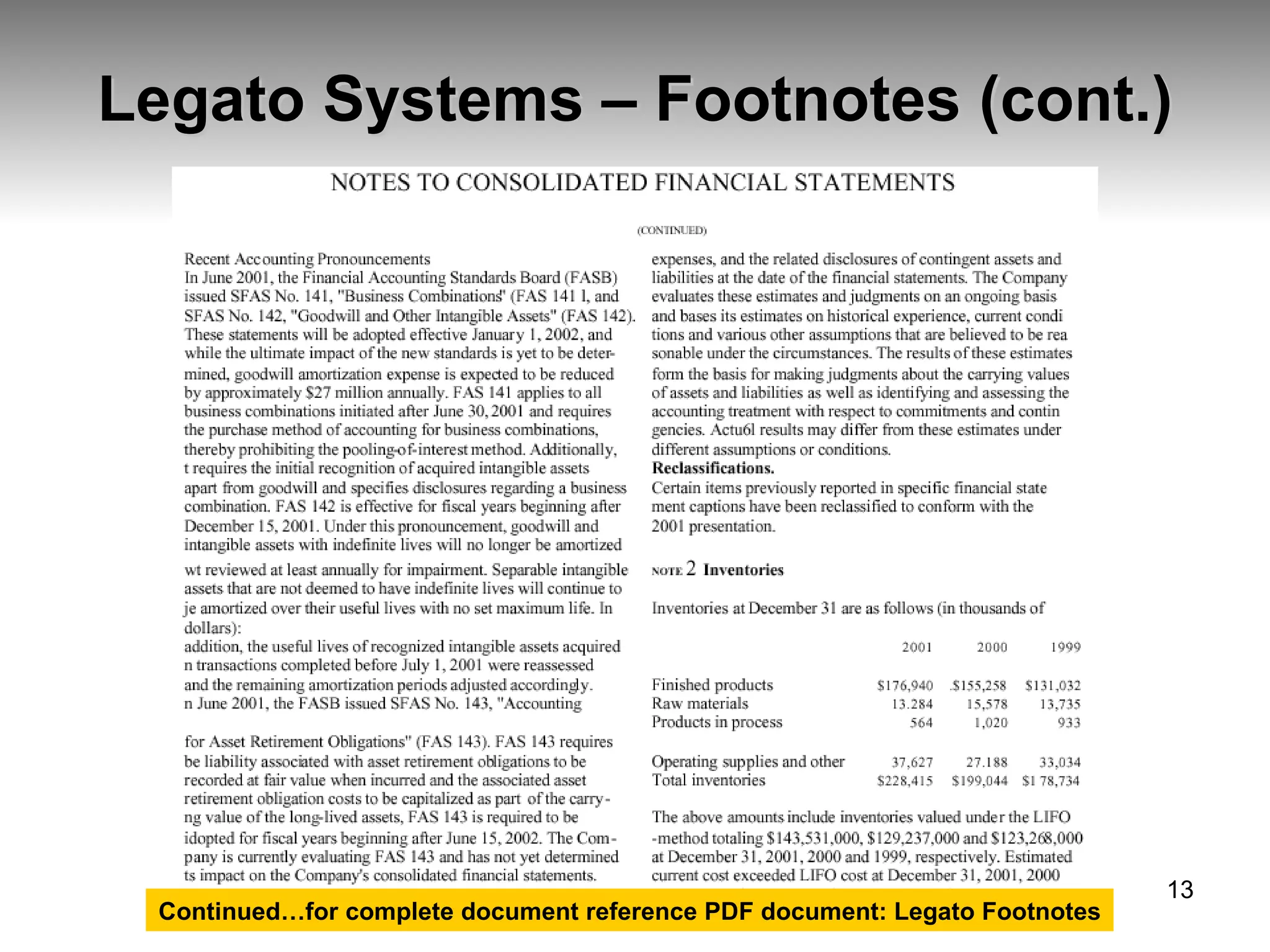
Footnotes Notes to financial statements are a critical part of the statements and must be read to understand the material presented.  If an analyst only looks at the “numbers,” often relevant facts that surround and impact the results may be missed. For examples of footnotes, refer to the PDF document:  Legato Footnotes  (legato_footnotes.pdf) available in the online classroom.
Legato Systems - Footnotes Continued…for complete document reference PDF document: Legato Footnotes
Legato Systems – Footnotes (cont.) Continued…for complete document reference PDF document: Legato Footnotes
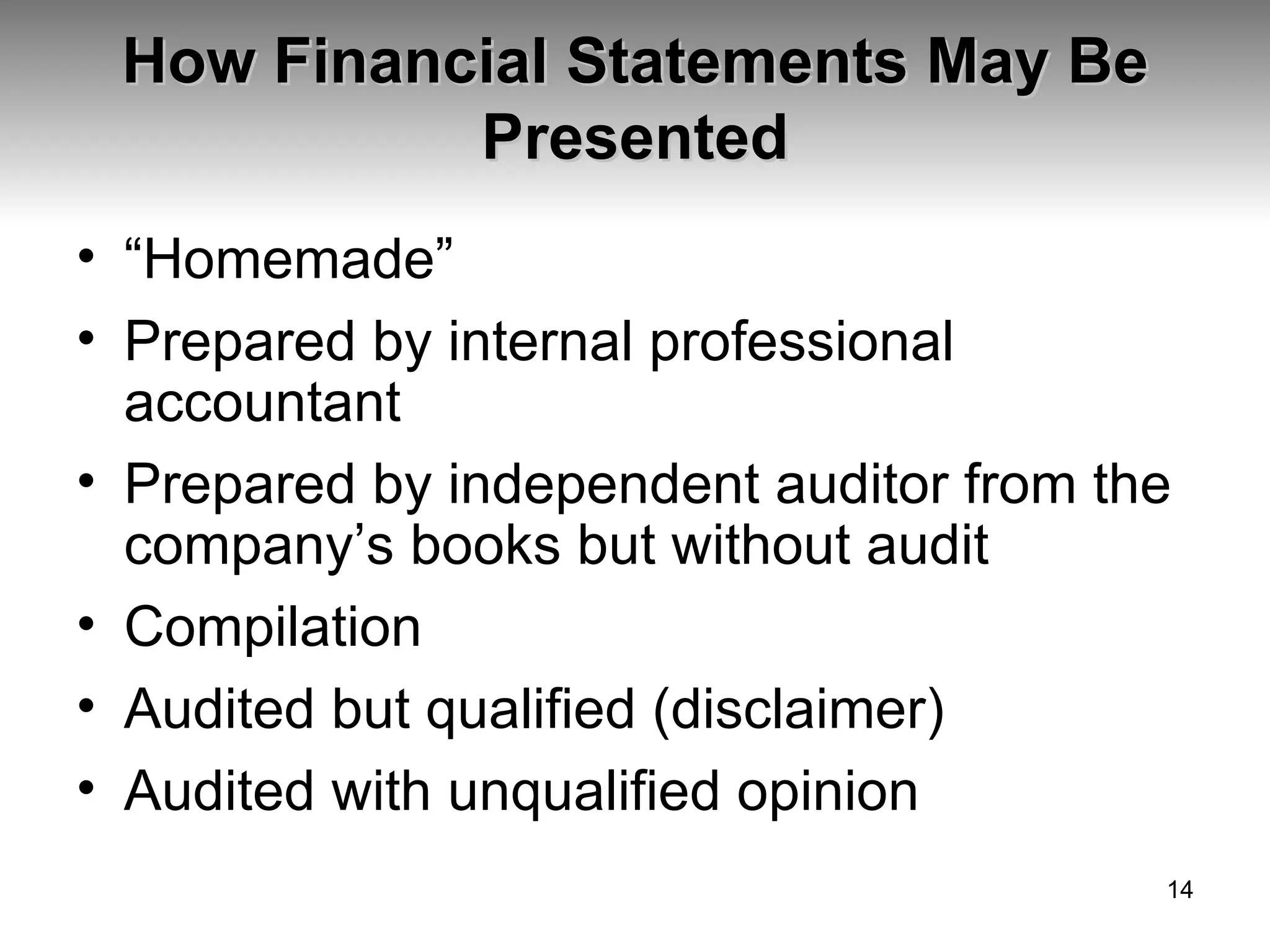
How Financial Statements May Be Presented “ Homemade” Prepared by internal professional accountant Prepared by independent auditor from the company’s books but without audit Compilation Audited but qualified (disclaimer) Audited with unqualified opinion
Question for class discussion How would you measure the comfort level you would have with a financial statement that fell into each category just described?
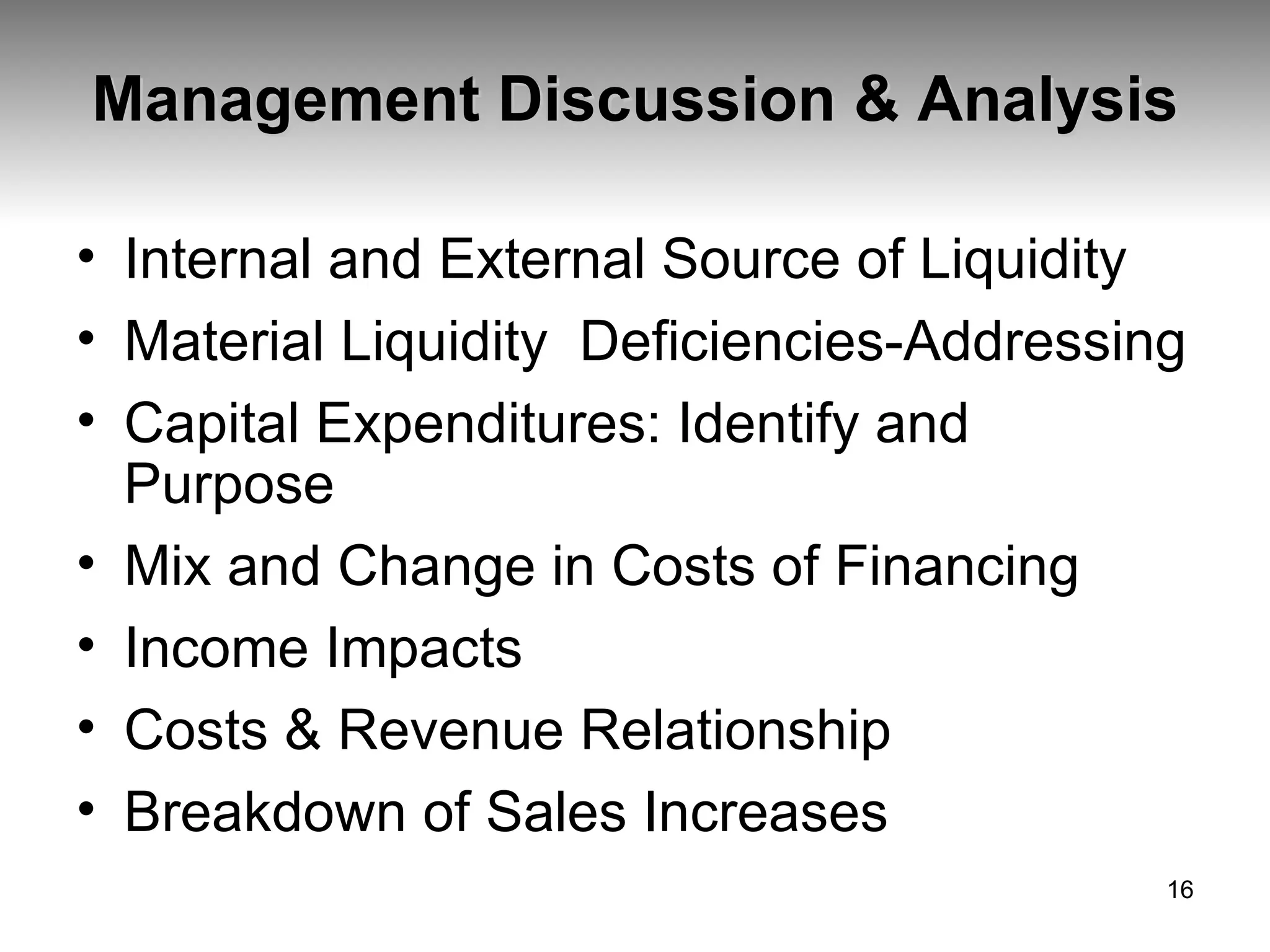
Management Discussion & Analysis Internal and External Source of Liquidity Material Liquidity  Deficiencies-Addressing Capital Expenditures: Identify and Purpose Mix and Change in Costs of Financing Income Impacts Costs & Revenue Relationship Breakdown of Sales Increases
Role of the Auditor Let’s review and discuss the article below regarding the role of the auditor, edited by Michael Dennis, CBF, MBA, a frequent contributor to CMA (note that this article can be found also in the CMA Encyclopedia of Credit). Refer to the PDF document:  Role of the Auditor  (auditor_role.pdf) available in the online classroom.
Audit Report (see p. 15 of text, REC Inc) “ We have audited…..” ” We conducted our audits….” “ In our opinion….” “ We have also audited…..”  (Note: SOX, section 404 re; Internal Controls)
Annual Report Created and distributed by a business Includes: Financial Statements Reports from company officers about major company events of the prior year and forecasts for the next year Publicly traded companies file annual reports as “10K” with SEC (Securities and Exchange Commission)
Other Periodic Filings 10Q Filing – quarterly financial reports required of public companies 8K Filing – other reports as events occur, such as change in auditing firms, bankruptcy These filings are required by the SEC
FASB and GAAP The SEC has U.S. congressional authority to set accounting polices and has delegated this to the Financial Accounting Standards Board (FASB).  These accounting policies are called  Generally Accepted Accounting Principles (GAAP).
GAAP, FASB, and the SEC More detailed information about GAAP, FASB, and the SEC is contained in the PDF document GAAP.FASB.SEC (available in the online classroom). The following Web sites contain additional information:  GAAP: http://www.investopedia.com/terms/g/gaap.asp  Official FASB Web site:  http://www.fasb.org These links can be accessed on the classroom Web site.
Session Objectives Have you met the following objectives for the Session? Understand the concepts, expectations, technical and administrative areas that are part of the online course process offered by CMA. Recognize the overall issues involved with financial statement analysis.

Financial Statement Analysis I Session 1

  • 1.
    Financial Statement AnalysisI Session 1: Overview Instructor Paul Beretz, CICE
  • 2.
    Overview Financial statementsform the basis for understanding the financial position of a business/firm and for assessing its historical and prospective financial performance. The main purpose of financial analysis is to provide reasonable clues and answers to specific questions posed by problems of interest to the analyst.
  • 3.
    What does financialanalysis include? Ratio analysis Cash flow (source and use) Capital expenditure programs External and internal conditions that have or could effect financial soundness of the customer Trend analysis (change from period to period) Accuracy and competency of financial statements (accountants letter and footnotes)
  • 4.
    Financial statements meandifferent things to different people Stockholders Earnings per share and asset base Company management Cash available, expense levels, opportunities for financial growth, high profits (for lenders) Creditors Overall financial conditions: financial strength (balance sheet) and earnings power (profit and loss statement and cash flow) Bankers Assets to cover loans, operating profits, owner investment
  • 5.
    Where to findfinancial statements Sources Customer Credit agencies Lenders Public Records
  • 6.
    What comprises aset of financial statements? Income statement/statement of stockholders’ equity (more in Session 3) Balance sheet (Session 2) Statement of retained earnings (Session 2) Statement of shareholders’ equity (Session 2) Statement of cash flows (a.k.a. Source and Use of Fund, Session 4) Footnotes and Mgmt. Discussion (Session 1)
  • 7.
    Samples of threefinancial statements Balance Sheet Profit and Loss Funds Flow Refer to samples in PDF document: Sample Financial Statements (statement_samples.pdf), available in the online classroom.
  • 8.
  • 9.
    Profit and LossStatement
  • 10.
  • 11.
    Footnotes Notes tofinancial statements are a critical part of the statements and must be read to understand the material presented. If an analyst only looks at the “numbers,” often relevant facts that surround and impact the results may be missed. For examples of footnotes, refer to the PDF document: Legato Footnotes (legato_footnotes.pdf) available in the online classroom.
  • 12.
    Legato Systems -Footnotes Continued…for complete document reference PDF document: Legato Footnotes
  • 13.
    Legato Systems –Footnotes (cont.) Continued…for complete document reference PDF document: Legato Footnotes
  • 14.
    How Financial StatementsMay Be Presented “ Homemade” Prepared by internal professional accountant Prepared by independent auditor from the company’s books but without audit Compilation Audited but qualified (disclaimer) Audited with unqualified opinion
  • 15.
    Question for classdiscussion How would you measure the comfort level you would have with a financial statement that fell into each category just described?
  • 16.
    Management Discussion &Analysis Internal and External Source of Liquidity Material Liquidity Deficiencies-Addressing Capital Expenditures: Identify and Purpose Mix and Change in Costs of Financing Income Impacts Costs & Revenue Relationship Breakdown of Sales Increases
  • 17.
    Role of theAuditor Let’s review and discuss the article below regarding the role of the auditor, edited by Michael Dennis, CBF, MBA, a frequent contributor to CMA (note that this article can be found also in the CMA Encyclopedia of Credit). Refer to the PDF document: Role of the Auditor (auditor_role.pdf) available in the online classroom.
  • 18.
    Audit Report (seep. 15 of text, REC Inc) “ We have audited…..” ” We conducted our audits….” “ In our opinion….” “ We have also audited…..” (Note: SOX, section 404 re; Internal Controls)
  • 19.
    Annual Report Createdand distributed by a business Includes: Financial Statements Reports from company officers about major company events of the prior year and forecasts for the next year Publicly traded companies file annual reports as “10K” with SEC (Securities and Exchange Commission)
  • 20.
    Other Periodic Filings10Q Filing – quarterly financial reports required of public companies 8K Filing – other reports as events occur, such as change in auditing firms, bankruptcy These filings are required by the SEC
  • 21.
    FASB and GAAPThe SEC has U.S. congressional authority to set accounting polices and has delegated this to the Financial Accounting Standards Board (FASB). These accounting policies are called Generally Accepted Accounting Principles (GAAP).
  • 22.
    GAAP, FASB, andthe SEC More detailed information about GAAP, FASB, and the SEC is contained in the PDF document GAAP.FASB.SEC (available in the online classroom). The following Web sites contain additional information: GAAP: http://www.investopedia.com/terms/g/gaap.asp Official FASB Web site: http://www.fasb.org These links can be accessed on the classroom Web site.
  • 23.
    Session Objectives Haveyou met the following objectives for the Session? Understand the concepts, expectations, technical and administrative areas that are part of the online course process offered by CMA. Recognize the overall issues involved with financial statement analysis.