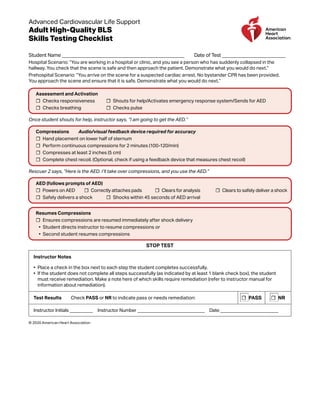
Advanced Cardiovascular Life Support
Adult High-Quality BLS
Skills Testing Checklist
Student Name __________________________________________________  Date of Test __________________________
Hospital Scenario: “You are working in a hospital or clinic, and you see a person who has suddenly collapsed in the
hallway. You check that the scene is safe and then approach the patient. Demonstrate what you would do next.”
Prehospital Scenario: “You arrive on the scene for a suspected cardiac arrest. No bystander CPR has been provided.
You approach the scene and ensure that it is safe. Demonstrate what you would do next.”
Assessment and Activation
☐ Checks responsiveness ☐ Shouts for help/Activates emergency response system/Sends for AED
☐ Checks breathing ☐ Checks pulse
Once student shouts for help, instructor says, “I am going to get the AED.”
Compressions  Audio/visual feedback device required for accuracy
☐ Hand placement on lower half of sternum
☐ Perform continuous compressions for 2 minutes (100-120/min)
☐ Compresses at least 2 inches (5 cm)
☐ Complete chest recoil. (Optional, check if using a feedback device that measures chest recoil)
Rescuer 2 says, “Here is the AED. I’ll take over compressions, and you use the AED.”
AED (follows prompts of AED)
☐ Powers on AED  ☐ Correctly attaches pads ☐ Clears for analysis ☐ Clears to safely deliver a shock
☐ Safely delivers a shock ☐ Shocks within 45 seconds of AED arrival
Resumes Compressions
☐ Ensures compressions are resumed immediately after shock delivery
• Student directs instructor to resume compressions or
• Second student resumes compressions
STOP TEST
Instructor Notes
 
• Place a check in the box next to each step the student completes successfully.
 
• If the student does not complete all steps successfully (as indicated by at least 1 blank check box), the student
must receive remediation. Make a note here of which skills require remediation (refer to instructor manual for
information about remediation).
Test Results  Check PASS or NR to indicate pass or needs remediation: ☐ PASS ☐ NR
Instructor Initials __________ Instructor Number _____________________________ Date _________________________
© 2020 American Heart Association
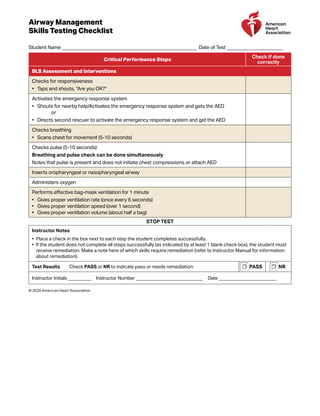
Airway Management
Skills Testing Checklist
Student Name _______________________________________________________ Date of Test _______________________
Critical Performance Steps
Check if done
correctly
BLS Assessment and Interventions
Checks for responsiveness
• Taps and shouts, “Are you OK?”
Activates the emergency response system
• Shouts for nearby help/Activates the emergency response system and gets the AED
or
• Directs second rescuer to activate the emergency response system and get the AED
Checks breathing
• Scans chest for movement (5-10 seconds)
Checks pulse (5-10 seconds)
Breathing and pulse check can be done simultaneously
Notes that pulse is present and does not initiate chest compressions or attach AED
Inserts oropharyngeal or nasopharyngeal airway
Administers oxygen
Performs effective bag-mask ventilation for 1 minute
• Gives proper ventilation rate (once every 6 seconds)
• Gives proper ventilation speed (over 1 second)
• Gives proper ventilation volume (about half a bag)
STOP TEST
Instructor Notes
 
• Place a check in the box next to each step the student completes successfully.
 
• If the student does not complete all steps successfully (as indicated by at least 1 blank check box), the student must
receive remediation. Make a note here of which skills require remediation (refer to Instructor Manual for information
about remediation).
Test Results  Check PASS or NR to indicate pass or needs remediation: ☐ PASS ☐ NR
Instructor Initials __________ Instructor Number _____________________________ Date _________________________
© 2020 American Heart Association
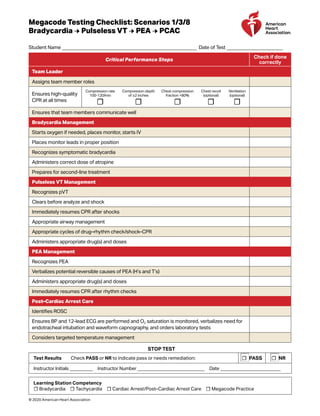
Megacode Testing Checklist: Scenarios 1/3/8
Bradycardia → Pulseless VT → PEA → PCAC
Student Name _______________________________________________________ Date of Test _______________________
Critical Performance Steps
Check if done
correctly
Team Leader
Assigns team member roles
Ensures high-quality
CPR at all times
Compression rate
100-120/min
☐
Compression depth
of ≥2 inches
☐
Chest compression
fraction >80%
☐
Chest recoil
(optional)
☐
Ventilation
(optional)
☐
Ensures that team members communicate well
Bradycardia Management
Starts oxygen if needed, places monitor, starts IV
Places monitor leads in proper position
Recognizes symptomatic bradycardia
Administers correct dose of atropine
Prepares for second-line treatment
Pulseless VT Management
Recognizes pVT
Clears before analyze and shock
Immediately resumes CPR after shocks
Appropriate airway management
Appropriate cycles of drug–rhythm check/shock–CPR
Administers appropriate drug(s) and doses
PEA Management
Recognizes PEA
Verbalizes potential reversible causes of PEA (H’s and T’s)
Administers appropriate drug(s) and doses
Immediately resumes CPR after rhythm checks
Post–Cardiac Arrest Care
Identifies ROSC
Ensures BP and 12-lead ECG are performed and O2 saturation is monitored, verbalizes need for
endotracheal intubation and waveform capnography, and orders laboratory tests
Considers targeted temperature management
STOP TEST
Test Results  Check PASS or NR to indicate pass or needs remediation: ☐ PASS ☐ NR
Instructor Initials __________ Instructor Number _____________________________ Date __________________________
Learning Station Competency
☐ Bradycardia ☐ Tachycardia ☐ Cardiac Arrest/Post–Cardiac Arrest Care ☐ Megacode Practice
© 2020 American Heart Association
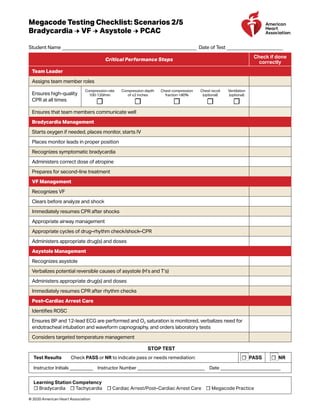
Megacode Testing Checklist: Scenarios 2/5
Bradycardia → VF → Asystole → PCAC
Student Name _______________________________________________________ Date of Test _______________________
Critical Performance Steps
Check if done
correctly
Team Leader
Assigns team member roles
Ensures high-quality
CPR at all times
Compression rate
100-120/min
☐
Compression depth
of ≥2 inches
☐
Chest compression
fraction >80%
☐
Chest recoil
(optional)
☐
Ventilation
(optional)
☐
Ensures that team members communicate well
Bradycardia Management
Starts oxygen if needed, places monitor, starts IV
Places monitor leads in proper position
Recognizes symptomatic bradycardia
Administers correct dose of atropine
Prepares for second-line treatment
VF Management
Recognizes VF
Clears before analyze and shock
Immediately resumes CPR after shocks
Appropriate airway management
Appropriate cycles of drug–rhythm check/shock–CPR
Administers appropriate drug(s) and doses
Asystole Management
Recognizes asystole
Verbalizes potential reversible causes of asystole (H’s and T’s)
Administers appropriate drug(s) and doses
Immediately resumes CPR after rhythm checks
Post–Cardiac Arrest Care
Identifies ROSC
Ensures BP and 12-lead ECG are performed and O2 saturation is monitored, verbalizes need for
endotracheal intubation and waveform capnography, and orders laboratory tests
Considers targeted temperature management
STOP TEST
Test Results  Check PASS or NR to indicate pass or needs remediation: ☐ PASS ☐ NR
Instructor Initials __________ Instructor Number _____________________________ Date __________________________
Learning Station Competency
☐ Bradycardia ☐ Tachycardia ☐ Cardiac Arrest/Post–Cardiac Arrest Care ☐ Megacode Practice
© 2020 American Heart Association
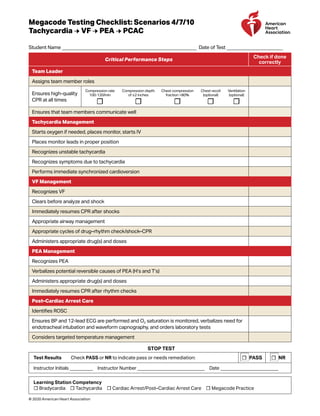
Megacode Testing Checklist: Scenarios 4/7/10
Tachycardia → VF → PEA → PCAC
Student Name _______________________________________________________ Date of Test _______________________
Critical Performance Steps
Check if done
correctly
Team Leader
Assigns team member roles
Ensures high-quality
CPR at all times
Compression rate
100-120/min
☐
Compression depth
of ≥2 inches
☐
Chest compression
fraction >80%
☐
Chest recoil
(optional)
☐
Ventilation
(optional)
☐
Ensures that team members communicate well
Tachycardia Management
Starts oxygen if needed, places monitor, starts IV
Places monitor leads in proper position
Recognizes unstable tachycardia
Recognizes symptoms due to tachycardia
Performs immediate synchronized cardioversion
VF Management
Recognizes VF
Clears before analyze and shock
Immediately resumes CPR after shocks
Appropriate airway management
Appropriate cycles of drug–rhythm check/shock–CPR
Administers appropriate drug(s) and doses
PEA Management
Recognizes PEA
Verbalizes potential reversible causes of PEA (H’s and T’s)
Administers appropriate drug(s) and doses
Immediately resumes CPR after rhythm checks
Post–Cardiac Arrest Care
Identifies ROSC
Ensures BP and 12-lead ECG are performed and O2 saturation is monitored, verbalizes need for
endotracheal intubation and waveform capnography, and orders laboratory tests
Considers targeted temperature management
STOP TEST
Test Results  Check PASS or NR to indicate pass or needs remediation: ☐ PASS ☐ NR
Instructor Initials __________ Instructor Number _____________________________ Date _________________________
Learning Station Competency
☐ Bradycardia ☐ Tachycardia ☐ Cardiac Arrest/Post–Cardiac Arrest Care ☐ Megacode Practice
© 2020 American Heart Association
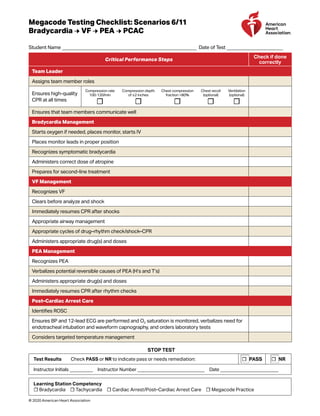
Megacode Testing Checklist: Scenarios 6/11
Bradycardia → VF → PEA → PCAC
Student Name _______________________________________________________ Date of Test _______________________
Critical Performance Steps
Check if done
correctly
Team Leader
Assigns team member roles
Ensures high-quality
CPR at all times
Compression rate
100-120/min
☐
Compression depth
of ≥2 inches
☐
Chest compression
fraction >80%
☐
Chest recoil
(optional)
☐
Ventilation
(optional)
☐
Ensures that team members communicate well
Bradycardia Management
Starts oxygen if needed, places monitor, starts IV
Places monitor leads in proper position
Recognizes symptomatic bradycardia
Administers correct dose of atropine
Prepares for second-line treatment
VF Management
Recognizes VF
Clears before analyze and shock
Immediately resumes CPR after shocks
Appropriate airway management
Appropriate cycles of drug–rhythm check/shock–CPR
Administers appropriate drug(s) and doses
PEA Management
Recognizes PEA
Verbalizes potential reversible causes of PEA (H’s and T’s)
Administers appropriate drug(s) and doses
Immediately resumes CPR after rhythm checks
Post–Cardiac Arrest Care
Identifies ROSC
Ensures BP and 12-lead ECG are performed and O2 saturation is monitored, verbalizes need for
endotracheal intubation and waveform capnography, and orders laboratory tests
Considers targeted temperature management
STOP TEST
Test Results  Check PASS or NR to indicate pass or needs remediation: ☐ PASS ☐ NR
Instructor Initials __________ Instructor Number _____________________________ Date _________________________
Learning Station Competency
☐ Bradycardia ☐ Tachycardia ☐ Cardiac Arrest/Post–Cardiac Arrest Care ☐ Megacode Practice
© 2020 American Heart Association
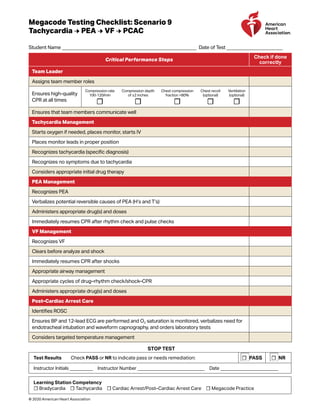
Megacode Testing Checklist: Scenario 9
Tachycardia → PEA → VF → PCAC
Student Name _______________________________________________________ Date of Test _______________________
Critical Performance Steps
Check if done
correctly
Team Leader
Assigns team member roles
Ensures high-quality
CPR at all times
Compression rate
100-120/min
☐
Compression depth
of ≥2 inches
☐
Chest compression
fraction >80%
☐
Chest recoil
(optional)
☐
Ventilation
(optional)
☐
Ensures that team members communicate well
Tachycardia Management
Starts oxygen if needed, places monitor, starts IV
Places monitor leads in proper position
Recognizes tachycardia (specific diagnosis)
Recognizes no symptoms due to tachycardia
Considers appropriate initial drug therapy
PEA Management
Recognizes PEA
Verbalizes potential reversible causes of PEA (H’s and T’s)
Administers appropriate drug(s) and doses
Immediately resumes CPR after rhythm check and pulse checks
VF Management
Recognizes VF
Clears before analyze and shock
Immediately resumes CPR after shocks
Appropriate airway management
Appropriate cycles of drug–rhythm check/shock–CPR
Administers appropriate drug(s) and doses
Post–Cardiac Arrest Care
Identifies ROSC
Ensures BP and 12-lead ECG are performed and O2 saturation is monitored, verbalizes need for
endotracheal intubation and waveform capnography, and orders laboratory tests
Considers targeted temperature management
STOP TEST
Test Results  Check PASS or NR to indicate pass or needs remediation: ☐ PASS ☐ NR
Instructor Initials __________ Instructor Number _____________________________ Date _________________________
Learning Station Competency
☐ Bradycardia ☐ Tachycardia ☐ Cardiac Arrest/Post–Cardiac Arrest Care ☐ Megacode Practice
© 2020 American Heart Association
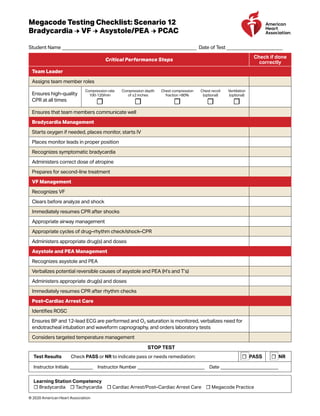
Megacode Testing Checklist: Scenario 12
Bradycardia → VF → Asystole/PEA → PCAC
Student Name _______________________________________________________ Date of Test _______________________
Critical Performance Steps
Check if done
correctly
Team Leader
Assigns team member roles
Ensures high-quality
CPR at all times
Compression rate
100-120/min
☐
Compression depth
of ≥2 inches
☐
Chest compression
fraction >80%
☐
Chest recoil
(optional)
☐
Ventilation
(optional)
☐
Ensures that team members communicate well
Bradycardia Management
Starts oxygen if needed, places monitor, starts IV
Places monitor leads in proper position
Recognizes symptomatic bradycardia
Administers correct dose of atropine
Prepares for second-line treatment
VF Management
Recognizes VF
Clears before analyze and shock
Immediately resumes CPR after shocks
Appropriate airway management
Appropriate cycles of drug–rhythm check/shock–CPR
Administers appropriate drug(s) and doses
Asystole and PEA Management
Recognizes asystole and PEA
Verbalizes potential reversible causes of asystole and PEA (H’s and T’s)
Administers appropriate drug(s) and doses
Immediately resumes CPR after rhythm checks
Post–Cardiac Arrest Care
Identifies ROSC
Ensures BP and 12-lead ECG are performed and O2 saturation is monitored, verbalizes need for
endotracheal intubation and waveform capnography, and orders laboratory tests
Considers targeted temperature management
STOP TEST
Test Results  Check PASS or NR to indicate pass or needs remediation: ☐ PASS ☐ NR
Instructor Initials __________ Instructor Number _____________________________ Date _________________________
Learning Station Competency
☐ Bradycardia ☐ Tachycardia ☐ Cardiac Arrest/Post–Cardiac Arrest Care ☐ Megacode Practice
© 2020 American Heart Association

ACLScombinepdf.pdf

  • 1.
    Advanced Cardiovascular LifeSupport Adult High-Quality BLS Skills Testing Checklist Student Name __________________________________________________  Date of Test __________________________ Hospital Scenario: “You are working in a hospital or clinic, and you see a person who has suddenly collapsed in the hallway. You check that the scene is safe and then approach the patient. Demonstrate what you would do next.” Prehospital Scenario: “You arrive on the scene for a suspected cardiac arrest. No bystander CPR has been provided. You approach the scene and ensure that it is safe. Demonstrate what you would do next.” Assessment and Activation ☐ Checks responsiveness ☐ Shouts for help/Activates emergency response system/Sends for AED ☐ Checks breathing ☐ Checks pulse Once student shouts for help, instructor says, “I am going to get the AED.” Compressions  Audio/visual feedback device required for accuracy ☐ Hand placement on lower half of sternum ☐ Perform continuous compressions for 2 minutes (100-120/min) ☐ Compresses at least 2 inches (5 cm) ☐ Complete chest recoil. (Optional, check if using a feedback device that measures chest recoil) Rescuer 2 says, “Here is the AED. I’ll take over compressions, and you use the AED.” AED (follows prompts of AED) ☐ Powers on AED  ☐ Correctly attaches pads ☐ Clears for analysis ☐ Clears to safely deliver a shock ☐ Safely delivers a shock ☐ Shocks within 45 seconds of AED arrival Resumes Compressions ☐ Ensures compressions are resumed immediately after shock delivery • Student directs instructor to resume compressions or • Second student resumes compressions STOP TEST Instructor Notes   • Place a check in the box next to each step the student completes successfully.   • If the student does not complete all steps successfully (as indicated by at least 1 blank check box), the student must receive remediation. Make a note here of which skills require remediation (refer to instructor manual for information about remediation). Test Results  Check PASS or NR to indicate pass or needs remediation: ☐ PASS ☐ NR Instructor Initials __________ Instructor Number _____________________________ Date _________________________ © 2020 American Heart Association
  • 2.
    Airway Management Skills TestingChecklist Student Name _______________________________________________________ Date of Test _______________________ Critical Performance Steps Check if done correctly BLS Assessment and Interventions Checks for responsiveness • Taps and shouts, “Are you OK?” Activates the emergency response system • Shouts for nearby help/Activates the emergency response system and gets the AED or • Directs second rescuer to activate the emergency response system and get the AED Checks breathing • Scans chest for movement (5-10 seconds) Checks pulse (5-10 seconds) Breathing and pulse check can be done simultaneously Notes that pulse is present and does not initiate chest compressions or attach AED Inserts oropharyngeal or nasopharyngeal airway Administers oxygen Performs effective bag-mask ventilation for 1 minute • Gives proper ventilation rate (once every 6 seconds) • Gives proper ventilation speed (over 1 second) • Gives proper ventilation volume (about half a bag) STOP TEST Instructor Notes   • Place a check in the box next to each step the student completes successfully.   • If the student does not complete all steps successfully (as indicated by at least 1 blank check box), the student must receive remediation. Make a note here of which skills require remediation (refer to Instructor Manual for information about remediation). Test Results  Check PASS or NR to indicate pass or needs remediation: ☐ PASS ☐ NR Instructor Initials __________ Instructor Number _____________________________ Date _________________________ © 2020 American Heart Association
  • 3.
    Megacode Testing Checklist:Scenarios 1/3/8 Bradycardia → Pulseless VT → PEA → PCAC Student Name _______________________________________________________ Date of Test _______________________ Critical Performance Steps Check if done correctly Team Leader Assigns team member roles Ensures high-quality CPR at all times Compression rate 100-120/min ☐ Compression depth of ≥2 inches ☐ Chest compression fraction >80% ☐ Chest recoil (optional) ☐ Ventilation (optional) ☐ Ensures that team members communicate well Bradycardia Management Starts oxygen if needed, places monitor, starts IV Places monitor leads in proper position Recognizes symptomatic bradycardia Administers correct dose of atropine Prepares for second-line treatment Pulseless VT Management Recognizes pVT Clears before analyze and shock Immediately resumes CPR after shocks Appropriate airway management Appropriate cycles of drug–rhythm check/shock–CPR Administers appropriate drug(s) and doses PEA Management Recognizes PEA Verbalizes potential reversible causes of PEA (H’s and T’s) Administers appropriate drug(s) and doses Immediately resumes CPR after rhythm checks Post–Cardiac Arrest Care Identifies ROSC Ensures BP and 12-lead ECG are performed and O2 saturation is monitored, verbalizes need for endotracheal intubation and waveform capnography, and orders laboratory tests Considers targeted temperature management STOP TEST Test Results  Check PASS or NR to indicate pass or needs remediation: ☐ PASS ☐ NR Instructor Initials __________ Instructor Number _____________________________ Date __________________________ Learning Station Competency ☐ Bradycardia ☐ Tachycardia ☐ Cardiac Arrest/Post–Cardiac Arrest Care ☐ Megacode Practice © 2020 American Heart Association
  • 4.
    Megacode Testing Checklist:Scenarios 2/5 Bradycardia → VF → Asystole → PCAC Student Name _______________________________________________________ Date of Test _______________________ Critical Performance Steps Check if done correctly Team Leader Assigns team member roles Ensures high-quality CPR at all times Compression rate 100-120/min ☐ Compression depth of ≥2 inches ☐ Chest compression fraction >80% ☐ Chest recoil (optional) ☐ Ventilation (optional) ☐ Ensures that team members communicate well Bradycardia Management Starts oxygen if needed, places monitor, starts IV Places monitor leads in proper position Recognizes symptomatic bradycardia Administers correct dose of atropine Prepares for second-line treatment VF Management Recognizes VF Clears before analyze and shock Immediately resumes CPR after shocks Appropriate airway management Appropriate cycles of drug–rhythm check/shock–CPR Administers appropriate drug(s) and doses Asystole Management Recognizes asystole Verbalizes potential reversible causes of asystole (H’s and T’s) Administers appropriate drug(s) and doses Immediately resumes CPR after rhythm checks Post–Cardiac Arrest Care Identifies ROSC Ensures BP and 12-lead ECG are performed and O2 saturation is monitored, verbalizes need for endotracheal intubation and waveform capnography, and orders laboratory tests Considers targeted temperature management STOP TEST Test Results  Check PASS or NR to indicate pass or needs remediation: ☐ PASS ☐ NR Instructor Initials __________ Instructor Number _____________________________ Date __________________________ Learning Station Competency ☐ Bradycardia ☐ Tachycardia ☐ Cardiac Arrest/Post–Cardiac Arrest Care ☐ Megacode Practice © 2020 American Heart Association
  • 5.
    Megacode Testing Checklist:Scenarios 4/7/10 Tachycardia → VF → PEA → PCAC Student Name _______________________________________________________ Date of Test _______________________ Critical Performance Steps Check if done correctly Team Leader Assigns team member roles Ensures high-quality CPR at all times Compression rate 100-120/min ☐ Compression depth of ≥2 inches ☐ Chest compression fraction >80% ☐ Chest recoil (optional) ☐ Ventilation (optional) ☐ Ensures that team members communicate well Tachycardia Management Starts oxygen if needed, places monitor, starts IV Places monitor leads in proper position Recognizes unstable tachycardia Recognizes symptoms due to tachycardia Performs immediate synchronized cardioversion VF Management Recognizes VF Clears before analyze and shock Immediately resumes CPR after shocks Appropriate airway management Appropriate cycles of drug–rhythm check/shock–CPR Administers appropriate drug(s) and doses PEA Management Recognizes PEA Verbalizes potential reversible causes of PEA (H’s and T’s) Administers appropriate drug(s) and doses Immediately resumes CPR after rhythm checks Post–Cardiac Arrest Care Identifies ROSC Ensures BP and 12-lead ECG are performed and O2 saturation is monitored, verbalizes need for endotracheal intubation and waveform capnography, and orders laboratory tests Considers targeted temperature management STOP TEST Test Results  Check PASS or NR to indicate pass or needs remediation: ☐ PASS ☐ NR Instructor Initials __________ Instructor Number _____________________________ Date _________________________ Learning Station Competency ☐ Bradycardia ☐ Tachycardia ☐ Cardiac Arrest/Post–Cardiac Arrest Care ☐ Megacode Practice © 2020 American Heart Association
  • 6.
    Megacode Testing Checklist:Scenarios 6/11 Bradycardia → VF → PEA → PCAC Student Name _______________________________________________________ Date of Test _______________________ Critical Performance Steps Check if done correctly Team Leader Assigns team member roles Ensures high-quality CPR at all times Compression rate 100-120/min ☐ Compression depth of ≥2 inches ☐ Chest compression fraction >80% ☐ Chest recoil (optional) ☐ Ventilation (optional) ☐ Ensures that team members communicate well Bradycardia Management Starts oxygen if needed, places monitor, starts IV Places monitor leads in proper position Recognizes symptomatic bradycardia Administers correct dose of atropine Prepares for second-line treatment VF Management Recognizes VF Clears before analyze and shock Immediately resumes CPR after shocks Appropriate airway management Appropriate cycles of drug–rhythm check/shock–CPR Administers appropriate drug(s) and doses PEA Management Recognizes PEA Verbalizes potential reversible causes of PEA (H’s and T’s) Administers appropriate drug(s) and doses Immediately resumes CPR after rhythm checks Post–Cardiac Arrest Care Identifies ROSC Ensures BP and 12-lead ECG are performed and O2 saturation is monitored, verbalizes need for endotracheal intubation and waveform capnography, and orders laboratory tests Considers targeted temperature management STOP TEST Test Results  Check PASS or NR to indicate pass or needs remediation: ☐ PASS ☐ NR Instructor Initials __________ Instructor Number _____________________________ Date _________________________ Learning Station Competency ☐ Bradycardia ☐ Tachycardia ☐ Cardiac Arrest/Post–Cardiac Arrest Care ☐ Megacode Practice © 2020 American Heart Association
  • 7.
    Megacode Testing Checklist:Scenario 9 Tachycardia → PEA → VF → PCAC Student Name _______________________________________________________ Date of Test _______________________ Critical Performance Steps Check if done correctly Team Leader Assigns team member roles Ensures high-quality CPR at all times Compression rate 100-120/min ☐ Compression depth of ≥2 inches ☐ Chest compression fraction >80% ☐ Chest recoil (optional) ☐ Ventilation (optional) ☐ Ensures that team members communicate well Tachycardia Management Starts oxygen if needed, places monitor, starts IV Places monitor leads in proper position Recognizes tachycardia (specific diagnosis) Recognizes no symptoms due to tachycardia Considers appropriate initial drug therapy PEA Management Recognizes PEA Verbalizes potential reversible causes of PEA (H’s and T’s) Administers appropriate drug(s) and doses Immediately resumes CPR after rhythm check and pulse checks VF Management Recognizes VF Clears before analyze and shock Immediately resumes CPR after shocks Appropriate airway management Appropriate cycles of drug–rhythm check/shock–CPR Administers appropriate drug(s) and doses Post–Cardiac Arrest Care Identifies ROSC Ensures BP and 12-lead ECG are performed and O2 saturation is monitored, verbalizes need for endotracheal intubation and waveform capnography, and orders laboratory tests Considers targeted temperature management STOP TEST Test Results  Check PASS or NR to indicate pass or needs remediation: ☐ PASS ☐ NR Instructor Initials __________ Instructor Number _____________________________ Date _________________________ Learning Station Competency ☐ Bradycardia ☐ Tachycardia ☐ Cardiac Arrest/Post–Cardiac Arrest Care ☐ Megacode Practice © 2020 American Heart Association
  • 8.
    Megacode Testing Checklist:Scenario 12 Bradycardia → VF → Asystole/PEA → PCAC Student Name _______________________________________________________ Date of Test _______________________ Critical Performance Steps Check if done correctly Team Leader Assigns team member roles Ensures high-quality CPR at all times Compression rate 100-120/min ☐ Compression depth of ≥2 inches ☐ Chest compression fraction >80% ☐ Chest recoil (optional) ☐ Ventilation (optional) ☐ Ensures that team members communicate well Bradycardia Management Starts oxygen if needed, places monitor, starts IV Places monitor leads in proper position Recognizes symptomatic bradycardia Administers correct dose of atropine Prepares for second-line treatment VF Management Recognizes VF Clears before analyze and shock Immediately resumes CPR after shocks Appropriate airway management Appropriate cycles of drug–rhythm check/shock–CPR Administers appropriate drug(s) and doses Asystole and PEA Management Recognizes asystole and PEA Verbalizes potential reversible causes of asystole and PEA (H’s and T’s) Administers appropriate drug(s) and doses Immediately resumes CPR after rhythm checks Post–Cardiac Arrest Care Identifies ROSC Ensures BP and 12-lead ECG are performed and O2 saturation is monitored, verbalizes need for endotracheal intubation and waveform capnography, and orders laboratory tests Considers targeted temperature management STOP TEST Test Results  Check PASS or NR to indicate pass or needs remediation: ☐ PASS ☐ NR Instructor Initials __________ Instructor Number _____________________________ Date _________________________ Learning Station Competency ☐ Bradycardia ☐ Tachycardia ☐ Cardiac Arrest/Post–Cardiac Arrest Care ☐ Megacode Practice © 2020 American Heart Association