09/12/2012


               AC Joint "
               Dislocations & Instability

                                              !


     Is the ACJ Important?
                                                        Rangger et al. Orthopade 2002 Jun;
                                                                   31(6):587-90 
!    YES – for overhead athletes:


!    Following ACJ Dislocations:
     !    30% of overhead athletes had to
          reduce sport
     !    9% had to change sport
     !    Climbers and patients performing
          strength training had to reduce their
          activities or give up sports 
     !    Altered activities in overhead ball sports


     Is the ACJ Important?
                                                           Cox. Am J Sports Med, 1981
!    YES – for high demand professions:


!    Following ACJ Injuries:
     !    164 US Naval Cadets
     !    Residual symptoms found at 6 month follow-up:
          !    36% of Grade 1
          !    48% of Grade 2
               !    Major in 13% 
               !    Minor in 35%
          !    69% of Grade 3 


                                                                                                      1
09/12/2012


         2
09/12/2012


Indications for Stabilisation
     !    Literature = Type 4, 5 & 6


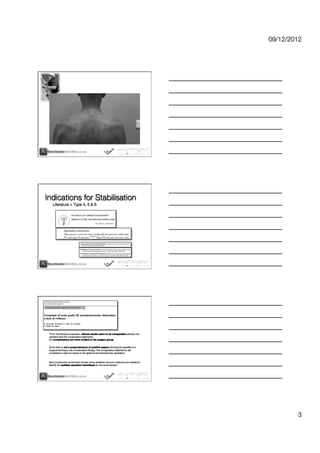
Ceccarelli et al. 2008


!      From the literature evaluation, clinical results seem to be comparable between the
     operative and the conservative treatments, "
     but complications are more evident in the surgery group. "
     
!    Since there is not a preponderance of positive papers showing the benefits of a
     surgical technique over conservative therapy, the nonoperative treatment is still
     considered a valid procedure in the grade III acromioclavicular separation.


!    More prospective randomized studies using validated outcome measures are needed to
     identify the suitable operation techniques for the acute injuries. 


                                                                                                     3
09/12/2012


What are we trying to achieve?

    •     A pain free & stable shoulder "
         that has enough mobility, strength "
         & muscle control for a patient s "
         desired level of activity & participation 


                     •    Peter Rheinlaender


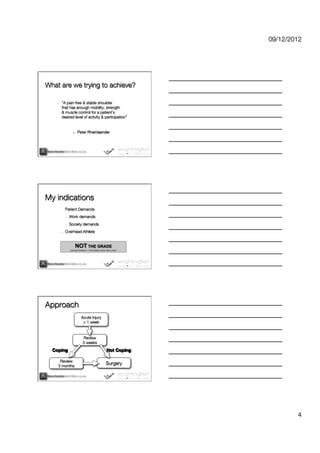
My indications
         !    Patient Demands
              !    Work demands
              !    Society demands
         !    Overhead Athlete


Approach
                            Acute Injury
                             < 1 week


                             Review
                             3 weeks
  Coping
                                   Not Coping

     Review"
    3 months
                                            Surgery


                                                                   4
09/12/2012


      Surgical procedures


Coracoclavicular "
Ligaments
      Harris et. al. Am J Sports Med. 2000


!     Strength – 500N (+/- 134)
!     Stiffness – 103N/mm (+/- 30)
!     Uniaxial Tension 25mm/min


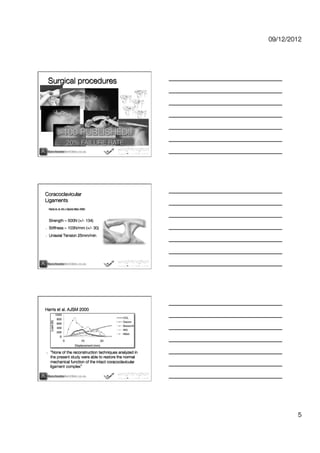
Harris et al. AJSM 2000


 •       None of the reconstruction techniques analyzed in
       the present study were able to restore the normal
       mechanical function of the intact coracoclavicular
       ligament complex 


                                                                      5
09/12/2012


     ACJ Ligaments 
               Fukuda et al. JBJSA. 1986

!     Two thirds of the superior stability
      for lesser displacements
!     90% the posterior stability


     Dynamic Stability
        !    Delto-trapezial fascia
     Fukuda et al. JBJSA. 1986: Copeland & Kessel. Injury.
     1980; DePalma. 1973; Urist. JBJS 1963.


             Lizaur et al. JBJS. 1994


     My Experience
       2001
                                                    2008


                                                                                 6
09/12/2012


Revisions !!!


     LARS Ligament (Corin)
!    Braided Polyethylenetraphthalate
!    1500N tensile strength (30 LAC)
!    No reduction in mechanical resilience after over 10
     million wear cycles loaded in torsion, traction and
     flexion [Fialka et al. 2005; 
!    Vascularisation & Fibrous ingrowth - Collagen Type 1
     [Trieb et al. Eur Surg Res. 2004; Yu et al. 2005; Pelletier & Durand]


                                                                                       7
09/12/2012


Standard repair


              Shoulderdoc.co.uk


Modification 1


                Shoulderdoc.co.uk


Modification 2


          Shoulderdoc.co.uk


                                              8
09/12/2012


Closure
!    Repair the Superior AC Ligaments
!    Repair the Delto-Trapezial Fascia


x-rays - "
Day 1, 3 weeks, 3 months, 1yr, 2yrs


         Shoulderdoc.co.uk
                   Shoulderdoc.co.uk


          Shoulderdoc.co.uk
              Shoulderdoc.co.uk


                                                                            9
09/12/2012


POST-OP
!    Phase 1: (Level 1-2 Exercises)
     !    Core stability & Scapula control
     !    Proprioceptive exercises (minimal weightbearing below 90 degrees)
     !    Active ROM as comfortable
     !    Do not force or stretch
     !    No resistance exercises 
!    Phase 2: (Level 2-3 Exercises)
     !    Progress to light resistance exercises as tolerated
     !    Sports-specific rehabilitation - Plyometrics and pertubation training
!    Phase 3: (Level 3+ Exercises)
     !     Regain scapula & glenohumeral stability working for shoulder joint control
          rather than range
     !    Gradually Strengthen


                  THANK YOU

             •    lenfunk@shoulderdoc.co.uk


                                                                                                10

Acj instability mac 2012

  • 1.
    09/12/2012 AC Joint " Dislocations & Instability ! Is the ACJ Important? Rangger et al. Orthopade 2002 Jun; 31(6):587-90 !  YES – for overhead athletes: !  Following ACJ Dislocations: !  30% of overhead athletes had to reduce sport !  9% had to change sport !  Climbers and patients performing strength training had to reduce their activities or give up sports !  Altered activities in overhead ball sports Is the ACJ Important? Cox. Am J Sports Med, 1981 !  YES – for high demand professions: !  Following ACJ Injuries: !  164 US Naval Cadets !  Residual symptoms found at 6 month follow-up: !  36% of Grade 1 !  48% of Grade 2 !  Major in 13% !  Minor in 35% !  69% of Grade 3 1
  • 2.
  • 3.
    09/12/2012 Indications for Stabilisation !  Literature = Type 4, 5 & 6 Ceccarelli et al. 2008 !  From the literature evaluation, clinical results seem to be comparable between the operative and the conservative treatments, " but complications are more evident in the surgery group. " !  Since there is not a preponderance of positive papers showing the benefits of a surgical technique over conservative therapy, the nonoperative treatment is still considered a valid procedure in the grade III acromioclavicular separation. !  More prospective randomized studies using validated outcome measures are needed to identify the suitable operation techniques for the acute injuries. 3
  • 4.
    09/12/2012 What are wetrying to achieve? •  A pain free & stable shoulder " that has enough mobility, strength " & muscle control for a patient s " desired level of activity & participation •  Peter Rheinlaender My indications !  Patient Demands !  Work demands !  Society demands !  Overhead Athlete Approach Acute Injury < 1 week Review 3 weeks Coping Not Coping Review" 3 months Surgery 4
  • 5.
    09/12/2012 Surgical procedures Coracoclavicular " Ligaments Harris et. al. Am J Sports Med. 2000 !  Strength – 500N (+/- 134) !  Stiffness – 103N/mm (+/- 30) !  Uniaxial Tension 25mm/min Harris et al. AJSM 2000 •  None of the reconstruction techniques analyzed in the present study were able to restore the normal mechanical function of the intact coracoclavicular ligament complex 5
  • 6.
    09/12/2012 ACJ Ligaments Fukuda et al. JBJSA. 1986 !  Two thirds of the superior stability for lesser displacements !  90% the posterior stability Dynamic Stability !  Delto-trapezial fascia Fukuda et al. JBJSA. 1986: Copeland & Kessel. Injury. 1980; DePalma. 1973; Urist. JBJS 1963. Lizaur et al. JBJS. 1994 My Experience 2001 2008 6
  • 7.
    09/12/2012 Revisions !!! LARS Ligament (Corin) !  Braided Polyethylenetraphthalate !  1500N tensile strength (30 LAC) !  No reduction in mechanical resilience after over 10 million wear cycles loaded in torsion, traction and flexion [Fialka et al. 2005; !  Vascularisation & Fibrous ingrowth - Collagen Type 1 [Trieb et al. Eur Surg Res. 2004; Yu et al. 2005; Pelletier & Durand] 7
  • 8.
    09/12/2012 Standard repair Shoulderdoc.co.uk Modification 1 Shoulderdoc.co.uk Modification 2 Shoulderdoc.co.uk 8
  • 9.
    09/12/2012 Closure !  Repair the Superior AC Ligaments !  Repair the Delto-Trapezial Fascia x-rays - " Day 1, 3 weeks, 3 months, 1yr, 2yrs Shoulderdoc.co.uk Shoulderdoc.co.uk Shoulderdoc.co.uk Shoulderdoc.co.uk 9
  • 10.
    09/12/2012 POST-OP !  Phase 1: (Level 1-2 Exercises) !  Core stability & Scapula control !  Proprioceptive exercises (minimal weightbearing below 90 degrees) !  Active ROM as comfortable !  Do not force or stretch !  No resistance exercises !  Phase 2: (Level 2-3 Exercises) !  Progress to light resistance exercises as tolerated !  Sports-specific rehabilitation - Plyometrics and pertubation training !  Phase 3: (Level 3+ Exercises) !  Regain scapula & glenohumeral stability working for shoulder joint control rather than range !  Gradually Strengthen THANK YOU •  lenfunk@shoulderdoc.co.uk 10