SCREENING THE SHOULDER
GIRDLE IN ELITE TENNIS
PLAYERS

                                Ann Cools, PT, PhD
                                Dept Rehab. Sciences & Physiotherapy
                                Ghent University, Belgium
           Ann Cools Wrightington Nov 2012                     1
Purpose of this presentation:
1.   Rationale for strength and ROM
     screening in the overhead athlete

2.   Results from studies on elite
     adolescent tennis players (Swedish
     Tennis Federation)

3.   Implications for injury prevention
     programs and return to play criteria
                       Ann Cools Wrightington Nov 2012   2
Why performing screening in
  healthy elite overhead athletes?

Performance enhancement: longitudinal
follow up in view of performance/
ranking

Injury prevention - risk factors for
injury and preventive programs

Return to play – normative data and
individual results after injury
                    Ann Cools Wrightington Nov 2012   3
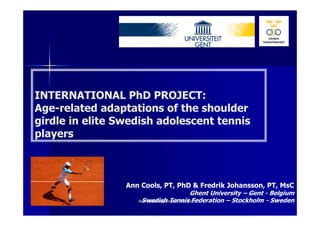
INTERNATIONAL PhD PROJECT:
Age-related adaptations of the shoulder
girdle in elite Swedish adolescent tennis
players


                 Ann Cools, PT, PhD & Fredrik Johansson, PT, MsC
                                                Ghent University – Gent - Belgium
                     Swedish Tennis Federation – Stockholm - Sweden
                    Ann Cools Wrightington Nov 2012                         4
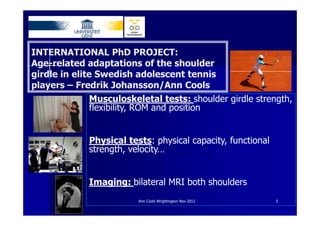
INTERNATIONAL PhD PROJECT:
Age-related adaptations of the shoulder
girdle in elite Swedish adolescent tennis
players – Fredrik Johansson/Ann Cools
               Musculoskeletal tests: shoulder girdle strength,
               flexibility, ROM and position


             Physical tests: physical capacity, functional
             strength, velocity…


             Imaging: bilateral MRI both shoulders
                         Ann Cools Wrightington Nov 2012     5
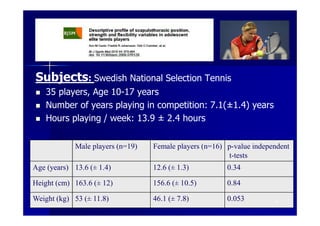
Subjects: Swedish National Selection Tennis
    35 players, Age 10-17 years
    Number of years playing in competition: 7.1(±1.4) years
    Hours playing / week: 13.9 ± 2.4 hours


            Male players (n=19)         Female players (n=16) p-value independent
                                                              t-tests
Age (years) 13.6 (± 1.4)                12.6 (± 1.3)                0.34

Height (cm) 163.6 (± 12)                156.6 (± 10.5)              0.84

Weight (kg) 53 (± 11.8)                 46.1 (± 7.8)
                                  Ann Cools Wrightington Nov 2012   0.053   6
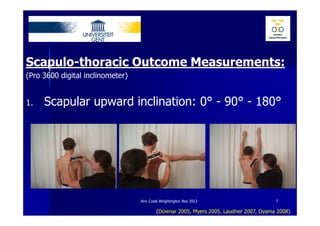
Scapulo-thoracic Outcome Measurements:
(Pro 3600 digital inclinometer)


1.   Scapular upward inclination: 0° - 90° - 180°


                                  Ann Cools Wrightington Nov 2012                      7

                                          (Downar 2005, Myers 2005, Laudner 2007, Oyama 2008)
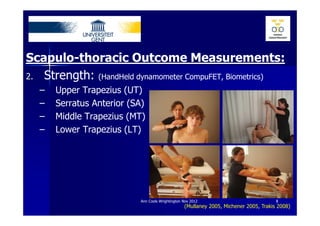
Scapulo-thoracic Outcome Measurements:
2. Strength: (HandHeld dynamometer CompuFET, Biometrics)
  –   Upper Trapezius (UT)
  –   Serratus Anterior (SA)
  –   Middle Trapezius (MT)
  –   Lower Trapezius (LT)


                          Ann Cools Wrightington Nov 2012                             8
                                                 (Mullaney 2005, Michener 2005, Trakis 2008)
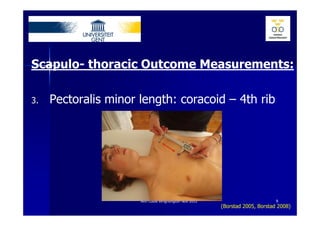
Scapulo- thoracic Outcome Measurements:

3.   Pectoralis minor length: coracoid – 4th rib


                      Ann Cools Wrightington Nov 2012                         9
                                                        (Borstad 2005, Borstad 2008)
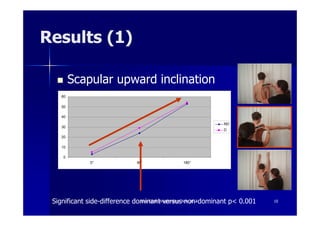
Results (1)

         Scapular upward inclination
    60

    50

    40
                                                               ND
    30
                                                               D
    20

    10

     0
              0°               90°              180°


 Significant side-difference dominant versusNov 2012
                               Ann Cools Wrightington non-dominant p< 0.001   10
Discussion

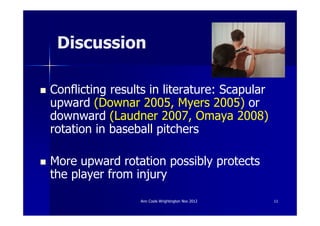
Conflicting results in literature: Scapular
upward (Downar 2005, Myers 2005) or
downward (Laudner 2007, Omaya 2008)
rotation in baseball pitchers

More upward rotation possibly protects
the player from injury
                 Ann Cools Wrightington Nov 2012   11
Results(2)

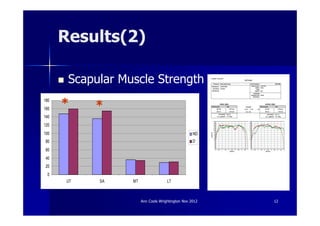
       Scapular Muscle Strength
180
160
      *    *
140
120
100                                                ND
 80                                                D
 60
 40
 20
 0
      UT    SA    MT                 LT


                       Ann Cools Wrightington Nov 2012   12
Discussion

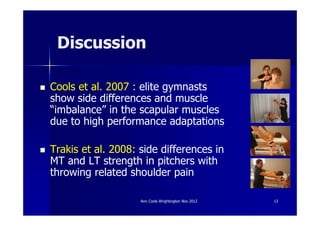
Cools et al. 2007 : elite gymnasts
show side differences and muscle
“imbalance” in the scapular muscles
due to high performance adaptations

Trakis et al. 2008: side differences in
MT and LT strength in pitchers with
throwing related shoulder pain

                    Ann Cools Wrightington Nov 2012   13
Results (3)

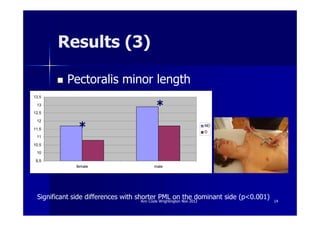
            Pectoralis minor length
13,5

 13

12,5
                                             *
 12

11,5            *                                             ND
                                                              D
 11

10,5

 10

 9,5
               female                       male


 Significant side differences with shorter PML on Nov 2012
                                     Ann Cools Wrightington
                                                            the dominant side (p<0.001)   14
Discussion

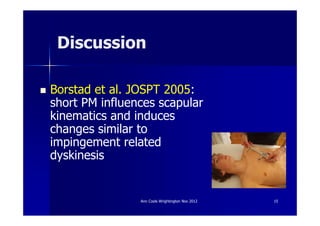
Borstad et al. JOSPT 2005:
short PM influences scapular
kinematics and induces
changes similar to
impingement related
dyskinesis


                Ann Cools Wrightington Nov 2012   15
Limitation of the first study:
  Descriptive profile of elite tennis
  players 11-17y, no subdivision in
  age groups, limited sample size


  Only scapular position and strength,
  no shoulder measurements


Purpose of the 2nd study: Age-
 related changes in shoulder and
 scapular variables in elite tennis
 players between 10-20 years
                       Ann Cools Wrightington Nov 2012   16
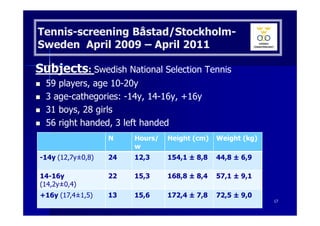
Tennis-screening Båstad/Stockholm-
Sweden April 2009 – April 2011

Subjects: Swedish National Selection Tennis
  59 players, age 10-20y
  3 age-cathegories: -14y, 14-16y, +16y
  31 boys, 28 girls
  56 right handed, 3 left handed
                   N    Hours/         Height (cm)         Weight (kg)
                        w
-14y (12,7y±0,8)   24   12,3           154,1 ± 8,8         44,8 ± 6,9

14-16y             22   15,3           168,8 ± 8,4         57,1 ± 9,1
(14,2y±0,4)
+16y (17,4±1,5)    13   15,6           172,4 ± 7,8         72,5 ± 9,0
                         Ann Cools Wrightington Nov 2012                 17
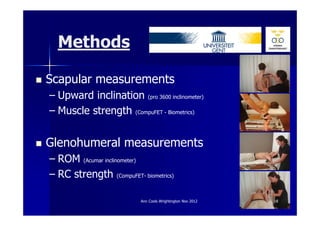
Methods

Scapular measurements
– Upward inclination (pro 3600 inclinometer)
– Muscle strength (CompuFET - Biometrics)


Glenohumeral measurements
– ROM (Acumar inclinometer)
– RC strength (CompuFET- biometrics)

                          Ann Cools Wrightington Nov 2012   18
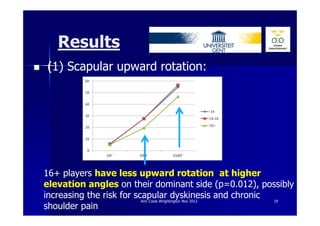
Results
(1) Scapular upward rotation:


16+ players have less upward rotation at higher
elevation angles on their dominant side (p=0.012), possibly
increasing the risk for scapular dyskinesis and chronic
                          Ann Cools Wrightington Nov 2012 19
shoulder pain
Results
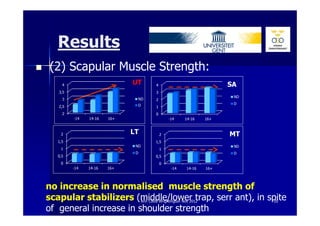
(2) Scapular Muscle Strength:
    4                        UT        4                            SA
   3,5                                 3
                                                                     ND
    3                             ND   2
                                  D                                  D
   2,5                                 1
    2                                  0
         -14   14-16   16+                     -14    14-16   16+


    2                        LT            2                        MT
  1,5                                  1,5
                              ND                                     ND
    1                                      1
                              D                                      D
  0,5                                  0,5
    0                                      0
         -14   14-16   16+                      -14   14-16   16+


no increase in normalised muscle strength of
scapular stabilizers (middle/lower trap, serr ant), in spite
                        Ann Cools Wrightington Nov 2012  20

of general increase in shoulder strength
Results

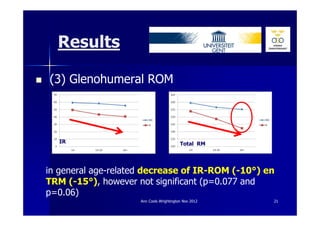
(3) Glenohumeral ROM


   IR                                     Total RM


in general age-related decrease of IR-ROM (-10°) en
TRM (-15°), however not significant (p=0.077 and
p=0.06)
                     Ann Cools Wrightington Nov 2012   21
Results

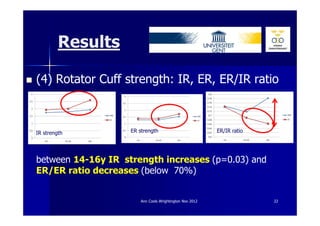
(4) Rotator Cuff strength: IR, ER, ER/IR ratio


IR strength         ER strength                           ER/IR ratio


between 14-16y IR strength increases (p=0.03) and
ER/ER ratio decreases (below 70%)


                        Ann Cools Wrightington Nov 2012                 22
Conclusions

Age-related changes in shoulder and
 scapular variables possibly increase
 the risk for overuse injury in the
 shoulder
  - Decrease of glenohumeral ROM
  - Insufficient gain in scapular stabilizing
    muscle strength
  - Changes in rotator cuff muscle balance
                Ann Cools Wrightington Nov 2012   23
Physical testing
&

MRI screening of the shoulder
in Elite Swedish Tennis Players
Fredrik Johansson, Stockholm, Sweden, SVTF
Ann Cools, PhD, Ghent University, Belgium
Edin De Bri PhD, Orthopeadic Surgeon, Stockholm, Sweden

                                       Ann Cools Wrightington Nov 2012   24
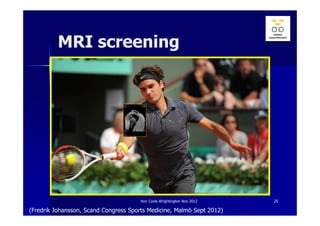
MRI screening


                                       Ann Cools Wrightington Nov 2012   25

(Fredrik Johansson, Scand Congress Sports Medicine, Malmö Sept 2012)
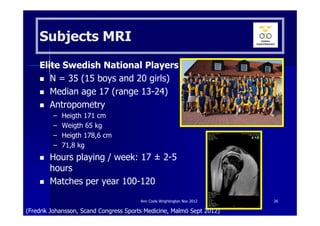
Subjects MRI
    Elite Swedish National Players
       N = 35 (15 boys and 20 girls)
       Median age 17 (range 13-24)
       Antropometry
         –   Heigth 171 cm
         –   Weigth 65 kg
         –   Heigth 178,6 cm
         –   71,8 kg
        Hours playing / week: 17 ± 2-5
        hours
        Matches per year 100-120

                                        Ann Cools Wrightington Nov 2012   26

(Fredrik Johansson, Scand Congress Sports Medicine, Malmö Sept 2012)
MRI findings results
        19 players (54,2%) had a normal MRI
        examination
        16 players (45.8%) had an abnormal
        examination.
        14 players showed a total of 16 tendinosis
        (2 players both in IS/SS), predominately in
        Infraspinatus (10), Supraspinatus (5) and
        Subscapularis (1).
                                       Ann Cools Wrightington Nov 2012   27

(Fredrik Johansson, Scand Congress Sports Medicine, Malmö Sept 2012)
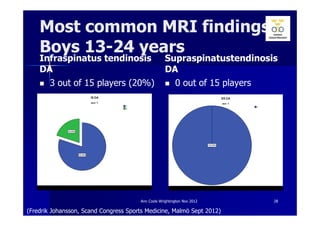
Most common MRI findings
    Boys 13-24 years
    Infraspinatus tendinosis                        Supraspinatustendinosis
    DA                                              DA
      3 out of 15 players (20%)                       0 out of 15 players


                                       Ann Cools Wrightington Nov 2012    28

(Fredrik Johansson, Scand Congress Sports Medicine, Malmö Sept 2012)
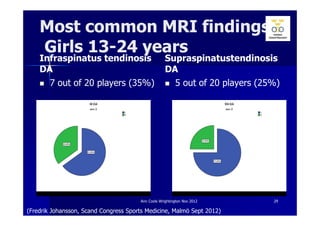
Most common MRI findings
    Girls 13-24 years
    Infraspinatus tendinosis                        Supraspinatustendinosis
    DA                                              DA
      7 out of 20 players (35%)                       5 out of 20 players (25%)


                                       Ann Cools Wrightington Nov 2012       29

(Fredrik Johansson, Scand Congress Sports Medicine, Malmö Sept 2012)
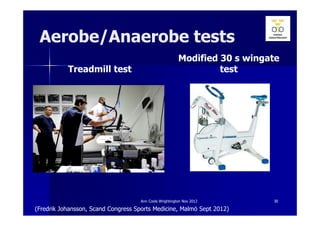
Aerobe/Anaerobe tests
                                                         Modified 30 s wingate
           Treadmill test                                         test


                                     Ann Cools Wrightington Nov 2012        30

(Fredrik Johansson, Scand Congress Sports Medicine, Malmö Sept 2012)
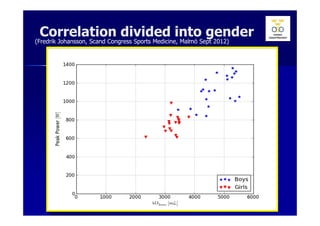
Correlation divided into gender
(Fredrik Johansson, Scand Congress Sports Medicine, Malmö Sept 2012)


                                     Ann Cools Wrightington Nov 2012   31
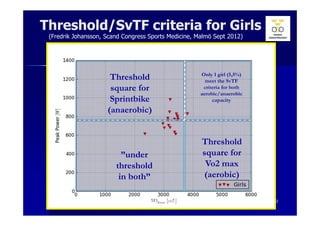
Threshold/SvTF criteria for Girls
 (Fredrik Johansson, Scand Congress Sports Medicine, Malmö Sept 2012)


                                                                   Only 1 girl (5,5%)
                      Threshold                                      meet the SvTF
                      square for                                    criteria for both
                                                                   aerobic/anaerobic
                      Sprintbike                                        capacity

                     (anaerobic)


                                                                   Threshold
                          ”under                                   square for
                        threshold                                   Vo2 max
                         in both”                                  (aerobic)

                                 Ann Cools Wrightington Nov 2012                        32
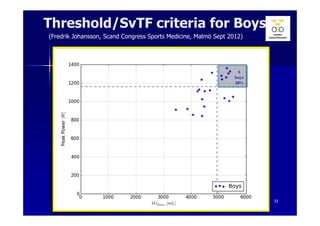
Threshold/SvTF criteria for Boys
(Fredrik Johansson, Scand Congress Sports Medicine, Malmö Sept 2012)


                                                                   6
                                                                  boys
                                                                  28%


                                Ann Cools Wrightington Nov 2012          33
Is general physical capacity related to local
joint load?

Are the shoulders in the girls more prone to
degeneration/injury because the physical
capacity is not keeping up with the
demand?

Are tendinopathy findings on MRI correlated
to decreased muscle strength?
                Ann Cools Wrightington Nov 2012   34
Implications of shoulder
screening for injury
prevention and return
to play after injury?
         Ann Cools Wrightington Nov 2012   35
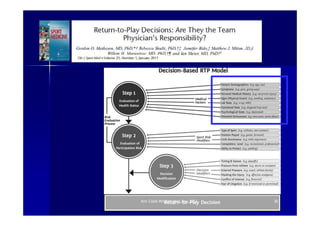
Ann Cools Wrightington Nov 2012   36
“Ideal” criteria for return to play
McCarty et al. Clin Sports Med 23 (2004) 335-351


Little/no pain
Patient subjectivity
Near normal ROM
Near normal strength
Normal functional ability
Normal sport-specific skills

                          Ann Cools Wrightington Nov 2012   37
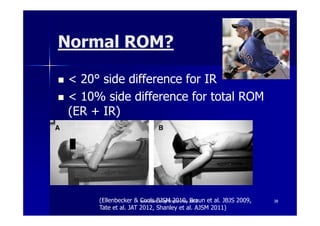
Normal ROM?

< 20° side difference for IR
< 10% side difference for total ROM
(ER + IR)


     (Ellenbecker & Cools BJSM 2010, 2012
                     Ann Cools Wrightington Nov Braun et al. JBJS 2009,   38
     Tate et al. JAT 2012, Shanley et al. AJSM 2011)
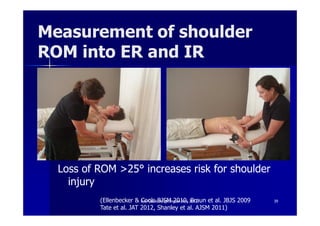
Measurement of shoulder
ROM into ER and IR


  Loss of ROM >25° increases risk for shoulder
    injury
          (Ellenbecker & Ann CoolsBJSM 2010, 2012
                          Cools Wrightington Nov Braun et al. JBJS 2009   39
          Tate et al. JAT 2012, Shanley et al. AJSM 2011)
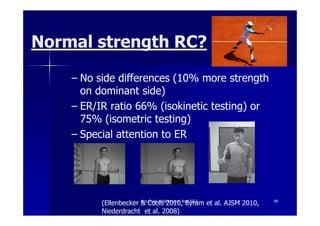
Normal strength RC?

    – No side differences (10% more strength
      on dominant side)
    – ER/IR ratio 66% (isokinetic testing) or
      75% (isometric testing)
    – Special attention to ER


          (Ellenbecker Ann Cools 2010,Nov 2012 et al. AJSM 2010,
                       & Cools Wrightington Byram                  40

          Niederdracht et al. 2008)
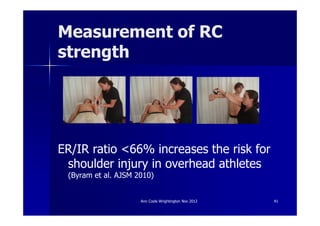
Measurement of RC
strength


ER/IR ratio <66% increases the risk for
 shoulder injury in overhead athletes
 (Byram et al. AJSM 2010)


                     Ann Cools Wrightington Nov 2012   41
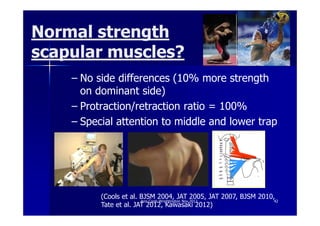
Normal strength
scapular muscles?
    – No side differences (10% more strength
      on dominant side)
    – Protraction/retraction ratio = 100%
    – Special attention to middle and lower trap


          (Cools et al. BJSM 2004, JAT 2005, JAT 2007, BJSM 2010,
                        Ann Cools Wrightington Nov 2012          42
          Tate et al. JAT 2012, Kawasaki 2012)
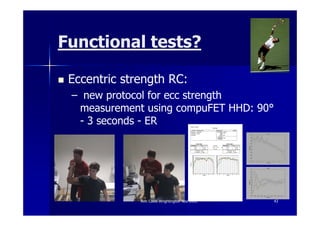
Functional tests?

 Eccentric strength RC:
 – new protocol for ecc strength
  measurement using compuFET HHD: 90°
  - 3 seconds - ER


              Ann Cools Wrightington Nov 2012   43
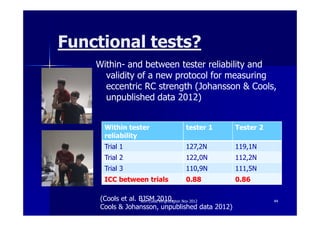
Functional tests?
    Within- and between tester reliability and
      validity of a new protocol for measuring
      eccentric RC strength (Johansson & Cools,
      unpublished data 2012)


      Within tester            tester 1          Tester 2
      reliability
      Trial 1                  127,2N            119,1N
      Trial 2                  122,0N            112,2N
      Trial 3                  110,9N            111,5N
      ICC between trials       0.88              0.86

     (Cools et al. BJSM 2010, Nov 2012
                    Ann Cools Wrightington                  44
     Cools & Johansson, unpublished data 2012)
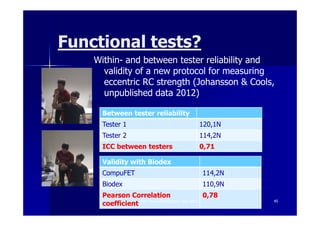
Functional tests?
    Within- and between tester reliability and
      validity of a new protocol for measuring
      eccentric RC strength (Johansson & Cools,
      unpublished data 2012)

      Between tester reliability
      Tester 1                                120,1N
      Tester 2                                114,2N
      ICC between testers                     0,71

      Validity with Biodex
      CompuFET                                 114,2N
      Biodex                                   110,9N
      Pearson Correlation                         0,78
      coefficient Ann Cools Wrightington Nov 2012        45
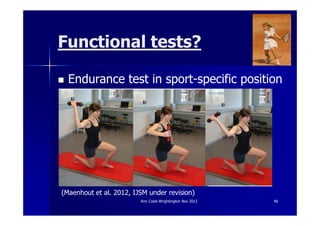
Functional tests?

  Endurance test in sport-specific position


(Maenhout et al. 2012, IJSM under revision)
                         Ann Cools Wrightington Nov 2012   46
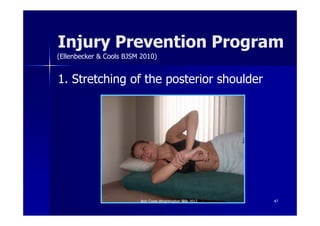
Injury Prevention Program
(Ellenbecker & Cools BJSM 2010)


1. Stretching of the posterior shoulder


                         Ann Cools Wrightington Nov 2012   47
Injury Prevention Program
(Cools et al. BJSM 2008, Ellenbecker & Cools BJSM 2010)


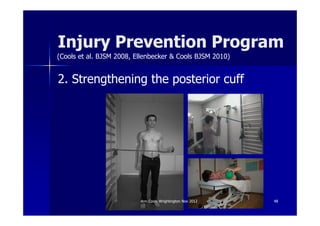
2. Strengthening the posterior cuff


                          Ann Cools Wrightington Nov 2012   48
Injury Prevention Program
(Cools et al. AJSM 2007, De Mey et al. JOSPT 2009,
Ellenbecker & Cools BJSM 2010)

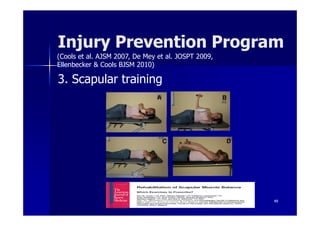
3. Scapular training


                          Ann Cools Wrightington Nov 2012   49
Take home message
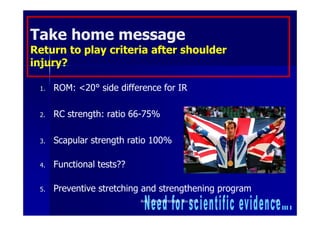
Return to play criteria after shoulder
injury?

 1.   ROM: <20° side difference for IR

 2.   RC strength: ratio 66-75%

 3.   Scapular strength ratio 100%

 4.   Functional tests??

 5.   Preventive stretching and strengthening program
                           Ann Cools Wrightington Nov 2012   50
(Gent- Belgium)


                  Ann Cools Wrightington Nov 2012   51

Ann cools 4 screening tennis players [compatibiliteitsmodus]

  • 1.
    SCREENING THE SHOULDER GIRDLEIN ELITE TENNIS PLAYERS Ann Cools, PT, PhD Dept Rehab. Sciences & Physiotherapy Ghent University, Belgium Ann Cools Wrightington Nov 2012 1
  • 2.
    Purpose of thispresentation: 1. Rationale for strength and ROM screening in the overhead athlete 2. Results from studies on elite adolescent tennis players (Swedish Tennis Federation) 3. Implications for injury prevention programs and return to play criteria Ann Cools Wrightington Nov 2012 2
  • 3.
    Why performing screeningin healthy elite overhead athletes? Performance enhancement: longitudinal follow up in view of performance/ ranking Injury prevention - risk factors for injury and preventive programs Return to play – normative data and individual results after injury Ann Cools Wrightington Nov 2012 3
  • 4.
    INTERNATIONAL PhD PROJECT: Age-relatedadaptations of the shoulder girdle in elite Swedish adolescent tennis players Ann Cools, PT, PhD & Fredrik Johansson, PT, MsC Ghent University – Gent - Belgium Swedish Tennis Federation – Stockholm - Sweden Ann Cools Wrightington Nov 2012 4
  • 5.
    INTERNATIONAL PhD PROJECT: Age-relatedadaptations of the shoulder girdle in elite Swedish adolescent tennis players – Fredrik Johansson/Ann Cools Musculoskeletal tests: shoulder girdle strength, flexibility, ROM and position Physical tests: physical capacity, functional strength, velocity… Imaging: bilateral MRI both shoulders Ann Cools Wrightington Nov 2012 5
  • 6.
    Subjects: Swedish NationalSelection Tennis 35 players, Age 10-17 years Number of years playing in competition: 7.1(±1.4) years Hours playing / week: 13.9 ± 2.4 hours Male players (n=19) Female players (n=16) p-value independent t-tests Age (years) 13.6 (± 1.4) 12.6 (± 1.3) 0.34 Height (cm) 163.6 (± 12) 156.6 (± 10.5) 0.84 Weight (kg) 53 (± 11.8) 46.1 (± 7.8) Ann Cools Wrightington Nov 2012 0.053 6
  • 7.
    Scapulo-thoracic Outcome Measurements: (Pro3600 digital inclinometer) 1. Scapular upward inclination: 0° - 90° - 180° Ann Cools Wrightington Nov 2012 7 (Downar 2005, Myers 2005, Laudner 2007, Oyama 2008)
  • 8.
    Scapulo-thoracic Outcome Measurements: 2.Strength: (HandHeld dynamometer CompuFET, Biometrics) – Upper Trapezius (UT) – Serratus Anterior (SA) – Middle Trapezius (MT) – Lower Trapezius (LT) Ann Cools Wrightington Nov 2012 8 (Mullaney 2005, Michener 2005, Trakis 2008)
  • 9.
    Scapulo- thoracic OutcomeMeasurements: 3. Pectoralis minor length: coracoid – 4th rib Ann Cools Wrightington Nov 2012 9 (Borstad 2005, Borstad 2008)
  • 10.
    Results (1) Scapular upward inclination 60 50 40 ND 30 D 20 10 0 0° 90° 180° Significant side-difference dominant versusNov 2012 Ann Cools Wrightington non-dominant p< 0.001 10
  • 11.
    Discussion Conflicting results inliterature: Scapular upward (Downar 2005, Myers 2005) or downward (Laudner 2007, Omaya 2008) rotation in baseball pitchers More upward rotation possibly protects the player from injury Ann Cools Wrightington Nov 2012 11
  • 12.
    Results(2) Scapular Muscle Strength 180 160 * * 140 120 100 ND 80 D 60 40 20 0 UT SA MT LT Ann Cools Wrightington Nov 2012 12
  • 13.
    Discussion Cools et al.2007 : elite gymnasts show side differences and muscle “imbalance” in the scapular muscles due to high performance adaptations Trakis et al. 2008: side differences in MT and LT strength in pitchers with throwing related shoulder pain Ann Cools Wrightington Nov 2012 13
  • 14.
    Results (3) Pectoralis minor length 13,5 13 12,5 * 12 11,5 * ND D 11 10,5 10 9,5 female male Significant side differences with shorter PML on Nov 2012 Ann Cools Wrightington the dominant side (p<0.001) 14
  • 15.
    Discussion Borstad et al.JOSPT 2005: short PM influences scapular kinematics and induces changes similar to impingement related dyskinesis Ann Cools Wrightington Nov 2012 15
  • 16.
    Limitation of thefirst study: Descriptive profile of elite tennis players 11-17y, no subdivision in age groups, limited sample size Only scapular position and strength, no shoulder measurements Purpose of the 2nd study: Age- related changes in shoulder and scapular variables in elite tennis players between 10-20 years Ann Cools Wrightington Nov 2012 16
  • 17.
    Tennis-screening Båstad/Stockholm- Sweden April2009 – April 2011 Subjects: Swedish National Selection Tennis 59 players, age 10-20y 3 age-cathegories: -14y, 14-16y, +16y 31 boys, 28 girls 56 right handed, 3 left handed N Hours/ Height (cm) Weight (kg) w -14y (12,7y±0,8) 24 12,3 154,1 ± 8,8 44,8 ± 6,9 14-16y 22 15,3 168,8 ± 8,4 57,1 ± 9,1 (14,2y±0,4) +16y (17,4±1,5) 13 15,6 172,4 ± 7,8 72,5 ± 9,0 Ann Cools Wrightington Nov 2012 17
  • 18.
    Methods Scapular measurements – Upwardinclination (pro 3600 inclinometer) – Muscle strength (CompuFET - Biometrics) Glenohumeral measurements – ROM (Acumar inclinometer) – RC strength (CompuFET- biometrics) Ann Cools Wrightington Nov 2012 18
  • 19.
    Results (1) Scapular upwardrotation: 16+ players have less upward rotation at higher elevation angles on their dominant side (p=0.012), possibly increasing the risk for scapular dyskinesis and chronic Ann Cools Wrightington Nov 2012 19 shoulder pain
  • 20.
    Results (2) Scapular MuscleStrength: 4 UT 4 SA 3,5 3 ND 3 ND 2 D D 2,5 1 2 0 -14 14-16 16+ -14 14-16 16+ 2 LT 2 MT 1,5 1,5 ND ND 1 1 D D 0,5 0,5 0 0 -14 14-16 16+ -14 14-16 16+ no increase in normalised muscle strength of scapular stabilizers (middle/lower trap, serr ant), in spite Ann Cools Wrightington Nov 2012 20 of general increase in shoulder strength
  • 21.
    Results (3) Glenohumeral ROM IR Total RM in general age-related decrease of IR-ROM (-10°) en TRM (-15°), however not significant (p=0.077 and p=0.06) Ann Cools Wrightington Nov 2012 21
  • 22.
    Results (4) Rotator Cuffstrength: IR, ER, ER/IR ratio IR strength ER strength ER/IR ratio between 14-16y IR strength increases (p=0.03) and ER/ER ratio decreases (below 70%) Ann Cools Wrightington Nov 2012 22
  • 23.
    Conclusions Age-related changes inshoulder and scapular variables possibly increase the risk for overuse injury in the shoulder - Decrease of glenohumeral ROM - Insufficient gain in scapular stabilizing muscle strength - Changes in rotator cuff muscle balance Ann Cools Wrightington Nov 2012 23
  • 24.
    Physical testing & MRI screeningof the shoulder in Elite Swedish Tennis Players Fredrik Johansson, Stockholm, Sweden, SVTF Ann Cools, PhD, Ghent University, Belgium Edin De Bri PhD, Orthopeadic Surgeon, Stockholm, Sweden Ann Cools Wrightington Nov 2012 24
  • 25.
    MRI screening Ann Cools Wrightington Nov 2012 25 (Fredrik Johansson, Scand Congress Sports Medicine, Malmö Sept 2012)
  • 26.
    Subjects MRI Elite Swedish National Players N = 35 (15 boys and 20 girls) Median age 17 (range 13-24) Antropometry – Heigth 171 cm – Weigth 65 kg – Heigth 178,6 cm – 71,8 kg Hours playing / week: 17 ± 2-5 hours Matches per year 100-120 Ann Cools Wrightington Nov 2012 26 (Fredrik Johansson, Scand Congress Sports Medicine, Malmö Sept 2012)
  • 27.
    MRI findings results 19 players (54,2%) had a normal MRI examination 16 players (45.8%) had an abnormal examination. 14 players showed a total of 16 tendinosis (2 players both in IS/SS), predominately in Infraspinatus (10), Supraspinatus (5) and Subscapularis (1). Ann Cools Wrightington Nov 2012 27 (Fredrik Johansson, Scand Congress Sports Medicine, Malmö Sept 2012)
  • 28.
    Most common MRIfindings Boys 13-24 years Infraspinatus tendinosis Supraspinatustendinosis DA DA 3 out of 15 players (20%) 0 out of 15 players Ann Cools Wrightington Nov 2012 28 (Fredrik Johansson, Scand Congress Sports Medicine, Malmö Sept 2012)
  • 29.
    Most common MRIfindings Girls 13-24 years Infraspinatus tendinosis Supraspinatustendinosis DA DA 7 out of 20 players (35%) 5 out of 20 players (25%) Ann Cools Wrightington Nov 2012 29 (Fredrik Johansson, Scand Congress Sports Medicine, Malmö Sept 2012)
  • 30.
    Aerobe/Anaerobe tests Modified 30 s wingate Treadmill test test Ann Cools Wrightington Nov 2012 30 (Fredrik Johansson, Scand Congress Sports Medicine, Malmö Sept 2012)
  • 31.
    Correlation divided intogender (Fredrik Johansson, Scand Congress Sports Medicine, Malmö Sept 2012) Ann Cools Wrightington Nov 2012 31
  • 32.
    Threshold/SvTF criteria forGirls (Fredrik Johansson, Scand Congress Sports Medicine, Malmö Sept 2012) Only 1 girl (5,5%) Threshold meet the SvTF square for criteria for both aerobic/anaerobic Sprintbike capacity (anaerobic) Threshold ”under square for threshold Vo2 max in both” (aerobic) Ann Cools Wrightington Nov 2012 32
  • 33.
    Threshold/SvTF criteria forBoys (Fredrik Johansson, Scand Congress Sports Medicine, Malmö Sept 2012) 6 boys 28% Ann Cools Wrightington Nov 2012 33
  • 34.
    Is general physicalcapacity related to local joint load? Are the shoulders in the girls more prone to degeneration/injury because the physical capacity is not keeping up with the demand? Are tendinopathy findings on MRI correlated to decreased muscle strength? Ann Cools Wrightington Nov 2012 34
  • 35.
    Implications of shoulder screeningfor injury prevention and return to play after injury? Ann Cools Wrightington Nov 2012 35
  • 36.
  • 37.
    “Ideal” criteria forreturn to play McCarty et al. Clin Sports Med 23 (2004) 335-351 Little/no pain Patient subjectivity Near normal ROM Near normal strength Normal functional ability Normal sport-specific skills Ann Cools Wrightington Nov 2012 37
  • 38.
    Normal ROM? < 20°side difference for IR < 10% side difference for total ROM (ER + IR) (Ellenbecker & Cools BJSM 2010, 2012 Ann Cools Wrightington Nov Braun et al. JBJS 2009, 38 Tate et al. JAT 2012, Shanley et al. AJSM 2011)
  • 39.
    Measurement of shoulder ROMinto ER and IR Loss of ROM >25° increases risk for shoulder injury (Ellenbecker & Ann CoolsBJSM 2010, 2012 Cools Wrightington Nov Braun et al. JBJS 2009 39 Tate et al. JAT 2012, Shanley et al. AJSM 2011)
  • 40.
    Normal strength RC? – No side differences (10% more strength on dominant side) – ER/IR ratio 66% (isokinetic testing) or 75% (isometric testing) – Special attention to ER (Ellenbecker Ann Cools 2010,Nov 2012 et al. AJSM 2010, & Cools Wrightington Byram 40 Niederdracht et al. 2008)
  • 41.
    Measurement of RC strength ER/IRratio <66% increases the risk for shoulder injury in overhead athletes (Byram et al. AJSM 2010) Ann Cools Wrightington Nov 2012 41
  • 42.
    Normal strength scapular muscles? – No side differences (10% more strength on dominant side) – Protraction/retraction ratio = 100% – Special attention to middle and lower trap (Cools et al. BJSM 2004, JAT 2005, JAT 2007, BJSM 2010, Ann Cools Wrightington Nov 2012 42 Tate et al. JAT 2012, Kawasaki 2012)
  • 43.
    Functional tests? Eccentricstrength RC: – new protocol for ecc strength measurement using compuFET HHD: 90° - 3 seconds - ER Ann Cools Wrightington Nov 2012 43
  • 44.
    Functional tests? Within- and between tester reliability and validity of a new protocol for measuring eccentric RC strength (Johansson & Cools, unpublished data 2012) Within tester tester 1 Tester 2 reliability Trial 1 127,2N 119,1N Trial 2 122,0N 112,2N Trial 3 110,9N 111,5N ICC between trials 0.88 0.86 (Cools et al. BJSM 2010, Nov 2012 Ann Cools Wrightington 44 Cools & Johansson, unpublished data 2012)
  • 45.
    Functional tests? Within- and between tester reliability and validity of a new protocol for measuring eccentric RC strength (Johansson & Cools, unpublished data 2012) Between tester reliability Tester 1 120,1N Tester 2 114,2N ICC between testers 0,71 Validity with Biodex CompuFET 114,2N Biodex 110,9N Pearson Correlation 0,78 coefficient Ann Cools Wrightington Nov 2012 45
  • 46.
    Functional tests? Endurance test in sport-specific position (Maenhout et al. 2012, IJSM under revision) Ann Cools Wrightington Nov 2012 46
  • 47.
    Injury Prevention Program (Ellenbecker& Cools BJSM 2010) 1. Stretching of the posterior shoulder Ann Cools Wrightington Nov 2012 47
  • 48.
    Injury Prevention Program (Coolset al. BJSM 2008, Ellenbecker & Cools BJSM 2010) 2. Strengthening the posterior cuff Ann Cools Wrightington Nov 2012 48
  • 49.
    Injury Prevention Program (Coolset al. AJSM 2007, De Mey et al. JOSPT 2009, Ellenbecker & Cools BJSM 2010) 3. Scapular training Ann Cools Wrightington Nov 2012 49
  • 50.
    Take home message Returnto play criteria after shoulder injury? 1. ROM: <20° side difference for IR 2. RC strength: ratio 66-75% 3. Scapular strength ratio 100% 4. Functional tests?? 5. Preventive stretching and strengthening program Ann Cools Wrightington Nov 2012 50
  • 51.
    (Gent- Belgium) Ann Cools Wrightington Nov 2012 51