EMBEDDING VOICE SYNTHESIZER AS
ASSISTANCE NAVIGATION SYSTEM FOR
VISUALLY IMPAIRED PERSONS
Mohamed Fezari, Rachid Sammouda, and
Salah Bensaoula
BADJI Mokhtar Annaba University , ALGERIA
Computer Science Department, King Saud University, Saudi Arabia
25/10/2016ACIT-2015
2
INTRODUCTION
 In this research work we describe the
design of an assistance navigation
system for Visually-Impaired and Blind
Persons.
 It is based on a new type of
microcontroller with synthesizer speech
module VR-Stamp.
 The system is a portable, self-contained
that will allow blind and visually impaired
individuals to travel through familiar and
unfamiliar routes without the assistance
25/10/2016ACIT-2015
3
INTRODUCTION
 A variety of high-tech devices, using different types of
range finders are available in the market and have been
widely used too, but they are discarded on the basis of
cost and other factors. Some of the old devices are:
Nottingham Obstacle Detector, (NOD) [2],
Binaural Sonic Aid (Sonic guide) [3],
Guide Cane [4],
Mowat Sensor [4],
C-5 Laser cane [5].
Advancement in technology has resulted in developing the
old devices into new ones with additional features.
25/10/2016ACIT-2015
4
CONSIDERATIONS IN THE DESIGN
 The blind is not able to see the display panel,
control buttons, or labels. Hence the device
should be easy to control: No complex control
buttons, switches and display panel should be
present. Moreover, the ETA device should be
low-price to be used by more blind persons.
 Our system is developed for portable (small size
and lightweight), inexpensive and easy to use,
and low-power consumption (supplied by
battery).
25/10/2016ACIT-2015
5
MAIN COMPONENTS AND SYSTEM
PRESENTATION
25/10/2016ACIT-2015
6
MAIN COMPONENTS AND SYSTEM
PRESENTATION
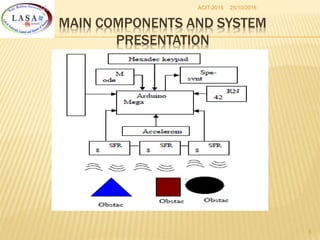
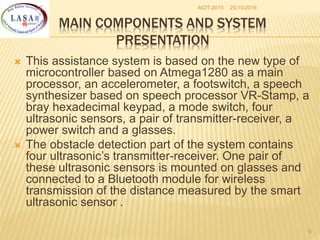
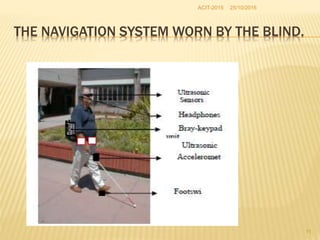
 This assistance system is based on the new type of
microcontroller based on Atmega1280 as a main
processor, an accelerometer, a footswitch, a speech
synthesizer based on speech processor VR-Stamp, a
bray hexadecimal keypad, a mode switch, four
ultrasonic sensors, a pair of transmitter-receiver, a
power switch and a glasses.
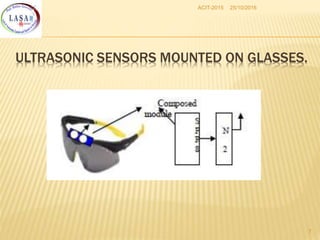
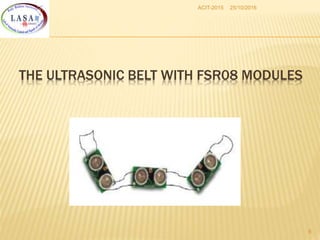
 The obstacle detection part of the system contains
four ultrasonic’s transmitter-receiver. One pair of
these ultrasonic sensors is mounted on glasses and
connected to a Bluetooth module for wireless
transmission of the distance measured by the smart
ultrasonic sensor .
25/10/2016ACIT-2015
7
ULTRASONIC SENSORS MOUNTED ON GLASSES.
25/10/2016ACIT-2015
8
THE ULTRASONIC BELT WITH FSR08 MODULES
25/10/2016ACIT-2015
9
SPEECH SYNTHESIZER VR-STAMP
 Voice Recognition Stamp [26] is a new component
from Sensory inc. It has more capabilities designed
for embedded systems. It was designed for consumer
telephony products and cost-sensitive consumer
electronic applications such as home electronics,
personal security, and personal communication
because of its performances:
 - Noise-robust Speaker Independent (SI) and
Speaker Dependent (SD) recognition.
 - High quality, 2.4-7.8 kbps speech synthesis &
 - Speaker Verification Word Spot (SVWS) -Noise
robust voice biometric security.
25/10/2016ACIT-2015
10
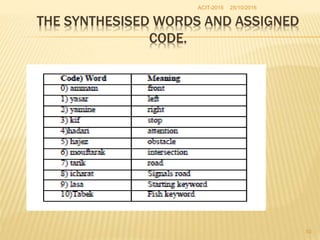
THE SYNTHESISED WORDS AND ASSIGNED
CODE.
25/10/2016ACIT-2015
11
THE NAVIGATION SYSTEM WORN BY THE BLIND.
25/10/2016ACIT-2015
12
FLOWCHART OF FUNCTIONING
25/10/2016ACIT-2015
13
EXPERIMENTS AND TESTS
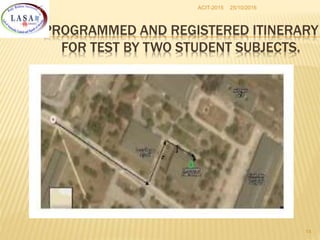
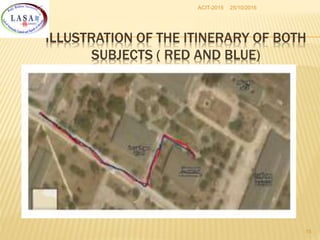
 In the experiment, we selected two students
from our department, first subject is a girl of
age 22 and the second is a boy of age 23
years. The selected path has a distance of
187 meters and four decision points in the
following order: turn left, turn right, turn right
and stop.
25/10/2016ACIT-2015
14
PROGRAMMED AND REGISTERED ITINERARY
FOR TEST BY TWO STUDENT SUBJECTS.
25/10/2016ACIT-2015
15
ILLUSTRATION OF THE ITINERARY OF BOTH
SUBJECTS ( RED AND BLUE)
25/10/2016ACIT-2015
16
DISCUSSION
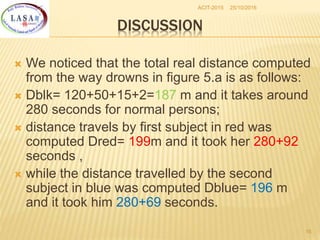
 We noticed that the total real distance computed
from the way drowns in figure 5.a is as follows:
 Dblk= 120+50+15+2=187 m and it takes around
280 seconds for normal persons;
 distance travels by first subject in red was
computed Dred= 199m and it took her 280+92
seconds ,
 while the distance travelled by the second
subject in blue was computed Dblue= 196 m
and it took him 280+69 seconds.
25/10/2016ACIT-2015
17
CONCLUSIONS AND PERSPECTIVES
 The designed navigation system has been developed in
order to enhance the independent mobility of blind
individuals, and thus improve the quality of their
everyday lives. The use of the footswitch is highly
advantageous because without it, drift errors due to the
accelerometer and double integration would be
considerably greater in magnitude and would reduce the
effective range of the electronic travel aid.
 More tests are in progress to improve the system
regarding speech synthesis words. More new efficient
sensors can be added such as compass or even explore
the sensors and applications within smart phones.
 The global positioning system (GPS) [29] will be
employed to get the user position information. Further
research is required to determine the utility of this aid.
25/10/2016ACIT-2015
18
Thank You for
your Attention

Acit15 376

  • 1.
    EMBEDDING VOICE SYNTHESIZERAS ASSISTANCE NAVIGATION SYSTEM FOR VISUALLY IMPAIRED PERSONS Mohamed Fezari, Rachid Sammouda, and Salah Bensaoula BADJI Mokhtar Annaba University , ALGERIA Computer Science Department, King Saud University, Saudi Arabia
  • 2.
    25/10/2016ACIT-2015 2 INTRODUCTION  In thisresearch work we describe the design of an assistance navigation system for Visually-Impaired and Blind Persons.  It is based on a new type of microcontroller with synthesizer speech module VR-Stamp.  The system is a portable, self-contained that will allow blind and visually impaired individuals to travel through familiar and unfamiliar routes without the assistance
  • 3.
    25/10/2016ACIT-2015 3 INTRODUCTION  A varietyof high-tech devices, using different types of range finders are available in the market and have been widely used too, but they are discarded on the basis of cost and other factors. Some of the old devices are: Nottingham Obstacle Detector, (NOD) [2], Binaural Sonic Aid (Sonic guide) [3], Guide Cane [4], Mowat Sensor [4], C-5 Laser cane [5]. Advancement in technology has resulted in developing the old devices into new ones with additional features.
  • 4.
    25/10/2016ACIT-2015 4 CONSIDERATIONS IN THEDESIGN  The blind is not able to see the display panel, control buttons, or labels. Hence the device should be easy to control: No complex control buttons, switches and display panel should be present. Moreover, the ETA device should be low-price to be used by more blind persons.  Our system is developed for portable (small size and lightweight), inexpensive and easy to use, and low-power consumption (supplied by battery).
  • 5.
  • 6.
    25/10/2016ACIT-2015 6 MAIN COMPONENTS ANDSYSTEM PRESENTATION  This assistance system is based on the new type of microcontroller based on Atmega1280 as a main processor, an accelerometer, a footswitch, a speech synthesizer based on speech processor VR-Stamp, a bray hexadecimal keypad, a mode switch, four ultrasonic sensors, a pair of transmitter-receiver, a power switch and a glasses.  The obstacle detection part of the system contains four ultrasonic’s transmitter-receiver. One pair of these ultrasonic sensors is mounted on glasses and connected to a Bluetooth module for wireless transmission of the distance measured by the smart ultrasonic sensor .
  • 7.
  • 8.
  • 9.
    25/10/2016ACIT-2015 9 SPEECH SYNTHESIZER VR-STAMP Voice Recognition Stamp [26] is a new component from Sensory inc. It has more capabilities designed for embedded systems. It was designed for consumer telephony products and cost-sensitive consumer electronic applications such as home electronics, personal security, and personal communication because of its performances:  - Noise-robust Speaker Independent (SI) and Speaker Dependent (SD) recognition.  - High quality, 2.4-7.8 kbps speech synthesis &  - Speaker Verification Word Spot (SVWS) -Noise robust voice biometric security.
  • 10.
  • 11.
  • 12.
  • 13.
    25/10/2016ACIT-2015 13 EXPERIMENTS AND TESTS In the experiment, we selected two students from our department, first subject is a girl of age 22 and the second is a boy of age 23 years. The selected path has a distance of 187 meters and four decision points in the following order: turn left, turn right, turn right and stop.
  • 14.
    25/10/2016ACIT-2015 14 PROGRAMMED AND REGISTEREDITINERARY FOR TEST BY TWO STUDENT SUBJECTS.
  • 15.
    25/10/2016ACIT-2015 15 ILLUSTRATION OF THEITINERARY OF BOTH SUBJECTS ( RED AND BLUE)
  • 16.
    25/10/2016ACIT-2015 16 DISCUSSION  We noticedthat the total real distance computed from the way drowns in figure 5.a is as follows:  Dblk= 120+50+15+2=187 m and it takes around 280 seconds for normal persons;  distance travels by first subject in red was computed Dred= 199m and it took her 280+92 seconds ,  while the distance travelled by the second subject in blue was computed Dblue= 196 m and it took him 280+69 seconds.
  • 17.
    25/10/2016ACIT-2015 17 CONCLUSIONS AND PERSPECTIVES The designed navigation system has been developed in order to enhance the independent mobility of blind individuals, and thus improve the quality of their everyday lives. The use of the footswitch is highly advantageous because without it, drift errors due to the accelerometer and double integration would be considerably greater in magnitude and would reduce the effective range of the electronic travel aid.  More tests are in progress to improve the system regarding speech synthesis words. More new efficient sensors can be added such as compass or even explore the sensors and applications within smart phones.  The global positioning system (GPS) [29] will be employed to get the user position information. Further research is required to determine the utility of this aid.
  • 18.