CHAPTER 4 :
WHAT BOOKS AND
BURIALS TELL US
by Shanel Andria
D’Souza
Indian Literary Sources
• Religious in nature.
• The Puranic and Epic
literature are considered as
history by Indians, but it
contains no definite dates for
events and kingdoms.
• The effort of history writing
was shown by a large number of
inscriptions, coins, and local chronicles.
• Literary and Archaeological records are the two main categories
that give evidences of Ancient Indian History.
The Vedic literature is in a different language as the Vedic
language.
Includes literature of Vedic, Sanskrit, Pali, Prakrit, and other
literature along with foreign accounts.
 Vocabulary contains a wide range of meaning and is
different in grammatical usages.
Mode of pronunciation in which emphasis changes the
meaning entirely.
 Does not reveal the political history.
The Archaeological source includes epigraphic,
numismatic, and other architectural remains.
The Archaeological explorations and excavations have
opened the great landscapes of new information.
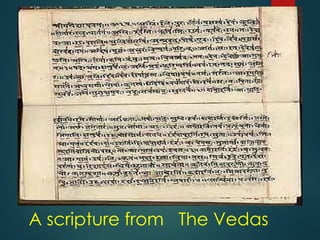
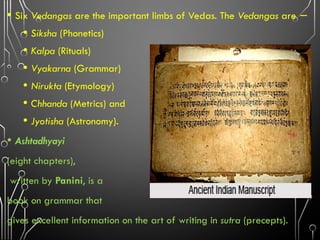
A scripture from The Vedas
• Six Vedangas are the important limbs of Vedas. The Vedangas are −
• Siksha (Phonetics)
• Kalpa (Rituals)
• Vyakarna (Grammar)
• Nirukta (Etymology)
• Chhanda (Metrics) and
• Jyotisha (Astronomy).
• Ashtadhyayi
(eight chapters),
written by Panini, is a
book on grammar that
gives excellent information on the art of writing in sutra (precepts).
 Vedic literature includes the
Brahmanas, the Aranyakas, and
the Upanishads.
 The Jain and the Buddhist
literature- written
in Prakrit and Pali languages.
 The Ramayana and
the Mahabharata are epics of
great historical importance.
 Prakrit language - form of Sanskrit language.
 Pali language – form of Prakrit language which was
used in Magadha.
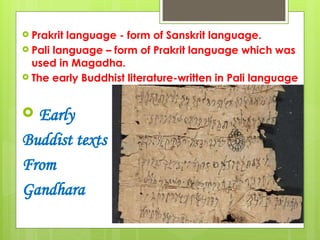
 The early Buddhist literature-written in Pali language
 Early
Buddist texts
From
Gandhara
Ancient Books
 The historic information mentioned in Jaina literature help us in
reconstructing the history of different regions of India.
 The Dharmasutras and the Smritis were the rules and regulations for the
general public and the rulers, Equated with the constitution and the law
books of the modern concept of politics and society. Example
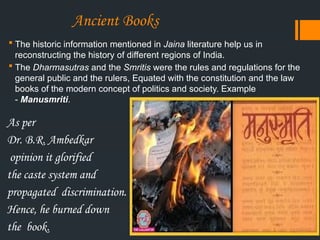
- Manusmriti.
As per
Dr. B.R. Ambedkar
opinion it glorified
the caste system and
propagated discrimination.
Hence, he burned down
the book.
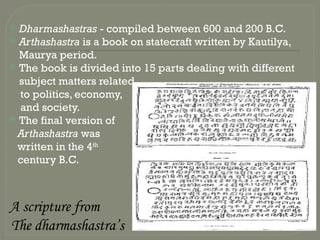
 Dharmashastras - compiled between 600 and 200 B.C.
 Arthashastra is a book on statecraft written by Kautilya,
Maurya period.
 The book is divided into 15 parts dealing with different
subject matters related
to politics, economy,
and society.
 The final version of
Arthashastra was
written in the 4th
century B.C.
A scripture from
The dharmashastra’s
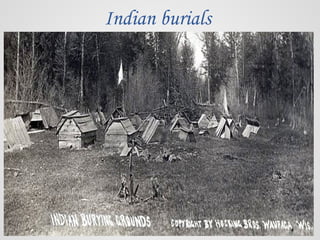
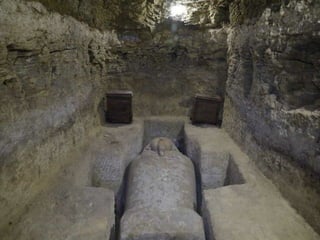
Indian burials
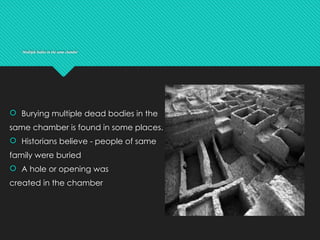
Multiple bodies in the same chamber
 Burying multiple dead bodies in the
same chamber is found in some places.
 Historians believe - people of same
family were buried
 A hole or opening was
created in the chamber
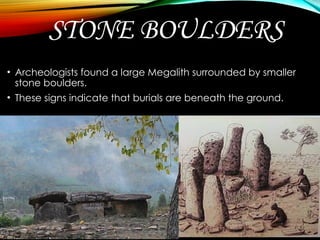
STONE BOULDERS
• Archeologists found a large Megalith surrounded by smaller
stone boulders.
• These signs indicate that burials are beneath the ground.
Inamgaon and its significance in studying burials
• In Maharashtra, a village of the post-Harappan period
was found.
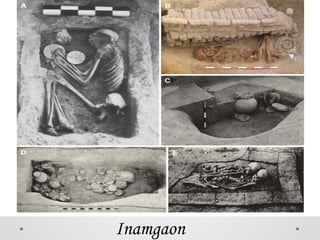
• When excavated, the pits were found of people buried
after their death.
• Vessels with food and water were kept beside the body.
• These practices at Inamgaon - strange facts to the
Archeologists.
• These burial sites were strangely found either inside or
outside the verandah of the house. Megaliths i.e. huge
rocks were used to mark burials of Inamgaon as well.
Inamgaon
Special burials at Inamgaon
•Some burial practices were considered to be
special because of the tomb-like vessels
used to bury the dead.
•Burials that are at least 2000 to 3600 years
old.
•A special burial - where a male skeleton was
enclosed in a huge clay jar.
•It consisted of 4 legs that helped the body to
rest in a sleeping position.
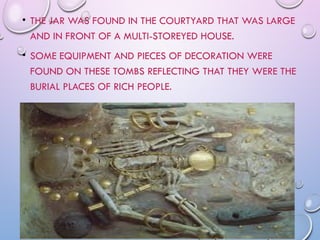
• THE JAR WAS FOUND IN THE COURTYARD THAT WAS LARGE
AND IN FRONT OF A MULTI-STOREYED HOUSE.
• SOME EQUIPMENT AND PIECES OF DECORATION WERE
FOUND ON THESE TOMBS REFLECTING THAT THEY WERE THE
BURIAL PLACES OF RICH PEOPLE.
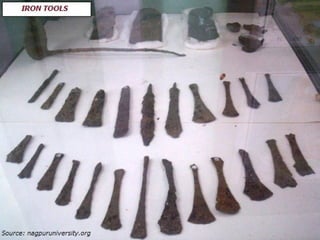
Tools used by the people
 Archaeologists have found Stone Age tools 25,000-
50,000 year-old all over the world.
 The most common are daggers and spear points for
hunting, hand axes and choppers for cutting up
meat and scrapers for cleaning animal hides.
 Other tools were used to dig roots, peel bark and
remove the skins of animals.
 Splinters of bones were used as needles and
fishhooks.
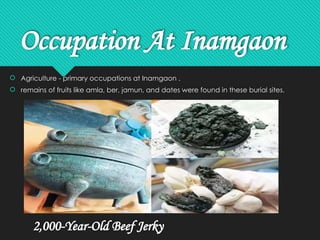
Occupation At Inamgaon
 Agriculture - primary occupations at Inamgaon .
 remains of fruits like amla, ber, jamun, and dates were found in these burial sites.
2,000-Year-Old Beef Jerky
ANIMALS FOUND AT INAMGAON
Below Animals were found in Inamgaon’s burial sites.
• Aquatic Animals – Crabs, fishes, turtles, and
crocodiles.
• Terrestrial Animals – Evidence of cattle, horse, dog,
sheep, donkey, buffalo, goat, antelope, mongoose,
black bug, spotted deer, sambhar, pig, and hare.
• People also consumed animal flesh as food as marks
of cutting tools have been found on the animal
bones.
 As the burials were ancient, the
skeletons were quite decomposed
and archeologists had to study them
minutely.
 It was concluded that skeletons with
prominent hips were those of women
and regular hips were of men.
Differentiation between male and female skeletons
CONCLUSION
About Books –
 AI-Biruni gave important information about India. He was Arab scholar
and contemporary of Mahmud of Ghazni.
 AI-Biruni studied Sanskrit and acquired knowledge of Indian society and
culture through literature. Therefore, his observations are based on his
knowledge about Indian society and culture, but he did not give any
political information of his times.
About Inamgoan –
Inamgaon Settlement – The village of Inamgaon is considered to be at least
3600 years old. It means that this settlement started around the same
period when Rigveda was composed.
End of Inamgaon – The settlement of the Inamgaon was subsequently ended
some 2700 years ago around 700 B.C.
Chapter 4 Social Science class 5 lesson.pptx

Chapter 4 Social Science class 5 lesson.pptx

  • 1.
    CHAPTER 4 : WHATBOOKS AND BURIALS TELL US by Shanel Andria D’Souza
  • 2.
    Indian Literary Sources •Religious in nature. • The Puranic and Epic literature are considered as history by Indians, but it contains no definite dates for events and kingdoms. • The effort of history writing was shown by a large number of inscriptions, coins, and local chronicles. • Literary and Archaeological records are the two main categories that give evidences of Ancient Indian History.
  • 3.
    The Vedic literatureis in a different language as the Vedic language. Includes literature of Vedic, Sanskrit, Pali, Prakrit, and other literature along with foreign accounts.  Vocabulary contains a wide range of meaning and is different in grammatical usages. Mode of pronunciation in which emphasis changes the meaning entirely.  Does not reveal the political history. The Archaeological source includes epigraphic, numismatic, and other architectural remains. The Archaeological explorations and excavations have opened the great landscapes of new information.
  • 4.
  • 5.
    • Six Vedangasare the important limbs of Vedas. The Vedangas are − • Siksha (Phonetics) • Kalpa (Rituals) • Vyakarna (Grammar) • Nirukta (Etymology) • Chhanda (Metrics) and • Jyotisha (Astronomy). • Ashtadhyayi (eight chapters), written by Panini, is a book on grammar that gives excellent information on the art of writing in sutra (precepts).
  • 6.
     Vedic literatureincludes the Brahmanas, the Aranyakas, and the Upanishads.  The Jain and the Buddhist literature- written in Prakrit and Pali languages.  The Ramayana and the Mahabharata are epics of great historical importance.
  • 7.
     Prakrit language- form of Sanskrit language.  Pali language – form of Prakrit language which was used in Magadha.  The early Buddhist literature-written in Pali language  Early Buddist texts From Gandhara
  • 8.
    Ancient Books  Thehistoric information mentioned in Jaina literature help us in reconstructing the history of different regions of India.  The Dharmasutras and the Smritis were the rules and regulations for the general public and the rulers, Equated with the constitution and the law books of the modern concept of politics and society. Example - Manusmriti. As per Dr. B.R. Ambedkar opinion it glorified the caste system and propagated discrimination. Hence, he burned down the book.
  • 9.
     Dharmashastras -compiled between 600 and 200 B.C.  Arthashastra is a book on statecraft written by Kautilya, Maurya period.  The book is divided into 15 parts dealing with different subject matters related to politics, economy, and society.  The final version of Arthashastra was written in the 4th century B.C. A scripture from The dharmashastra’s
  • 10.
  • 11.
    Multiple bodies inthe same chamber  Burying multiple dead bodies in the same chamber is found in some places.  Historians believe - people of same family were buried  A hole or opening was created in the chamber
  • 12.
    STONE BOULDERS • Archeologistsfound a large Megalith surrounded by smaller stone boulders. • These signs indicate that burials are beneath the ground.
  • 13.
    Inamgaon and itssignificance in studying burials • In Maharashtra, a village of the post-Harappan period was found. • When excavated, the pits were found of people buried after their death. • Vessels with food and water were kept beside the body. • These practices at Inamgaon - strange facts to the Archeologists. • These burial sites were strangely found either inside or outside the verandah of the house. Megaliths i.e. huge rocks were used to mark burials of Inamgaon as well.
  • 14.
  • 15.
    Special burials atInamgaon •Some burial practices were considered to be special because of the tomb-like vessels used to bury the dead. •Burials that are at least 2000 to 3600 years old. •A special burial - where a male skeleton was enclosed in a huge clay jar. •It consisted of 4 legs that helped the body to rest in a sleeping position.
  • 17.
    • THE JARWAS FOUND IN THE COURTYARD THAT WAS LARGE AND IN FRONT OF A MULTI-STOREYED HOUSE. • SOME EQUIPMENT AND PIECES OF DECORATION WERE FOUND ON THESE TOMBS REFLECTING THAT THEY WERE THE BURIAL PLACES OF RICH PEOPLE.
  • 18.
    Tools used bythe people  Archaeologists have found Stone Age tools 25,000- 50,000 year-old all over the world.  The most common are daggers and spear points for hunting, hand axes and choppers for cutting up meat and scrapers for cleaning animal hides.  Other tools were used to dig roots, peel bark and remove the skins of animals.  Splinters of bones were used as needles and fishhooks.
  • 20.
    Occupation At Inamgaon Agriculture - primary occupations at Inamgaon .  remains of fruits like amla, ber, jamun, and dates were found in these burial sites. 2,000-Year-Old Beef Jerky
  • 21.
    ANIMALS FOUND ATINAMGAON Below Animals were found in Inamgaon’s burial sites. • Aquatic Animals – Crabs, fishes, turtles, and crocodiles. • Terrestrial Animals – Evidence of cattle, horse, dog, sheep, donkey, buffalo, goat, antelope, mongoose, black bug, spotted deer, sambhar, pig, and hare. • People also consumed animal flesh as food as marks of cutting tools have been found on the animal bones.
  • 22.
     As theburials were ancient, the skeletons were quite decomposed and archeologists had to study them minutely.  It was concluded that skeletons with prominent hips were those of women and regular hips were of men. Differentiation between male and female skeletons
  • 23.
    CONCLUSION About Books – AI-Biruni gave important information about India. He was Arab scholar and contemporary of Mahmud of Ghazni.  AI-Biruni studied Sanskrit and acquired knowledge of Indian society and culture through literature. Therefore, his observations are based on his knowledge about Indian society and culture, but he did not give any political information of his times. About Inamgoan – Inamgaon Settlement – The village of Inamgaon is considered to be at least 3600 years old. It means that this settlement started around the same period when Rigveda was composed. End of Inamgaon – The settlement of the Inamgaon was subsequently ended some 2700 years ago around 700 B.C.