MADE BY :- NARENDRA KUMAR
K.V.LKO CANN”T LUCKNOW
 Acids: the words ‘acids’ has been derived
from a latin words ‘acidus’ which means
‘sour’. Thus,all sour substance essentially
contain acids.hence acids are chemical
substance which have sour taste and turn
neutral litmus solution (sol.in distilled water
which is purple in colour) into red you may
have test same food like fruits, that tests
sour. Other examples are unripe grapes,
curd vinegar, tranmind and lemon- all contain
acids.
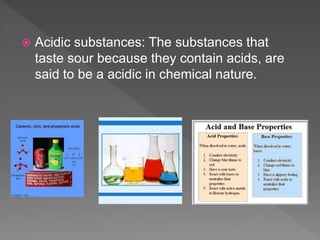
 Acidic substances: The substances that
taste sour because they contain acids, are
said to be a acidic in chemical nature.
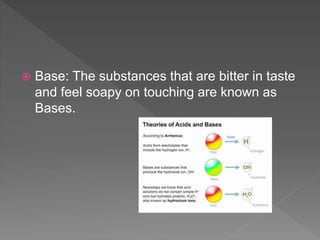
 Base: The substances that are bitter in taste
and feel soapy on touching are known as
Bases.
 Basic substances: The nature of substances
which are bitter in taste and soapy in touch is
said to be basic in nature.
 Indicator: The complex naturally occuring
substances which change their colour on
coming in contact with other substances are
called indicators. For example, turmeric is an
indicator. Some more examples of naturally
occuring indicators are litmus, turmeric,
china rose petals (Gudhal). Indicators show
different colours in acidic, basic and neutral
solutions.
 Neutral substances: Substances which are
neither acidic nor basic are called neutral
substances.
 Neutralisation: The reaction between an acid
and a base is known as neutralisation. In the
process of neutralisation, salt and water are
produced with the evolution of heat.
 Acid + Base → Salt + Water ( Heat is
evolved) For example: Hydrolchloric acid
(HCl)- Acid + Sodium hydroxide (NaOH)-
Base → Sodium chloride (NaCl) – Salt +
Water (H2O)
 Salt: The product formed ( a new substance)
by neutralisation reaction between an acid
and a base is called salt.
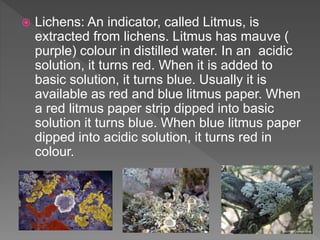
 Lichens: An indicator, called Litmus, is
extracted from lichens. Litmus has mauve (
purple) colour in distilled water. In an acidic
solution, it turns red. When it is added to
basic solution, it turns blue. Usually it is
available as red and blue litmus paper. When
a red litmus paper strip dipped into basic
solution it turns blue. When blue litmus paper
dipped into acidic solution, it turns red in
colour.
 Some of neutral acid – basic indicators are-
 i) Turmeric: It turns from yellow to red in
alkaline (basic) solution.
 ii) China rose petal solution turns dark pink
(magenta) in acidic solution and green in
basic solution.
 Synthetic Indicator: Phenolphthalein and
methyl orange are some examples of
chemicals which act as acid-base indicators.
For example, phenolphthalein solution
becomes colourless in acidic medium. When
the medium is basic, it turns pink in colour.
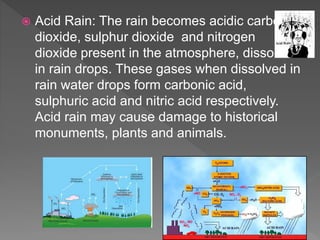
 Acid Rain: The rain becomes acidic carbon
dioxide, sulphur dioxide and nitrogen
dioxide present in the atmosphere, dissolve
in rain drops. These gases when dissolved in
rain water drops form carbonic acid,
sulphuric acid and nitric acid respectively.
Acid rain may cause damage to historical
monuments, plants and animals.
 Ant sting: The ant sting contains formic
acidic which when injected into the skin
causes pain and irritation. By applying moist
baking soda the effect of the sting can be
netralised.
 Antacid: Antacid are substances which are
used to neutralise excessive acid release in
our stomach. Milk of magnesia is an antacid
which contains magnesium hydroxide.

Acids ,base and salts

  • 1.
    MADE BY :-NARENDRA KUMAR K.V.LKO CANN”T LUCKNOW
  • 2.
     Acids: thewords ‘acids’ has been derived from a latin words ‘acidus’ which means ‘sour’. Thus,all sour substance essentially contain acids.hence acids are chemical substance which have sour taste and turn neutral litmus solution (sol.in distilled water which is purple in colour) into red you may have test same food like fruits, that tests sour. Other examples are unripe grapes, curd vinegar, tranmind and lemon- all contain acids.
  • 3.
     Acidic substances:The substances that taste sour because they contain acids, are said to be a acidic in chemical nature.
  • 4.
     Base: Thesubstances that are bitter in taste and feel soapy on touching are known as Bases.
  • 5.
     Basic substances:The nature of substances which are bitter in taste and soapy in touch is said to be basic in nature.
  • 6.
     Indicator: Thecomplex naturally occuring substances which change their colour on coming in contact with other substances are called indicators. For example, turmeric is an indicator. Some more examples of naturally occuring indicators are litmus, turmeric, china rose petals (Gudhal). Indicators show different colours in acidic, basic and neutral solutions.
  • 7.
     Neutral substances:Substances which are neither acidic nor basic are called neutral substances.
  • 8.
     Neutralisation: Thereaction between an acid and a base is known as neutralisation. In the process of neutralisation, salt and water are produced with the evolution of heat.  Acid + Base → Salt + Water ( Heat is evolved) For example: Hydrolchloric acid (HCl)- Acid + Sodium hydroxide (NaOH)- Base → Sodium chloride (NaCl) – Salt + Water (H2O)
  • 9.
     Salt: Theproduct formed ( a new substance) by neutralisation reaction between an acid and a base is called salt.
  • 10.
     Lichens: Anindicator, called Litmus, is extracted from lichens. Litmus has mauve ( purple) colour in distilled water. In an acidic solution, it turns red. When it is added to basic solution, it turns blue. Usually it is available as red and blue litmus paper. When a red litmus paper strip dipped into basic solution it turns blue. When blue litmus paper dipped into acidic solution, it turns red in colour.
  • 11.
     Some ofneutral acid – basic indicators are-  i) Turmeric: It turns from yellow to red in alkaline (basic) solution.  ii) China rose petal solution turns dark pink (magenta) in acidic solution and green in basic solution.
  • 12.
     Synthetic Indicator:Phenolphthalein and methyl orange are some examples of chemicals which act as acid-base indicators. For example, phenolphthalein solution becomes colourless in acidic medium. When the medium is basic, it turns pink in colour.
  • 13.
     Acid Rain:The rain becomes acidic carbon dioxide, sulphur dioxide and nitrogen dioxide present in the atmosphere, dissolve in rain drops. These gases when dissolved in rain water drops form carbonic acid, sulphuric acid and nitric acid respectively. Acid rain may cause damage to historical monuments, plants and animals.
  • 14.
     Ant sting:The ant sting contains formic acidic which when injected into the skin causes pain and irritation. By applying moist baking soda the effect of the sting can be netralised.
  • 15.
     Antacid: Antacidare substances which are used to neutralise excessive acid release in our stomach. Milk of magnesia is an antacid which contains magnesium hydroxide.