Antihistaminic Agent Medicinal Chemistry t.Y. B. Pharm
Histamine is an organic nitrogenous compound that sends messages between cells throughout the body.
It was first Identified by Barger and Dale in 1910 from plant fungus ergot and later in animal tissues (in 1911).
In 20th century, Dale studied the allergic response of histamine.
Antihistaminic agents
Histamine-
Histamineis an organic nitrogenous compound that sends messages between
cells throughout the body.
It was first Identified by Barger and Dale in 1910 from plant fungus ergot and
later in animal tissues (in 1911).
In 20th century, Dale studied the allergic response of histamine.
Histamine is an amine derivative autacoid also known as tissue amine, found
in human, animals, and plants (Stinging Nettle) It is mainly stored in storage
granules of the mast cells of skin, GI mucosa, lungs, liver, placenta (*slow
turnover – synthesis and metabolism are slow), and in non-mast cells of
neurons, epidermis, and vascular endothelial cells (*fast turnover – synthesis
and metabolism are rapid).
3.
Antihistaminic agents
Histamine-
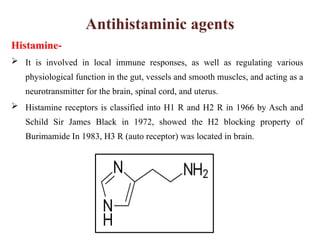
Itis involved in local immune responses, as well as regulating various
physiological function in the gut, vessels and smooth muscles, and acting as a
neurotransmitter for the brain, spinal cord, and uterus.
Histamine receptors is classified into H1 R and H2 R in 1966 by Asch and
Schild Sir James Black in 1972, showed the H2 blocking property of
Burimamide In 1983, H3 R (auto receptor) was located in brain.
4.
Antihistaminic agents
Classification ofHistamine Receptors:
H1 R: Inflammatory and Immune Response
H2 R: Gastric Acid Secretions
H3 R: Auto-receptor
H4 R: Auto-receptor
Physiological/Pharmacological Function
By H1-receptor
Allergic & immunogenic Reaction
Contract the large vessels by IP3/DAG pathway and Dilation of small blood
vessels by EDRF (NO)- dependent action
Smooth muscle contraction
Bronchoconstriction
Release the catecholamines
Neurotramsmi
5.
Antihistaminic agents
Physiological/Pharmacological Function
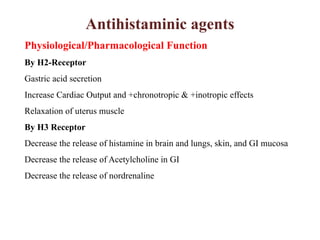
ByH2-Receptor
Gastric acid secretion
Increase Cardiac Output and +chronotropic & +inotropic effects
Relaxation of uterus muscle
By H3 Receptor
Decrease the release of histamine in brain and lungs, skin, and GI mucosa
Decrease the release of Acetylcholine in GI
Decrease the release of nordrenaline
6.
Antihistaminic agents
Biosynthesis &Metabolism
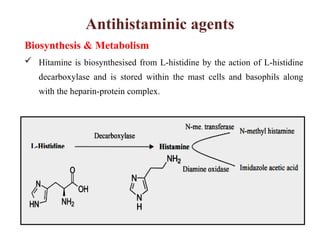
Hitamine is biosynthesised from L-histidine by the action of L-histidine
decarboxylase and is stored within the mast cells and basophils along
with the heparin-protein complex.
7.
Antihistaminic agents
ANTIHISTAMINES
Theseare the drugs which diminish or antagonize the actions of
endogenously released histamine in the body (they do not
prevent the formation of histamine).
Antihistamines are generally antagonists of H1 receptor.
These are used for the treatment of allergy and pruritis.
Antagonists of H2 receptor are used to inhibit gastric acid
secretion (treatment of peptic ulcer), however, antagonists of H3
receptor are not used therapeutically.
8.
Antihistaminic agents
Classificationof Antihistamines (H1R-Blocker)
A) Based on Sedative Action
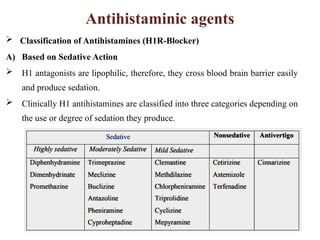
H1 antagonists are lipophilic, therefore, they cross blood brain barrier easily
and produce sedation.
Clinically H1 antihistamines are classified into three categories depending on
the use or degree of sedation they produce.
9.
Antihistaminic agents
Classificationof Antihistamines (H1R-Blocker)
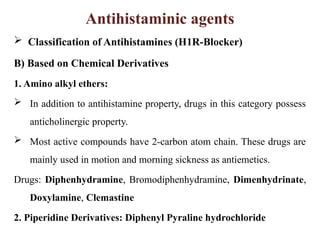
B) Based on Chemical Derivatives
1. Amino alkyl ethers:
In addition to antihistamine property, drugs in this category possess
anticholinergic property.
Most active compounds have 2-carbon atom chain. These drugs are
mainly used in motion and morning sickness as antiemetics.
Drugs: Diphenhydramine, Bromodiphenhydramine, Dimenhydrinate,
Doxylamine, Clemastine
2. Piperidine Derivatives: Diphenyl Pyraline hydrochloride
10.
Antihistaminic agents
Classificationof Antihistamines (H1R-Blocker)
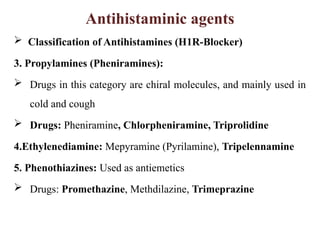
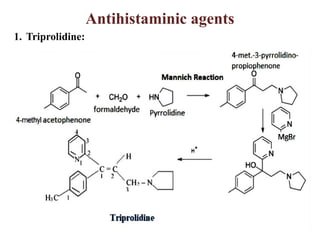
3. Propylamines (Pheniramines):
Drugs in this category are chiral molecules, and mainly used in
cold and cough
Drugs: Pheniramine, Chlorpheniramine, Triprolidine
4.Ethylenediamine: Mepyramine (Pyrilamine), Tripelennamine
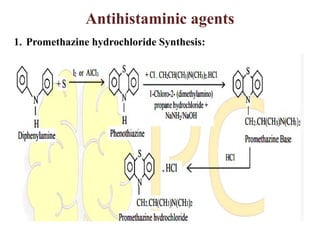
5. Phenothiazines: Used as antiemetics
Drugs: Promethazine, Methdilazine, Trimeprazine
Antihistaminic agents
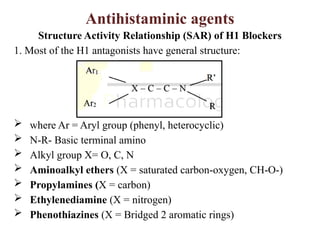
Structure ActivityRelationship (SAR) of H1 Blockers
1. Most of the H1 antagonists have general structure:
where Ar = Aryl group (phenyl, heterocyclic)
N-R- Basic terminal amino
Alkyl group X= O, C, N
Aminoalkyl ethers (X = saturated carbon-oxygen, CH-O-)
Propylamines (X = carbon)
Ethylenediamine (X = nitrogen)
Phenothiazines (X = Bridged 2 aromatic rings)
13.
Antihistaminic agents
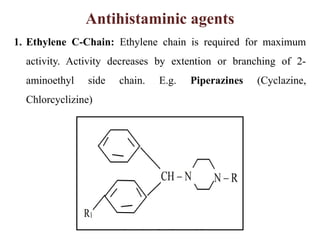
1. EthyleneC-Chain: Ethylene chain is required for maximum
activity. Activity decreases by extention or branching of 2-
aminoethyl side chain. E.g. Piperazines (Cyclazine,
Chlorcyclizine)
14.
Antihistaminic agents
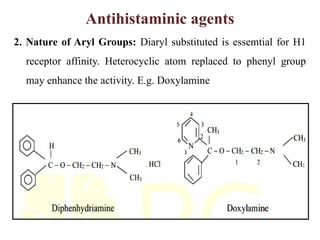
2. Natureof Aryl Groups: Diaryl substituted is essemtial for H1
receptor affinity. Heterocyclic atom replaced to phenyl group
may enhance the activity. E.g. Doxylamine
15.
Antihistaminic agents
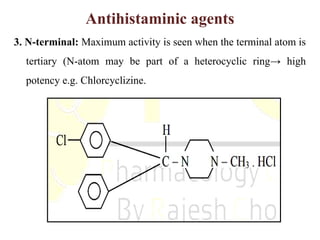
3. N-terminal:Maximum activity is seen when the terminal atom is
tertiary (N-atom may be part of a heterocyclic ring→ high
potency e.g. Chlorcyclizine.