ACHONDROGENESI
S
Arish Ayub
American University of Barbados
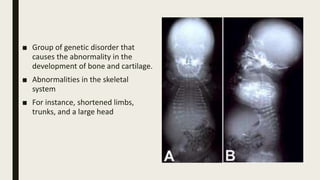
■ Group of genetic disorder that
causes the abnormality in the
development of bone and cartilage.
■ Abnormalities in the skeletal
system
■ For instance, shortened limbs,
trunks, and a large head
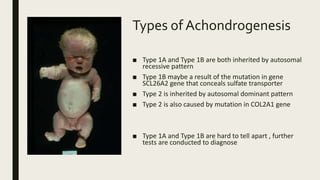
Types of Achondrogenesis
■ Type 1A and Type 1B are both inherited by autosomal
recessive pattern
■ Type 1B maybe a result of the mutation in gene
SCL26A2 gene that conceals sulfate transporter
■ Type 2 is inherited by autosomal dominant pattern
■ Type 2 is also caused by mutation in COL2A1 gene
■ Type 1A and Type 1B are hard to tell apart , further
tests are conducted to diagnose
■ Type 1 A is caused by a defect in the microtubules of the Golgi apparatus
■ GMAP-210 moves proteins from the endoplasmic reticulum to the Golgi apparatus.
Due to the defect from mutation, GMAP-210 is no longer able to move the proteins,
which causes the proteins to gather up and swell in the endoplasmic reticulum
■ the loss of Golgi apparatus function affects some cells, such as those responsible for
forming bone and cartilage, more than others.
Statistics
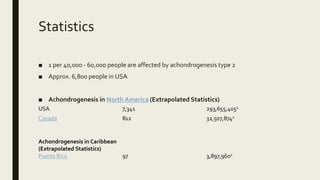
■ 1 per 40,000 - 60,000 people are affected by achondrogenesis type 2
■ Approx. 6,800 people in USA
■ Achondrogenesis in North America (Extrapolated Statistics)
USA 7,341 293,655,4051
Canada 812 32,507,8742
Achondrogenesis in Caribbean
(Extrapolated Statistics)
Puerto Rico 97 3,897,9602
Studies
■ A study done by Godfrey, M., & Hollister, D.W. (1988, December) analyzed the collagen
and bone produced by dermal fibroblast on those who have a mild case of type 2
achondrogenesis.
■ Showed thatType I collagen taken from bone and types I and III collagen produced by
dermal fibroblasts were normal
■ Hyaline cartilage had about equal amounts of types I and II collagen. All type II cyanogen
bromide peptides with heterozygosity for an abnormal pro alpha 1(II) chain that impaired
folding of type II collagen.
■ Showed that the dominant mutations of the COL2A1 gene may cause type II
achondrogenesis-hypochondrogenesis. Leading to different appearance
■ Godfrey, M., & Hollister, D.W. (1988, December). Retrieved from
https://www.ncbi.nlm.nih.gov/pmc/articles/PMC1715608/
Type 1A (Houston-HarrisType)
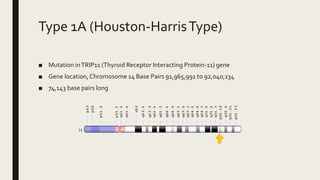
■ Mutation inTRIP11 (Thyroid Receptor Interacting Protein-11) gene
■ Gene location,Chromosome 14 Base Pairs 91,965,991 to 92,040,134
■ 74,143 base pairs long
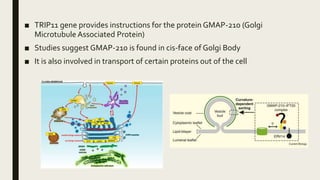
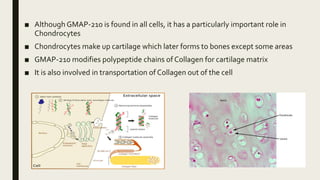
■ TRIP11 gene provides instructions for the protein GMAP-210 (Golgi
Microtubule Associated Protein)
■ Studies suggest GMAP-210 is found in cis-face of Golgi Body
■ It is also involved in transport of certain proteins out of the cell
■ Although GMAP-210 is found in all cells, it has a particularly important role in
Chondrocytes
■ Chondrocytes make up cartilage which later forms to bones except some areas
■ GMAP-210 modifies polypeptide chains of Collagen for cartilage matrix
■ It is also involved in transportation of Collagen out of the cell
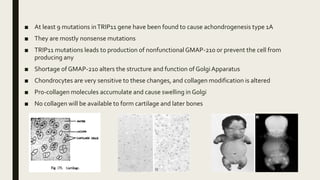
■ At least 9 mutations inTRIP11 gene have been found to cause achondrogenesis type 1A
■ They are mostly nonsense mutations
■ TRIP11 mutations leads to production of nonfunctionalGMAP-210 or prevent the cell from
producing any
■ Shortage of GMAP-210 alters the structure and function of GolgiApparatus
■ Chondrocytes are very sensitive to these changes, and collagen modification is altered
■ Pro-collagen molecules accumulate and cause swelling in Golgi
■ No collagen will be available to form cartilage and later bones
Type 1B (Parenti – FraccaroType)
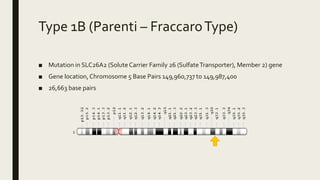
■ Mutation in SLC26A2 (Solute Carrier Family 26 (SulfateTransporter), Member 2) gene
■ Gene location,Chromosome 5 Base Pairs 149,960,737 to 149,987,400
■ 26,663 base pairs
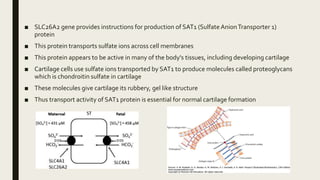
■ SLC26A2 gene provides instructions for production of SAT1 (Sulfate AnionTransporter 1)
protein
■ This protein transports sulfate ions across cell membranes
■ This protein appears to be active in many of the body's tissues, including developing cartilage
■ Cartilage cells use sulfate ions transported by SAT1 to produce molecules called proteoglycans
which is chondroitin sulfate in cartilage
■ These molecules give cartilage its rubbery, gel like structure
■ Thus transport activity of SAT1 protein is essential for normal cartilage formation
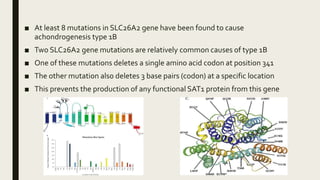
■ At least 8 mutations in SLC26A2 gene have been found to cause
achondrogenesis type 1B
■ Two SLC26A2 gene mutations are relatively common causes of type 1B
■ One of these mutations deletes a single amino acid codon at position 341
■ The other mutation also deletes 3 base pairs (codon) at a specific location
■ This prevents the production of any functional SAT1 protein from this gene
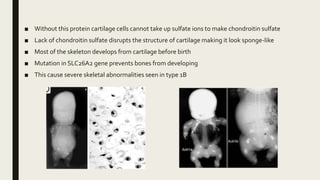
■ Without this protein cartilage cells cannot take up sulfate ions to make chondroitin sulfate
■ Lack of chondroitin sulfate disrupts the structure of cartilage making it look sponge-like
■ Most of the skeleton develops from cartilage before birth
■ Mutation in SLC26A2 gene prevents bones from developing
■ This cause severe skeletal abnormalities seen in type 1B
Type 2 (Langer-SaldinoType)
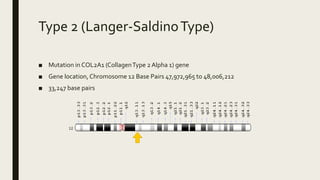
■ Mutation in COL2A1 (CollagenType 2 Alpha 1) gene
■ Gene location,Chromosome 12 Base Pairs 47,972,965 to 48,006,212
■ 33,247 base pairs
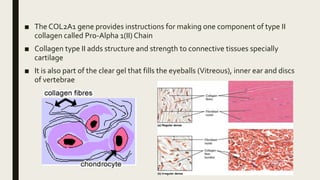
■ The COL2A1 gene provides instructions for making one component of type II
collagen called Pro-Alpha 1(II) Chain
■ Collagen type II adds structure and strength to connective tissues specially
cartilage
■ It is also part of the clear gel that fills the eyeballs (Vitreous), inner ear and discs
of vertebrae
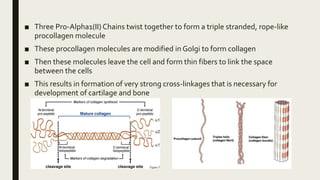
■ Three Pro-Alpha1(II) Chains twist together to form a triple stranded, rope-like
procollagen molecule
■ These procollagen molecules are modified in Golgi to form collagen
■ Then these molecules leave the cell and form thin fibers to link the space
between the cells
■ This results in formation of very strong cross-linkages that is necessary for
development of cartilage and bone
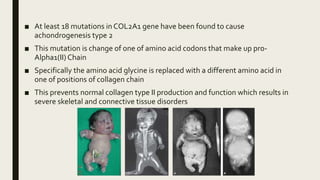
■ At least 18 mutations in COL2A1 gene have been found to cause
achondrogenesis type 2
■ This mutation is change of one of amino acid codons that make up pro-
Alpha1(II) Chain
■ Specifically the amino acid glycine is replaced with a different amino acid in
one of positions of collagen chain
■ This prevents normal collagen type II production and function which results in
severe skeletal and connective tissue disorders
Inheritance
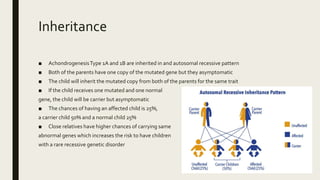
■ AchondrogenesisType 1A and 1B are inherited in and autosomal recessive pattern
■ Both of the parents have one copy of the mutated gene but they asymptomatic
■ The child will inherit the mutated copy from both of the parents for the same trait
■ If the child receives one mutated and one normal
gene, the child will be carrier but asymptomatic
■ The chances of having an affected child is 25%,
a carrier child 50% and a normal child 25%
■ Close relatives have higher chances of carrying same
abnormal genes which increases the risk to have children
with a rare recessive genetic disorder
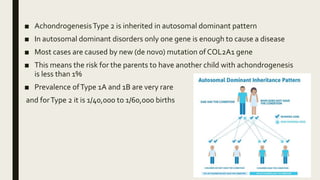
■ AchondrogenesisType 2 is inherited in autosomal dominant pattern
■ In autosomal dominant disorders only one gene is enough to cause a disease
■ Most cases are caused by new (de novo) mutation of COL2A1 gene
■ This means the risk for the parents to have another child with achondrogenesis
is less than 1%
■ Prevalence ofType 1A and 1B are very rare
and forType 2 it is 1/40,000 to 1/60,000 births
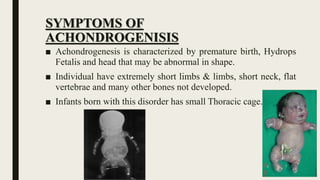
SYMPTOMS OF
ACHONDROGENISIS
■ Achondrogenesis is characterized by premature birth, Hydrops
Fetalis and head that may be abnormal in shape.
■ Individual have extremely short limbs & limbs, short neck, flat
vertebrae and many other bones not developed.
■ Infants born with this disorder has small Thoracic cage.
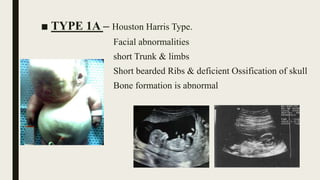
■ TYPE 1A – Houston Harris Type.
Facial abnormalities
short Trunk & limbs
Short bearded Ribs & deficient Ossification of skull
Bone formation is abnormal
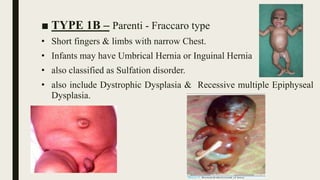
■ TYPE 1B – Parenti - Fraccaro type
• Short fingers & limbs with narrow Chest.
• Infants may have Umbrical Hernia or Inguinal Hernia
• also classified as Sulfation disorder.
• also include Dystrophic Dysplasia & Recessive multiple Epiphyseal
Dysplasia.
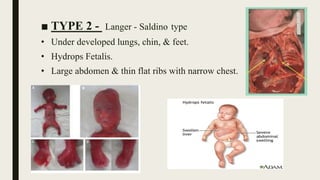
■ TYPE 2 - Langer - Saldino type
• Under developed lungs, chin, & feet.
• Hydrops Fetalis.
• Large abdomen & thin flat ribs with narrow chest.
DIAGANOSIS
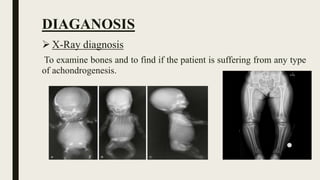
X-Ray diagnosis
To examine bones and to find if the patient is suffering from any type
of achondrogenesis.
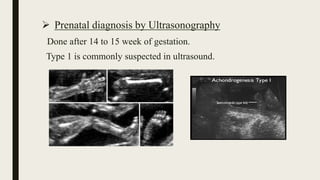
 Prenatal diagnosis by Ultrasonography
Done after 14 to 15 week of gestation.
Type 1 is commonly suspected in ultrasound.
 Prenatal diagnosis by molecular studies
Prenatal diagnosis of achondrogenesis type IB and type II may be
accomplished by mutation analysis of chorionic villus DNA or
amniocyte DNA in the first or second trimester.
TREATMENT
■ Treatment of achondrogenesis is symptomatic and supportive and
involves palliative care, in which physicians attempt to reduce or
minimize pain, stress and specific symptoms associated with the
disorder.
■ Genetic counseling is recommended for families with an affected
child.
■ Psychosocial support for the entire family is essential as well.
ORGANISATIONS
■ European Skeletal Dysplasia Network UK
■ Human Growth Foundation New York
■ MAGIC Foundation USA
■ Restricted Growth Association UK
References
■ Godfrey, M., & Hollister, D.W. (1988, December). Retrieved from
https://www.ncbi.nlm.nih.gov/pmc/articles/PMC1715608
■ AchondrogenesisType 1B. (n.d.). Retrieved from https://www.dovemed.com/diseases-
conditions/achondrogenesis-type-1b/
■ Achondrogenesis type 1A. (n.d.). Retrieved from
https://rarediseases.info.nih.gov/diseases/459/achondrogenesis-type-1a
■ Achondrogenesis - Genetics Home Reference - NIH. (n.d.). Retrieved from
https://ghr.nlm.nih.gov/condition/achondrogenesis
References
■ https://ghr.nlm.nih.gov/condition/achondrogenesis
■ https://rarediseases.info.nih.gov/diseases/2882/achondrogenesis
■ https://rarediseases.org/rare-diseases/achondrogenesis/
■ https://www.healthline.com/health/achondrogenesis
■ https://emedicine.medscape.com/article/941176-overview

Achondrogenenisis

  • 1.
  • 2.
    ■ Group ofgenetic disorder that causes the abnormality in the development of bone and cartilage. ■ Abnormalities in the skeletal system ■ For instance, shortened limbs, trunks, and a large head
  • 3.
    Types of Achondrogenesis ■Type 1A and Type 1B are both inherited by autosomal recessive pattern ■ Type 1B maybe a result of the mutation in gene SCL26A2 gene that conceals sulfate transporter ■ Type 2 is inherited by autosomal dominant pattern ■ Type 2 is also caused by mutation in COL2A1 gene ■ Type 1A and Type 1B are hard to tell apart , further tests are conducted to diagnose
  • 4.
    ■ Type 1A is caused by a defect in the microtubules of the Golgi apparatus ■ GMAP-210 moves proteins from the endoplasmic reticulum to the Golgi apparatus. Due to the defect from mutation, GMAP-210 is no longer able to move the proteins, which causes the proteins to gather up and swell in the endoplasmic reticulum ■ the loss of Golgi apparatus function affects some cells, such as those responsible for forming bone and cartilage, more than others.
  • 5.
    Statistics ■ 1 per40,000 - 60,000 people are affected by achondrogenesis type 2 ■ Approx. 6,800 people in USA ■ Achondrogenesis in North America (Extrapolated Statistics) USA 7,341 293,655,4051 Canada 812 32,507,8742 Achondrogenesis in Caribbean (Extrapolated Statistics) Puerto Rico 97 3,897,9602
  • 6.
    Studies ■ A studydone by Godfrey, M., & Hollister, D.W. (1988, December) analyzed the collagen and bone produced by dermal fibroblast on those who have a mild case of type 2 achondrogenesis. ■ Showed thatType I collagen taken from bone and types I and III collagen produced by dermal fibroblasts were normal ■ Hyaline cartilage had about equal amounts of types I and II collagen. All type II cyanogen bromide peptides with heterozygosity for an abnormal pro alpha 1(II) chain that impaired folding of type II collagen. ■ Showed that the dominant mutations of the COL2A1 gene may cause type II achondrogenesis-hypochondrogenesis. Leading to different appearance ■ Godfrey, M., & Hollister, D.W. (1988, December). Retrieved from https://www.ncbi.nlm.nih.gov/pmc/articles/PMC1715608/
  • 7.
    Type 1A (Houston-HarrisType) ■Mutation inTRIP11 (Thyroid Receptor Interacting Protein-11) gene ■ Gene location,Chromosome 14 Base Pairs 91,965,991 to 92,040,134 ■ 74,143 base pairs long
  • 8.
    ■ TRIP11 geneprovides instructions for the protein GMAP-210 (Golgi Microtubule Associated Protein) ■ Studies suggest GMAP-210 is found in cis-face of Golgi Body ■ It is also involved in transport of certain proteins out of the cell
  • 9.
    ■ Although GMAP-210is found in all cells, it has a particularly important role in Chondrocytes ■ Chondrocytes make up cartilage which later forms to bones except some areas ■ GMAP-210 modifies polypeptide chains of Collagen for cartilage matrix ■ It is also involved in transportation of Collagen out of the cell
  • 10.
    ■ At least9 mutations inTRIP11 gene have been found to cause achondrogenesis type 1A ■ They are mostly nonsense mutations ■ TRIP11 mutations leads to production of nonfunctionalGMAP-210 or prevent the cell from producing any ■ Shortage of GMAP-210 alters the structure and function of GolgiApparatus ■ Chondrocytes are very sensitive to these changes, and collagen modification is altered ■ Pro-collagen molecules accumulate and cause swelling in Golgi ■ No collagen will be available to form cartilage and later bones
  • 11.
    Type 1B (Parenti– FraccaroType) ■ Mutation in SLC26A2 (Solute Carrier Family 26 (SulfateTransporter), Member 2) gene ■ Gene location,Chromosome 5 Base Pairs 149,960,737 to 149,987,400 ■ 26,663 base pairs
  • 12.
    ■ SLC26A2 geneprovides instructions for production of SAT1 (Sulfate AnionTransporter 1) protein ■ This protein transports sulfate ions across cell membranes ■ This protein appears to be active in many of the body's tissues, including developing cartilage ■ Cartilage cells use sulfate ions transported by SAT1 to produce molecules called proteoglycans which is chondroitin sulfate in cartilage ■ These molecules give cartilage its rubbery, gel like structure ■ Thus transport activity of SAT1 protein is essential for normal cartilage formation
  • 13.
    ■ At least8 mutations in SLC26A2 gene have been found to cause achondrogenesis type 1B ■ Two SLC26A2 gene mutations are relatively common causes of type 1B ■ One of these mutations deletes a single amino acid codon at position 341 ■ The other mutation also deletes 3 base pairs (codon) at a specific location ■ This prevents the production of any functional SAT1 protein from this gene
  • 14.
    ■ Without thisprotein cartilage cells cannot take up sulfate ions to make chondroitin sulfate ■ Lack of chondroitin sulfate disrupts the structure of cartilage making it look sponge-like ■ Most of the skeleton develops from cartilage before birth ■ Mutation in SLC26A2 gene prevents bones from developing ■ This cause severe skeletal abnormalities seen in type 1B
  • 15.
    Type 2 (Langer-SaldinoType) ■Mutation in COL2A1 (CollagenType 2 Alpha 1) gene ■ Gene location,Chromosome 12 Base Pairs 47,972,965 to 48,006,212 ■ 33,247 base pairs
  • 16.
    ■ The COL2A1gene provides instructions for making one component of type II collagen called Pro-Alpha 1(II) Chain ■ Collagen type II adds structure and strength to connective tissues specially cartilage ■ It is also part of the clear gel that fills the eyeballs (Vitreous), inner ear and discs of vertebrae
  • 17.
    ■ Three Pro-Alpha1(II)Chains twist together to form a triple stranded, rope-like procollagen molecule ■ These procollagen molecules are modified in Golgi to form collagen ■ Then these molecules leave the cell and form thin fibers to link the space between the cells ■ This results in formation of very strong cross-linkages that is necessary for development of cartilage and bone
  • 18.
    ■ At least18 mutations in COL2A1 gene have been found to cause achondrogenesis type 2 ■ This mutation is change of one of amino acid codons that make up pro- Alpha1(II) Chain ■ Specifically the amino acid glycine is replaced with a different amino acid in one of positions of collagen chain ■ This prevents normal collagen type II production and function which results in severe skeletal and connective tissue disorders
  • 19.
    Inheritance ■ AchondrogenesisType 1Aand 1B are inherited in and autosomal recessive pattern ■ Both of the parents have one copy of the mutated gene but they asymptomatic ■ The child will inherit the mutated copy from both of the parents for the same trait ■ If the child receives one mutated and one normal gene, the child will be carrier but asymptomatic ■ The chances of having an affected child is 25%, a carrier child 50% and a normal child 25% ■ Close relatives have higher chances of carrying same abnormal genes which increases the risk to have children with a rare recessive genetic disorder
  • 20.
    ■ AchondrogenesisType 2is inherited in autosomal dominant pattern ■ In autosomal dominant disorders only one gene is enough to cause a disease ■ Most cases are caused by new (de novo) mutation of COL2A1 gene ■ This means the risk for the parents to have another child with achondrogenesis is less than 1% ■ Prevalence ofType 1A and 1B are very rare and forType 2 it is 1/40,000 to 1/60,000 births
  • 21.
    SYMPTOMS OF ACHONDROGENISIS ■ Achondrogenesisis characterized by premature birth, Hydrops Fetalis and head that may be abnormal in shape. ■ Individual have extremely short limbs & limbs, short neck, flat vertebrae and many other bones not developed. ■ Infants born with this disorder has small Thoracic cage.
  • 22.
    ■ TYPE 1A– Houston Harris Type. Facial abnormalities short Trunk & limbs Short bearded Ribs & deficient Ossification of skull Bone formation is abnormal
  • 23.
    ■ TYPE 1B– Parenti - Fraccaro type • Short fingers & limbs with narrow Chest. • Infants may have Umbrical Hernia or Inguinal Hernia • also classified as Sulfation disorder. • also include Dystrophic Dysplasia & Recessive multiple Epiphyseal Dysplasia.
  • 24.
    ■ TYPE 2- Langer - Saldino type • Under developed lungs, chin, & feet. • Hydrops Fetalis. • Large abdomen & thin flat ribs with narrow chest.
  • 25.
    DIAGANOSIS X-Ray diagnosis To examinebones and to find if the patient is suffering from any type of achondrogenesis.
  • 26.
     Prenatal diagnosisby Ultrasonography Done after 14 to 15 week of gestation. Type 1 is commonly suspected in ultrasound.
  • 27.
     Prenatal diagnosisby molecular studies Prenatal diagnosis of achondrogenesis type IB and type II may be accomplished by mutation analysis of chorionic villus DNA or amniocyte DNA in the first or second trimester.
  • 28.
    TREATMENT ■ Treatment ofachondrogenesis is symptomatic and supportive and involves palliative care, in which physicians attempt to reduce or minimize pain, stress and specific symptoms associated with the disorder. ■ Genetic counseling is recommended for families with an affected child. ■ Psychosocial support for the entire family is essential as well.
  • 29.
    ORGANISATIONS ■ European SkeletalDysplasia Network UK ■ Human Growth Foundation New York ■ MAGIC Foundation USA ■ Restricted Growth Association UK
  • 30.
    References ■ Godfrey, M.,& Hollister, D.W. (1988, December). Retrieved from https://www.ncbi.nlm.nih.gov/pmc/articles/PMC1715608 ■ AchondrogenesisType 1B. (n.d.). Retrieved from https://www.dovemed.com/diseases- conditions/achondrogenesis-type-1b/ ■ Achondrogenesis type 1A. (n.d.). Retrieved from https://rarediseases.info.nih.gov/diseases/459/achondrogenesis-type-1a ■ Achondrogenesis - Genetics Home Reference - NIH. (n.d.). Retrieved from https://ghr.nlm.nih.gov/condition/achondrogenesis
  • 31.
    References ■ https://ghr.nlm.nih.gov/condition/achondrogenesis ■ https://rarediseases.info.nih.gov/diseases/2882/achondrogenesis ■https://rarediseases.org/rare-diseases/achondrogenesis/ ■ https://www.healthline.com/health/achondrogenesis ■ https://emedicine.medscape.com/article/941176-overview