Moving from “Sole
    Proprietorships” to
     “Merchandising
     Corporations!!!”
 Chapter 14:
Accounting for
Sales and Cash
   Receipts
Essential Outcomes

14. Understands the relationship between
  sales, cash sales and sales tax by
  being able to:
   a. Explain the difference between a service
      business & a merchandising business.
   b. Explain the difference between a retailer
      & a wholesaler
   c. Record a variety of sales and cash
      receipt transactions in a general journal
   d. Calculate sales tax, sales discount and
      sales returns & allowances
   e. Define the accounting terms in this
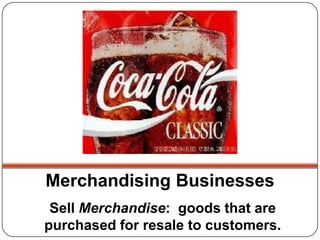
Merchandising Businesses
 Sell Merchandise: goods that are
purchased for resale to customers.
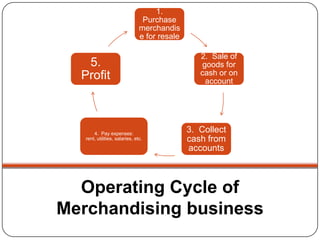
1.
                                 Purchase
                                merchandis
                                e for resale

                                                  2. Sale of
   5.                                             goods for
  Profit                                          cash or on
                                                   account


       4. Pay expenses:
                                               3. Collect
   rent, utilities, salaries, etc.             cash from
                                               accounts


  Operating Cycle of
Merchandising business
New account for Merchandising
               Business:
 Merchandise Inventory:
   Merchandise: goods bought for resale
  Inventory: items of merchandise the business
   has in stock
  Merchandise Inventory Account: inventory is
   represented in the General Ledger as an asset
  Normal Balance: Debit
  Items in the Merchandise Inventory account are
   sold during the year and more items for resale are
   purchased during the year
  Merchandise Inventory ONLY USED when
   recording adjusting entries
New account for Merchandising
              Business:
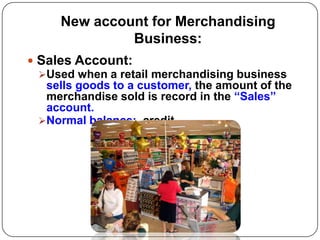
 Sales Account:
  Used when a retail merchandising business
   sells goods to a customer, the amount of the
   merchandise sold is record in the “Sales”
   account.
  Normal balance: credit
Sales Transactions
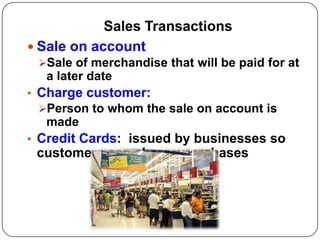
 Sale on account
 Sale of merchandise that will be paid for at
  a later date
• Charge customer:
 Person to whom the sale on account is
  made
• Credit Cards: issued by businesses so
 customers can charge purchases
Sales Slip
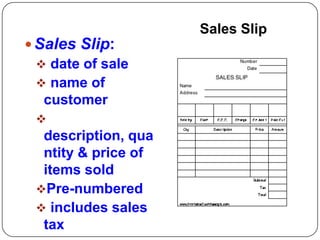
 Sales Slip:
   date of sale
   name of
   customer
 
  description, qua
  ntity & price of
  items sold
 Pre-numbered
  includes sales
  tax
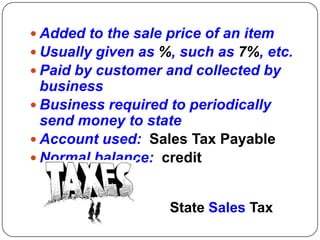
 Added to the sale price of an item
 Usually given as %, such as 7%, etc.
 Paid by customer and collected by
  business
 Business required to periodically
  send money to state
 Account used: Sales Tax Payable
 Normal balance: credit


                    State Sales Tax
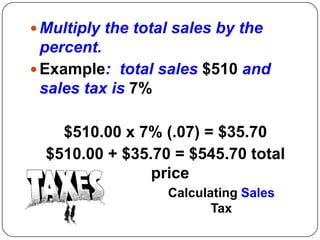
 Multiply the total sales by the
  percent.
 Example: total sales $510 and
  sales tax is 7%

    $510.00 x 7% (.07) = $35.70
  $510.00 + $35.70 = $545.70 total
                price
                   Calculating Sales
                          Tax
Credit Terms

 Credit Terms: state the time allowed
  for payment for customers who
  purchased merchandise on account
 Credit term is: n/30
   “n” stands for net (or total amount of
    the sale) & 30 stands for number of
    days customer has to pay bill
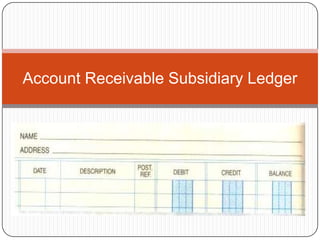
Account Receivable Subsidiary Ledger
Accounts Receivable Subsidiary Ledger


 Businesses that have lots
  of people charging on
  account, set up “accounts
  receivable subsidiary
  ledger”
 A/R subsidiary ledger has
  account forms for “each”
  customer who charges on
  account
Accounts Receivable Subsidiary Ledger

 A/R Subsidiary Ledger is book or ledger
  that provides detailed information for
  each client (not part of General Ledger)
 In General Ledger, have Accounts
  Receivable account that equals total of
  all accounts in A/R subsidiary ledger
 Accounts Receivable is a “controlling
  account”—has a summary of all
  information recorded in the A/R
  Subsidiary Ledger
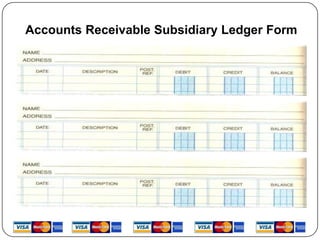
Accounts Receivable Subsidiary Ledger Form
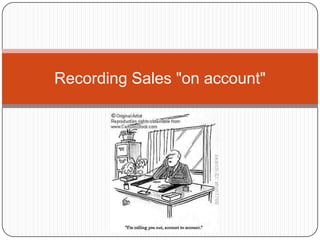
Recording Sales "on account"
Accounts Receivable Subsidiary Ledger

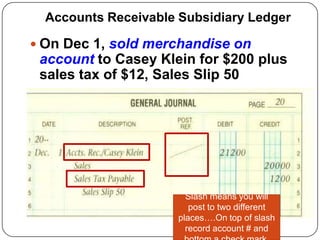
 On Dec 1, sold merchandise on
 account to Casey Klein for $200 plus
 sales tax of $12, Sales Slip 50


                        Slash means you will
                         post to two different
                      places….On top of slash
                        record account # and
Sales Returns & Allowance

 Sales Returns: Customer returns
  merchandise due to wrong size, wrong
  color, defective, etc.—any merchandise
  returned for credit or cash refund
  called sales return.
 Sales Allowance: customer finds
  merchandise or damaged or
  defective, but is still useable, seller
  may grant a price reduction if customer
  willing to keep merchandise—thus, this
  is called a sales allowance
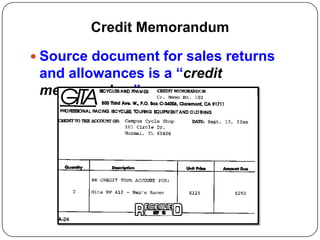
Credit Memorandum

 Source document for sales returns
 and allowances is a “credit
 memorandum”.
Sales Returns & Allowance Account

 Reduces or decreases total revenue
  earned by the business
 Returns or allowances recorded in
  Sales Return & Allowance account
 Sales Returns & Allowances is
  “contra account to Sales Account
 Contra Account: means that its
  balances decreases the contra
  revenue account (this would be
  Sales)
Sales Returns & Allowance Account

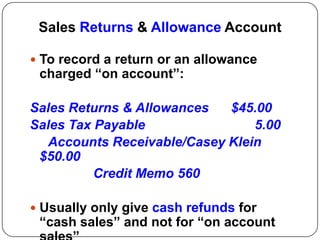
 To record a return or an allowance
 charged “on account”:

Sales Returns & Allowances  $45.00
Sales Tax Payable               5.00
  Accounts Receivable/Casey Klein
 $50.00
          Credit Memo 560

 Usually only give cash refunds for
 “cash sales” and not for “on account
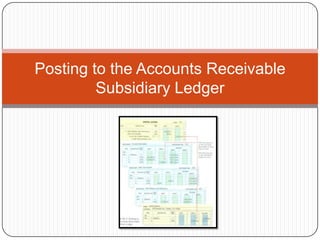
Posting to the Accounts Receivable
         Subsidiary Ledger
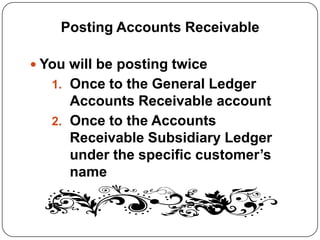
Posting Accounts Receivable

 You will be posting twice
   1. Once to the General Ledger
      Accounts Receivable account
   2. Once to the Accounts
      Receivable Subsidiary Ledger
      under the specific customer’s
      name
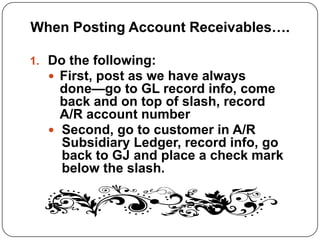
When Posting Account Receivables….

1. Do the following:
    First, post as we have always
    done—go to GL record info, come
    back and on top of slash, record
    A/R account number
   Second, go to customer in A/R
    Subsidiary Ledger, record info, go
    back to GJ and place a check mark
    below the slash.
Cash Receipts
Kinds of Cash Receipts

1. Cash receipt: a
   transaction in
   which money
   comes in to a
   business
2. Three most
   common forms of
   cash for a
   merchandising
   business are:
     Payments from
       charge
       customers
     Cash sales
Cash Sales
1. Business receives full payment at
     time of sale
2.   Cash registers record daily sales on
     two tapes: one customer receives
     and one is kept inside cash register
3.   End of day, cash register totaled and
     cleared
4.   A proof is usually made to make sure
     cash in register equals the cash
     register tape
5.   Tape used for proof becomes source
     document for journal entry for cash
     sales
Bankcard Sales


1. Bank cards issued by bank and
   honored at many business
2. Bank card sales are separate from
   Cash Sales
3. Bank card sales are included on the
   Cash Register sales slip
4. Record separately from the Cash
   Sales
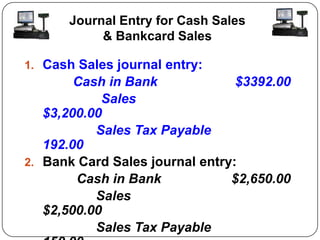
Journal Entry for Cash Sales
            & Bankcard Sales

1. Cash Sales journal entry:
        Cash in Bank             $3392.00
            Sales
   $3,200.00
           Sales Tax Payable
   192.00
2. Bank Card Sales journal entry:
        Cash in Bank            $2,650.00
           Sales
   $2,500.00
           Sales Tax Payable
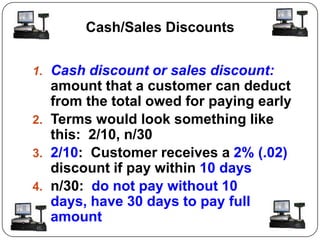
Cash/Sales Discounts


1. Cash discount or sales discount:
   amount that a customer can deduct
   from the total owed for paying early
2. Terms would look something like
   this: 2/10, n/30
3. 2/10: Customer receives a 2% (.02)
   discount if pay within 10 days
4. n/30: do not pay without 10
   days, have 30 days to pay full
   amount
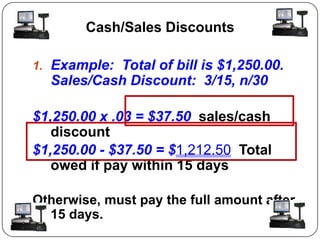
Cash/Sales Discounts

1. Example: Total of bill is $1,250.00.
  Sales/Cash Discount: 3/15, n/30

$1,250.00 x .03 = $37.50 sales/cash
   discount
$1,250.00 - $37.50 = $1,212.50 Total
   owed if pay within 15 days

Otherwise, must pay the full amount after
  15 days.
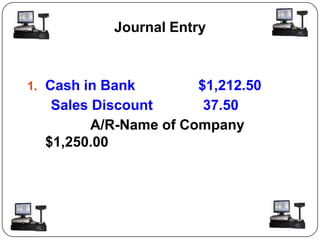
Journal Entry


1. Cash in Bank        $1,212.50
   Sales Discount       37.50
         A/R-Name of Company
  $1,250.00
That’s all folks!!!

 Now, on to our workbooks for some hands on
 work!

Acct chapter 14

  • 1.
    Moving from “Sole Proprietorships” to “Merchandising Corporations!!!” Chapter 14: Accounting for Sales and Cash Receipts
  • 2.
    Essential Outcomes 14. Understandsthe relationship between sales, cash sales and sales tax by being able to: a. Explain the difference between a service business & a merchandising business. b. Explain the difference between a retailer & a wholesaler c. Record a variety of sales and cash receipt transactions in a general journal d. Calculate sales tax, sales discount and sales returns & allowances e. Define the accounting terms in this
  • 3.
    Merchandising Businesses SellMerchandise: goods that are purchased for resale to customers.
  • 4.
    1. Purchase merchandis e for resale 2. Sale of 5. goods for Profit cash or on account 4. Pay expenses: 3. Collect rent, utilities, salaries, etc. cash from accounts Operating Cycle of Merchandising business
  • 5.
    New account forMerchandising Business:  Merchandise Inventory:  Merchandise: goods bought for resale Inventory: items of merchandise the business has in stock Merchandise Inventory Account: inventory is represented in the General Ledger as an asset Normal Balance: Debit Items in the Merchandise Inventory account are sold during the year and more items for resale are purchased during the year Merchandise Inventory ONLY USED when recording adjusting entries
  • 6.
    New account forMerchandising Business:  Sales Account: Used when a retail merchandising business sells goods to a customer, the amount of the merchandise sold is record in the “Sales” account. Normal balance: credit
  • 7.
    Sales Transactions  Saleon account Sale of merchandise that will be paid for at a later date • Charge customer: Person to whom the sale on account is made • Credit Cards: issued by businesses so customers can charge purchases
  • 8.
    Sales Slip  SalesSlip:  date of sale  name of customer  description, qua ntity & price of items sold Pre-numbered  includes sales tax
  • 9.
     Added tothe sale price of an item  Usually given as %, such as 7%, etc.  Paid by customer and collected by business  Business required to periodically send money to state  Account used: Sales Tax Payable  Normal balance: credit State Sales Tax
  • 10.
     Multiply thetotal sales by the percent.  Example: total sales $510 and sales tax is 7% $510.00 x 7% (.07) = $35.70 $510.00 + $35.70 = $545.70 total price Calculating Sales Tax
  • 11.
    Credit Terms  CreditTerms: state the time allowed for payment for customers who purchased merchandise on account  Credit term is: n/30  “n” stands for net (or total amount of the sale) & 30 stands for number of days customer has to pay bill
  • 12.
  • 13.
    Accounts Receivable SubsidiaryLedger  Businesses that have lots of people charging on account, set up “accounts receivable subsidiary ledger”  A/R subsidiary ledger has account forms for “each” customer who charges on account
  • 14.
    Accounts Receivable SubsidiaryLedger  A/R Subsidiary Ledger is book or ledger that provides detailed information for each client (not part of General Ledger)  In General Ledger, have Accounts Receivable account that equals total of all accounts in A/R subsidiary ledger  Accounts Receivable is a “controlling account”—has a summary of all information recorded in the A/R Subsidiary Ledger
  • 15.
  • 16.
  • 17.
    Accounts Receivable SubsidiaryLedger  On Dec 1, sold merchandise on account to Casey Klein for $200 plus sales tax of $12, Sales Slip 50 Slash means you will post to two different places….On top of slash record account # and
  • 18.
    Sales Returns &Allowance  Sales Returns: Customer returns merchandise due to wrong size, wrong color, defective, etc.—any merchandise returned for credit or cash refund called sales return.  Sales Allowance: customer finds merchandise or damaged or defective, but is still useable, seller may grant a price reduction if customer willing to keep merchandise—thus, this is called a sales allowance
  • 19.
    Credit Memorandum  Sourcedocument for sales returns and allowances is a “credit memorandum”.
  • 20.
    Sales Returns &Allowance Account  Reduces or decreases total revenue earned by the business  Returns or allowances recorded in Sales Return & Allowance account  Sales Returns & Allowances is “contra account to Sales Account  Contra Account: means that its balances decreases the contra revenue account (this would be Sales)
  • 21.
    Sales Returns &Allowance Account  To record a return or an allowance charged “on account”: Sales Returns & Allowances $45.00 Sales Tax Payable 5.00 Accounts Receivable/Casey Klein $50.00 Credit Memo 560  Usually only give cash refunds for “cash sales” and not for “on account
  • 22.
    Posting to theAccounts Receivable Subsidiary Ledger
  • 23.
    Posting Accounts Receivable You will be posting twice 1. Once to the General Ledger Accounts Receivable account 2. Once to the Accounts Receivable Subsidiary Ledger under the specific customer’s name
  • 24.
    When Posting AccountReceivables…. 1. Do the following:  First, post as we have always done—go to GL record info, come back and on top of slash, record A/R account number  Second, go to customer in A/R Subsidiary Ledger, record info, go back to GJ and place a check mark below the slash.
  • 25.
  • 26.
    Kinds of CashReceipts 1. Cash receipt: a transaction in which money comes in to a business 2. Three most common forms of cash for a merchandising business are:  Payments from charge customers  Cash sales
  • 27.
    Cash Sales 1. Businessreceives full payment at time of sale 2. Cash registers record daily sales on two tapes: one customer receives and one is kept inside cash register 3. End of day, cash register totaled and cleared 4. A proof is usually made to make sure cash in register equals the cash register tape 5. Tape used for proof becomes source document for journal entry for cash sales
  • 28.
    Bankcard Sales 1. Bankcards issued by bank and honored at many business 2. Bank card sales are separate from Cash Sales 3. Bank card sales are included on the Cash Register sales slip 4. Record separately from the Cash Sales
  • 29.
    Journal Entry forCash Sales & Bankcard Sales 1. Cash Sales journal entry: Cash in Bank $3392.00 Sales $3,200.00 Sales Tax Payable 192.00 2. Bank Card Sales journal entry: Cash in Bank $2,650.00 Sales $2,500.00 Sales Tax Payable
  • 30.
    Cash/Sales Discounts 1. Cashdiscount or sales discount: amount that a customer can deduct from the total owed for paying early 2. Terms would look something like this: 2/10, n/30 3. 2/10: Customer receives a 2% (.02) discount if pay within 10 days 4. n/30: do not pay without 10 days, have 30 days to pay full amount
  • 31.
    Cash/Sales Discounts 1. Example:Total of bill is $1,250.00. Sales/Cash Discount: 3/15, n/30 $1,250.00 x .03 = $37.50 sales/cash discount $1,250.00 - $37.50 = $1,212.50 Total owed if pay within 15 days Otherwise, must pay the full amount after 15 days.
  • 32.
    Journal Entry 1. Cashin Bank $1,212.50 Sales Discount 37.50 A/R-Name of Company $1,250.00
  • 33.
    That’s all folks!!! Now, on to our workbooks for some hands on work!